Circle Theorems
Learn it by playing
Answer these questions to earn energy, then fish and explore. No account needed.
Lesson notes
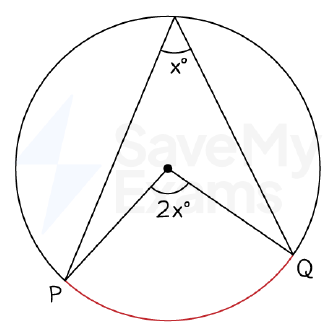
Angles at Centre & Circumference
- The angle at the centre is twice the angle at the circumference subtended by the same arc.
- Both angles are formed from the same two points on the circumference.
- The theorem applies even when the triangle parts overlap or form a diamond shape.
- Use the reflex angle at the centre when the angle at the circumference is obtuse.
- Common mistake: confusing this theorem with opposite angles in a cyclic quadrilateral.
Angle at Centre & Circumference
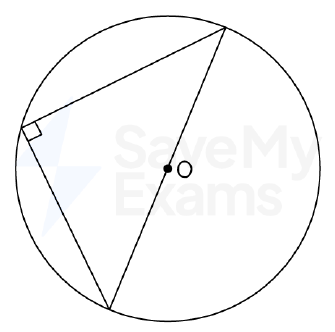
Angle in a Semicircle
- The angle in a semicircle is 90°.
- This is a special case of the centre-circumference theorem (angle on diameter = 180°, halved).
- The right angle is opposite the diameter.
- All three vertices must lie on the circumference, with one side as the diameter.
- Often used with Pythagoras' theorem to find lengths.
Angle in a Semicircle
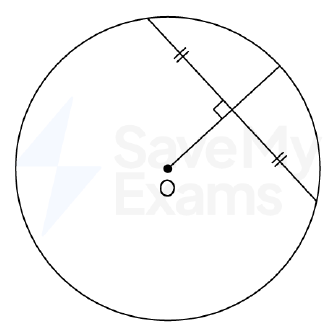
Theorems with Chords
- A radius that is perpendicular to a chord bisects the chord.
- Conversely, the perpendicular bisector of a chord passes through the centre.
- Equal chords are equidistant from the centre.
- Chords and radii often form isosceles triangles.
Radius Bisects a Chord
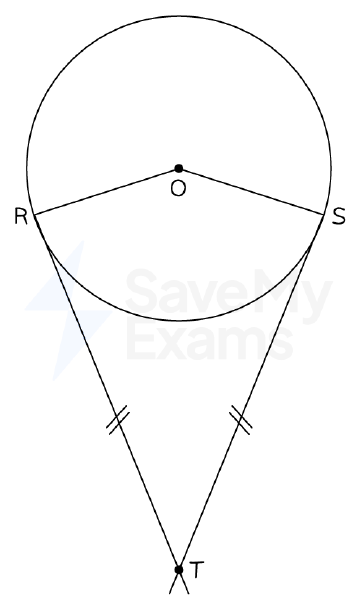
Theorems with Tangents
- A radius and a tangent meet at right angles (90°).
- Tangents from an external point are equal in length.
- Two tangents from the same point form a kite with two right angles.
- Use Pythagoras or trigonometry in the right triangles formed.
Tangents from an External Point
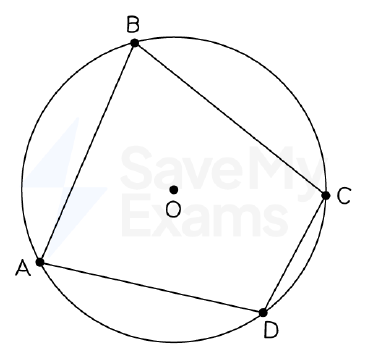
Angles in Cyclic Quadrilaterals
- A cyclic quadrilateral has all four vertices on the circumference.
- Opposite angles in a cyclic quadrilateral add up to 180°.
- This theorem does not apply to quadrilaterals with vertices not all on the circle.
- Mark all angles on the diagram to help find relationships.
Cyclic Quadrilateral
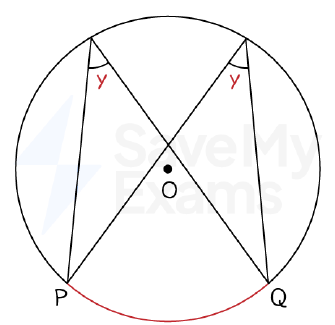
Angles in the Same Segment
- Angles in the same segment are equal.
- They are subtended by the same chord.
- Look for a 'bowtie' shape with two angles on the same side of the chord.
- The theorem works both ways: angles at either end of the chord are also equal.
Angles in the Same Segment
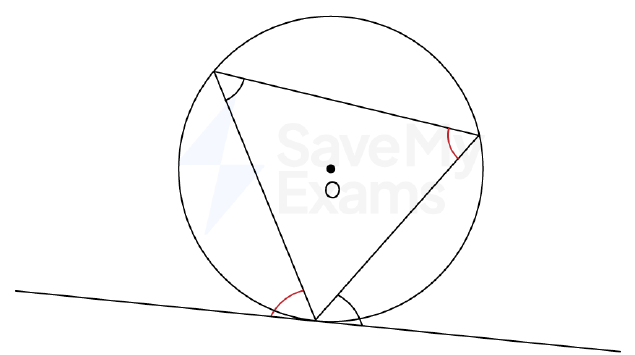
The Alternate Segment Theorem
- The angle between a chord and a tangent equals the angle in the alternate segment.
- The alternate segment is the region on the opposite side of the chord from the angle.
- Identify a cyclic triangle with one vertex touching the tangent.
- The equal angle is inside the triangle opposite the side that forms the first angle.
Alternate Segment Theorem
General Tips
- Always give a reason for each angle found (quote the circle theorem or angle fact).
- Look for isosceles triangles formed by radii and chords.
- Add radii and right angles to the diagram to reveal relationships.
- Use properties of triangles, quadrilaterals, and parallel lines alongside circle theorems.
Slides
Sign up free to view the lesson slides
Step through every slide for this topic — plus flashcards and revision notes — with a free account.
Practice questions
Free preview — 8 of 26 questions. Sign up to see them all.
1.In a circle, the angle at the centre is twice the angle at the circumference. If the angle at the circumference is 35°, what is the angle at the centre?
Easy- A70°
- B35°
- C17.5°
- D140°
2.What is the angle in a semicircle?
Easy- A90°
- B180°
- C45°
- D60°
3.A radius and a tangent meet at what angle?
Easy- A90°
- B180°
- C45°
- D0°
4.Opposite angles in a cyclic quadrilateral add up to:
Easy- A180°
- B90°
- C360°
- D270°
5.In the diagram, A, B, C, D lie on a circle with centre O. EA is a tangent at A. Angle EAB = 61°, angle BAC = 55°. Find angle BAO.
Medium- A29°
- B61°
- C55°
- D35°
6.A, B, C, D are points on a circle, centre O. DOB is a straight line. Angle DAC = 58°. Find angle CDB.
Medium- A58°
- B32°
- C29°
- D122°
7.P, Q, R are points on a circle, centre O. PO is parallel to QR and angle POQ = 48°. Find angle OPR.
Medium- A24°
- B48°
- C12°
- D36°
8.K, L, M are points on a circle. KS is a tangent at K. KM is a diameter and triangle KLM is isosceles. Find z.
Hard- A45°
- B90°
- C60°
- D30°
Unlock all 26 questions & more
Create a free account to see every question, the slides, flashcards and revision notes for this topic.