Linear Graphs
Learn it by playing
Answer these questions to earn energy, then fish and explore. No account needed.
Lesson notes
Equations of Straight Lines (y = mx + c)
- The general equation is y = mx + c, where m is the gradient and c is the y-intercept.
- Gradient = rise/run; positive for uphill, negative for downhill.
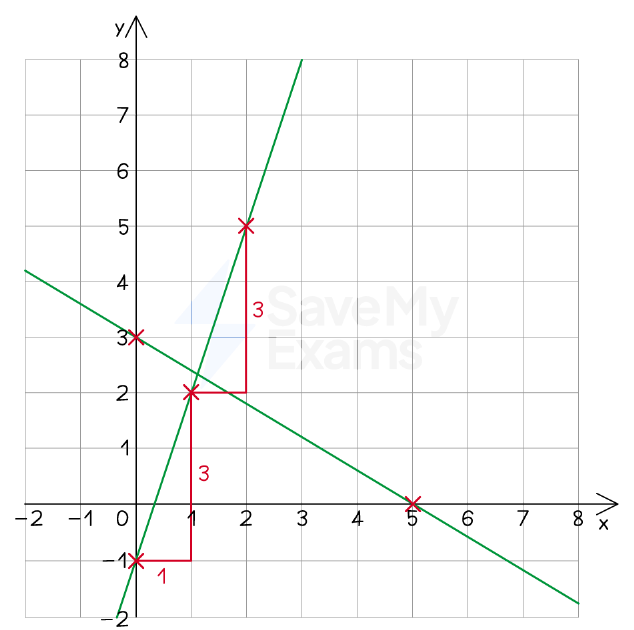
- To find the equation from a graph: find gradient using a triangle, read off y-intercept, substitute into y = mx + c.
- If y-intercept is not visible, substitute a known point into y = mx + c and solve for c.
- Horizontal lines: y = c; vertical lines: x = k.
- Rearrange equations like ax + by = c into y = mx + c to identify gradient and intercept.
y = mx + c
Drawing Straight Line Graphs
- Create a table of values for x and y, plot points, and join with a straight line.
- Use at least 3 points to ensure accuracy.
- Alternatively, start at y-intercept (c) and move up m units for every 1 unit right (down if m negative).
- For equations in form ax + by = c, find x-intercept (set y=0) and y-intercept (set x=0), then plot.
- If gradient is a fraction a/b, go a units up for every b units right.
Drawing straight line graphs from their equations
Parallel Lines
- Parallel lines have the same gradient.
- Equation of a line parallel to y = mx + c is y = mx + d (different y-intercept).
- To find a parallel line through a given point: use same gradient, substitute point to find d.
Parallel lines
Perpendicular Lines
- Perpendicular lines meet at right angles (90°).
- Gradients m₁ and m₂ satisfy m₁ × m₂ = -1 (negative reciprocals).
- To find a perpendicular gradient: m₂ = -1/m₁.
- To find equation of perpendicular line: find negative reciprocal of given gradient, substitute point to find c.
- A perpendicular bisector cuts a segment in half at right angles; passes through midpoint.
Perpendicular lines
Slides
Sign up free to view the lesson slides
Step through every slide for this topic — plus flashcards and revision notes — with a free account.
Practice questions
Free preview — 8 of 40 questions. Sign up to see them all.
1.A straight line, l, has equation y = 5x + 12. What is the gradient of line l?
Easy- A5
- B12
- C-5
- D-12
2.The line y = 3x − 2 crosses the y-axis at G. What are the coordinates of G?
Easy- A(0, -2)
- B(0, 2)
- C(-2, 0)
- D(2, 0)
3.Find the coordinates of the point where the line y = 3x − 8 crosses the y-axis.
Easy- A(0, -8)
- B(0, 8)
- C(-8, 0)
- D(8, 0)
4.Write down the gradient of the line y = 3x − 8.
Easy- A3
- B-8
- C-3
- D8
5.Find the gradient of a line that is perpendicular to 8y + 4x = 5.
Medium- A2
- B-2
- C1/2
- D-1/2
6.The equation of line L is 3x − 8y + 20 = 0. Find the gradient of line L.
Medium- A3/8
- B-3/8
- C8/3
- D-8/3
7.Line L passes through the points (0, -3) and (6, 9). Find the equation of line L.
Medium- Ay = 2x - 3
- By = 2x + 3
- Cy = -2x - 3
- Dy = -2x + 3
8.Find the gradient of the line that is perpendicular to the line 2y = 3 + 5x.
Medium- A-2/5
- B2/5
- C-5/2
- D5/2
Unlock all 40 questions & more
Create a free account to see every question, the slides, flashcards and revision notes for this topic.