Sequences
Learn it by playing
Answer these questions to earn energy, then fish and explore. No account needed.
Lesson notes
Introduction to Sequences
- A sequence is an ordered set of numbers that follow a rule (e.g., 3, 6, 9, 12… add 3 each time).
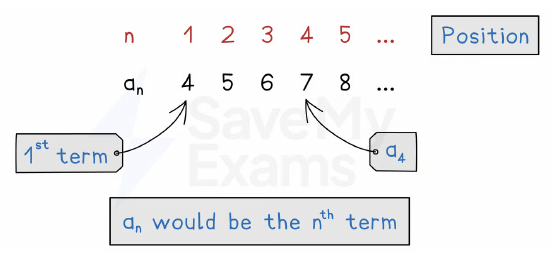
- Each number in a sequence is called a term; its position is denoted by n (n=1 for first term).
- A term-to-term rule tells how to get the next term from the current one (e.g., add 4, multiply by 3).
- A position-to-term rule (nth term formula) lets you find any term directly: substitute n=1,2,3…
- To check if a value belongs to a sequence, set the nth term equal to the value and solve for n; if n is a whole number, it is in the sequence.
Sequence position notation
nth Terms of Linear Sequences
- A linear (arithmetic) sequence has a constant common difference (d) between consecutive terms.
- The nth term formula is dn + b, where d is the common difference and b is the term before the first term (zero term).
- To find b, continue the sequence backwards by one term (subtract d from the first term).
- Example: For 5, 7, 9, 11… d=2, b=3 → nth term = 2n+3.
- For decreasing sequences, d is negative (e.g., 15,10,5… d=-5, b=20 → nth term = -5n+20).
Quadratic Sequences
- A quadratic sequence has an nth term involving n²; its second differences are constant.
- To find the nth term: Step 1 – find first and second differences. Step 2 – halve the second difference to get a (coefficient of n²).
- Step 3 – write out an² and subtract from the original sequence to get a linear sequence. Step 4 – find the nth term of that linear sequence (bn+c).
- Step 5 – add an² + bn + c to get the nth term formula.
- Example: For 6,9,14,21,30… second difference=2 → a=1; an²=1,4,9,16,25; difference=5,5,5,5,5 → linear nth term=5; so nth term = n²+5.
- Common simple quadratics: n²+1, 2n², (n+1)²-2, etc.
Other Sequences
- Cubic sequences have constant third differences; nth term involves n³. The coefficient a = (third difference)/6.
- Exponential (geometric) sequences multiply by a constant common ratio (r) each time; nth term = a × rⁿ (or a × rⁿ⁻¹).
- Common sequences: prime numbers (2,3,5,7…), triangular numbers (1,3,6,10…), cube numbers (1,8,27,64…).
- Sequences can be combined: e.g., fractions with linear numerator and cubic denominator, or sums of two sequences.
- Harder problems may involve setting up and solving equations (e.g., simultaneous equations) to find unknown terms or ratios.
Fibonacci and Special Sequences
- In a Fibonacci sequence, each term is the sum of the two previous terms (e.g., 1,1,2,3,5,8…).
- Given first two terms a and b, the 3rd term is a+b, 4th is a+2b, 5th is 2a+3b, 6th is 3a+5b.
- To find unknown terms in a Fibonacci sequence, set up equations using given terms and solve.
- Some sequences follow a pattern like adding a decreasing amount or using a specific rule (e.g., term-to-term rules).
Finding Terms and Checking Membership
- To find a specific term, substitute n into the nth term formula (e.g., 20th term of n²+5 = 20²+5 = 405).
- To check if a number is in a sequence, set the nth term equal to the number and solve for n; if n is a positive integer, it is a term.
- Example: Is 98 in the sequence 8n+2? 8n+2=98 → n=12, yes. Is 124? 8n+2=124 → n=15.25, no.
- Always write the position number above each term in the exam to help spot patterns.
Slides
Sign up free to view the lesson slides
Step through every slide for this topic — plus flashcards and revision notes — with a free account.
Practice questions
Free preview — 8 of 55 questions. Sign up to see them all.
1.What is the next term in the sequence 8, 11, 14, 17, 20?
Easy- A21
- B22
- C23
- D24
2.The nth term of a sequence is n2 + 1. What are the first three terms?
Easy- A2, 5, 10
- B1, 4, 9
- C2, 4, 8
- D1, 5, 10
3.Write an expression for the nth term of the sequence 15, 12, 9, 6.
Medium- A18 - 3n
- B3n + 12
- C15 - 3n
- D3n + 15
4.A sequence has nth term 2n2 + 5n - 15. Find the difference between the 4th term and the 5th term.
Medium- A23
- B27
- C19
- D31
5.In a sequence, T1 = 17, T2 = 12, T3 = 7, T4 = 2. Find T5.
Easy- A-3
- B-8
- C3
- D0
6.The nth term of a sequence is 60 - 8n. Find the largest number in this sequence.
Medium- A52
- B60
- C56
- D48
7.Find an expression for the nth term of the sequence 12, 19, 26, 33, 40.
Medium- A7n + 5
- B5n + 7
- C7n + 12
- D12n + 7
8.Find an expression for the nth term of the sequence 7, 5, 3, 1, -1, ...
Medium- A9 - 2n
- B2n + 5
- C7 - 2n
- D2n + 7
Unlock all 55 questions & more
Create a free account to see every question, the slides, flashcards and revision notes for this topic.