Vectors
Learn it by playing
Answer these questions to earn energy, then fish and explore. No account needed.
Lesson notes
Introduction to Column Vectors
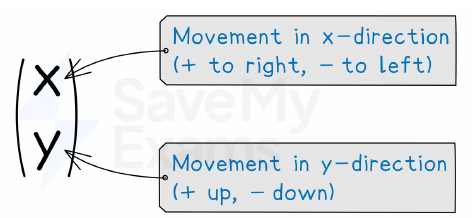
- A column vector describes a translation: e.g. \begin{pmatrix}6\\3\end{pmatrix} means 6 right, 3 up.
- Add/subtract vectors component-wise: top numbers together, bottom numbers together.
- Multiply a vector by a scalar (a number) by multiplying each component.
- Follow order of operations when combining scalar multiplication and addition.
- Example: 2\begin{pmatrix}5\\2\end{pmatrix}+5\begin{pmatrix}3\\-1\end{pmatrix}=\begin{pmatrix}10\\4\end{pmatrix}+\begin{pmatrix}15\\-5\end{pmatrix}=\begin{pmatrix}25\\-1\end{pmatrix}.
Column vector components
Representing Vectors as Diagrams
- A vector has magnitude (size) and direction; shown by an arrow.
- Vectors are written in bold (or underlined by hand), e.g. \mathbf{a} or \underline{a}.
- \overrightarrow{AB} goes from A to B; \overrightarrow{BA} is opposite direction.
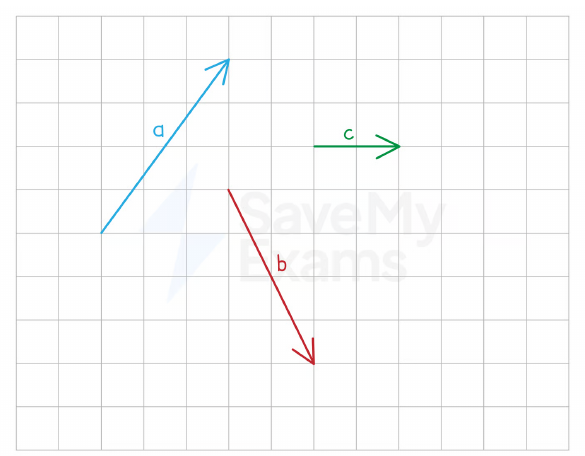
- To draw \begin{pmatrix}3\\4\end{pmatrix}, start at a point, move 3 right, 4 up, draw arrow.
- Multiplying by a positive scalar changes length but not direction; negative scalar reverses direction.
- To add vectors diagrammatically, place them tip-to-tail; the resultant goes from start to end.
Drawing vectors a, b and c on a grid
Magnitude of a Vector
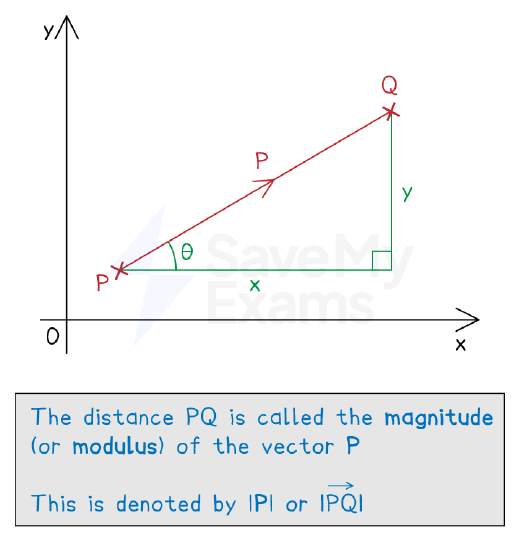
- The magnitude (modulus) of a vector is its length, always positive.
- For \mathbf{a}=\begin{pmatrix}x\\y\end{pmatrix}, |\mathbf{a}|=\√{x2+y2} (Pythagoras).
- Magnitude is independent of direction: |\overrightarrow{AB}|=|\overrightarrow{BA}|.
- If a vector is multiplied by scalar k, its magnitude is multiplied by |k|.
The magnitude of a vector as the hypotenuse PQ
Position & Displacement Vectors
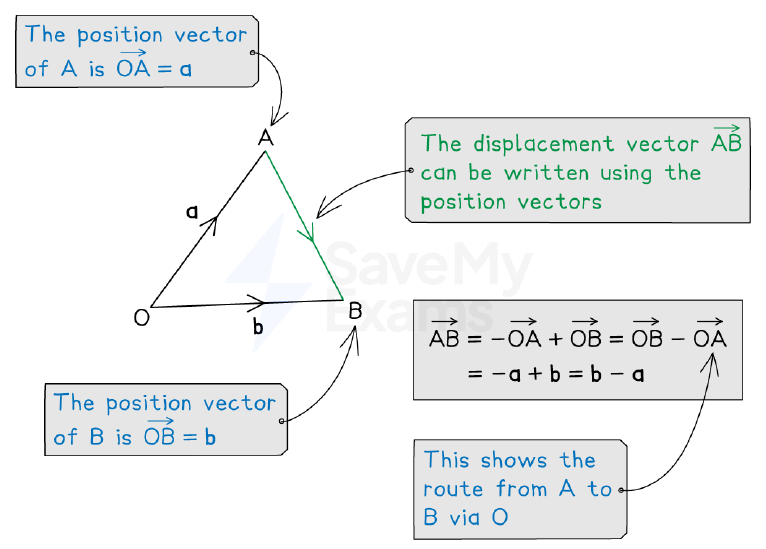
- A position vector locates a point relative to the origin O: \overrightarrow{OA}=\mathbf{a}.
- Coordinates equal components: point (3,-2) has position vector \begin{pmatrix}3\\-2\end{pmatrix}.
- A displacement vector goes from one point to another: \overrightarrow{AB}=\mathbf{b}-\mathbf{a}.
- Use \overrightarrow{AB}=-\mathbf{a}+\mathbf{b} to find displacement from position vectors.
Position and displacement vectors in triangle OAB
Finding Vector Paths
- A vector path is a sequence of vectors from start to end.
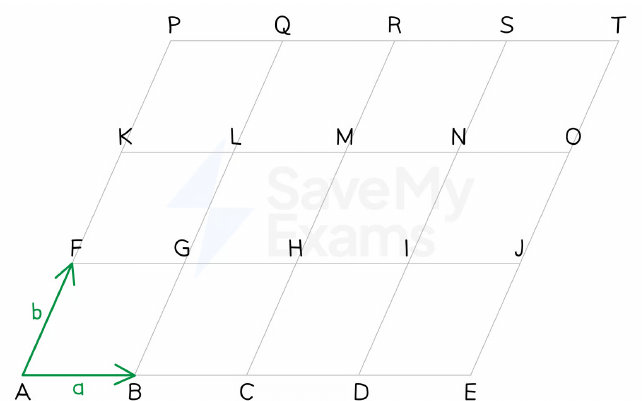
- In a grid of parallelograms, horizontal moves are multiples of one vector, diagonal moves of another.
- Count steps in each direction to express a vector in terms of given vectors.
- Negative signs indicate opposite direction.
A grid of parallelograms for vector paths
Problem Solving with Vectors
- Two vectors are parallel if one is a scalar multiple of the other.
- To prove three points are collinear, show two vectors between them are parallel and share a common point.
- Ratios along a line: if AX:XB=3:5, then \overrightarrow{AX}=\frac{3}{8}\overrightarrow{AB}.
- Use vector algebra to find unknown points or prove geometric properties.
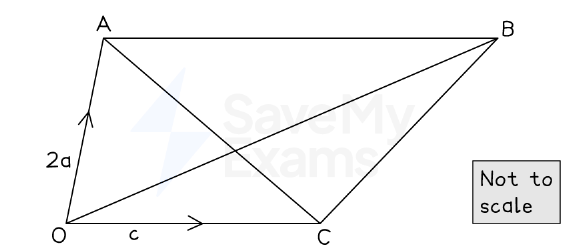
Trapezium OABC
Slides
Sign up free to view the lesson slides
Step through every slide for this topic — plus flashcards and revision notes — with a free account.
Practice questions
Free preview — 8 of 52 questions. Sign up to see them all.
1.What is the column vector representing a translation of 3 units to the right and 4 units down?
Easy- A\begin{pmatrix}3\\-4\end{pmatrix}
- B\begin{pmatrix}-3\\4\end{pmatrix}
- C\begin{pmatrix}3\\4\end{pmatrix}
- D\begin{pmatrix}-3\\-4\end{pmatrix}
2.Given \mathbf{a} = \begin{pmatrix}5\\2\end{pmatrix} and \mathbf{b} = \begin{pmatrix}3\\-1\end{pmatrix}, find \mathbf{a} + \mathbf{b}.
Easy- A\begin{pmatrix}8\\1\end{pmatrix}
- B\begin{pmatrix}8\\3\end{pmatrix}
- C\begin{pmatrix}2\\1\end{pmatrix}
- D\begin{pmatrix}2\\3\end{pmatrix}
3.Given \mathbf{a} = \begin{pmatrix}4\\-2\end{pmatrix}, what is 2\mathbf{a}?
Easy- A\begin{pmatrix}8\\-4\end{pmatrix}
- B\begin{pmatrix}6\\0\end{pmatrix}
- C\begin{pmatrix}8\\4\end{pmatrix}
- D\begin{pmatrix}2\\-1\end{pmatrix}
4.Find the magnitude of the vector \begin{pmatrix}3\\4\end{pmatrix}.
Easy- A5
- B7
- C12
- D25
5.The displacement vector from A to B is \overrightarrow{AB} = \mathbf{b} - \mathbf{a}. If \mathbf{a} = \begin{pmatrix}2\\5\end{pmatrix} and \mathbf{b} = \begin{pmatrix}7\\1\end{pmatrix}, what is \overrightarrow{AB}?
Easy- A\begin{pmatrix}5\\-4\end{pmatrix}
- B\begin{pmatrix}5\\4\end{pmatrix}
- C\begin{pmatrix}-5\\4\end{pmatrix}
- D\begin{pmatrix}9\\6\end{pmatrix}
6.Given \mathbf{p} = \begin{pmatrix}4\\5\end{pmatrix} and \mathbf{q} = \begin{pmatrix}-2\\7\end{pmatrix}, find 2\mathbf{p} + \mathbf{q}.
Easy- A\begin{pmatrix}6\\17\end{pmatrix}
- B\begin{pmatrix}6\\-3\end{pmatrix}
- C\begin{pmatrix}2\\12\end{pmatrix}
- D\begin{pmatrix}10\\12\end{pmatrix}
7.Given \mathbf{a} = \begin{pmatrix}-3\\2\end{pmatrix}, find |\mathbf{a}|.
Easy- A\√{13}
- B\√{5}
- C13
- D5
8.Point A is (6,4) and point B is (2,7). Write \overrightarrow{AB} as a column vector.
Easy- A\begin{pmatrix}-4\\3\end{pmatrix}
- B\begin{pmatrix}4\\-3\end{pmatrix}
- C\begin{pmatrix}-4\\-3\end{pmatrix}
- D\begin{pmatrix}4\\3\end{pmatrix}
Unlock all 52 questions & more
Create a free account to see every question, the slides, flashcards and revision notes for this topic.