Volume And Surface Area
Learn it by playing
Answer these questions to earn energy, then fish and explore. No account needed.
Lesson notes
Volume of Cubes and Cuboids
- Volume of a cuboid: V = lwh (length × width × height).
- A cube is a special cuboid with all sides equal: V = s³.
- Terms like 'depth' or 'breadth' may be used instead of height or width.
Cuboid
Volume of Prisms
- Volume of a prism: V = A × l where A is the cross-sectional area and l is the length.
- The cross-section is constant throughout the prism.
- If the volume and length are known, the cross-sectional area can be found by rearranging: A = V / l.
Prism
Volume of Cylinders
- Volume of a cylinder: V = πr²h (given in exam).
- A cylinder is like a prism with a circular cross-section.
Cylinder
Volume of Pyramids and Cones
- Volume of a pyramid: V = (1/3) × base area × perpendicular height.
- Volume of a cone: V = (1/3)πr²h (given in exam).
- The height must be perpendicular to the base.
Pyramid
Volume of Spheres
- Volume of a sphere: V = (4/3)πr³ (given in exam).
- A hemisphere is half a sphere: V = (2/3)πr³.
Sphere
Problem Solving with Volumes
- For compound shapes, find volumes of individual parts and add or subtract.
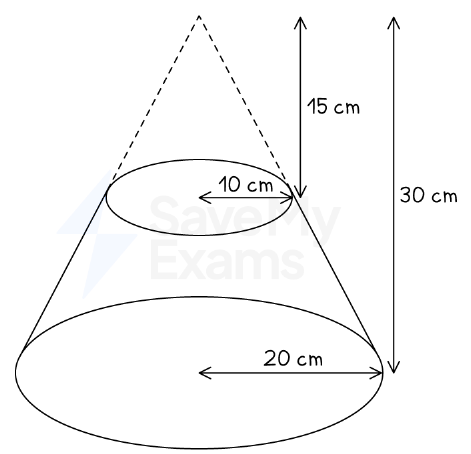
- For frustums (truncated cones/pyramids), subtract the smaller volume from the larger.
- Always check units and convert if necessary (e.g., cm to m, litres).
- Real-world problems often combine volume with cost or capacity.
Frustum of a cone
Surface Area of Cubes, Cuboids, Prisms, and Pyramids
- Surface area is the sum of the areas of all faces.
- For flat-faced solids, calculate each face area separately and add.
- Drawing a net can help visualise all faces.
Net of a pyramid
Surface Area of Cylinders
- Curved surface area: A = 2πrh (given in exam).
- Total surface area: A = 2πrh + 2πr² (not given).
- The net consists of two circles and a rectangle.
Net of a cylinder
Surface Area of Cones
- Curved surface area: A = πrl where l is slant height (given in exam).
- Total surface area: A = πrl + πr² (not given).
- Slant height l can be found using Pythagoras: l = √(r² + h²).
Net of a cone
Surface Area of Spheres and Hemispheres
- Surface area of a sphere: A = 4πr² (given in exam).
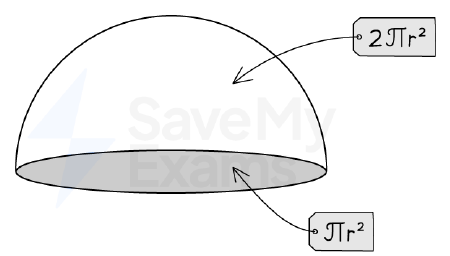
- Hemisphere curved surface area: 2πr²; total (including base): 3πr².
Surface area of a hemisphere
Slides
Sign up free to view the lesson slides
Step through every slide for this topic — plus flashcards and revision notes — with a free account.
Practice questions
Free preview — 8 of 58 questions. Sign up to see them all.
1.What is the formula for the volume of a cuboid with length l, width w, and height h?
Easy- AV = lwh
- BV = l + w + h
- CV = 2lw + 2wh + 2lh
- DV = l2 + w2 + h2
2.The volume of a cube is 1000 cm3. What is the side length of the cube?
Easy- A10 cm
- B100 cm
- C33.3 cm
- D31.6 cm
3.A solid cylinder has radius 3 cm and height 4.5 cm. Calculate its total surface area in terms of π.
Medium- A45π cm2
- B27π cm2
- C54π cm2
- D36π cm2
4.The volume of a cuboid is 180 cm3 and its base is a square of side 6 cm. What is its height?
Easy- A5 cm
- B30 cm
- C3 cm
- D6 cm
5.A hemisphere has radius 6 cm. Calculate its volume. Give your answer in terms of π.
Medium- A144π cm3
- B288π cm3
- C72π cm3
- D216π cm3
6.A solid metal cone has radius 10 cm and height 36 cm. Calculate its volume. Give your answer in terms of π.
Medium- A1200π cm3
- B3600π cm3
- C120π cm3
- D360π cm3
7.A solid cylinder and a solid sphere have the same radius r. The cylinder has height 8r. What fraction of the cylinder's volume is the sphere's volume?
Medium- A1/6
- B1/3
- C1/2
- D2/3
8.The surface area of a sphere is 81π cm2. Find the curved surface area of a cylinder with radius 3r and height 8r, where r is the sphere's radius.
Hard- A972π cm2
- B216π cm2
- C108π cm2
- D324π cm2
Unlock all 58 questions & more
Create a free account to see every question, the slides, flashcards and revision notes for this topic.