Working With Fdp
Learn it by playing
Answer these questions to earn energy, then fish and explore. No account needed.
Lesson notes
Converting Fractions, Decimals & Percentages
- Percentage to decimal: Divide by 100 (move digits two places right). E.g., 6% = 0.06, 350% = 3.5.
- Decimal to percentage: Multiply by 100 (move digits two places left, add %). E.g., 0.35 = 35%, 0.004 = 0.4%.
- Decimal to fraction: Write digits over 10ⁿ (n = decimal places). E.g., 0.3 = 3/10, 0.07 = 7/100, 0.513 = 513/1000.
- Percentage to fraction: Write over 100. E.g., 37% = 37/100.
- Fraction to decimal: Convert to fraction over power of 10. E.g., 3/5 = 6/10 = 0.6; 7/20 = 35/100 = 0.35.
- Fraction to percentage: Convert to decimal then multiply by 100. E.g., 4/5 = 0.8 = 80%.
- Learn simple recurring decimals: 0.333… = 1/3, 0.666… = 2/3.
Recurring Decimals
- Recurring decimal: A decimal with a repeating pattern; e.g., 0.323232… = 0.3̇2̇.
- Notation: Dot over single repeating digit; dots over first and last of repeating block (e.g., 0.1̇2̇ for 0.121212…).
- Converting to fraction: Set x = decimal, multiply by 10ⁿ until two lines have same repeating part, subtract, solve for x.
- Worked example: 0.3̇07̇ → x = 0.307307…, 1000x = 307.307…, subtract: 999x = 307, so x = 307/999.
- Always simplify fraction to lowest terms.
Ordering Fractions, Decimals & Percentages
- Ordering fractions only: Write all with a common denominator, then compare numerators.
- Example: 3/5, 1/2, 13/20, 7/12 → common denominator 60 → 36/60, 30/60, 39/60, 35/60 → order: 1/2, 7/12, 3/5, 13/20.
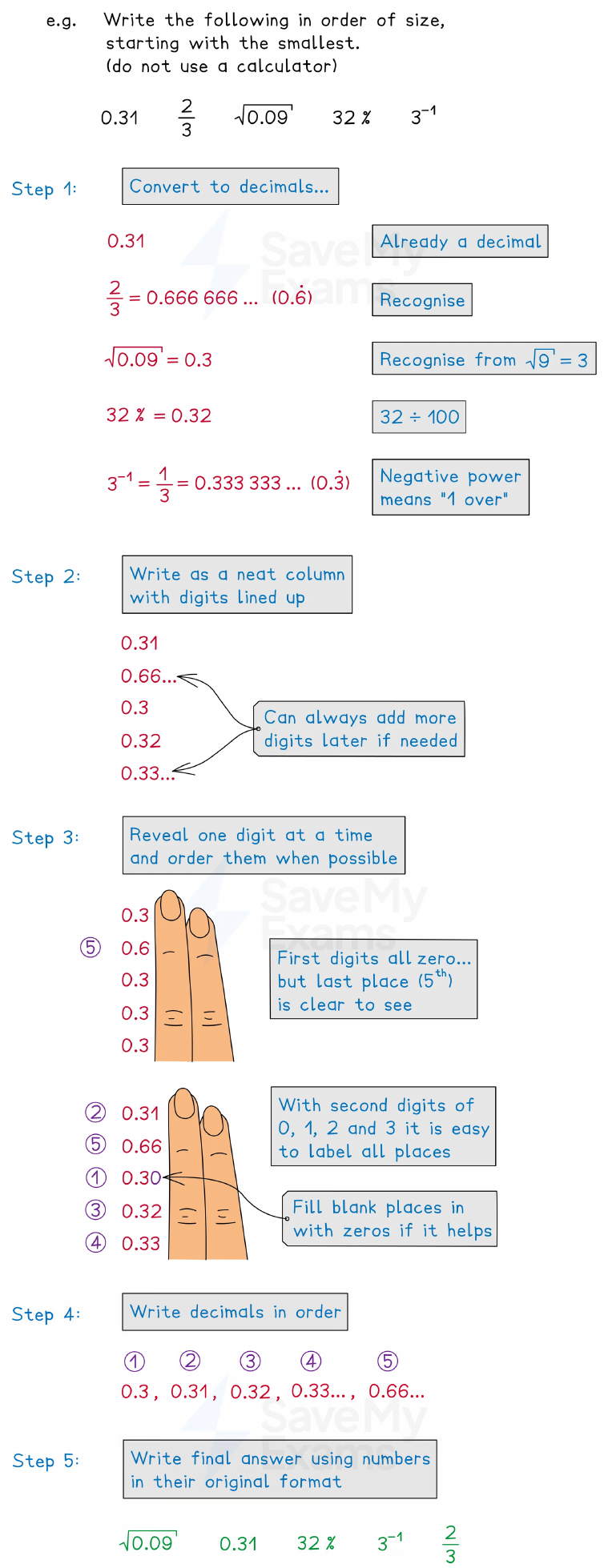
- Ordering mixed FDP: Convert everything to decimals (or percentages) for easy comparison.
- Example: 7/8, 5/6, 0.8, 78% → decimals: 0.875, 0.833…, 0.8, 0.78 → order: 78% < 0.8 < 5/6 < 7/8.
- Use symbols: < (less than), > (greater than), ≤, ≥, =, ≠.
Ordering FDP: the 5-step method
Common Conversions & Tips
- Memorise: 1/2 = 0.5 = 50%, 1/4 = 0.25 = 25%, 3/4 = 0.75 = 75%, 1/5 = 0.2 = 20%, 1/10 = 0.1 = 10%.
- Calculator tip: Use calculator to check conversions even in non-calculator questions (for verification).
- Non-calculator tip: For fractions, use short division or halving (e.g., 7/8 = half of 7/4, etc.).
Slides
Sign up free to view the lesson slides
Step through every slide for this topic — plus flashcards and revision notes — with a free account.
Practice questions
Free preview — 8 of 45 questions. Sign up to see them all.
1.Which of the following is the decimal equivalent of 3/5?
Easy- A0.35
- B0.6
- C1.67
2.Write 0.45 as a percentage.
Easy- A4.5%
- B45%
- C0.45%
- D450%
3.Convert 72% to a fraction in its simplest form.
Easy- A72/100
- B18/25
- C36/50
- D7.2/10
4.Which number has the largest value?
Medium- A0.3030
- B1/3
- C0.0330
- D3/10
- E33%
5.Mr Mason asks 240 Year 11 students what they want to do next year. 15% want to go to college, 3/4 want to stay at school, and the rest do not know. How many students do not know?
Medium- A24
- B36
- C60
- D12
6.Karen got 32 out of 80 in a maths test and 38% in an English test. Did she get a higher percentage in maths or English?
Medium- AMaths
- BEnglish
- CSame
- DCannot tell
7.Prove algebraically that the recurring decimal 0.25̇ (0.25555...) equals which fraction?
Hard- A23/90
- B25/99
- C23/99
- D25/90
8.Show that the recurring decimal 0.17̇ (0.17777...) equals which fraction?
Hard- A8/45
- B17/99
- C16/90
- D8/90
Unlock all 45 questions & more
Create a free account to see every question, the slides, flashcards and revision notes for this topic.