Electromagnetic Spectrum
Learn it by playing
Answer these questions to earn energy, then fish and explore. No account needed.
Lesson notes
Electromagnetic Waves
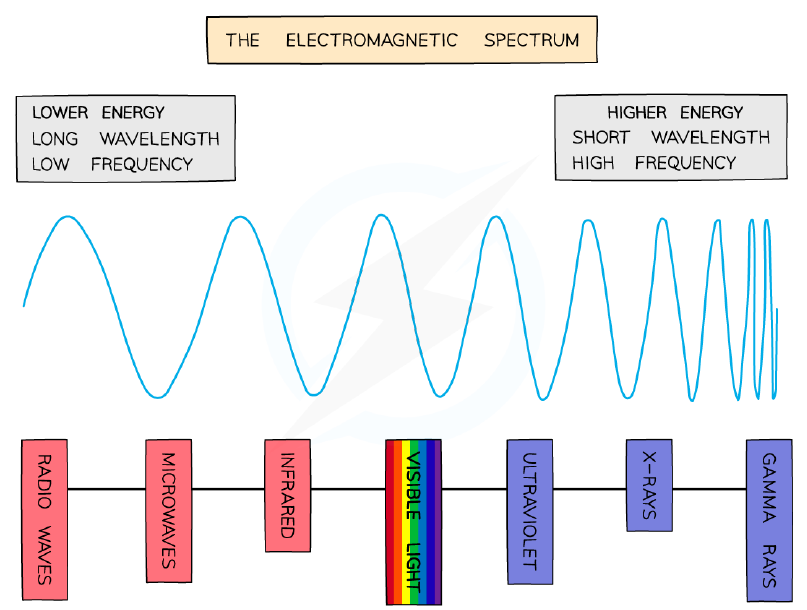
- The electromagnetic spectrum is a continuous range of waves arranged by wavelength or frequency.
- Longer wavelength → lower frequency; shorter wavelength → higher frequency.
- Order from longest to shortest wavelength: radio waves, microwaves, infrared, visible light (ROYGBIV), ultraviolet, X-rays, gamma rays.
- All EM waves are transverse waves that transfer energy.
- All EM waves travel at the same speed in a vacuum: 3.0 × 10⁸ m/s (also approximately the speed in air).
- Visible light is only a small part of the EM spectrum.
The electromagnetic spectrum, showing the seven regions in order of decreasing wavelength (increasing frequency), from radio waves to gamma rays.
Uses of Electromagnetic Waves
- Radio waves: radio/TV transmissions, astronomy, RFID.
- Microwaves: satellite TV, mobile phones, microwave ovens, WiFi.
- Infrared: remote controls, thermal imaging, optical fibres, intruder alarms.
- Visible light: vision, photography, illumination.
- Ultraviolet: security marking, detecting fake bank notes, sterilising water, fluorescence.
- X-rays: medical scanning, security scanners (absorbed by bone, pass through tissue).
- Gamma rays: sterilising food/equipment, cancer detection and treatment.
Dangers of Electromagnetic Waves
- Higher frequency EM waves carry more energy and can ionise atoms (UV, X-rays, gamma rays).
- Microwaves: internal heating of body cells (water absorption).
- Infrared: skin burns.
- Ultraviolet: skin cancer, eye damage; protection via sunscreen and sunglasses.
- X-rays and gamma rays: cell mutation, DNA damage, cancer; radiographers use lead screens.
- Ionising radiation risk increases with frequency and dose.
Communications
- Microwaves are used for satellite communication (mobile phones, satellite TV) because they are not absorbed/reflected by the atmosphere.
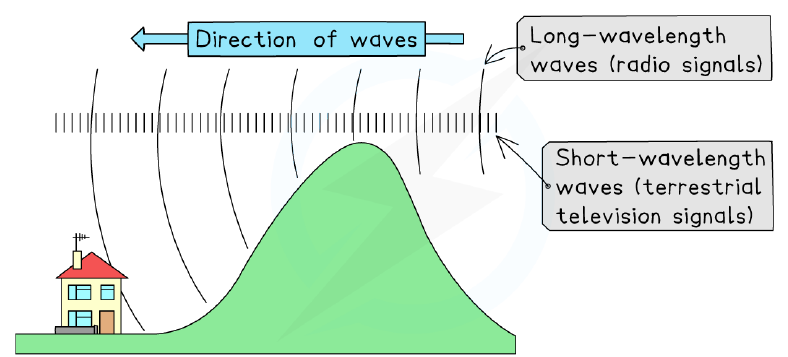
- Radio waves diffract around hills (similar wavelength to obstacles), used for local radio and Bluetooth.
- Optical fibres use visible light or infrared for high-speed broadband; high frequency allows high data rates.
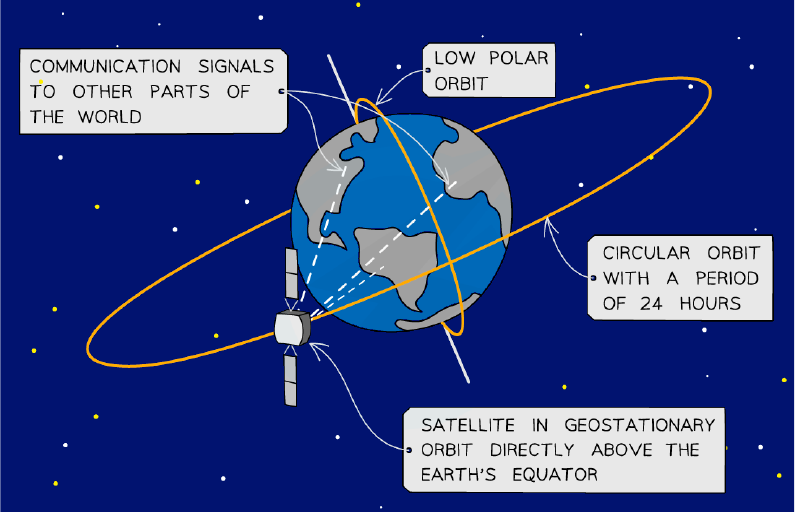
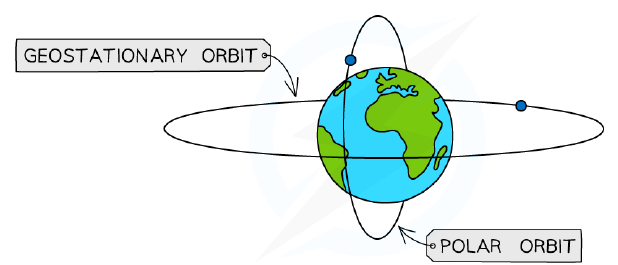
- Geostationary satellites: orbit at 36 000 km, period 24 h, used for broadcasting; longer time delay.
- Low‑orbit/polar satellites: orbit at ~200 km, shorter delay, used for weather and imaging.
A satellite in geostationary orbit above the Earth's equator, showing communication signals to other parts of the world.
Digital & Analogue Signals (Extended)
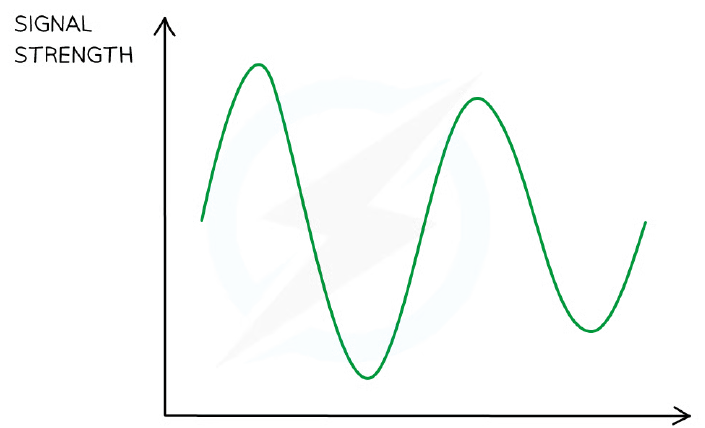
- Analogue signals vary continuously and can take any value.
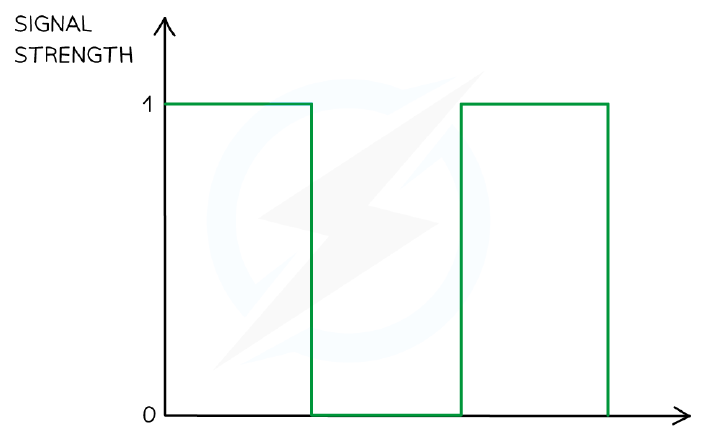
- Digital signals have only two states (0/1, high/low).
- Digital signals can be regenerated with minimal noise, giving larger range and higher data rate.
- Extra data can be added to digital signals for error checking.
- Digital sampling converts an analogue signal to digital by recording at set time intervals.
A digital signal, which can only take one of two states (0 or 1).
Slides
Sign up free to view the lesson slides
Step through every slide for this topic — plus flashcards and revision notes — with a free account.
Practice questions
Free preview — 8 of 41 questions. Sign up to see them all.
1.Which of the following lists the electromagnetic spectrum in order of decreasing wavelength?
Easy- ARadio waves, microwaves, infrared, visible, ultraviolet, X-rays, gamma rays
- BGamma rays, X-rays, ultraviolet, visible, infrared, microwaves, radio waves
- CRadio waves, infrared, microwaves, visible, ultraviolet, gamma rays, X-rays
- DVisible, infrared, radio waves, microwaves, ultraviolet, X-rays, gamma rays
2.All electromagnetic waves travel at the same speed in a vacuum. What is this speed?
Easy- A3.0 × 108 m/s
- B3.0 × 106 m/s
- C3.0 × 1010 m/s
- D3.0 × 103 m/s
3.Which type of electromagnetic radiation is used for television remote controls?
Easy- AInfrared
- BRadio waves
- CUltraviolet
- DMicrowaves
4.Which of the following is a harmful effect of excessive exposure to ultraviolet radiation?
Easy- ASkin cancer
- BInternal heating of body cells
- CSkin burns
- DMutation of DNA
5.Which type of electromagnetic radiation has a wavelength of about 1 km?
Easy- ARadio waves
- BMicrowaves
- CInfrared
- DVisible light
6.A geostationary satellite orbits at a height of 36 000 km above the Earth's surface. What is its orbital period?
Easy- A24 hours
- B12 hours
- C48 hours
- D72 hours
7.Which property increases as you move from radio waves to gamma rays in the electromagnetic spectrum?
Easy- AFrequency
- BWavelength
- CSpeed in a vacuum
- DAmplitude
8.Which type of signal can only take one of two discrete values?
Easy- ADigital signal
- BAnalogue signal
- CRadio signal
- DMicrowave signal
Unlock all 41 questions & more
Create a free account to see every question, the slides, flashcards and revision notes for this topic.