General Properties Of Waves
Learn it by playing
Answer these questions to earn energy, then fish and explore. No account needed.
Lesson notes
Wave Basics & Energy Transfer
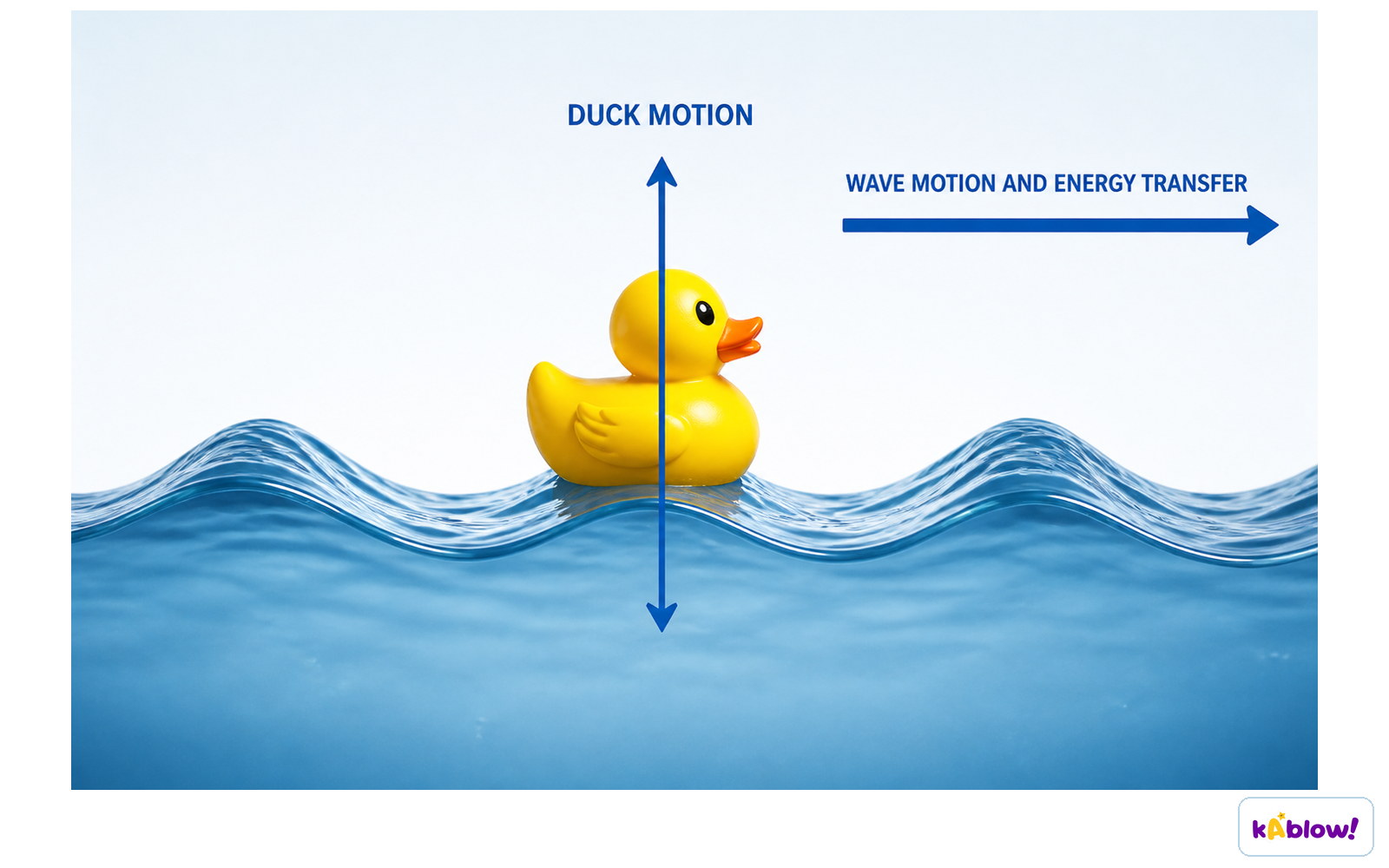
- Waves transfer energy without transferring matter.
- Objects floating on water bob up and down but do not move with the wave – evidence that matter is not transferred.
- Waves are described as oscillations or vibrations about a fixed point.
- Ripples cause water particles to oscillate up and down; sound waves cause air particles to vibrate back and forth.
A toy duck bobbing up and down on water waves, illustrating that waves transfer energy but not matter.
Features of a Wave
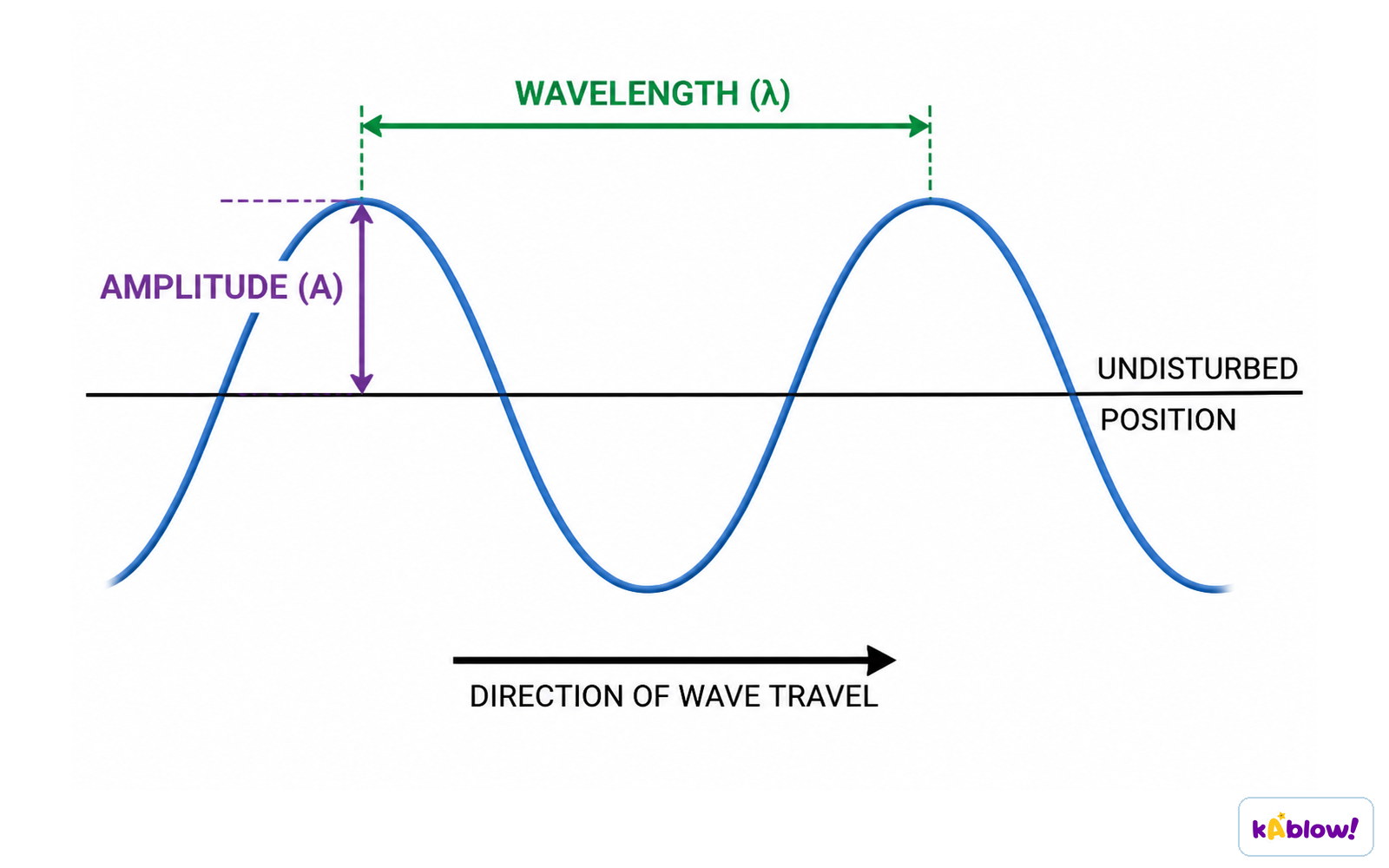
- Amplitude – maximum displacement from undisturbed position; measured in metres (m).
- Wavelength (λ) – distance from one point on the wave to the same point on the next wave; measured in metres (m).
- Frequency (f) – number of waves passing a point per second; measured in hertz (Hz).
- Crest (peak) – highest point above undisturbed position; trough – lowest point below.
- Wavefront – a line representing a single wave; arrow (ray) shows direction of travel.
- Wave speed – distance travelled by a wave each second.
Amplitude and wavelength
The Wave Equation
- Wave speed equation: v = f × λ (v = wave speed in m/s, f = frequency in Hz, λ = wavelength in m).
- Period (T) – time for one complete oscillation; T = 1/f (seconds).
- Frequency and period are related: f = 1/T and T = 1/f.
- Both transverse and longitudinal waves obey the wave equation.
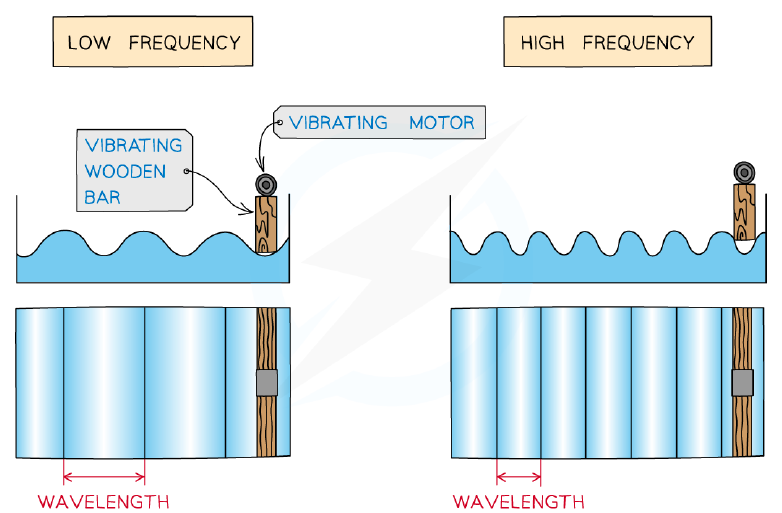
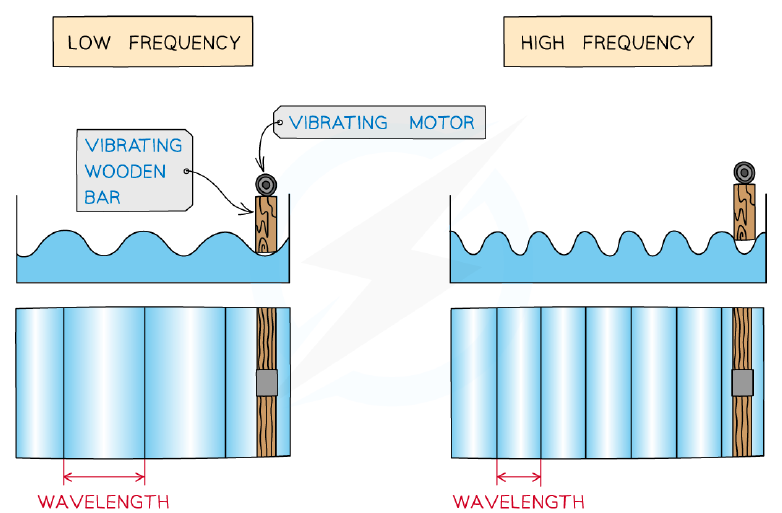
Ripple tank patterns for low- and high-frequency vibration: higher frequency gives a shorter wavelength.
Transverse Waves
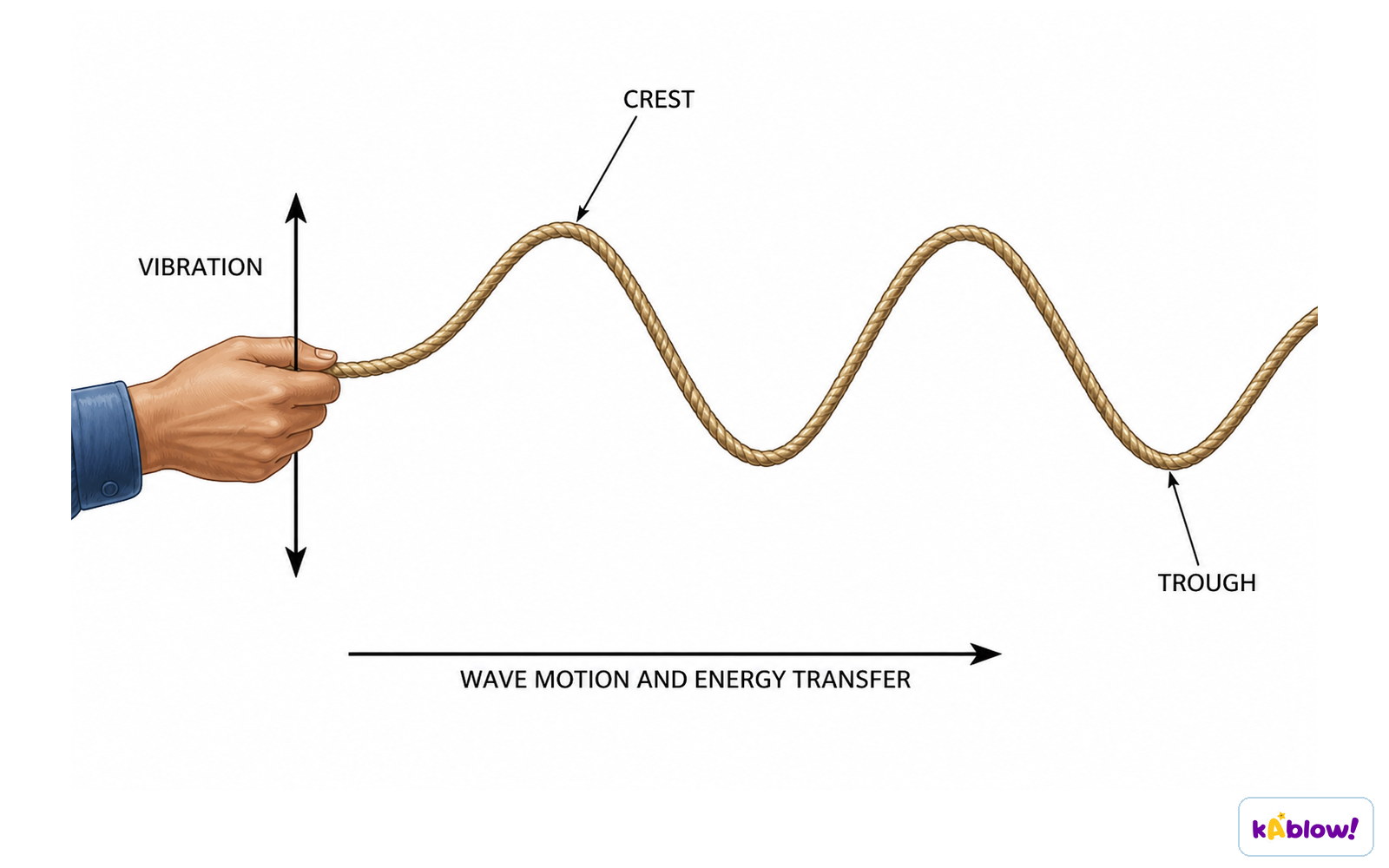
- Transverse waves: vibration is perpendicular to direction of energy transfer.
- Have peaks and troughs.
- Examples: electromagnetic waves (light, radio, X-rays), ripples on water, seismic S-waves.
- Mechanical transverse waves can travel in solids and on liquid surfaces, but not in liquids or gases.
- Non-mechanical transverse waves (e.g., light) can travel in a vacuum.
Transverse wave motion in a rope: vibration at 90 degrees to the direction of energy transfer, with wave peak and wave trough labelled.
Longitudinal Waves
- Longitudinal waves: vibration is parallel to direction of energy transfer.
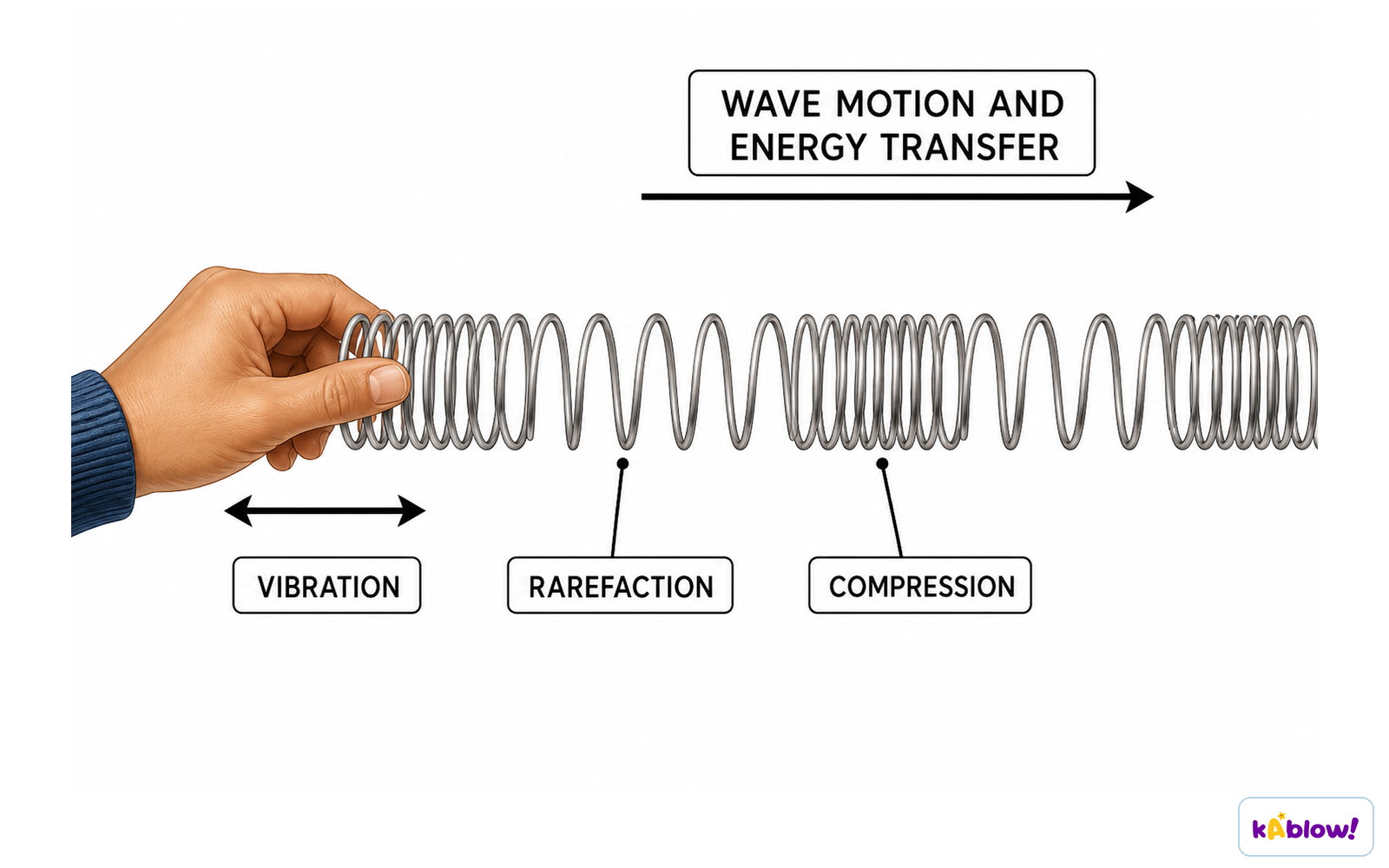
- Have compressions (particles close together) and rarefactions (particles spaced apart).
- Examples: sound waves, seismic P-waves.
- Can travel in solids, liquids, and gases; cannot travel in a vacuum.
- Density and pressure change along the wave.
Longitudinal wave motion in a spring, showing compression and rarefaction.
Wave Behaviour: Reflection, Refraction, Diffraction
- All waves can undergo reflection, refraction, and diffraction.
- Reflection – wave hits a boundary and stays in the original medium; angle of incidence = angle of reflection.
- Refraction – wave changes speed when entering a different medium; wavelength changes but frequency stays the same; direction may change (towards normal if slowing down, away if speeding up).
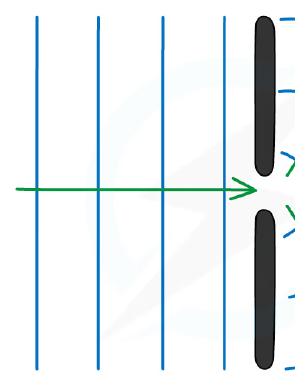
- Diffraction – waves spread out when passing through a narrow gap or around an edge.
- Diffraction is most prominent when gap width ≈ wavelength; larger gap → less diffraction.
- Longer wavelengths diffract more than shorter wavelengths.
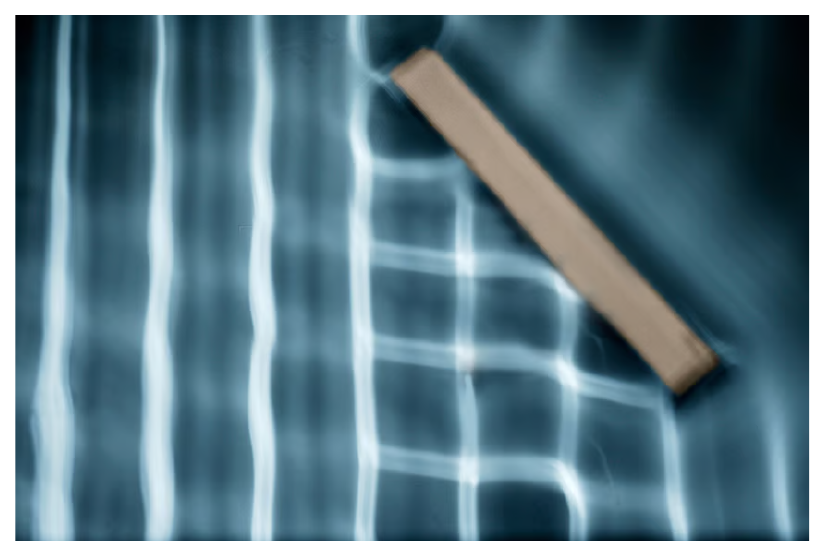
Reflection at a water surface

Ripple Tank Experiments
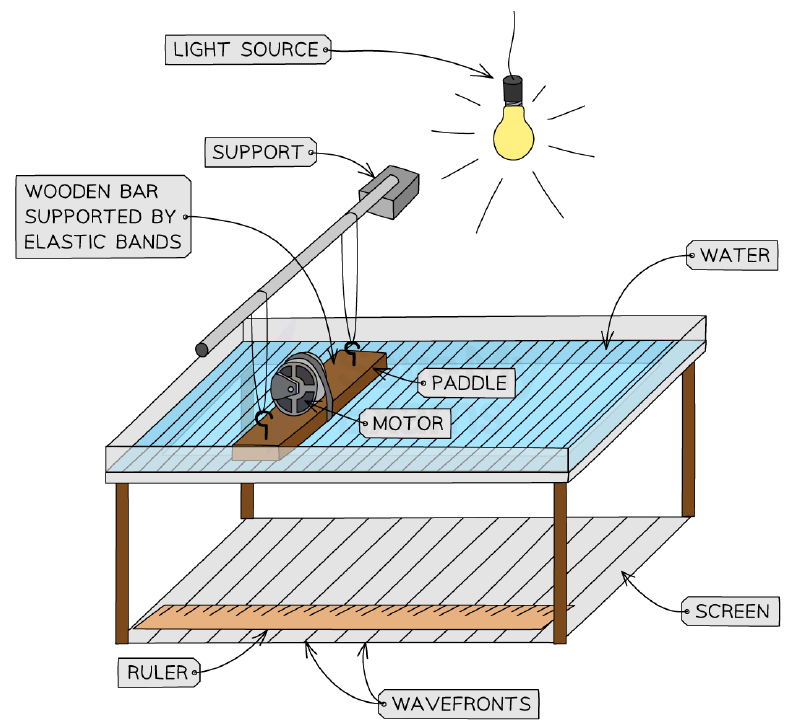
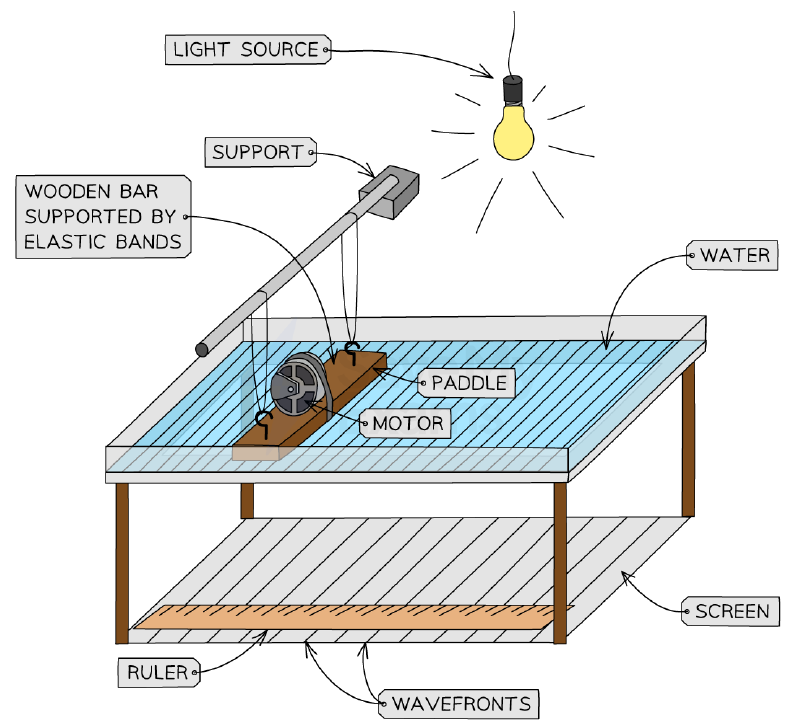
- A ripple tank demonstrates wave properties using water waves.
- Reflection: wavefronts reflect off a metal bar placed in the water.
- Refraction: a glass block creates shallow water; waves slow down and wavelength decreases.
- Diffraction: barriers with gaps or edges show spreading of waves.
- Changing motor frequency changes wavelength: higher frequency → shorter wavelength.
A ripple tank experimental set-up for demonstrating wave properties.
Slides
Sign up free to view the lesson slides
Step through every slide for this topic — plus flashcards and revision notes — with a free account.
Practice questions
Free preview — 8 of 54 questions. Sign up to see them all.
1.Which of the following is the correct definition of a wave?
Easy- AA transfer of energy without transfer of matter
- BA transfer of matter without transfer of energy
- CA transfer of both energy and matter
- DA transfer of neither energy nor matter
2.The source vibrates with twice the amplitude while its frequency and wave speed stay constant. What happens to the wavelength?
Easy- AIt stays the same
- BIt doubles
- CIt halves
- DIt becomes zero
3.Which of the following is a transverse wave?
Easy- ASound wave
- BSeismic P-wave
- CLight wave
- DLongitudinal wave in a slinky
4.A wave has a speed of 3.0 m/s and a wavelength of 0.5 m. What is its frequency?
Medium- A1.5 Hz
- B6.0 Hz
- C0.17 Hz
- D3.5 Hz
5.The source frequency doubles while the wave speed stays constant. What happens to the distance between neighbouring compressions?
Easy- AIt halves
- BIt doubles
- CIt remains unchanged
- DIt becomes four times larger
6.Which of the following changes occurs when a water wave passes from deep water into shallow water?
Medium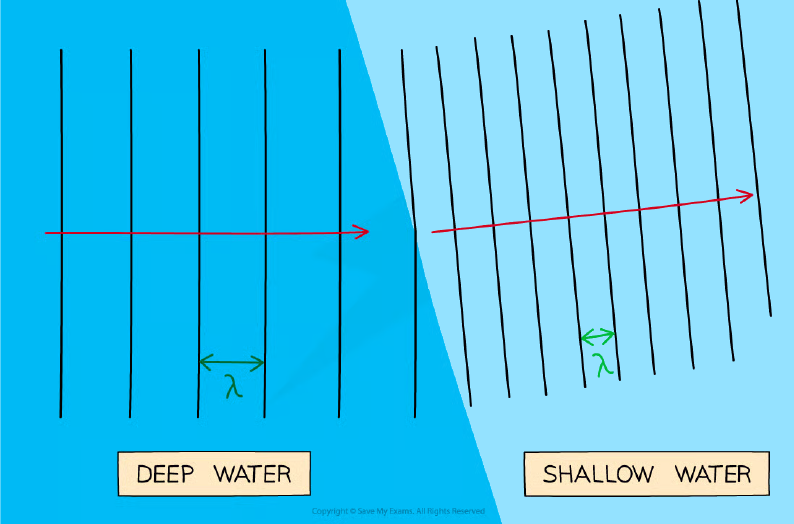
- AIts frequency increases
- BIts wavelength decreases
- CIts speed increases
- DIts amplitude remains constant
7.A wave has a time period of 0.25 s. What is its frequency?
Easy- A0.25 Hz
- B4.0 Hz
- C2.5 Hz
- D0.4 Hz
8.Diffraction of waves is most pronounced when:
Easy- AThe gap is much larger than the wavelength
- BThe gap is approximately equal to the wavelength
- CThe gap is much smaller than the wavelength
- DThe wavelength is zero
Unlock all 54 questions & more
Create a free account to see every question, the slides, flashcards and revision notes for this topic.