Stars & The Universe
Learn it by playing
Answer these questions to earn energy, then fish and explore. No account needed.
Lesson notes
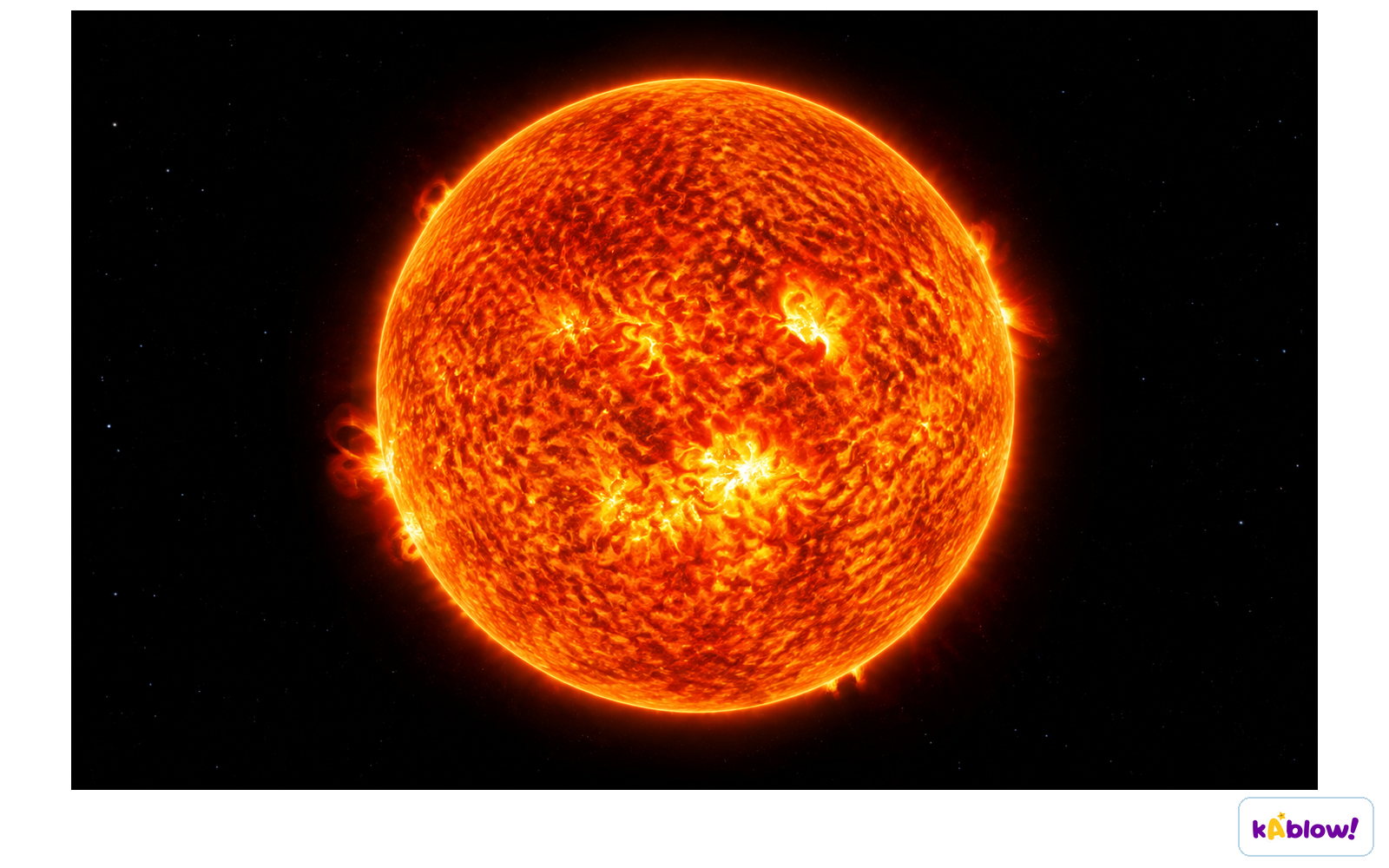
The Sun as a Star
- The Sun is a medium-sized star at the centre of the Solar System.
- It consists mostly of hydrogen and helium.
- It radiates most energy in the infrared, visible and ultraviolet regions.
- In the core, nuclear fusion converts hydrogen into helium, releasing huge energy.
- All stable stars are powered by nuclear fusion.
The Sun as a star
Scale of the Universe
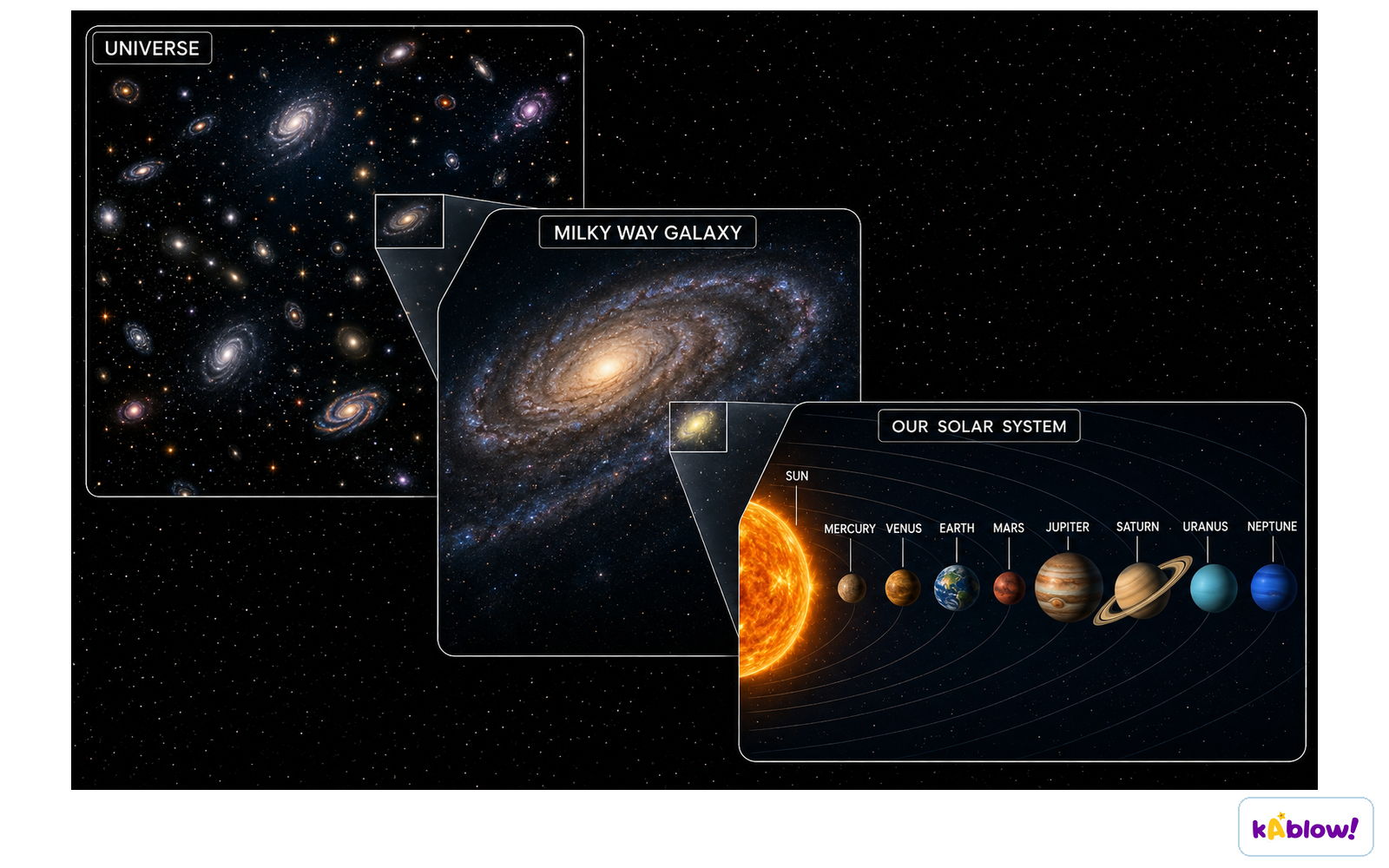
- The Universe is a large collection of billions of galaxies.
- A galaxy is a large collection of billions of stars.
- The Milky Way is our galaxy; the Sun is one of its billions of stars.
- Other stars in the Milky Way are much further from Earth than the Sun.
- A light-year is the distance light travels in one year (≈ 9.5 × 10¹⁵ m).
- The Milky Way's diameter is about 100 000 light-years.
Hierarchy of the Universe
Star Formation
- Stars form from a nebula (cloud of gas and dust).
- Gravity pulls particles together to form a protostar; density and temperature increase.
- When the core is hot enough, nuclear fusion begins → stable star.
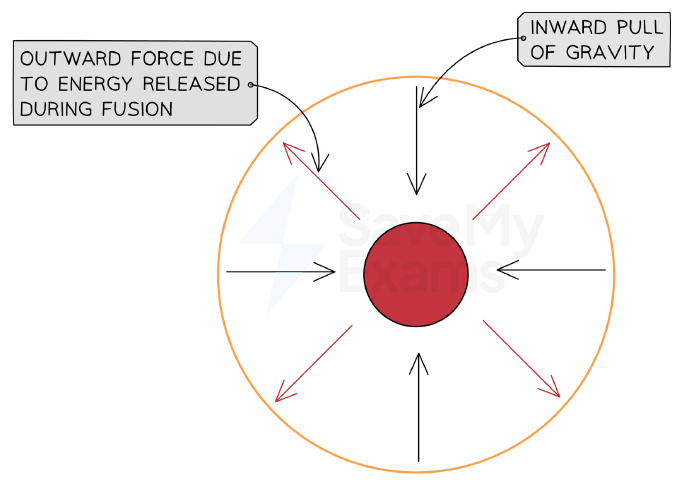
- In a stable star, inward gravitational forces balance outward thermal pressure.
Balanced forces in a stable star
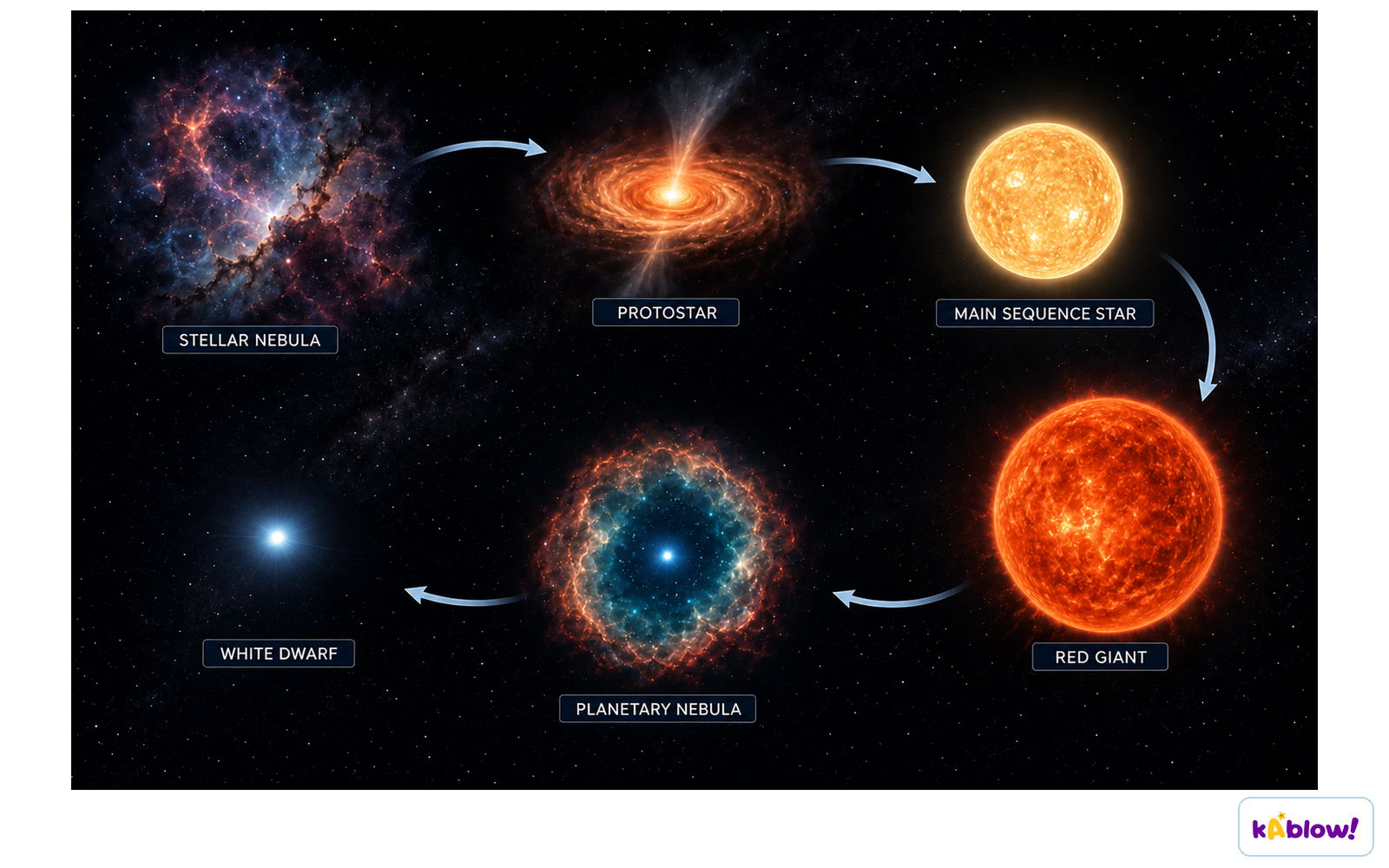
Life Cycle of Low-Mass Stars (≤ 8 solar masses)
- After stable phase: red giant → planetary nebula → white dwarf.
- Red giant: hydrogen depleted, core shrinks and heats, helium fuses to carbon, outer layers expand.
- Planetary nebula: outer layers ejected; core collapses.
- White dwarf: hot, dense core that cools and dims over time.
Life cycle of a low-mass star
Life Cycle of High-Mass Stars (> 8 solar masses)
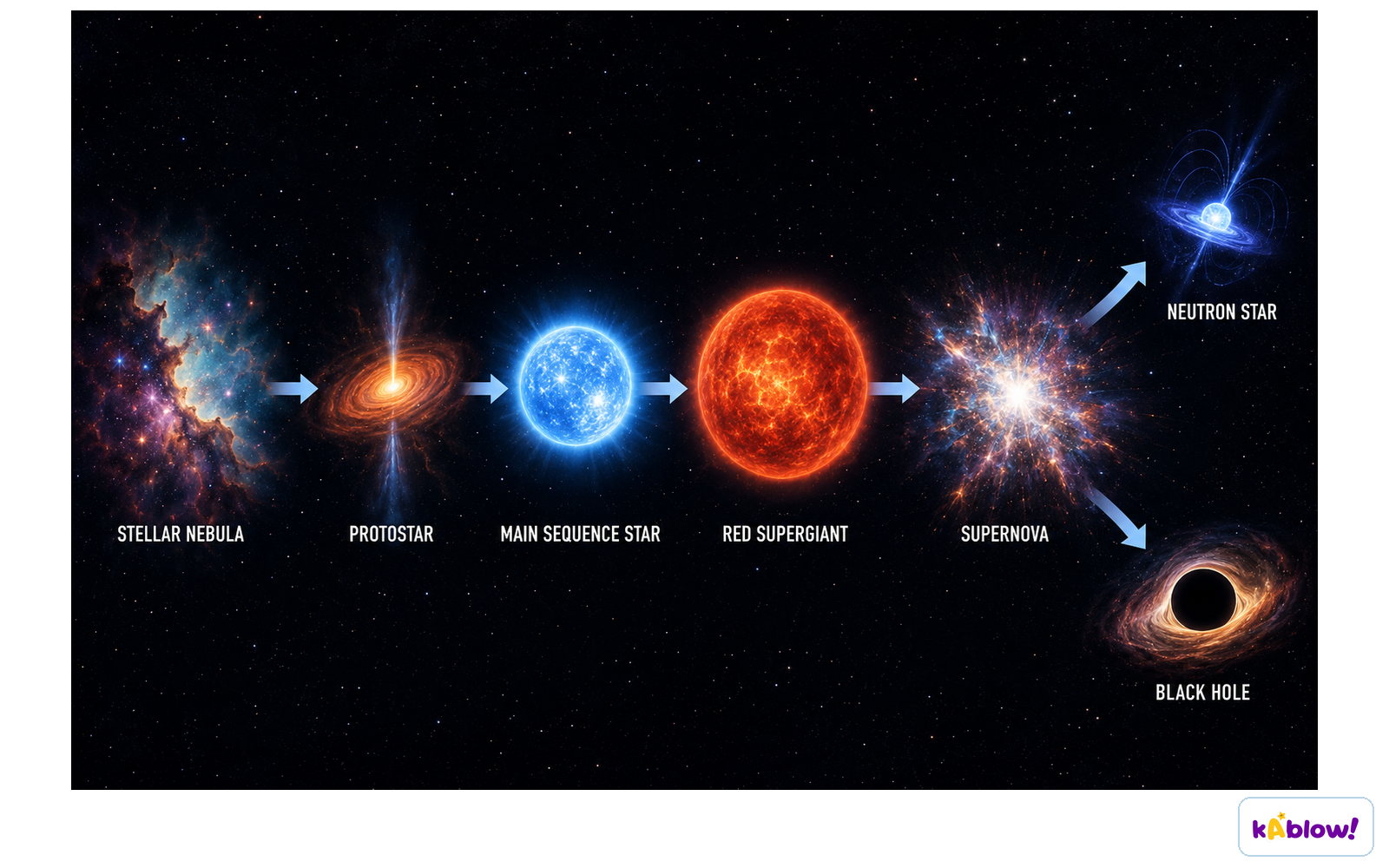
- After stable phase: red supergiant → supernova → neutron star or black hole.
- Red supergiant: fuses heavier elements up to iron; core collapses and expands repeatedly.
- Supernova: core collapses rapidly, triggering a huge explosion; heavy elements (heavier than iron) are formed.
- Neutron star: dense remnant at the centre; if massive enough, collapses to a black hole.
- Nebulae from supernovae may form new stars and planets.
Life cycle of high-mass stars
Galactic Redshift
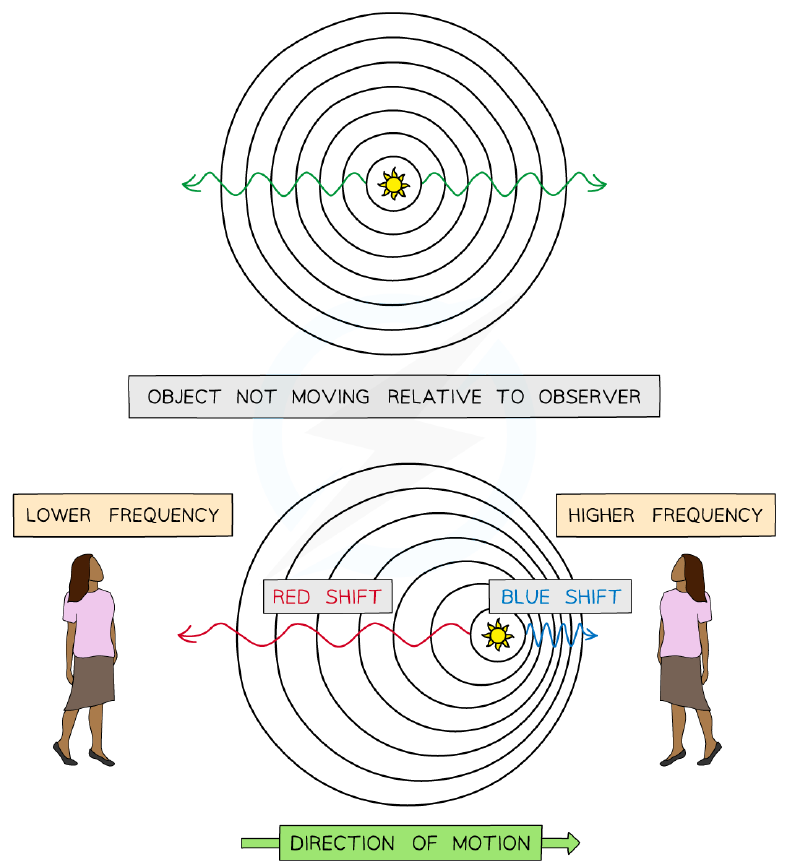
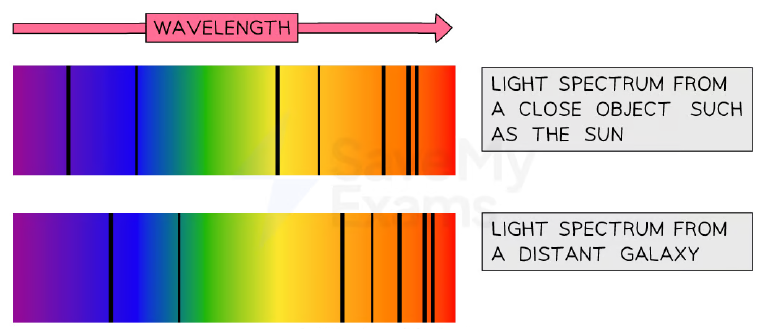
- Redshift is the increase in wavelength of light from a source moving away (Doppler effect).
- Light from distant galaxies is redshifted compared to hydrogen on Earth → galaxies are moving away.
- Greater redshift means the galaxy is further away and moving faster.
- This shows the Universe is expanding.
Redshift and blueshift of light
The Big Bang Theory
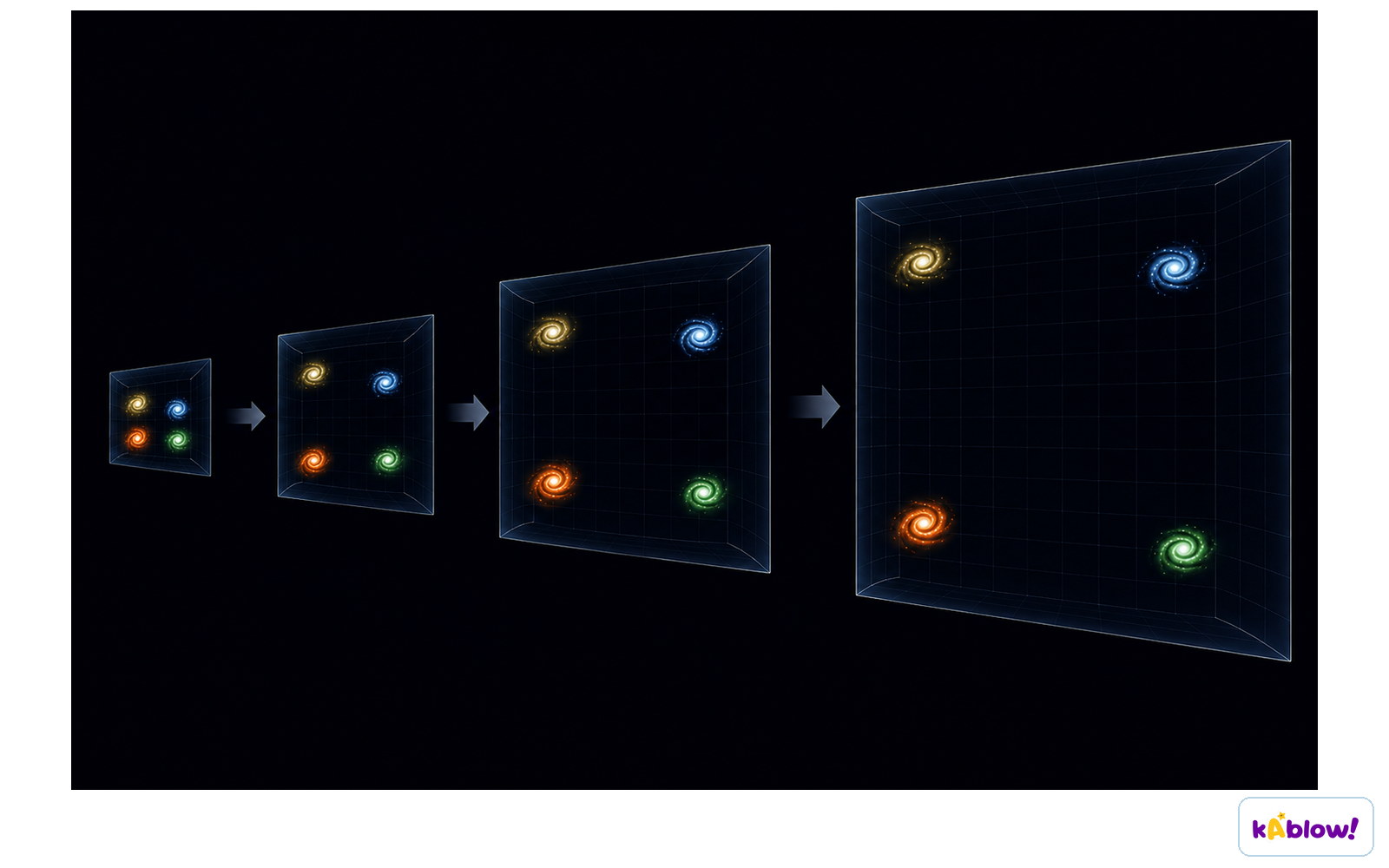
- The Universe began about 14 billion years ago from a hot, dense single point.
- Evidence: galactic redshift (galaxies receding → expansion) and cosmic microwave background radiation (CMBR).
- CMBR is uniform microwave radiation from all directions, left over from the early Universe.
- CMBR was originally high-energy gamma radiation; it has been redshifted as the Universe expanded.
The Big Bang Theory showing the expansion of the universe from a single point.
Age of the Universe (Extended)
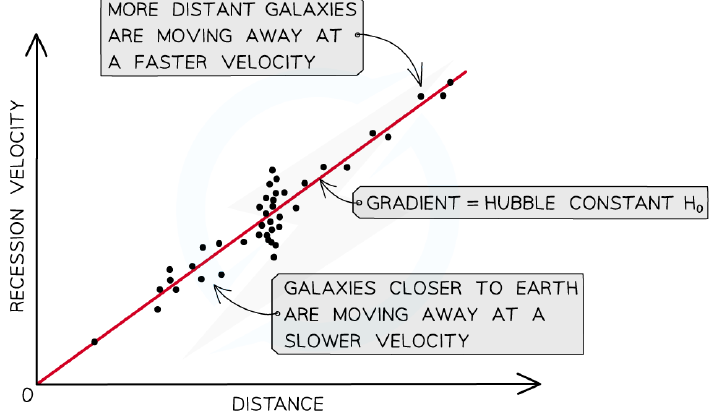
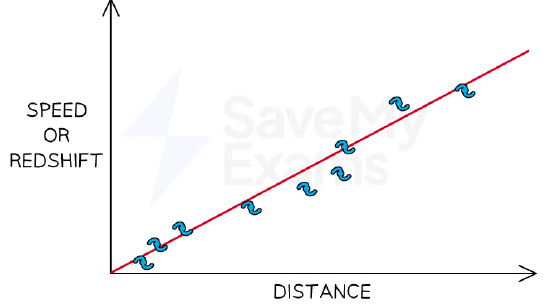
- Hubble's law: recession speed v is proportional to distance d: v = H₀ d.
- Hubble constant H₀ = 2.2 × 10⁻¹⁸ per second (current accepted value).
- Age of Universe ≈ 1 / H₀ ≈ 13.7 billion years.
- Distance to galaxies measured using redshift and brightness of supernovae (standard candles).
Graph of galaxy recession velocity against distance
Slides
Sign up free to view the lesson slides
Step through every slide for this topic — plus flashcards and revision notes — with a free account.
Practice questions
Free preview — 8 of 46 questions. Sign up to see them all.
1.Which of the following is the correct definition of a galaxy?
Easy- AA large collection of billions of stars
- BA large collection of billions of planets
- CA large collection of billions of galaxies
- DA large collection of billions of moons
2.What is the approximate diameter of the Milky Way galaxy in light-years?
Easy- A100 000 light-years
- B1 million light-years
- C10 000 light-years
- D1 billion light-years
3.What is the name of the force that pulls the outer layers of a star inwards during its stable phase?
Easy- AGravitational force
- BThermal pressure
- CNuclear force
- DElectromagnetic force
4.What is the correct order of stages in the life cycle of a star similar in mass to the Sun after the stable star phase?
Easy- ARed giant, planetary nebula, white dwarf
- BRed supergiant, supernova, neutron star
- CPlanetary nebula, white dwarf, red giant
- DWhite dwarf, red giant, planetary nebula
5.What does the observed redshift in the light from distant galaxies indicate?
Easy- AGalaxies are moving away from Earth
- BGalaxies are moving towards Earth
- CGalaxies are stationary
- DGalaxies are shrinking
6.The Hubble constant H0 is approximately 2.2 × 10⁻¹⁸ per second. A galaxy is at a distance of 1.0 × 10²³ m. What is its recessional velocity?
Medium- A2.2 × 10⁵ m/s
- B2.2 × 10⁻⁴¹ m/s
- C4.5 × 10⁴⁰ m/s
- D2.2 × 10⁻⁵ m/s
7.Which of the following is evidence for the Big Bang theory?
Easy- AGalactic redshift and cosmic microwave background radiation
- BThe Sun's energy from nuclear fusion
- CThe existence of black holes
- DThe formation of planetary nebulae
8.What is the approximate age of the Universe according to the Hubble constant?
Easy- A13.7 billion years
- B13.7 million years
- C4.5 billion years
- D100 billion years
Unlock all 46 questions & more
Create a free account to see every question, the slides, flashcards and revision notes for this topic.