Assessing ecosystems
Learn it by playing
Answer these questions to earn energy, then fish and explore. No account needed.
Lesson notes
Why assess ecosystems?
- Assessing ecosystems helps detect changes over time, such as a decline in a species.
- It reveals the impact of human activities like pollution or deforestation.
- Information gathered can guide decisions to protect and manage ecosystems.
What is a quadrat?
- A quadrat is a square frame, usually made of wood or metal.
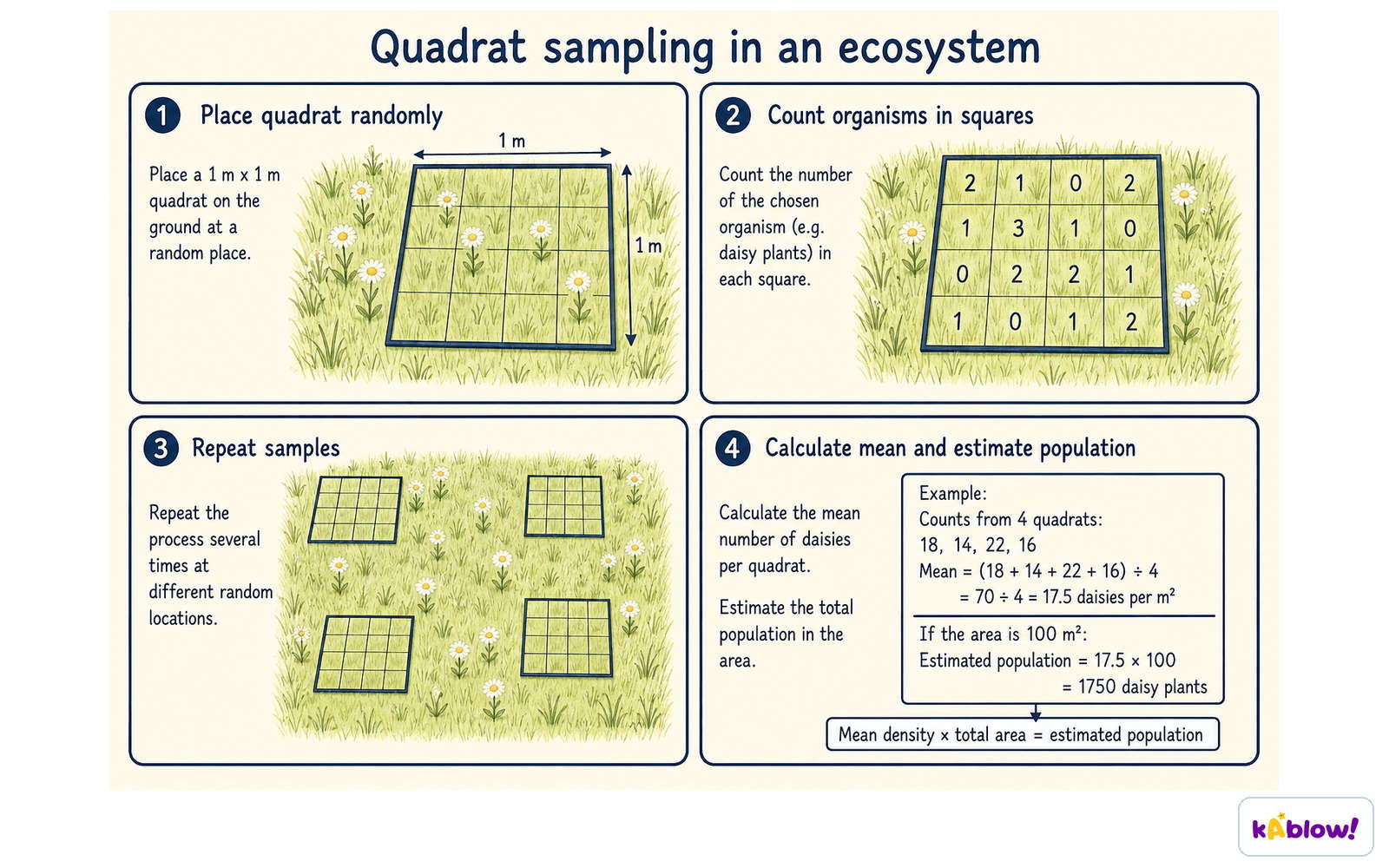
- It defines a sample area within an ecosystem, often 1 m × 1 m (area = 1 m²).
- Quadrats are used to estimate the number of organisms in a large area.
Using quadrats: method
- Random placement – use a random number generator for coordinates to avoid bias.
- Count organisms – identify and count all organisms inside the quadrat.
- Repeat the process in different parts of the area to get multiple samples.
- Calculate mean – find the average number of organisms per quadrat.
Use random quadrat samples, calculate the mean count per square metre, and multiply by habitat area to estimate the population.
Estimating total population
- Total population = average per quadrat × total area.
- The average per quadrat gives the number per 1 m².
- Multiply by the total area (in m²) to estimate the population size.
- Example: 12 daisies per quadrat in a 10 000 m² field gives 120 000 daisies.
Key points to remember
- Quadrats provide an estimate, not an exact count.
- Random placement is essential to avoid bias.
- More quadrats improve the accuracy of the estimate.
- Assessments help monitor ecosystem health over time.
Slides
Sign up free to view the lesson slides
Step through every slide for this topic — plus flashcards and revision notes — with a free account.
Practice questions
Free preview — 8 of 56 questions. Sign up to see them all.
1.What is a quadrat?
Easy- AA square frame used to sample an area in an ecosystem
- BA device for measuring temperature in an ecosystem
- CA type of organism found in soil
- DA method for capturing animals
2.What is the typical area of a quadrat?
Easy- A1 m²
- B10 m²
- C0.5 m²
- D2 m²
3.Why are quadrats placed randomly when studying an ecosystem?
Easy- ATo avoid bias in the sample
- BTo make the experiment faster
- CTo ensure all organisms are counted
- DTo make the quadrats easier to place
4.A field has an area of 5000 m². Students use quadrats of 1 m² and find an average of 20 clover plants per quadrat. What is the estimated total number of clover plants?
Medium- A100,000
- B250
- C5,000
- D20,000
5.A field has an area of 2,500 m² and the average number of dandelions per m² quadrat is 8. What is the estimated total number of dandelions?
Medium- A20,000
- B2,500
- C8
- D312.5
6.After placing 15 quadrats in a 4,000 m² area, the average number of organisms per m² quadrat is 10. What is the estimated total population?
Medium- A40,000
- B15,000
- C4,000
- D10
7.Which of the following is the correct formula to estimate the total population of a species in an area using quadrats?
Medium- ATotal population = (average number per quadrat) × (total area)
- BTotal population = (total area) / (average number per quadrat)
- CTotal population = (average number per quadrat) / (total area)
- DTotal population = (number of quadrats) × (average number per quadrat)
8.Why is it often not possible to count every single organism in a large area?
Easy- AIt would take too much time and effort
- BOrganisms move too fast
- CThe area is too small
- DThere are no organisms
Unlock all 56 questions, flashcards & more
Create a free account to see every question, the slides, flashcards and revision notes for this topic.