Gas exchange in plants
Learn it by playing
Answer these questions to earn energy, then fish and explore. No account needed.
Lesson notes
Overview of Gas Exchange in Plants
- Plants exchange gases with the environment to survive.
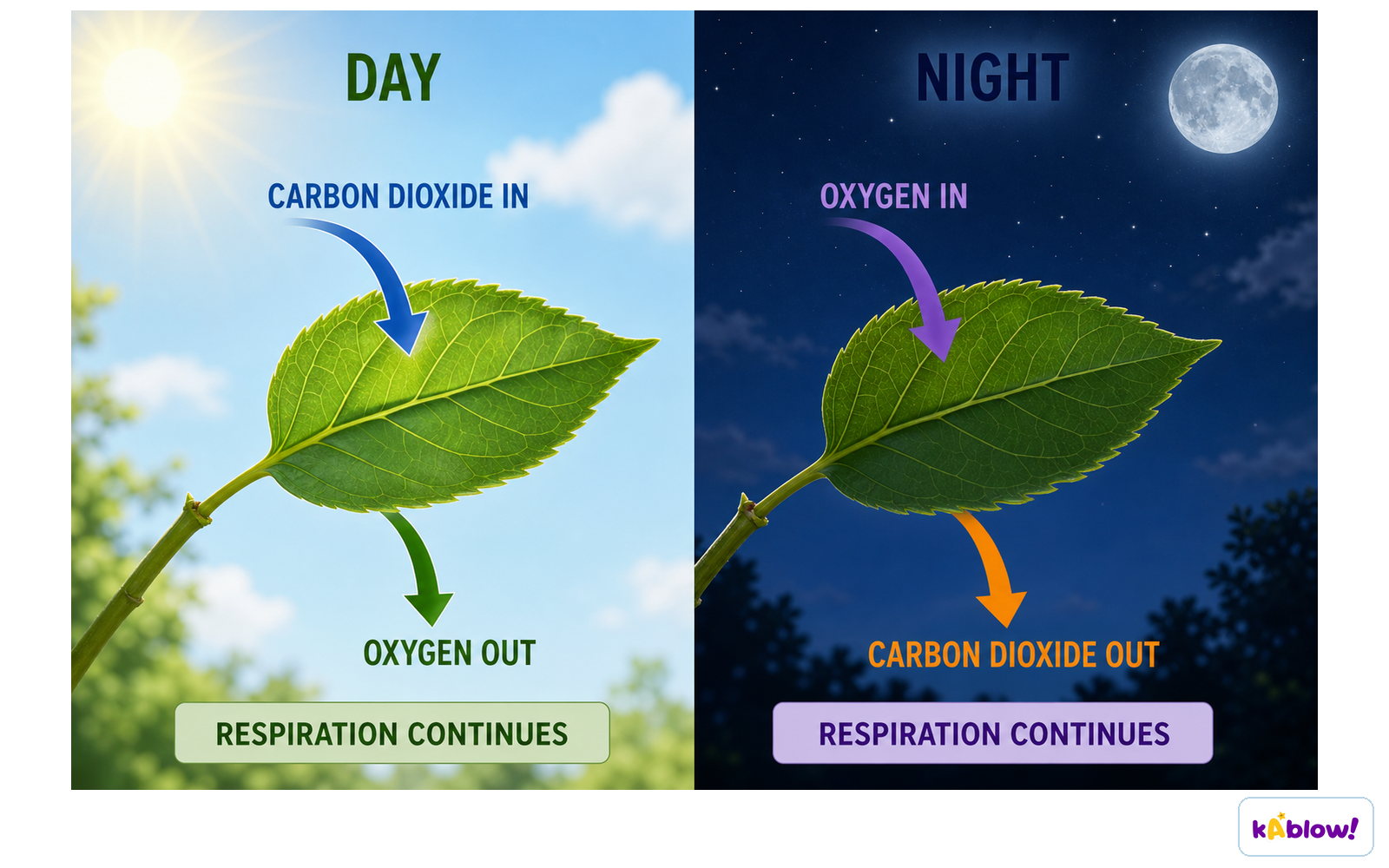
- Photosynthesis: takes in carbon dioxide and releases oxygen.
- Respiration: takes in oxygen and releases carbon dioxide.
- The leaf is the main organ for gas exchange.
In daylight, net carbon dioxide enters and oxygen leaves; at night, net oxygen enters and carbon dioxide leaves.
Stomata
- Stomata are small openings mainly on the underside of leaves.
- Each stoma is surrounded by two guard cells that control its opening and closing.
- When open, carbon dioxide enters and oxygen and water vapour exit.
- Stomata allow gas exchange while regulating water loss.
Guard Cells
- Guard cells swell and open stomata when the plant has plenty of water.
- When water is scarce, guard cells shrink and close stomata to prevent water loss.
- They control the balance between gas exchange and water conservation.
Spongy Mesophyll
- The spongy mesophyll layer has loosely arranged cells with air spaces.
- Air spaces facilitate the movement of gases through the leaf.
- Carbon dioxide diffuses through air spaces to reach palisade cells for photosynthesis.
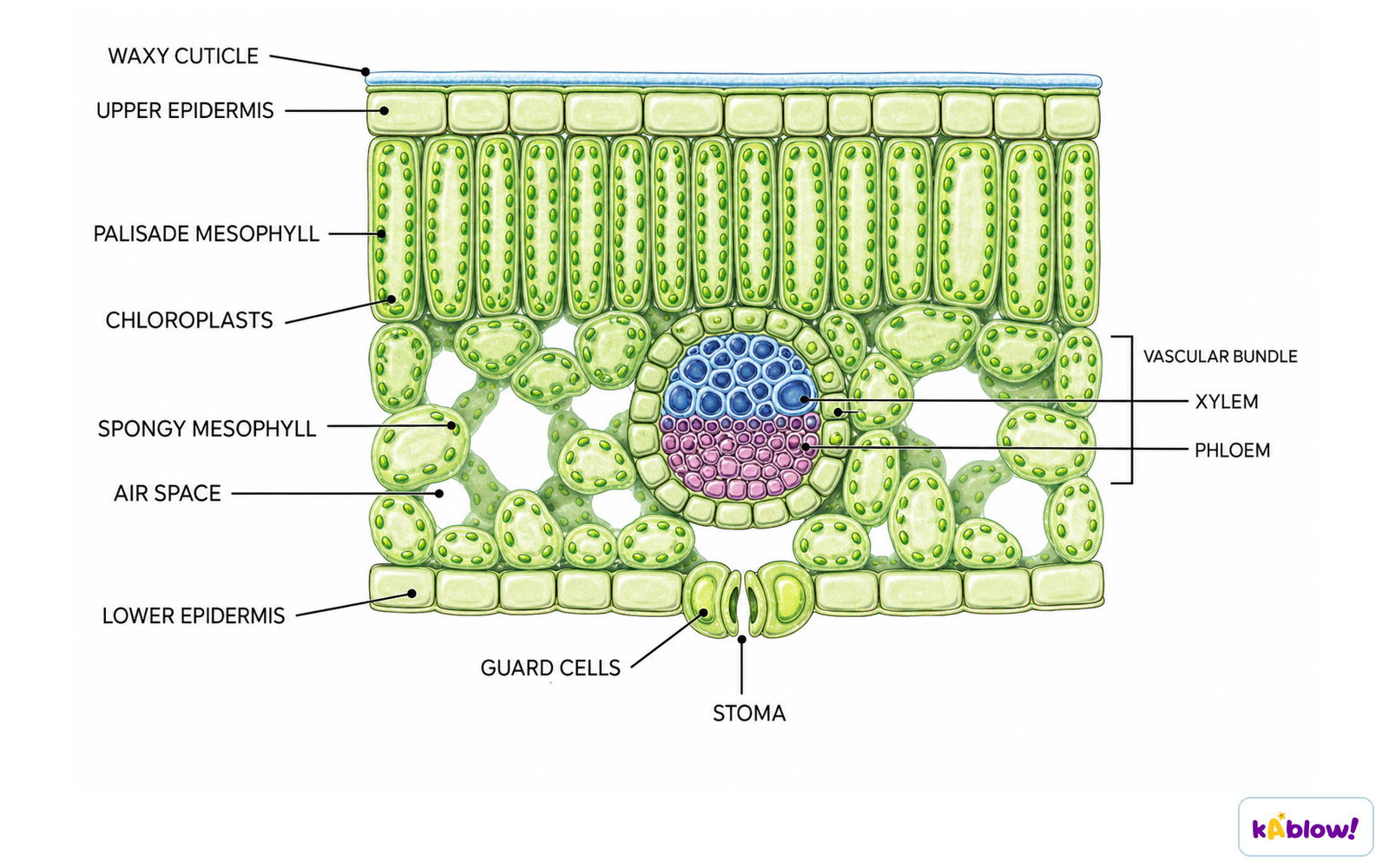
A dicotyledonous leaf cross-section showing epidermal layers, mesophyll, air spaces, a vascular bundle, chloroplasts and guard cells.
Palisade Mesophyll
- The palisade mesophyll layer consists of tightly packed cells.
- These cells are rich in chloroplasts, the site of photosynthesis.
- The arrangement maximises light absorption for photosynthesis.
Waxy Cuticle
- The waxy cuticle is a thin, protective layer covering the leaf surface.
- It prevents excessive water loss by reducing evaporation.
- It allows light to penetrate for photosynthesis.
Cross-section of a leaf showing cuticle, epidermis, palisade and spongy mesophyll, air spaces, stoma and guard cells.
Slides
Sign up free to view the lesson slides
Step through every slide for this topic — plus flashcards and revision notes — with a free account.
Practice questions
Free preview — 8 of 57 questions. Sign up to see them all.
1.Where are stomata mainly located on a leaf?
Easy- AUnderside of the leaf
- BUpper side of the leaf
- CBoth sides equally
- DOnly on the leaf edges
2.Which cells control the opening and closing of stomata?
Easy- AGuard cells
- BPalisade cells
- CSpongy mesophyll cells
- DEpidermal cells
3.During photosynthesis, plants take in which gas?
Easy- ACarbon dioxide
- BOxygen
- CNitrogen
- DWater vapour
4.Which layer of the leaf contains loosely arranged cells with air spaces?
Easy- ASpongy mesophyll
- BPalisade mesophyll
- CWaxy cuticle
- DEpidermis
5.What is the main function of the waxy cuticle on a leaf?
Easy- APrevent excessive water loss
- BAbsorb carbon dioxide
- CCarry out photosynthesis
- DOpen and close stomata
6.When water is scarce, what happens to the stomata?
Easy- AThey close to prevent water loss
- BThey open wider to absorb more carbon dioxide
- CThey remain unchanged
- DThey move to the upper leaf surface
7.Which statement about gas exchange in plants is correct?
Medium- APlants take in oxygen and release carbon dioxide only during respiration
- BPlants take in carbon dioxide and release oxygen only during photosynthesis
- CPlants take in oxygen and release carbon dioxide only during photosynthesis
- DPlants take in carbon dioxide and release oxygen only during respiration
8.Why are palisade mesophyll cells well suited for photosynthesis?
Medium- AThey are tightly packed and rich in chloroplasts
- BThey contain large air spaces
- CThey are located on the leaf underside
- DThey have a waxy coating
Unlock all 57 questions, flashcards & more
Create a free account to see every question, the slides, flashcards and revision notes for this topic.