Plant and animal cells
Learn it by playing
Answer these questions to earn energy, then fish and explore. No account needed.
Lesson notes
Cell Basics
- All animals and plants are made of tiny cells, the basic building blocks of life.
- Cells can only be seen with a microscope.
- Cells contain organelles that carry out different functions.
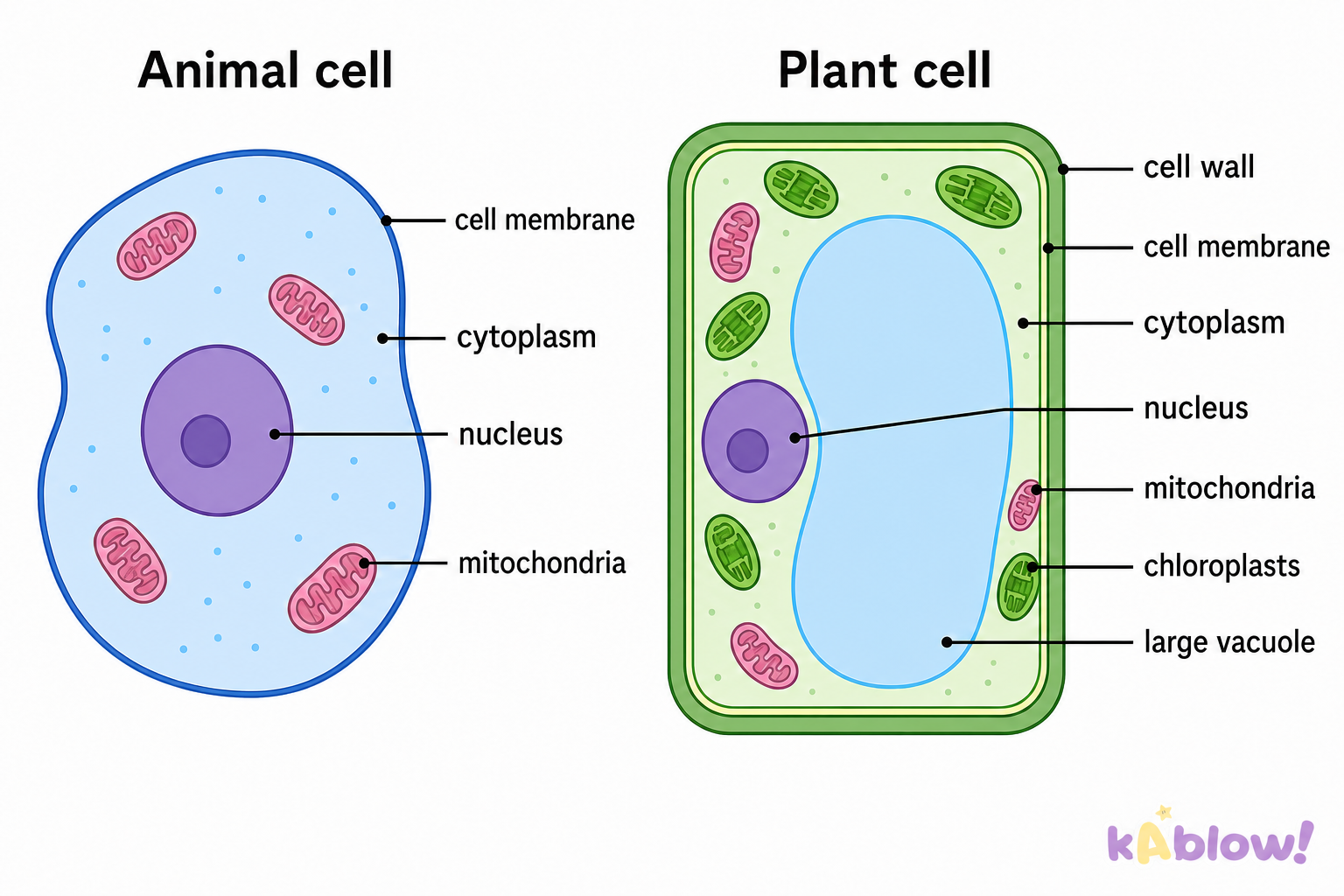
Organelles in Both Plant and Animal Cells
- Cell membrane – controls what enters and leaves the cell.
- Nucleus – controls cell activities and contains genetic material.
- Cytoplasm – where chemical reactions happen.
- Mitochondria – where aerobic respiration occurs, releasing energy from glucose.
Organelles Only in Plant Cells
- Cell wall – covers the cell membrane and gives strength.
- Vacuole – contains cell sap (a solution of sugars and salts).
- Chloroplasts – where photosynthesis takes place; contain the green pigment chlorophyll.
Key Differences
- Plant cells have a cell wall, vacuole, and chloroplasts; animal cells do not.
- Both cell types have a cell membrane, nucleus, cytoplasm, and mitochondria.
- The cell wall is made of cellulose and provides structural support.
Diagram
Diagram
Diagram
Slides
Sign up free to view the lesson slides
Step through every slide for this topic — plus flashcards and revision notes — with a free account.
Practice questions
Free preview — 8 of 26 questions. Sign up to see them all.
1.Which of the following is found in both plant and animal cells?
Easy- ACell wall
- BChloroplast
- CNucleus
- DVacuole
2.Which organelle is only found in plant cells?
Easy- AMitochondrion
- BCell membrane
- CChloroplast
- DCytoplasm
3.Which of the following is NOT found in an animal cell?
Easy- ACell wall
- BCell membrane
- CNucleus
- DMitochondria
4.A student observes a cell under a microscope and sees a cell wall, a large vacuole, and chloroplasts. What type of cell is it most likely to be?
Medium- AAnimal cell
- BBacterial cell
- CPlant cell
- DFungal cell
5.What is the function of the cell membrane?
Easy- AControls the activities of the cell
- BControls what goes in and out of the cell
- CWhere chemical reactions happen
- DWhere aerobic respiration takes place
6.What is the function of the nucleus?
Easy- AControls the activities of the cell
- BCarries out respiration
- CStores cell sap
- DControls what enters and leaves the cell
7.Which organelle is responsible for controlling the activities of the cell?
Easy- ACytoplasm
- BMitochondrion
- CNucleus
- DCell membrane
8.Which organelle is the site of aerobic respiration?
Easy- ANucleus
- BChloroplast
- CMitochondrion
- DVacuole
Unlock all 26 questions, flashcards & more
Create a free account to see every question, the slides, flashcards and revision notes for this topic.