Chemical formulae
Learn it by playing
Answer these questions to earn energy, then fish and explore. No account needed.
Lesson notes
Element Symbols
- Each element has a unique symbol, e.g., C for carbon, Cu for copper.
- The first letter of a symbol is always a capital letter; if a second letter exists, it is lower case.
- Some symbols come from Latin names, e.g., Cu from×cuprum×.
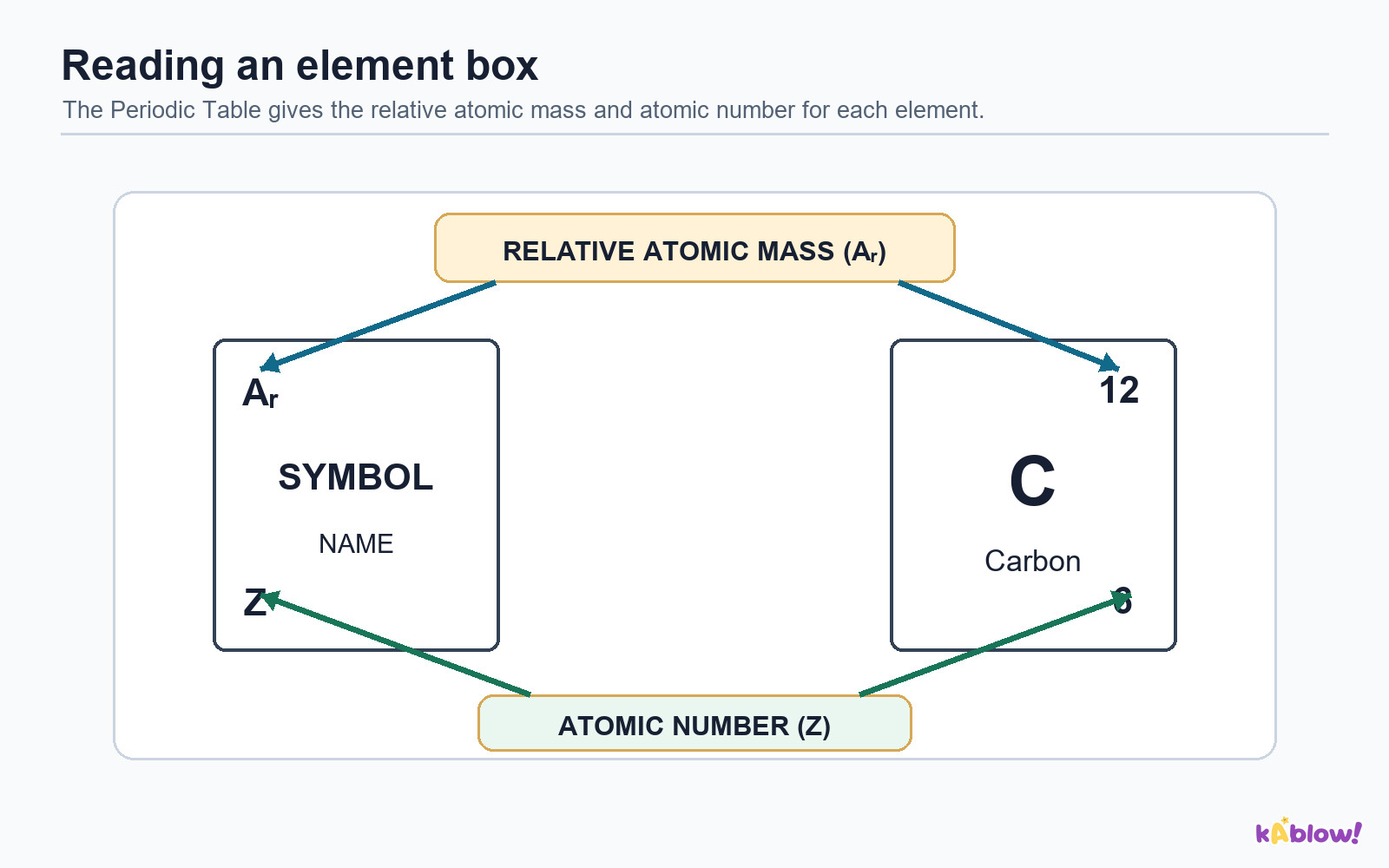
The Periodic Table key showing where relative atomic mass (Ar) and atomic number (Z) are given for each element, using carbon as the example.
Diatomic Molecules
- Some elements exist as pairs of atoms (diatomic molecules).
- Example: oxygen gas is written as O₂ – the subscript 2 means two oxygen atoms joined.
- Other diatomic elements: H₂, N₂, F₂, Cl₂, Br₂, I₂.
Compounds and Formulae
- A compound is a substance where two or more different elements are chemically joined.
- Compounds have different properties from the elements they are made from.
- A chemical formula shows the elements and the number of atoms of each in a compound.
- Example: H₂O means two hydrogen atoms and one oxygen atom.
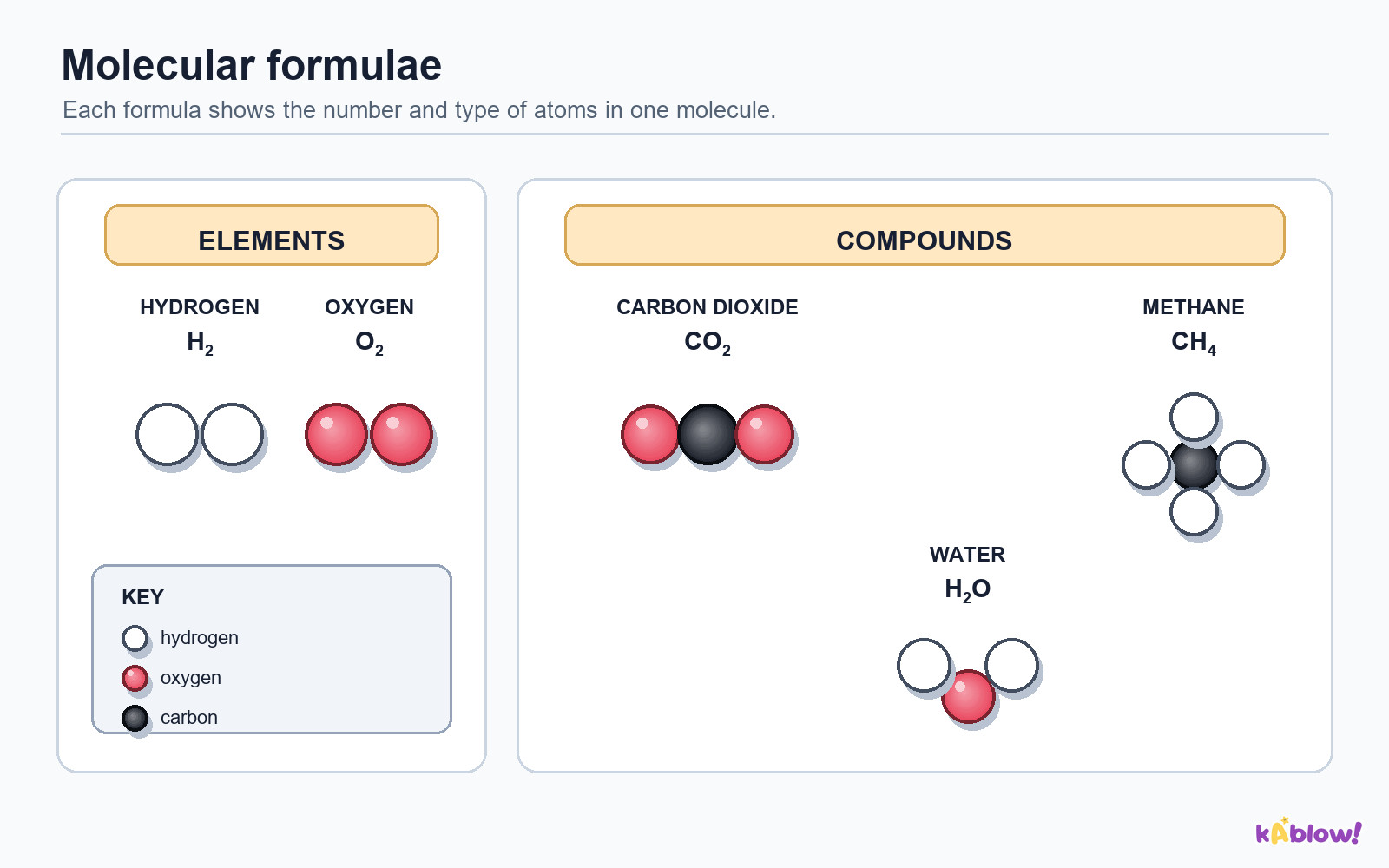
Diagrammatic representation of hydrogen, oxygen, carbon dioxide, water and methane, with a key for atom colours (white = hydrogen, red = oxygen, black = carbon).
Distinguishing Elements and Compounds
- Be careful: Co (cobalt, element) vs CO (carbon monoxide, compound).
- In CO, both letters are capital because it is two elements: C and O.
- The subscript numbers show the number of atoms: e.g., CO₂ has one C and two O atoms.
Common Compounds Table
- Al₂O₃ – aluminium oxide: 2 Al, 3 O.
- CO₂ – carbon dioxide: 1 C, 2 O.
- HCl – hydrochloric acid: 1 H, 1 Cl.
- MgO – magnesium oxide: 1 Mg, 1 O.
- SiO₂ – silicon dioxide: 1 Si, 2 O.
- NaCl – sodium chloride: 1 Na, 1 Cl.
- H₂SO₄ – sulfuric acid: 2 H, 1 S, 4 O.
- H₂O – water: 2 H, 1 O.
Writing Chemical Formulae
- Use the element symbols from the periodic table.
- Write the number of atoms as a subscript after the element symbol.
- If there is only one atom, no subscript is written (e.g., O in H₂O).
- The order of elements often follows standard conventions (e.g., metal first, then non-metal).
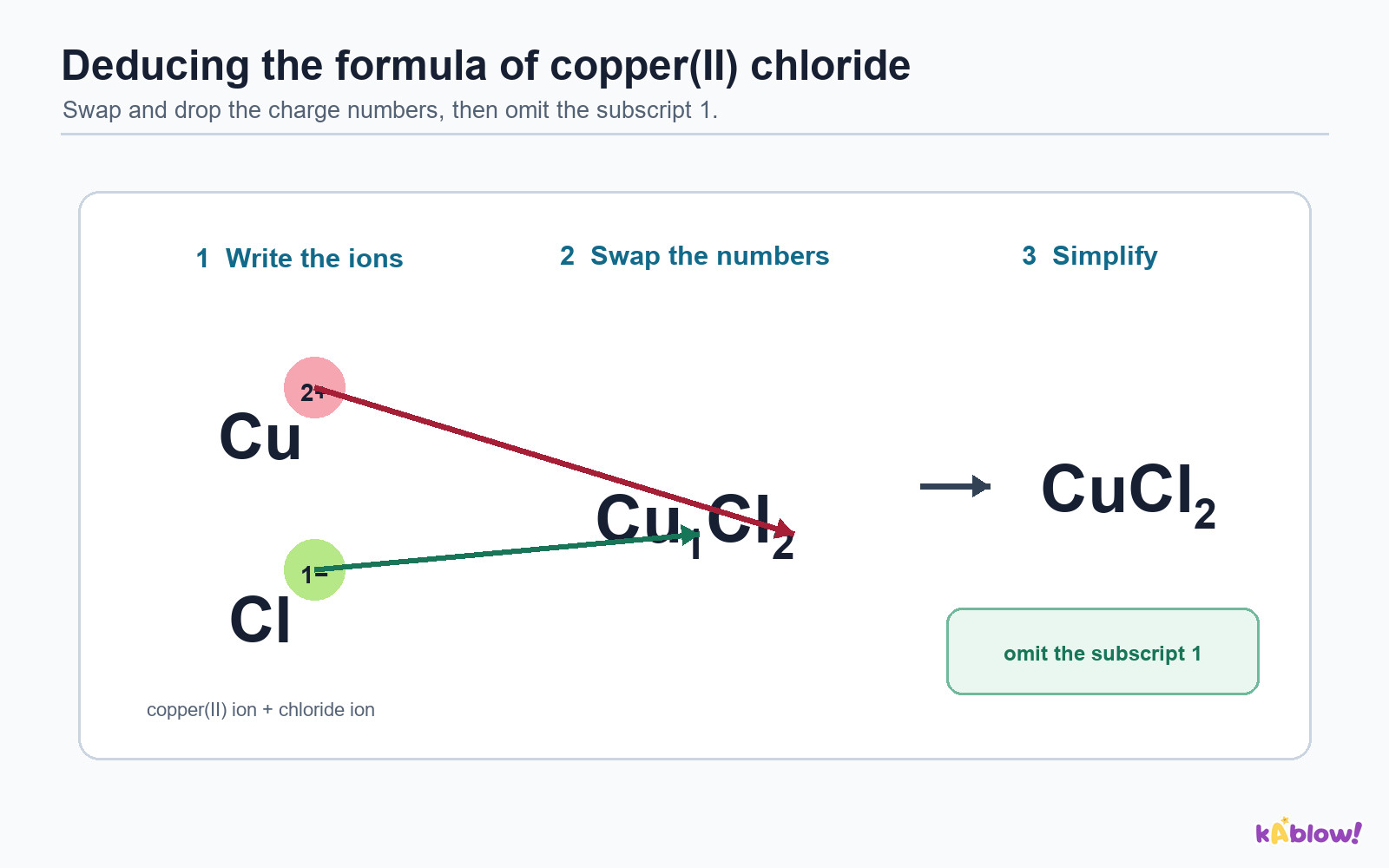
The charges on Cu2+ and Cl- swap and drop to give the formula CuCl2.
Examples from Workbook
- NaOH – sodium hydroxide: 1 Na, 1 O, 1 H.
- FeS – iron sulfide: 1 Fe, 1 S.
- NH₃ – ammonia: 1 N, 3 H.
- CaO – calcium oxide: 1 Ca, 1 O.
- Li₂O – lithium oxide: 2 Li, 1 O.
- CaCl₂ – calcium chloride: 1 Ca, 2 Cl.
- CH₄ – methane: 1 C, 4 H.
- Na₂CO₃ – sodium carbonate: 2 Na, 1 C, 3 O.
- K₂SO₄ – potassium sulphate: 2 K, 1 S, 4 O.
Atomic structure of oxygen (O) – 8 protons, 8 neutrons, 2 electrons in inner shell, 6 in outer shell. Oxygen atoms often pair to form O₂.
Particle arrangement in solids, liquids, and gases. In compounds, atoms of different elements are chemically joined (e.g., H₂O molecules).
Slides
Sign up free to view the lesson slides
Step through every slide for this topic — plus flashcards and revision notes — with a free account.
Practice questions
Free preview — 8 of 60 questions. Sign up to see them all.
1.Which of the following is the correct chemical formula for water?
Easy- AH2O
- BHO2
- CH2O2
- DOH2
2.The symbol 'Co' represents which element?
Easy- ACobalt
- BCarbon monoxide
- CCopper
- DCarbon
3.How many oxygen atoms are in the formula H2SO4?
Easy- A1
- B2
- C4
- D6
4.Which of the following compounds has the formula NaCl?
Easy- ASodium hydroxide
- BSodium chloride
- CSodium carbonate
- DSodium oxide
5.What is the chemical formula for aluminium oxide?
Medium- AAlO
- BAl2O
- CAlO3
- DAl2O3
6.Which statement is true about compounds?
Easy- ACompounds have the same properties as the elements they are made from.
- BCompounds have different properties to the elements they are made from.
- CCompounds are only made from one type of atom.
- DCompounds cannot be represented by chemical formulae.
7.What does the subscript 2 in O2 indicate?
Easy- ATwo oxygen molecules
- BTwo oxygen atoms joined together
- CTwo different types of oxygen
- DTwo oxygen electrons
8.Which of the following is the correct formula for carbon dioxide?
Easy- ACO
- BCo2
- CC2O
Unlock all 60 questions, flashcards & more
Create a free account to see every question, the slides, flashcards and revision notes for this topic.