Thermal decomposition
Learn it by playing
Answer these questions to earn energy, then fish and explore. No account needed.
Lesson notes
What is Thermal Decomposition?
- Thermal decomposition is a chemical reaction where a compound is heated and breaks down into smaller, simpler products.
- It requires heat energy to break the chemical bonds in the compound.
Example: Copper Carbonate
- Heating copper carbonate (green) produces copper oxide (black) and carbon dioxide gas.
- Word equation: copper carbonate → copper oxide + carbon dioxide.
- Symbol equation: CuCO₃ → CuO + CO₂.
- The colour change from green to black is evidence of a chemical reaction.
- The release of carbon dioxide gas is another sign of reaction.
General Rule for Metal Carbonates
- When heated, a metal carbonate generally decomposes into a metal oxide and carbon dioxide.
- Example: magnesium carbonate → magnesium oxide + carbon dioxide (MgCO₃ → MgO + CO₂).
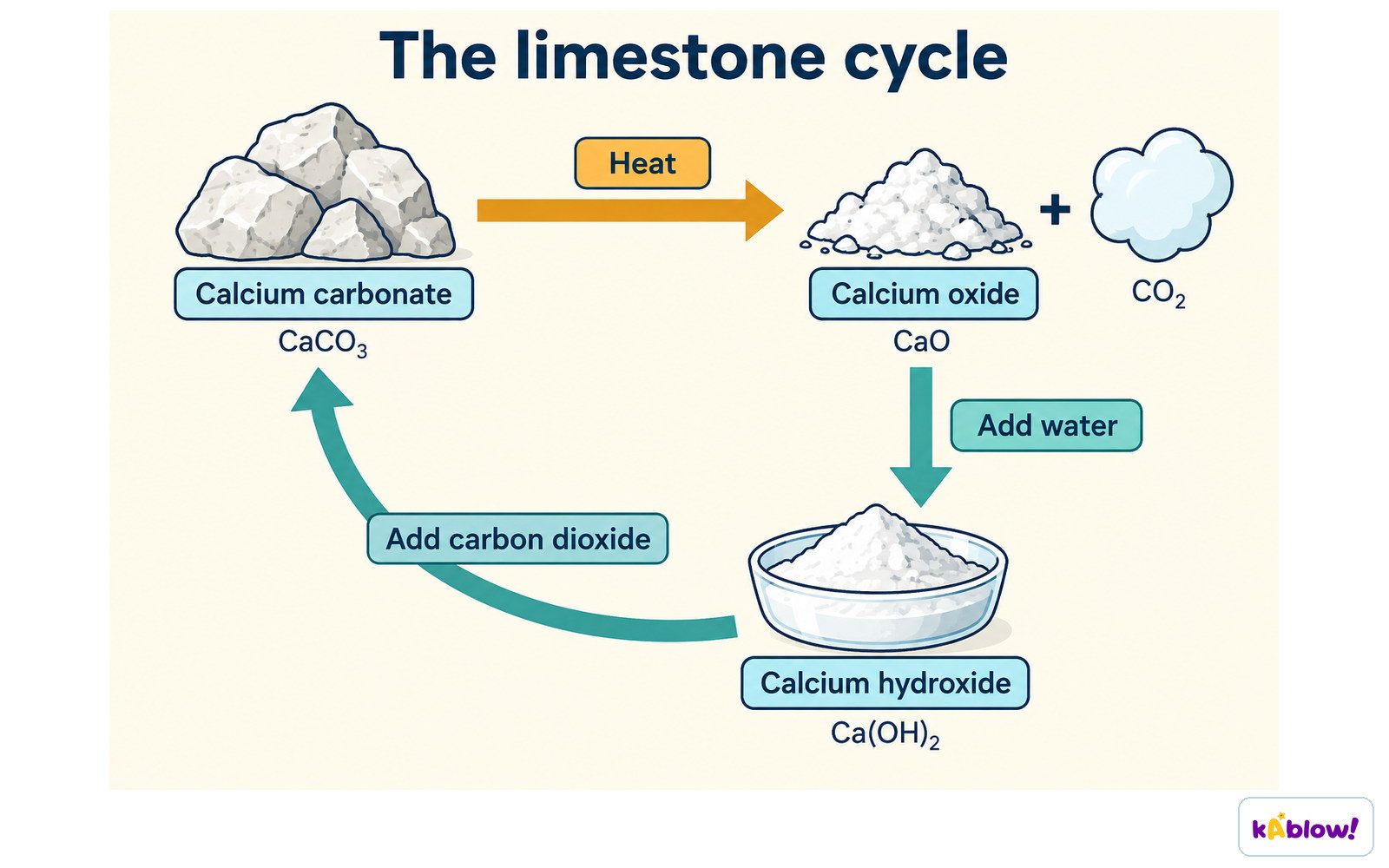
- Example: calcium carbonate → calcium oxide + carbon dioxide (CaCO₃ → CaO + CO₂).
Heating calcium carbonate produces calcium oxide and carbon dioxide. Adding water and then carbon dioxide completes the limestone cycle.
Testing for Carbon Dioxide
- Carbon dioxide gas turns limewater (calcium hydroxide solution) milky/cloudy white.
- This is a positive test for carbon dioxide.
Example: Hydrogen Peroxide
- Hydrogen peroxide decomposes into water and oxygen gas when heated.
- Word equation: hydrogen peroxide → water + oxygen.
- Balanced symbol equation: 2H₂O₂ → 2H₂O + O₂.
Testing for Oxygen
- Oxygen gas will relight a glowing splint.
- This is a positive test for oxygen.
Balancing Equations
- Example: Silver oxide decomposes: 2Ag₂O → 4Ag + O₂ (balanced).
- Always ensure the number of atoms of each element is equal on both sides.
Particle arrangement in solids, liquids, and gases. Thermal decomposition involves breaking bonds, often producing gases.
Slides
Sign up free to view the lesson slides
Step through every slide for this topic — plus flashcards and revision notes — with a free account.
Practice questions
Free preview — 8 of 56 questions. Sign up to see them all.
1.What is thermal decomposition?
Easy- AA reaction where a compound is heated and breaks down into simpler products
- BA reaction where two elements combine to form a compound
- CA reaction where a substance burns in oxygen
- DA reaction where a compound is broken down by electricity
2.When copper carbonate undergoes thermal decomposition, what are the products?
Easy- ACopper oxide and carbon dioxide
- BCopper and carbon dioxide
- CCopper oxide and oxygen
- DCopper and oxygen
3.What colour change occurs when copper carbonate is heated?
Easy- AFrom green to black
- BFrom black to green
- CFrom green to white
- DFrom white to black
4.Which test is used to confirm that a gas is carbon dioxide?
Easy- ABubble the gas through limewater; it turns milky
- BHold a glowing splint near it; it relights
- CHold a lighted splint near it; it pops
- DCollect the gas in a test tube and smell it
5.Balance the equation: ___ Ag2O → ___ Ag + O2
Medium- A2 Ag2O → 4 Ag + O2
- BAg2O → 2 Ag + O2
- C2 Ag2O → 2 Ag + O2
- D3 Ag2O → 6 Ag + O2
6.Which of the following is a sign that a chemical reaction has occurred when heating copper carbonate?
Easy- AA colour change and gas release
- BOnly a colour change
- COnly gas release
- DNo change is observed
7.What is the balanced chemical equation for the thermal decomposition of hydrogen peroxide?
Medium- A2 H2O2 → 2 H2O + O2
- BH2O2 → H2O + O2
- C2 H2O2 → H2O + 2 O2
- DH2O2 → 2 H2O + O2
8.What is the test for oxygen gas?
Easy- AIt relights a glowing splint
- BIt turns limewater milky
- CIt burns with a squeaky pop
- DIt bleaches damp litmus paper
Unlock all 56 questions, flashcards & more
Create a free account to see every question, the slides, flashcards and revision notes for this topic.