Pressure
Learn it by playing
Answer these questions to earn energy, then fish and explore. No account needed.
Lesson notes
What is Pressure?
- Pressure is a measure of how much force is applied over a given area.
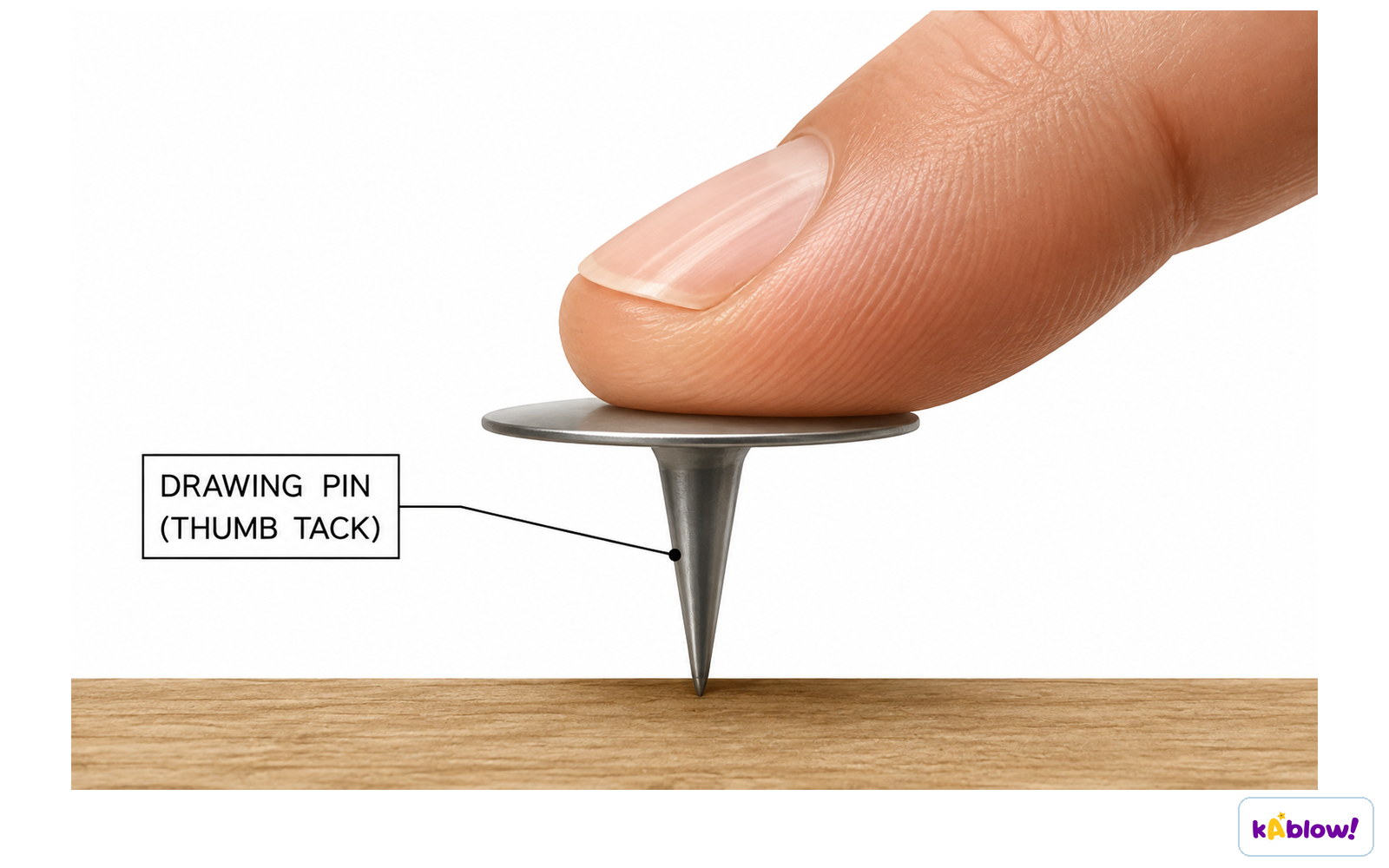
- The same force applied over a smaller area produces a larger pressure.
- Pressure in a liquid increases with depth because of the weight of liquid above.
- Atmospheric pressure decreases as altitude increases because there is less weight of air above.
A finger pushes a drawing pin into a surface; the sharp point's small area concentrates the force into a large pressure.
Pressure in Liquids
- In a bottle of water, pressure is greatest at the bottom and least at the top.
- The hole at the bottom has the most water above it, so water shoots out fastest.
- The hole at the top has the least water above it, so water comes out slowest.
- This demonstrates that liquid pressure depends on depth.
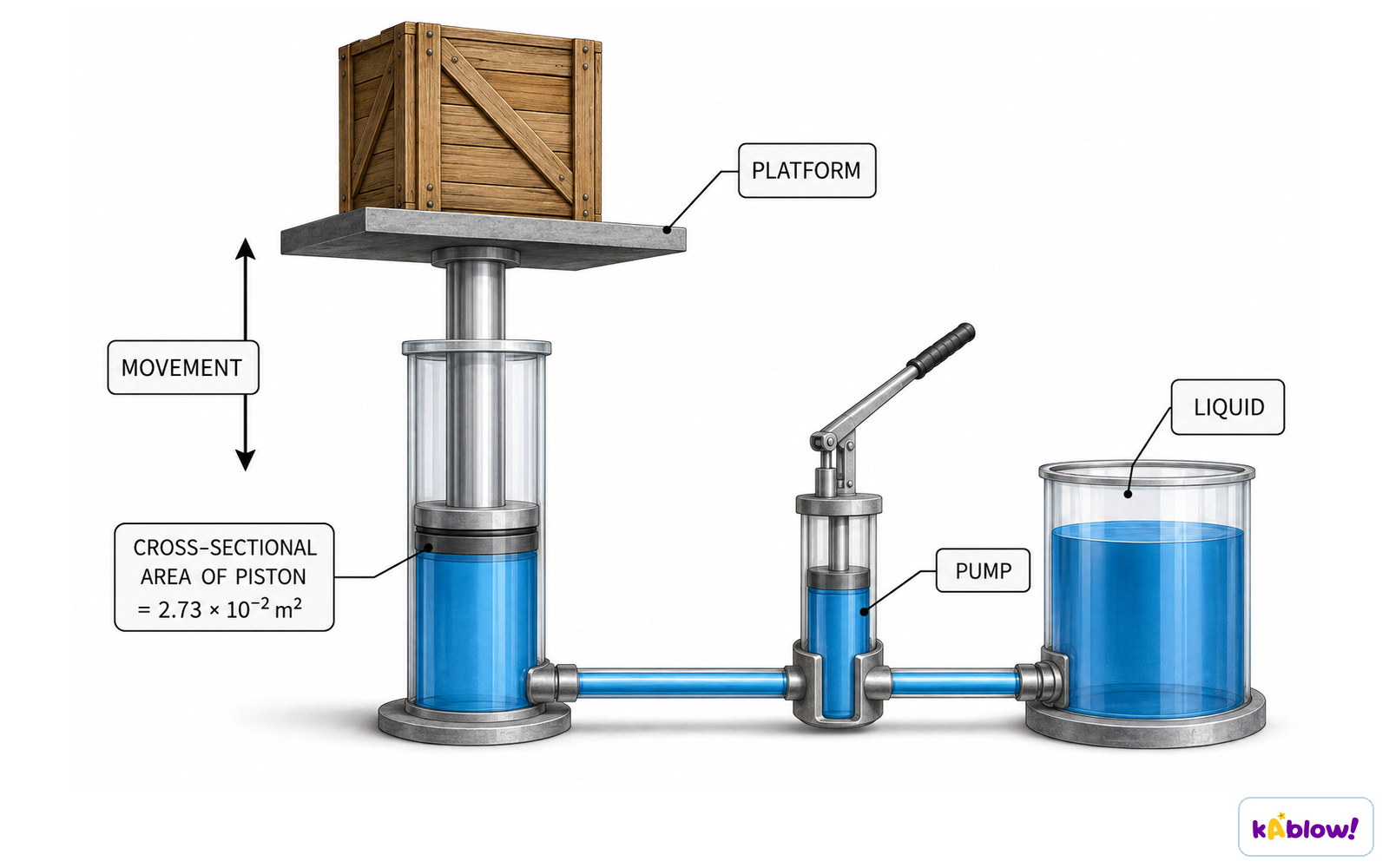
A hydraulic lift: a pump creates pressure in the liquid, transmitted to a piston of known cross-sectional area to raise the platform.
Atmospheric Pressure
- The atmosphere exerts pressure on everything due to the weight of air.
- Atmospheric pressure decreases as you go higher above Earth's surface.
- Higher altitude means less air above, so lower pressure.
The Pressure Equation
- Pressure = Force ÷ Area
- Force is measured in Newtons (N).
- Area is measured in square metres (m²).
- Pressure is measured in Pascals (Pa) or N/m².
- 1 Pa = 1 N/m².
Example Calculation
- A force of 500 N acts on an area of 0.25 m².
- Pressure = 500 N ÷ 0.25 m² = 2000 Pa.
- Always write the equation, substitute values, then calculate with units.
Applications of Pressure
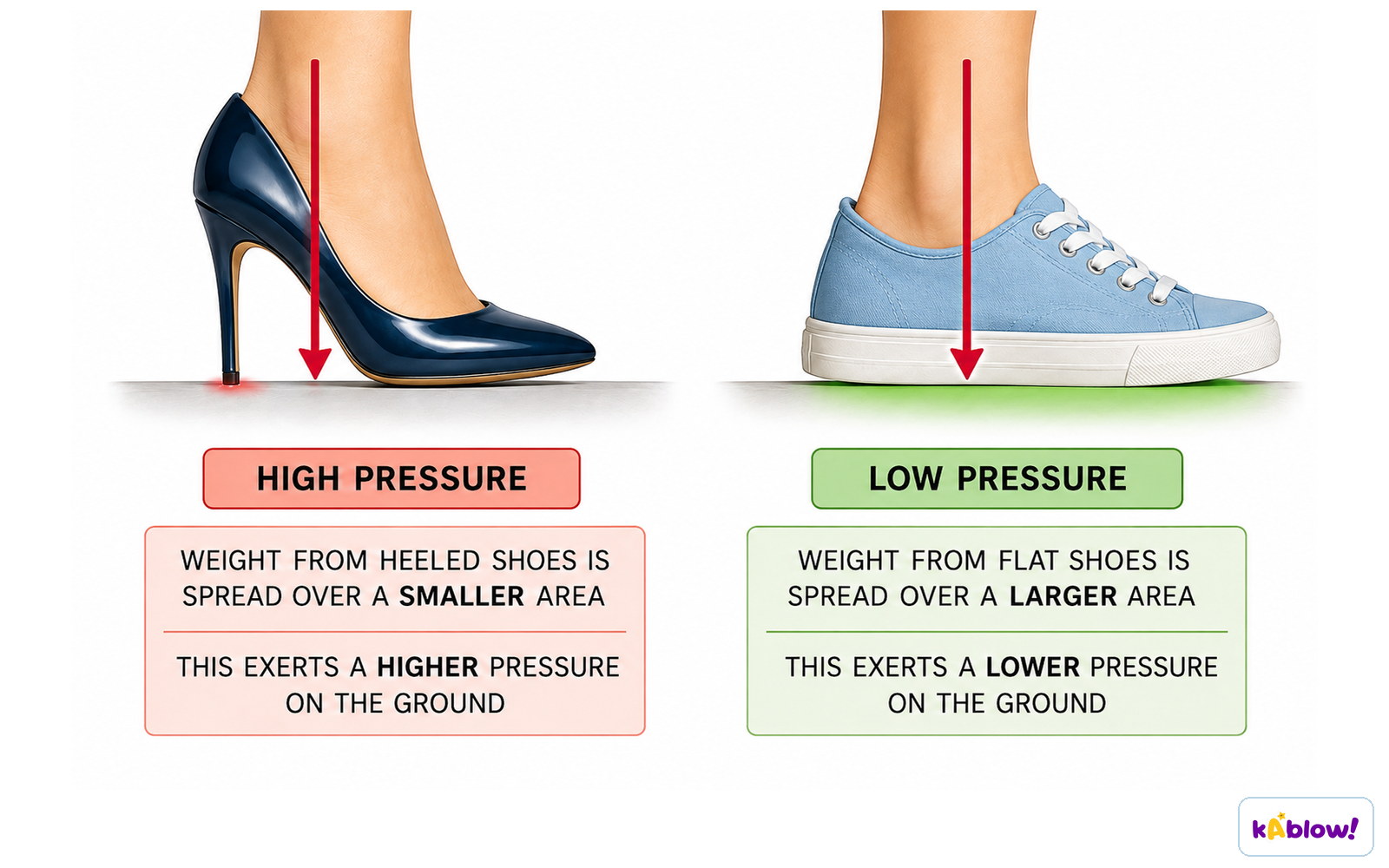
- A high heel shoe has a small area, so it exerts a large pressure and sinks into soft ground.
- A trainer has a larger area, so it exerts a smaller pressure and sinks less.
- Reducing area increases pressure; increasing area reduces pressure.
High heels concentrate weight over a small area (high pressure); flat shoes spread weight over a larger area (low pressure).
Particle arrangement in solids, liquids, and gases. Pressure in liquids and gases arises from particle collisions.
Slides
Sign up free to view the lesson slides
Step through every slide for this topic — plus flashcards and revision notes — with a free account.
Practice questions
Free preview — 8 of 56 questions. Sign up to see them all.
1.Which equation correctly links pressure, force, and area?
Easy- APressure = Force × Area
- BPressure = Force ÷ Area
- CPressure = Area ÷ Force
- DPressure = Force + Area
2.What is the unit of pressure?
Easy- ANewton (N)
- BMetre squared (m²)
- CPascal (Pa)
- DNewton per metre (N/m)
3.As we go higher above the Earth's surface, atmospheric pressure:
Easy- Aincreases
- Bdecreases
- Cstays the same
- Dbecomes zero
4.A bottle has three holes at different heights. From which hole does water come out fastest?
Medium- AThe top hole
- BThe middle hole
- CThe bottom hole
- DAll holes at the same speed
5.A crate weighs 2600 N and has a base area of 2 m². What pressure does it exert on the ground?
Easy- A1300 Pa
- B5200 Pa
- C130 Pa
- D2600 Pa
6.A book weighing 20 N lies on a table, covering an area of 0.02 m². The pressure exerted by the book on the table is:
Easy- A1000 Pa
- B100 Pa
- C0.001 Pa
- D400 Pa
7.A skip weighing 5000 N has a base area of 4 m². The pressure on the ground is:
Easy- A1250 Pa
- B20000 Pa
- C125 Pa
- D5000 Pa
8.A person weighing 700 N stands on the ground. The combined area of their shoes is 0.04 m². The pressure they exert is:
Easy- A17500 Pa
- B28 Pa
- C1750 Pa
- D28000 Pa
Unlock all 56 questions, flashcards & more
Create a free account to see every question, the slides, flashcards and revision notes for this topic.