The human eye
Learn it by playing
Answer these questions to earn energy, then fish and explore. No account needed.
Lesson notes
The Eye as an Optical Device
- The human eye contains a convex lens that focuses light onto the retina.
- A convex lens is wider in the middle than at the edges.
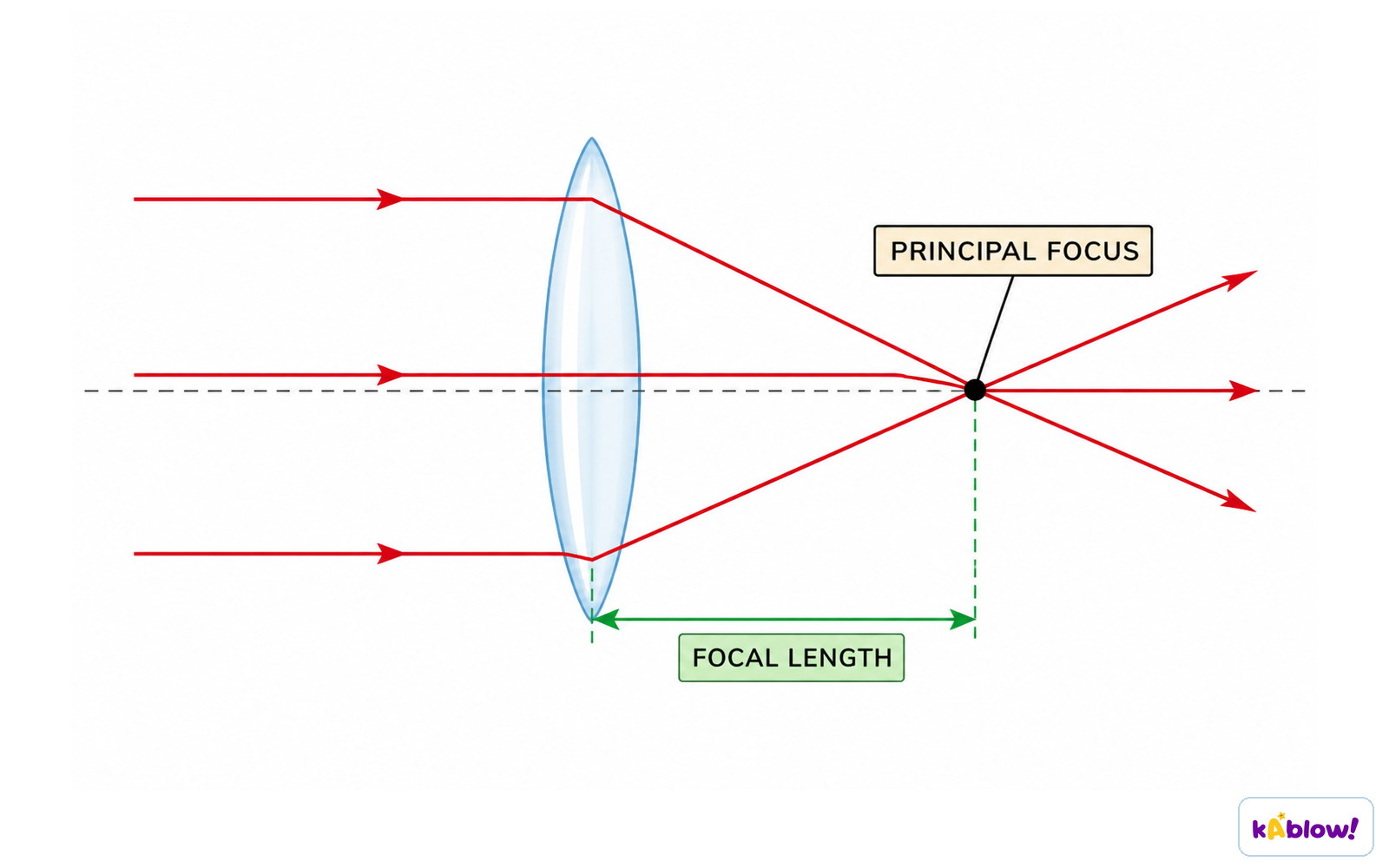
- Rays of light refract by different amounts depending on where they hit the lens, causing them to converge at a focal point.
- Convex lenses are used in glasses (for farsightedness), magnifying glasses, and telescopes.
Parts of the Eye and Their Functions
- Cornea: Transparent layer at the front; some refraction occurs here.
- Retina: Contains cells that detect light and colour; sensitive to bright light and can be damaged.
- Lens: Refracts light; muscles change its shape to adjust focus for near or far objects.
- Iris: Coloured part around the pupil; controls the amount of light entering the eye.
- Pupil: Dark opening in the centre; light passes through it.
- Nerve: Carries signals from the retina to the brain.
Pupil Size and Light Intensity
- In bright light, the iris closes (constricts) to make the pupil smaller, protecting the retina from damage.
- In dim light, the iris opens (dilates) to make the pupil larger, allowing more light to reach the retina.
Lens Shape and Refraction
- The more curved the lens, the more light refracts.
- A more curved lens has a shorter focal length (distance from lens to focal point).
- Muscles change the lens shape to focus on objects at different distances.
A converging lens brings parallel rays to the principal focus; focal length is measured from the lens to that point.
Refraction of light entering the eye: light bends as it passes from air into the cornea/lens.
Slides
Sign up free to view the lesson slides
Step through every slide for this topic — plus flashcards and revision notes — with a free account.
Practice questions
Free preview — 8 of 58 questions. Sign up to see them all.
1.A lens that is wider in the middle than at the edges is called a:
Easy- Aconvex lens
- Bconcave lens
- Ccylindrical lens
- Ddiverging lens
2.The human eye contains a:
Easy- Aconvex lens
- Bconcave lens
- Cboth convex and concave lenses
- Dno lens
3.Which part of the eye contains cells that detect light and colour?
Easy- Aretina
- Bcornea
- Clens
- Diris
4.The coloured part of the eye is the:
Easy- Airis
- Bpupil
- Ccornea
- Dretina
5.Which of the following is NOT a use of convex lenses?
Easy- Aglasses for farsightedness
- Bmagnifying glasses
- Ctelescopes
- Dglasses for nearsightedness
6.What happens to the pupil in very bright conditions?
Easy- Ait becomes smaller
- Bit becomes larger
- Cit changes colour
- Dit closes completely
7.The part of the eye that refracts light and can change shape is the:
Easy- Alens
- Bcornea
- Cretina
- Dpupil
8.A convex lens causes light rays to:
Easy- Aconverge
- Bdiverge
- Creflect
- Ddiffract
Unlock all 58 questions, flashcards & more
Create a free account to see every question, the slides, flashcards and revision notes for this topic.