
Formulae, Equations & Calculations
Aprenda jogando
Responda a estas perguntas para ganhar energia, depois pesque e explore. Sem precisar de conta.
Notas de aula
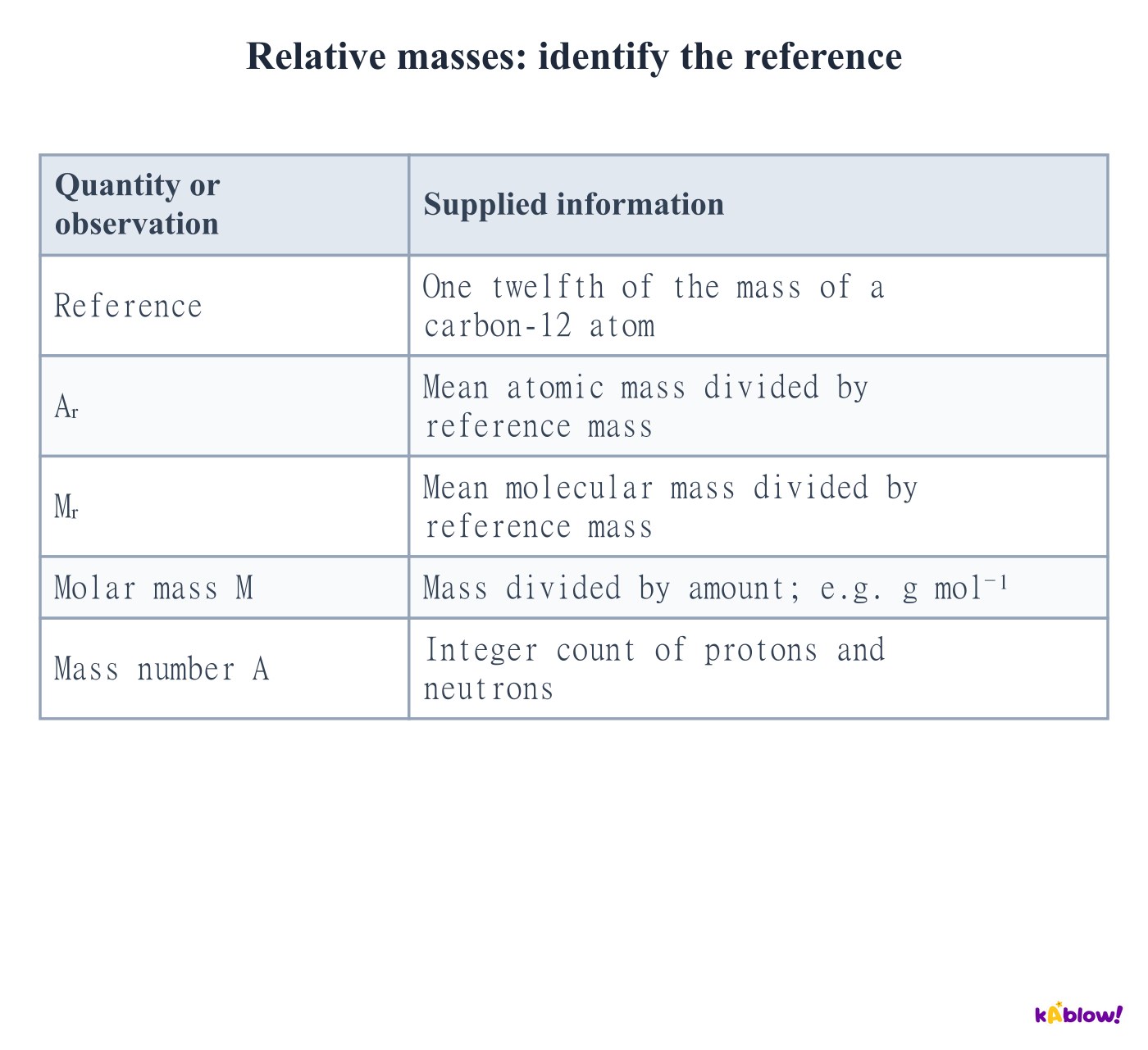
Distinguish relative mass from molar mass
- Relative atomic mass is the mean mass of an atom relative to one twelfth of the mass of a carbon-12 atom. Relative molecular mass uses the corresponding mean molecular mass. Both are dimensionless ratios.
- A relative isotopic mass describes a specified isotope. Mass number instead counts protons and neutrons and is an integer; it is not an exact measurement of relative isotopic mass.
- Molar mass is mass per amount, commonly expressed in g mol⁻¹. Its numerical correspondence with a relative mass in school calculations does not give the relative mass a unit.
Relative masses: identify the reference
Calculate a weighted mean from isotope abundances
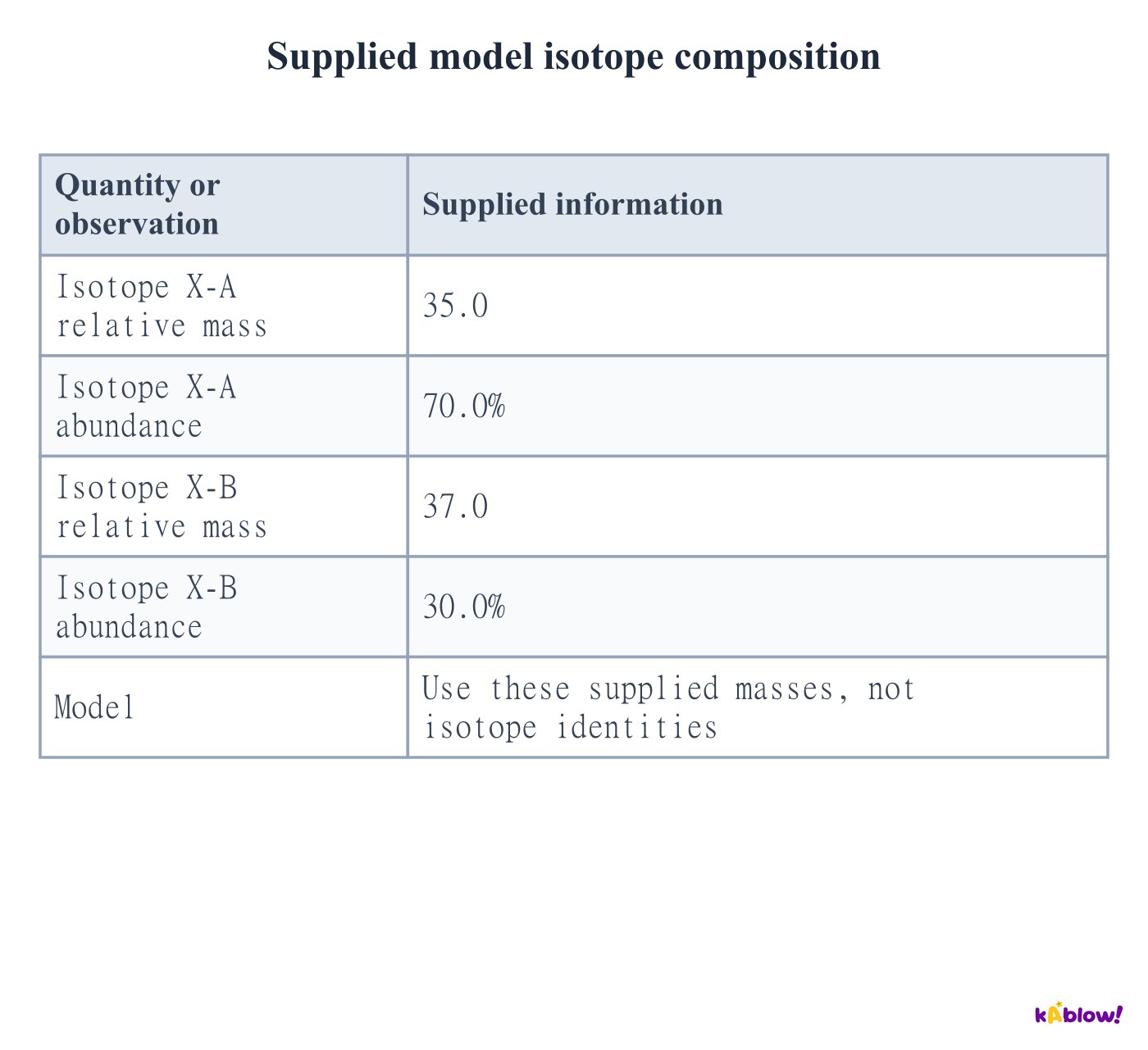
- Multiply each supplied relative isotopic mass by its fractional abundance, then add the contributions. For percentage abundances, divide the total percentage-weighted sum by 100.
- The more abundant isotope contributes more strongly. The result must lie between the supplied isotope masses and usually nearer the more abundant one.
- Use the sample composition actually supplied. A simple unweighted mean is justified only when the abundances are equal.
Supplied model isotope composition
Use isotopic masses rather than integer mass numbers
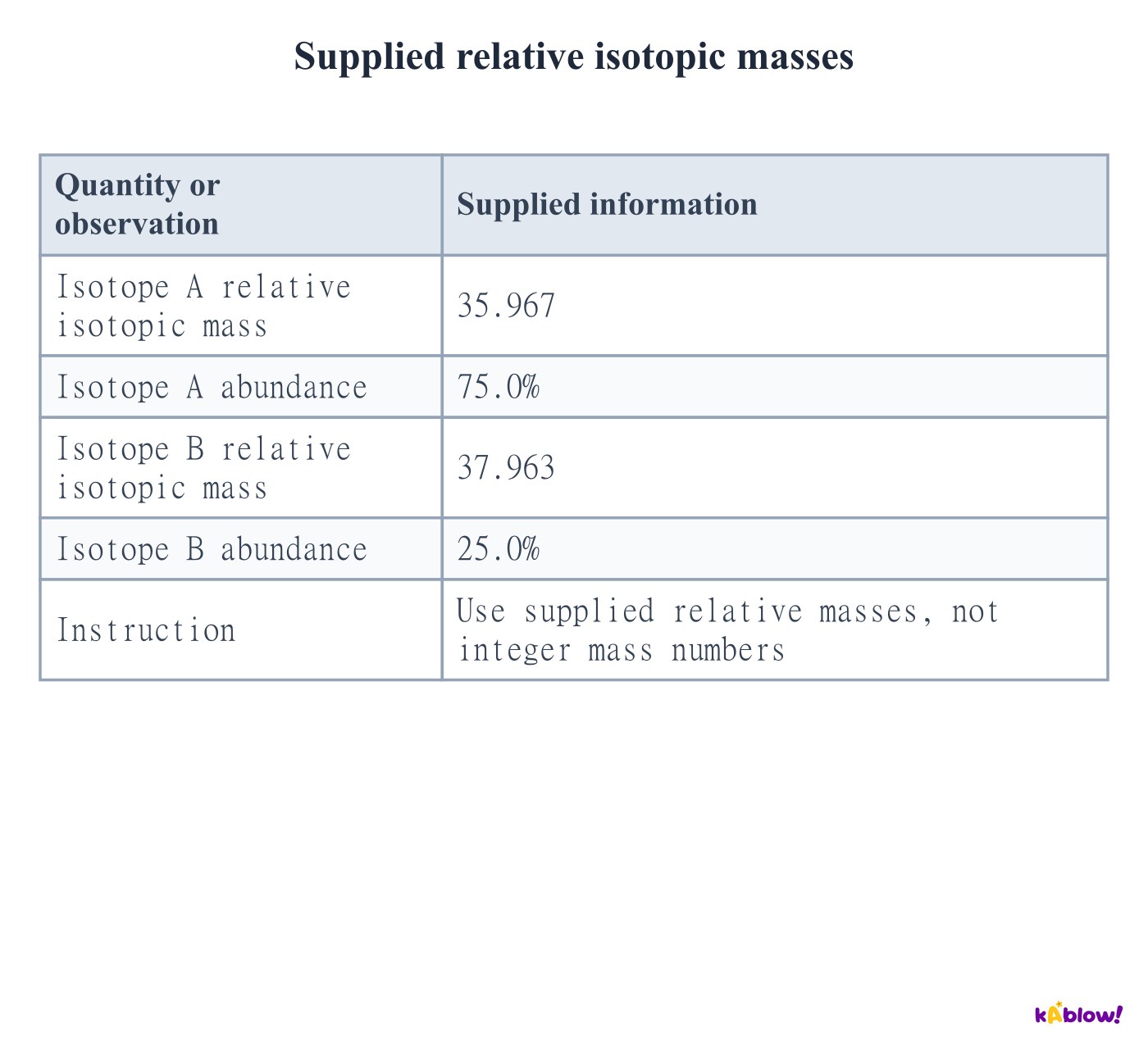
- When precise relative isotopic masses are supplied, use them in the weighted mean. Replacing each with its mass number changes the calculation.
- For the supplied precise-isotope record, retain intermediate digits and apply the requested final precision. Do not round the isotope masses before weighting.
- If a task explicitly uses integer mass numbers as an approximation, state that approximation. It does not redefine relative isotopic mass as an integer.
Supplied relative isotopic masses
Count every atom in a formula
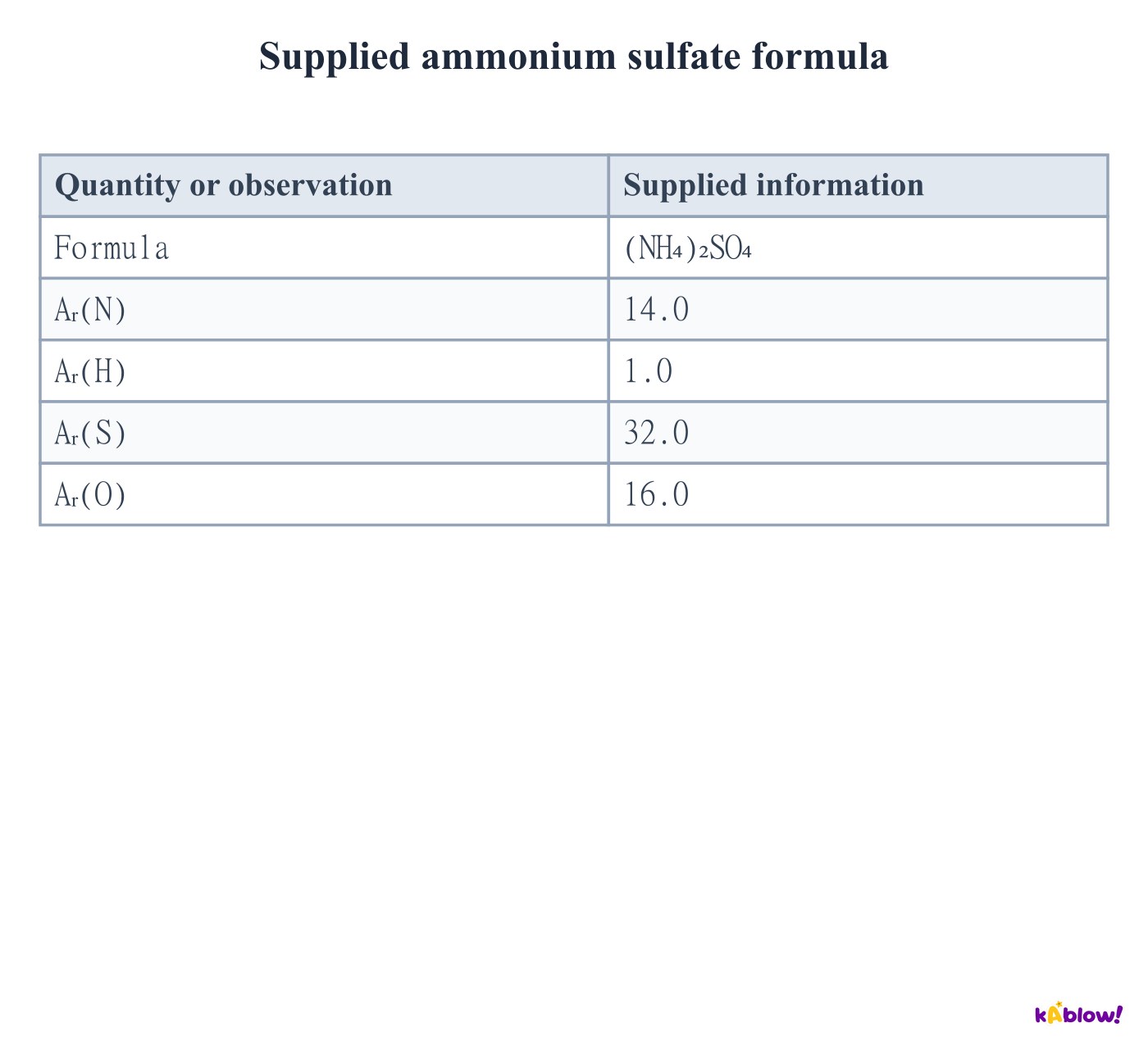
- Sum the supplied relative atomic masses for all atoms represented by a formula. A subscript outside brackets multiplies every atom within the brackets.
- In (NH₄)₂SO₄, the bracket contains two nitrogen atoms and eight hydrogen atoms in total; the sulfate group contributes one sulfur and four oxygen atoms.
- Use relative formula mass for an ionic solid rather than implying it contains discrete molecules. Relative molecular mass uses the actual molecular formula, not automatically the empirical formula.
Supplied ammonium sulfate formula
Infer an empirical formula from element masses
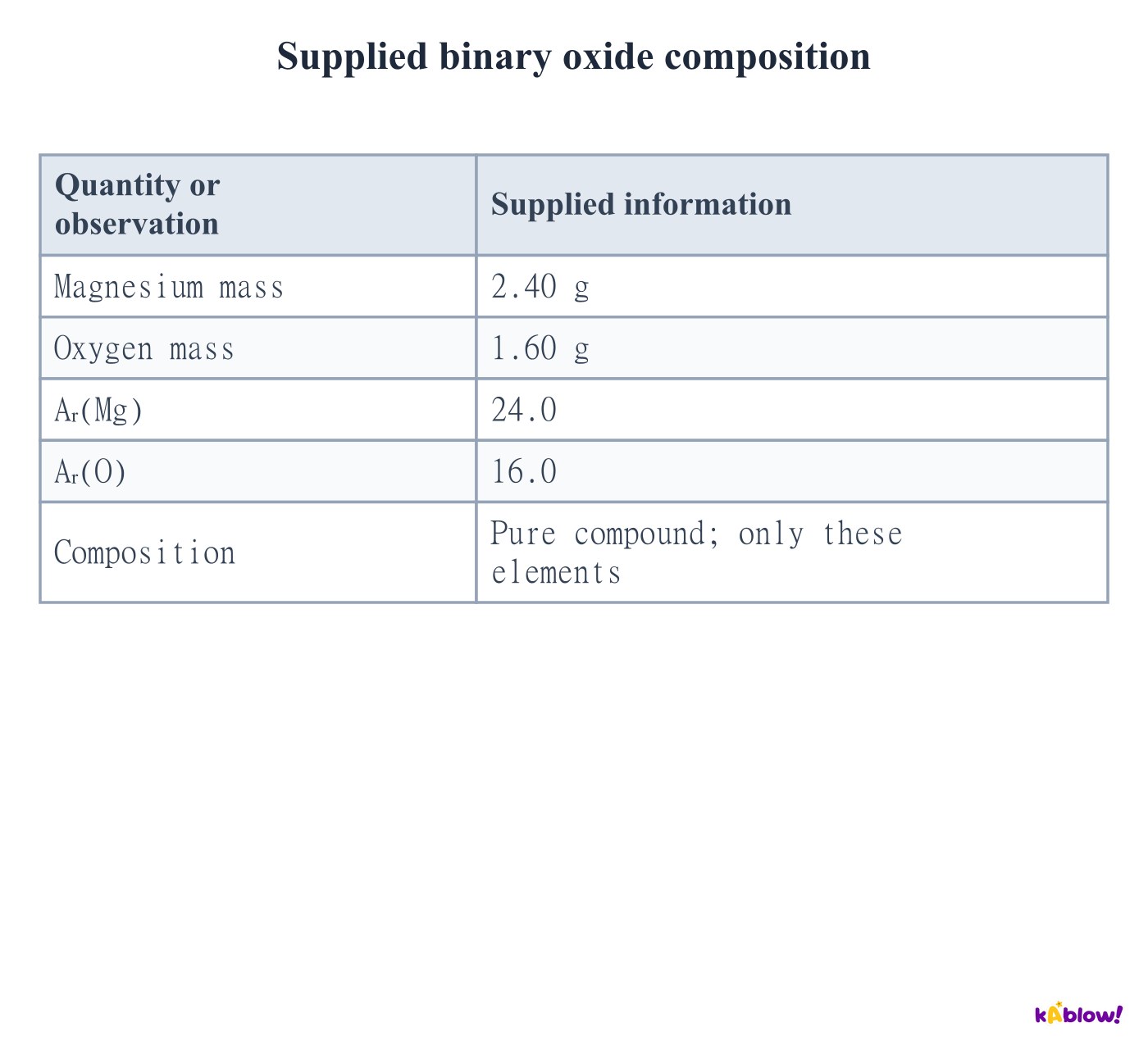
- An empirical formula gives the simplest whole-number ratio of atoms of each element. Element masses must first be converted to amounts before ratios are compared.
- Divide each element mass by the corresponding molar mass, then divide all resulting amounts by the smallest. Retain enough precision to identify the ratio.
- The supplied oxide is assumed pure and contains only magnesium and oxygen. Such assumptions matter: unexplained impurities cannot simply be assigned to oxygen.
Supplied binary oxide composition
Use percentage composition as a convenient mass basis
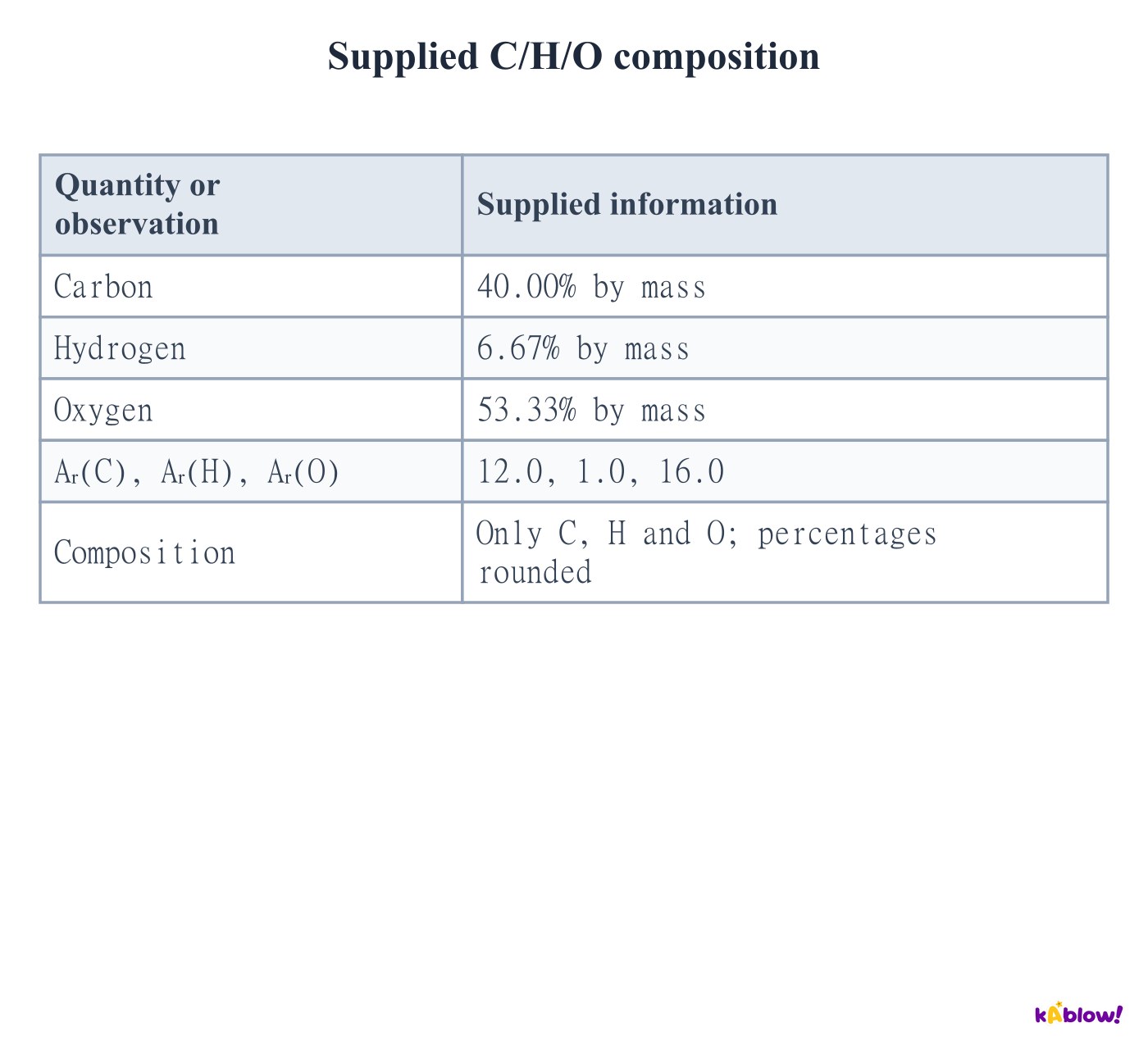
- For mass percentages, imagine a 100 g sample so each percentage becomes the corresponding mass in grams. The chosen sample size cancels when amounts are normalised.
- Divide each mass by its atomic molar mass and then compare the amounts. Equal percentages do not imply equal atom counts when elements have different atomic masses.
- Small departures from integers may arise from rounded experimental data. Check whether one consistent small whole-number ratio fits all elements before writing the formula.
Supplied C/H/O composition
Use a remainder only when composition is specified
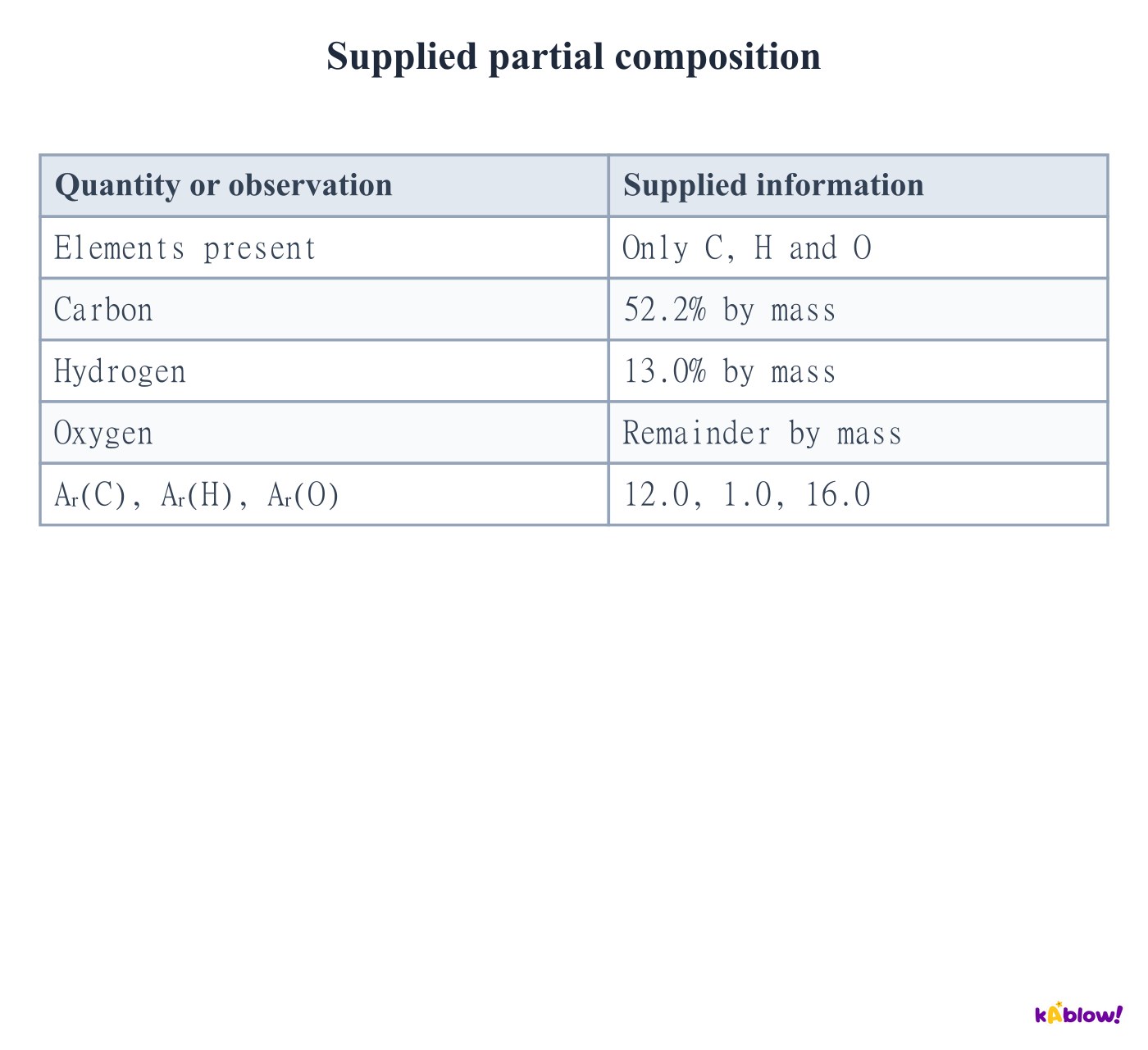
- Find an unlisted element by subtraction only when the problem states that the sample contains just the specified elements. A missing percentage alone does not identify an unknown element.
- For the supplied C/H/O record, the oxygen percentage is the remainder after carbon and hydrogen. Convert that oxygen mass to amount before normalising.
- Show the assumed composition and method. Working helps expose mistakes and can earn method credit where the mark scheme allows; no universal mark rule replaces the actual question.
Supplied partial composition
Resolve a half-integer amount ratio
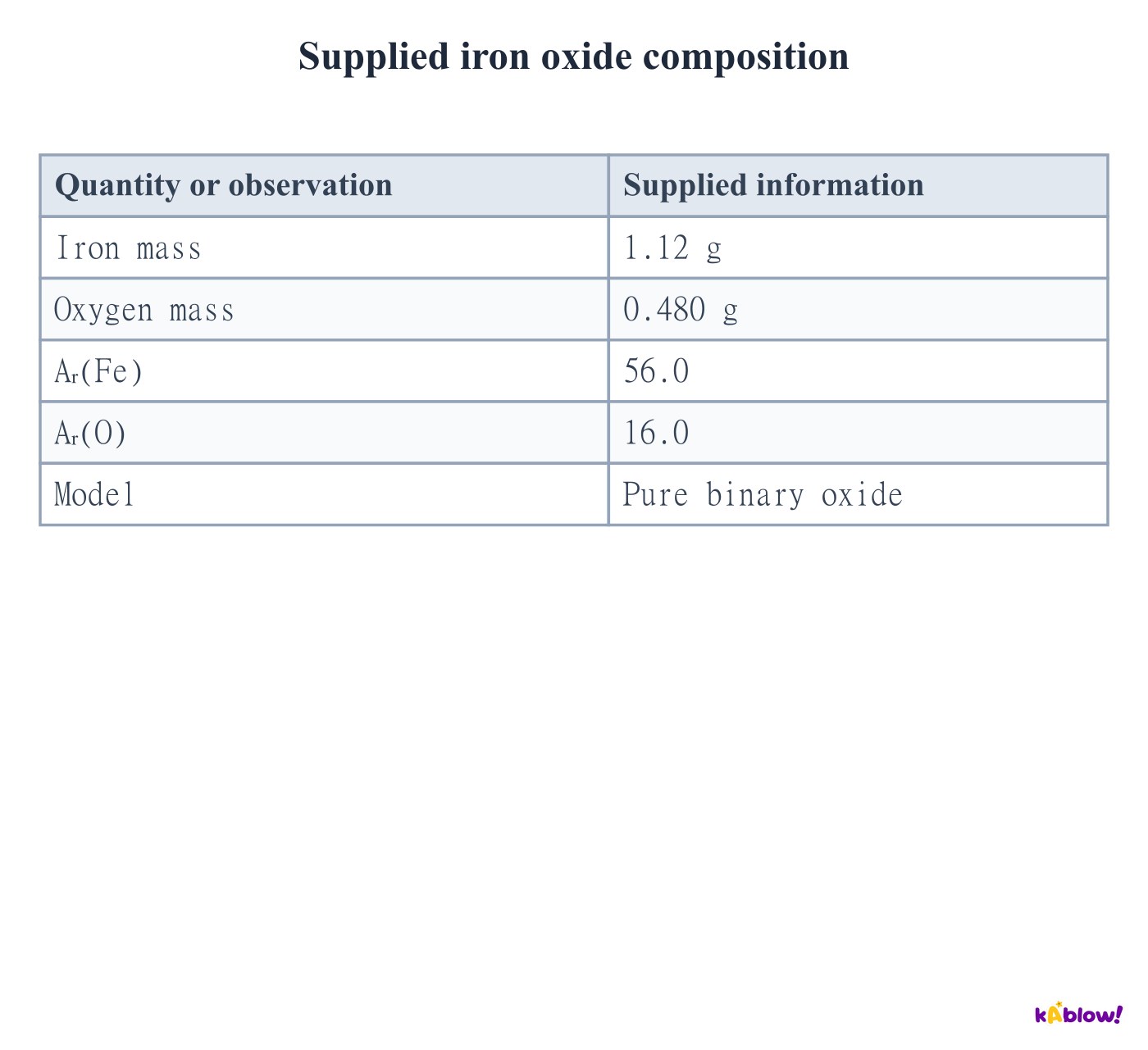
- Normalisation can produce a ratio such as 1:1.5. Multiply every part by the same factor to obtain the smallest whole-number ratio.
- Do not round 1.5 to either 1 or 2. That changes the composition represented by the formula rather than expressing the same ratio.
- For an iron oxide, compare the derived formula with the original element masses as a check. The experimental composition is evidence for the formula, not an instruction to assume a familiar oxide.
Supplied iron oxide composition
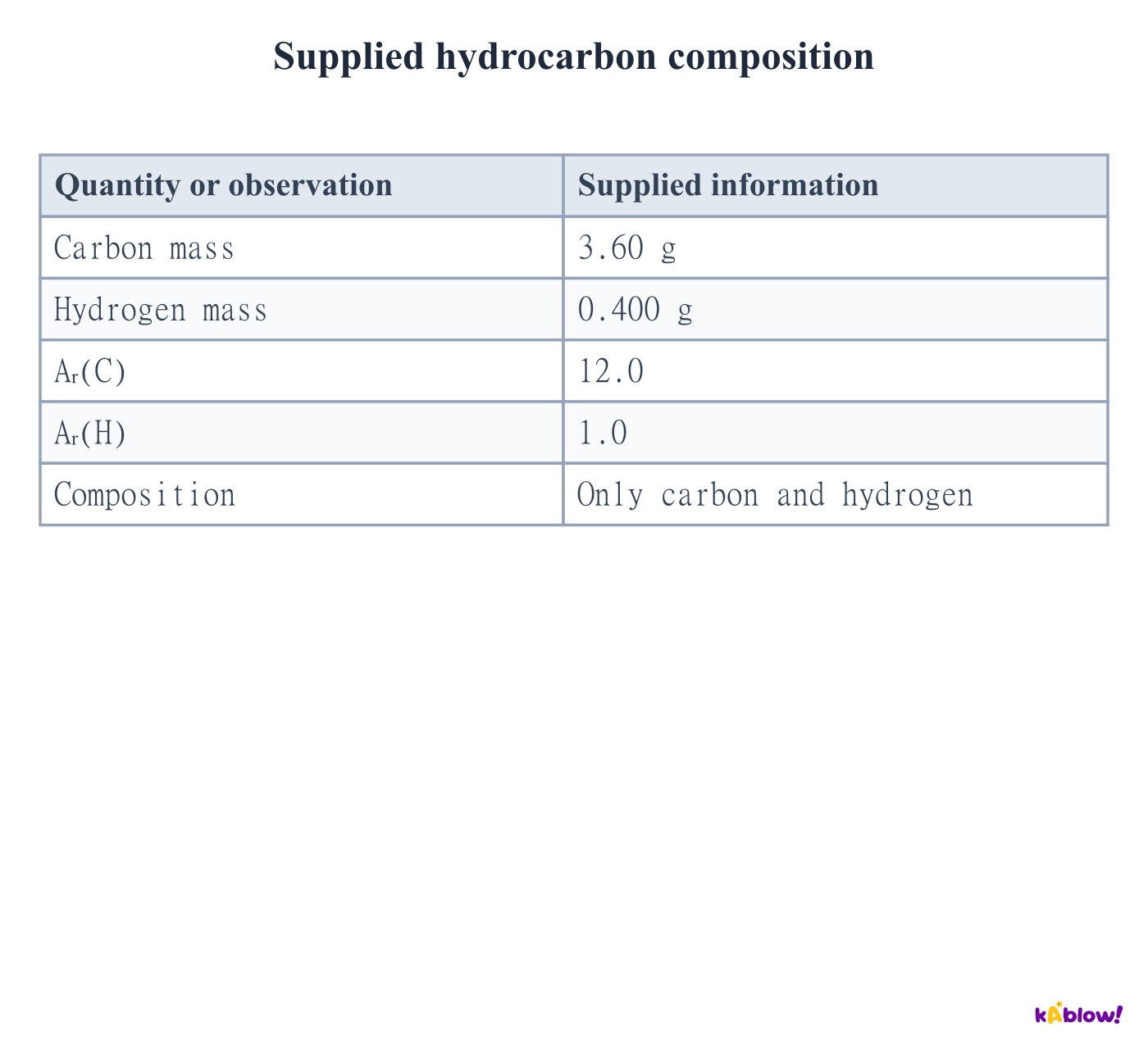
Resolve a ratio involving thirds
- A normalised ratio close to 1:1.333 can represent 3:4. Multiplying both entries by three preserves the ratio and gives whole numbers.
- Keep intermediate digits so 1.333 is not prematurely reduced to 1. A simple fractional ratio should fit the precision of the composition data.
- The empirical formula alone does not identify a molecular structure. Several molecular formulae or isomers can be compatible with one empirical ratio.
Supplied hydrocarbon composition
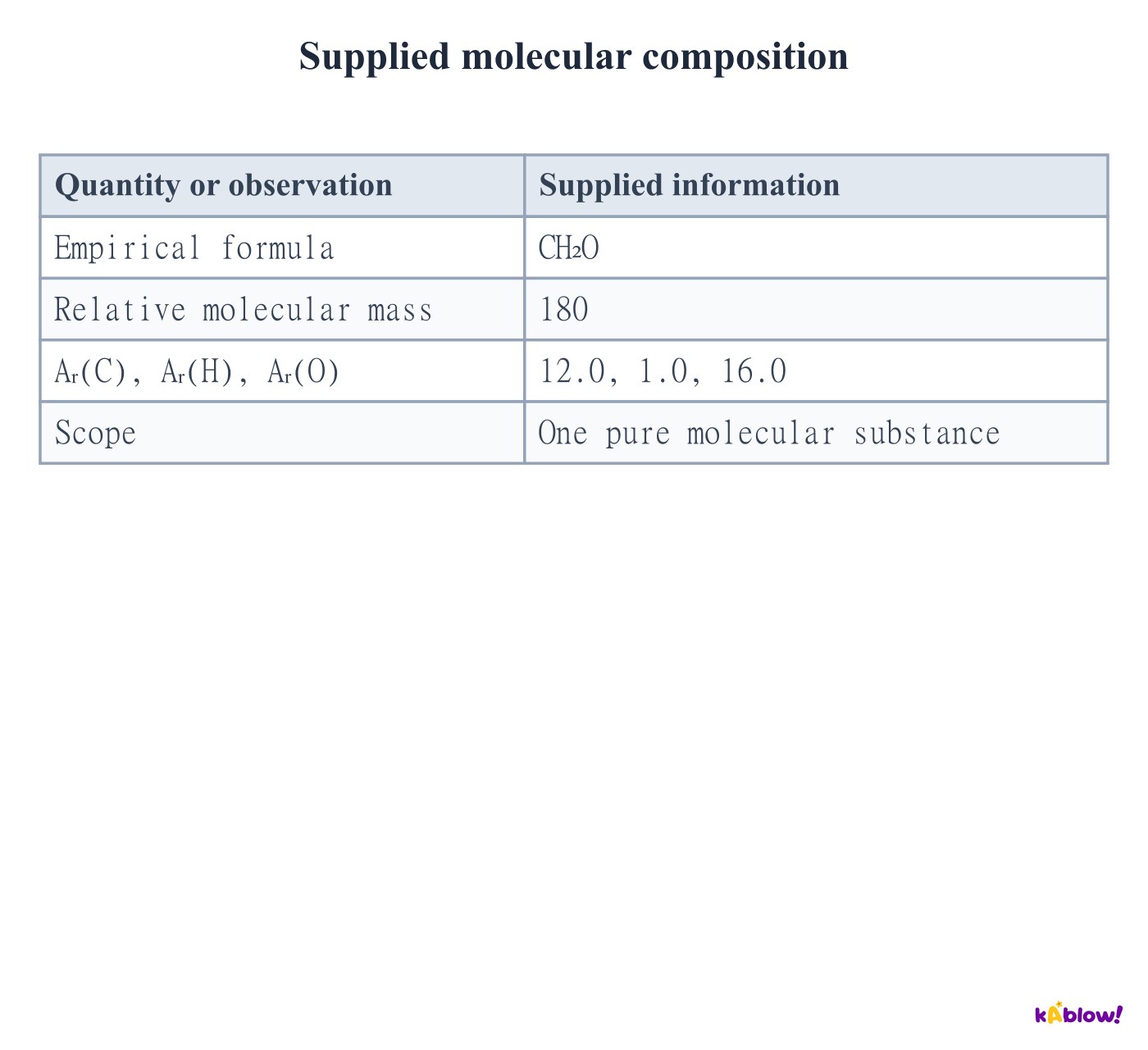
Obtain a molecular formula from an empirical formula
- A molecular formula gives the numbers of each atom in one molecule. It is a whole-number multiple of the empirical formula.
- Calculate the relative mass of the empirical formula, divide the measured relative molecular mass by that value, then multiply every empirical subscript by the resulting integer.
- This determines composition, not connectivity. Molecules with the same molecular formula may have different structures and properties.
Supplied molecular composition
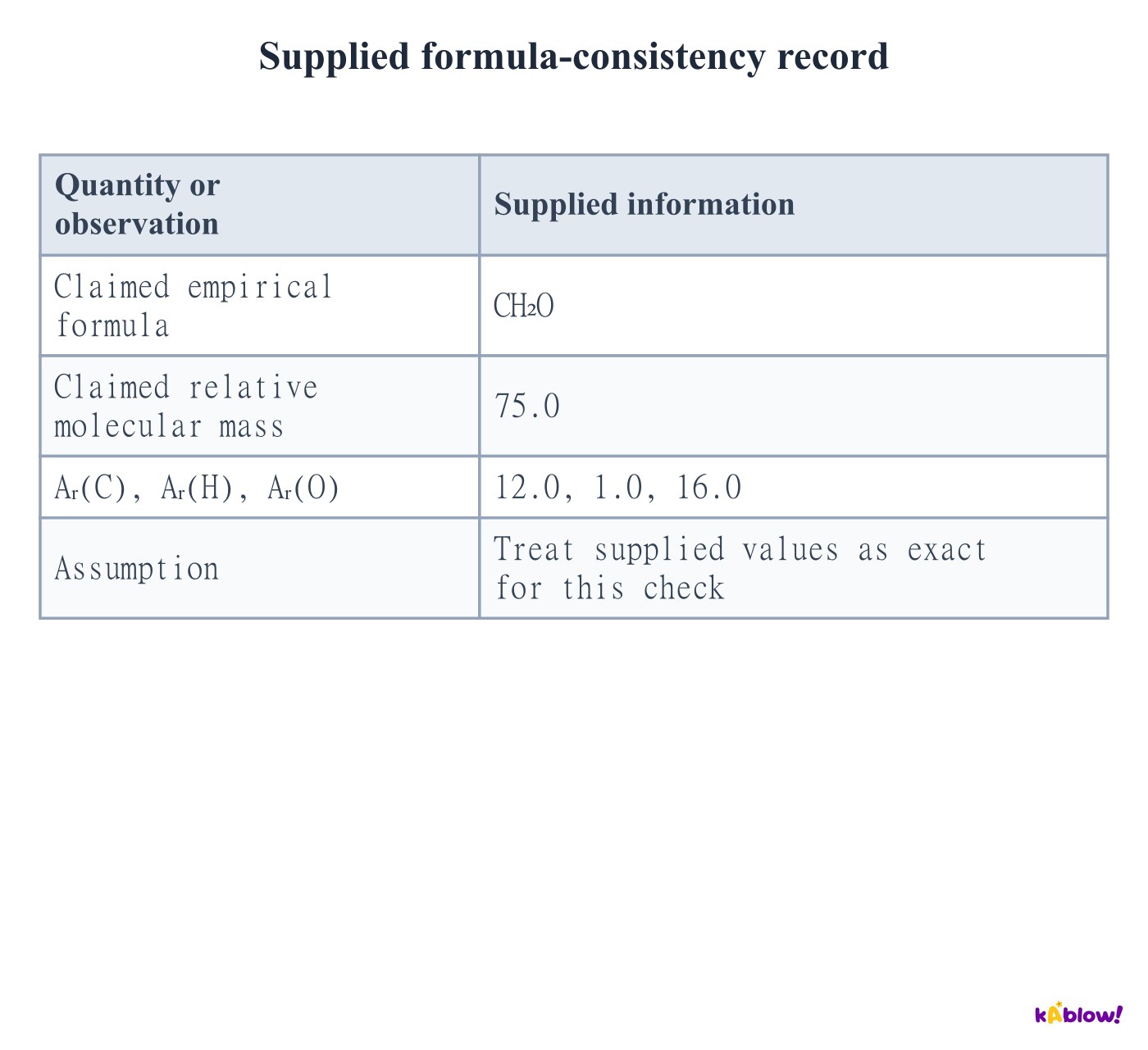
Check whether a claimed molecular formula is consistent
- The molecular-to-empirical mass ratio should be a positive integer within the precision of the evidence. A strongly non-integer result signals inconsistent data or assumptions.
- Do not round an exact ratio such as 2.5 to a convenient integer and silently change the relative molecular mass. Recheck composition, mass data and sample identity.
- An experimental result with uncertainty may justify a nearby integer, but the uncertainty must support that inference. The supplied consistency record asks for exact values.
Supplied formula-consistency record
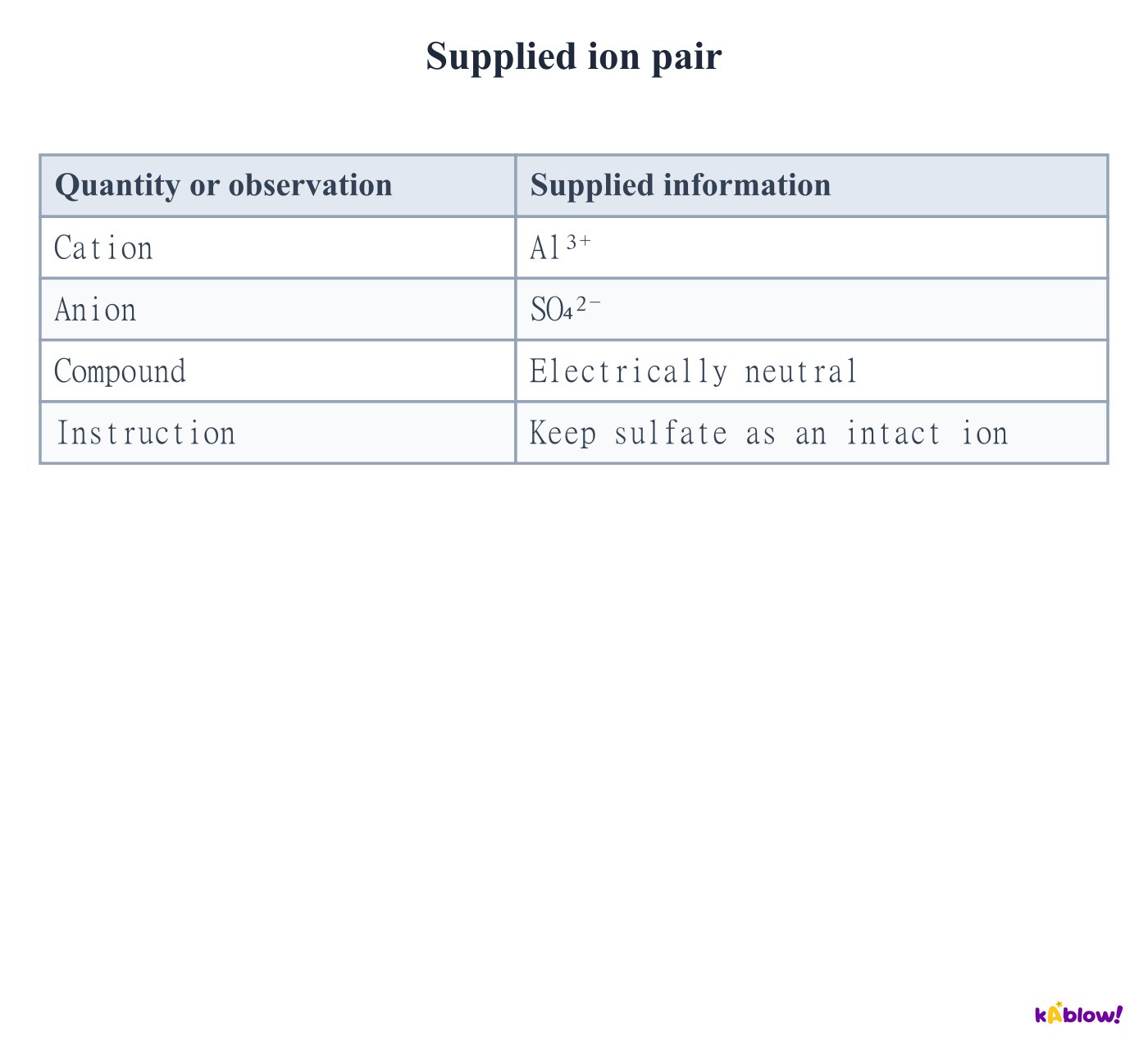
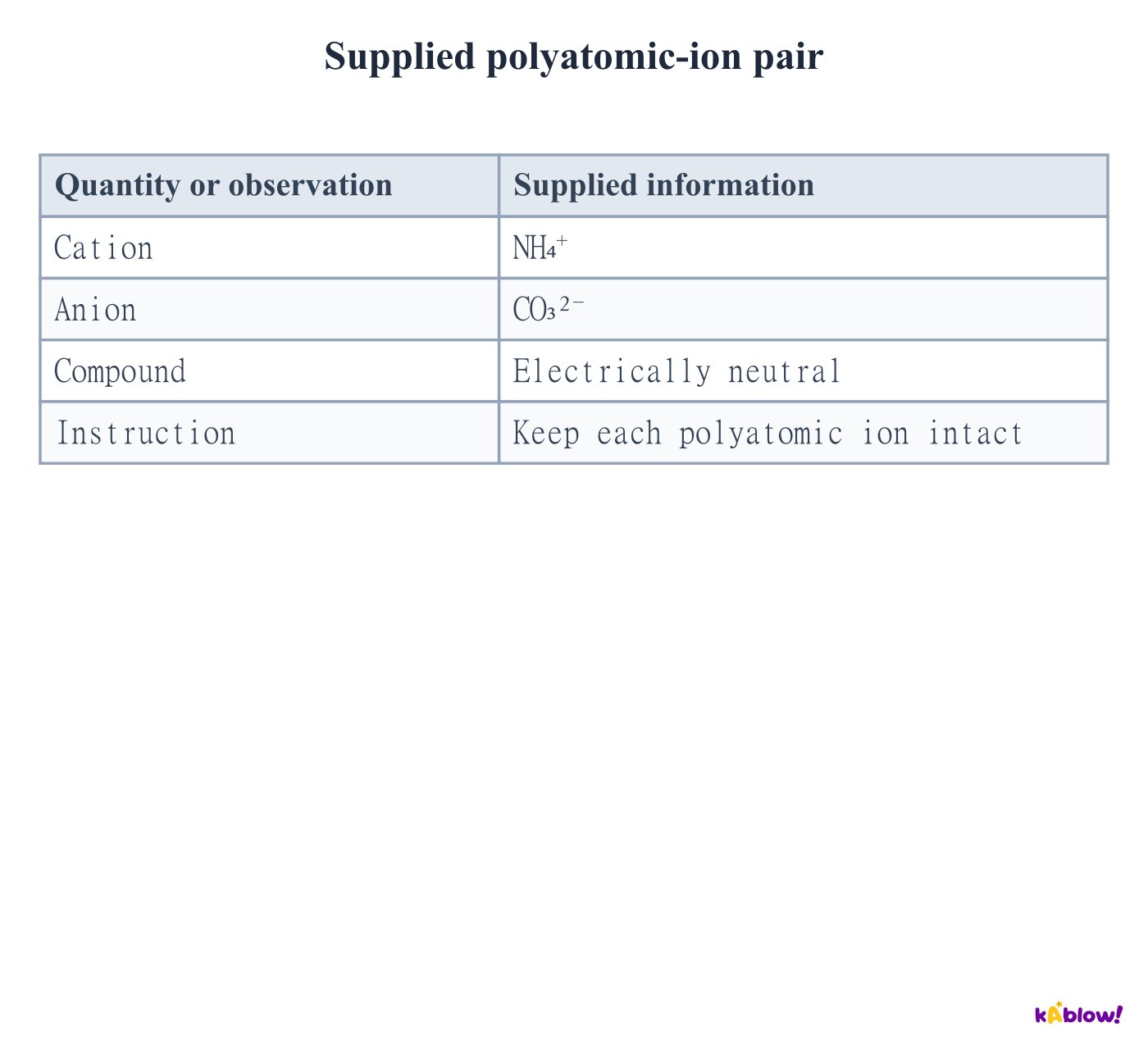
Construct an electrically neutral ionic formula
- Choose numbers of cations and anions so their total charges cancel. An ionic formula describes the constituent ion ratio rather than a discrete molecule.
- Keep a polyatomic ion intact and use brackets when more than one is required. The overall subscript and each internal subscript have different jobs.
- Simple-ion periodic trends are useful within their limits. Use a stated ion charge or oxidation state where needed rather than assigning every metal one fixed charge.
Supplied ion pair
Preserve polyatomic ions in formulae
- Ionic compounds can contain polyatomic cations such as ammonium, so a metal is not required in every ionic compound.
- For ammonium carbonate, neutrality determines how many intact ammonium and carbonate ions are present. Brackets prevent confusion about which atoms are multiplied.
- Do not reduce subscripts in a way that destroys an ion’s identity. For example, peroxide contains O₂²⁻: the valid formula Na₂O₂ is not replaced by NaO.
Supplied polyatomic-ion pair
Balance coefficients without changing substances
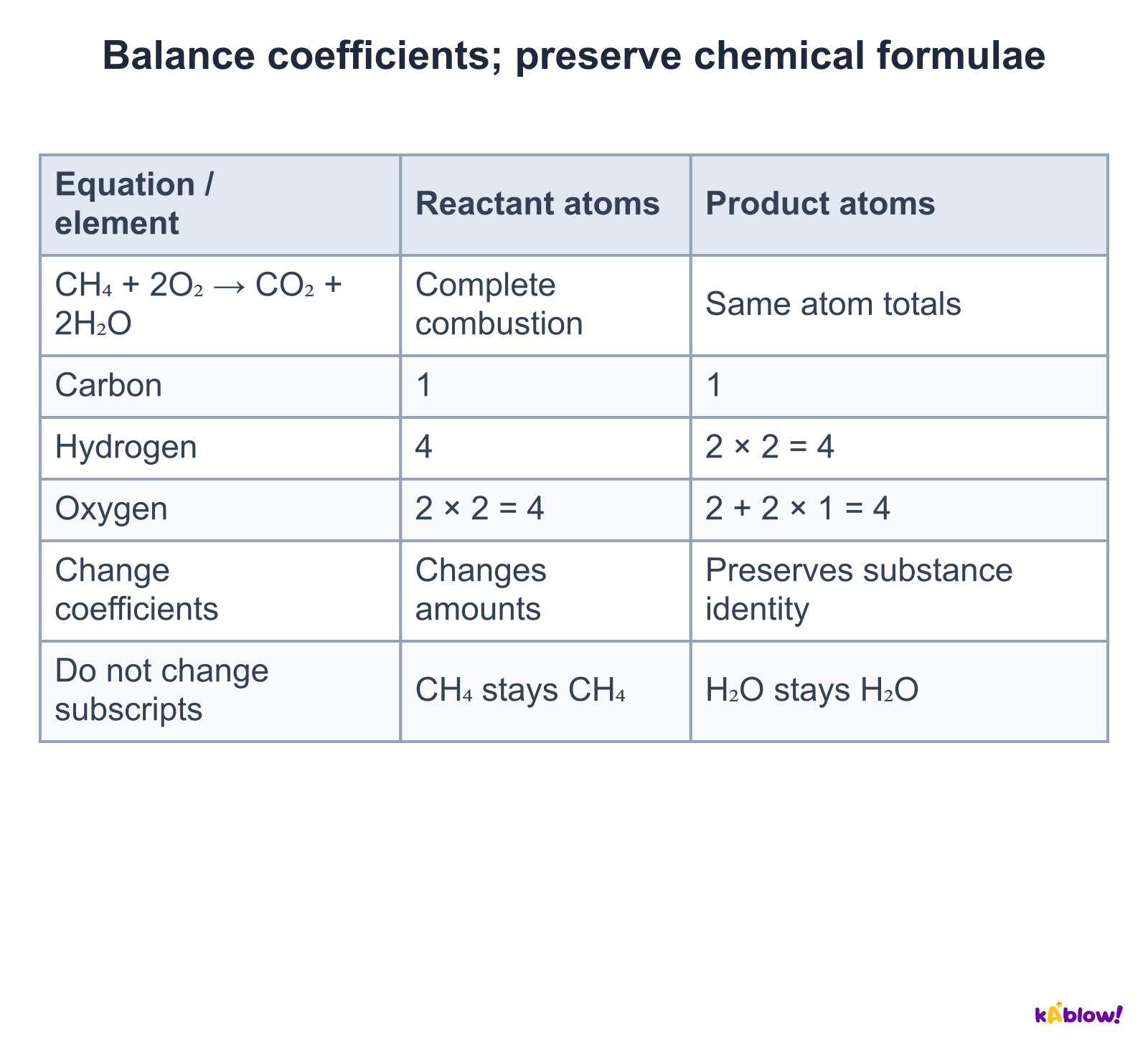
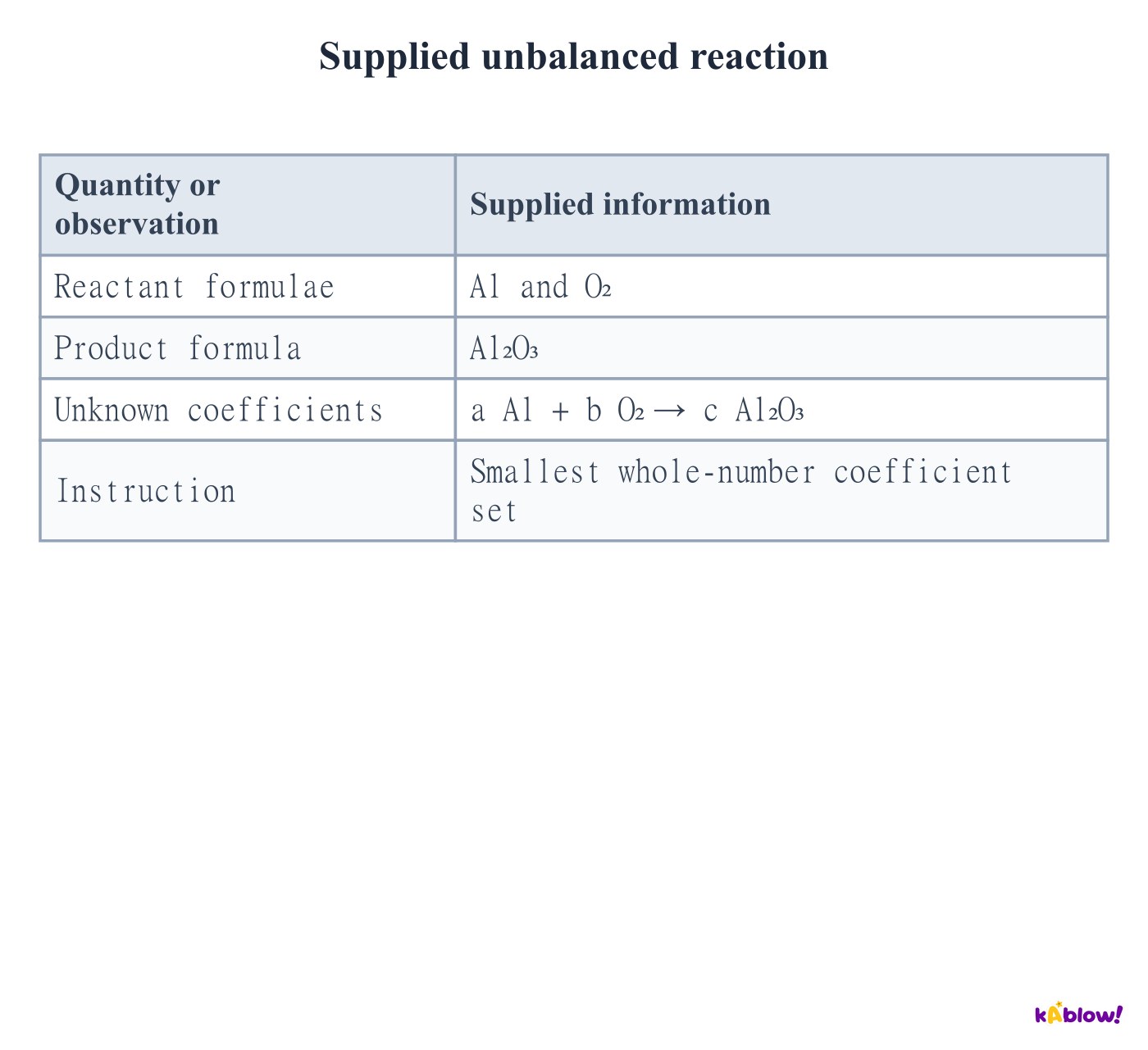
- A balanced chemical equation conserves the number of atoms of each element. Adjust coefficients in front of formulae while keeping each substance’s formula fixed.
- An atom-count table can check each element separately. Use the smallest whole-number coefficients when requested, although a scaled coefficient set represents the same ratio.
- Changing a subscript changes the substance. Changing an equation coefficient changes the amount represented without changing molecular or ionic identity.
Conserve each atom type
Balance a complete combustion equation
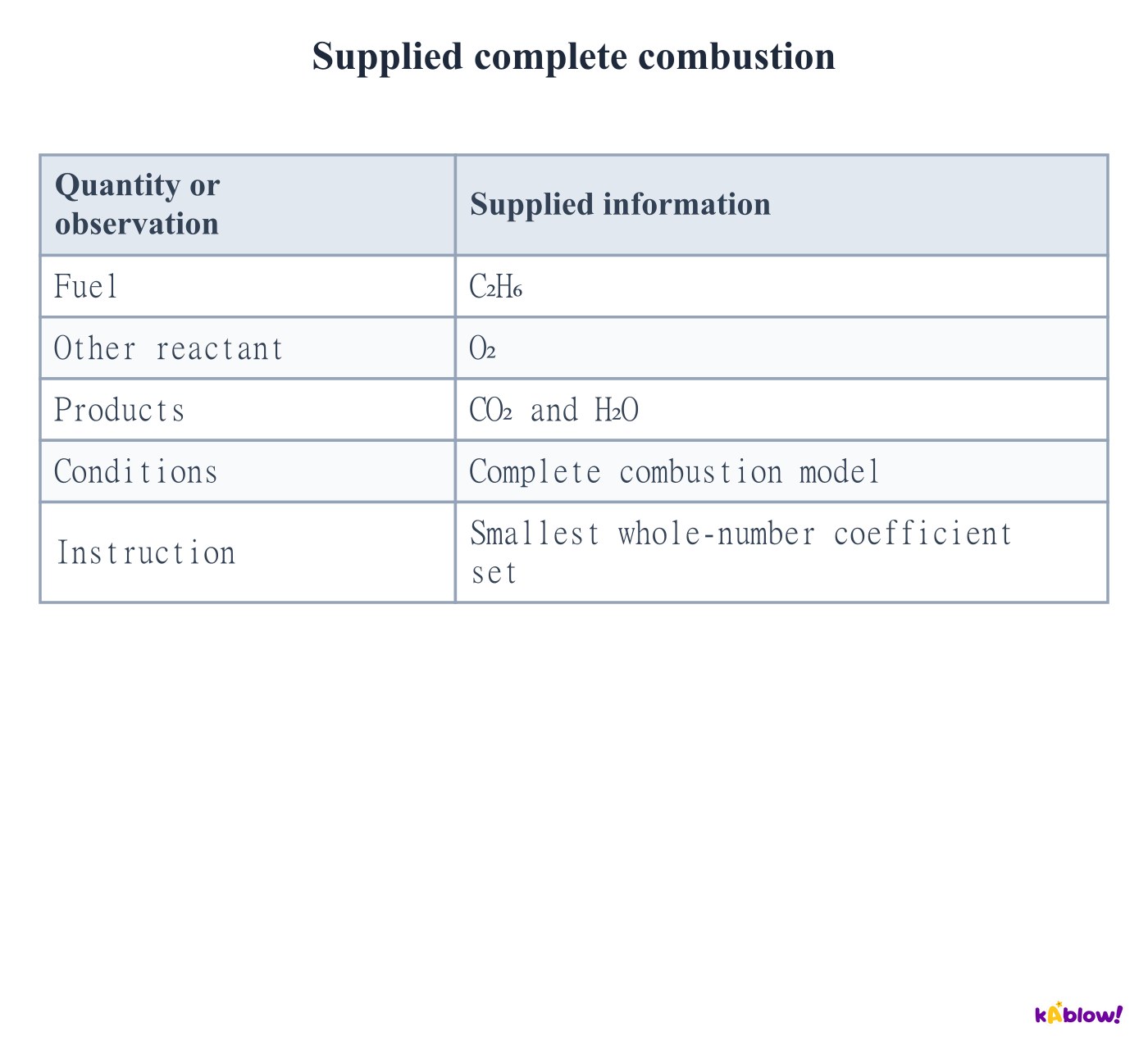
- When fuel and complete-combustion products are specified, balance carbon and hydrogen first, then oxygen. A fractional oxygen coefficient can be cleared by scaling all coefficients.
- This is a useful method rather than a chemical law about balancing order. The final atom totals determine whether the result is correct.
- State symbols depend on the measurement conditions. Water may be vapour during combustion and liquid after cooling; phase does not change the atom balance.
Supplied complete combustion
Interpret state symbols from the stated conditions
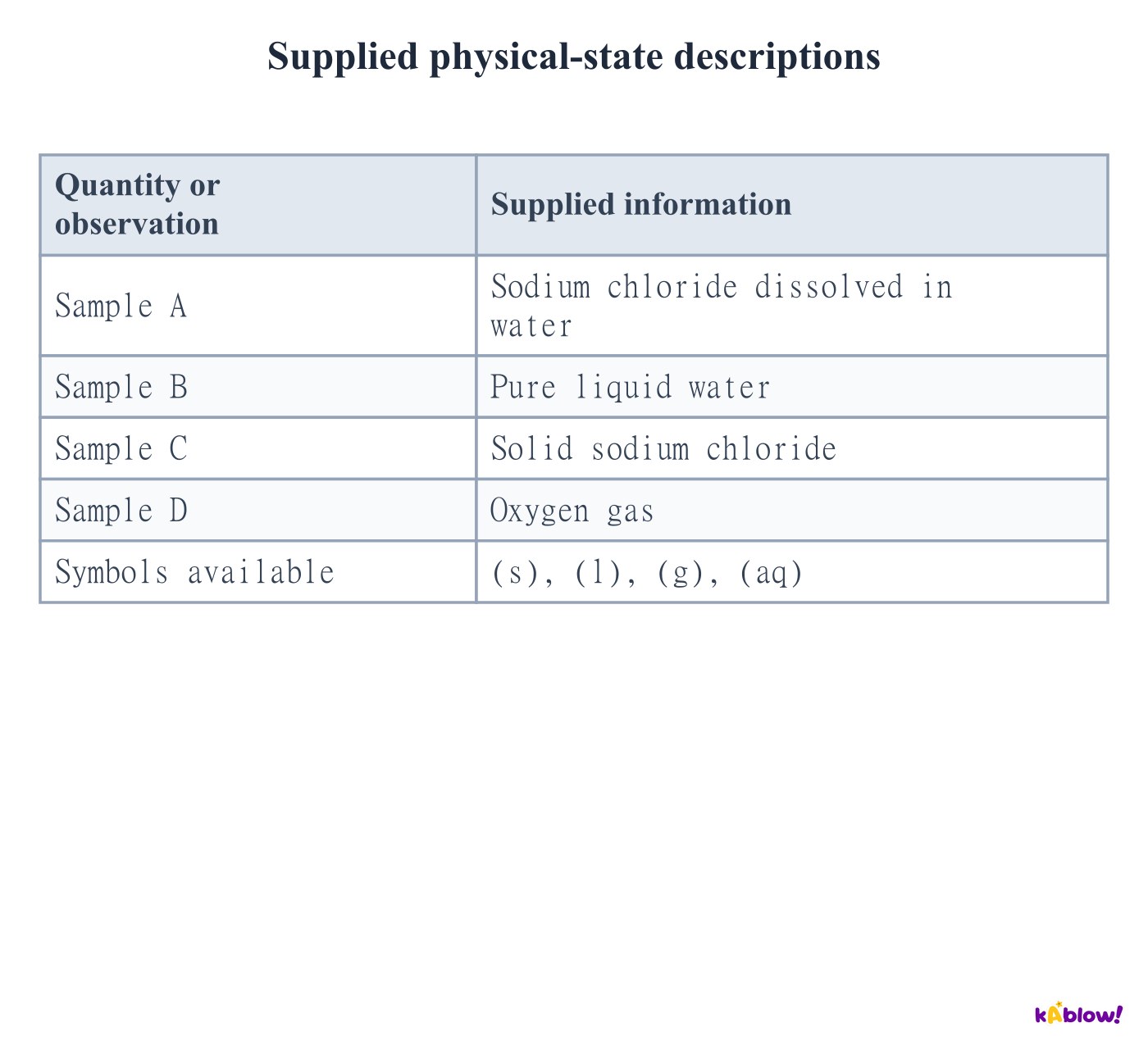
- Use (s) for solid, (l) for liquid, (g) for gas and (aq) for a species dissolved in water. Aqueous does not mean every liquid substance.
- An equation should represent the physical states relevant to its conditions. A soluble salt can be solid before dissolving and aqueous in its solution.
- State information helps decide which species to write as ions in an aqueous ionic equation. It is not decorative notation.
Supplied physical-state descriptions
Remove spectators from an ionic equation
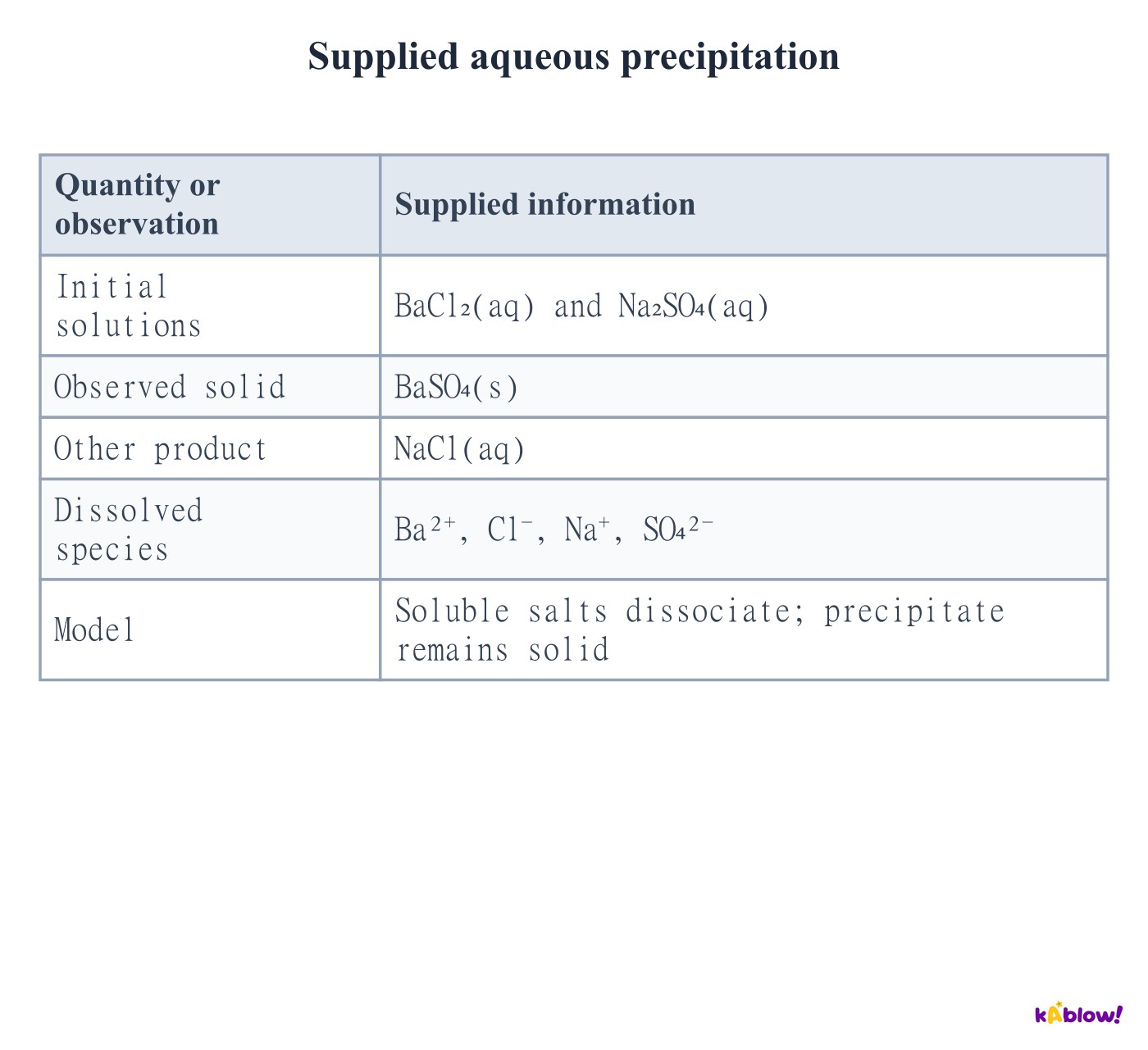
- For an aqueous reaction, first identify the species actually present. Split the soluble strong electrolytes used in the model into ions, then cancel unchanged spectator ions.
- Keep the precipitate as a solid formula. For the supplied mixture, the reacting ions form insoluble barium sulfate; sodium and chloride remain dissolved.
- Check both atom balance and total charge in the net ionic equation. A spectator is unchanged across the reaction, not simply an ion that has a small coefficient.
Supplied aqueous precipitation
Keep weak acids in their appropriate molecular form
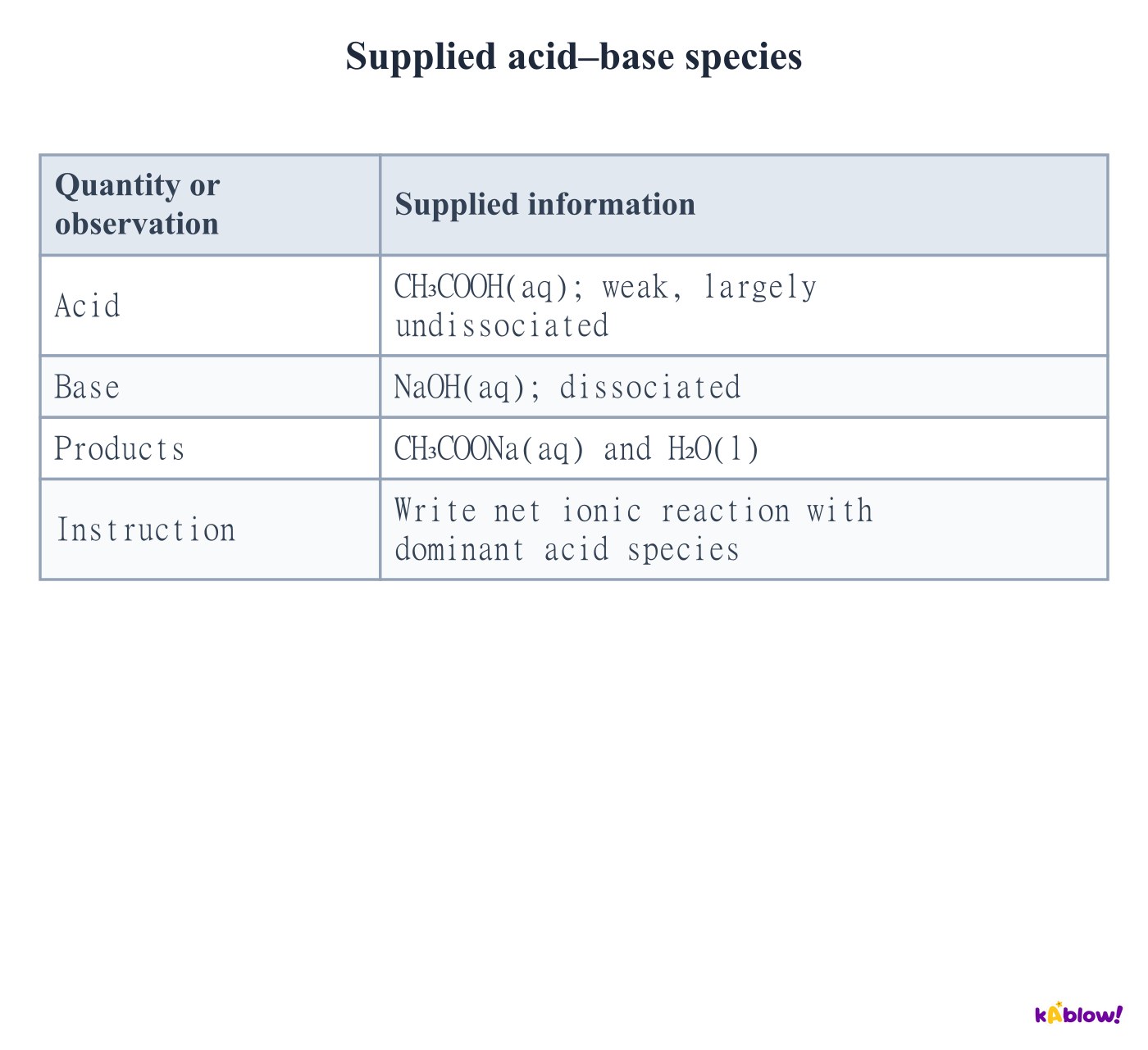
- Do not split every aqueous substance into separate ions. Water, weak electrolytes and insoluble solids require their appropriate chemical forms.
- Ethanoic acid is largely undissociated in the supplied model. Its reaction with hydroxide is CH₃COOH +OH⁻ →CH₃COO⁻ +H₂O, with sodium omitted as a spectator.
- The dominant-species ionic equation still conserves atoms and charge. Use the stated reaction chemistry rather than mechanically cancelling formula fragments.
Supplied acid–base species
Find the limiting reactant before calculating a maximum
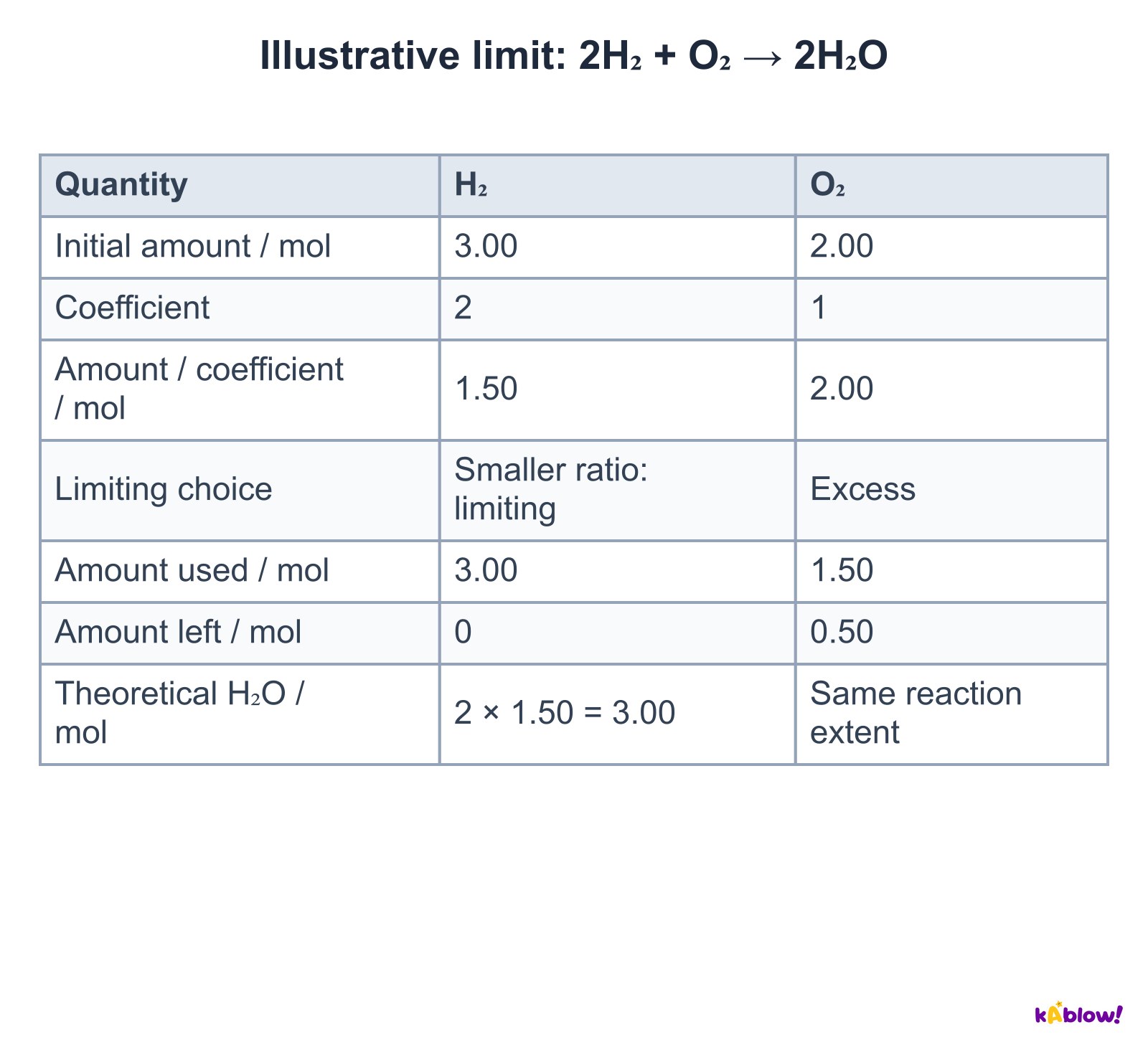
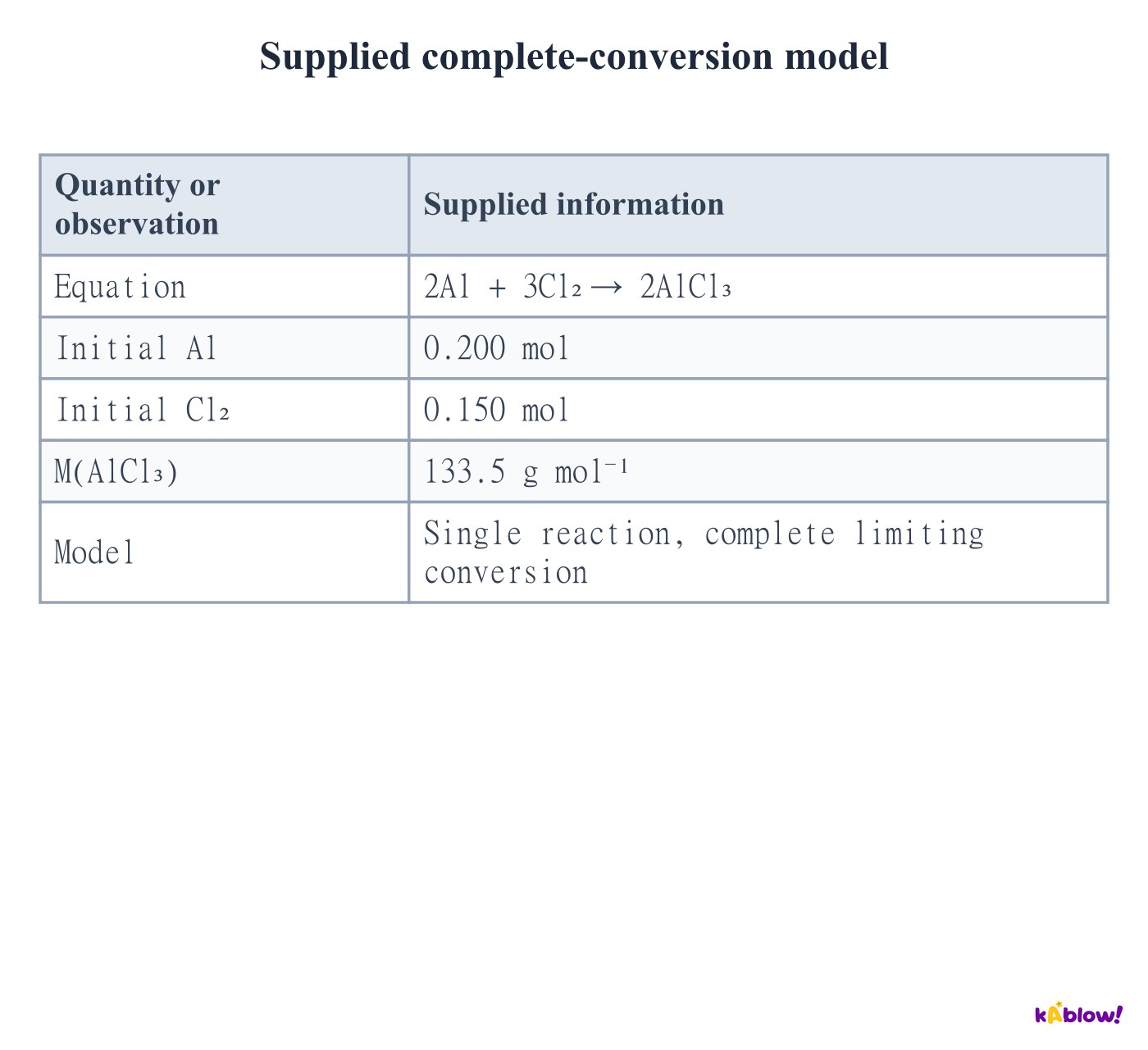
- Compare each reactant amount divided by its balanced-equation coefficient. The smallest value limits the possible reaction extent in a complete-conversion model.
- Use that extent to calculate product and unreacted excess. Comparing raw masses or raw mole values alone can choose the wrong limiting species.
- The theoretical maximum does not guarantee the isolated yield. Equilibrium or incomplete reaction can leave some limiting reactant unconverted in a real experiment.
Compare amount divided by coefficient
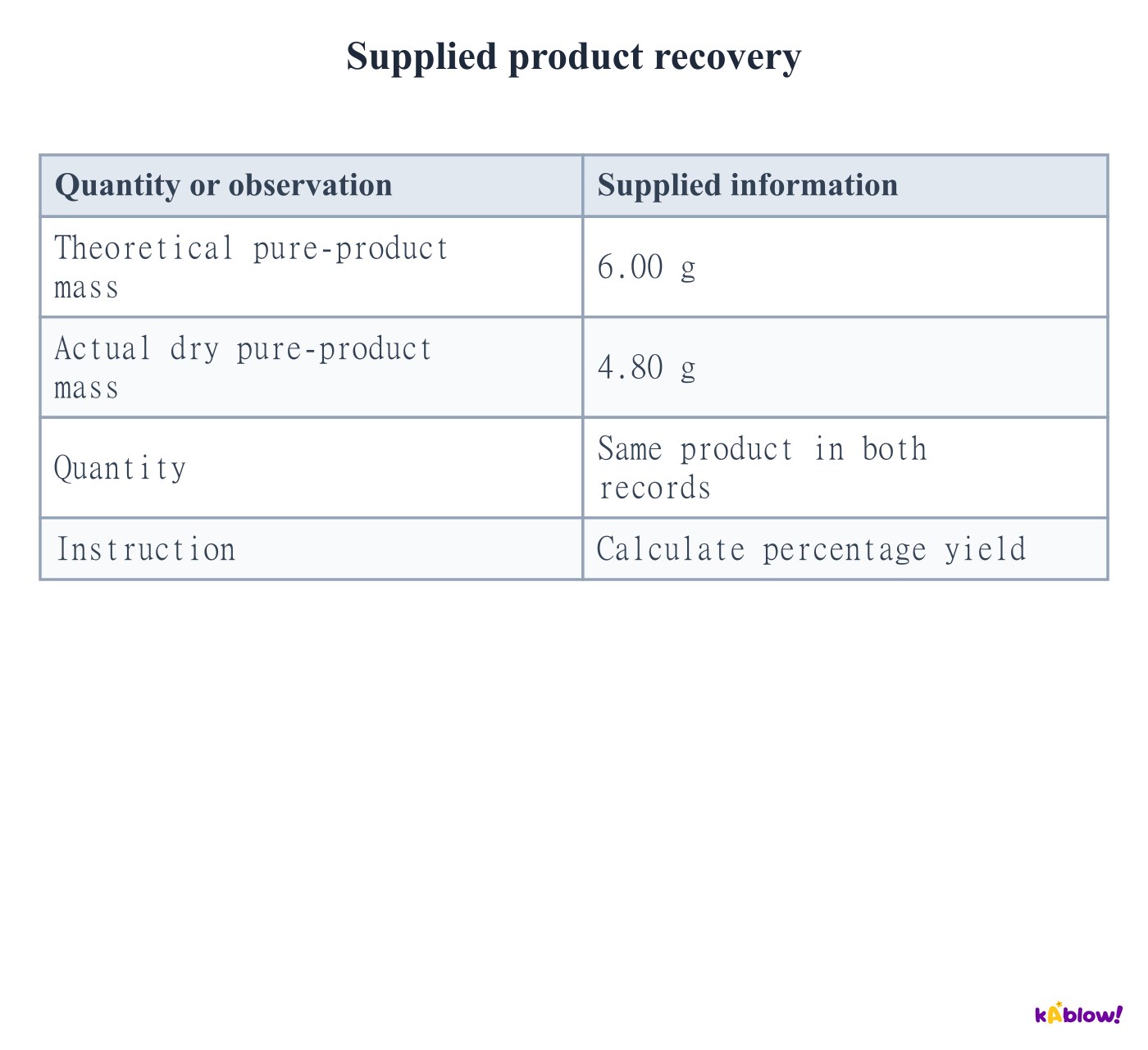
Compare actual and theoretical yield for the same product
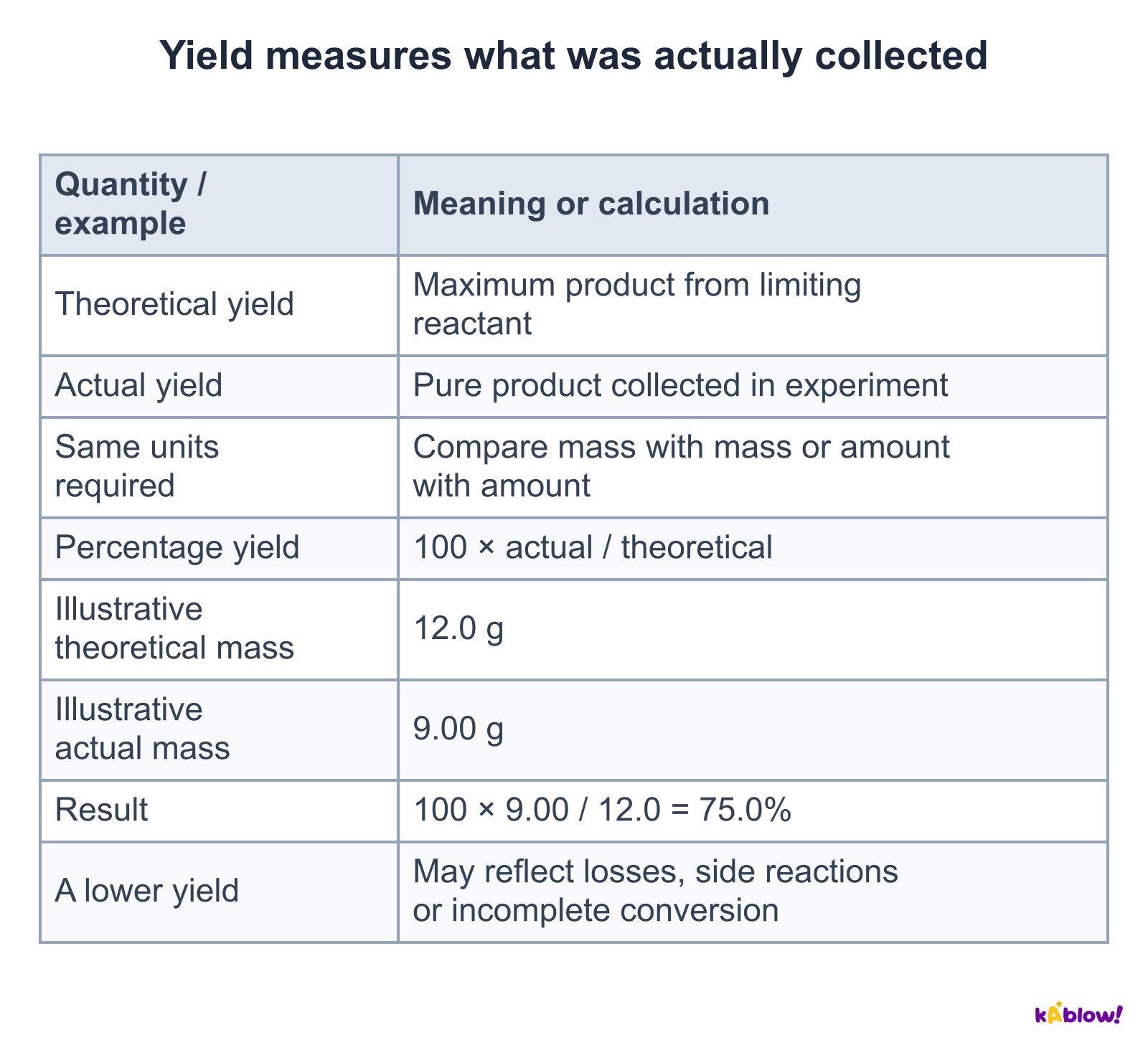
- Percentage yield is 100 times the actual product amount divided by its theoretical amount. Compare the same product in compatible units, using mass with mass or amount with amount.
- The theoretical quantity comes from the balanced equation and the limiting available reactant. The actual quantity refers to the isolated product under the stated purity assumptions.
- Incomplete conversion, competing reactions and losses during isolation can reduce yield. A lower measured yield alone does not identify which cause occurred.
Compare actual and theoretical yield
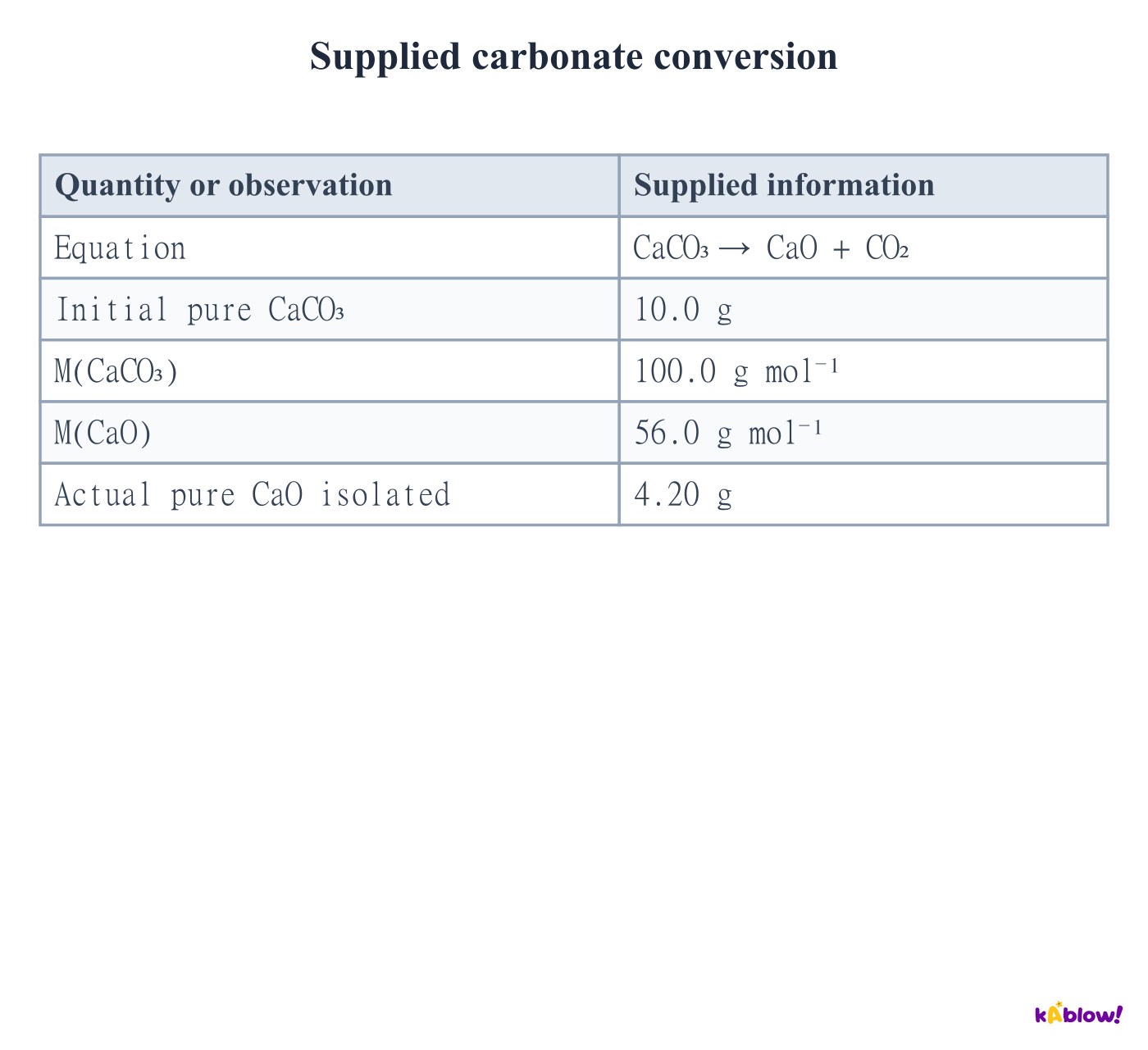
Calculate theoretical mass before percentage yield
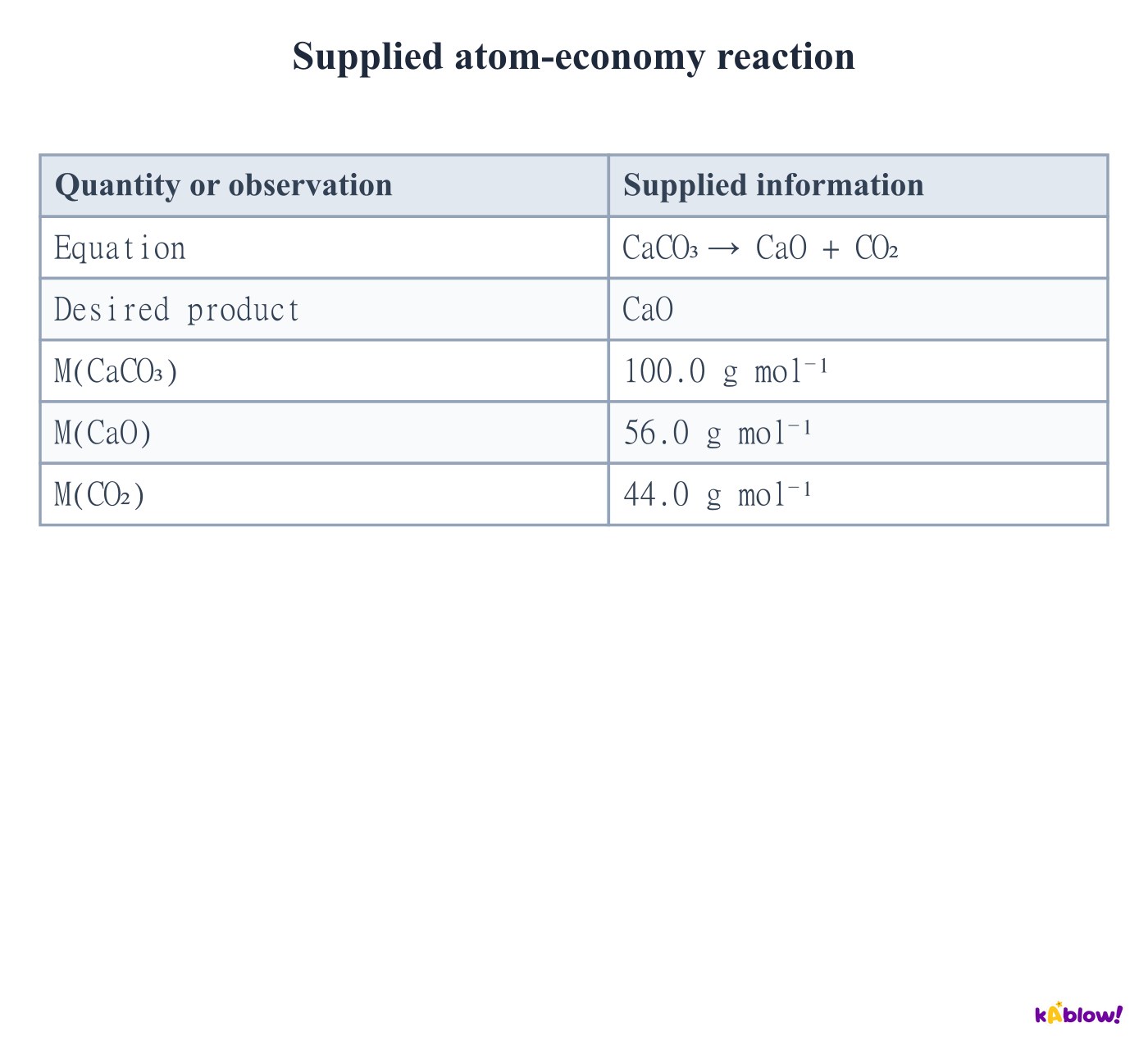
- A yield task may first require conversion of reactant mass to amount, application of the mole ratio and conversion of theoretical product amount to mass.
- For the carbonate model, CaCO₃ and CaO have a 1:1 amount ratio but different molar masses. Comparing their masses directly as a yield would mix different substances.
- Carry intermediate digits through the theoretical calculation. Only then compare the actual mass of the desired product with that theoretical mass.
Supplied carbonate conversion
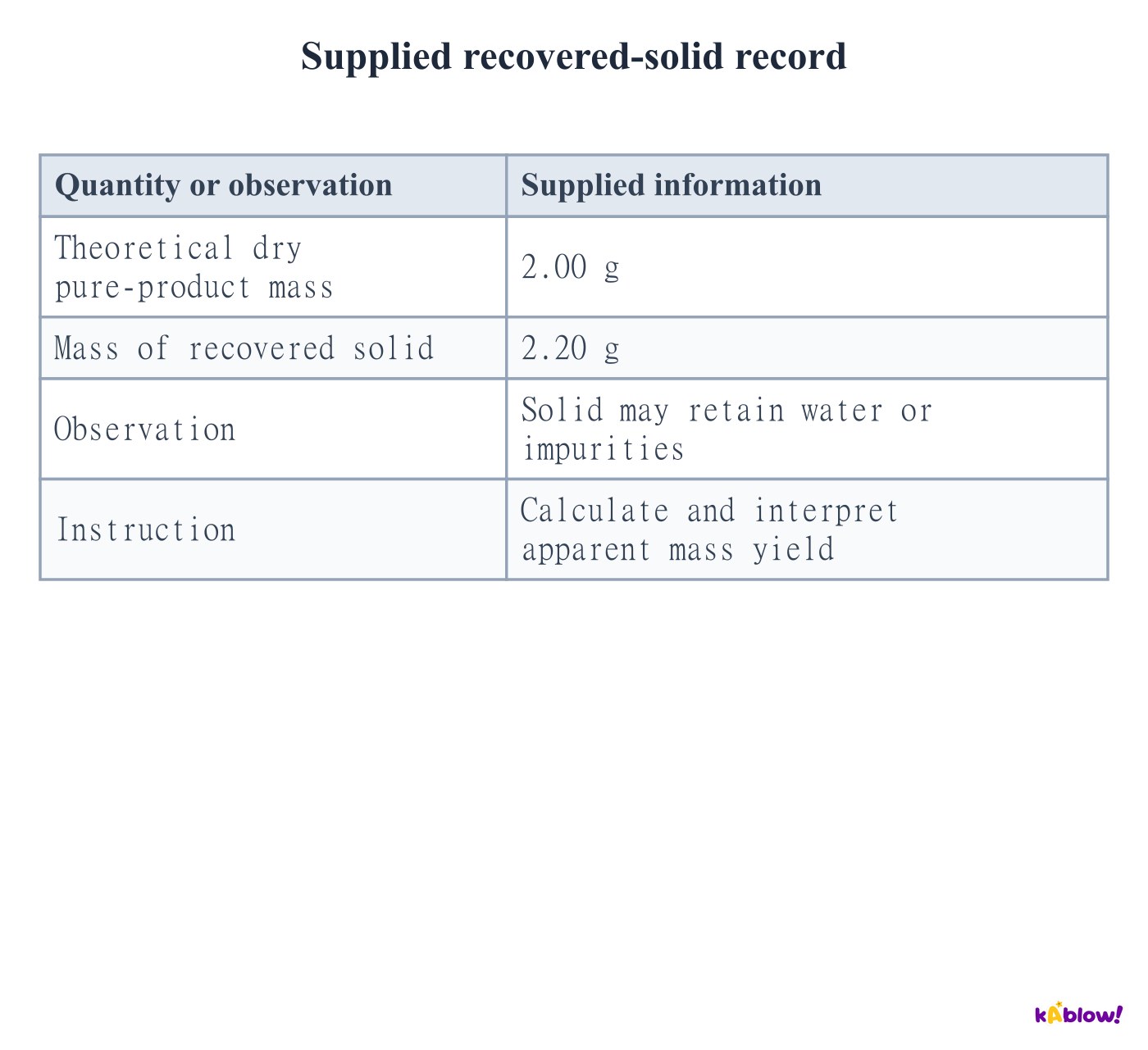
Interpret an apparent yield above 100 percent
- A calculated mass recovery above 100% is a possible experimental observation, but it cannot represent a pure-product yield above the valid theoretical maximum.
- Retained water, contamination, an incorrect reactant purity or the wrong reaction model can inflate the calculation. Identify which assumptions need checking.
- Do not call a reaction more than perfectly efficient merely because the recovered solid is heavy. A mass measurement is not by itself a product-purity measurement.
Supplied recovered-solid record
Calculate atom economy from a balanced equation
- Percentage atom economy is the coefficient-weighted mass of the desired product divided by the coefficient-weighted total mass of the reactants, multiplied by 100.
- It describes the ideal stoichiometric mass fraction reaching the desired product. It is not the percentage of the number of atoms, nor a measured experimental yield.
- Use all net-consumed reactants in the balanced equation. Actual excess quantities, solvents and unchanged catalysts are considered in wider process metrics rather than inserted arbitrarily into this ratio.
Include coefficients in atom economy
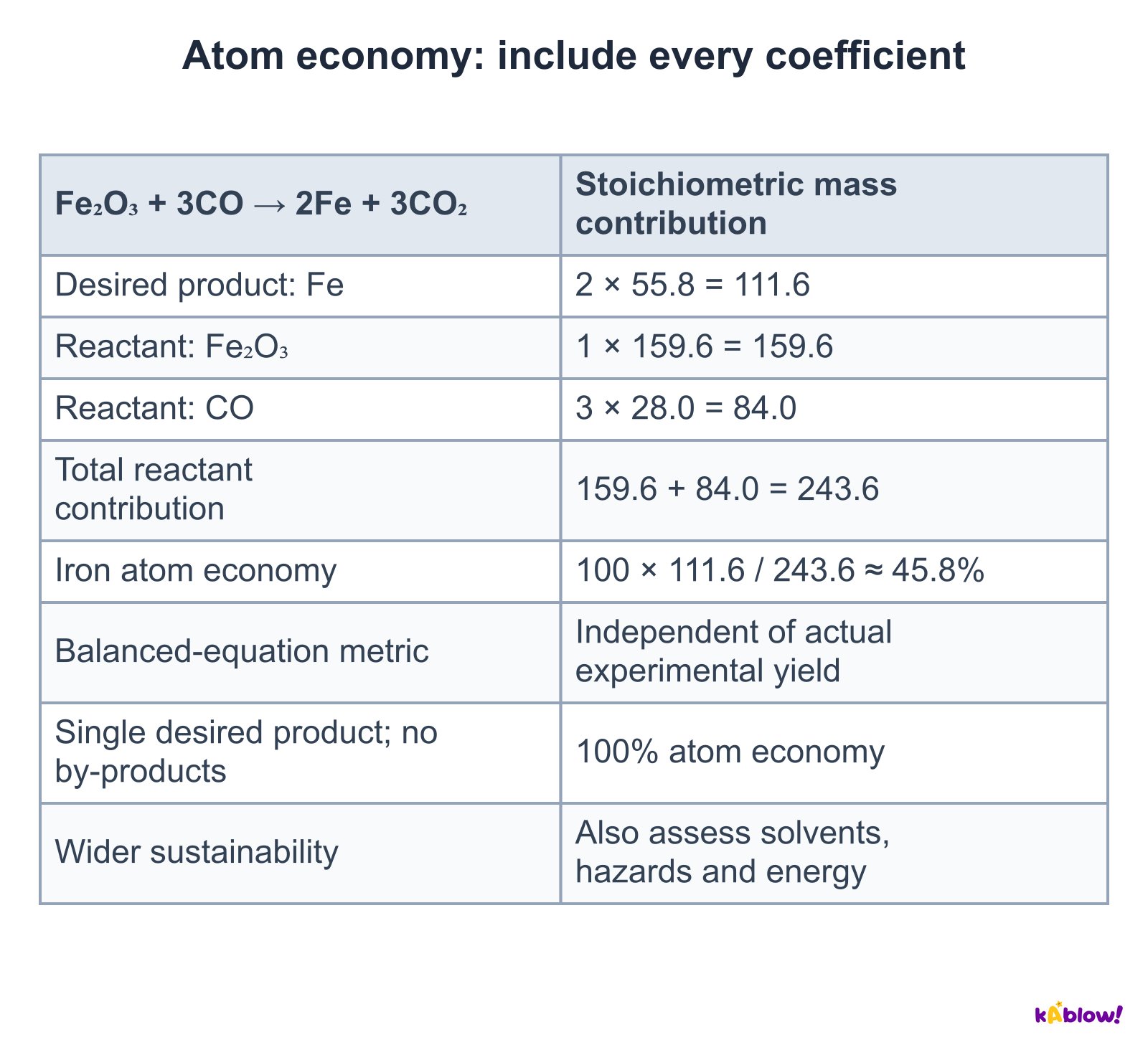
Include coefficients in both atom-economy totals
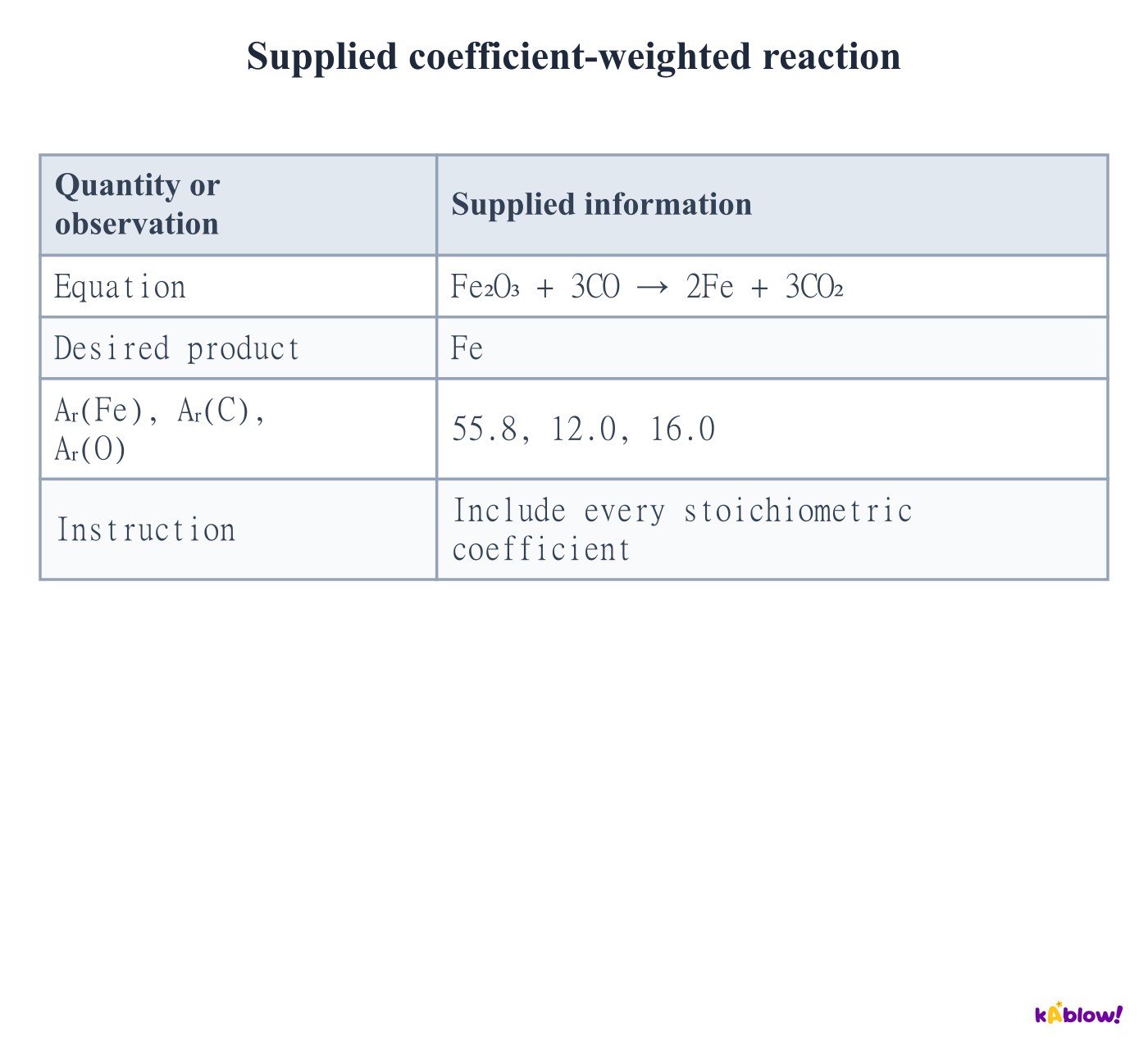
- A formula mass alone is not enough when its stoichiometric coefficient exceeds one. Multiply each reactant and desired-product contribution by the coefficient in the same balanced equation.
- The iron model forms two moles of Fe per equation event and consumes three moles of CO. Omitting either coefficient gives the wrong mass fraction.
- Scaling every equation coefficient by the same factor leaves atom economy unchanged because the factor cancels between numerator and denominator.
Include coefficients in atom economy
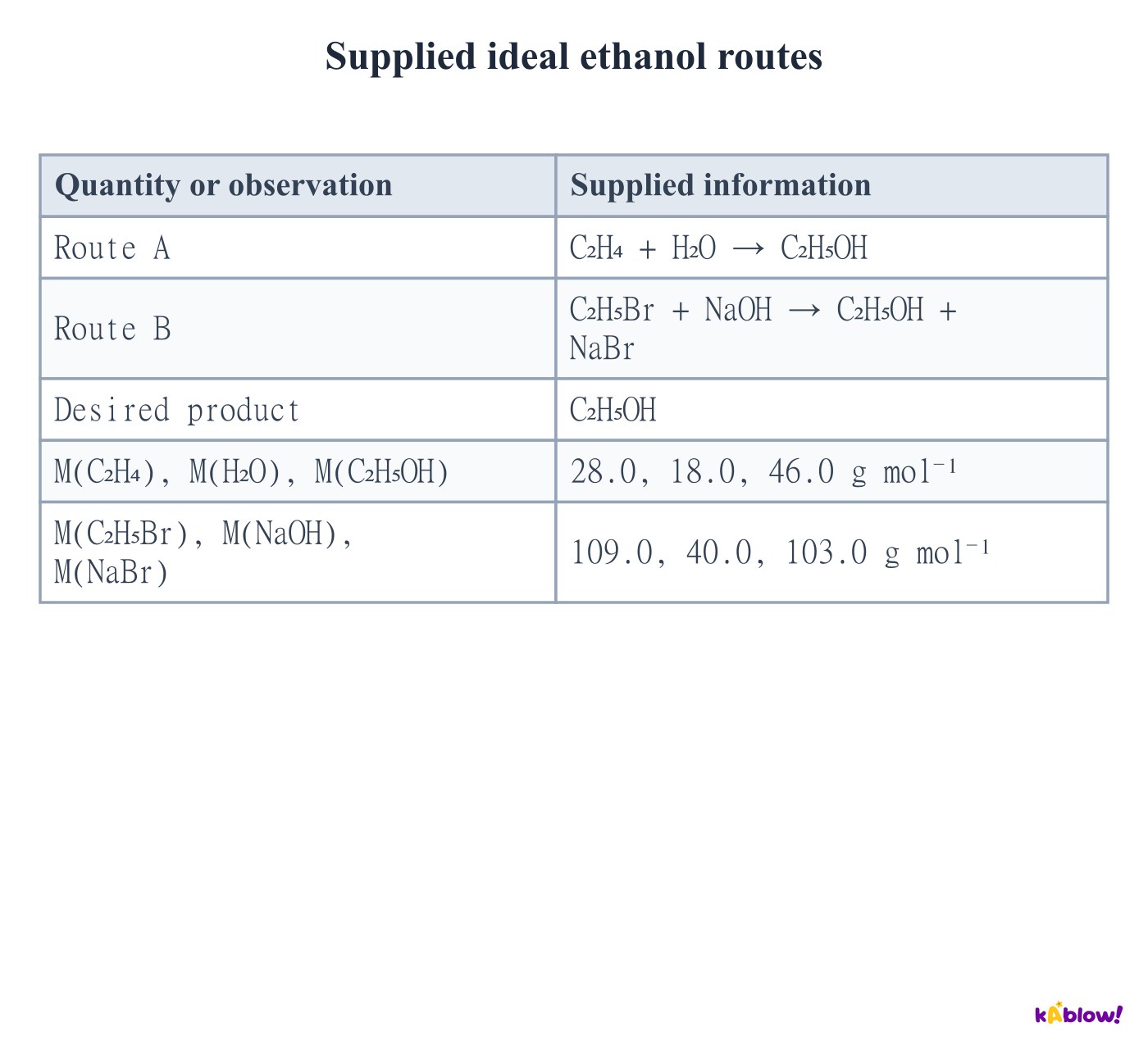
Compare routes that make the same desired product
- A balanced ideal reaction with a single desired product has 100% atom economy because all net reactant atoms reach that product. This does not guarantee complete conversion or recovery.
- A route that also forms a by-product allocates part of the reactant mass to that other substance. Specify the desired product before comparing atom economies.
- For the two ethanol equations, include water in hydration and sodium hydroxide in substitution. Excluding a consumed reagent would inflate the apparent atom economy.
Supplied ideal ethanol routes
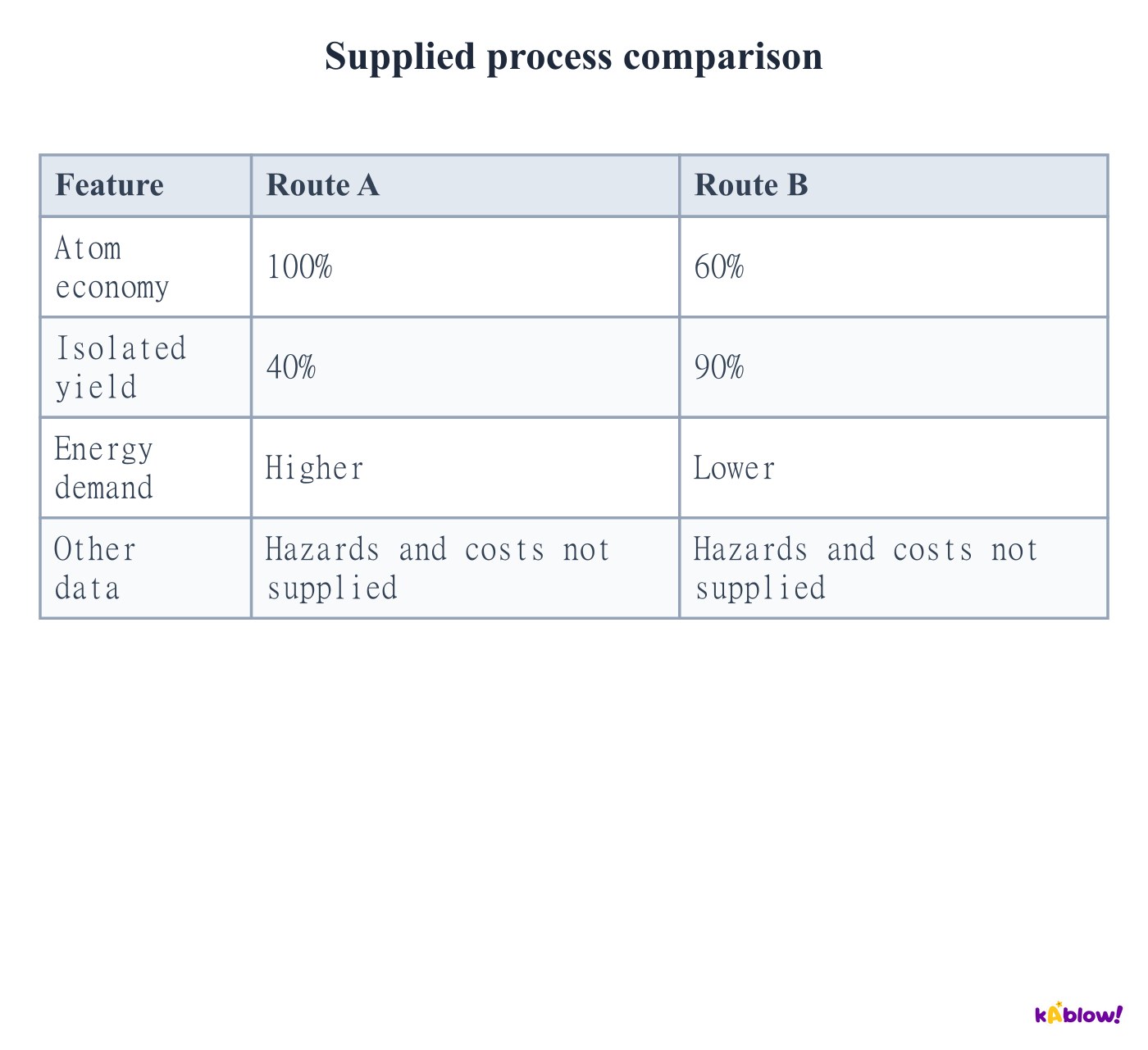
Evaluate a process beyond atom economy
- A high atom economy can reduce stoichiometric by-product waste, conserving raw materials and reducing separation or disposal demands.
- An overall route judgement also needs yield, energy, solvent use, hazard, feedstock origin, cost and treatment of waste. One high percentage cannot settle every economic or environmental question.
- The supplied process record contains trade-offs. Identify what each measurement supports and what further evidence is missing before claiming one route is best overall.
Supplied process comparison
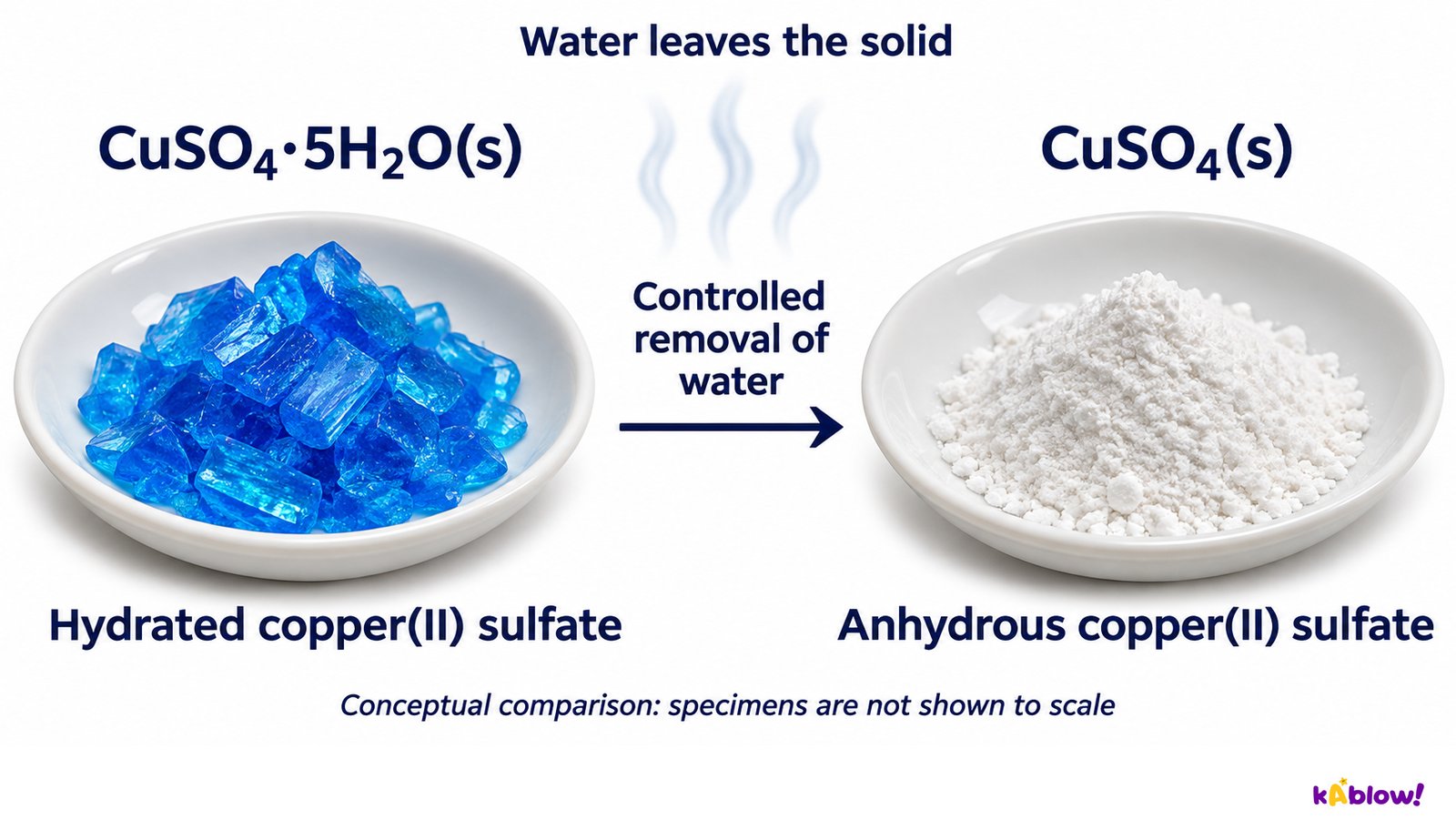
Interpret water of crystallisation in a hydrate formula
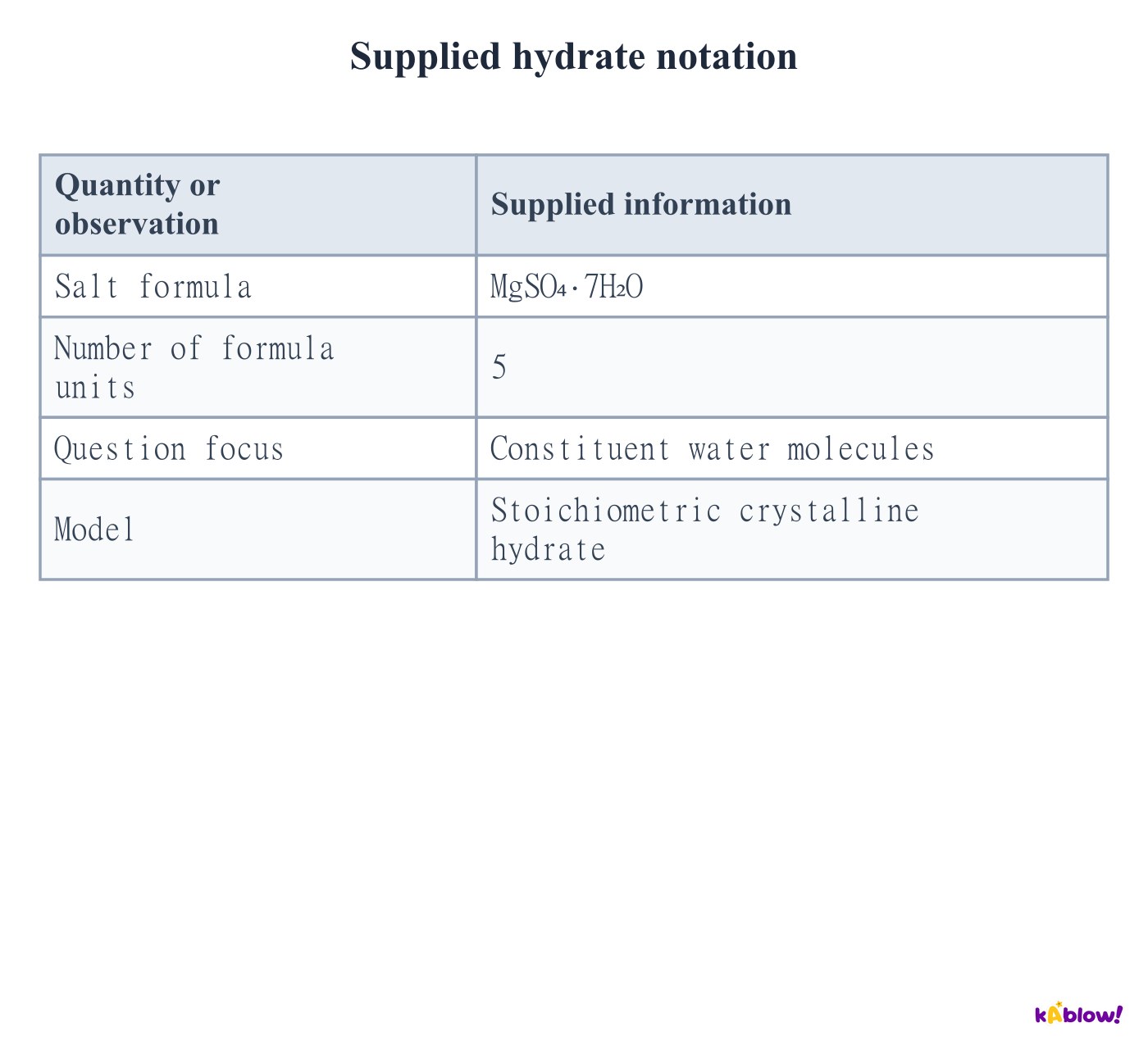
- Water of crystallisation is incorporated into a crystalline compound’s structure in a specified stoichiometric ratio. An anhydrous form contains no water of crystallisation.
- The dot in MgSO₄·7H₂O associates seven water molecules with each salt formula unit. It does not multiply every atom of the salt by seven.
- The copper sulfate comparison illustrates two solid forms, not a universal heating method. Suitable conditions can remove water, while excessive heating may decompose a salt.
Hydrated and anhydrous copper sulfate solids
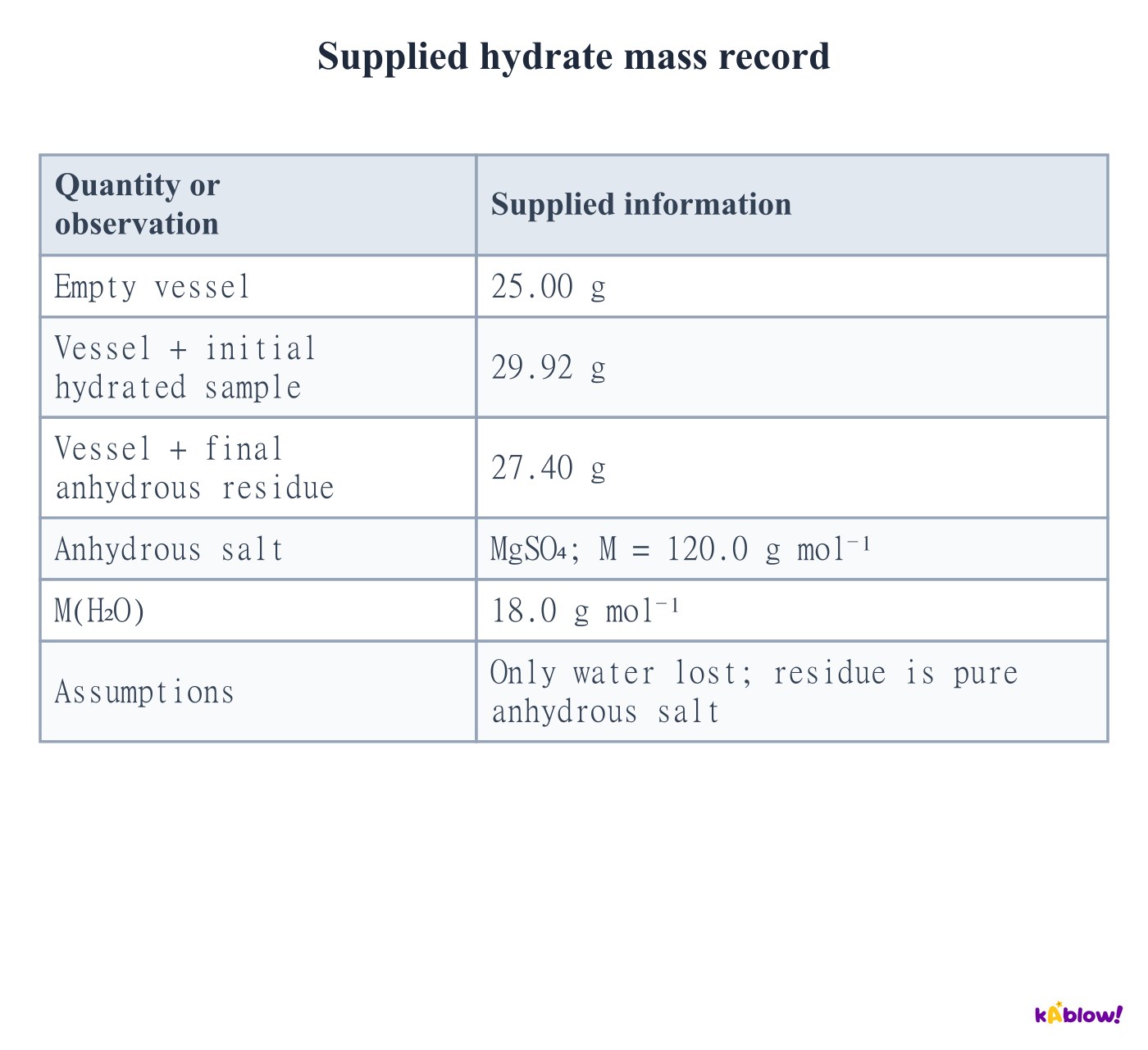
Calculate hydration using vessel-corrected masses
- Subtract the empty vessel from both combined mass readings. The initial sample mass and final residue mass must refer to the same vessel and sample.
- If only water is lost and the residue is pure anhydrous salt, the mass difference is water mass. Divide residue and water masses by their respective molar masses.
- The water-to-salt amount ratio gives x in the hydrate formula. A mass ratio is not the same as this mole ratio, and the assumptions must match the actual chemical change.
Supplied hydrate mass record
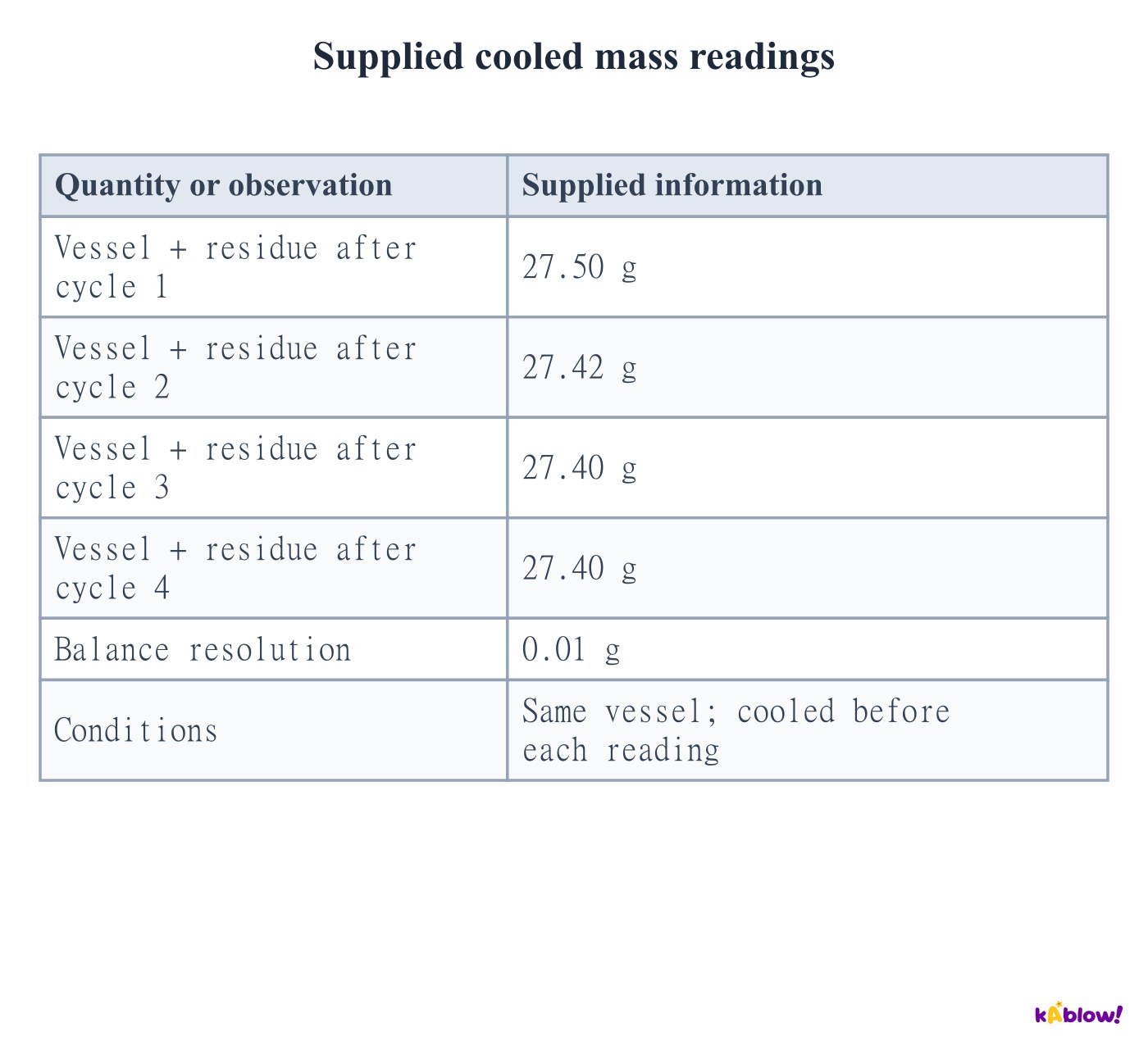
Use constant mass as evidence within a valid model
- Repeated cooling and weighing can show that the measured mass no longer changes within the balance resolution. Compare like-for-like readings after suitable controlled heating cycles.
- Constant mass alone does not prove complete dehydration. A stable partially hydrated or decomposed residue can also give repeated readings, so the chemical conditions matter.
- Cool before weighing and limit rehydration during handling. Interpreting measurements requires both the observed mass pattern and a justified residue identity.
Supplied cooled mass readings
Predict how deviations affect a calculated hydration number
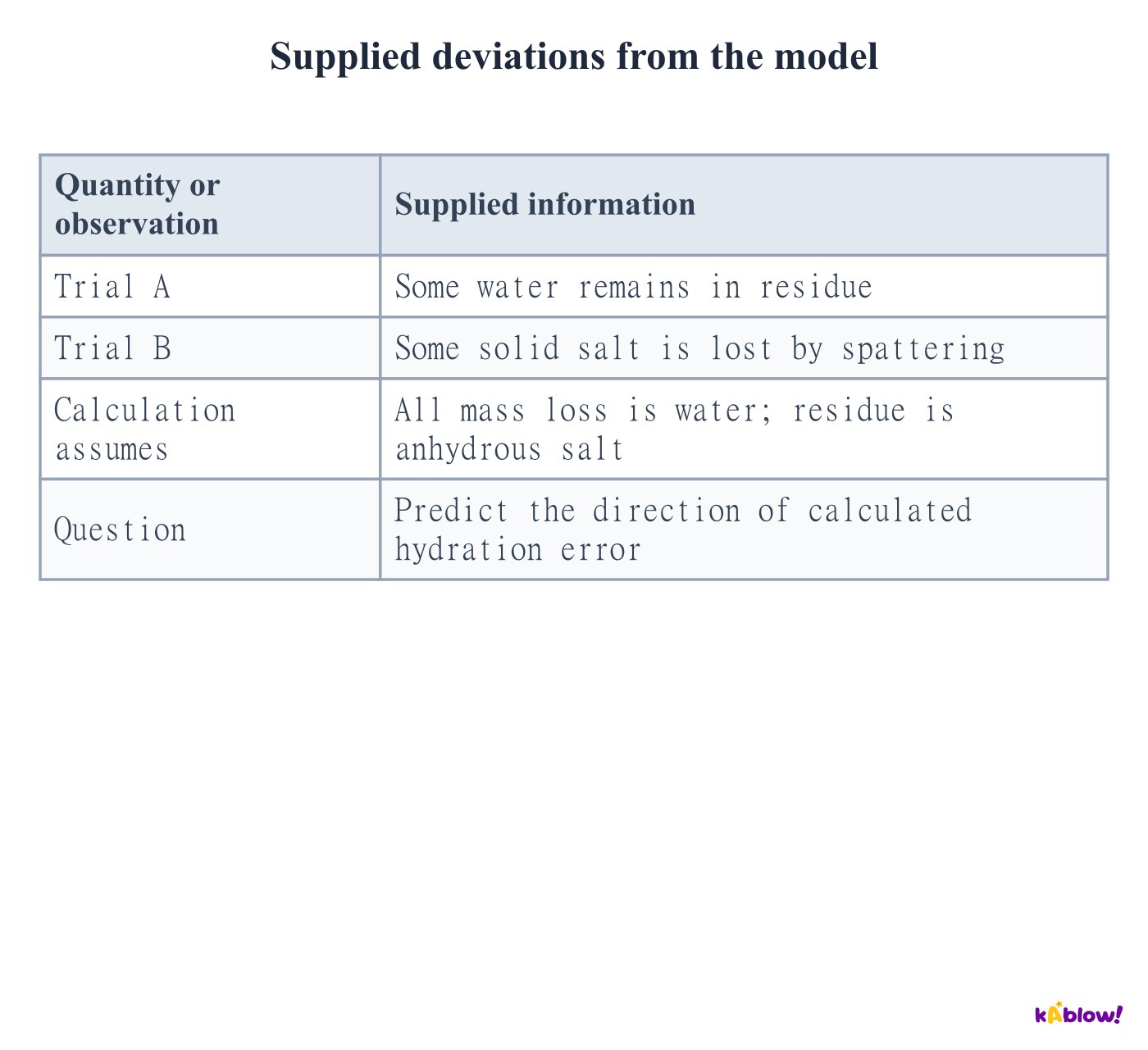
- If some water remains, the calculation overestimates anhydrous salt mass and underestimates water loss. Under that model the calculated water-to-salt ratio is too low.
- If solid salt spatters out, its mass loss can be mistaken for water and the residue salt amount becomes too small. Both effects push the calculated hydration ratio upward.
- These predictions depend on the stated isolated error. Several simultaneous errors can interact, so an unexplained result should prompt checks rather than an automatic correction.
Supplied deviations from the model
Slides
Sign up free to view the lesson slides
Step through every slide for this topic — plus flashcards and revision notes — with a free account.
Questões de prática
Prévia grátis — 8 de 60 perguntas. Cadastre-se para ver todas.
1.What is the mass number of the atom in the supplied particle inventory?
Medium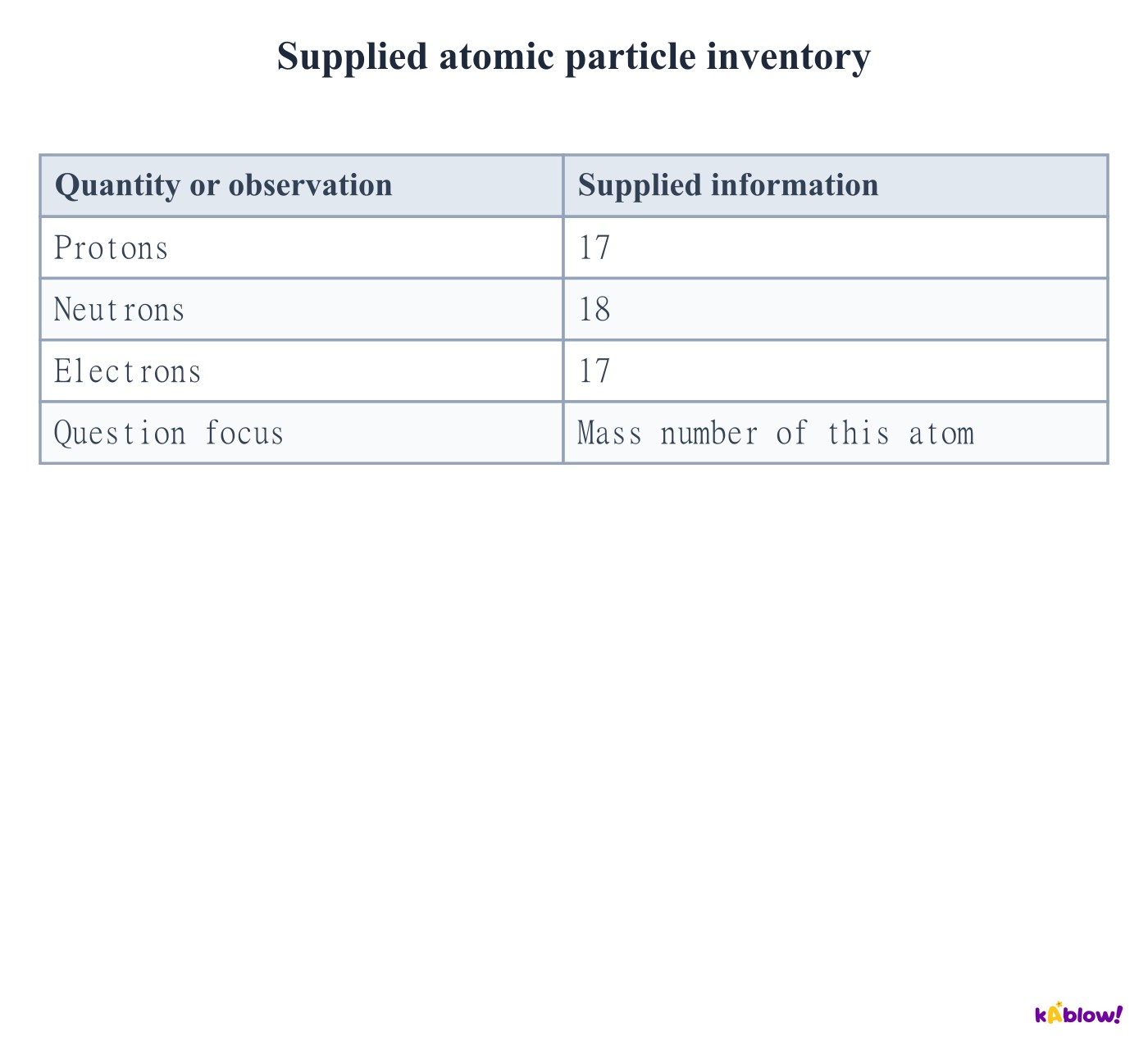
- A17
- B18
- C35
- D52
2.What relative atomic mass follows from the supplied model isotope composition?
Medium- A35.0
- B35.6
- C36.0
- D36.4
3.Which value is the weighted mean of the supplied precise relative isotopic masses?
Medium- A36.000
- B36.466
- C36.965
- D37.963
4.What relative formula mass follows for the supplied ammonium sulfate?
Medium- A114
- B128
- C132
- D148
5.What empirical formula follows from the supplied magnesium and oxygen masses?
Medium- AMgO
- BMg₂O
- CMgO₂
- DMg₂O₃
6.What empirical formula follows from the supplied C/H/O mass percentages?
Medium- ACHO
- BCH₂O
- CC₂HO
- DCH₂O₂
7.What oxygen mass percentage follows from the supplied partial composition?
Medium- A13.0%
- B34.8%
- C39.2%
- D47.8%
8.What empirical formula follows from the supplied iron oxide composition?
Medium- AFeO
- BFe₂O
- CFeO₂
- DFe₂O₃
Unlock all 60 questions, flashcards & more
Crie uma conta grátis para ver todas as perguntas, os slides, flashcards e resumos de revisão deste tópico.