
Scalars & Vectors
Aprenda jogando
Responda a estas perguntas para ganhar energia, depois pesque e explore. Sem precisar de conta.
Notas de aula
Distinguish magnitude from direction
- A scalar has magnitude without a spatial direction. Examples include mass, time, energy, temperature, speed and distance. A scalar can still have a negative value, as electric charge can.
- A vector has magnitude and direction. Examples include displacement, velocity, acceleration, force and momentum. Specify reference axes or a compass direction in a vector answer.
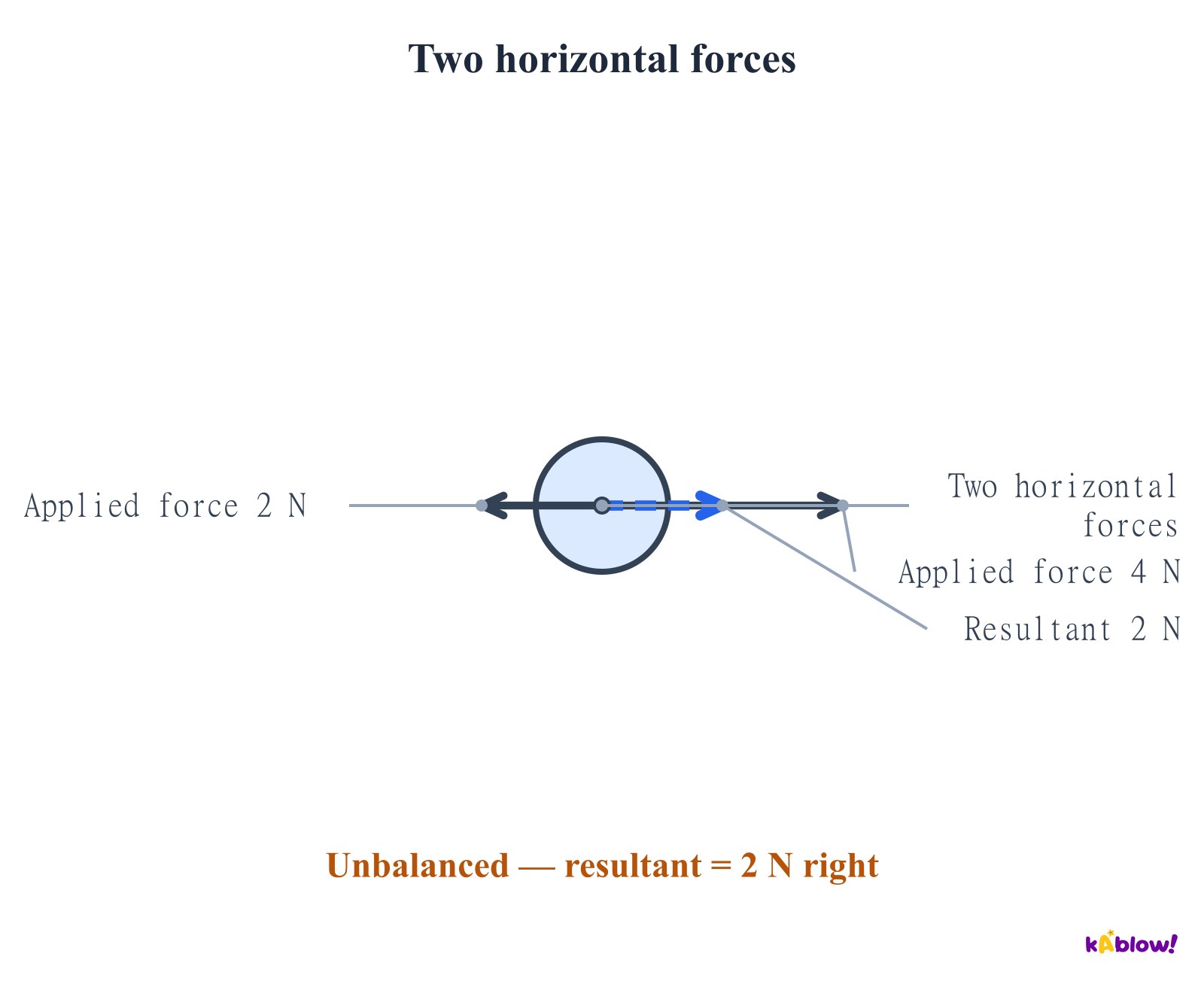
- An arrow represents a vector: its length is proportional to magnitude at the chosen scale and its arrowhead shows direction. Moving a free vector parallel to itself does not change that vector.
- The zero vector has magnitude zero and no unique direction. Multiplying a nonzero vector by a negative scalar reverses its direction and multiplies its magnitude by the absolute value of that scalar.
Vector arrows and a resultant
Distance, displacement, speed and velocity
- Distance is total path length travelled. Displacement is the vector change in position from the initial point to the final point. A return journey can have positive distance and zero displacement.
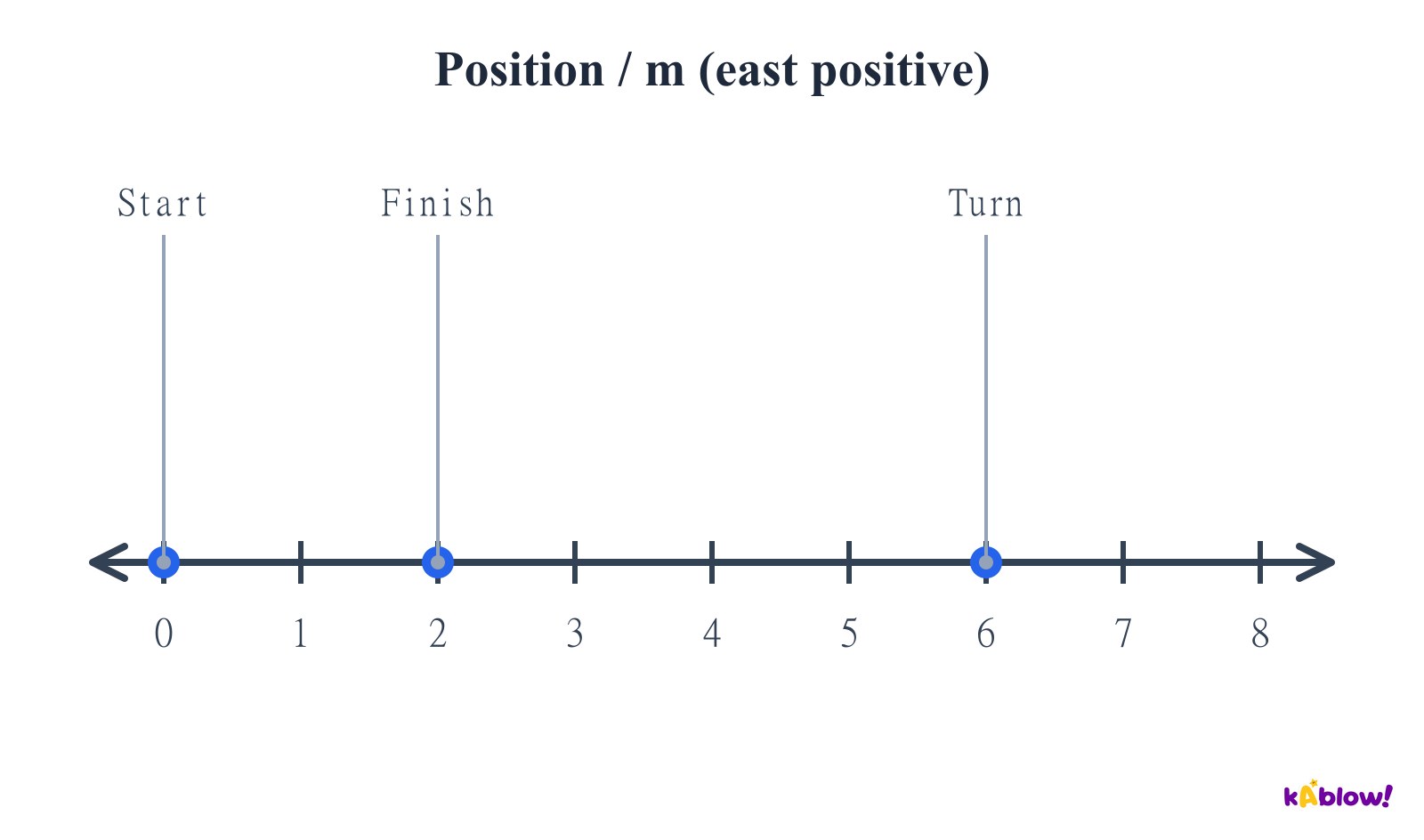
- For a journey 6 m east followed by 4 m west, distance is 10 m and displacement is 2 m east. Adding path lengths is different from adding signed changes in position.
- Average speed is total distance divided by elapsed time. Average velocity is displacement divided by elapsed time. They can differ over the same journey.
- Constant speed does not guarantee constant velocity: changing direction changes velocity, as in motion round a bend.
A journey on an east–west line
Add and subtract vectors
- For collinear vectors, choose a positive direction and add signed components. A force 9 N east combined with 4 N west gives 5 N east.
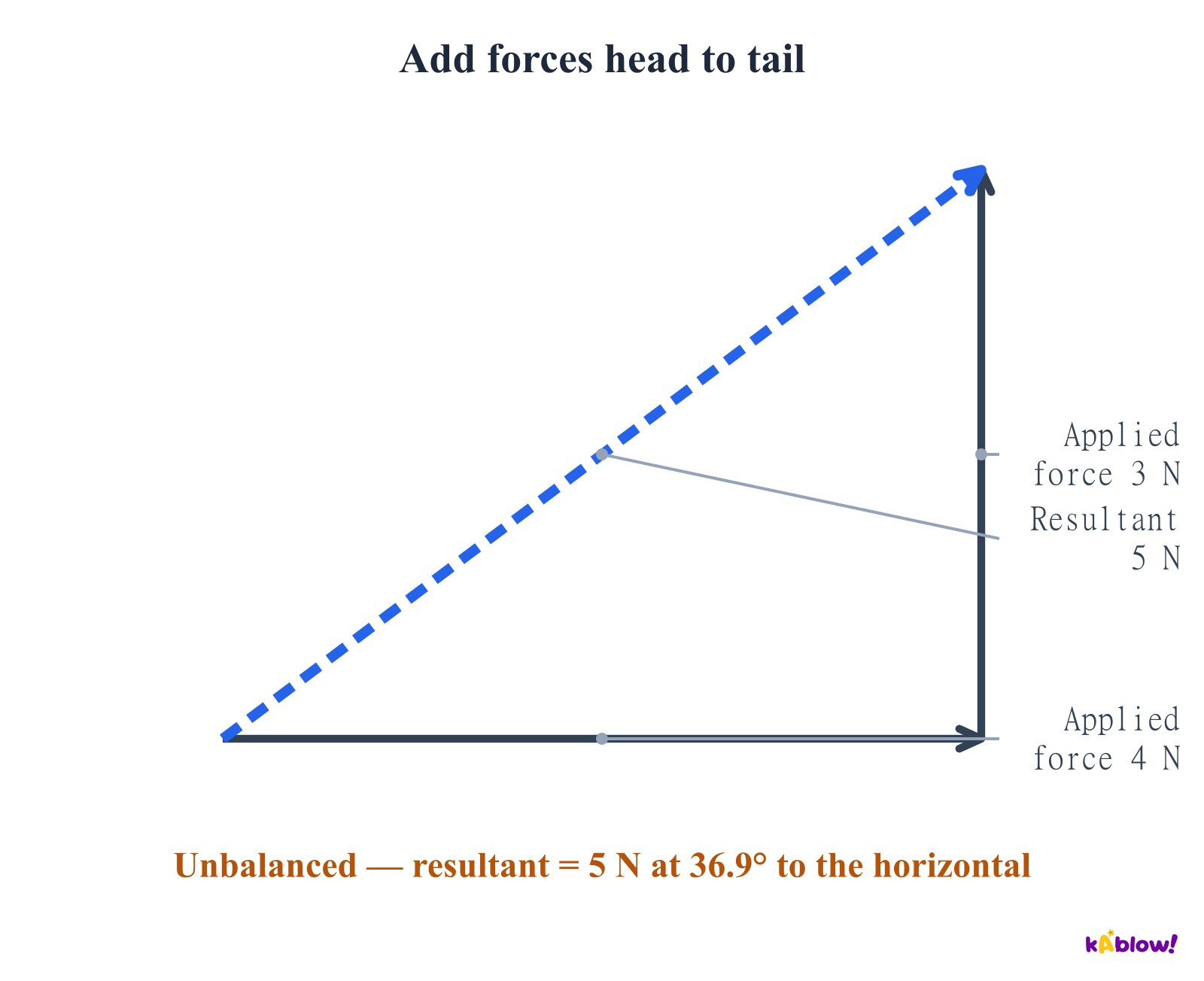
- For head-to-tail addition, place each new vector’s tail at the previous head without changing its length or direction. The resultant joins the initial tail to the final head.
- For the parallelogram method, give two vectors a shared tail. The diagonal from that shared tail to the opposite corner is the resultant.
- Subtraction A − B means A + (−B). Reverse B before constructing the sum. A scale drawing must use one consistent magnitude scale, with its result converted back to physical units.
Head-to-tail force addition
Calculate perpendicular resultants
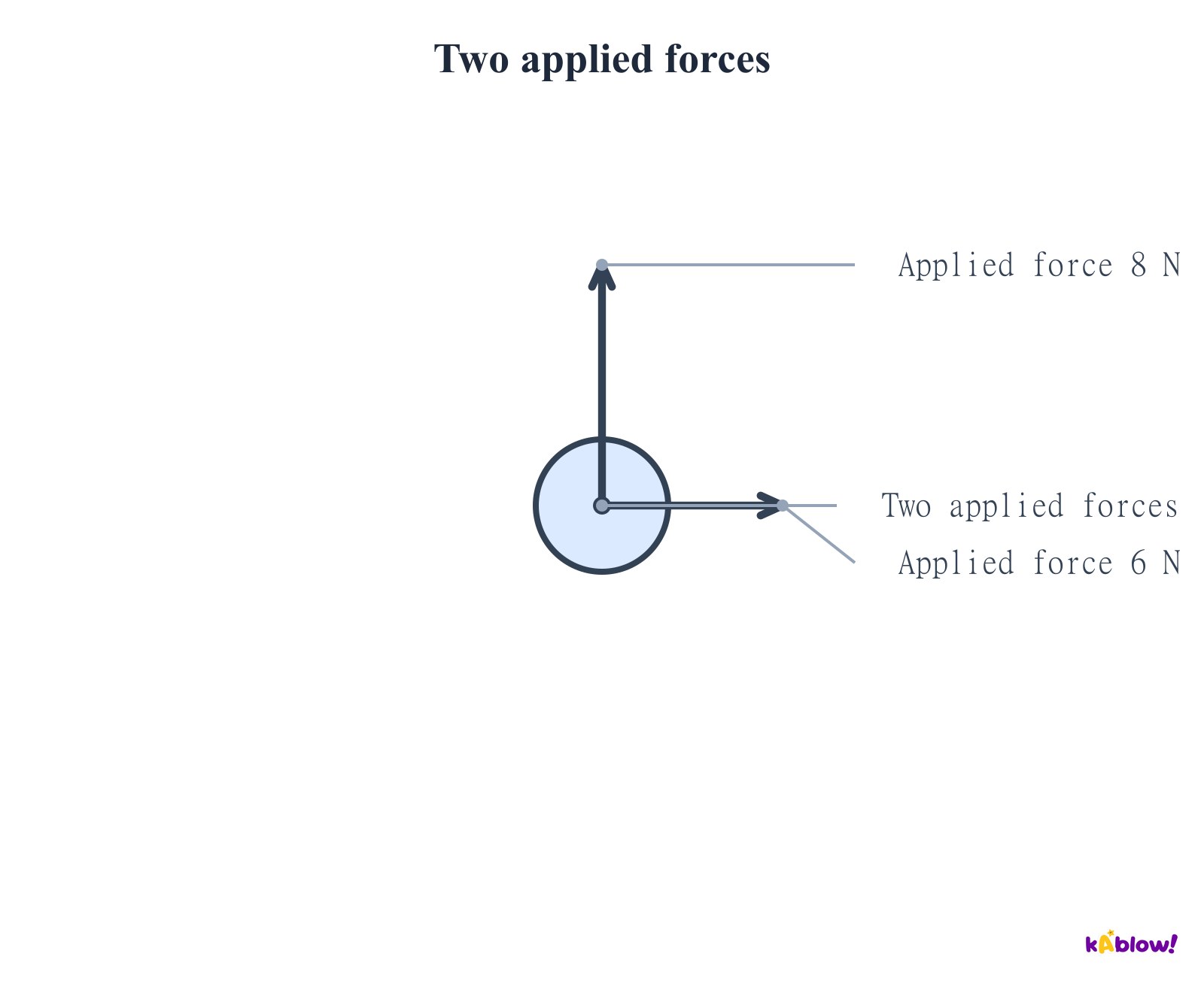
- For perpendicular components A and B, the resultant magnitude is R = √(A² + B²). Do not add magnitudes directly unless the vectors point in the same direction.
- The angle from the A direction toward B satisfies tan θ = B/A. State which axis the angle is measured from and use component signs to choose the correct quadrant.
- For 3 N east and 4 N north, R = 5 N and θ = tan⁻¹(4/3) ≈ 53.1° north of east. The angle from north is instead about 36.9°.
- AQA calculations here focus on two vectors at right angles; scale constructions may use other angles. Components provide a consistent way to reason about direction.
Two perpendicular forces
Resolve a vector into components
- Resolving replaces a vector with perpendicular components that have the same combined effect. It does not create two additional forces alongside the original.
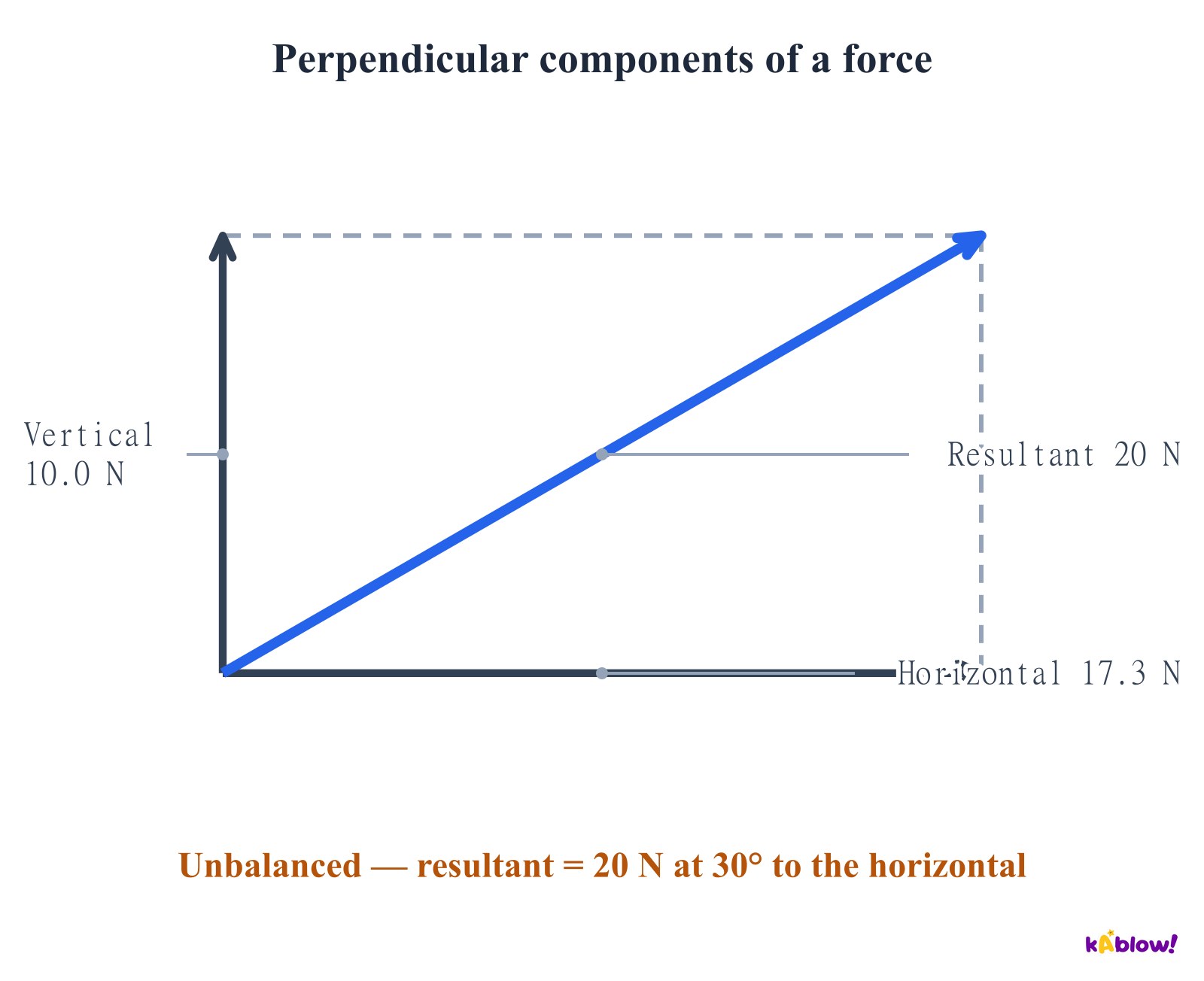
- If a force F is at angle θ above the positive horizontal, Fx = F cos θ and Fy = F sin θ. Signs depend on the chosen directions.
- If θ is measured from the vertical, the vertical component is F cos θ and the horizontal component is F sin θ. Identify the adjacent side before choosing sine or cosine.
- For F = 20 N at 30° above horizontal, Fx ≈ 17.3 N and Fy = 10 N. Recombining these perpendicular components gives the original force.
A 20 N force and its components
Resolve weight on an inclined plane
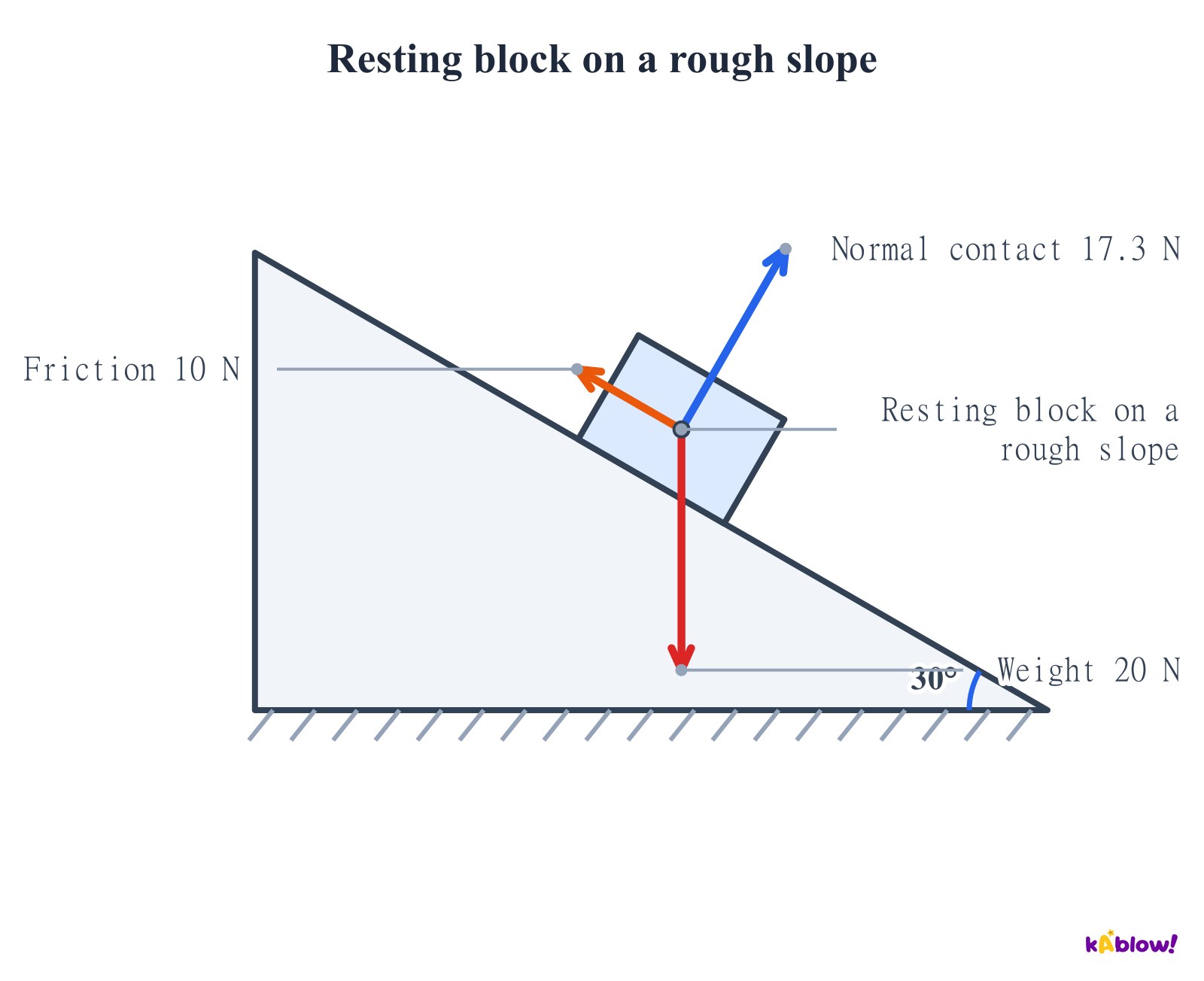
- Weight W acts vertically downward. On a plane inclined at θ to the horizontal, its component down the plane is W sin θ and its component perpendicular into the plane is W cos θ.
- The normal contact force acts perpendicular to the surface, away from it. It is not generally vertically upward on a slope. Friction acts along the surface and opposes relative motion or its tendency.
- If there is no perpendicular acceleration and no other forces with perpendicular components, R = W cos θ. This is a conditional force balance, not a universal rule for every slope problem.
- For a 20 N block on a rough 30° slope at rest with no other forces, the perpendicular component is about 17.3 N and the downslope component is 10 N. A 10 N static friction force acts upslope.
Force balance on a rough slope
Use equilibrium and closed force triangles
- A particle is in translational equilibrium when the vector sum of the forces on it is zero. In an inertial frame it has zero acceleration and can be at rest or moving with constant velocity.
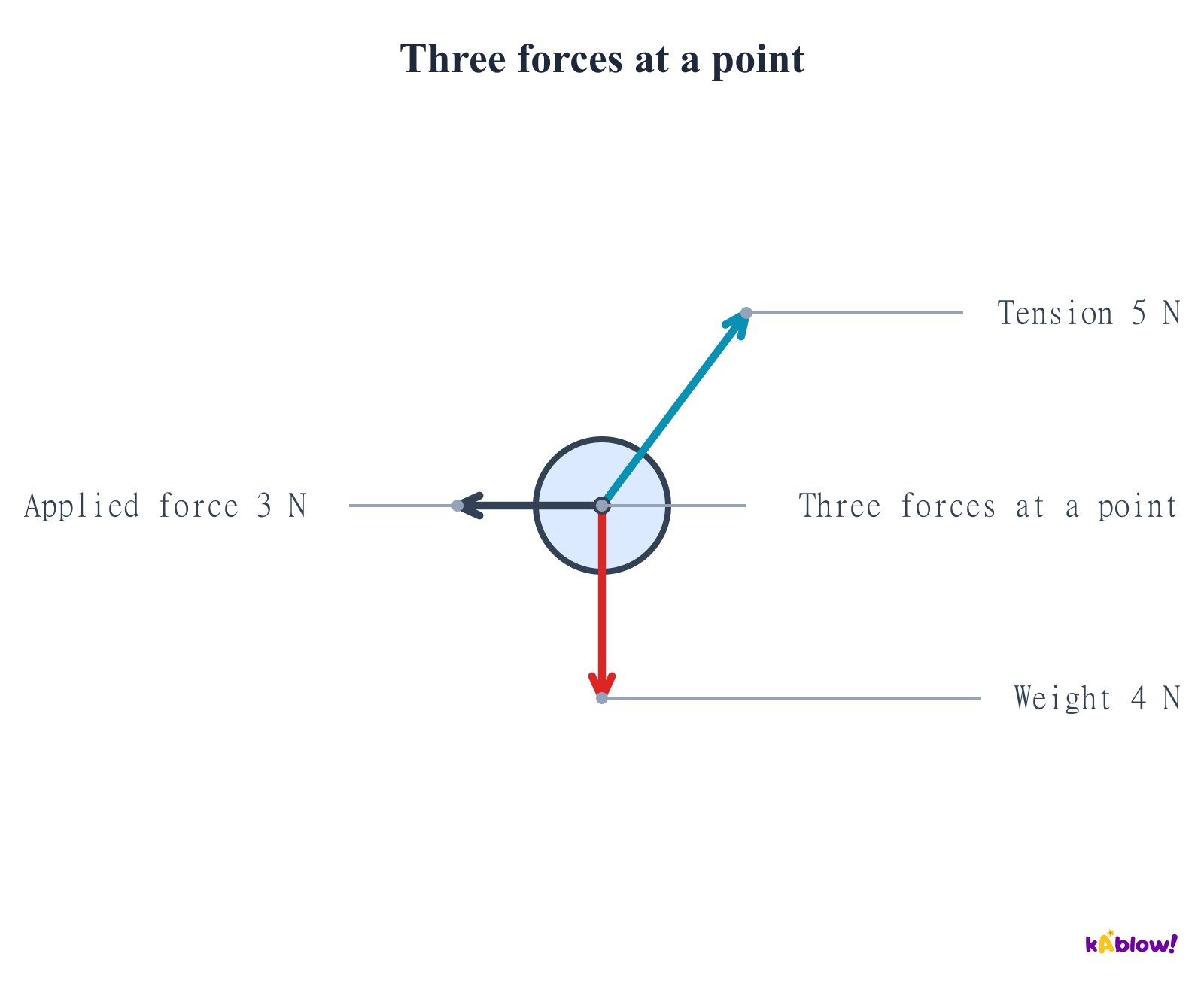
- For two forces to balance, they must be equal in magnitude and opposite in direction. For three coplanar forces acting at a point, a head-to-tail construction closes into a triangle.
- Resolve along two perpendicular axes to check ΣFx = 0 and ΣFy = 0. An equilibrant is equal in magnitude and opposite in direction to the existing resultant.
- These particle conditions concern forces acting at a point. A rigid body can also require a separate moment balance; do not assume that zero resultant force alone prevents rotation.
Three coplanar forces
Slides
Sign up free to view the lesson slides
Step through every slide for this topic — plus flashcards and revision notes — with a free account.
Questões de prática
Prévia grátis — 8 de 40 perguntas. Cadastre-se para ver todas.
1.Which quantity is a vector?
Easy- ADisplacement
- BDistance
- CMass
- DEnergy
2.Which quantity is a scalar?
Easy- AForce
- BSpeed
- CVelocity
- DAcceleration
3.A quantity can have a negative value. What can be concluded from the sign alone?
Medium- AIt cannot be a scalar
- BIt must be a force
- CIt is not enough to decide whether the quantity is a vector
- DIt must be a vector
4.A runner completes one circuit and returns to the starting point. Which statement is correct?
Easy- ADistance and displacement are both zero
- BDisplacement equals the circumference
- CAverage velocity must equal average speed
- DDisplacement is zero although distance travelled is positive
5.A person walks 6 m east and then 4 m west. What is the displacement from the start?
Easy- A2 m east
- B10 m east
- C2 m west
- D10 m west
6.A person walks 6 m east and then 4 m west. What distance is travelled?
Easy- A24 m
- B10 m
- C2 m
- D−2 m
7.A car moves round a bend at constant speed. Which statement can still be true?
Medium- AIts displacement must be zero
- BIts mass changes because velocity is a vector
- CIts velocity changes because its direction changes
- DIts acceleration must be zero
8.A particle travels 12 m in 3 s and returns to its starting point during that interval. What is its average velocity?
Medium- A4 m s−1
- B12 m s−1
- C36 m s−1
- D0 m s−1
Unlock all 40 questions & more
Crie uma conta grátis para ver todas as perguntas, os slides, flashcards e resumos de revisão deste tópico.