
Climate change: causes, evidence and responses
Aprenda jogando
Responda a estas perguntas para ganhar energia, depois pesque e explore. Sem precisar de conta.
Para educadores: slides de aula, resumos de revisão prontos para usar de Climate change: causes, evidence and responses (Geography, Physical Geography) — use na sua aula ou rode o tópico como atividade interativa de turma que seus aprendizes jogam como um jogo ao vivo.
Notas de aula
Evidence for climate change
- Climate evidence combines instrumental records, ocean and ice changes, sea level and dated proxies. Ice cores preserve past gas composition and provide temperature proxies; they do not directly record tomorrow’s weather.
- IPCC AR6 reported global surface warming of about 1.1°C for 2011–2020 compared with 1850–1900. State both periods. This historical average is not a claim about the present year, every region or a single-year Paris threshold.
Read a temperature statement
Causes
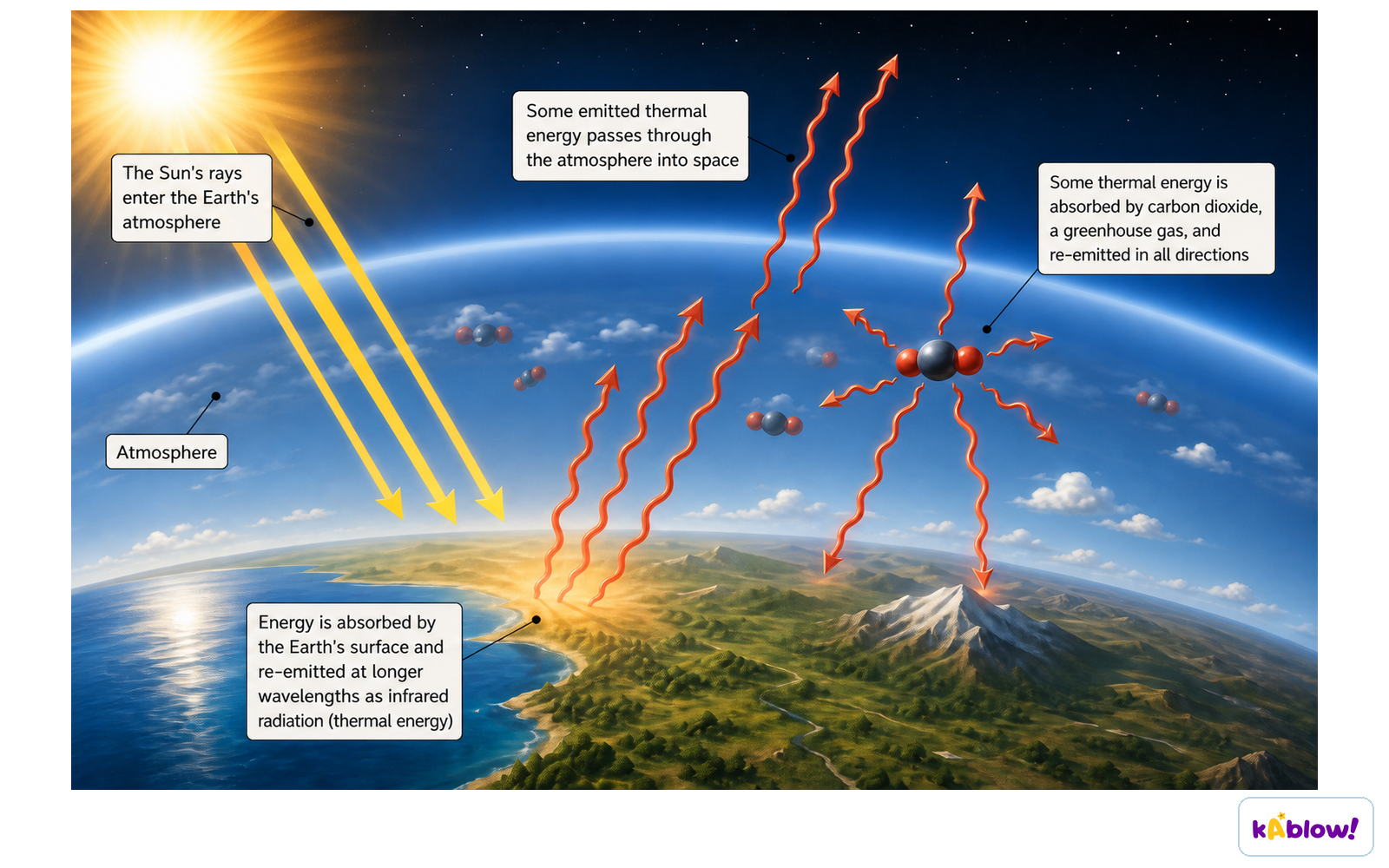
- The greenhouse effect involves absorption and emission of infrared radiation, not a sealed blanket that prevents all energy escaping. Increasing greenhouse gases changes Earth’s energy balance. Human activities, primarily greenhouse-gas emissions, are responsible for recent global warming.
- Fossil-fuel combustion and land-use change add CO2; agriculture, landfill and fossil-fuel systems emit methane, while soils and fertilisers can emit nitrous oxide. Water vapour largely amplifies warming as a feedback. Orbital changes influence long-term climate; large eruptions can temporarily cool through stratospheric sulfate aerosols. These do not account for the recent human-driven trend.
Infrared absorption and emission
Effects
- Climate change affects heat, rainfall, ecosystems, food and water risks, with different local consequences. Attribution to a specific event requires evidence; one storm or retreating glacier alone is not a complete global analysis.
- Sea-level rise includes thermal expansion and land-ice loss. Floating sea-ice melt contributes little directly to sea level. Flood risk also depends on local land movement, tides, storms, exposure and adaptation. Longer frost-free periods can benefit some activities but do not guarantee higher yields or offset all other impacts.
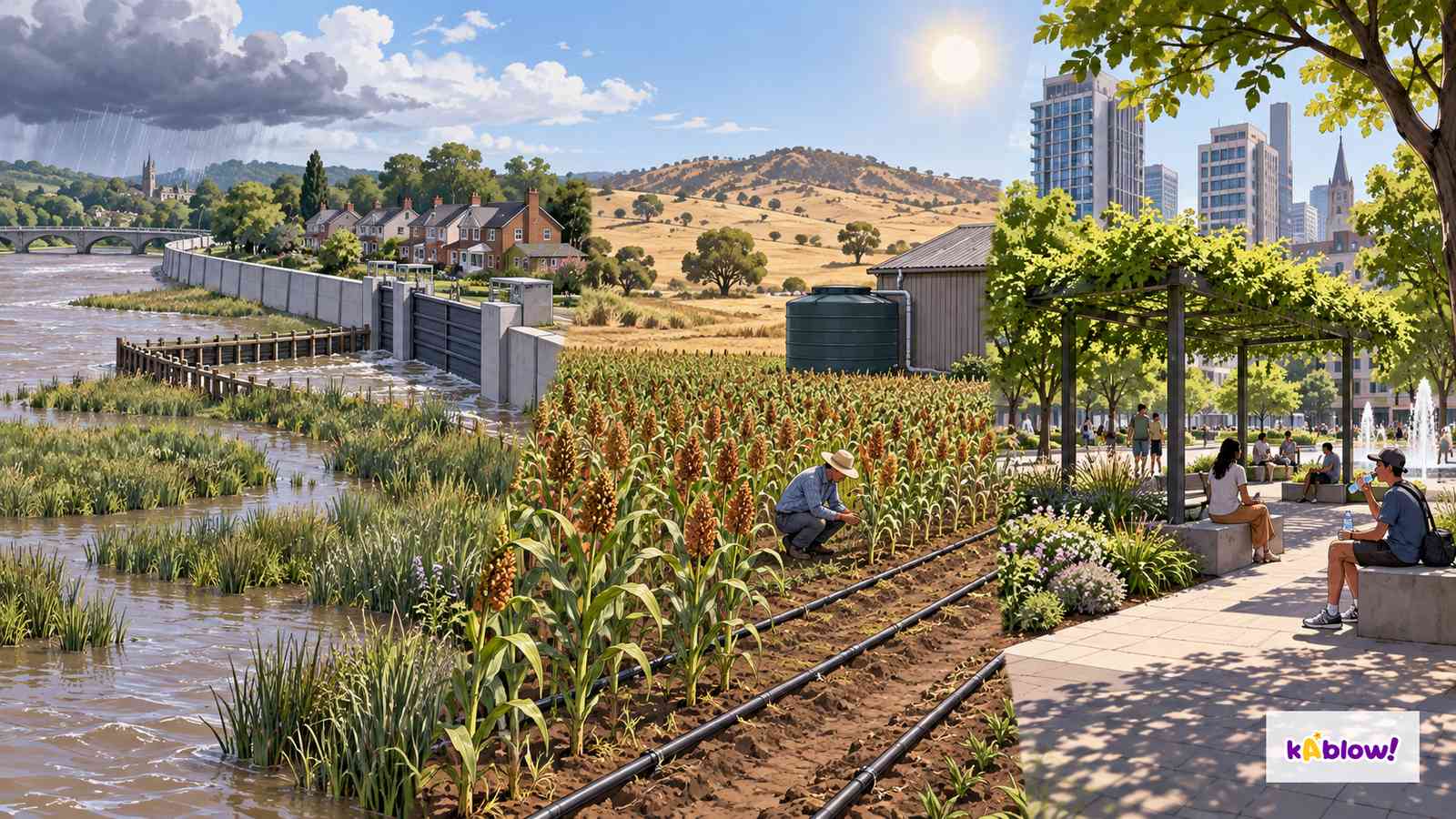
Imagined adaptation options
Managing climate change
- Mitigation reduces emissions or strengthens removals; adaptation manages risks and exposure. Energy efficiency, low-carbon energy, appropriate forestry and durable carbon storage need lifecycle, permanence and land-use evaluation. Flood protection, shade, water conservation and crop choices need local risk assessment.
- The Paris Agreement was adopted in 2015, seeking warming well below 2°C and pursuing efforts towards 1.5°C above pre-industrial conditions. It concerns long-term global temperature; a single-year anomaly is a different measure. Policy adoption is not proof that every target is achieved.
- Both response types need investment and fair access. Adaptation has limits and possible unintended effects; forest carbon can be lost, capture needs durable storage and defences retain residual risk. Evaluate effectiveness, maintenance and distribution rather than promising a risk-free solution.
Two complementary responses
Slides
Sign up free to view the lesson slides
Step through every slide for this topic — plus flashcards and revision notes — with a free account.
Questões de prática
Prévia grátis — 8 de 33 perguntas. Cadastre-se para ver todas.
1.What is the greenhouse effect?
Easy- Agreenhouse gases absorbing and emitting outgoing infrared radiation
- Bplants growing in glass
- Cthe sun cooling
- Drain forming
2.Which gas is the main greenhouse gas from burning fuels?
Easy- Aoxygen
- Bnitrogen
- Chelium
- Dcarbon dioxide
3.Which is a natural cause of climate change?
Easy- Adeforestation
- Bfarming cattle
- Cvolcanic eruptions
- Dburning coal
4.Which is a human cause?
Easy- Avolcanoes
- Bburning fossil fuels
- Csunspots
- Dorbital changes
5.Which gas does agriculture release?
Easy- Amethane
- Bhelium
- Cargon
- Dneon
6.What is mitigation?
Easy- Aadapting to its effects
- Bignoring it
- Ccausing it
- Dreducing the causes of climate change
7.What is adaptation?
Easy- Adenying it
- Bcausing it
- Cadjusting to the effects of climate change
- Dstopping emissions
8.What did the Paris Agreement (2015) aim for?
Easy- Aending winter
- Bhold long-term warming well below 2°C and pursue efforts towards 1.5°C above pre-industrial levels
- Cending the greenhouse effect
- Dbanning cars
Unlock all 33 questions & more
Crie uma conta grátis para ver todas as perguntas, os slides, flashcards e resumos de revisão deste tópico.
Provas anteriores
A prática com provas anteriores deste tópico chega em breve.
Em breve