
Plate tectonics and the structure of the Earth
Aprenda jogando
Responda a estas perguntas para ganhar energia, depois pesque e explore. Sem precisar de conta.
Para educadores: slides de aula, resumos de revisão prontos para usar de Plate tectonics and the structure of the Earth (Geography, Physical Geography) — use na sua aula ou rode o tópico como atividade interativa de turma que seus aprendizes jogam como um jogo ao vivo.
Notas de aula
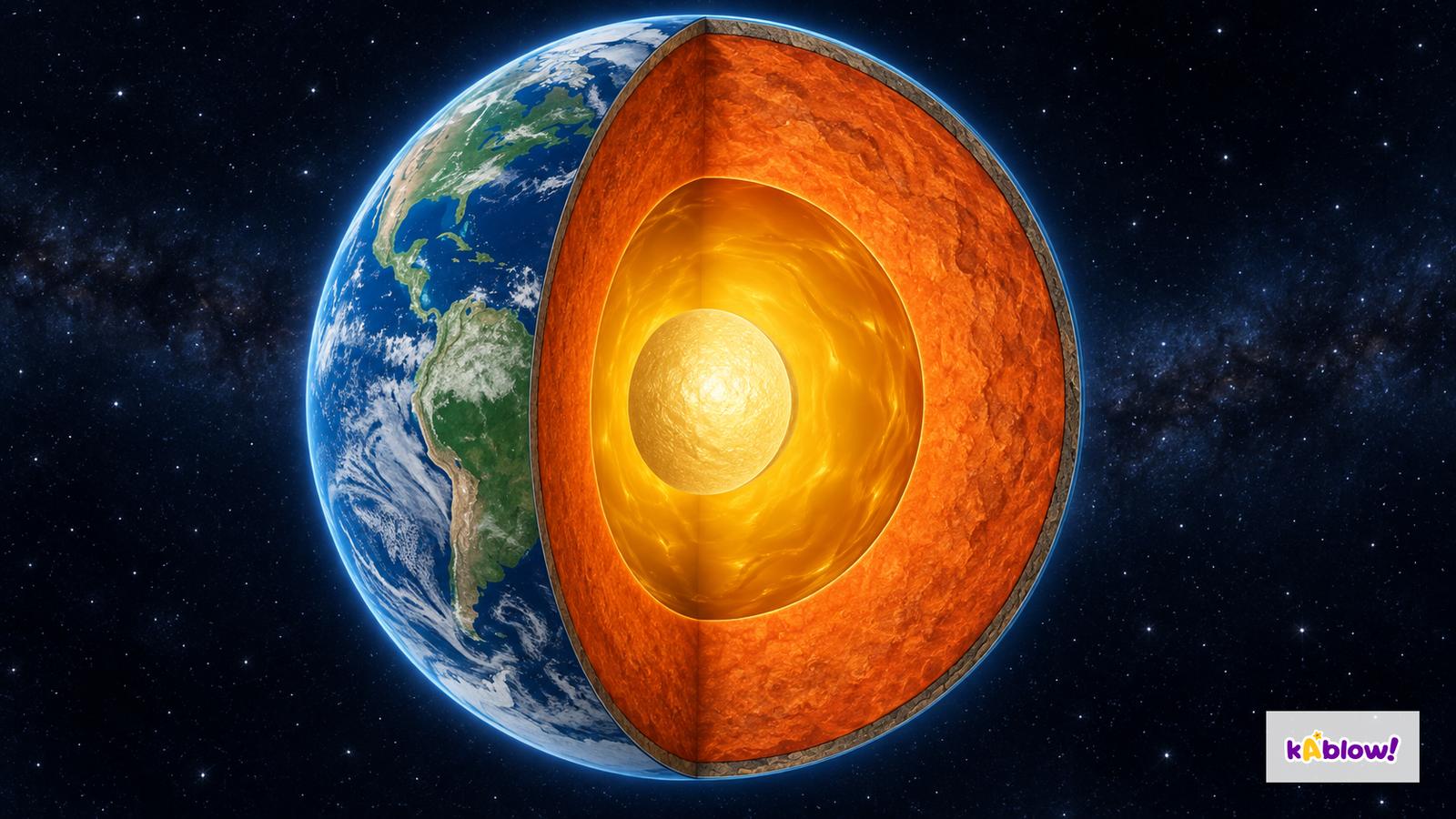
Structure of the Earth
- The thin crust is compositionally distinct from the mantle. Oceanic crust is generally thinner and denser than continental crust, with approximate thickness ranges depending on the setting. The mantle is about 2,900 km thick and mostly solid silicate rock; it can deform and flow slowly over geological time. Local partial melting does not make the whole mantle liquid or semi-molten.
- The outer core is liquid metal, mainly iron with nickel and lighter elements; the inner core is solid under high pressure. The cutaway colours are conceptual layer distinctions rather than a record of visible colour or proof of physical state.
- Tectonic plates consist of rigid lithosphere: crust plus the uppermost mantle. They move relative to one another over a weaker, mostly-solid asthenosphere. Do not equate plates with crust alone or describe them as rafts on a planet-wide magma ocean.
Conceptual Earth cutaway
Why plates move
- Mantle convection and plate motion form a coupled system. A cooling oceanic plate may become negatively buoyant; a descending slab can exert slab pull on the connected plate. Elevated lithosphere at a ridge contributes a gravitational force commonly called ridge push as plates move away from the ridge. Ridge push does not mean newly erupted magma physically wedges the plates apart.
- Mantle flow, slab pull, ridge forces and resistance interact differently among settings. A fixed circular conveyor diagram is a simplification, and not every plate has an attached subducting slab. Hotspots such as Hawaii are commonly linked to hot mantle upwelling and decompression melting, rather than an entirely molten plume rising straight from the core.
Separate the movement mechanisms
Plate boundaries
- At constructive or divergent boundaries, plates separate and mantle upwells. Falling pressure can cause partial melting; magma forms new oceanic crust at ridges. Continental extension can form downfaulted rift valleys. Eruptions and earthquakes vary in severity; do not call all divergent earthquakes gentle or imply every eruption builds an isolated shield cone.
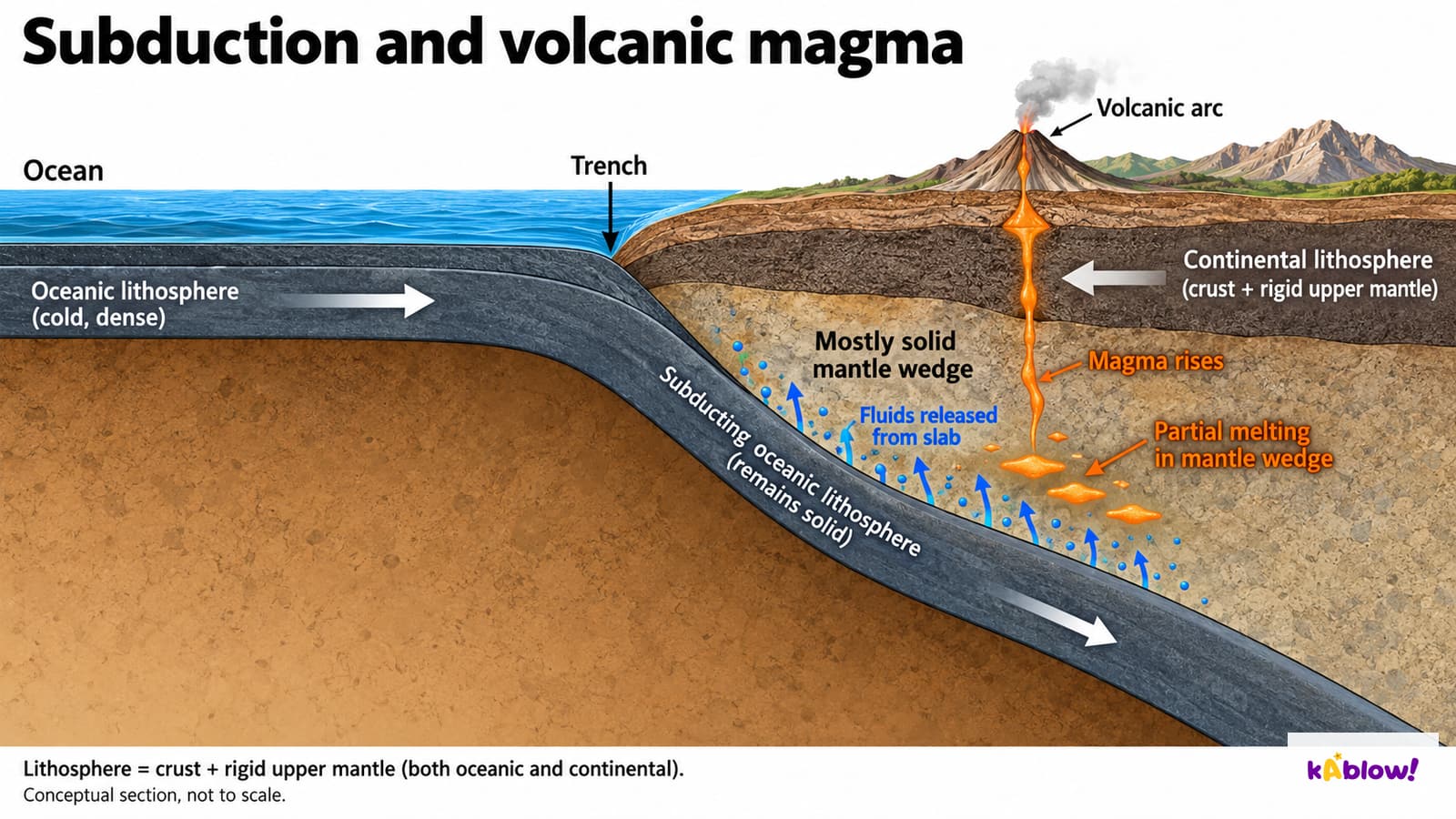
- At subduction boundaries, one oceanic lithospheric plate descends beneath another oceanic or continental plate. Fluid release from the slab promotes partial melting of the overlying mantle wedge. Buoyant magma may rise and evolve to feed a volcanic arc, while most of the mantle and slab remain solid. Trenches and earthquakes over a range of depths are characteristic, but not every segment has an active volcano. The Nazca–South American setting is an ocean–continent example.
- Continental collision, as between India and Eurasia, shortens and thickens crust through folding, faulting and underthrusting, forming mountain belts and earthquakes. It does not normally create a typical subduction volcanic arc simply because two continents meet. Avoid the literal claim that no crust can descend or be underthrust anywhere in collision.
- At conservative or transform boundaries, plates move laterally past one another. Friction can lock a fault segment while strain accumulates; sudden slip releases energy as seismic waves. Lithosphere is not normally created or destroyed at the boundary itself. The invented offset-road figure illustrates geometry, not a real measured displacement or a permanently open canyon.
Subduction and mantle-wedge melting
Distribution
- Most earthquakes are associated with boundaries, but intraplate earthquakes occur. Most volcanism is associated with spreading ridges and subduction arcs, while hotspots add exceptions. The Pacific Ring of Fire includes many subduction margins, transform segments and distinct local settings; it is not a single identical continuous boundary.
- The northern Mid-Atlantic Ridge separates North American and Eurasian plates; farther south the ridge separates South American and African plates. A location-specific plate pair must not be used for the entire ridge. Himalaya, Andes and San Andreas examples show different boundary mechanisms.
- Evidence includes repeated satellite positioning for present motion, magnetic polarity patterns and seafloor ages for spreading history, earthquake locations and depths for boundary geometry, and matching fossils and rocks for former connections. Evidence and model explanation should be linked rather than treating the occurrence of one volcano as proof of a particular movement rate.
Regional examples of boundary processes
Slides
Sign up free to view the lesson slides
Step through every slide for this topic — plus flashcards and revision notes — with a free account.
Questões de prática
Prévia grátis — 8 de 35 perguntas. Cadastre-se para ver todas.
1.What is the Earth's thin outer layer?
Easy- Athe crust
- Bthe mantle
- Cthe core
- Dthe atmosphere
2.What is the Pacific Ring of Fire?
Easy- Aa coral reef
- Ba desert
- Ca type of storm
- Da zone of many volcanoes and earthquakes
3.What is the mantle?
Easy- Athe atmosphere
- Bice
- Cmostly solid hot silicate rock beneath the crust, capable of slow flow
- Da liquid core
4.What is subduction?
Easy- Aplates dissolving
- Bone plate sinking beneath another
- Cplates colliding upwards
- Dplates sliding
5.What forms at a constructive boundary?
Easy- Amid-ocean ridges
- Bdeep trenches
- Cfold mountains
- Ddeserts
6.Which causes plates to move?
Easy- Awind
- Bthe Moon only
- Crivers
- Dinteracting mantle flow, slab pull and gravitational ridge push
7.What is slab pull?
Easy- Aa landslide
- Ba tide
- Ca sinking plate pulling the rest of the plate
- Dplates pushing apart
8.Which plates meet at a destructive boundary near South America?
Easy- ANorth American and African
- BNazca and South American
- CPacific and Indian
- DAfrican and Eurasian
Unlock all 35 questions & more
Crie uma conta grátis para ver todas as perguntas, os slides, flashcards e resumos de revisão deste tópico.
Provas anteriores
A prática com provas anteriores deste tópico chega em breve.
Em breve