
Migration, empires and the people
Aprenda jogando
Responda a estas perguntas para ganhar energia, depois pesque e explore. Sem precisar de conta.
Notas de aula
Early migrations (to 1500)
- Anglo-Saxon and Viking settlement occurred in different movements and contexts, including work, settlement, trade and conquest. Norman conquest in 1066 introduced a new ruling elite while many existing institutions continued. Avoid treating a modern national identity as unchanged across these centuries.
- Organised Jewish communities are documented in England after the Norman Conquest. Edward I ordered expulsion in 1290 amid persecution and financial and political pressures. This was an English order, not a uniform ban across all modern Britain. Some Jews remained or later lived secretly; communal readmission is conventionally associated with 1656 under Cromwell.
Selected migrations: avoid one uniform story
1500-1800
- Huguenots were French Protestants. Religious persecution drove movement before and after the 1685 revocation of the Edict of Nantes. Silk weaving in Spitalfields is one example among varied occupations; not every refugee arrived in 1685 or did the same work.
- African presence in Britain included free people as well as people subjected to enslavement. Imperial connections involved trade, conquest, military service, work, family and forced movement. Do not reduce all Black British history to slavery or describe every imperial migration as freely chosen.
- The 1807 Act prohibited British participation in the transatlantic slave trade; it did not end slavery everywhere. The 1833 abolition legislation took effect in most British colonies on 1 August 1834, with territorial exceptions. Coercive apprenticeship continued until 1838. Enslaved people’s resistance and Black abolitionists were important alongside other campaigns; compensation went to enslavers rather than the people they had enslaved.
Abolition was a process with limits
19th century
- The Great Famine began in 1845. Potato blight interacted with poverty, crop dependence and political and economic conditions, bringing mass death and emigration. Many people moved to Britain, but Irish migration existed before and continued afterwards. Avoid a precise emigration total without defining the years and destinations counted.
- From the 1880s, pogroms, persecution and restrictions in the Russian Empire drove many Jewish refugees, alongside other motives and networks. The 1905 Aliens Act introduced immigration controls amid antisemitic and anti-immigrant campaigning; it was not an explicit universal expulsion of every Jew.
- Push and pull factors are a starting model, not a complete explanation. Individual choices were shaped by resources, family networks, law and unequal freedom to move. Britain’s imperial links with India, Africa and the Caribbean created routes and relationships involving both opportunity and coercion.
20th century
- The Kindertransport brought about 10,000 mainly Jewish children to safety from Nazi-controlled territory, mostly in 1938–39, with a final small transport in 1940. Private organisations, guarantors and families arranged support with government permission. Parents generally could not accompany children, and many were later murdered. Rescue must be studied alongside separation and its limits.
- The Empire Windrush arrived in June 1948, with disembarkation commemorated on 22 June. The full manifest lists 1,027 passengers of varied origins. The often repeated 492 is not the ship’s total passenger count. Earlier Caribbean voyages and Black communities already existed; the voyage became a symbol rather than an absolute beginning.
- People travelled for varied reasons, including work, family and service connections; not all were government recruits. The wider Windrush generation shaped public services, industry, communities and culture. The NHS launched on 5 July 1948, after the voyage, so its later recruitment must not be projected onto every June passenger.
- Idi Amin ordered the expulsion of Asians from Uganda in 1972, with confiscation of property. Around 27,000 came to Britain through the Uganda Resettlement Board. Citizenship, family circumstances and destinations varied; these histories reflected earlier imperial connections.
- Ten states joined the EU in 2004. The UK opened its labour market to workers from the eight central and eastern European accession states, including Poland, with a registration scheme. This is a historical framework, not a description of current entry rights.
Different movements, different contexts
Reception, campaigning and racial discrimination
- Racist exclusion affected employment, accommodation and public life. In 1958 Black residents in Notting Hill experienced targeted attacks and harassment, including far-right agitation. Housing conditions and economic fears must not become excuses for violence or collective blame directed at migrants.
- Powell’s 1968 speech used racist, alarmist rhetoric and opposed the Race Relations Bill. Its claims should be analysed as political statements, not accepted as factual predictions. Communities, campaigners and supporters challenged discrimination and built organisations; migrants were active participants rather than only passive recipients of hostility.
- The 1965 Race Relations Act addressed discrimination in public places. The 1968 Act extended protection to employment and housing, and the 1976 Act addressed direct and indirect discrimination and strengthened institutions. Legislative changes did not automatically end racism. Compare specific settings and lived experiences rather than declaring universal acceptance.
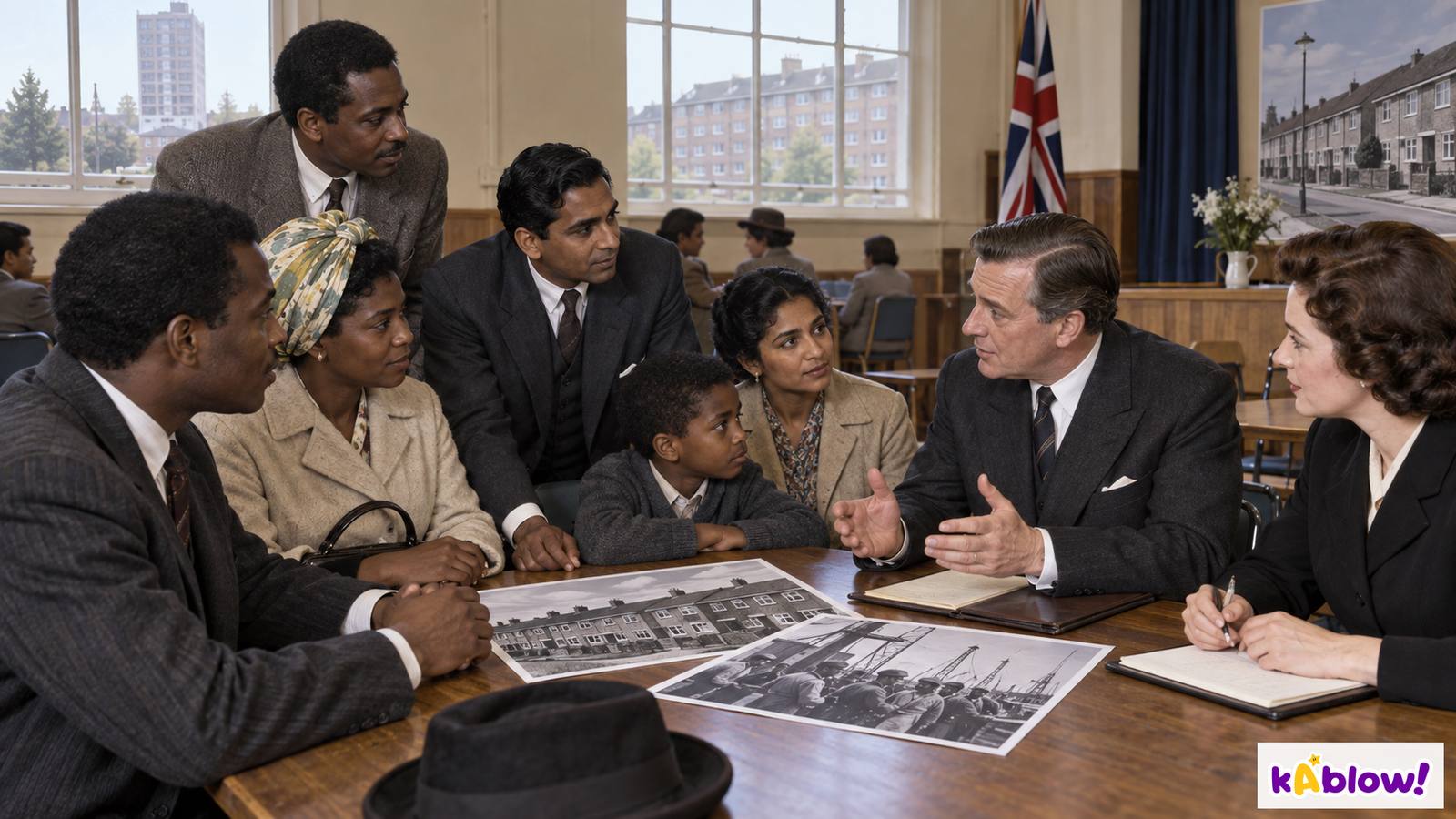
Housing, community discussion and rights
Citizenship, law and the limits of records
- The British Nationality Act 1948 took effect on 1 January 1949, after the June Windrush arrival. It created citizenship of the United Kingdom and Colonies within a wider shared British-subject/Commonwealth framework. It should not be described as first granting all Windrush passengers permission to enter; earlier status and later controls require separate explanation.
- The Commonwealth Immigrants Acts of 1962 and 1968 restricted entry within changing citizenship and immigration arrangements. Groups did not have identical rights at all dates. Political decisions, racialised pressures, legal categories and family circumstances need to be distinguished.
- A passenger list records selected details for an administrative purpose. It cannot establish every person’s motive, welcome or later experience. Cross-check categories and totals, and use letters, testimony, employment records and other evidence to investigate individual experiences. Do not mistake an imagined teaching image for an authenticated photograph.
Windrush: distinguish voyage, law and evidence
Slides
Sign up free to view the lesson slides
Step through every slide for this topic — plus flashcards and revision notes — with a free account.
Questões de prática
Prévia grátis — 8 de 37 perguntas. Cadastre-se para ver todas.
1.In which year did the Empire Windrush bring its well-known group of Caribbean passengers to Tilbury?
Easy- A1948
- B1938
- C1958
- D1968
2.What was the Kindertransport?
Easy- Aa post-war employment recruitment programme
- Ba rescue allowing every child’s parents to accompany them
- Ca programme that began only after the Second World War
- Da rescue movement bringing mainly Jewish children from Nazi-controlled territory
3.What did Edward I order in England in 1290?
Easy- Amade them lords
- Bbanned the Church
- Cexpelled them from England
- Dinvited them
4.In which year did Parliament prohibit British participation in the transatlantic slave trade?
Easy- A1962
- B1807
- C1700
- D1948
5.Who were Huguenots?
Easy- AFrench Protestants
- BSpanish Catholics
- CIrish farmers
- DRussian Jews
6.Which disaster drove a major increase in Irish emigration during the 1840s?
Easy- Athe Armada
- Bthe Windrush
- CProhibition
- Dthe Potato Famine
7.What did the Aliens Act 1905 introduce?
Easy- Aa law explicitly expelling all Jews already in Britain
- Bthe first restrictions on every movement of people in British history
- Cimmigration controls affecting many Jewish refugees from eastern Europe
- Dautomatic entry for every refugee regardless of circumstances
8.Why did some post-war employers recruit workers from the Caribbean?
Easy- Abecause the Windrush was the first ship ever to cross the Atlantic
- Bto fill labour shortages in services and industry
- Cbecause every Caribbean arrival already had the same government job
- Dbecause only military service permitted entry
Unlock all 37 questions & more
Crie uma conta grátis para ver todas as perguntas, os slides, flashcards e resumos de revisão deste tópico.