
Traditional and world music
Aprenda jogando
Responda a estas perguntas para ganhar energia, depois pesque e explore. Sem precisar de conta.
Para educadores: slides de aula, resumos de revisão prontos para usar de Traditional and world music (Music, Areas of Study) — use na sua aula ou rode o tópico como atividade interativa de turma que seus aprendizes jogam como um jogo ao vivo.
Notas de aula
Folk and traditional
- Folk and traditional practices are living, varied ways of making and sharing music. Learning by ear, demonstration and participation can coexist with notation, recordings and formal teaching. Repertoire may be inherited, newly composed, adapted or improvised; traditional does not mean fixed or simple.
- Irish traditional examples include fiddle, tin whistle, bodhrán, accordion and pipes in different combinations, as well as singing. Some songs use repeated verse or strophic structures and some instrumental music supports dancing, but a single list of forms or instruments cannot represent every Irish, Scottish or English tradition.
Transmission can combine several methods
Selected West African examples
- The djembe is a goblet-shaped hand drum associated with particular West African traditions and their wider spread. A selected ensemble may use interlocking parts, ostinato, call and response or improvisation. These are processes also found elsewhere, not compulsory features of every African performance.
- Some pressure or talking drums vary head tension and pitch in ways linked to speech contours in particular language practices. A kora is a plucked bridge harp associated with Mande-related traditions, while mbira refers to other lamellophone traditions, notably in southern Africa. Their instruments, roles and cultural settings should not be collapsed into one generic drumming style.
Describe processes in the selected passage
Selected Hindustani classical roles
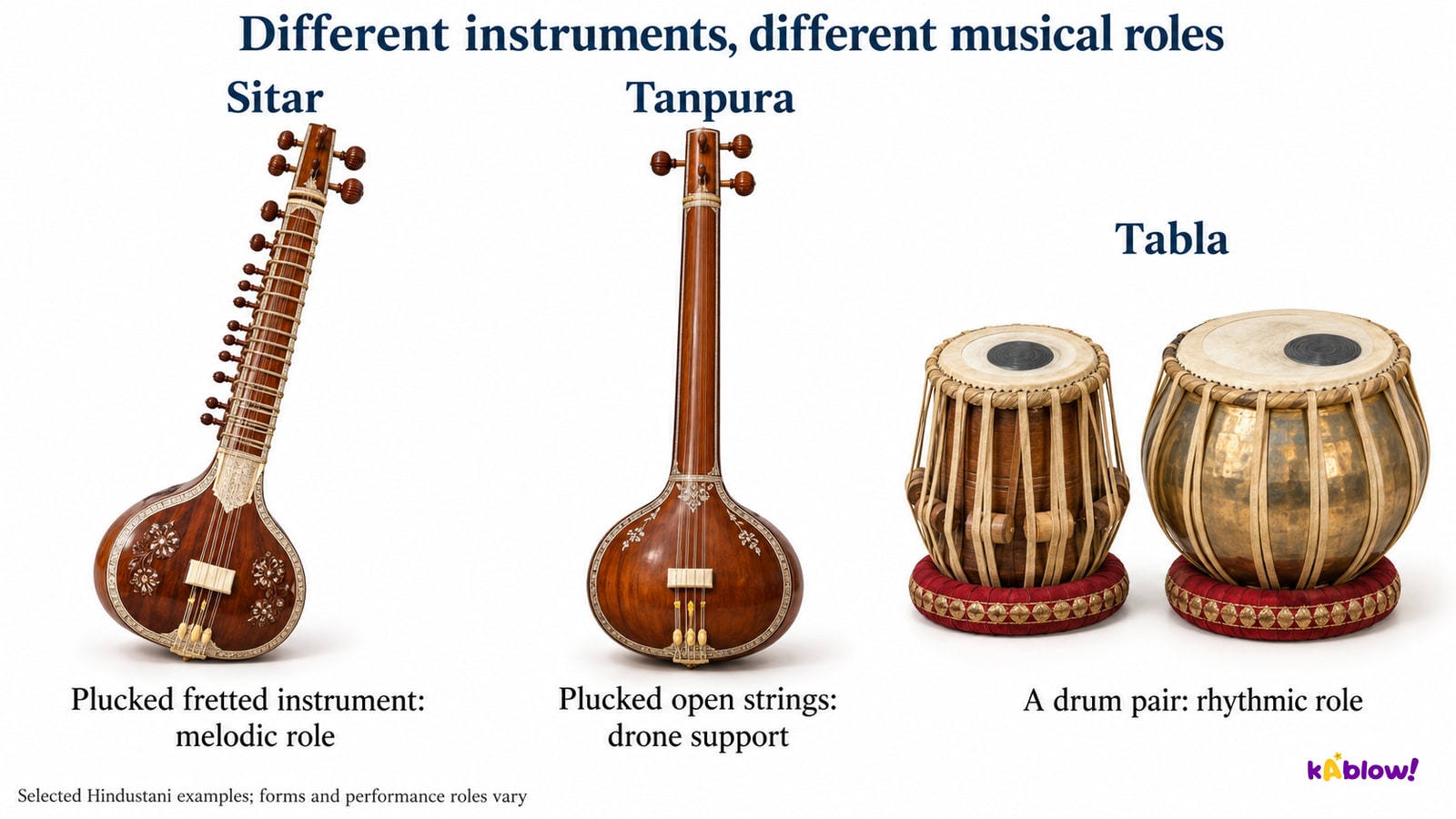
- Indian classical music includes major Hindustani and Carnatic traditions alongside many other regional musical practices. The selected instrument example here is Hindustani: sitar can develop melody, tanpura supports a recurring drone, and tabla supplies rhythmic participation or solo material. None of these is the only possible instrument or role.
- Raga involves characteristic pitches, phrases, emphasis, movement and ornament, with contextual associations; it is not only a scale or one fixed mood. Tala provides a recurring rhythmic framework with organised beats and subdivisions. Creative exploration follows learned practices rather than random notes.
- In some Hindustani instrumental formats, an alap introduces a raga without a fixed tala accompaniment; subsequent jor introduces pulse and jhala can develop rapid figuration. Format and terminology vary. These are not universal stages of every Indian classical performance, and unmetered does not mean devoid of all rhythmic shape.
Selected Hindustani instrument roles
Latin American
- Samba refers to varied Brazilian music and dance traditions with important Afro-Brazilian roots. Samba de roda in Bahia has a particular history and performance setting, while other samba ensembles use different instruments, roles and contexts. A low surdo pulse, tamborim or agogo is relevant in some examples, not all Brazilian music.
- Salsa, tango and bossa nova name different traditions with their own communities and histories. Describe a selected performance rather than treating Latin America as one rhythmic or instrumental category.
Caribbean
- Steelpan developed in Trinidad and has tuned areas in a steel surface. Different pan types cover different ranges and perform many repertoires. Calypso has Trinidadian traditions of storytelling, wit and social commentary, without requiring every song to be comic.
- Reggae developed in Jamaica and often features prominent bass and offbeat chordal articulation, sometimes called skank, on guitar or keyboard. An isolated offbeat is not enough to identify the entire tradition or its cultural meaning.
Different categories in Caribbean examples
Selected Arabic and Indonesian frameworks
- In the Arabic context, maqam combines pitch relationships with characteristic phrases, development and expressive practice. A scale diagram alone would not capture all of it. The oud is a plucked fretless lute used in several Middle Eastern, North African and related traditions; the specific repertoire and context matter.
- Gamelan refers to Indonesian ensemble traditions and their sets of instruments, often including gongs, metallophones, drums and sometimes strings, flutes or voices. Javanese and Balinese practices vary. Interlocking parts and cyclic organisation are relevant to particular repertoires rather than every Asian performance.
- In Javanese court-style examples, slendro has five principal pitches while pelog has a seven-pitch system with selected subsets in use. Actual intervals and tuning vary, including between ensembles. Pelog must not be called universally pentatonic, nor either system equated automatically with a Western equal-tempered scale.
Selected Javanese tuning-system distinctions
Compare selected examples fairly
- Name the specific tradition, performer and repertoire, then connect a musical observation to relevant evidence. Compare such features as melodic organisation, rhythmic framework, instrumental roles, interaction or transmission with appropriate context.
- A shared process such as call and response does not make two traditions identical, while a difference between two chosen performances does not prove a rule for a country or continent. The written tables and illustration teach concepts and roles, not recognition of a supplied audio excerpt.
Make the comparison specific
Slides
Sign up free to view the lesson slides
Step through every slide for this topic — plus flashcards and revision notes — with a free account.
Questões de prática
Prévia grátis — 8 de 36 perguntas. Cadastre-se para ver todas.
1.What is folk music?
Easy- Atraditional music of a community
- Bmodern electronic music
- Copera
- Dfilm music
2.What does oral tradition mean?
Easy- Amusic written in books
- Bmusic from computers
- Cmusic taught only in schools
- Dmusic passed on by ear
3.Which is a folk instrument from Ireland?
Easy- Atabla
- Bkora
- Cbodhrán
- Dsitar
4.What is a tin whistle?
Easy- Aa keyboard
- Ba duct flute prominent in Irish traditional music
- Ca drum
- Da string instrument
5.What is a djembe?
Easy- Aa West African drum
- Ban Indian string instrument
- Ca flute
- Dan organ
6.What is a sitar?
Easy- Aan African drum
- Ban Irish whistle
- Ca brass instrument
- Dan Indian plucked string instrument
7.What are tabla?
Easy- Awind instruments
- Bkeyboards
- Ca pair of Indian drums
- Dstringed instruments
8.What is a raga?
Easy- Aa choir
- Ba melodic framework with characteristic pitches, phrases and development
- Ca rhythm cycle
- Da drum pattern
Unlock all 36 questions & more
Crie uma conta grátis para ver todas as perguntas, os slides, flashcards e resumos de revisão deste tópico.
Provas anteriores
A prática com provas anteriores deste tópico chega em breve.
Em breve