
The muscular system
Aprenda jogando
Responda a estas perguntas para ganhar energia, depois pesque e explore. Sem precisar de conta.
Notas de aula
Types of muscle
- Three main tissues are skeletal, smooth and cardiac muscle. Skeletal muscle supports movement and posture and is commonly voluntary, while smooth muscle in organ and vessel walls and cardiac muscle in the heart operate largely involuntarily. Skeletal activity also includes automatic postural and reflex responses.
- Control labels overlap with tissue categories and must not be counted as extra independent types. Cardiac muscle is highly fatigue resistant under normal conditions but is not immune to oxygen shortage, disease or failure; never tires is an unsuitable absolute.
Tissue and control are different classifications
Major muscles
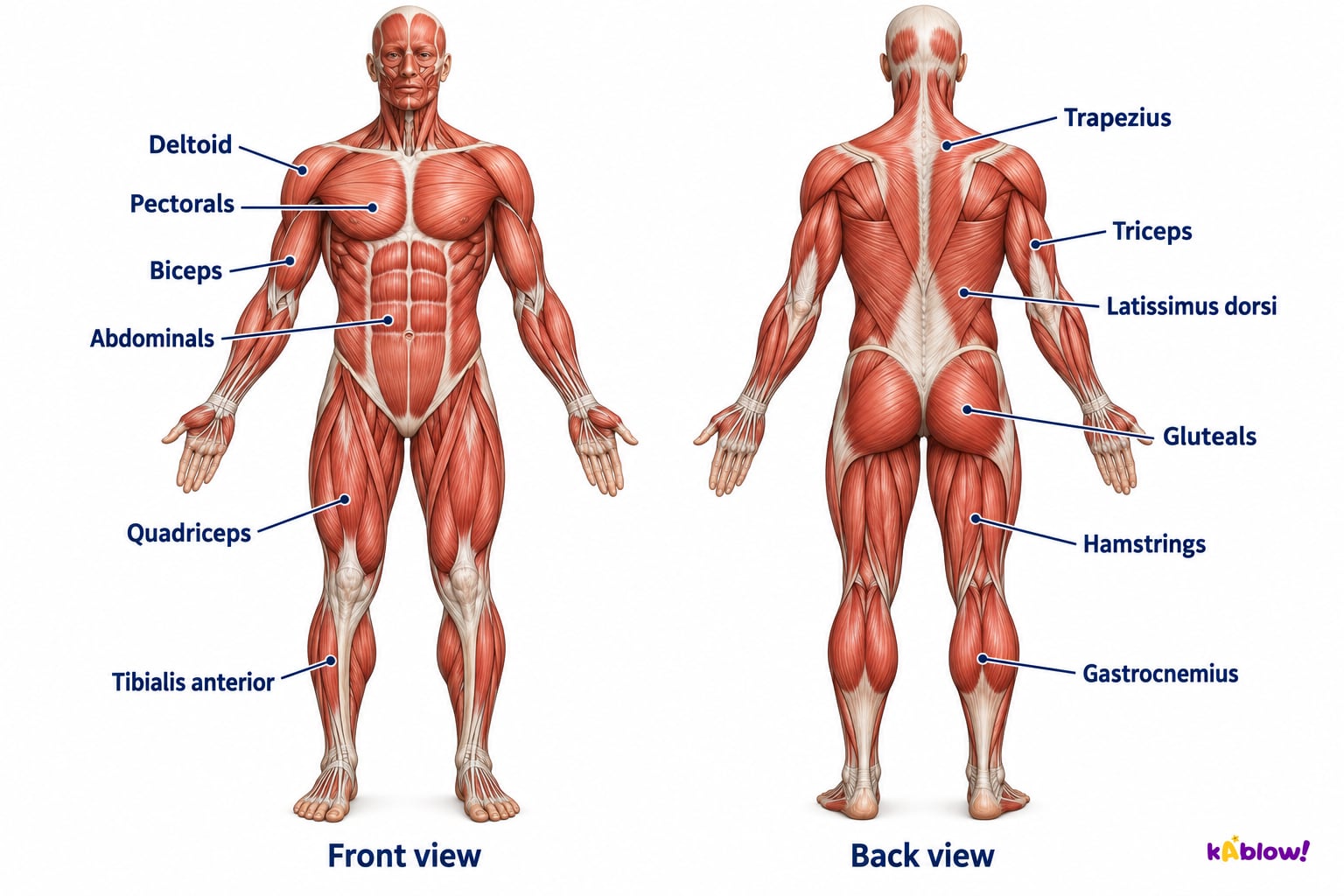
- The original superficial chart shows front deltoid, pectorals, biceps, abdominals, quadriceps and tibialis anterior; the back shows trapezius, triceps, latissimus dorsi, gluteals, hamstrings and gastrocnemius. Abdominals belong to the abdominal wall rather than being the stomach organ. The diagram is a location aid, not a fitness or body-shape target.
- Hip flexors and the rotator-cuff group are deeper and not labelled on this superficial view. Hip flexors contribute to hip flexion; rotator-cuff muscles contribute to shoulder rotation and stability. Muscle groups can have several actions and work with other muscles; the chart is not a complete anatomical atlas.
Selected superficial muscles: front and back
Antagonistic pairs
- Antagonistic muscles have opposing action roles at a specified joint: biceps/triceps at the elbow, quadriceps/hamstrings at the knee, hip flexors/gluteals at the hip, and tibialis anterior/calf muscles at the ankle are useful simplified examples. The agonist is a prime mover in the stated action.
- In a simple active movement, opposing activation may reduce to allow it, as shown in the existing elbow illustration. Real control can include co-contraction for stability and eccentric braking. Do not infer that the antagonist must always be fully relaxed or that a joint extending proves its extensor is shortening.
Simplified opposing actions at the elbow

Contractions
- A concentric contraction develops force while shortening, eccentric while lengthening and isometric with no appreciable overall length change in the stated action. An active lengthening muscle is not simply a relaxed muscle; holding a posture can be demanding despite no visible movement.
- GCSE PE commonly uses isotonic for length-changing concentric/eccentric actions. Strictly the term means constant tension, which real exercise movements need not maintain. Use the course convention and specify the muscle, joint and load when analysing a movement rather than relying on direction alone.
Active force does not always shorten muscle
Muscle fibres
- Type I fibres generally shorten more slowly and support sustained oxidative, fatigue-resistant work. Type II fibres can shorten and produce force more rapidly; IIa and IIx differ in metabolic properties and fatigue resistance. Fast-twitch does not mean no aerobic contribution, and slow-twitch does not mean impossible to fatigue.
- Muscles contain mixtures and recruitment changes with demand. Training, technique, development and other factors affect performance, so fibre type cannot determine participation or guarantee success in a sport. Detailed subtypes are extension where a board requires less detail.
Compare fibre tendencies
Tendons
- Tendons transmit muscle force to bone through connective tissue. Ligaments connect bone to bone and help stabilise joints. These structures are not muscle tissue and do not independently shorten as a muscle contraction.
- Skeletal muscles apply tensile pull through attachments; movement in other directions comes from opposing actions, external forces and controlled activation. A tendon must not be confused with the antagonist muscle or with a bone; joint geometry and appropriate loading influence force transmission.
Transmit force and stabilise joints
Muscle tone
- Muscle tone concerns background activity and resistance contributing to posture and readiness. It is not a visible appearance category or proof of strength. Different fibres and motor units contribute under neural control rather than every fibre being permanently maximally contracted.
- Opposing muscles may co-activate to support joint stability, including during static tasks. No visible motion does not mean no force or energy cost. Roles and activation depend on the task, load and required precision.
Tone, posture and co-activation
Analyse a curl by phase and load
- With a hand-held weight and the upper arm held still, elbow flexion to raise it can involve concentric elbow-flexor action; holding the position can involve isometric force. Slow controlled lowering under gravity can involve biceps lengthening eccentrically while the elbow extends.
- By contrast, active elbow extension against a resisting force can involve concentric triceps. The same joint direction can therefore occur with different active muscles and contraction types. These are mechanics examples, not an instruction to attempt any particular load.
Same flexor, different task phases
Slides
Sign up free to view the lesson slides
Step through every slide for this topic — plus flashcards and revision notes — with a free account.
Questões de prática
Prévia grátis — 8 de 39 perguntas. Cadastre-se para ver todas.
1.Which muscle forms the rounded cap over the shoulder?
Easy- Adeltoid
- Bpectoral
- Clatissimus dorsi
- Dtrapezius
2.Which muscle is in the chest?
Easy- Adeltoids
- Babdominals
- Cgluteals
- Dpectorals
3.Which muscle is on the front of the upper arm?
Easy- Adeltoid
- Btrapezius
- Cbiceps
- Dtriceps
4.Which muscle is on the back of the upper arm?
Easy- Apectoral
- Btriceps
- Cbiceps
- Ddeltoid
5.Which group forms part of the anterior abdominal wall, rather than the stomach organ?
Easy- Aabdominals
- Bpectorals
- Ctrapezius
- Dbiceps
6.Which muscle is the buttock muscle?
Easy- Ahamstrings
- Bquadriceps
- Cdeltoids
- Dgluteals
7.Which muscle is on the back of the thigh?
Easy- Acalf
- Bgluteals
- Chamstrings
- Dquadriceps
8.Which broad muscle covers much of the lower lateral back?
Easy- Apectoral
- Blatissimus dorsi
- Cdeltoid
- Dbiceps
Unlock all 39 questions & more
Crie uma conta grátis para ver todas as perguntas, os slides, flashcards e resumos de revisão deste tópico.