
Speaking and writing in Spanish
Aprenda jogando
Responda a estas perguntas para ganhar energia, depois pesque e explore. Sem precisar de conta.
Para educadores: slides de aula, resumos de revisão prontos para usar de Speaking and writing in Spanish (Spanish, Exam Skills) — use na sua aula ou rode o tópico como atividade interativa de turma que seus aprendizes jogam como um jogo ao vivo.
Notas de aula
Speaking tasks
- Speaking requirements differ by board and tier. Role plays simulate a situation, visual tasks use supplied images and conversations develop answers. Current AQA Spanish 8692 includes reading aloud with follow-up interaction; check your own specification.
- Answer and ask what the task requires, using appropriate register and length. Add detail where relevant; a memorised speech cannot replace a required question. This lesson supplies written practice models, not an audio recording or a measured pronunciation assessment.
Choose language for the task
Developing answers
- Develop a requested opinion with a reason and detail: Me gusta mi ciudad porque hay un parque. Los sábados veo allí a mis amigos. Porque gives a reason, pero and sin embargo contrast, además addition, por ejemplo an example and por eso a consequence.
- Choose relevant time frames: fui al museo is a past visit, voy a visitar is a future plan and me gustaría visitar a conditional wish. Voy alone can be present movement. Accuracy and relevance matter alongside range.
Develop a relevant answer
Describing a photo
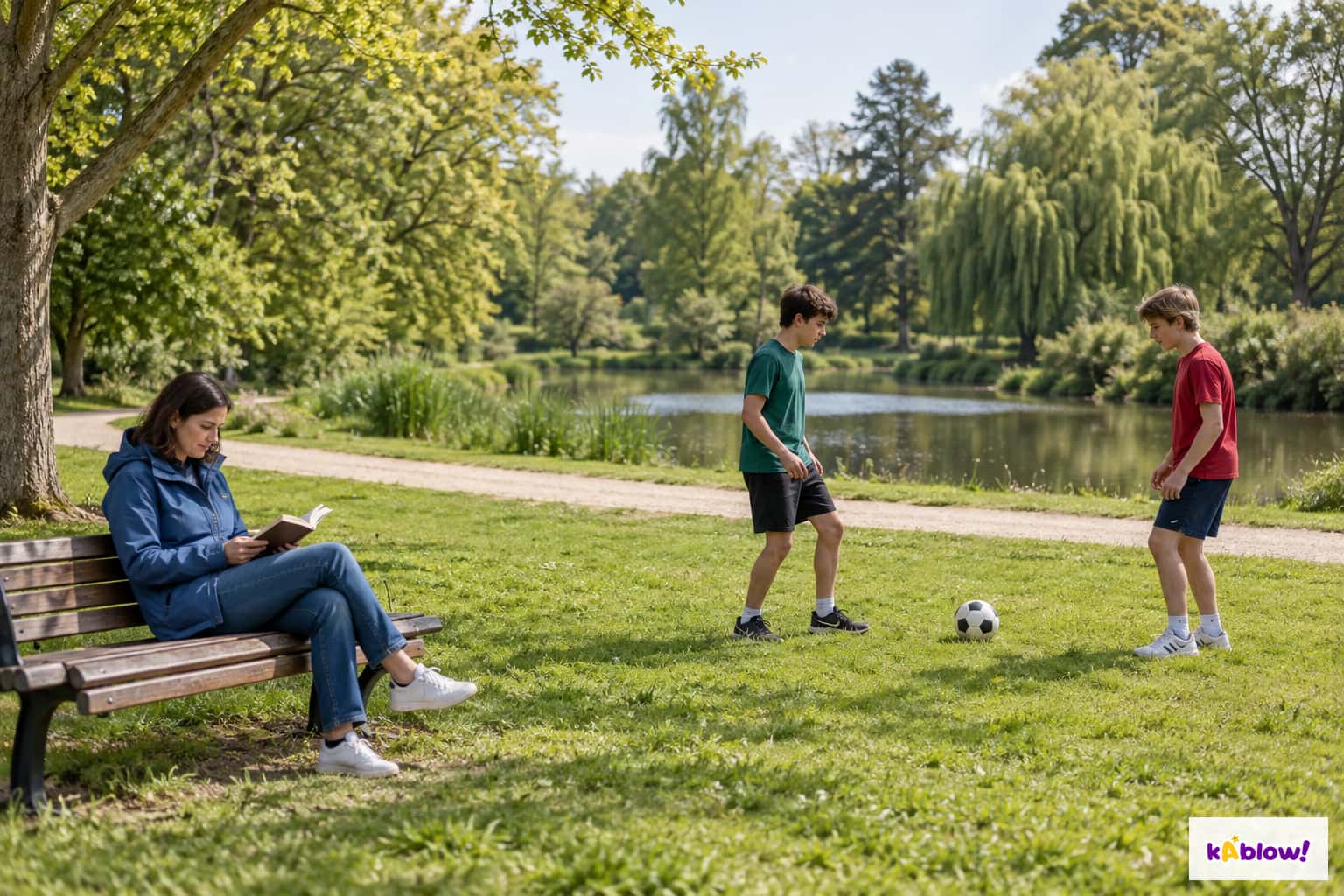
- Use the original generated park illustration: En la imagen hay tres personas. A la izquierda, una persona con una chaqueta azul está leyendo en un banco. A la derecha, dos personas están cerca de un balón. Al fondo hay árboles y agua.
- Left and right follow the viewer’s perspective here. En primer plano is foreground; al fondo background. A still ball does not prove a captured kick, and visible people do not establish names, family relationships, nationality or feelings. Distinguish observation from an uncertain inference.
Original park scene for Spanish picture practice
Handling unexpected questions
- No entiendo means I do not understand; ¿Puede repetir, por favor? requests repetition and ¿Puede hablar más despacio? requests slower speech. These use polite usted. In an assessment, follow the rules on repeating or rephrasing the particular prompt.
- A brief pause, bueno or pues can organise a response. En realidad introduces a clarification with meaning. Rephrase with words you know rather than replacing the answer with repeated fillers.
Clarify in conversation
Writing tasks
- Plan from the actual content bullets, response type and stated word count. Counts differ across boards, tiers and tasks, so 90–150 words is not a universal target. Cover each requested point coherently; a different order is acceptable unless instructions require one.
- Draft a connected message with appropriate reasons and time frames. Then check meaning, verbs, agreement and spelling. The lesson’s fictional models are examples, not compulsory scripts or a request for private information.
Plan the actual writing task
Translation into Spanish
- Translate the intended speaker, references and time. My friends are happy because they are going to visit a museum can be Mis amigos están contentos porque van a visitar un museo. The plural adjective and verbs match the group.
- For a feminine plural group use Mis amigas están contentas porque van a visitar un museo. Subject pronouns can be omitted when the reference is clear. Check articles, pronouns, negatives and word order; do not translate English mechanically.
Translate the intended reference
Checking
- Check task coverage and meaning first: who, when, negation and quantity. Then check verb conjugation, noun/adjective agreement, articles, pronouns and word order.
- Check spelling including acute vowel accents, él/el and sí/si, and the distinct letter ñ. Direct questions and exclamations take paired ¿…? and ¡…! around the relevant portion. Assessment consequences depend on the criteria; there is no universal fixed penalty for every accent error.
Check meaning before fine details
Complex structures
- Después de comer, hice los deberes uses an infinitive after después de, with the eater and the person doing homework the same in this model. Llevo dos años estudiando español includes a duration and gerund for an activity continuing now; llevar plus time alone is not the complete pattern.
- Si llueve, me quedaré en casa uses present indicative then future for this real future condition. Cuando sea mayor, viajaré uses present subjunctive for future reference; cuando tengo tiempo, leo uses indicative for a routine. These are context-specific models, not blanket rules for every si or cuando.
Use grammar for its stated meaning
Slides
Sign up free to view the lesson slides
Step through every slide for this topic — plus flashcards and revision notes — with a free account.
Questões de prática
Prévia grátis — 8 de 37 perguntas. Cadastre-se para ver todas.
1.What does "a la izquierda" mean?
Easy- Aon the left
- Bon the right
- Cin front
- Dbehind
2.What does "a la derecha" mean?
Easy- Aon the left
- Bin front
- Cbehind
- Don the right
3.In a picture description, what does al fondo mean?
Easy- Aon the left
- Bat the end of the year
- Cin the background
- Din the foreground
4.What does "en primer plano" mean?
Easy- Aat the top
- Bin the foreground
- Cin the background
- Don the right
5.Referring to ellos, what does están jugando mean?
Easy- Athey are playing
- Bthey were playing
- Cthey will play
- Dthey played
6.What does "no entiendo" mean?
Easy- AI do not know you
- BI do not agree
- CI do not like
- DI do not understand
7.What does "¿Puede hablar más despacio?" mean?
Easy- Acan you write more
- Bcan you speak faster
- Ccan you speak more slowly
- Dcan you speak louder
8.In conversation, what can bueno do as a discourse marker?
Easy- Asays no
- Bintroduce a response and allow a brief thinking pause
- Cends the conversation
- Dasks a question
Unlock all 37 questions & more
Crie uma conta grátis para ver todas as perguntas, os slides, flashcards e resumos de revisão deste tópico.
Provas anteriores
A prática com provas anteriores deste tópico chega em breve.
Em breve