
Equilibrium Constant (Kp) For Homogeneous Systems
விளையாடிக் கற்றுக்கொள்ளுங்கள்
ஆற்றல் சம்பாதிக்க இந்த கேள்விகளுக்குப் பதிலளியுங்கள், பின்னர் மீன் பிடித்து ஆராயுங்கள். கணக்கு தேவையில்லை.
பாட குறிப்புகள்
Identify a homogeneous dynamic equilibrium
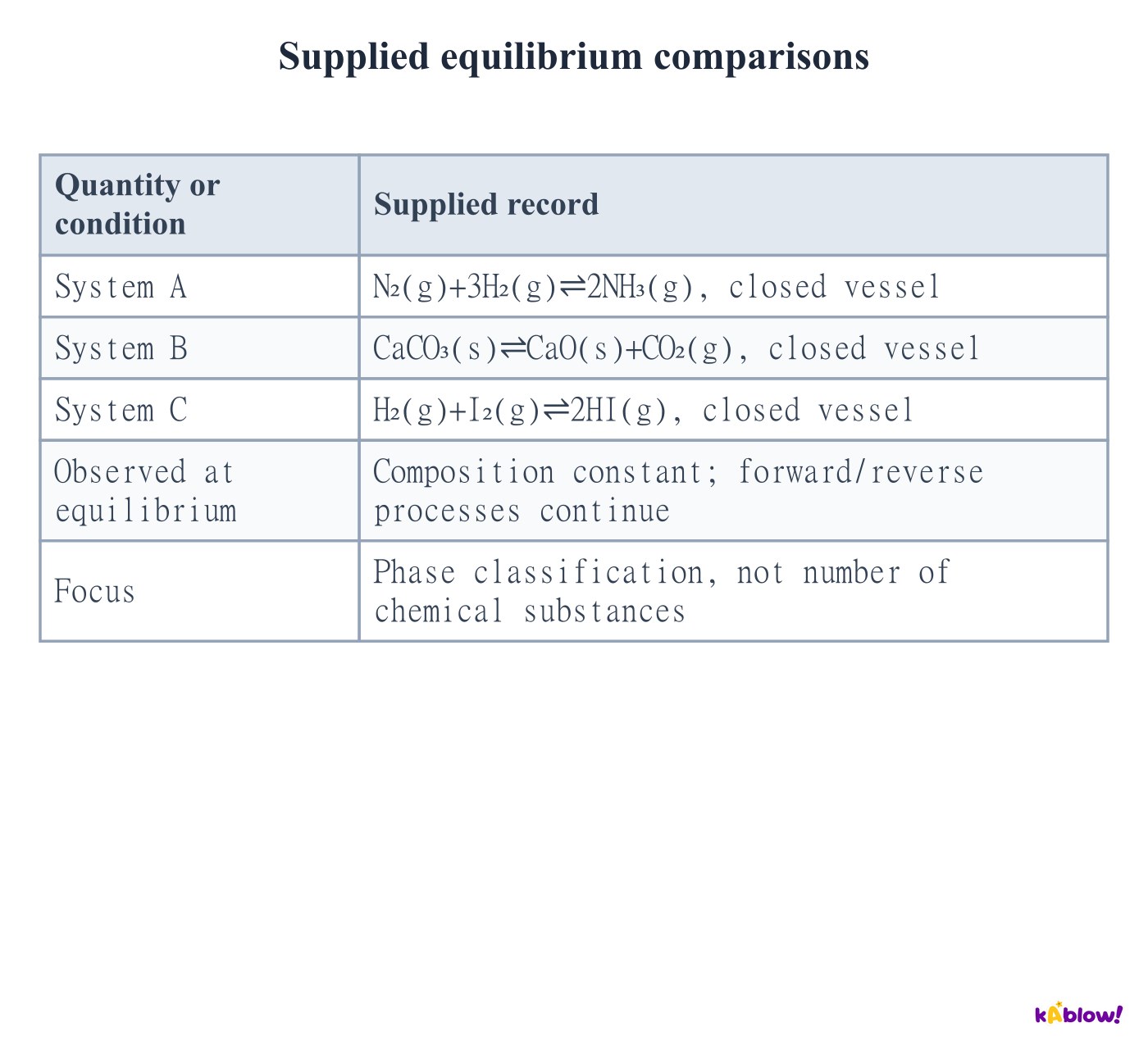
- A homogeneous equilibrium has all participating species in one phase. A mixture of several gases is homogeneous; one solid plus a gas is not.
- In a closed system at equilibrium, forward and reverse rates are equal while molecular reactions continue. Species amounts need not be equal.
- For a specified all-gas equation, Kp relates equilibrium partial pressures at a stated temperature. It is a composition relation, not a measure of how quickly equilibrium is reached.
Supplied equilibrium comparisons
Relate partial pressure to mole fraction
- For an ideal mixture, p(A)=y(A)Ptotal with y(A)=n(A)/ntotal. Partial pressure is what A alone would exert at the same volume and temperature.
- The supplied mixture has y(A)=2/(2+3)=0.40 and p(A)=0.40×150=60 kPa.
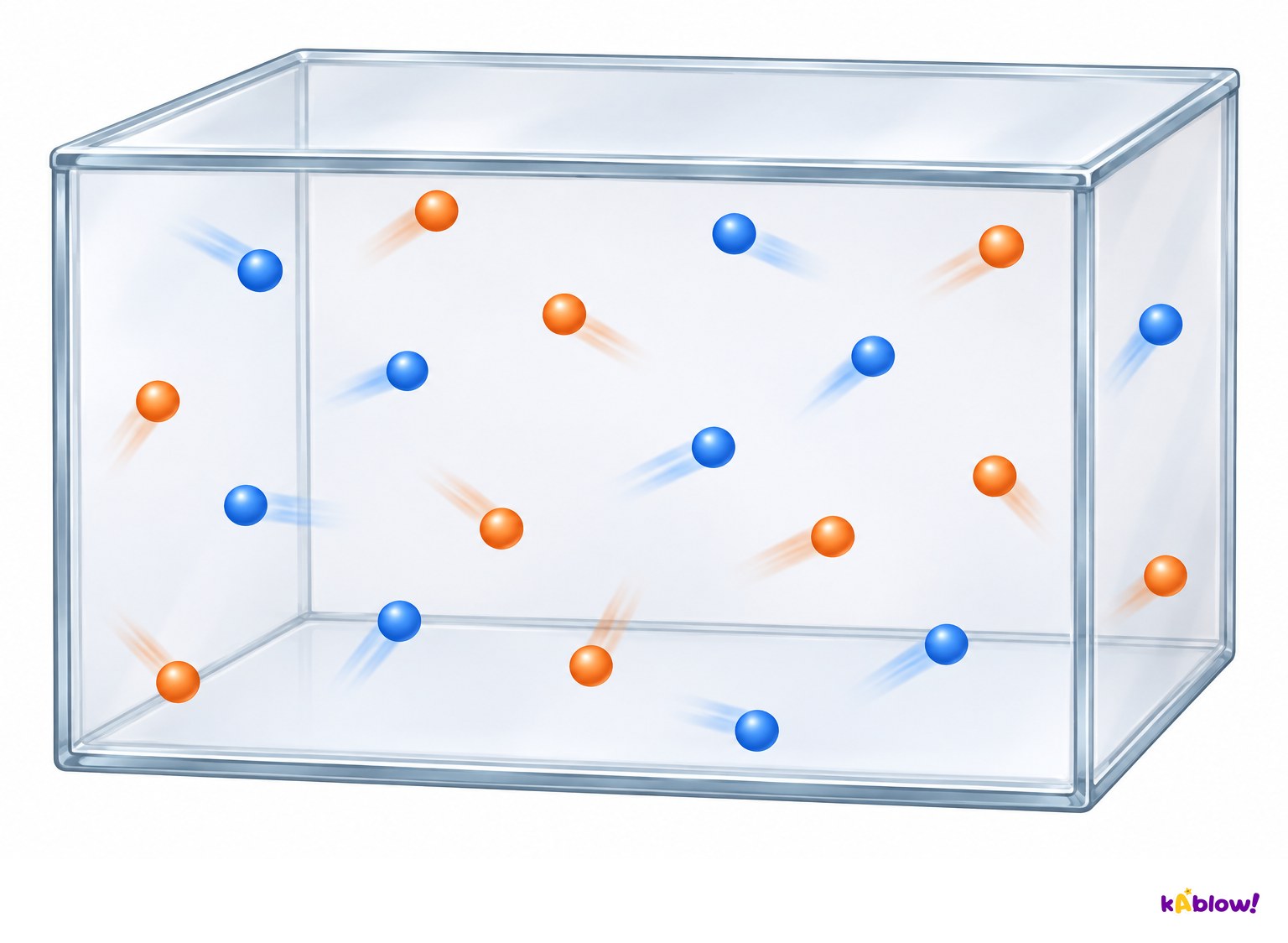
- Both species occupy the whole container. The qualitative mixture illustration shows intermingling, not separated volumes or a measured particle ratio.
Two gases share the full container
Include every gas in the mole-fraction denominator
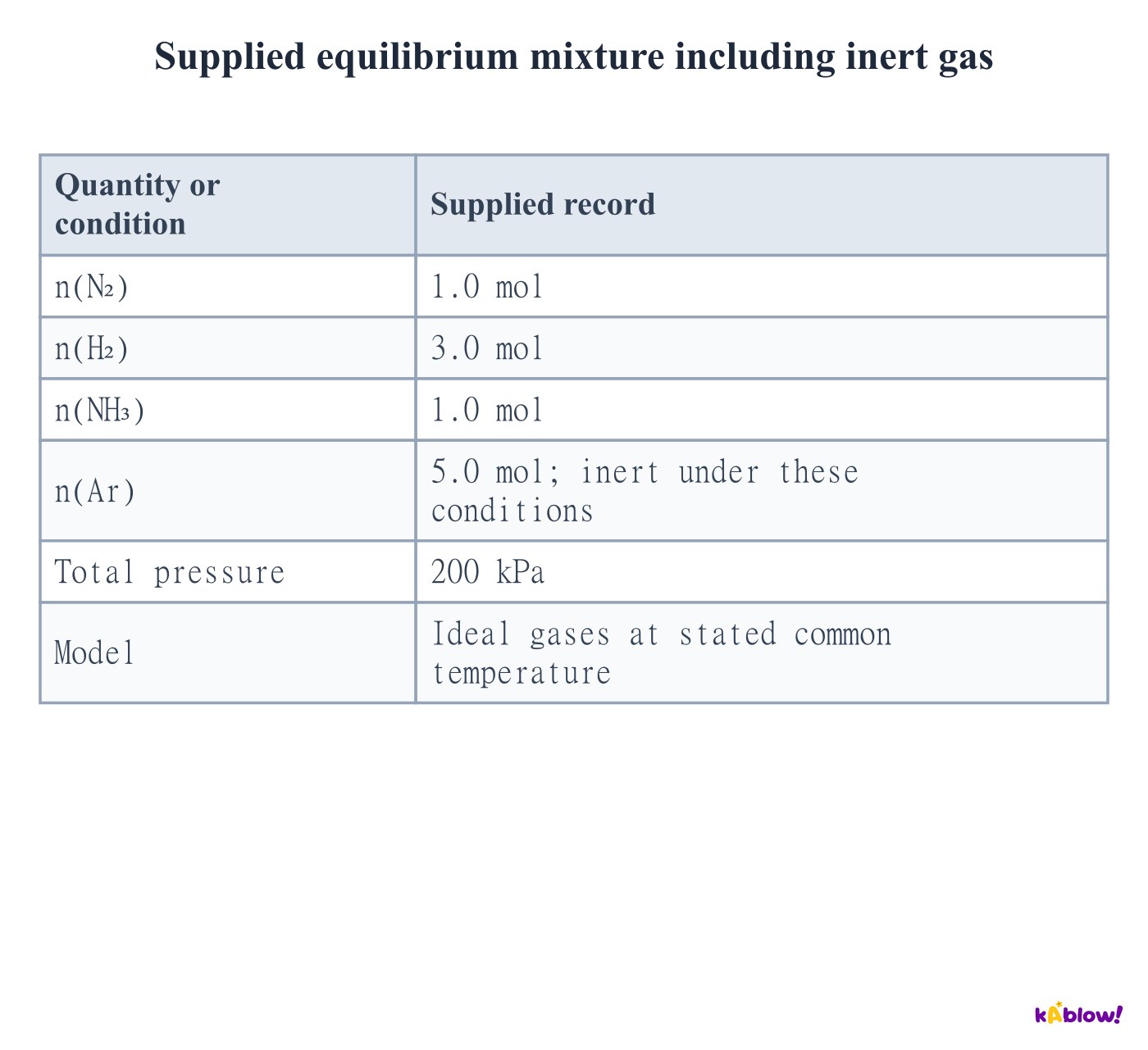
- Add equilibrium amounts of all gas species, including inert gases, when calculating total gas moles. An inert gas can contribute pressure without appearing in the reaction equation.
- The supplied mixture has10.0 mol in total. Nitrogen has mole fraction0.10, giving p(N₂)=20 kPa at200 kPa total.
- The mole fractions sum to one and partial pressures sum to total pressure. Use equilibrium amounts and retain unrounded intermediate values.
Supplied equilibrium mixture including inert gas
Construct a pressure-power equilibrium expression
- Raise each gas partial pressure to its stoichiometric coefficient. Multiply product terms and divide by reactant terms.
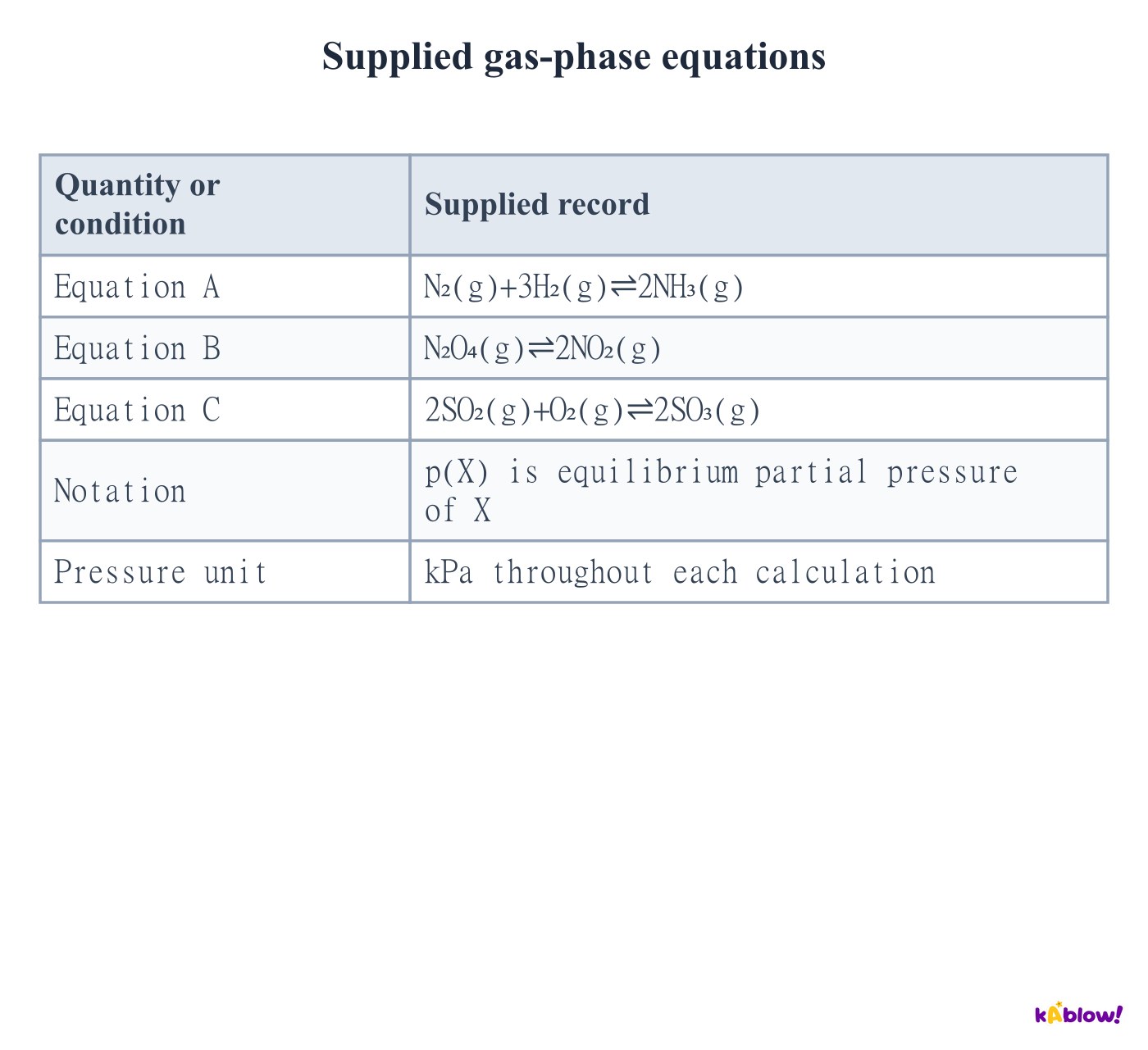
- For N₂+3H₂⇌2NH₃, Kp=p(NH₃)²/[p(N₂)p(H₂)³]. These powers are coefficients, not equilibrium amounts in moles.
- Use p(X) for partial pressure. Square brackets usually denote concentration; do not substitute concentrations into a pressure-based expression.
Supplied gas-phase equations
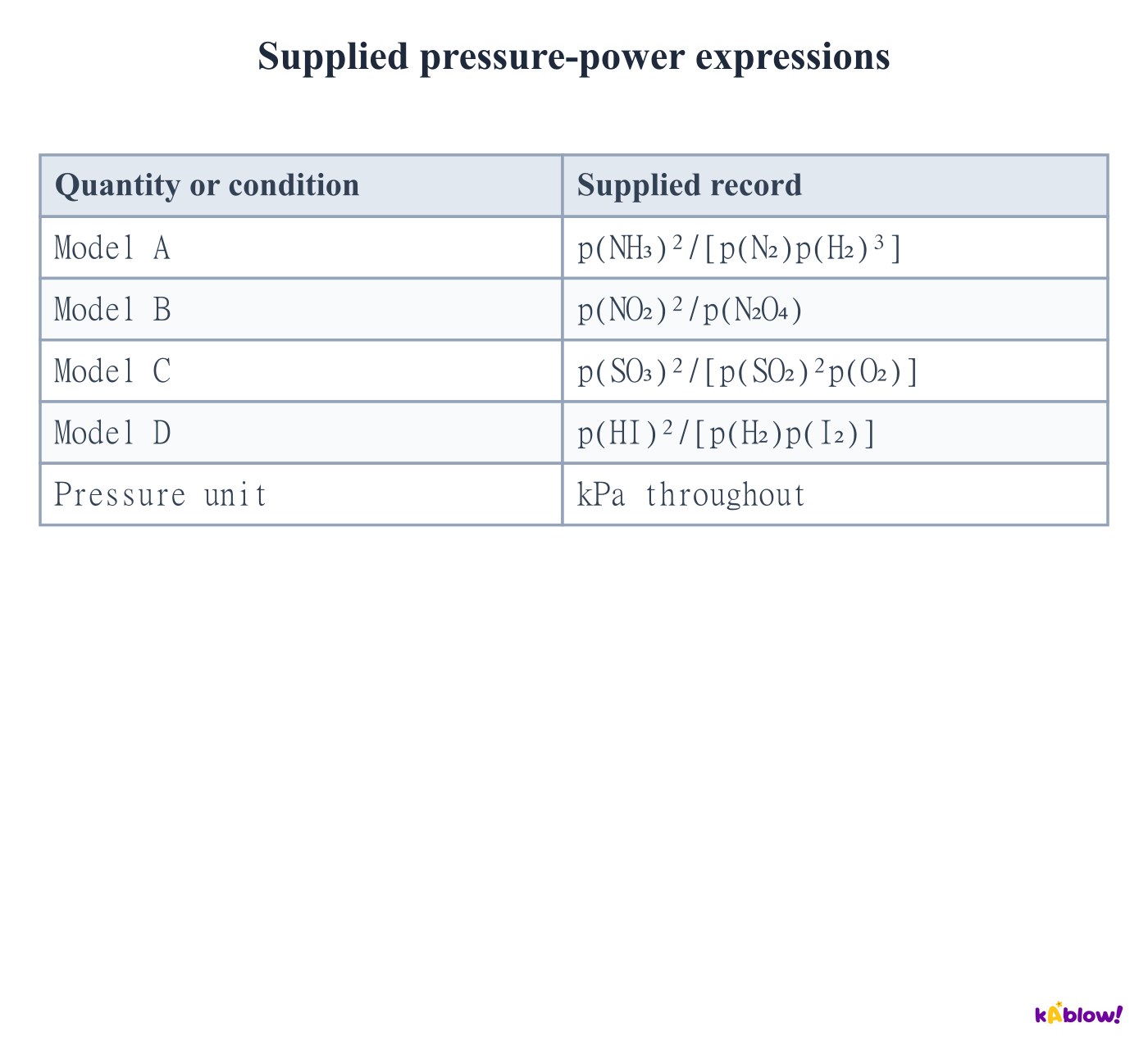
Derive the units in the AQA pressure-power convention
- Pressure-power Kp has units(pressure)^Δν, where Δν is total gaseous product coefficients minus total gaseous reactant coefficients.
- Using kPa, ammonia formation has kPa⁻², N₂O₄ dissociation has kPa, and SO₃ formation has kPa⁻¹. Equal gas totals give cancellation.
- A thermodynamic equilibrium constant instead uses dimensionless activities such as p/p°. Keep this distinction clear; use the convention and pressure unit requested in the question.
Supplied pressure-power expressions
Recognise when total pressure cancels
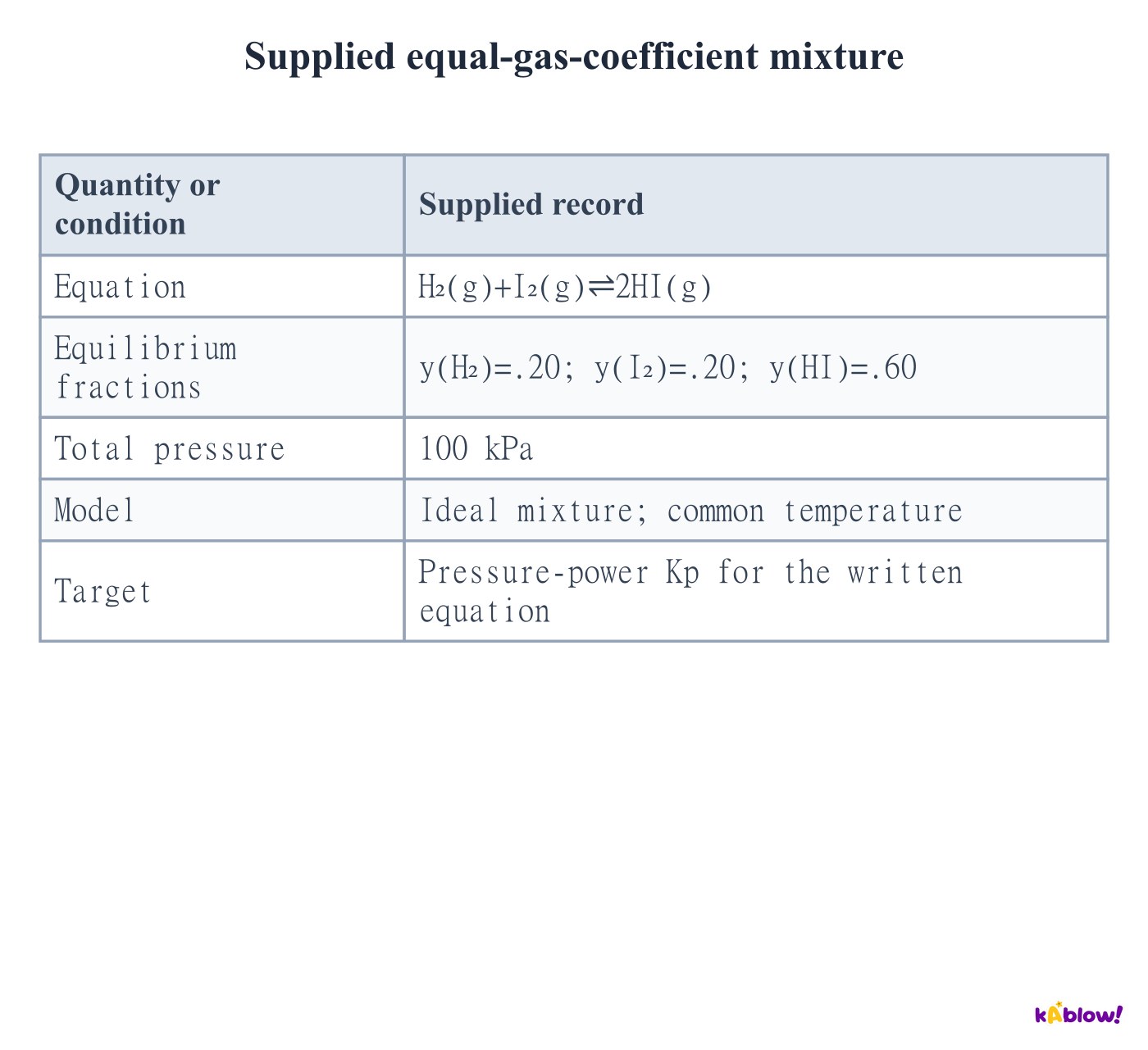
- Substitute p(X)=y(X)P into Kp. A factor P^Δν remains, so mole fractions alone are generally insufficient.
- For H₂+I₂⇌2HI, Δν=0 and P cancels. The supplied fractions give Kp=0.60²/(0.20×0.20)=9.0.
- This cancellation is a special algebraic result, not permission to drop pressure in equations with unequal gas totals. Fixed-temperature ideal compression does not shift this equal-gas-coefficient equilibrium.
Supplied equal-gas-coefficient mixture
Calculate Kp from equilibrium partial pressures
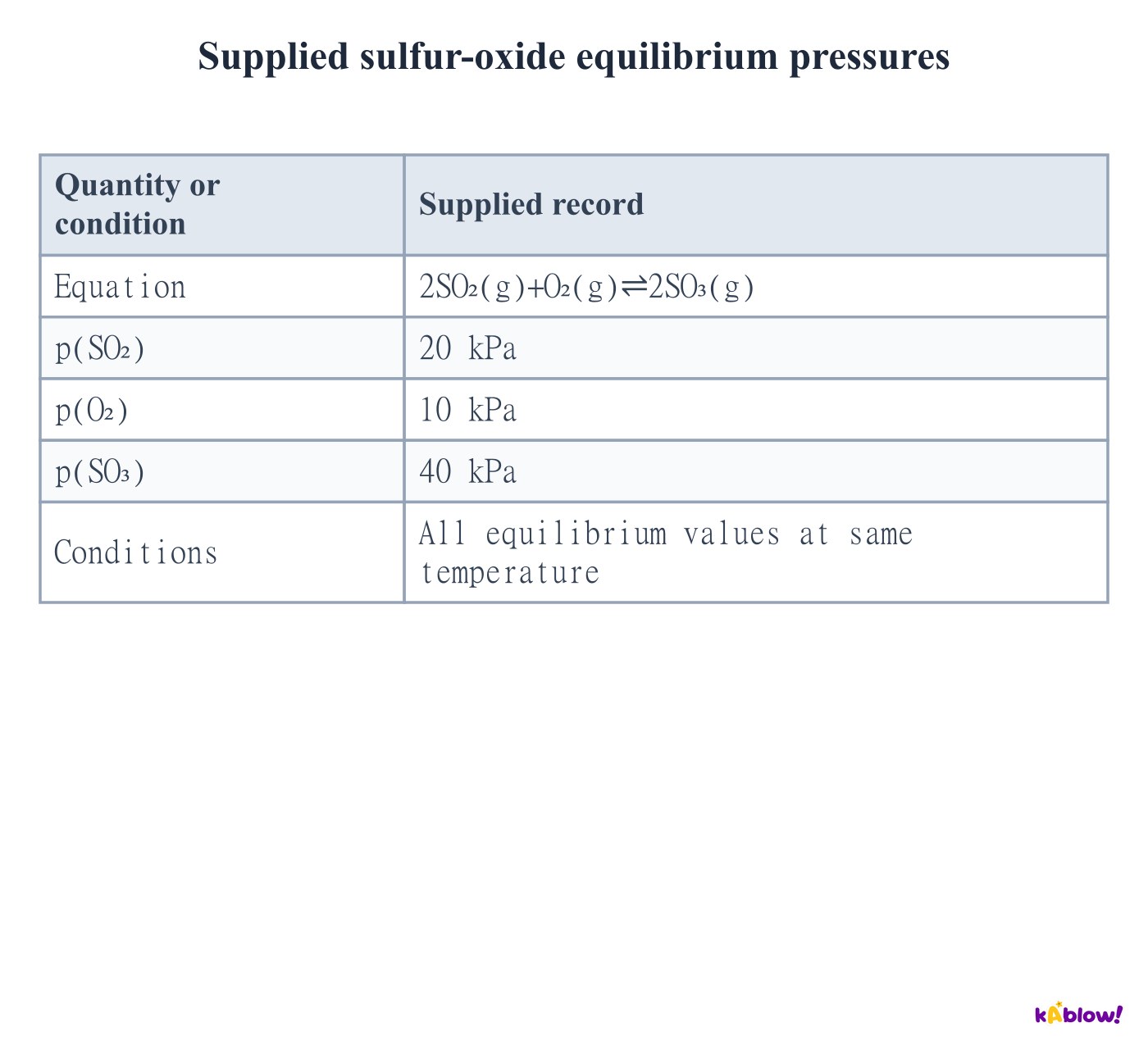
- For2SO₂+O₂⇌2SO₃, Kp=p(SO₃)²/[p(SO₂)²p(O₂)]. All pressures must use the same unit.
- The supplied values give40²/(20²×10)=0.400 kPa⁻¹. Square the complete numerical pressure values.
- These are equilibrium pressures, not initial pressures or concentrations. Deduce units from the same expression used for the calculation.
Supplied sulfur-oxide equilibrium pressures
Use stoichiometry before calculating fractions
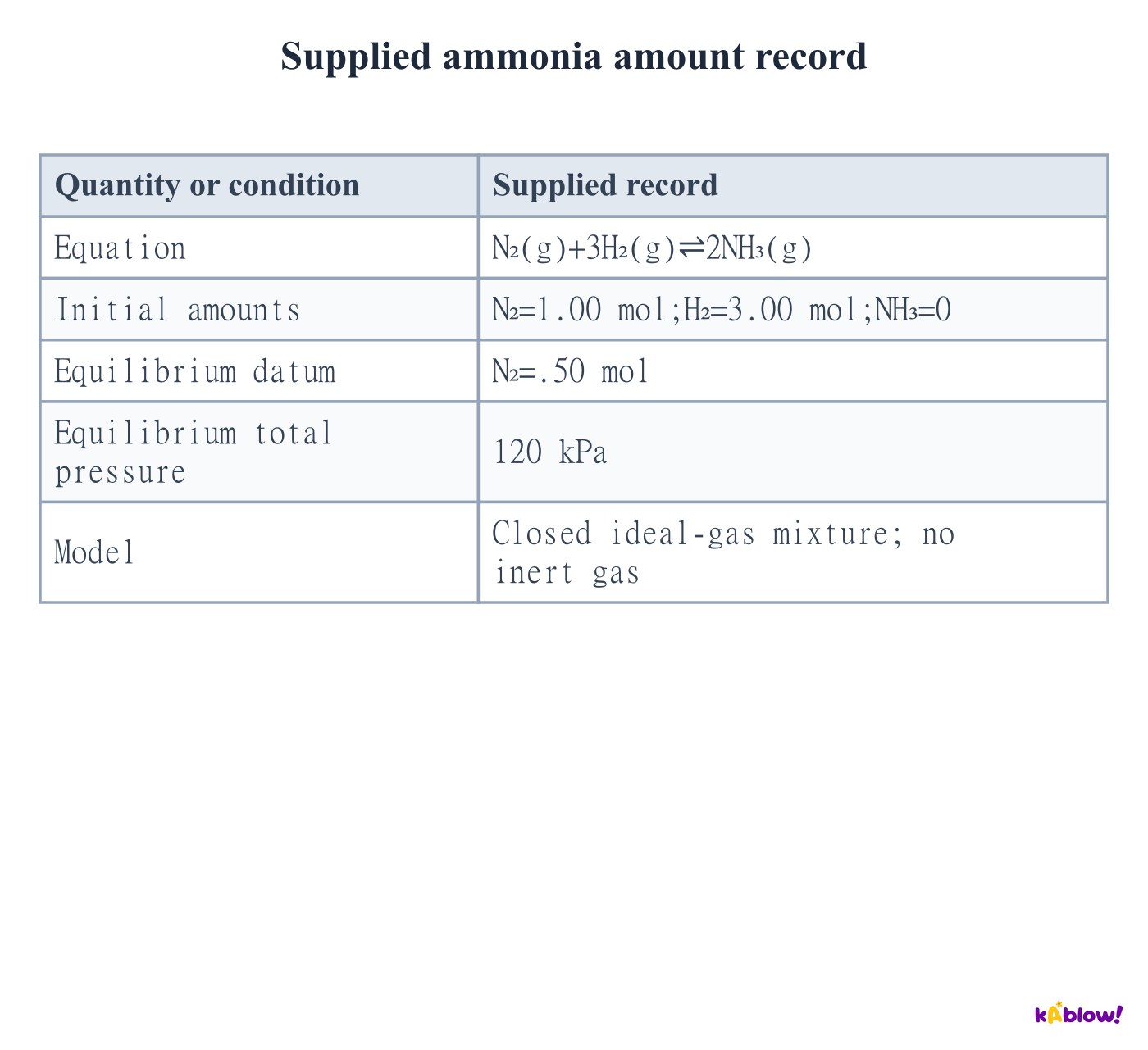
- The supplied nitrogen loss is0.50 mol. The reaction consumes1.50 mol H₂ and forms1.00 mol NH₃.
- Equilibrium amounts are0.50,1.50 and1.00 mol, so the total is3.00 mol rather than the initial4.00 mol.
- At120 kPa the partial pressures are20,60 and40 kPa respectively. Thus Kp=40²/(20×60³)=3.70×10⁻⁴ kPa⁻² to three significant figures.
Supplied ammonia amount record
Rearrange Kp to find total pressure
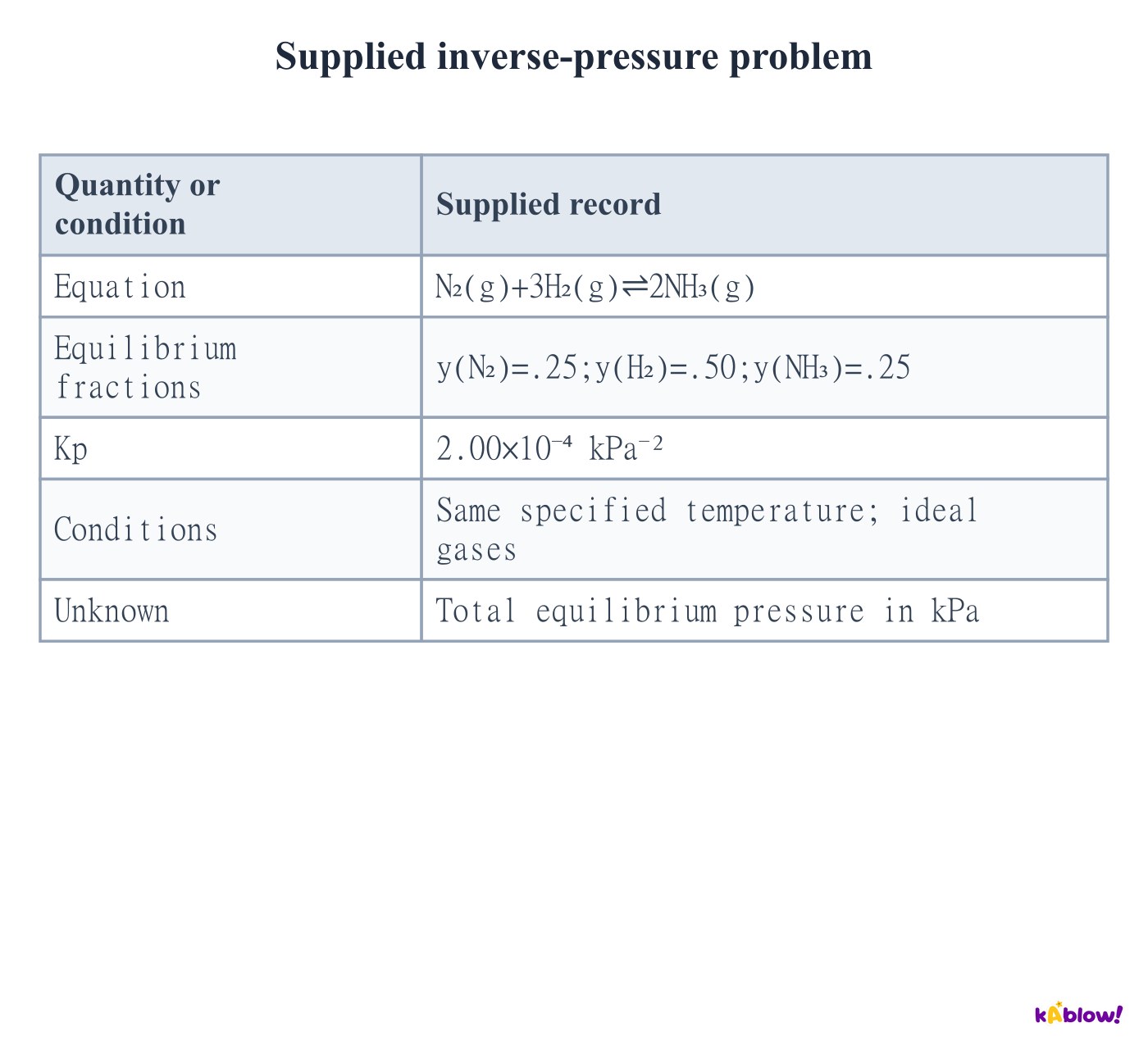
- For the supplied ammonia fractions, substitution gives Kp=[.25²/(.25×.50³)]P⁻²=2/P² when P is in kPa.
- Rearrange to P²=2/Kp. With Kp=2.00×10⁻⁴ kPa⁻², the positive pressure is100 kPa.
- Check dimensions and physical roots. A negative pressure root is inadmissible, and a reaction with Δν=0 cannot yield total pressure from Kp and fractions alone.
Supplied inverse-pressure problem
Solve for an unknown equilibrium fraction
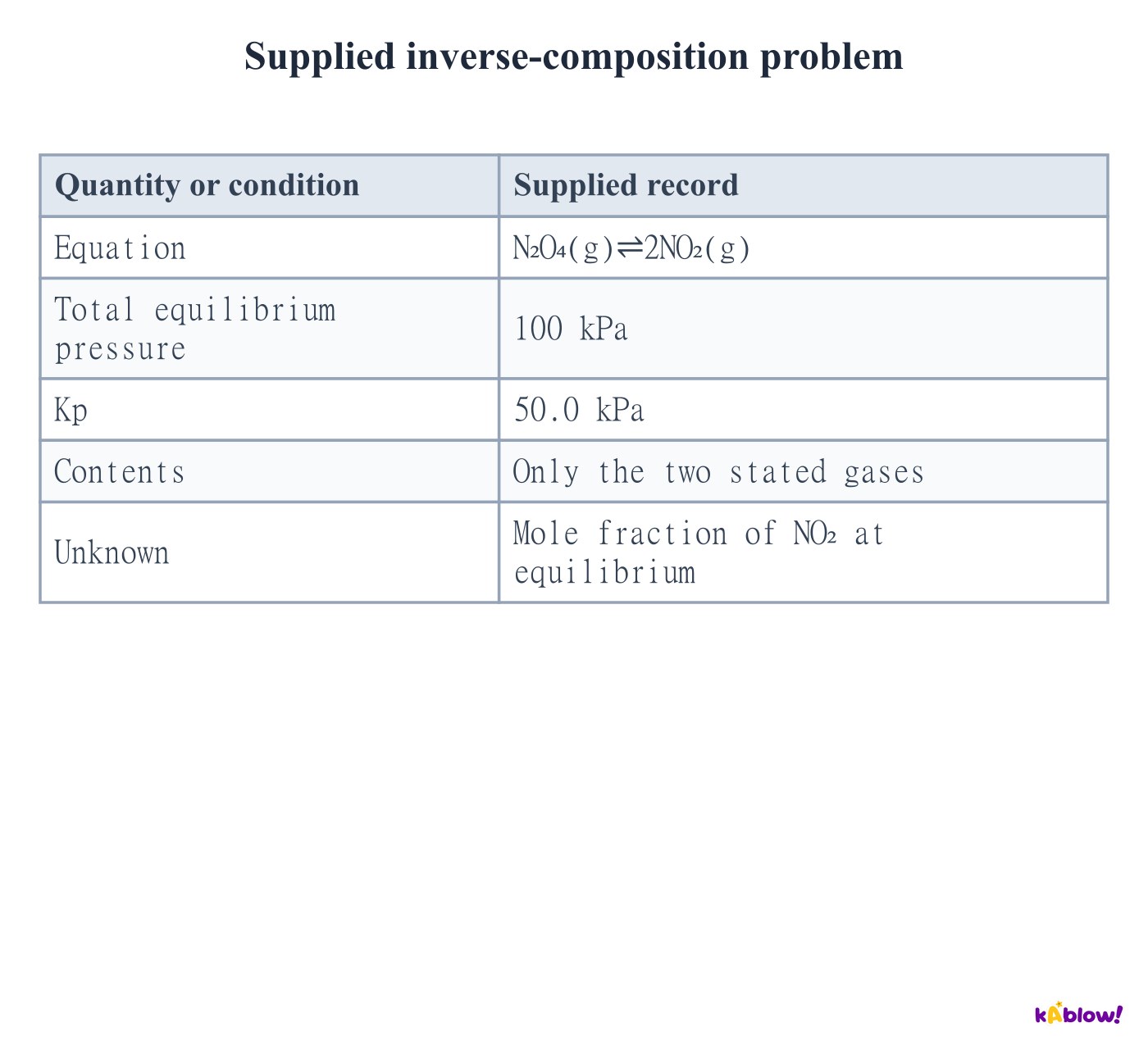
- Let x be the NO₂ mole fraction. With only N₂O₄ and NO₂ present, the other fraction is1−x.
- Kp=x²P/(1−x). The supplied values give100x²=50(1−x), or2x²+x−1=0.
- The roots are0.50 and−1. Reject−1 because mole fractions must lie from zero to one. The valid pressures are50 kPa each.
Supplied inverse-composition problem
Account for changing total moles during dissociation
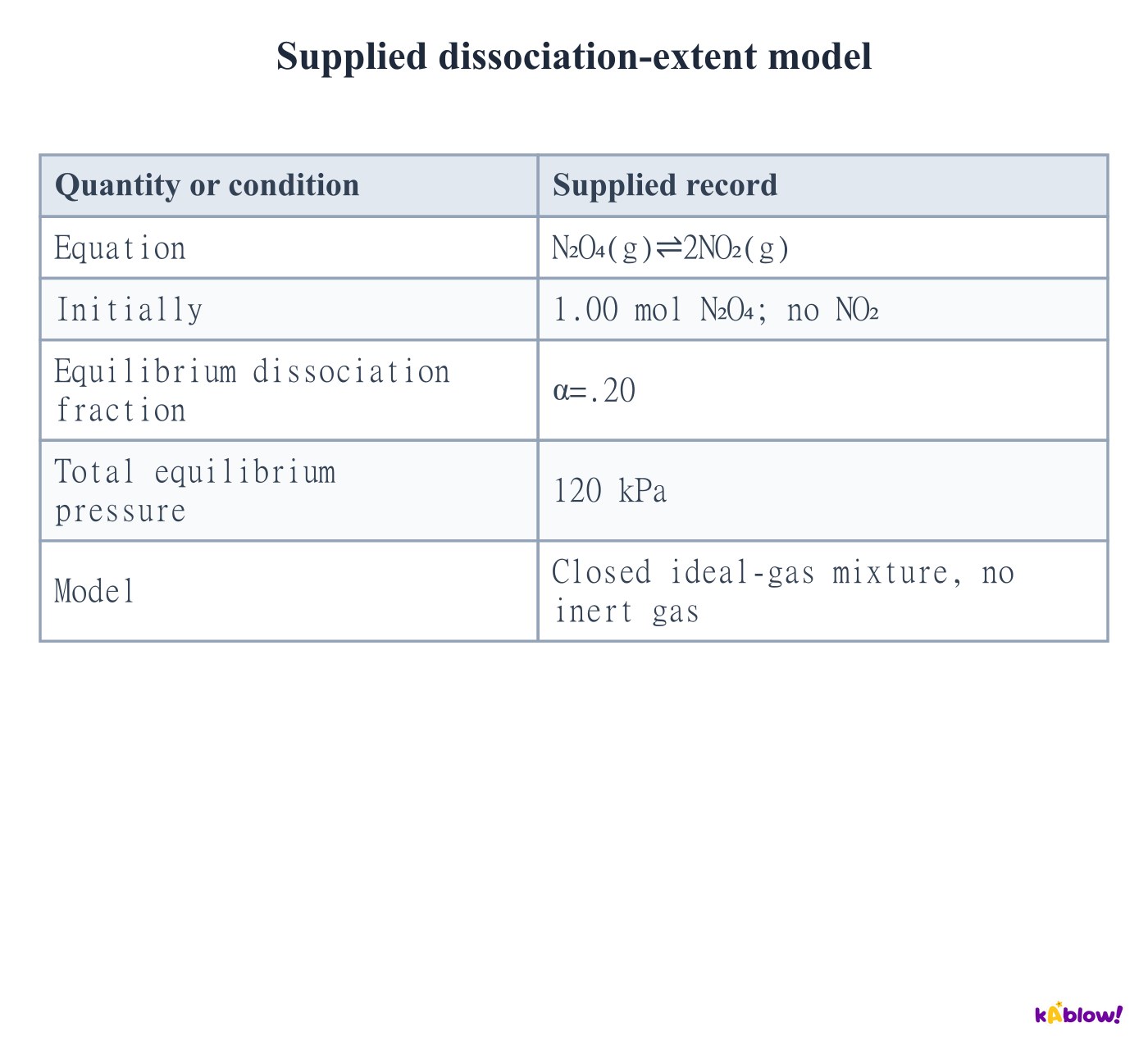
- Starting with1 mol N₂O₄ only, dissociation fraction α gives n(N₂O₄)=1−α, n(NO₂)=2α and ntotal=1+α.
- The fractions are(1−α)/(1+α) and2α/(1+α). Thus Kp=4α²P/(1−α²) for the ideal mixture.
- For α=.20 and P=120 kPa, equilibrium amounts are.80 and.40 mol, pressures80 and40 kPa, and Kp=20 kPa.
Supplied dissociation-extent model
Transform the constant when changing the equation
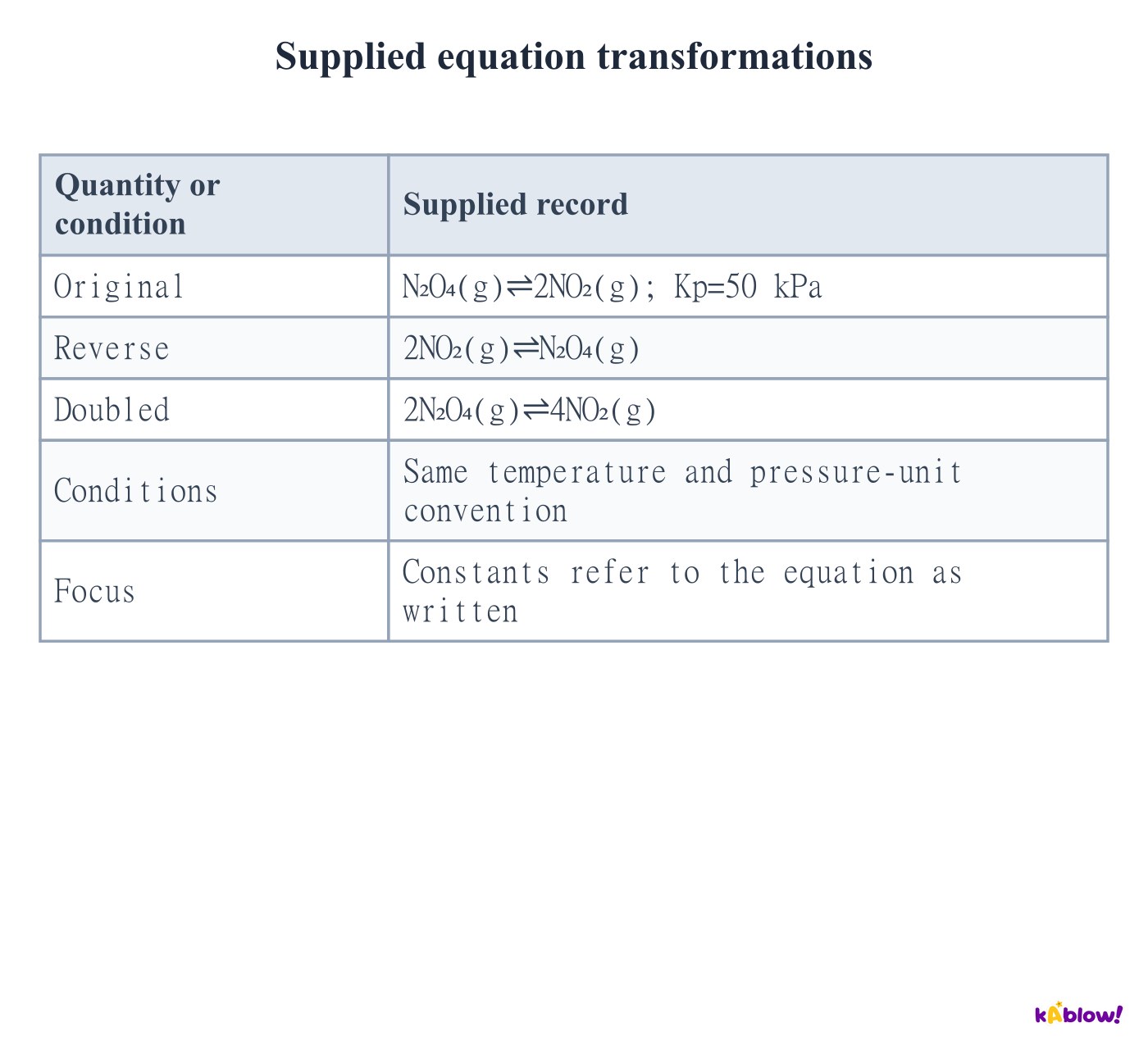
- Reversing an equation inverts its pressure-power Kp and its units. Multiplying every coefficient by a factor raises Kp to that power.
- If N₂O₄⇌2NO₂ has Kp=50 kPa, the reverse has0.020 kPa⁻¹ and the doubled equation has2500 kPa².
- These are different written reactions, not changes in the equilibrium temperature. Always compare constants for the same equation and unit convention.
Supplied equation transformations
Distinguish a pressure disturbance from changing Kp
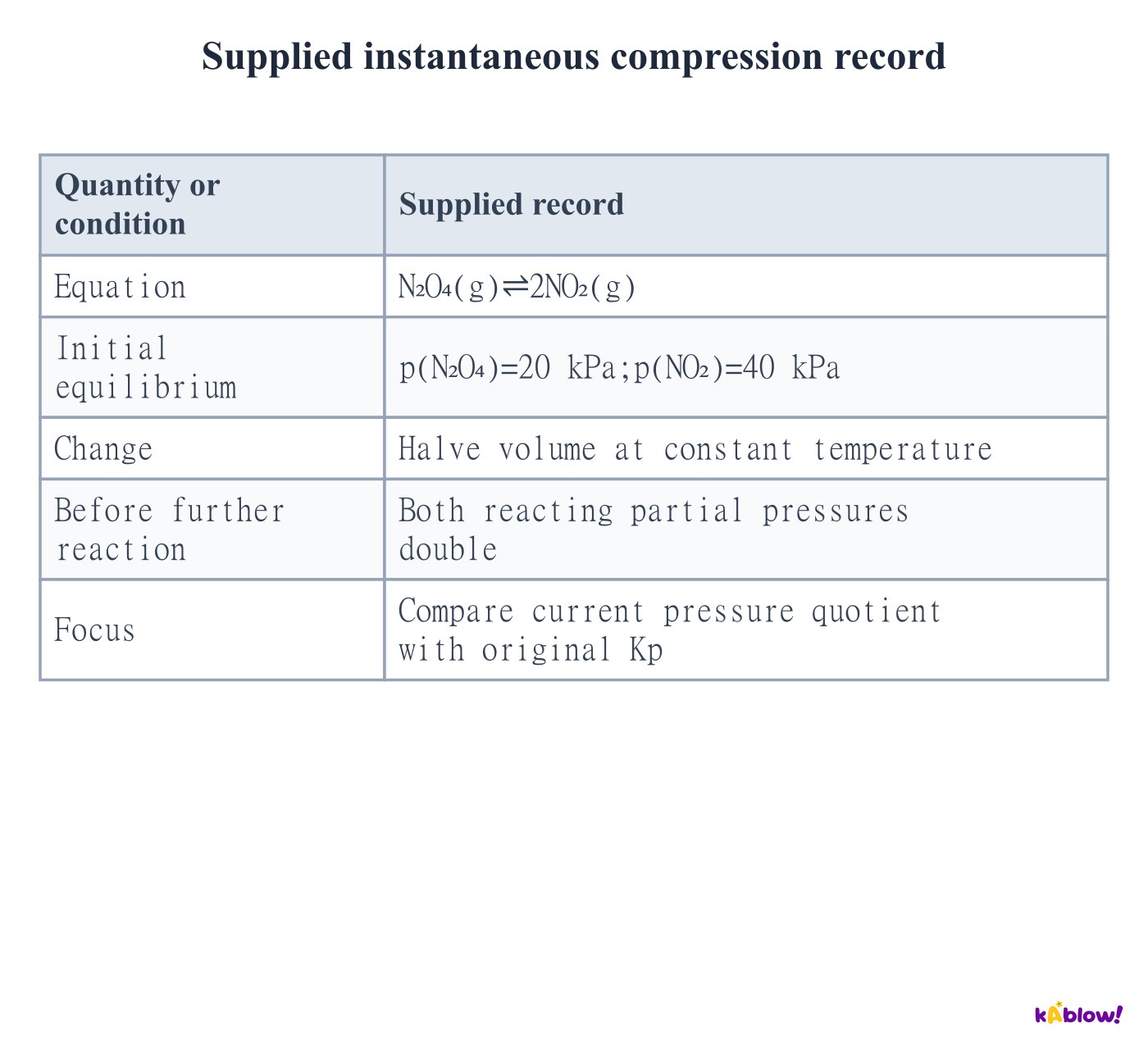
- At fixed temperature, halving the volume doubles every reacting gas partial pressure before further reaction occurs.
- For N₂O₄⇌2NO₂ the current quotient doubles because Δν=+1. It exceeds the unchanged Kp, so net reaction proceeds left toward fewer gas moles.
- The initial supplied Kp is40²/20=80 kPa. Immediately after compression Qp=80²/40=160 kPa; subsequent re-equilibration restores Qp=Kp.
Supplied instantaneous compression record
Treat inert addition at fixed volume correctly
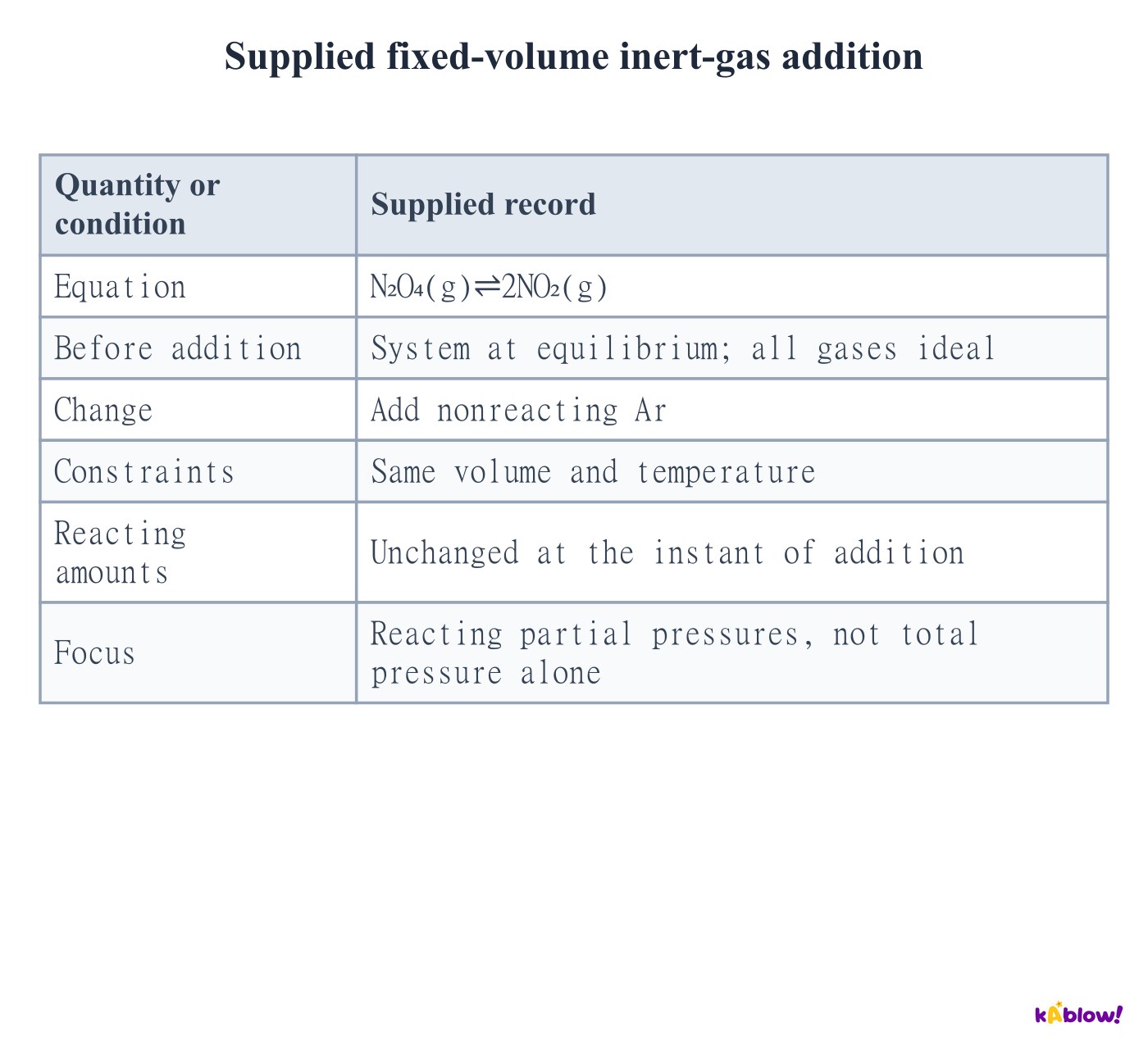
- For an ideal gas, p(X)=n(X)RT/V. Adding nonreacting argon at unchanged V and T leaves reacting partial pressures unchanged.
- Total pressure rises and reacting mole fractions fall, but their product y(X)P remains the same. The pressure quotient therefore remains equal to Kp.
- No ideal-gas equilibrium shift follows from this addition. A statement that any increase in total pressure favours fewer gas moles misses the constraint.
Supplied fixed-volume inert-gas addition
Treat inert addition at fixed total pressure separately
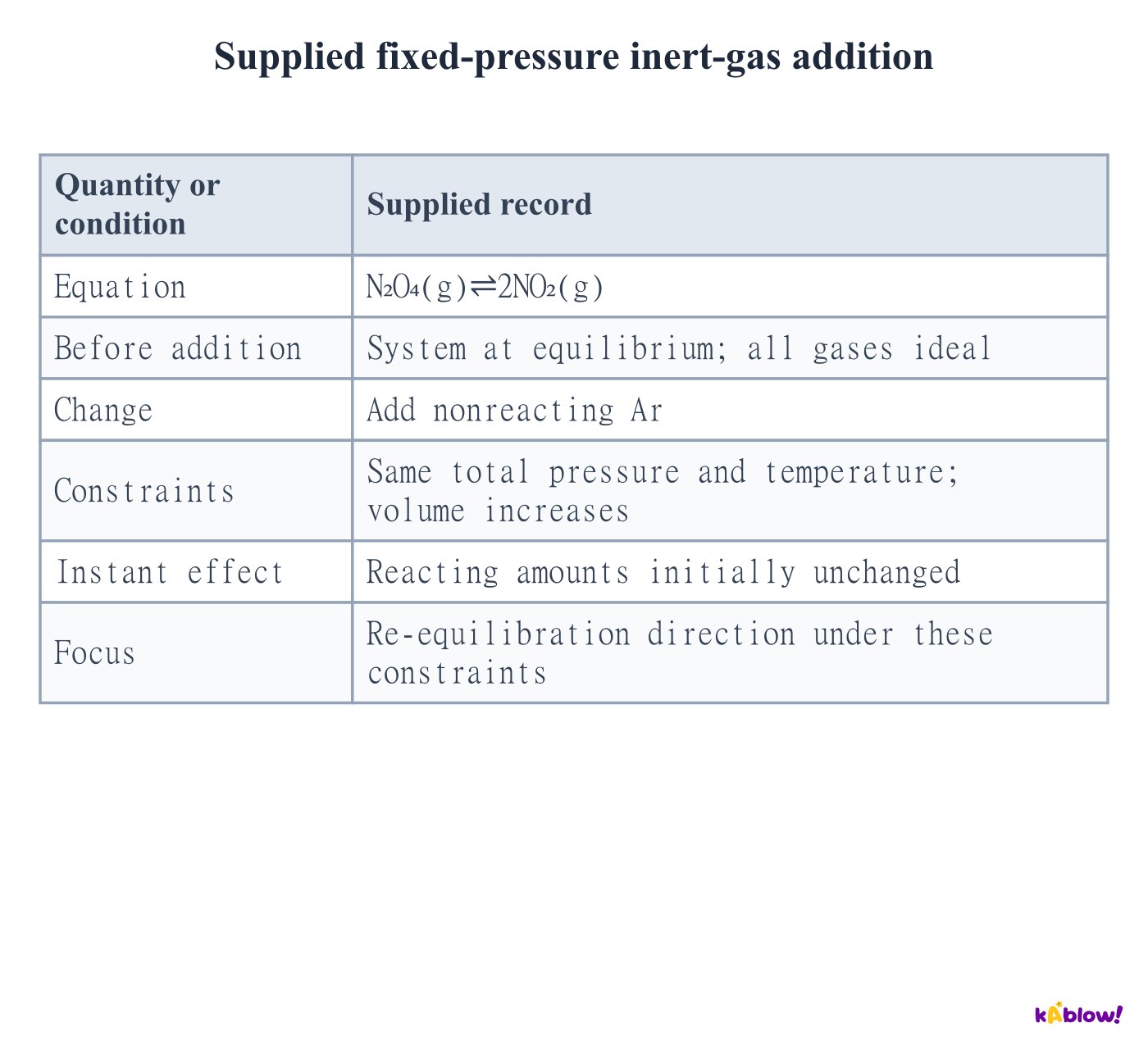
- Adding inert gas at fixed total pressure and temperature requires expansion. The reacting amounts initially stay constant but their partial pressures decrease.
- For N₂O₄⇌2NO₂ the quotient scales with P-like dilution to the power Δν=+1. It falls below Kp and net reaction proceeds right.
- This favours more gas moles and differs from adding inert at fixed volume. State the physical constraints before using a pressure rule.
Supplied fixed-pressure inert-gas addition
Link temperature trends to forward reaction enthalpy
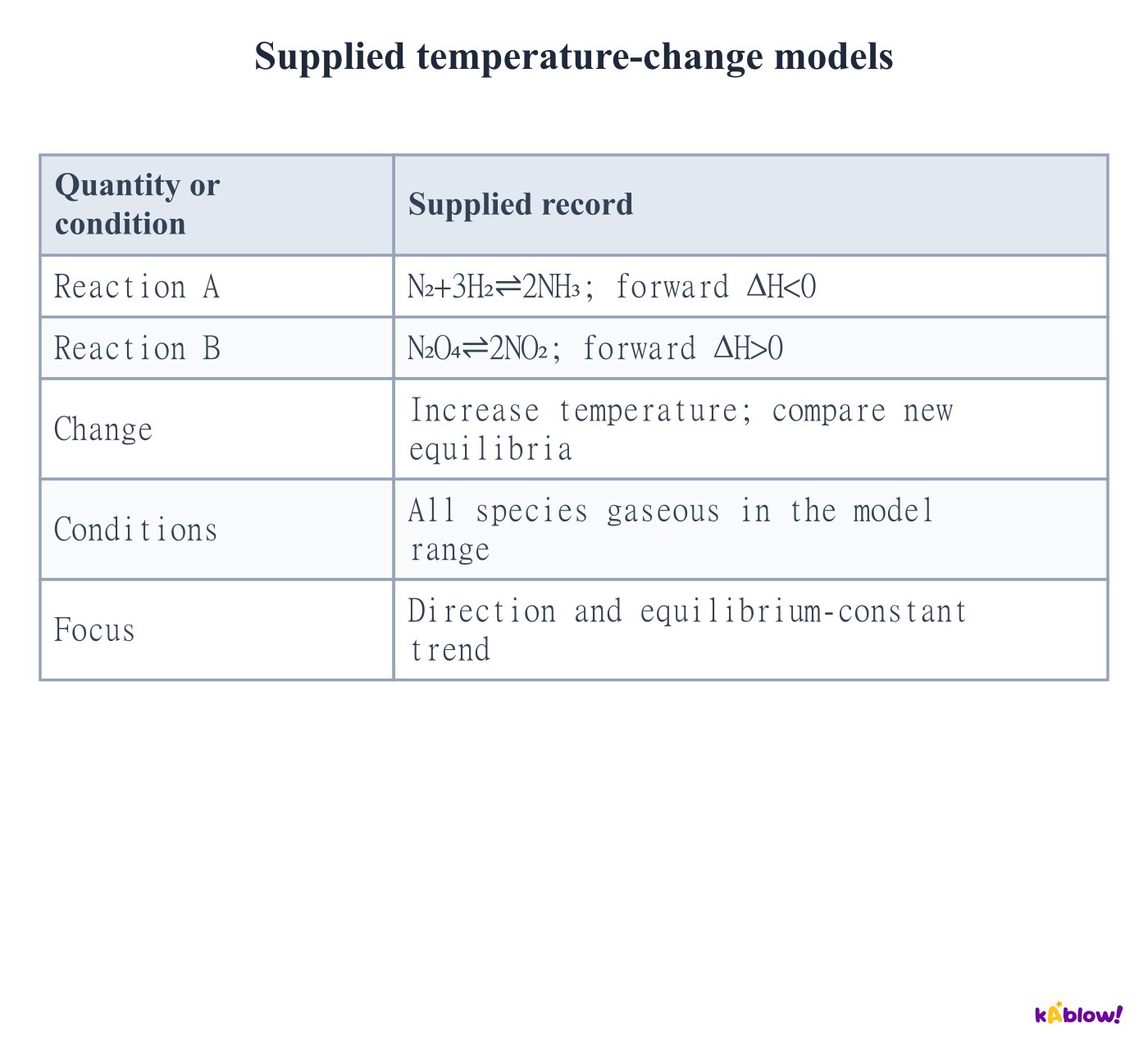
- For an exothermic forward reaction, increasing temperature decreases Kp and favours the reverse equilibrium direction under the usual comparison conditions.
- For an endothermic forward reaction, increasing temperature increases Kp and favours products. Cooling reverses these trends.
- The trend refers to the equation as written and the applicable temperature/phase range. A change in Kp does not describe how fast the new equilibrium is attained.
Supplied temperature-change models
Separate equilibrium composition from attainment time
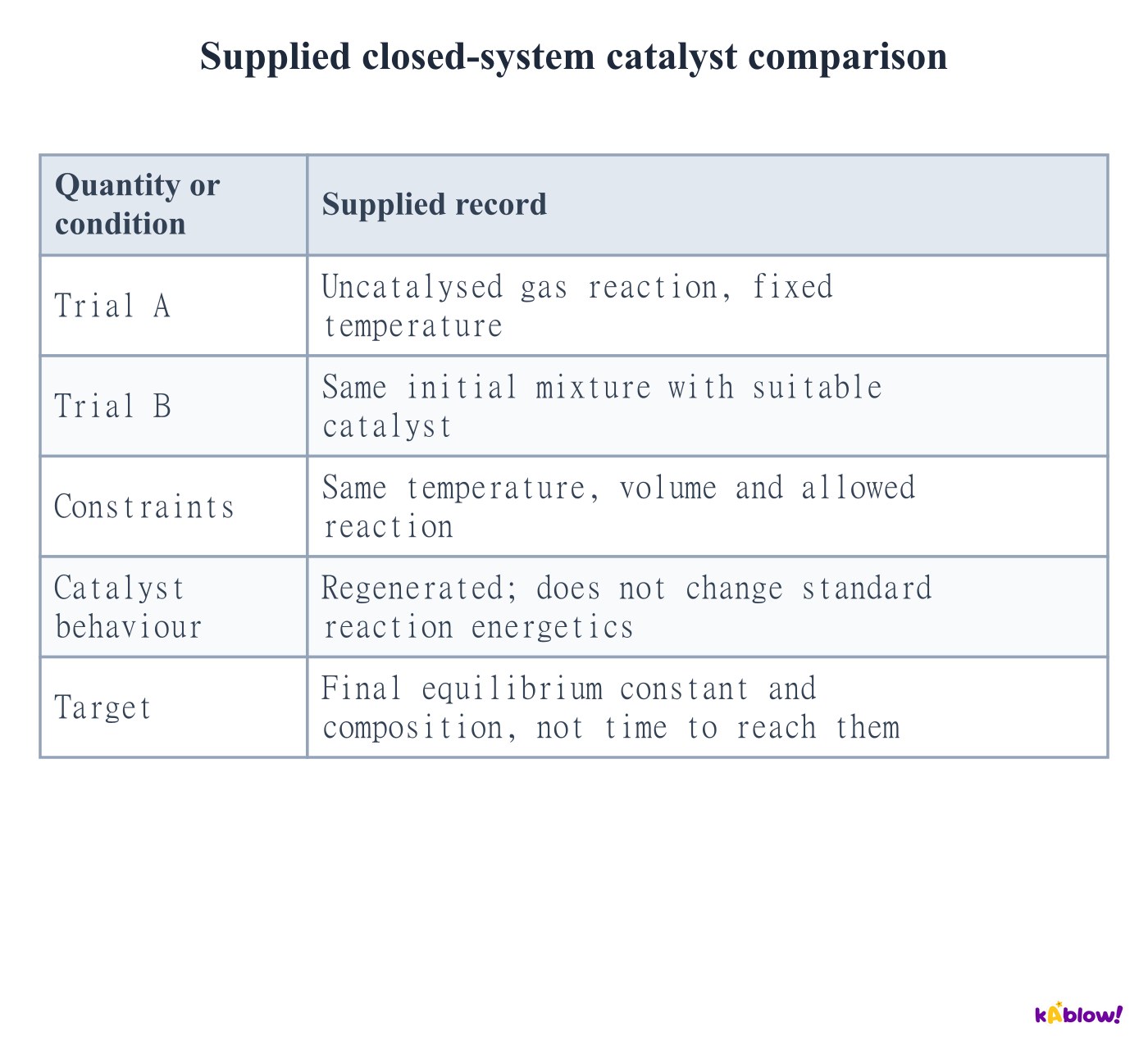
- A suitable catalyst supplies a faster reversible pathway while leaving Kp unchanged at the same temperature and reaction convention.
- The same closed-system constraints and initial mixture give the same final equilibrium composition, reached more quickly if the catalyst is effective.
- Forward and reverse rates are equal at equilibrium. Do not claim they are equal at every composition during the approach to equilibrium.
Supplied closed-system catalyst comparison
Keep the pressure unit consistent
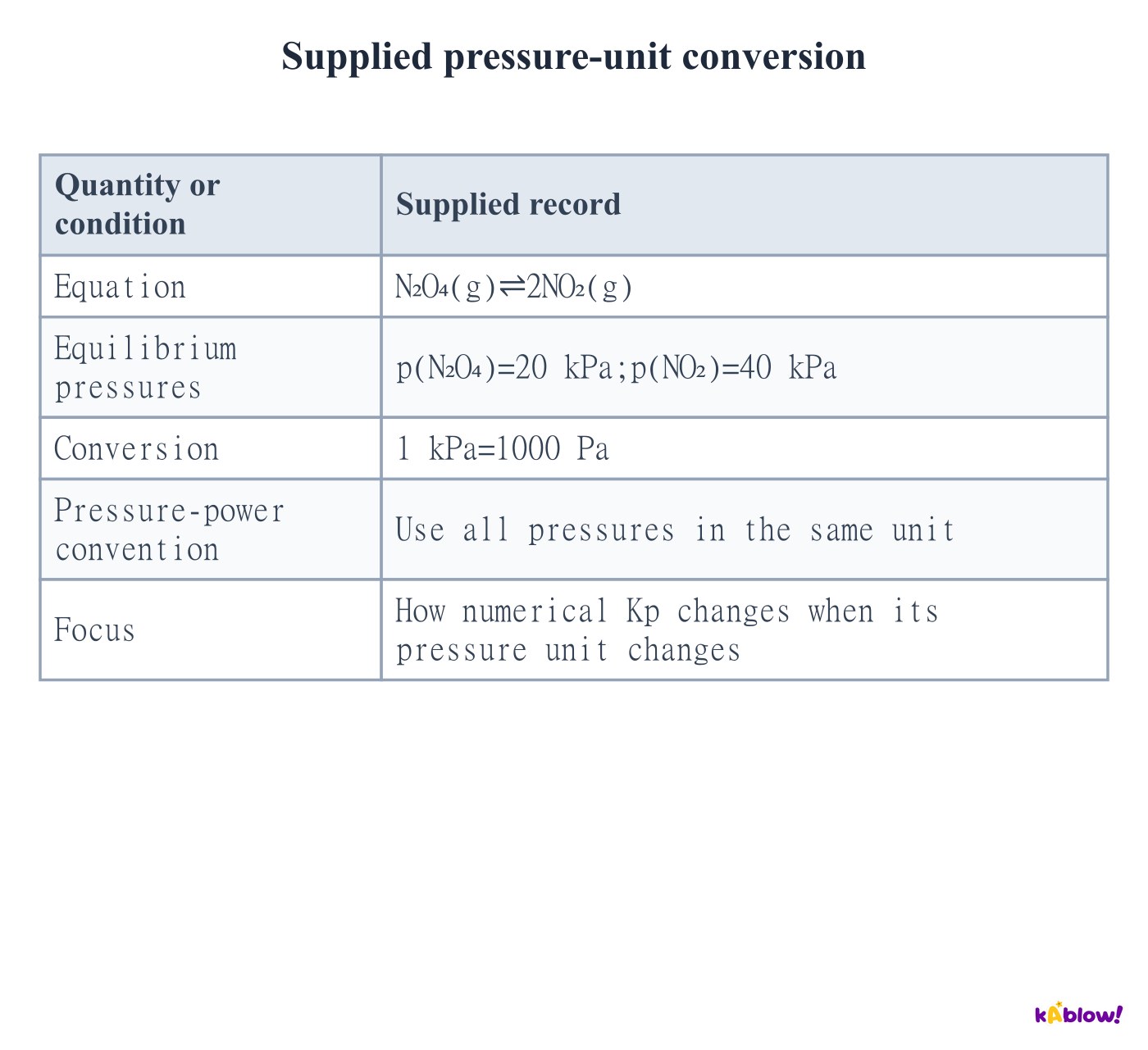
- The supplied pressures give Kp=40²/20=80 kPa. In pascals, Kp=40000²/20000=80000 Pa.
- The numerical change reflects the pressure unit, not a temperature change or a different chemical equilibrium. In general multiply the numerical value by1000^Δν when changing kPa to Pa.
- For Δν=−2, this conversion factor is10⁻⁶. A dimensionless activity-based constant uses a specified reference pressure and must not be confused with the dimensional pressure-power value.
Supplied pressure-unit conversion
Use Qp for a current non-equilibrium mixture
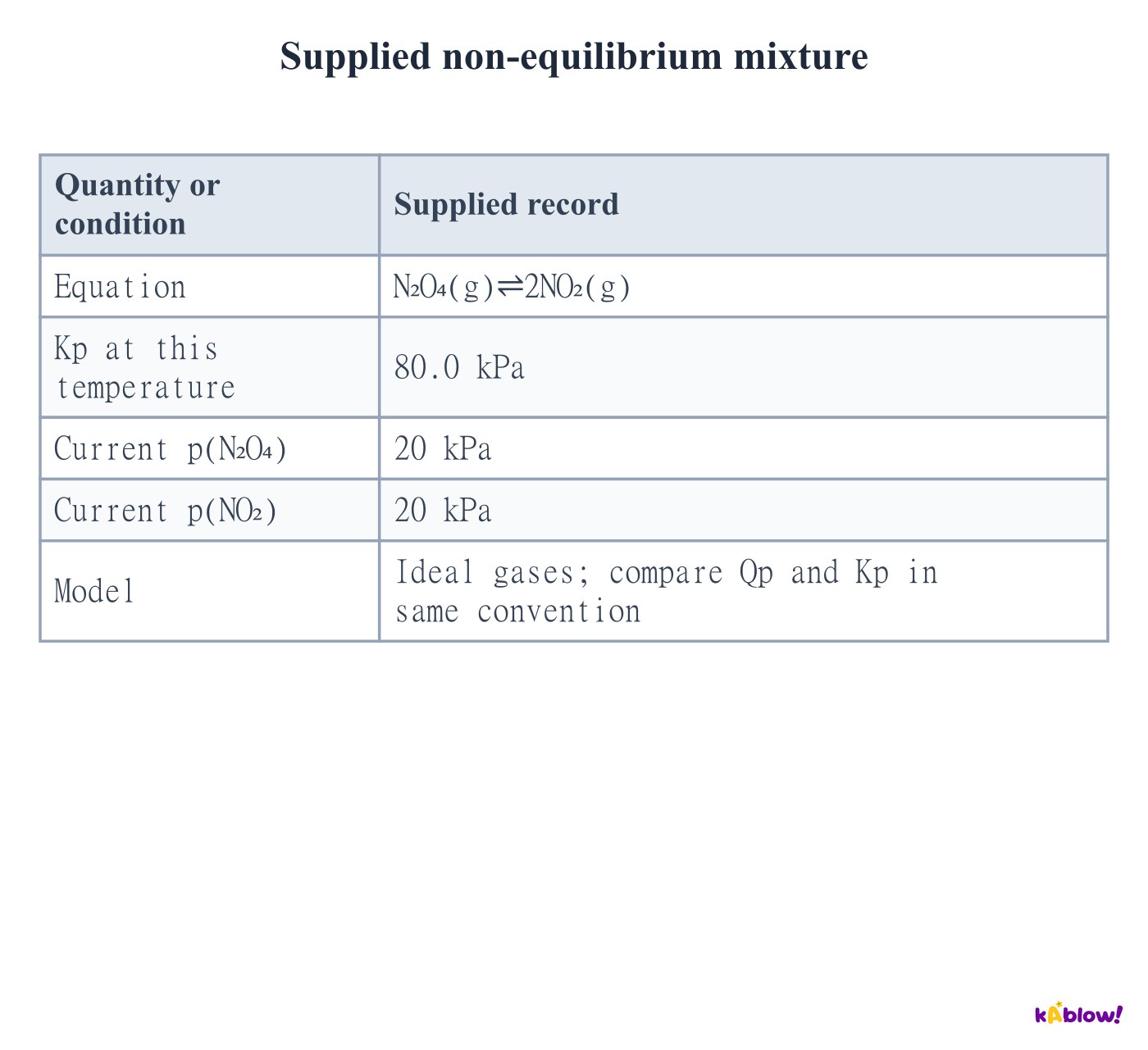
- Qp has the same expression as Kp but uses current partial pressures. Compare them with the same equation and pressure-unit convention.
- If Qp<Kp, net forward reaction is favoured; if Qp>Kp, net reverse reaction is favoured. At equilibrium Qp=Kp.
- For the supplied mixture Qp=20²/20=20 kPa, below Kp=80 kPa, so net dissociation proceeds right. This does not require every individual collision to be forward.
Supplied non-equilibrium mixture
Evaluate equilibrium yield alongside rate and cost
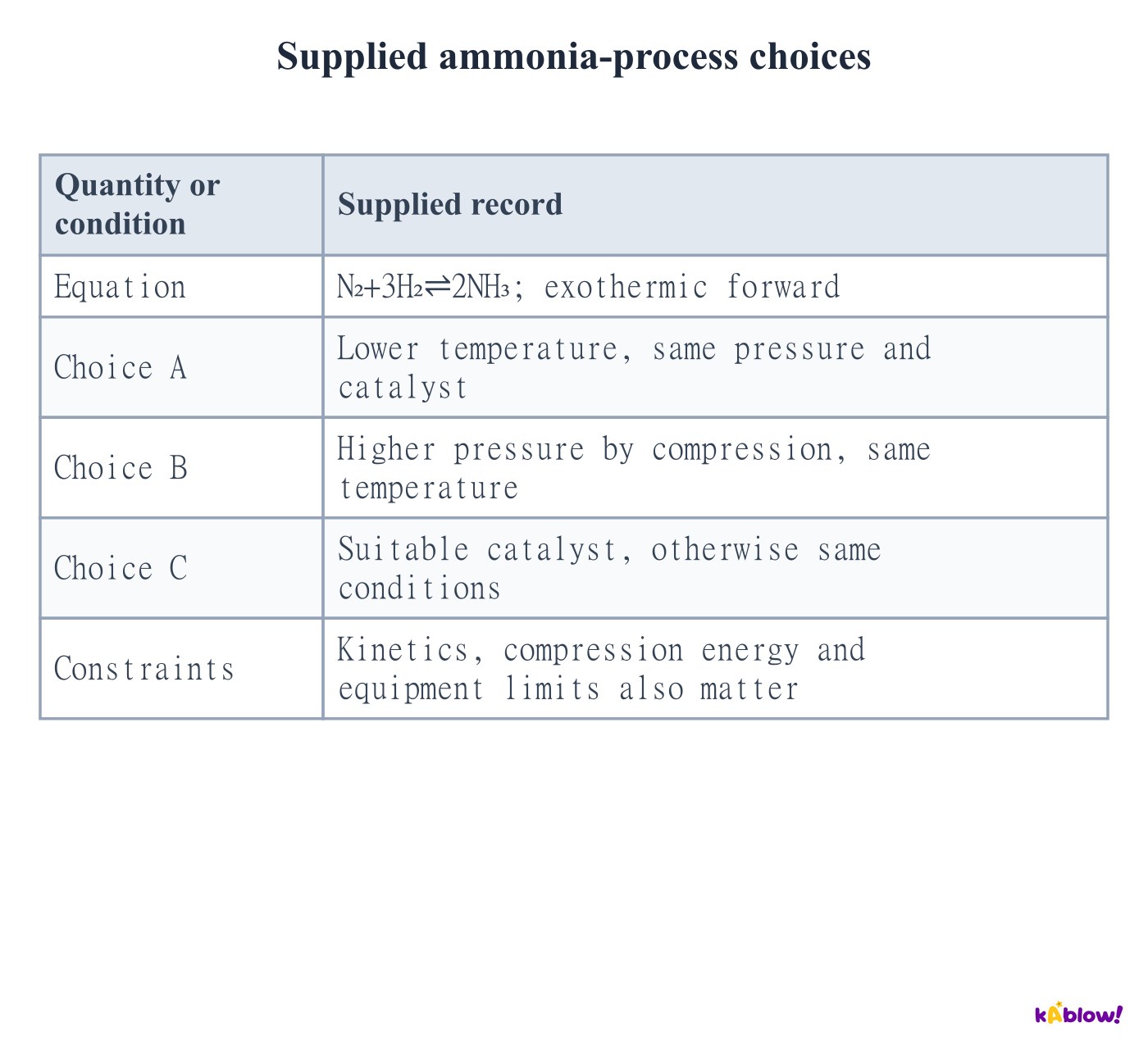
- Ammonia formation is exothermic and reduces gas moles. Lower temperature favours its equilibrium yield but can slow attainment.
- Compression at fixed temperature favours ammonia without changing Kp. It also requires energy and pressure-rated equipment.
- A catalyst helps reach equilibrium more quickly while leaving its position unchanged. Process choices combine equilibrium yield, kinetics, energy, separation and practical constraints.
Supplied ammonia-process choices
ஸ்லைடுகள்
Sign up free to view the lesson slides
Step through every slide for this topic — plus flashcards and revision notes — with a free account.
பயிற்சி கேள்விகள்
இலவச முன்னோட்டம் — 60-இல் 8 கேள்விகள். அனைத்தையும் பார்க்க பதிவு செய்யவும்.
1.Which supplied systems are homogeneous gas equilibria?
Medium- AA only
- BB only
- CA and C
- DA, B and C
2.Calculate p(A) from the supplied two-gas record.
Medium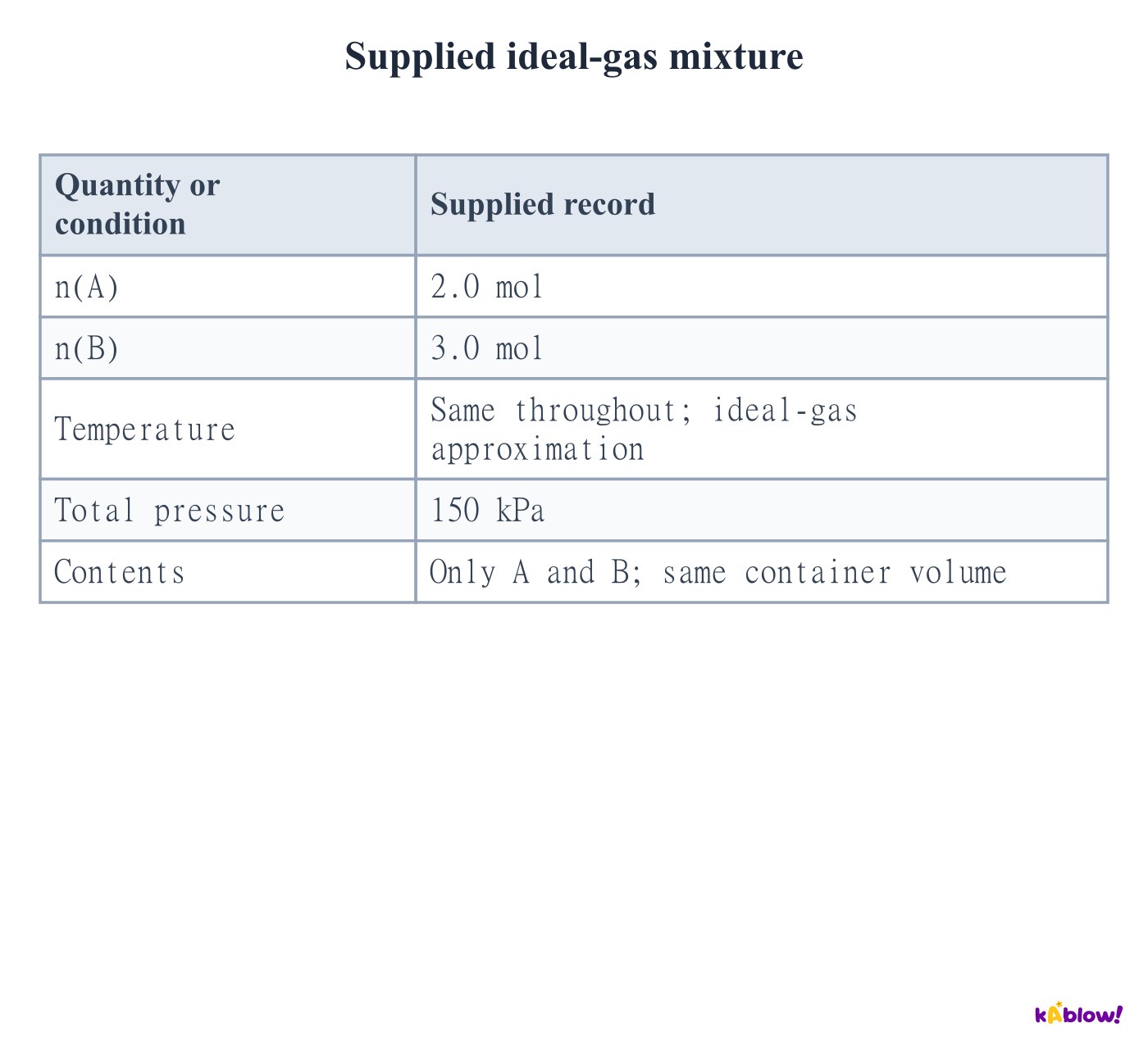
- A30 kPa
- B60 kPa
- C90 kPa
- D150 kPa
3.What is the supplied nitrogen partial pressure when the inert gas is included?
Medium- A20 kPa
- B40 kPa
- C50 kPa
- D200 kPa
4.Which expression belongs to supplied equation B?
Medium- Ap(NO₂)/p(N₂O₄)²
- Bp(NO₂)²/p(N₂O₄)
- Cp(N₂O₄)/p(NO₂)²
- Dp(NO₂)²×p(N₂O₄)
5.Which units belong to supplied model C when all pressures use kPa?
Medium- AkPa
- BkPa⁻¹
- CkPa⁻²
- DNo units
6.Calculate the pressure-power Kp for the supplied equal-gas-coefficient mixture.
Medium- A0.90
- B3.0
- C9.0
- D900
7.Calculate Kp for the supplied sulfur-oxide equilibrium.
Medium- A0.0400 kPa⁻¹
- B0.400 kPa⁻¹
- C4.00 kPa
- D40.0 kPa⁻²
8.What total amount of gas is present at equilibrium in the supplied ammonia record?
Medium- A2.00 mol
- B3.00 mol
- C4.00 mol
- D5.00 mol
Unlock all 60 questions, flashcards & more
இந்த தலைப்பிற்கான ஒவ்வொரு கேள்வியையும், ஸ்லைடுகளையும், ஃப்ளாஷ் கார்டுகளையும் மற்றும் திருப்புதல் குறிப்புகளையும் பார்க்க இலவச கணக்கை உருவாக்கவும்.