
Painting techniques
விளையாடிக் கற்றுக்கொள்ளுங்கள்
ஆற்றல் சம்பாதிக்க இந்த கேள்விகளுக்குப் பதிலளியுங்கள், பின்னர் மீன் பிடித்து ஆராயுங்கள். கணக்கு தேவையில்லை.
பாட குறிப்புகள்
Paint families and practical differences
- Watercolour commonly uses transparent washes and reserved paper lights, while conventional gouache is often opaque and matte. Individual pigments vary, and conventional gouache may be reworked with water. Acrylic gouache is a different binder system.
- Typical water-based acrylic uses an acrylic-polymer binder and is water-dilutable while wet. Conventional oils generally have a longer open working time. Formulation, thickness, media and environment affect drying; touch-dry and fully cured differ.
Compare typical handling
Application methods
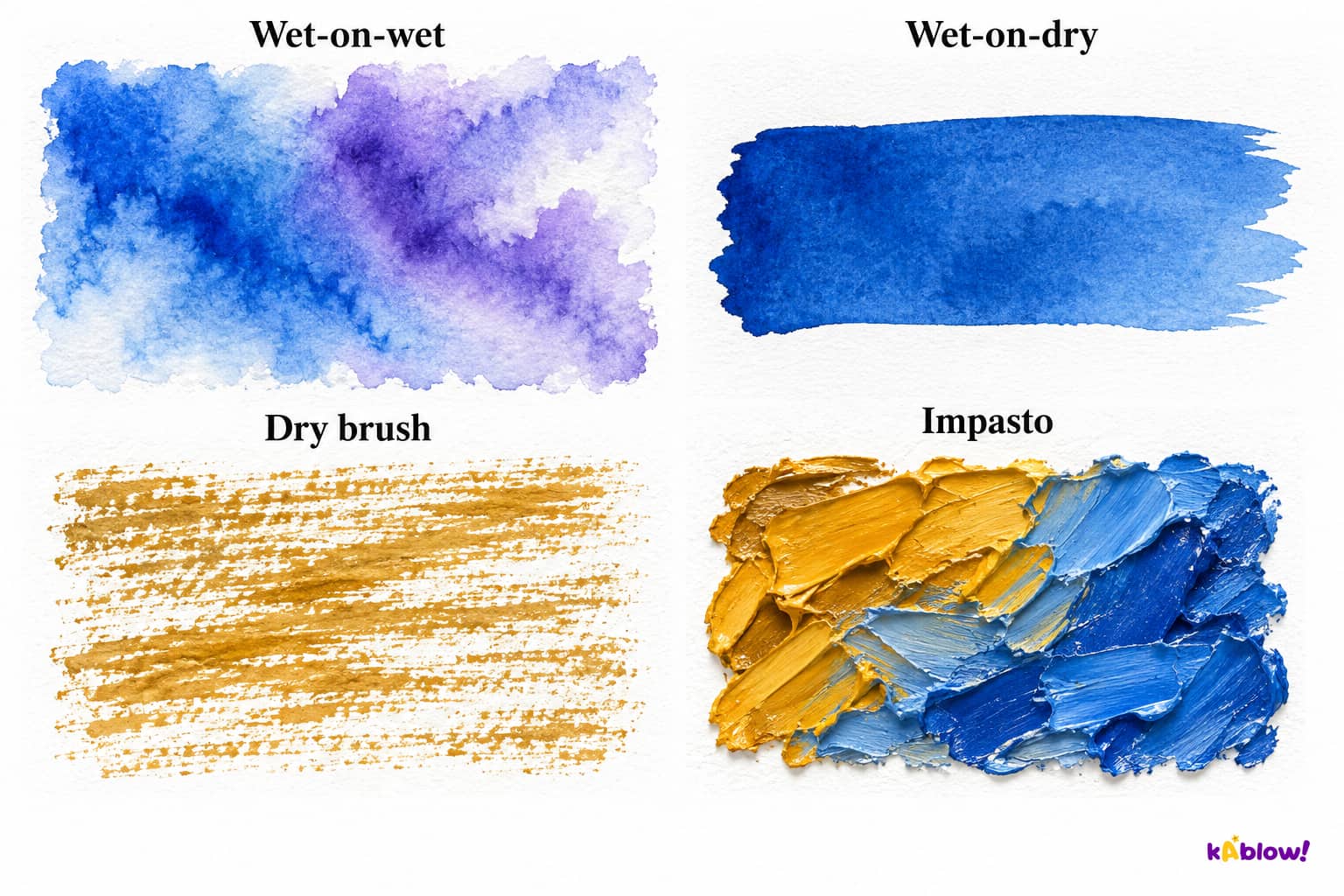
- Wet-on-wet can give diffused edges; wet-on-dry generally gives more defined ones in watercolour. Dry brush makes broken marks with relatively little moisture or paint. Impasto leaves raised paint ridges.
- A wash is fluid application; a glaze is transparent over a lower passage; scumbling is a thin broken upper layer, often opaque or semi-opaque. Test the actual paint, paper and timing rather than expect a fixed appearance from a name.
Compare application techniques
Supports and grounds
- Paper, woven canvas and panel are supports. Canvas can be stretched or mounted on a panel. A ground is a prepared surface layer; appropriate sizing or isolation may be separate.
- Follow compatibility and preparation instructions for support and paint. Some supports arrive pre-primed. Modern acrylic gesso and traditional gesso are different; do not treat every product or surface as interchangeable.
Support versus preparation
Tools and care
- Brush size, shape, point and handling affect the mark. A flat brush can cover broader planes, a fine round tip can make small controlled marks, and a knife can mix or apply paint.
- Test tools on a sample and clean with the method suited to the actual paint. Wet acrylic is easier to remove before it binds the bristles; some watercolour can be rewetted, so dried paint does not universally ruin a brush.
Layering and studio decisions
- Plan reserved white paper in a transparent watercolour approach. Lifting or opaque additions can sometimes change a passage, depending on pigments, paper and intention; correction is not simply impossible.
- In suitable layered oil practice, fat over lean concerns relative oil content and film flexibility, not just thick over thin. Consider drying and compatibility with the chosen system. If solvents are used, follow ventilation and handling instructions; solvent-free and water-mixable oil methods also exist.
Choose the appropriate practice
Opacity and test swatches
- Opaque layers substantially hide what is beneath; transparent layers allow it to remain visible. These are optical properties, not synonyms for dry or wet.
- Compare pigment and thickness on a suitable test support. For a dry-underlayer glaze exercise, allow adequate drying to preserve the layers; conventional gouache can reactivate where ordinary acrylic behaves differently.
Judge the actual layer
ஸ்லைடுகள்
Sign up free to view the lesson slides
Step through every slide for this topic — plus flashcards and revision notes — with a free account.
பயிற்சி கேள்விகள்
இலவச முன்னோட்டம் — 33-இல் 8 கேள்விகள். அனைத்தையும் பார்க்க பதிவு செய்யவும்.
1.Which description best fits conventional watercolour used in transparent washes?
Easy- Awater-dilutable paint often used to let the paper show through
- Bthick oil paint
- Cpermanent marker
- Dink
2.Which description best fits a typical water-based artist acrylic?
Easy- Aslow-drying oil
- Bpencil
- Cchalk
- Dpaint with an acrylic-polymer binder, usually relatively quick to dry
3.Compared with ordinary quick-drying artist acrylic, what is a common working property of conventional oil paint?
Easy- Atransparency only
- Bwater cleaning
- Ca generally longer open working time for blending
- Dfast drying
4.What is a wash?
Easy- Aa print
- Ba thin layer of diluted paint
- Ca thick layer
- Da drawing
5.What is impasto?
Easy- Athick paint showing brush or knife marks
- Ba thin wash
- Ca drawing
- Da print
6.In the watercolour exercise here, what is wet-on-dry?
Easy- Apainting onto wet paper
- Bno paint
- Cdrawing
- Dapplying wet paint to dry paper, generally allowing more defined edges
7.What is dry brush?
Easy- Athick paint
- Bink
- Cusing a relatively dry or lightly loaded brush for broken marks
- Dwet paint
8.What is scumbling?
Easy- Adrawing
- Bdragging a thin broken layer of usually opaque or semi-opaque paint over a lower layer
- Cthick paint
- Da wash
Unlock all 33 questions & more
இந்த தலைப்பிற்கான ஒவ்வொரு கேள்வியையும், ஸ்லைடுகளையும், ஃப்ளாஷ் கார்டுகளையும் மற்றும் திருப்புதல் குறிப்புகளையும் பார்க்க இலவச கணக்கை உருவாக்கவும்.