
Papers, boards and textiles
விளையாடிக் கற்றுக்கொள்ளுங்கள்
ஆற்றல் சம்பாதிக்க இந்த கேள்விகளுக்குப் பதிலளியுங்கள், பின்னர் மீன் பிடித்து ஆராயுங்கள். கணக்கு தேவையில்லை.
பாட குறிப்புகள்
Papers and boards
- Grammage is mass per area, usually g/m² or gsm. Thickness is measured separately, often in micrometres (µm), with 1 µm = 0.001 mm. Paper and board can be described by both; there is no universal gsm threshold that predicts thickness or every product classification.
- Select paper for its surface and task: cartridge for drawing, suitable layout paper for development, translucent tracing paper, grid paper and appropriate marker paper. Grade and medium compatibility matter; bleed-resistant does not mean every ink is prevented from penetrating.
- Corrugated board has a fluted medium with liners; folding carton boards such as duplex grades support printed packaging. Foil-lined board adds a metallic layer for selected functions; foam-core board combines lightweight core and facing layers for models. The entire construction determines performance, food-contact suitability and recycling options.
- Worked measurements: 200 g/m² × 0.25 m² = 50 g for the stated sheet. A separate thickness of 250 µm equals 0.25 mm. Neither number alone determines the other, because density and structure can vary.
Separate the measurements and construction
Textile fibres
- Natural fibres include plant-derived cotton and linen and animal-derived wool and silk. Synthetic fibres include polyester, nylon, acrylic and elastane; regenerated viscose is made by processing cellulose. Fibre source is separate from yarn formation, fabric construction or finish.
- Suitable cotton fabrics can absorb moisture and feel soft; wool can contribute resilience and insulation; polyester can offer strength and relatively low moisture absorption; nylon can provide abrasion resistance. Grade, yarn and fabric affect performance, so do not infer waterproofness or ideal comfort from a fibre name alone.
- Blends such as polycotton target property combinations, but ratio and construction matter. Elastane can add stretch and recovery. Discuss compromises, care and the available end-of-life route, since mixing fibres can complicate some recycling processes.
Fibre source is not fabric structure
Fabric construction
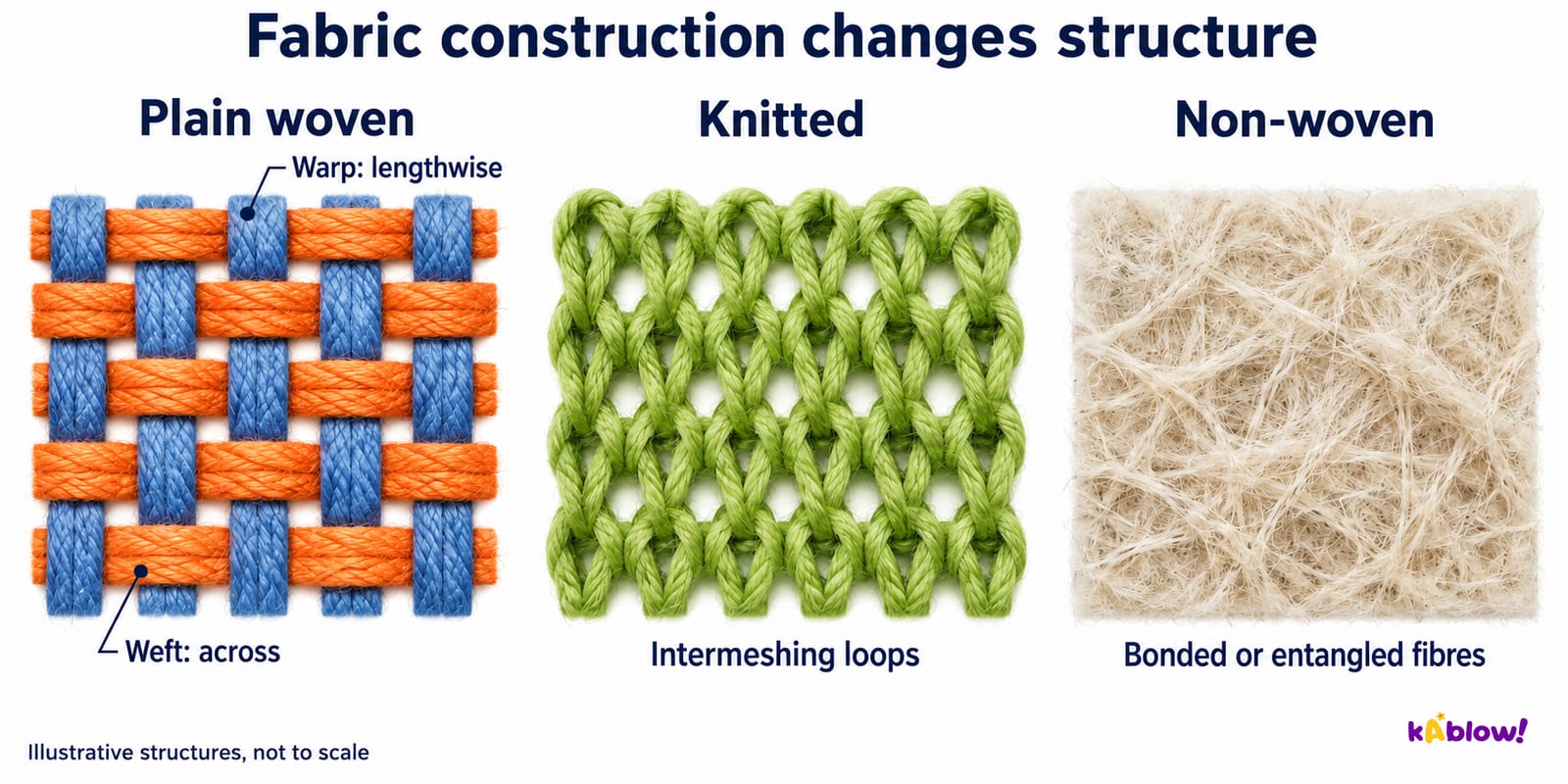
- Woven fabric interlaces lengthwise warp and across-width weft yarns. Plain weave alternates over one and under one, with each adjacent warp following the opposite sequence. Twill and satin use different interlacings. The original illustration shows a simple plain weave rather than a universal pattern for every woven textile.
- Knitted fabric intermeshes loops. Many knits can stretch as loops change shape, but structure, direction, fibre and finishing affect the outcome; woven fabric can also stretch, for example with elastane or along the bias.
- Nonwovens bond or entangle fibres rather than forming a regular woven grid or knitted loop structure. Felt is an example and need not use only one fibre type. The original magnified illustration is schematic, not a microscope image or a measured stretch comparison.
Fabric construction changes structure
Finishes and sustainability
- Finishes can alter handling, appearance or function, including water repellency, crease resistance or specified flame-retardant performance. Water-repellent does not automatically mean waterproof; a flame-retardant treatment is not a fireproof guarantee. Care, wear and construction affect lasting performance.
- An organic fibre claim and a certified processing standard have different scopes. Relevant standards can restrict inputs, but organic must not be taught as chemical-free, universally harmless or necessarily the lowest impact in every category. Recycled content likewise does not guarantee that the mixed, coated final product is recyclable.
- Consider durability, repair, actual wear, washing, drying, supply-chain conditions and waste. Synthetic textiles can shed plastic microfibres during manufacture, use or care. Compare relevant evidence and feasible collection routes rather than choosing solely from a natural, recycled or fashion label.
Test the scope of a sustainability claim
ஸ்லைடுகள்
Sign up free to view the lesson slides
Step through every slide for this topic — plus flashcards and revision notes — with a free account.
பயிற்சி கேள்விகள்
இலவச முன்னோட்டம் — 35-இல் 8 கேள்விகள். அனைத்தையும் பார்க்க பதிவு செய்யவும்.
1.What does gsm stand for?
Easy- Agrams per square metre
- Bgreat sheet material
- Cgeneral standard measure
- Dgram sheet mass
2.Which is a natural fibre?
Easy- Apolyester
- Bnylon
- Cacrylic
- Dcotton
3.Which paper is translucent for copying designs?
Easy- Anewsprint
- Bgrid
- Ctracing paper
- Dcartridge
4.Which is a synthetic fibre?
Easy- Alinen
- Bpolyester
- Cwool
- Dsilk
5.What is a blended fabric?
Easy- Aone made from two or more fibre types
- Bone made from one fibre
- Ca knitted fabric
- Da non-woven felt
6.Which is a common folding-carton board type used for packaging such as cereal boxes?
Easy- Afoam core
- Bcorrugated only
- Cmounting board
- Dduplex board
7.Which board type includes a metallic foil layer for selected packaging barrier functions?
Easy- Afoam core
- Btracing paper
- Cfoil-lined board
- Dgrey board
8.Which construction often stretches through deformation of intermeshing loops?
Easy- Anone
- Bknitted
- Cwoven
- Dfelt
Unlock all 35 questions & more
இந்த தலைப்பிற்கான ஒவ்வொரு கேள்வியையும், ஸ்லைடுகளையும், ஃப்ளாஷ் கார்டுகளையும் மற்றும் திருப்புதல் குறிப்புகளையும் பார்க்க இலவச கணக்கை உருவாக்கவும்.