
Keys, scales and the circle of fifths
விளையாடிக் கற்றுக்கொள்ளுங்கள்
ஆற்றல் சம்பாதிக்க இந்த கேள்விகளுக்குப் பதிலளியுங்கள், பின்னர் மீன் பிடித்து ஆராயுங்கள். கணக்கு தேவையில்லை.
கல்வியாளர்களுக்கு: Keys, scales and the circle of fifths (Music, Notation and Theory)-க்கான தயாரான பாட ஸ்லைடுகள், திருப்புதல் குறிப்புகள் — உங்கள் பாடத்தில் அவற்றைப் பயன்படுத்தவும், அல்லது கற்பவர்கள் நேரலை விளையாட்டாக விளையாடும் ஊடாடும் வகுப்பு செயல்பாடாக தலைப்பை இயக்கவும்.
பாட குறிப்புகள்
Major scales
- A major scale follows T T S T T T S from tonic to octave, with T a tone and S a semitone in this teaching model. C major uses natural pitch letters and a signature without sharps or flats, but chromatic accidentals can still appear in a C-major work.
- Scale degrees include tonic (1), supertonic (2), mediant (3), subdominant (4), dominant (5) and submediant (6). A leading note is a semitone below the tonic; the unraised seventh of natural minor is a whole tone below and is called subtonic. Degree names do not all identify the same fixed pitch in every key.
Build C major from successive steps
Minor scales
- Natural minor follows T S T T S T T. A natural minor is A B C D E F G A; harmonic minor raises G to G sharp. The conventional classical melodic-minor exercise raises F and G on the ascent and restores F and G natural on descent. Actual music and jazz melodic-minor practice can differ from that exercise.
- Relative major/minor share a key signature but have different tonics: C major/A minor and G major/E minor are examples. The minor signature reflects natural minor; harmonic or melodic raised degrees are normally notated as accidentals as needed. Parallel major/minor share a tonic instead, such as A major and A minor.
Three written A-minor scale forms
Circle of fifths
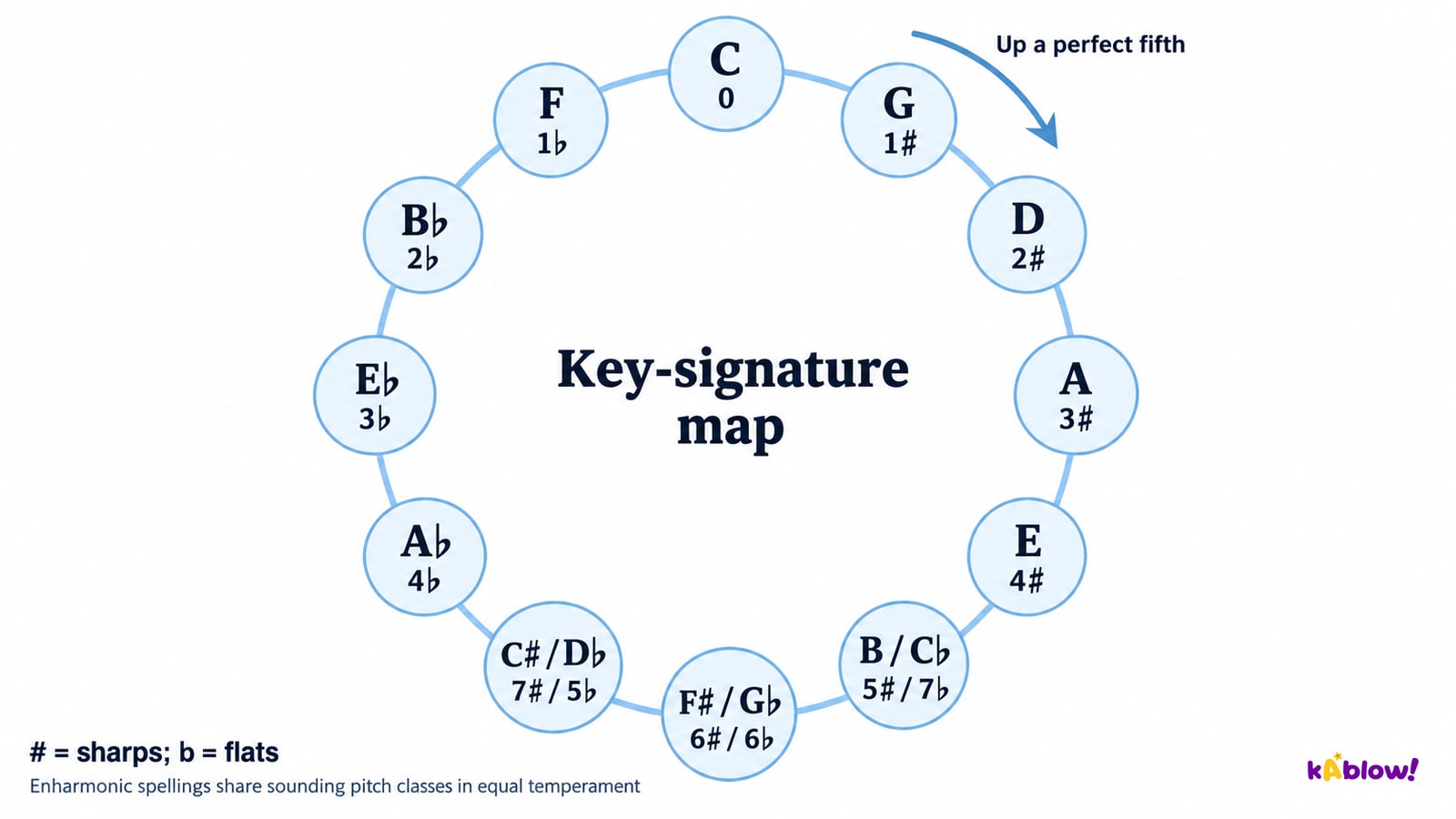
- The key-signature circle orders major tonic relationships by perfect fifths. With C at the top, clockwise upward fifths give G, D, A, E, B, F sharp and C sharp; anticlockwise downward fifths give F, B flat, E flat, A flat, D flat, G flat and C flat. Changes become sharper or flatter according to the current spelling.
- The graphic pairs B/Cb, F#/Gb and C#/Db. In twelve-tone equal temperament these pairs share sounding pitch classes but have different written signatures: 5 sharps/7 flats, 6 sharps/6 flats and 7 sharps/5 flats respectively. A respelling prevents a simple add-one-sharp count from continuing unchanged around the whole displayed circle.
- A signature alone does not decide the tonic: relative keys share it and local pitch alterations are possible. The circle helps compare key collections and related modulations; it is not the same as a diatonic descending-fifths chord progression within one key.
Circle of fifths: major keys
Modes
- Compare modes on the same tonic rather than by a vague mood. Dorian has a minor third and a sixth raised relative to natural minor: D E F G A B C D. Mixolydian lowers degree 7 relative to major: G A B C D E F G. These pitch relationships do not assign a single emotion to every performance.
- A mode needs an appropriate tonal reference and musical treatment, not merely a claim that any all-white-note passage starting on D must be Dorian. The same letter collection can support different tonal centres and functions in context.
Compare modes on a stated tonic
Other scales
- Pentatonic means five distinct pitch classes per octave, and different pentatonic collections have different intervals. C D E G A is a common major-pentatonic model. It does not guarantee freedom from dissonance when combined with a harmony, register or another part.
- A common minor-blues model is C Eb F Gb G Bb, related to C minor pentatonic C Eb F G Bb by adding Gb. Performed blue notes involve inflection and can lie between fixed equal-tempered pitches. This model is not a complete definition of all blues melody.
- A chromatic collection has twelve pitch classes per octave in this model; a whole-tone collection has six, moving by tones. Exclude the repeated octave tonic when counting distinct pitch classes. These are written teaching collections, not copied repertoire or a listening test.
ஸ்லைடுகள்
Sign up free to view the lesson slides
Step through every slide for this topic — plus flashcards and revision notes — with a free account.
பயிற்சி கேள்விகள்
இலவச முன்னோட்டம் — 36-இல் 8 கேள்விகள். அனைத்தையும் பார்க்க பதிவு செய்யவும்.
1.How many distinct pitch classes per octave does pentatonic mean, excluding octave repetition?
Easy- Afive
- Bseven
- Ceight
- Dtwelve
2.What is the tonic?
Easy- Athe fifth degree
- Bthe last note
- Ca chord
- Dthe first degree of a scale
3.What is the dominant?
Easy- Athe fourth degree
- Bthe seventh degree
- Cthe fifth degree of the scale
- Dthe first degree
4.What is the subdominant?
Easy- Athe seventh degree
- Bthe fourth degree
- Cthe fifth degree
- Dthe first degree
5.In the usual tonal sense, which description identifies a leading note?
Easy- Athe seventh degree a semitone below the tonic
- Bthe first degree
- Cthe fifth degree
- Dthe fourth degree
6.What is the mediant?
Easy- Athe second degree
- Bthe sixth degree
- Cthe fifth degree
- Dthe third degree
7.What is a relative minor?
Easy- Aa louder key
- Ba faster key
- Cthe minor key sharing a major key's signature
- Da minor key with no notes
8.What is the relative minor of C major?
Easy- AG minor
- BA minor
- CD minor
- DE minor
Unlock all 36 questions & more
இந்த தலைப்பிற்கான ஒவ்வொரு கேள்வியையும், ஸ்லைடுகளையும், ஃப்ளாஷ் கார்டுகளையும் மற்றும் திருப்புதல் குறிப்புகளையும் பார்க்க இலவச கணக்கை உருவாக்கவும்.
முந்தைய தேர்வுகள்
இந்த தலைப்பிற்கான முந்தைய தேர்வு பயிற்சி விரைவில் வருகிறது.
விரைவில் வருகிறது