
Properties Of Period 3 Elements & Their Oxides
Học bằng cách chơi
Trả lời những câu hỏi này để kiếm năng lượng, rồi câu cá và khám phá. Không cần tài khoản.
Ghi chú bài học
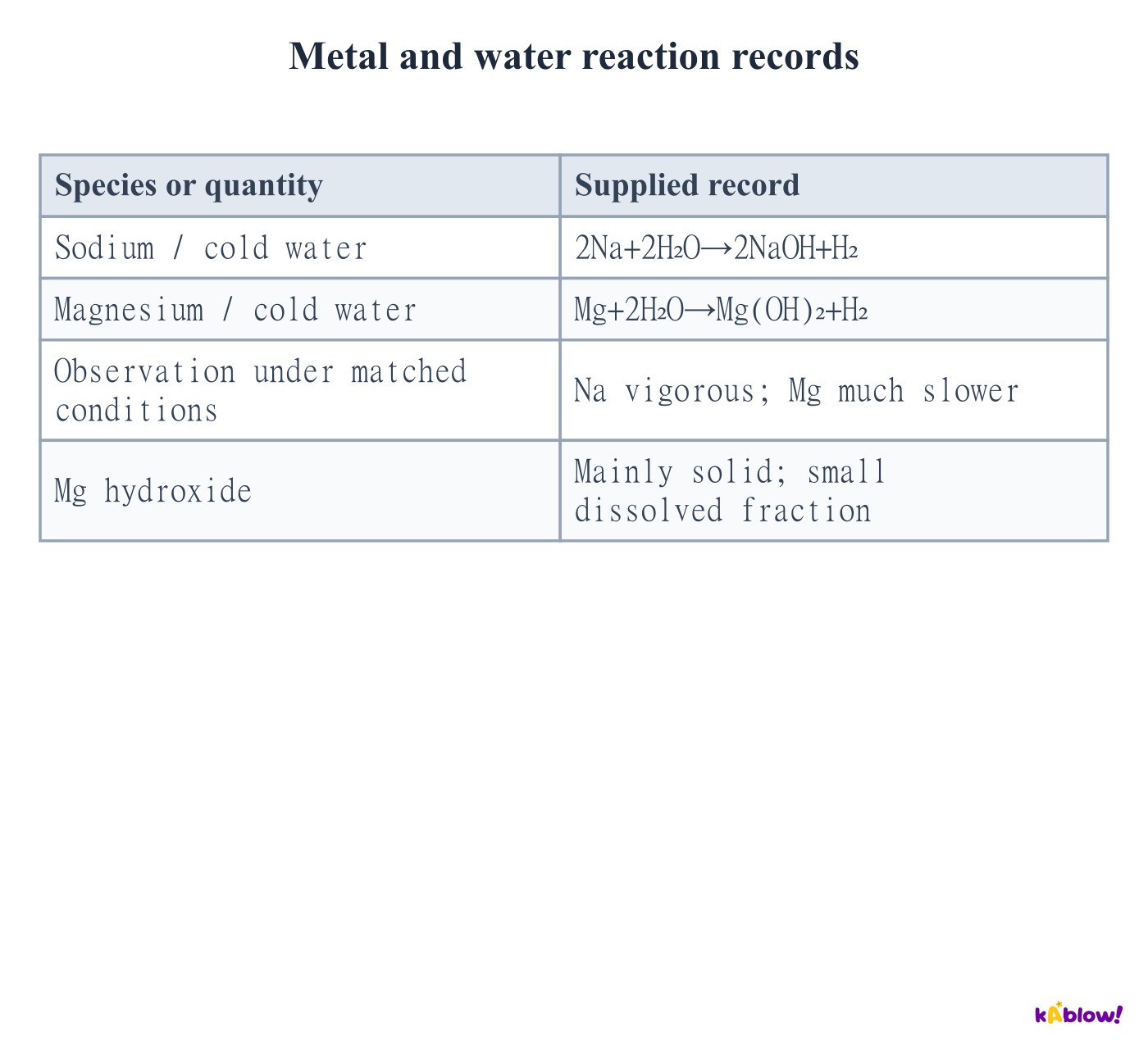
Compare sodium and magnesium with cold water
- Sodium reacts vigorously with cold water, forming sodium hydroxide solution and hydrogen. Heat can melt the metal; sodium has a low melting point for a metal.
- Magnesium reacts much more slowly with cold water. Its oxide/hydroxide surface layer limits contact, and sparingly soluble Mg(OH)₂ is mainly a solid product.
- The dissolved hydroxide raises pH. A measured pH depends on amount, water volume, temperature and equilibrium; it is not a fixed property of the metal name.
Metal and water reaction records
Distinguish steam from cold-water products
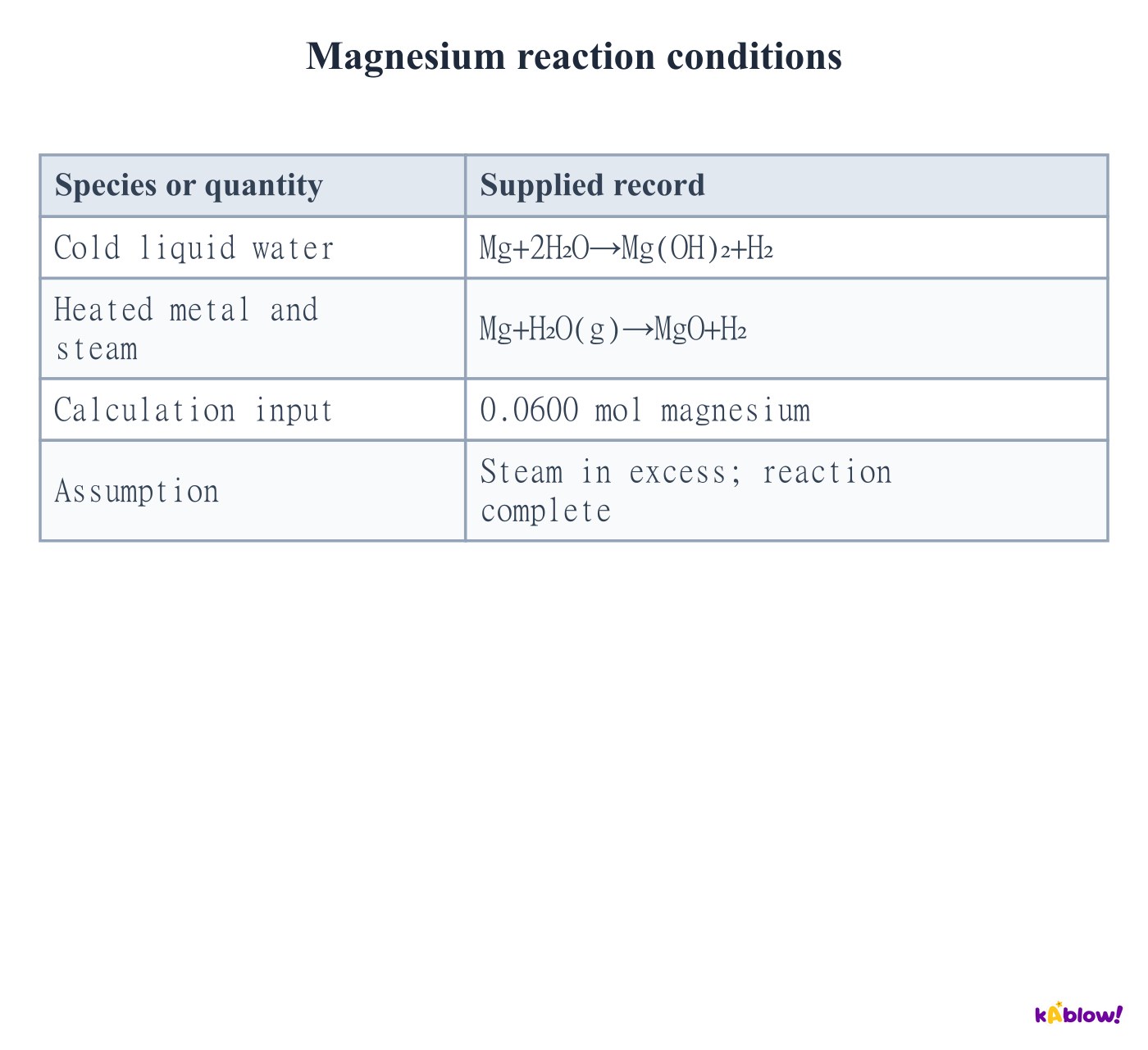
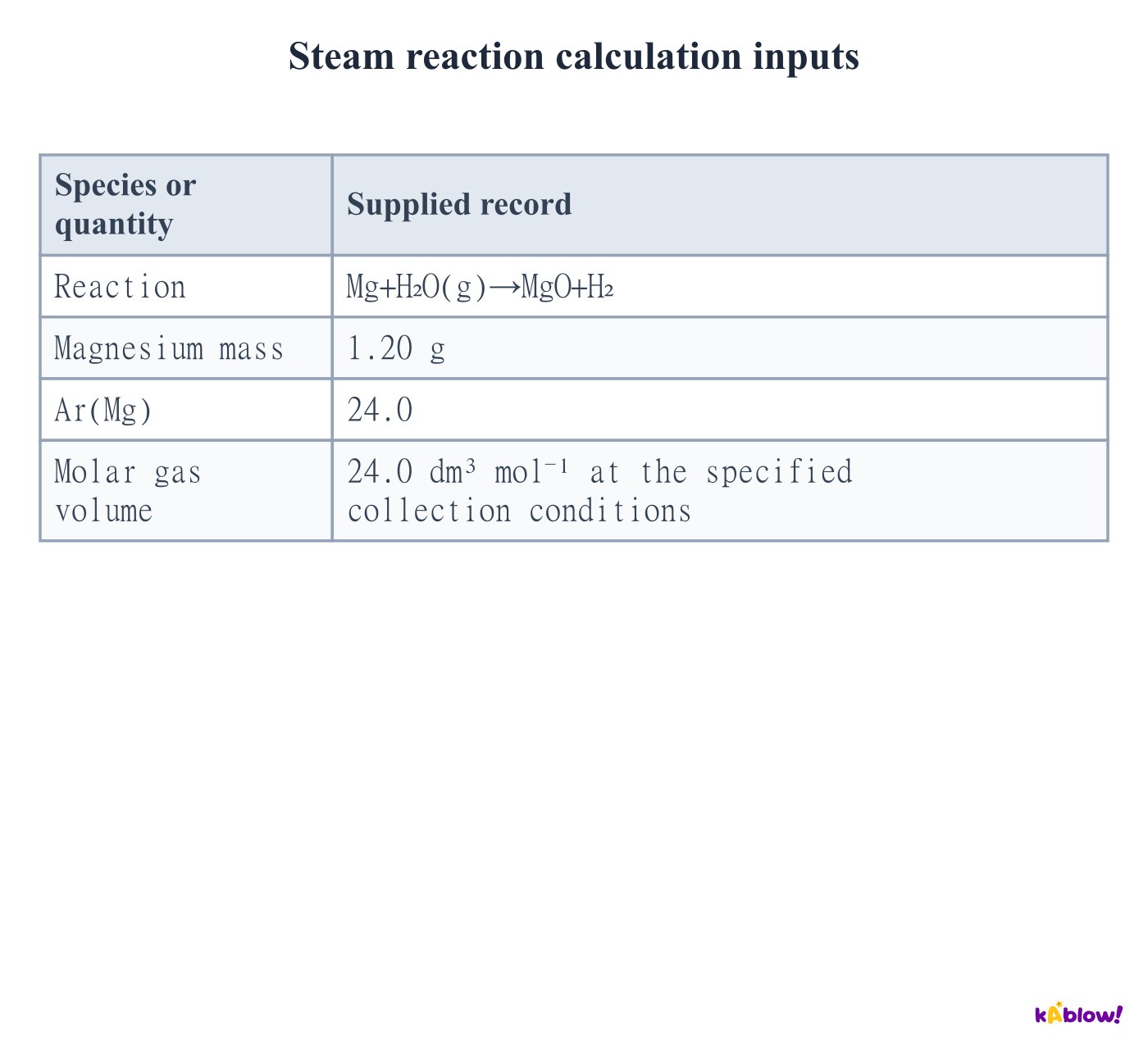
- Heated magnesium reacts with steam to give MgO(s) and H₂(g). This is faster than the usual cold-water reaction.
- Use Mg+H₂O(g)→MgO+H₂ for the steam model, rather than copying the hydroxide product from cold water.
- One mole of magnesium forms one mole of hydrogen in either balanced equation; the water coefficient and solid product differ.
Magnesium reaction conditions
Track electron transfer in metal–water reactions
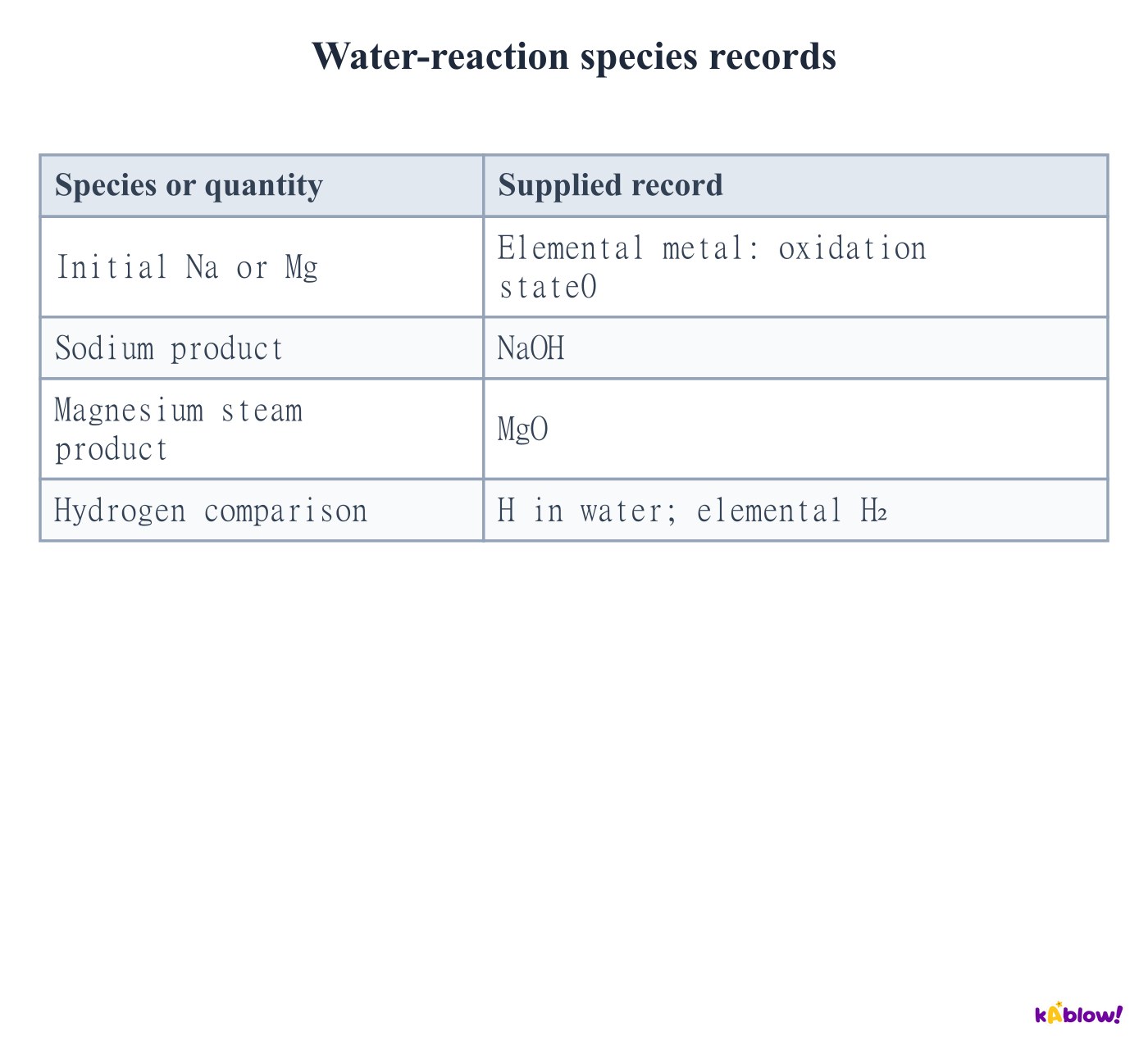
- Sodium changes from 0 to+1, while magnesium changes from 0 to+2. Both metals lose electrons and act as reducing agents.
- Hydrogen changes from +1 in water to 0 in H₂, so water is reduced in the bookkeeping. Oxygen remains−2.
- Balance atoms and total electron transfer. Two Na atoms supply the two electrons required to make one H₂ molecule.
Water-reaction species records
Write the specified sodium and magnesium oxides
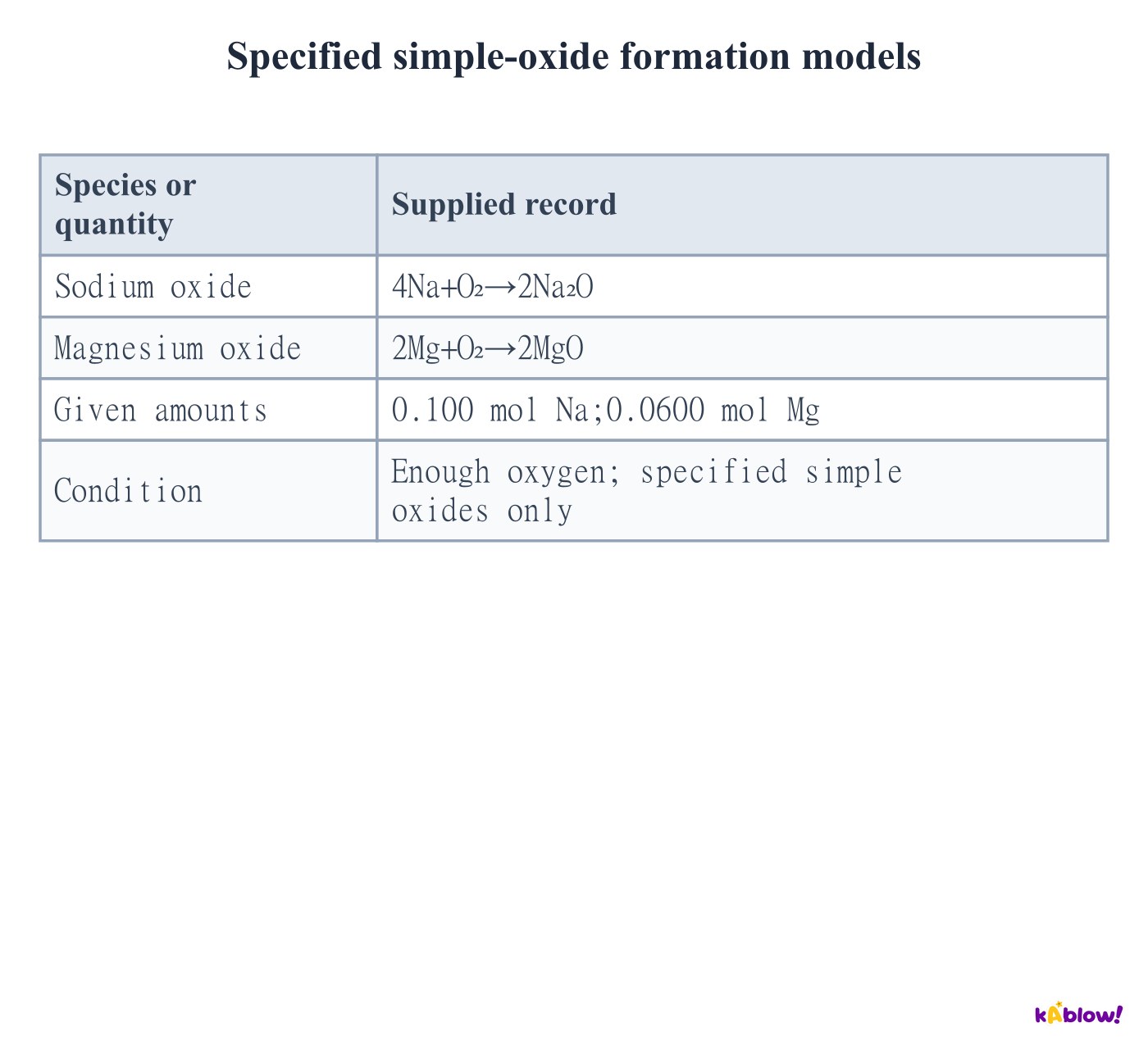
- The AQA simple-oxide models are4Na+O₂→2Na₂O and 2Mg+O₂→2MgO. Their products are white ionic solids.
- The specified sodium oxide is not a claim that every sodium–oxygen experiment gives only Na₂O. Peroxide formation can compete, especially in excess oxygen.
- State the product model before calculating amounts. For Na₂O the Na:oxide ratio is2:1; for MgO the Mg:oxide ratio is1:1.
Specified simple-oxide formation models
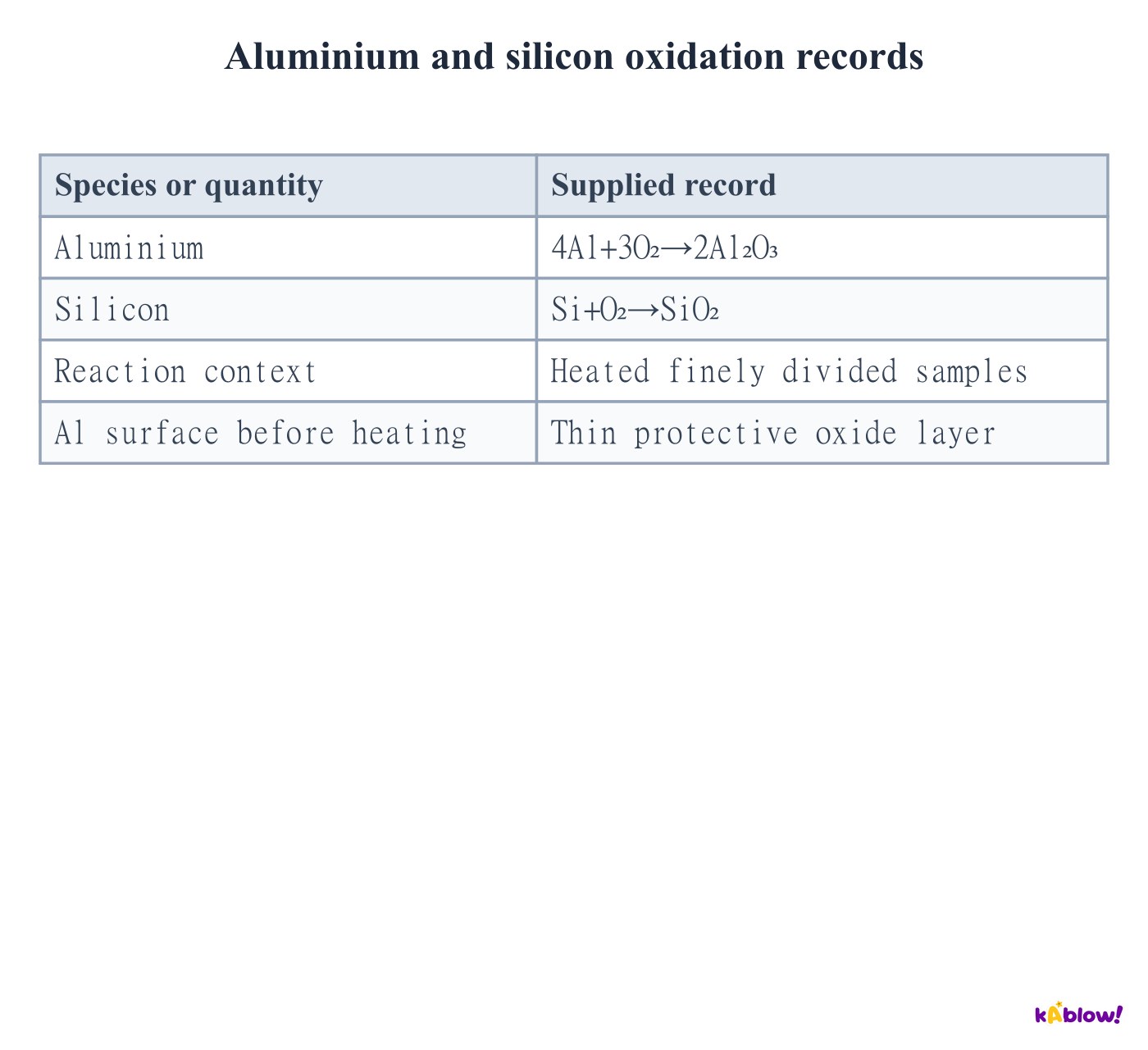
Explain aluminium protection and silicon oxidation
- Aluminium forms a thin adherent oxide layer that restricts further attack. Heated powder can react much more readily because surface area and coating conditions differ.
- 4Al+3O₂→2Al₂O₃ and Si+O₂→SiO₂ conserve both element counts. The products have different bonding and structure.
- A lack of rapid reaction at room temperature can reflect kinetics and surface protection; it does not mean oxide formation is thermodynamically impossible.
Aluminium and silicon oxidation records
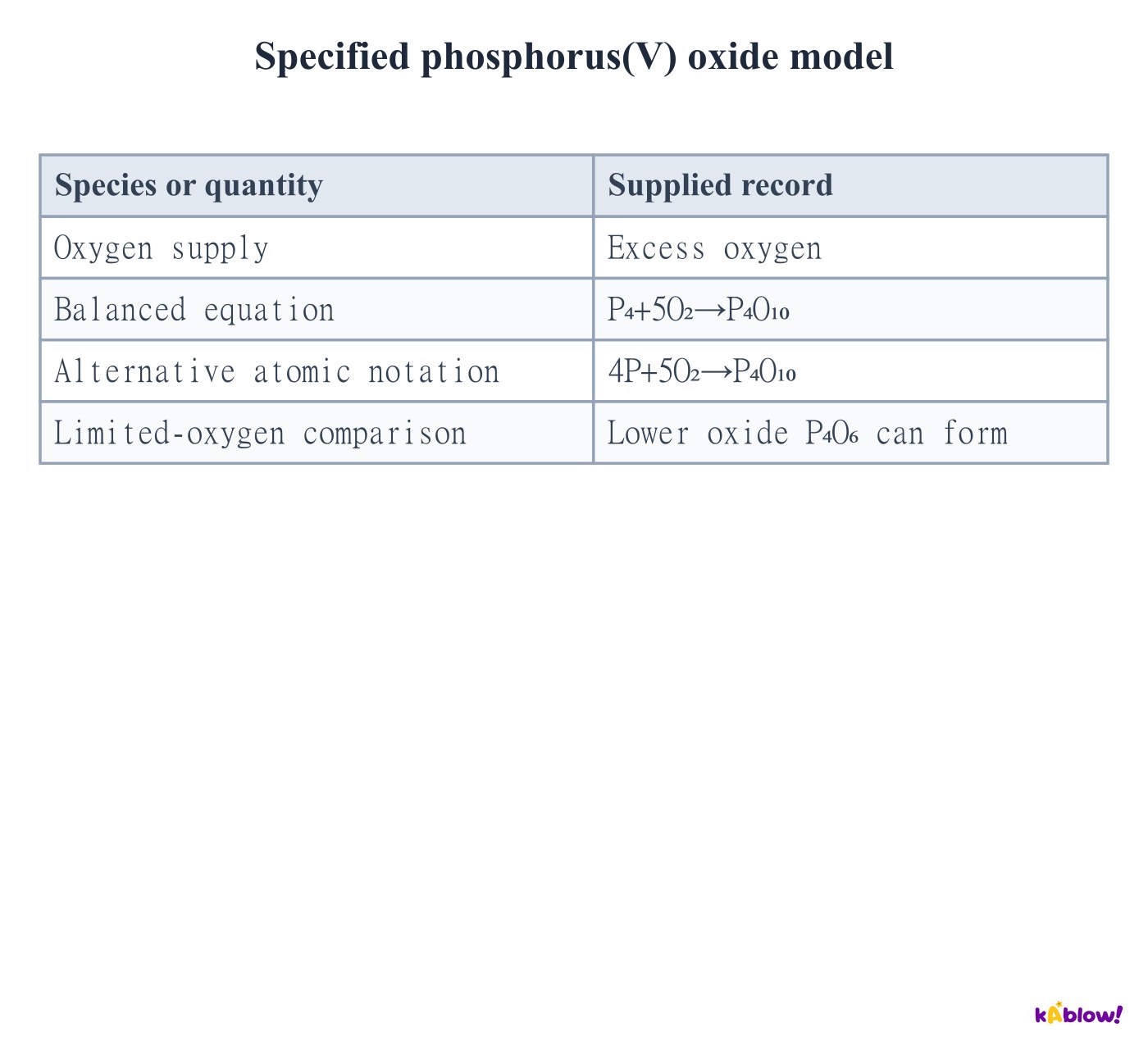
Form phosphorus(V) oxide with the oxygen condition stated
- Excess oxygen favours phosphorus(V) oxide, written P₄O₁₀ in this molecular model. Its empirical formula is P₂O₅.
- P₄+5O₂→P₄O₁₀ is a balanced molecular equation. Atomic P notation can represent other phosphorus allotropes without claiming that all contain P₄ molecules.
- Limited oxygen can give phosphorus(III) oxide. Do not claim that every combustion must produce the highest oxidation state.
Specified phosphorus(V) oxide model
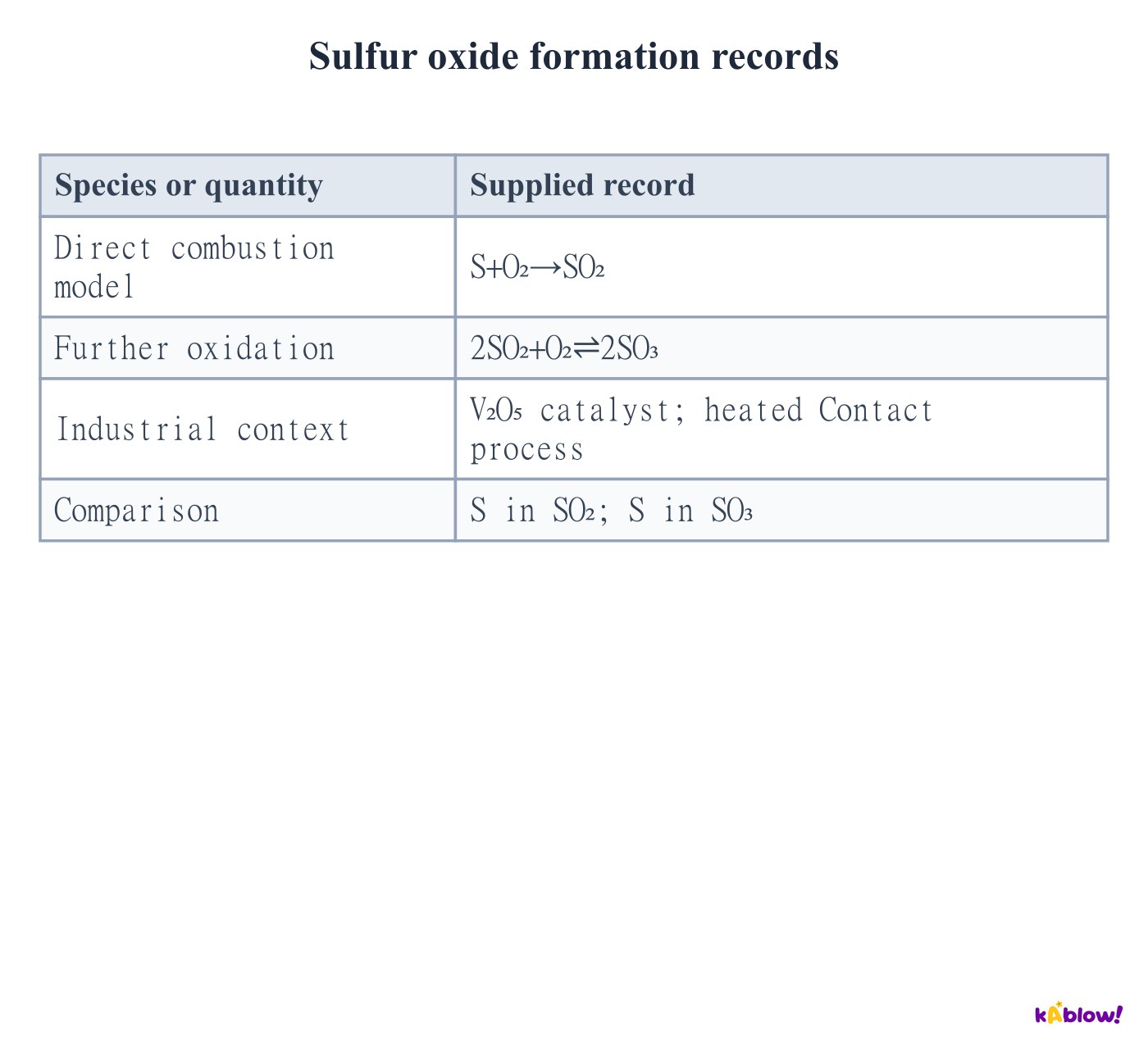
Separate sulfur combustion from further oxidation
- Burning sulfur mainly gives SO₂, with sulfur in oxidation state +4. SO₃ contains sulfur at+6.
- Sulfur trioxide is formed by further oxidation:2SO₂+O₂⇌2SO₃, using the catalytic Contact-process conditions.
- A catalyst speeds approach to equilibrium; it does not change the equilibrium constant. Avoid replacing this route with an unqualified claim of direct sulfur combustion to SO₃.
Sulfur oxide formation records
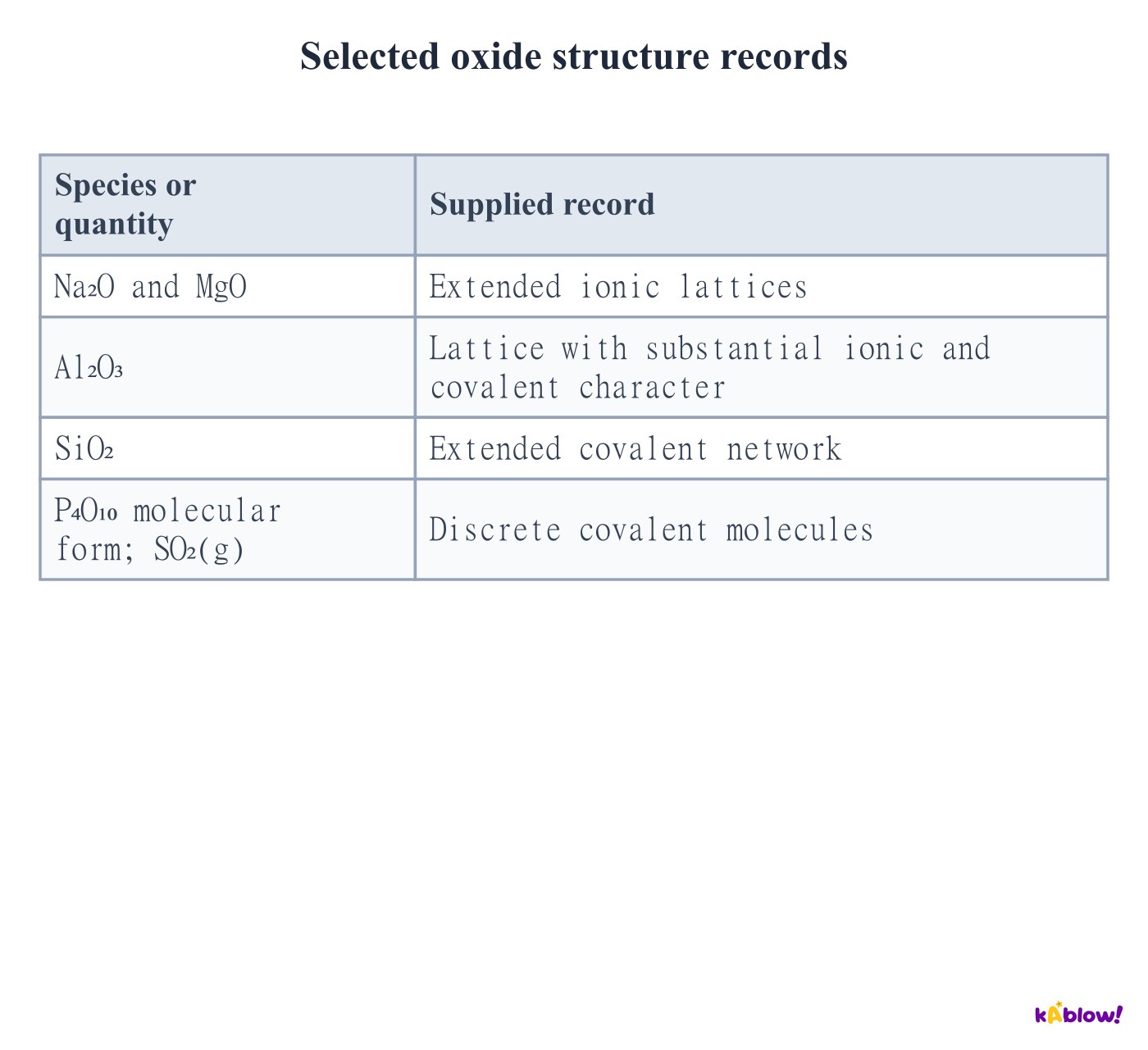
Use structure rather than a metal/non-metal slogan
- Na₂O and MgO form extended ionic lattices. Al₂O₃ is commonly treated as ionic at this level, with significant covalent character from polarization.
- Silicon dioxide forms an extended covalent network, while SO₂ gas and a molecular form of P₄O₁₀ consist of discrete molecules.
- Across these oxides the increasing covalent contribution is useful, but composition alone does not specify every solid form or predict every property.
Selected oxide structure records
Explain high ionic melting temperatures with limits
- Melting an ionic oxide requires disruption of strong electrostatic attractions throughout its lattice. These are not attractions between separate Na₂O molecules.
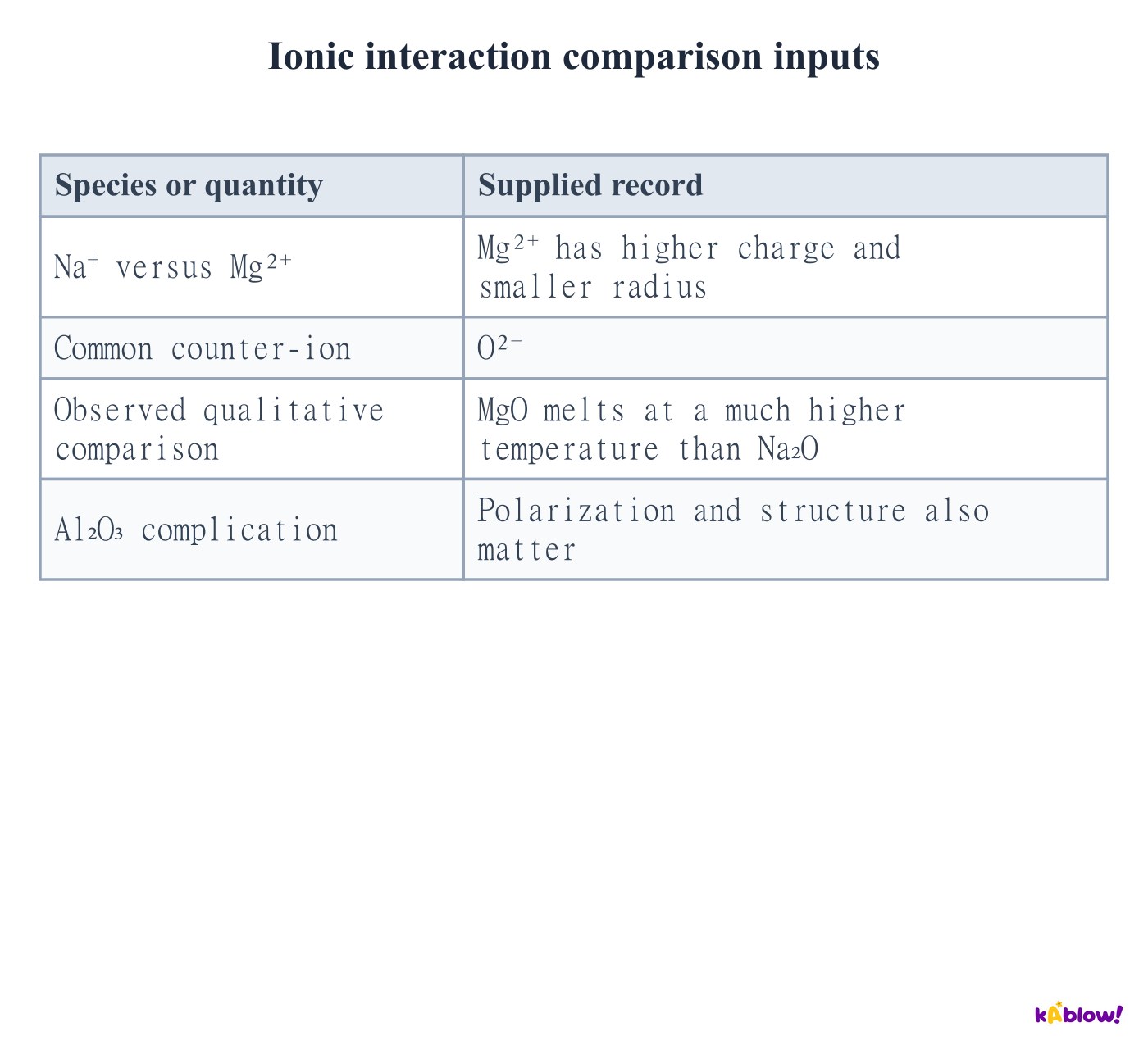
- Mg²⁺ is smaller and more highly charged than Na⁺; its stronger attraction to oxide helps explain MgO’s higher melting temperature.
- Do not extrapolate a monotonic charge-only sequence through Al₂O₃. Crystal structure, covalent character and entropy also influence melting.
Ionic interaction comparison inputs
Connect silica connectivity to its formula and melting
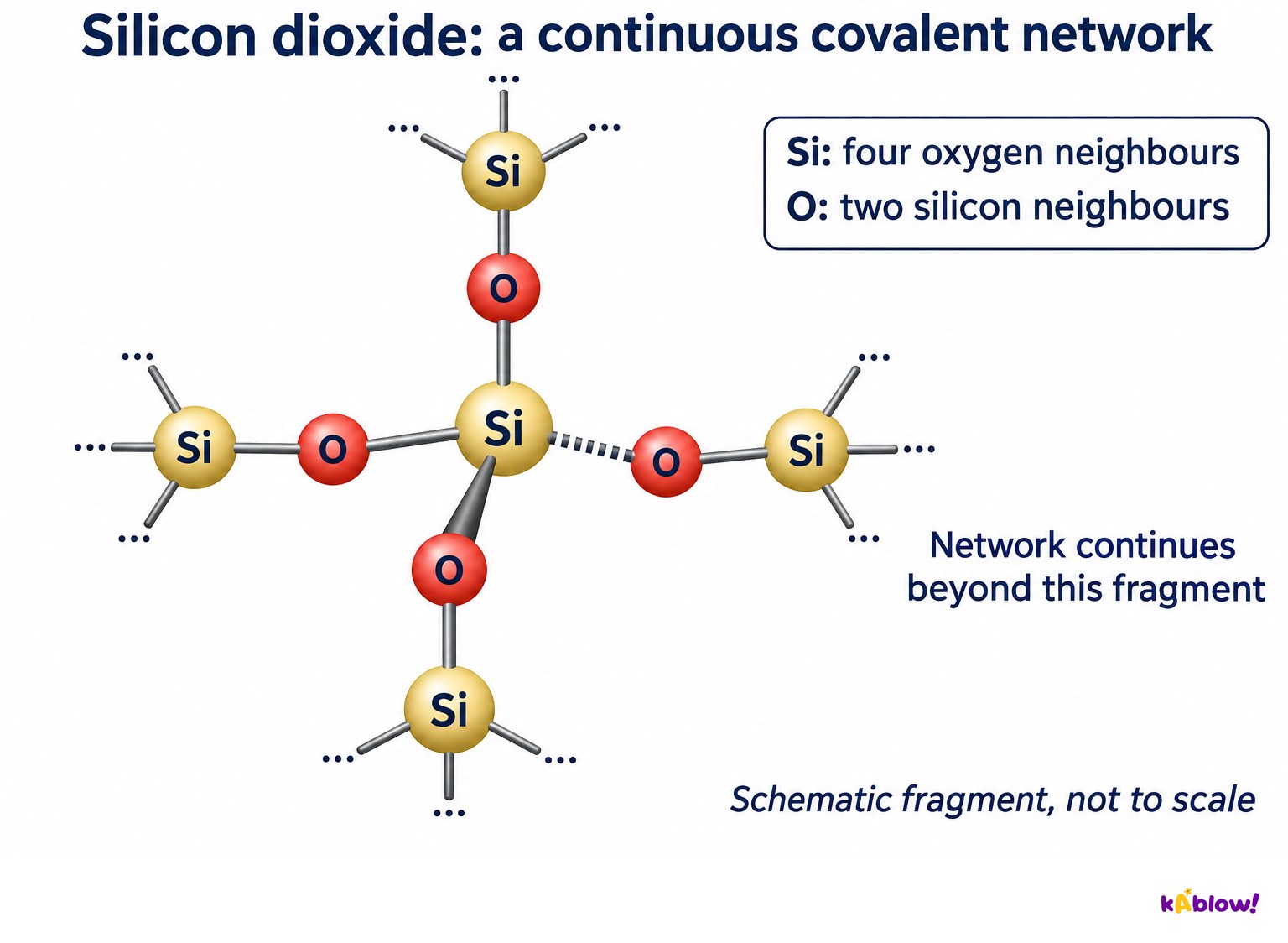
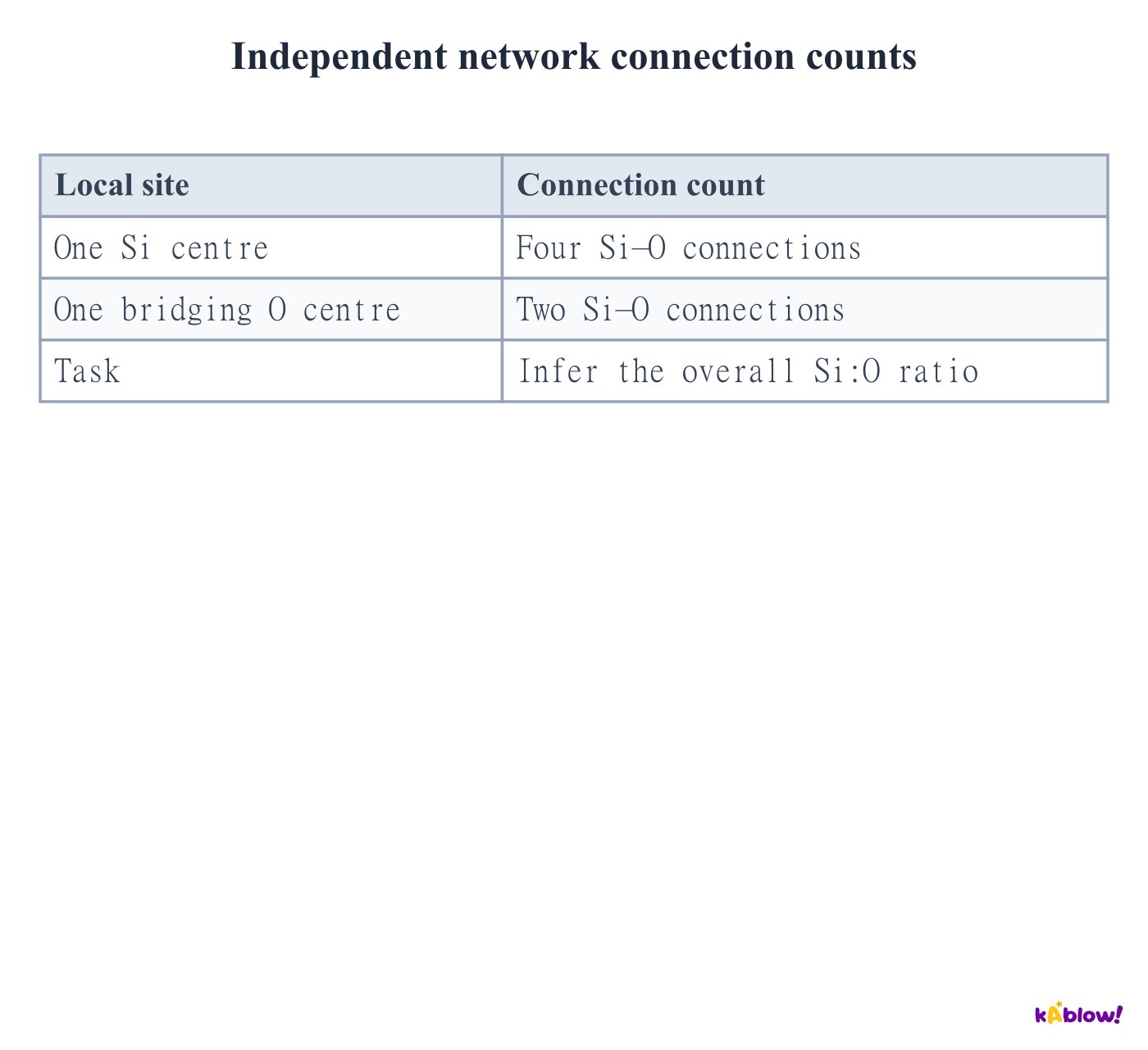
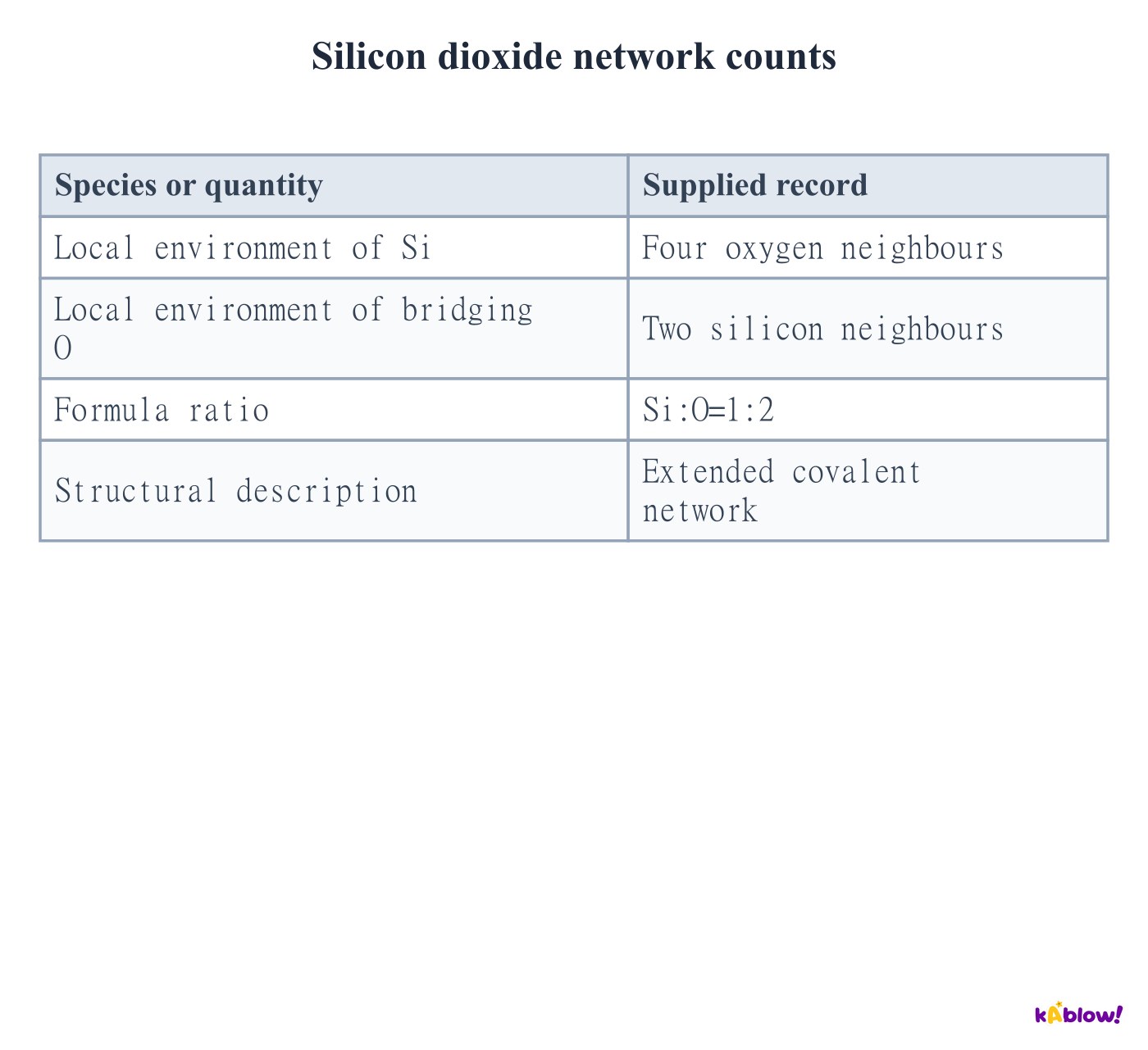
- The reviewed network illustration shows silicon linked through oxygen bridges. Each Si has four O neighbours; each bridging O links two Si atoms.
- Sharing oxygen between neighbouring Si centres gives the overall SiO₂ ratio, rather than a set of isolated O=Si=O molecules in ordinary silica.
- Melting requires extensive reorganisation of a strong covalent network. It does not require every bond in the specimen to break simultaneously.
A continuous silicon dioxide network
Qualify the molecular-oxide melting pattern
- The broad highest-oxide pattern is high melting for Na₂O, MgO, Al₂O₃ and SiO₂, then much lower phase-change temperatures for molecular forms of P₄O₁₀ and SO₃. MgO is highest in the usual comparison; the sequence is not monotonic.
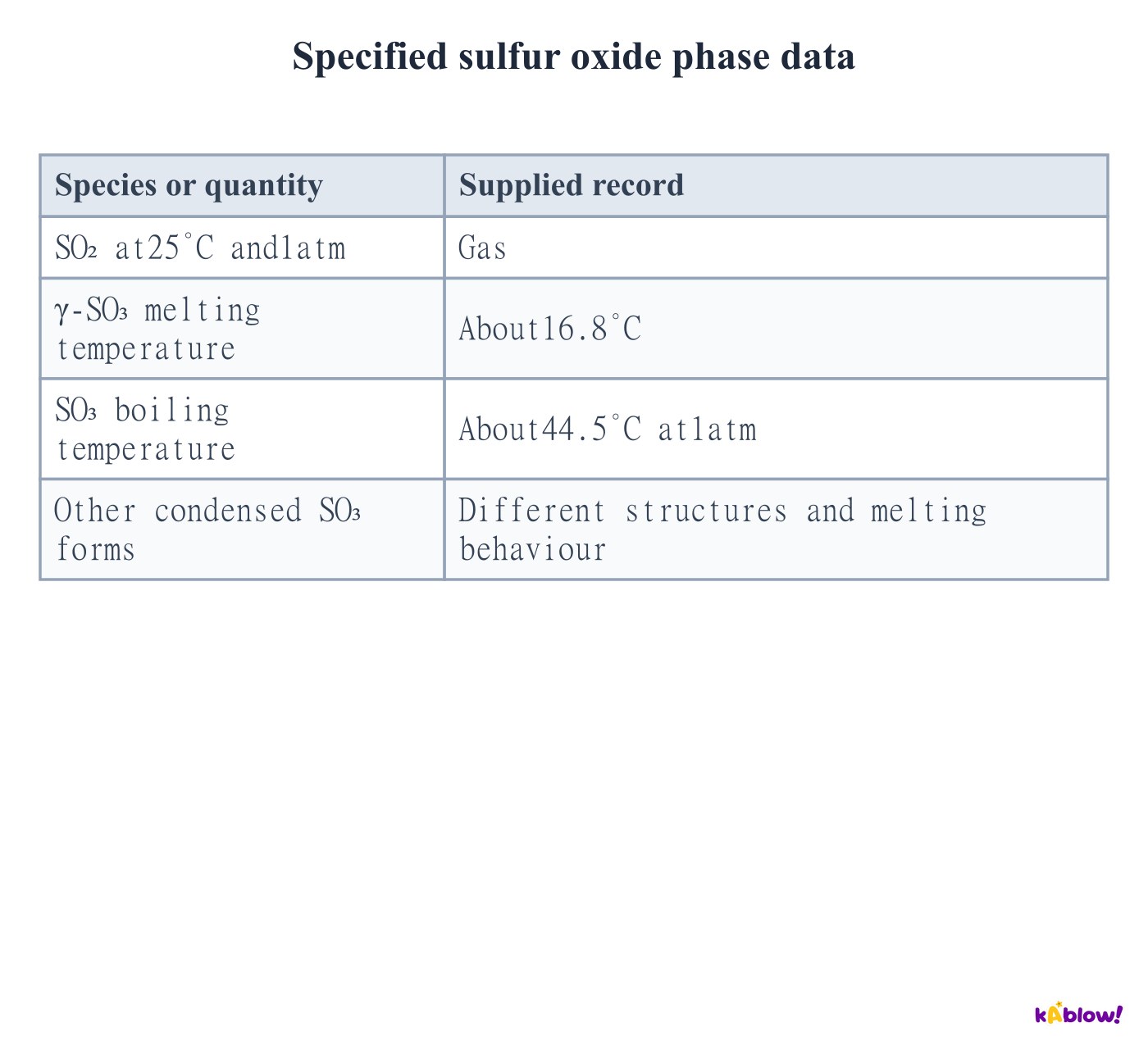
- SO₂ is a gas at 25°C. The specified γ-SO₃ form is liquid between its roughly16.8°C melting and 44.5°C boiling temperatures at ordinary pressure.
- SO₃ has multiple condensed forms; P₄O₁₀ also has different structures and can sublime. Avoid an exact universal melting curve or the claim that both sulfur oxides are always room-temperature gases.
Specified sulfur oxide phase data
Form hydroxide when sodium oxide reacts with water
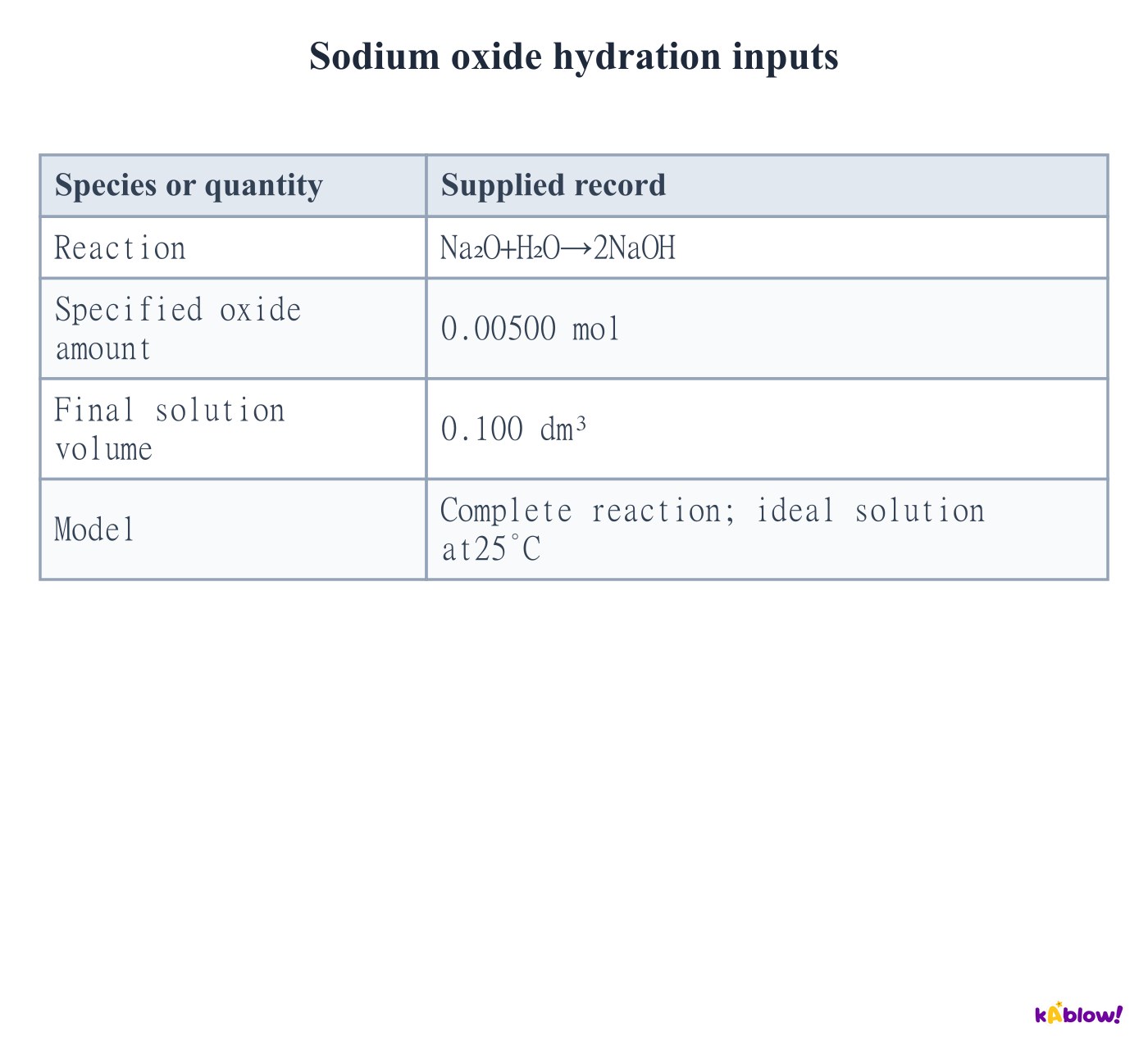
- Na₂O(s)+H₂O(l)→2NaOH(aq) forms a strongly alkaline solution when enough oxide is present. The pH still depends on concentration.
- Oxide ions in the lattice accept protons from water. The formal bookkeeping O²⁻+H₂O→2OH⁻ does not mean free oxide ions persist in aqueous solution.
- For the supplied ideal calculation, 0.00500 mol Na₂O supplies0.0100 mol OH⁻ in 0.100 dm³, so[OH⁻]=0.100 mol dm⁻³ and pH 13.00 at 25°C.
Sodium oxide hydration inputs
Distinguish hydroxide solubility from base strength
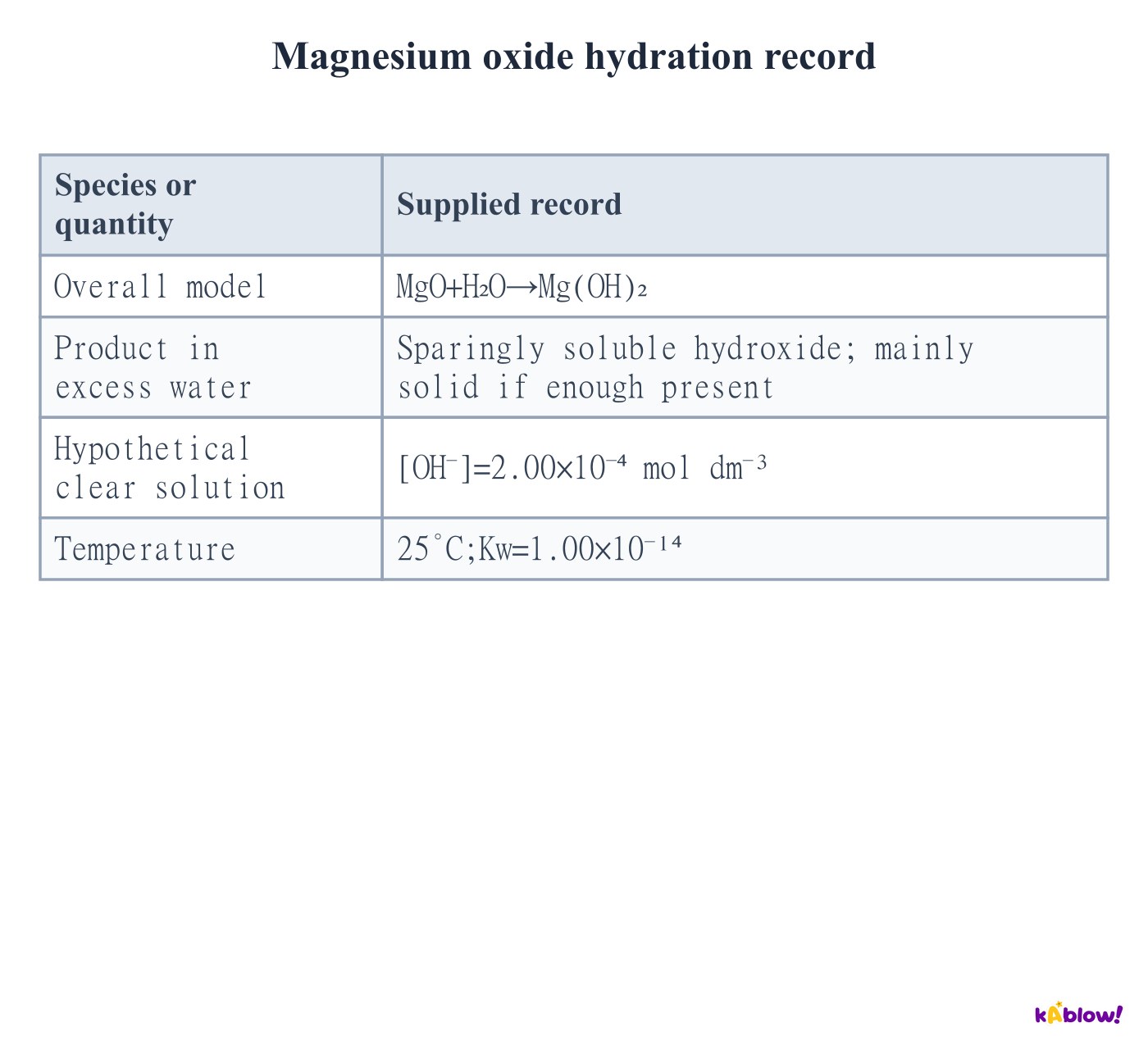
- MgO can hydrate to Mg(OH)₂. The hydroxide is sparingly soluble, so a suspension can contain much more solid than dissolved material.
- A moderately alkaline saturated solution reflects limited dissolved hydroxide; it is not evidence that the dissolved hydroxide ion is a weak base.
- Use supplied concentrations or solubility data for pH. Do not assign a universal pH 10 to every mass and dilution of MgO or Mg(OH)₂.
Magnesium oxide hydration record
Avoid equating water insolubility with neutral behaviour
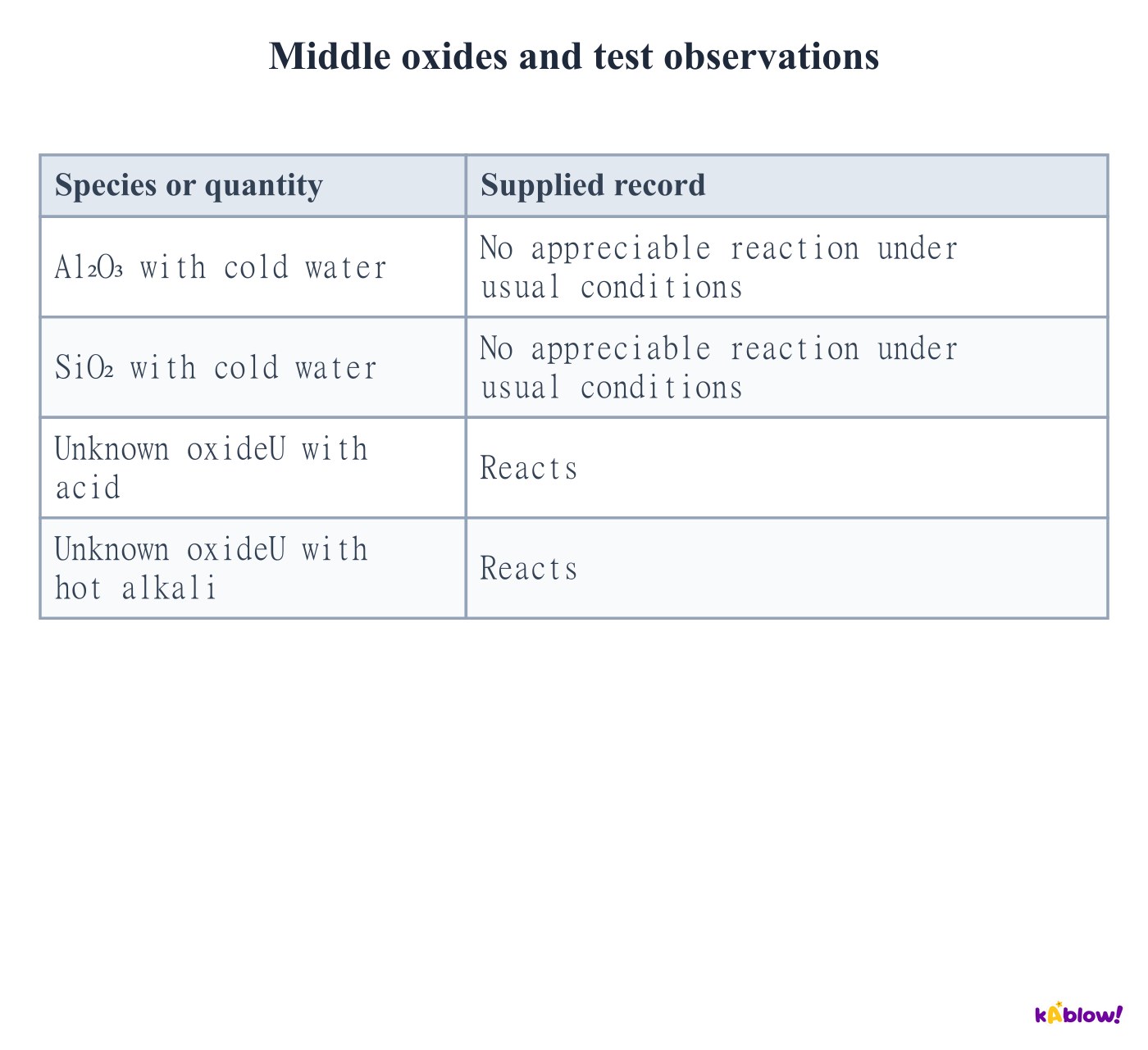
- Al₂O₃ and SiO₂ show no appreciable reaction with cold water under ordinary conditions. Strong lattices/networks and kinetic barriers matter.
- This observation does not make either oxide neutral. Aluminium oxide is amphoteric; silicon dioxide is acidic in its reactions with suitable bases.
- Acid/base classification uses appropriate acid and base reactions, not simply whether a solid visibly dissolves in water.
Middle oxides and test observations
Form phosphoric acid without calling it strong
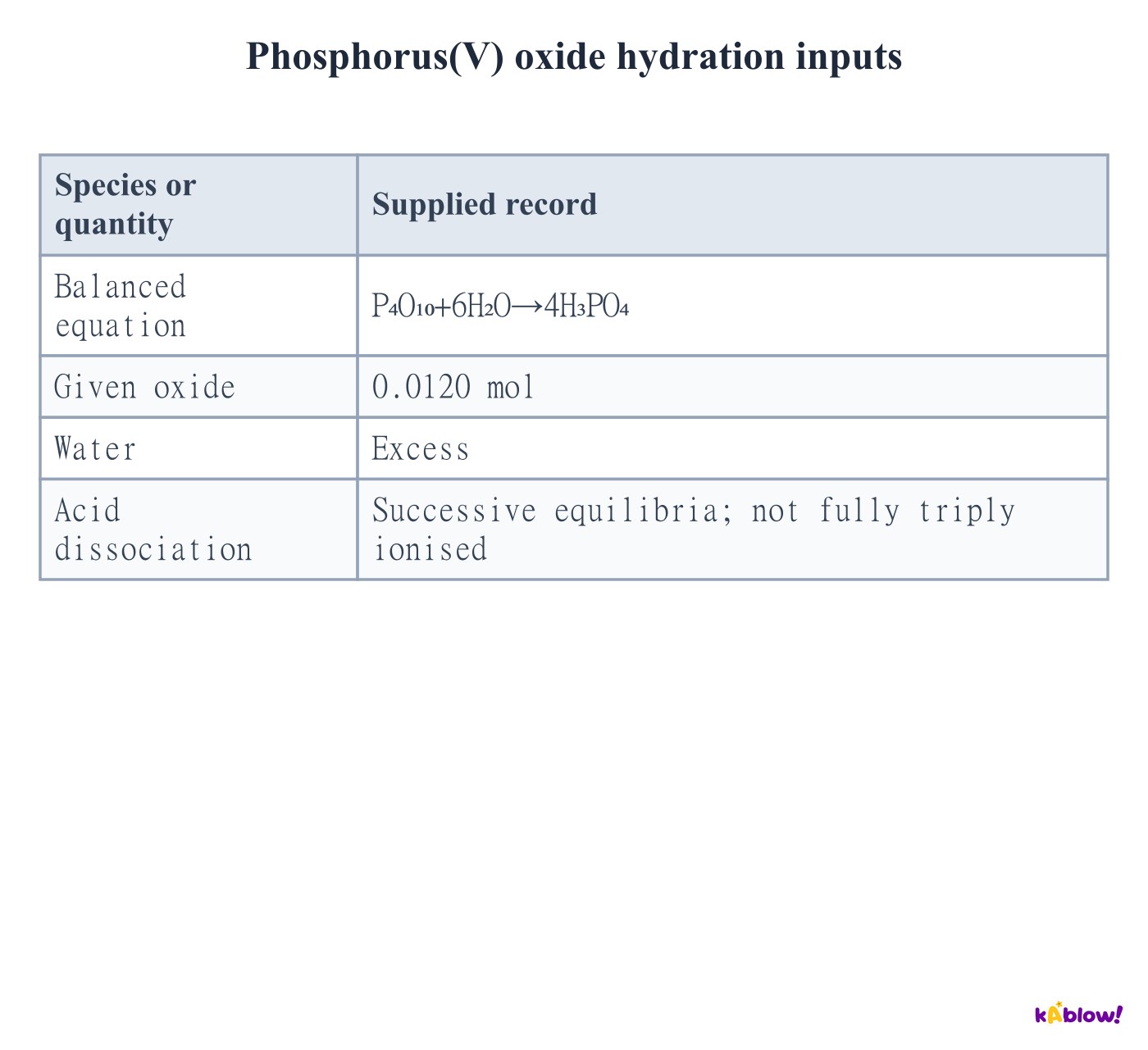
- Phosphorus(V) oxide reacts with excess water to form phosphoric acid:H₃PO₄. One mole P₄O₁₀ yields four moles of acid.
- Phosphoric acid is a weak, triprotic acid. A low measured pH does not by itself make an acid strong, and its three ionisation steps are not equally extensive.
- The reaction can be very exothermic. The equation teaches composition and stoichiometry, rather than serving as an instruction to perform an uncontrolled hydration.
Phosphorus(V) oxide hydration inputs
Describe sulfur dioxide in water as an equilibrium system
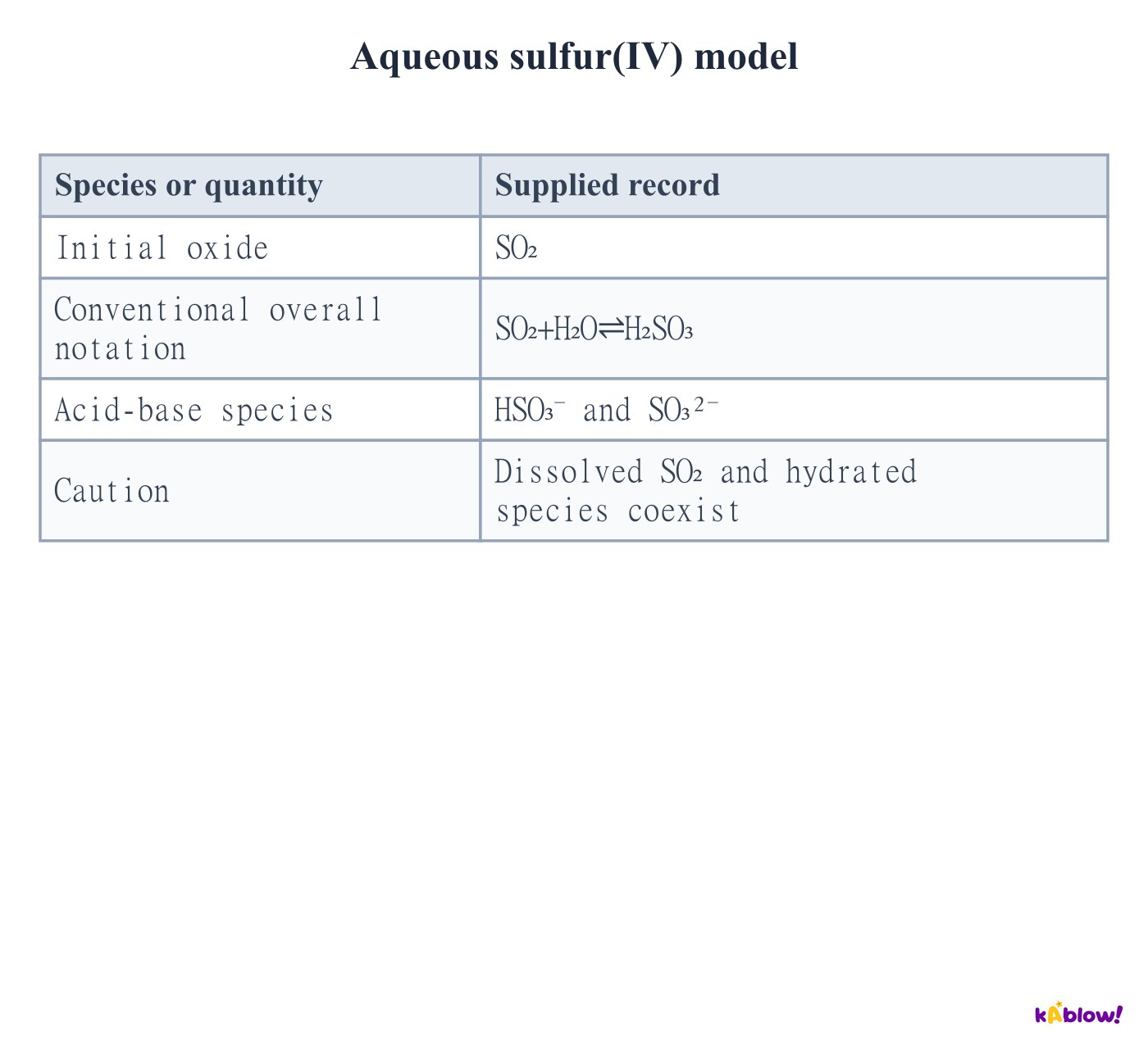
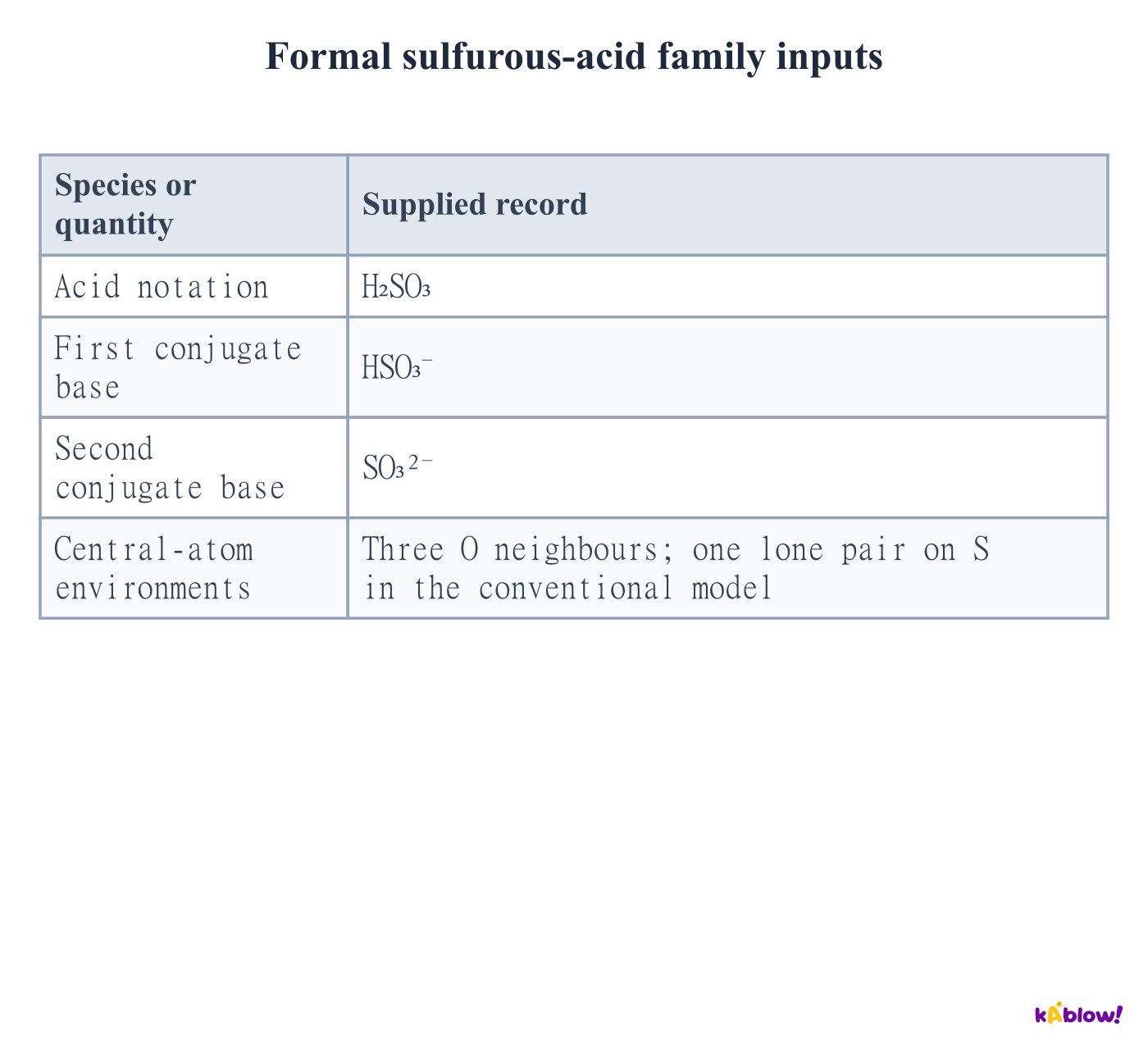
- Sulfur dioxide dissolves in water and gives an acidic solution. H₂SO₃ is conventional sulfurous-acid notation for the aqueous sulfur(IV) system.
- Do not describe the solution as pure molecular H₂SO₃. Dissolved SO₂, hydrated species and acid-base equilibria contribute.
- Hydrogensulfite HSO₃⁻ and sulfite SO₃²⁻ arise on successive proton loss in the formal acid model; sulfur remains at oxidation state +4.
Aqueous sulfur(IV) model
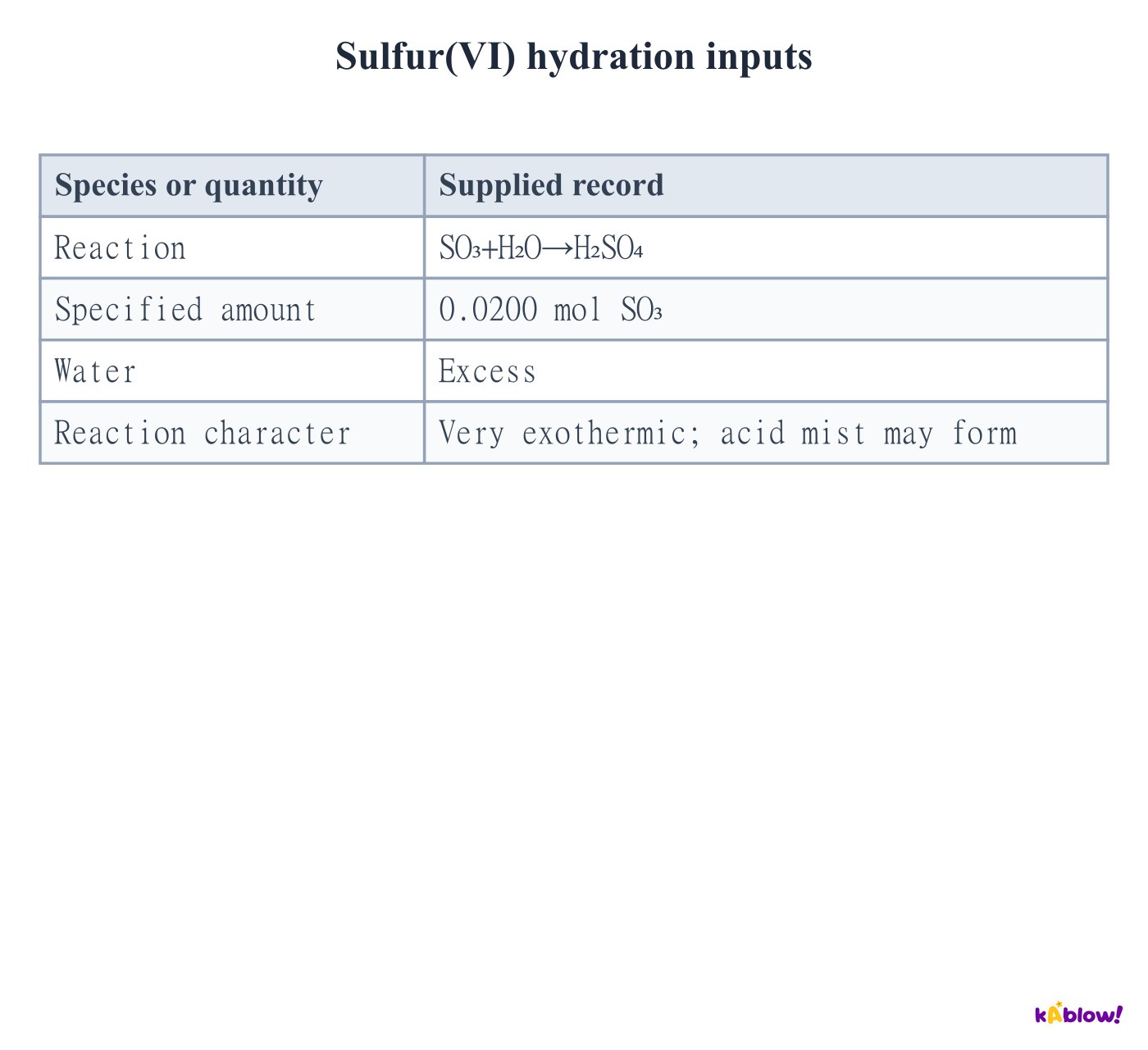
Connect sulfur trioxide to sulfuric acid
- SO₃ reacts with water to form sulfuric acid, retaining sulfur at oxidation state +6. This hydration is very exothermic.
- The conceptual equation is SO₃+H₂O→H₂SO₄. It does not prescribe direct mixing as a classroom or industrial procedure.
- In dilute aqueous solution, the first proton loss of H₂SO₄ is treated as complete. The second is an equilibrium and depends on concentration.
Sulfur(VI) hydration inputs
Read the phosphoric-acid displayed structure
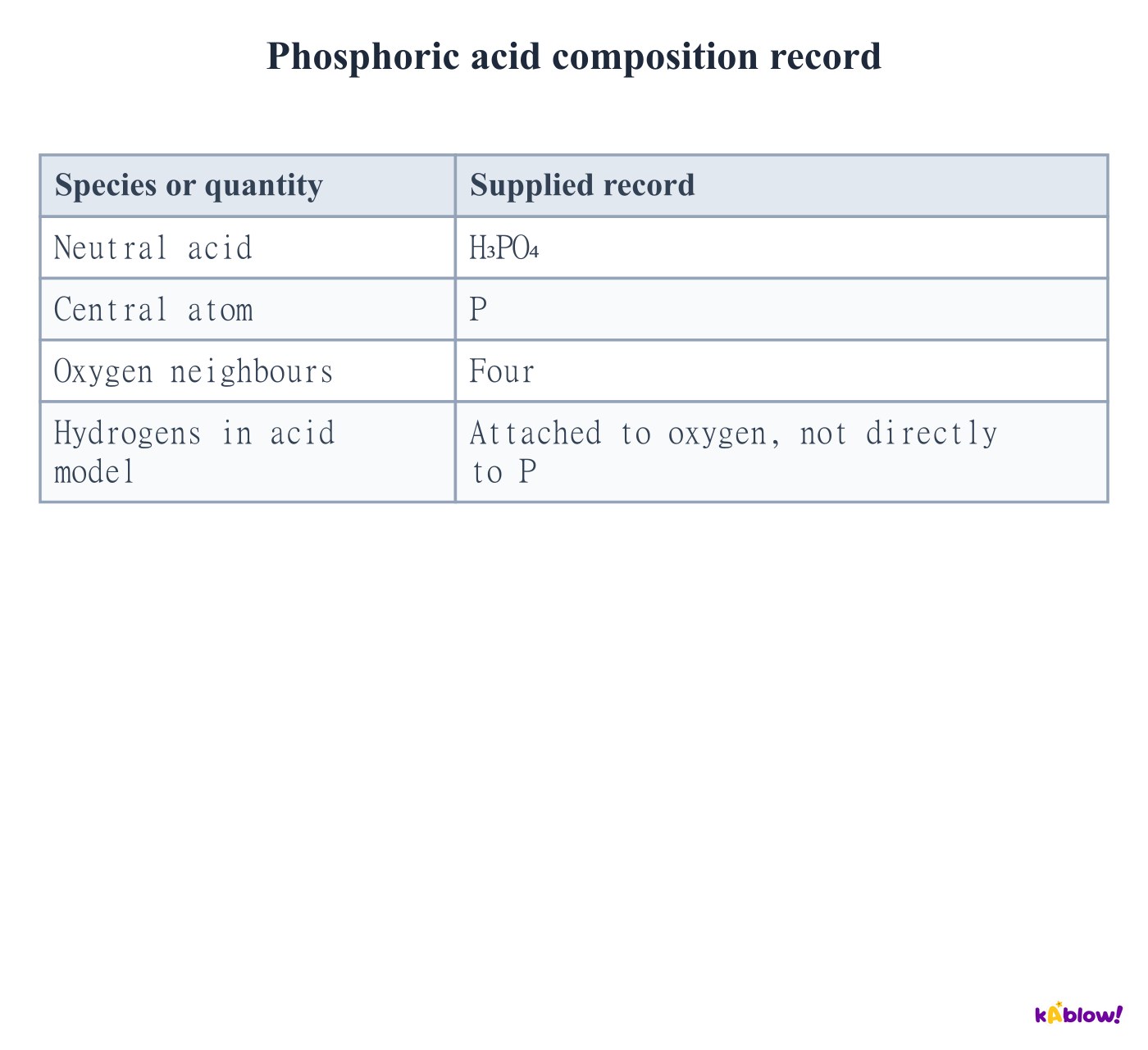
- The original displayed formula shows a central P with four oxygen neighbours: one conventional P=O and three P–O–H groups.
- The oxygen arrangement around P is approximately tetrahedral; a flat displayed projection does not imply a square planar molecule.
- The formula specifies three acidic O–H hydrogens. It does not contain three P–H bonds. Single/double-bond placement is a useful formal Lewis description.
Conventional phosphate-family displayed structures
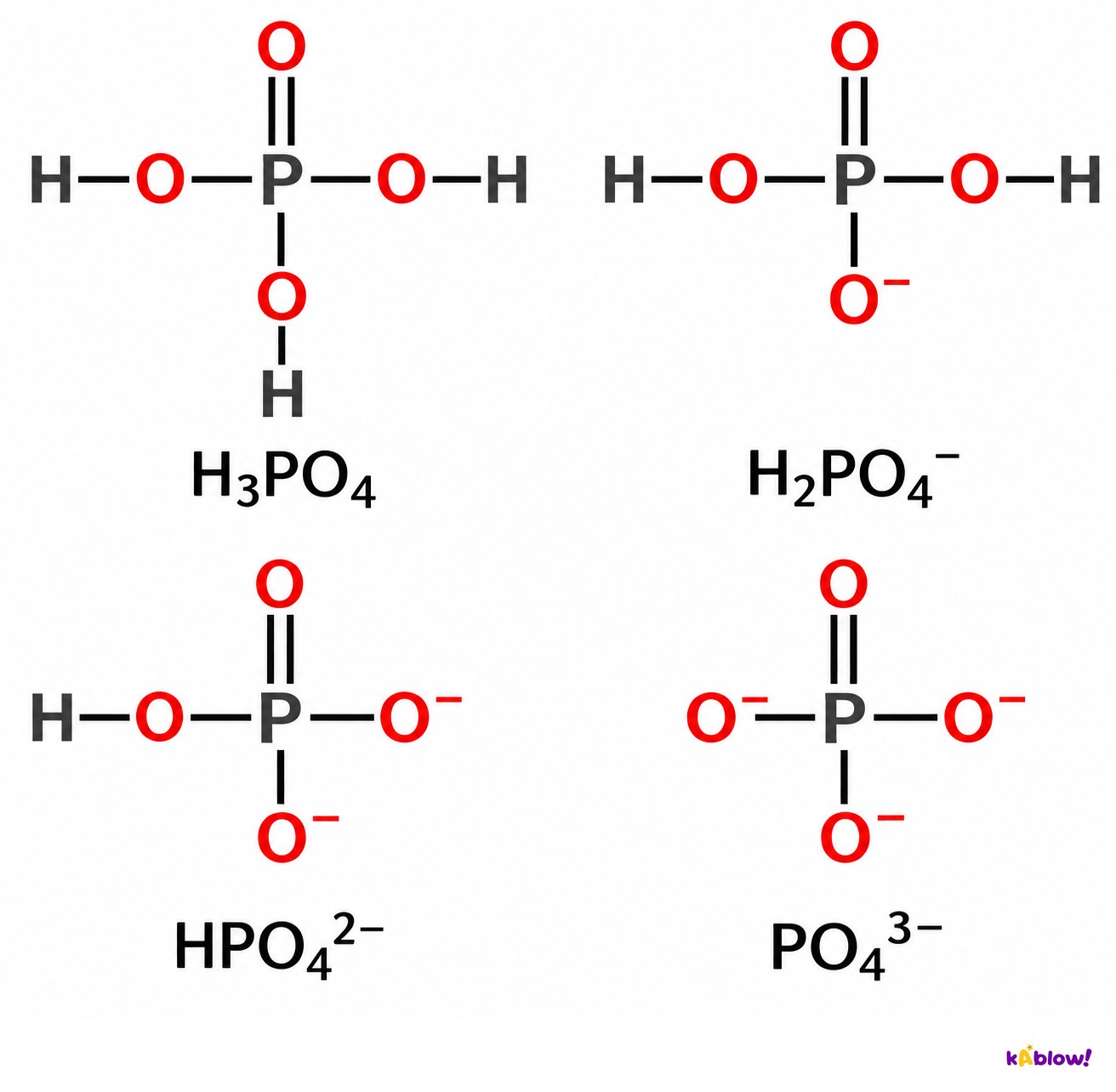
Preserve the oxygen skeleton through phosphate proton loss
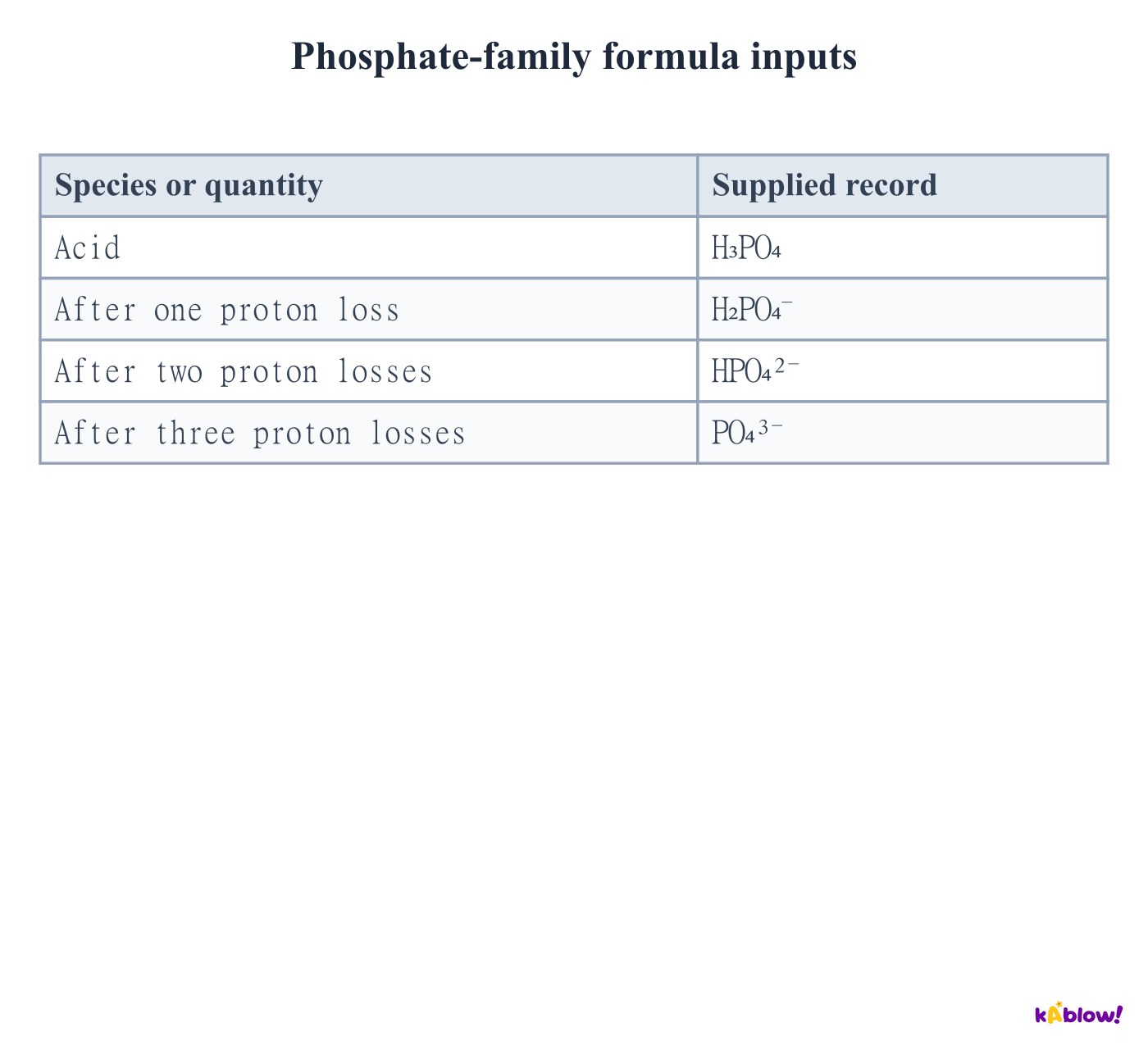
- Successive proton loss gives H₂PO₄⁻, HPO₄²⁻ and PO₄³⁻. Each step removes H⁺ and makes the remaining species one charge more negative.
- The four-oxygen skeleton remains. In a conventional Lewis contributor, an O–H becomes O⁻ when its proton is lost.
- Actual anions have delocalised bonding; the drawn single and double bonds are not a claim of permanently distinct measured P–O bond orders.
Conventional phosphate-family displayed structures
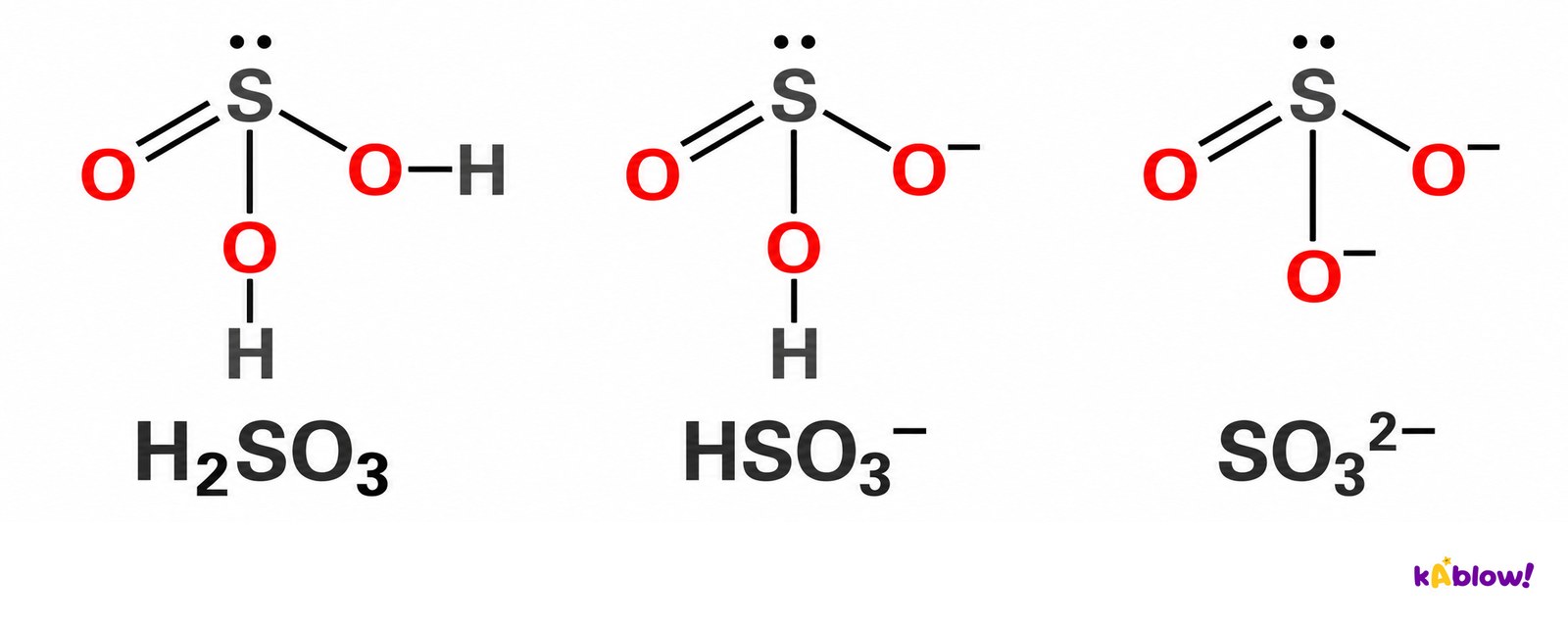
Read sulfurous-acid and sulfite-family structures
- The formal H₂SO₃ contributor has one S=O and two S–O–H groups. Sulfur has three oxygen neighbours and a lone pair.
- One or two proton losses give HSO₃⁻ and SO₃²⁻, keeping the three-oxygen framework. The S–O connections are not S–H bonds.
- This formal model supports composition and proton accounting; aqueous speciation and resonance need more than one fixed drawing.
Conventional sulfite-family displayed structures
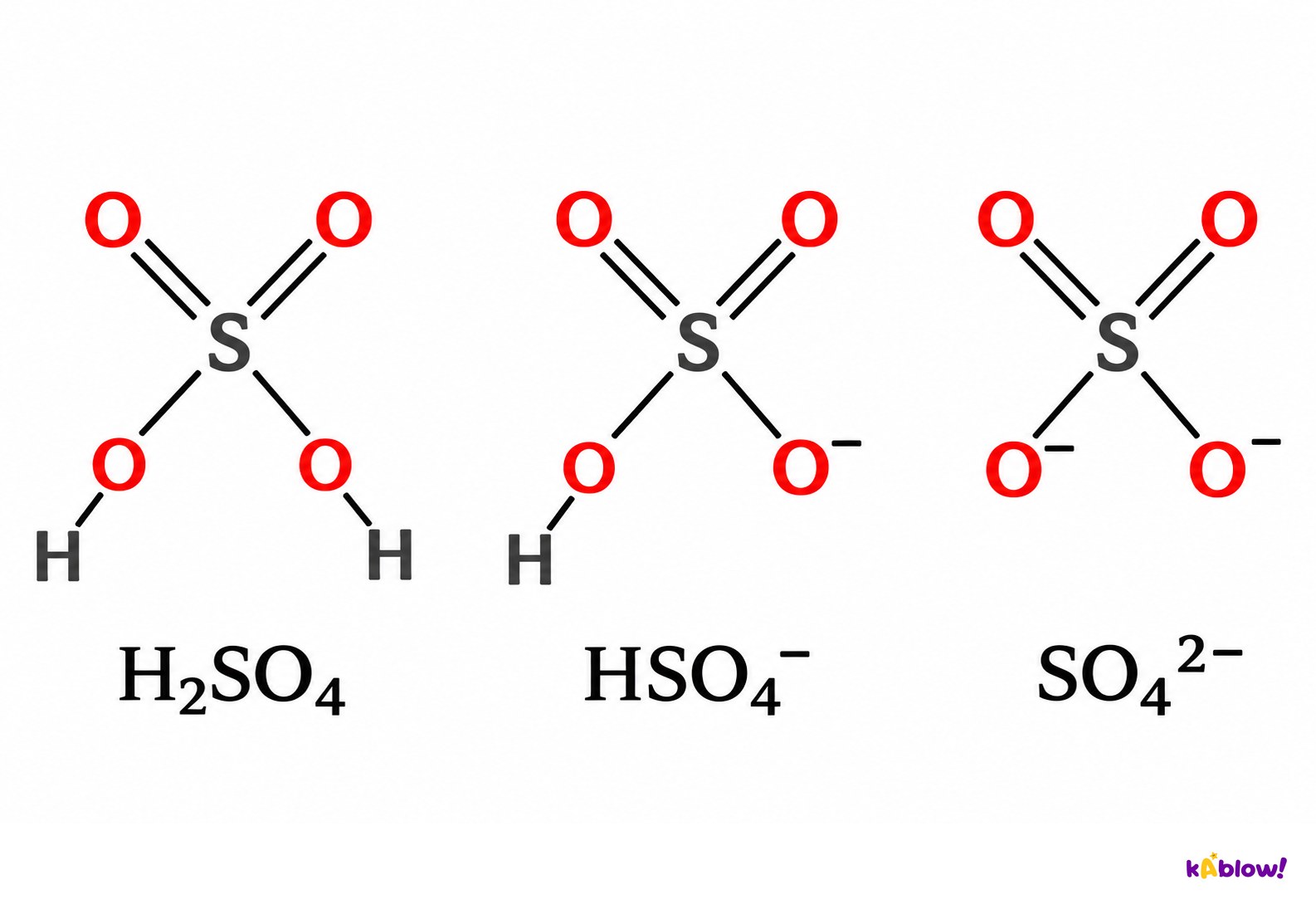
Read sulfuric-acid and sulfate-family structures
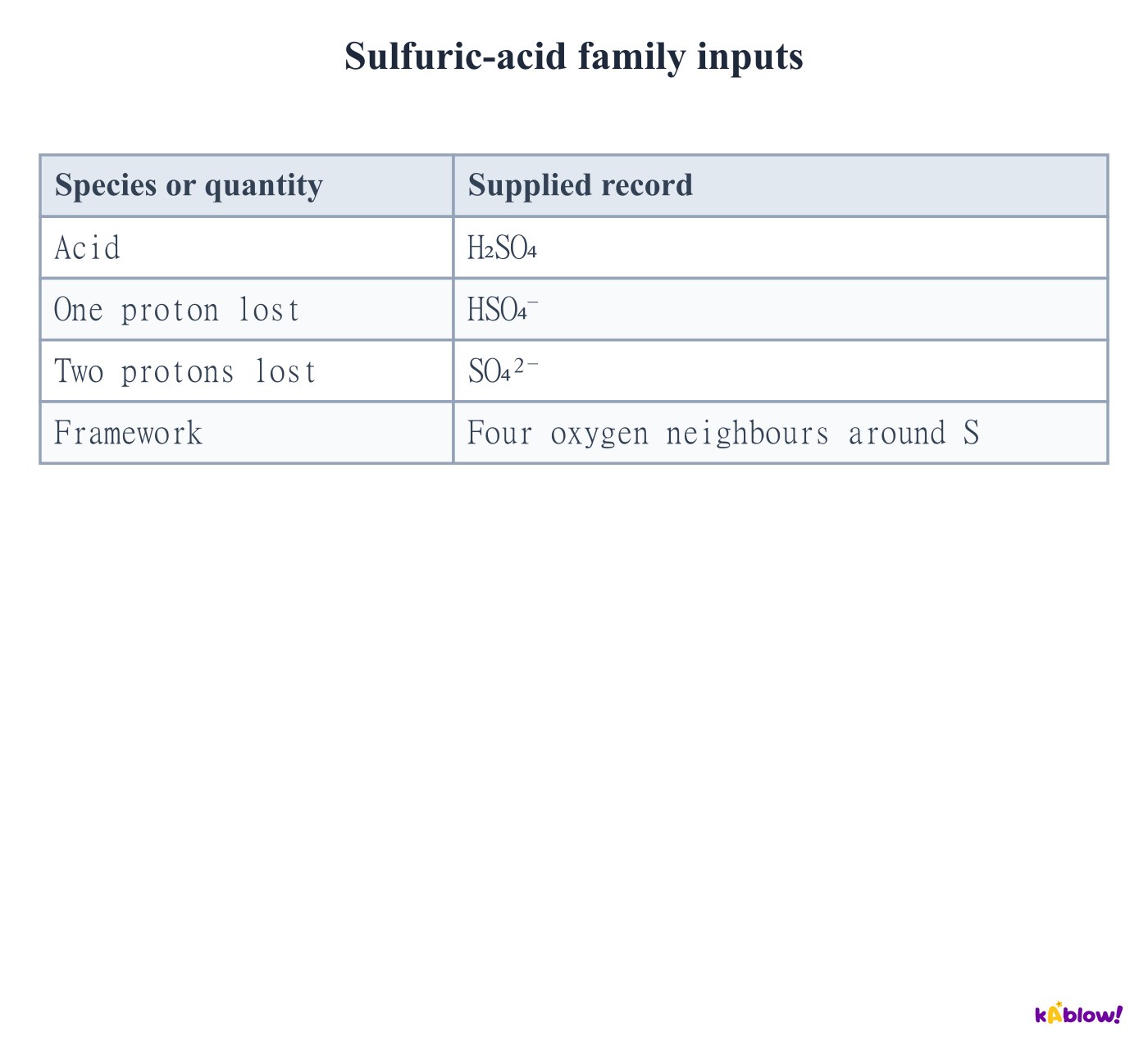
- The displayed conventional H₂SO₄ contributor has two S=O bonds and two S–O–H groups. Sulfur has four oxygen neighbours.
- First proton loss gives HSO₄⁻; second gives SO₄²⁻. Hydrogens attach to oxygen, and each proton loss changes one O–H group to formal O⁻.
- The approximately tetrahedral oxygen arrangement is projected onto the page. Sulfate has delocalised S–O bonding, so the chosen Lewis contributor is not a set of fixed experimental bond types.
Conventional sulfate-family displayed structures
Separate acid dissociation from full neutralisation
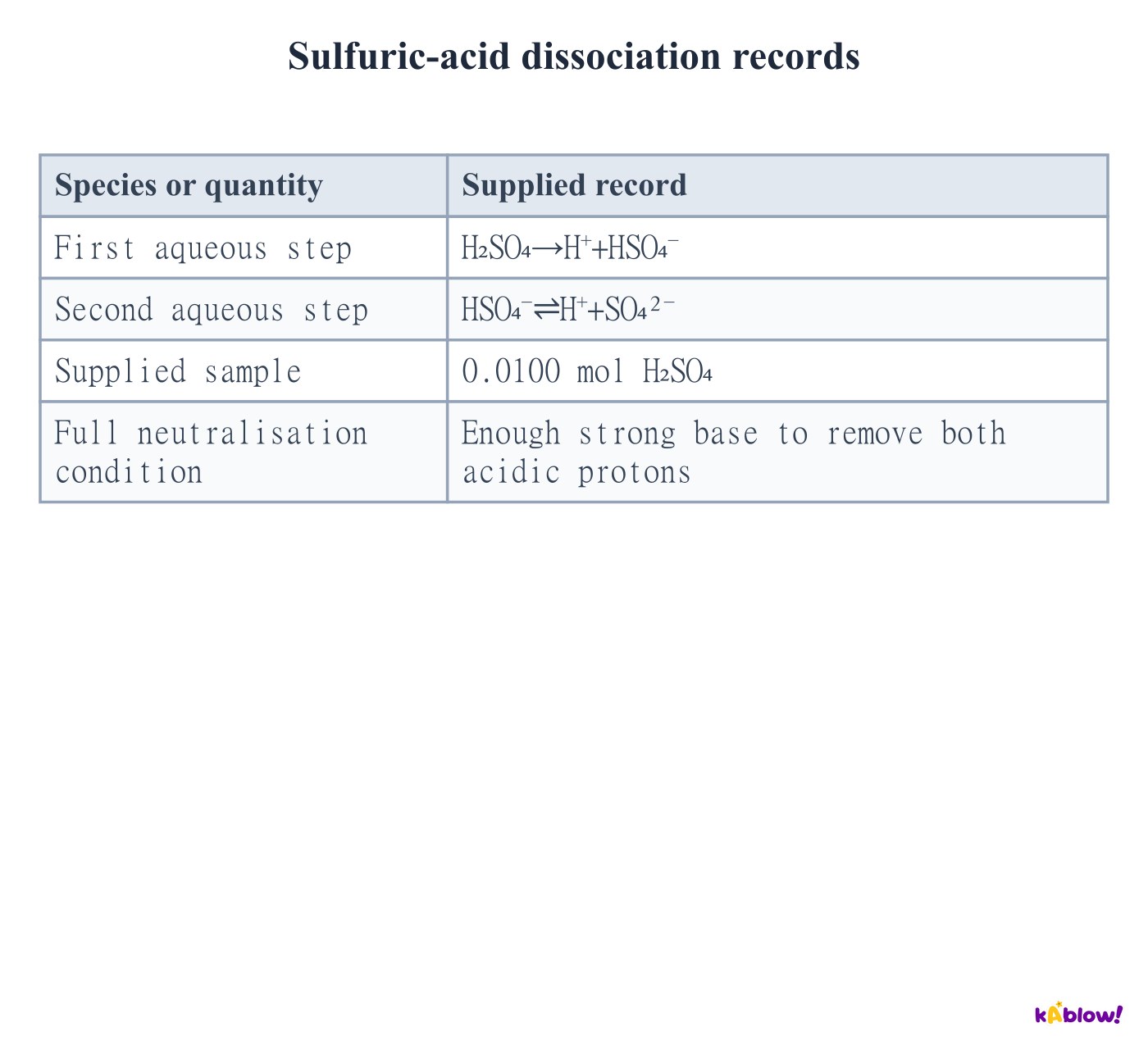
- In the dilute aqueous model, H₂SO₄’s first dissociation is effectively complete; the second must be represented by an equilibrium.
- Do not automatically assume[H⁺]=2c in every unneutralised sulfuric-acid solution. The extent of the second step depends on equilibrium and concentration.
- Complete neutralisation by sufficient strong base still requires two moles OH⁻ per mole H₂SO₄; stoichiometric capacity is not the same as initial free[H⁺].
Sulfuric-acid dissociation records
Neutralise acid with a basic oxide
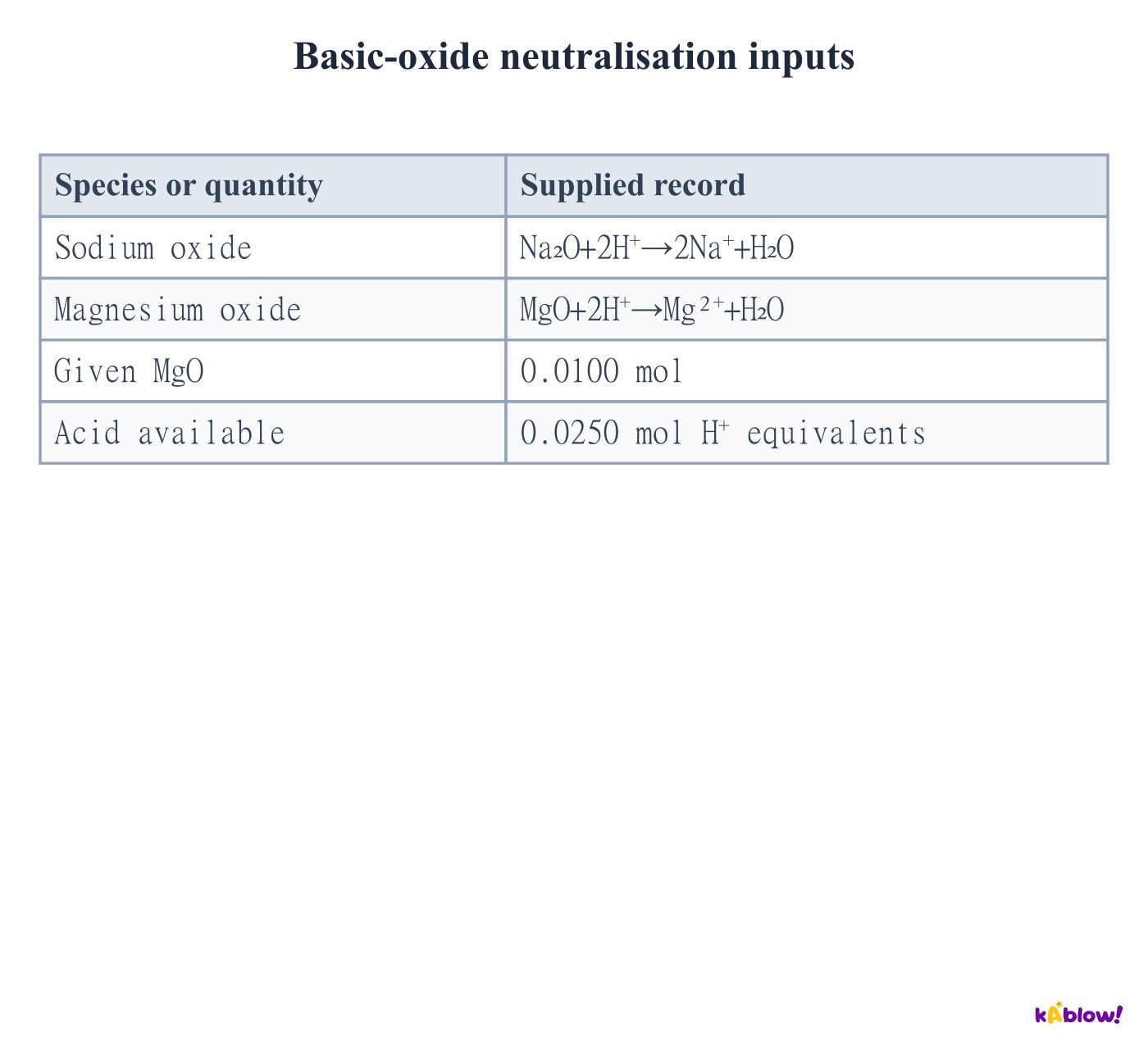
- Na₂O and MgO act as bases by accepting protons from acids. MgO+2HCl→MgCl₂+H₂O is a molecular example.
- In the ionic equations, oxide is consumed and water forms. Magnesium remains +2 and sodium remains +1, so this is not a metal oxidation reaction.
- For the supplied MgO amount, 0.0200 mol acid equivalents are consumed, leaving0.00500 mol when the stated acid is in excess.
Basic-oxide neutralisation inputs
Show the basic role of amphoteric aluminium oxide
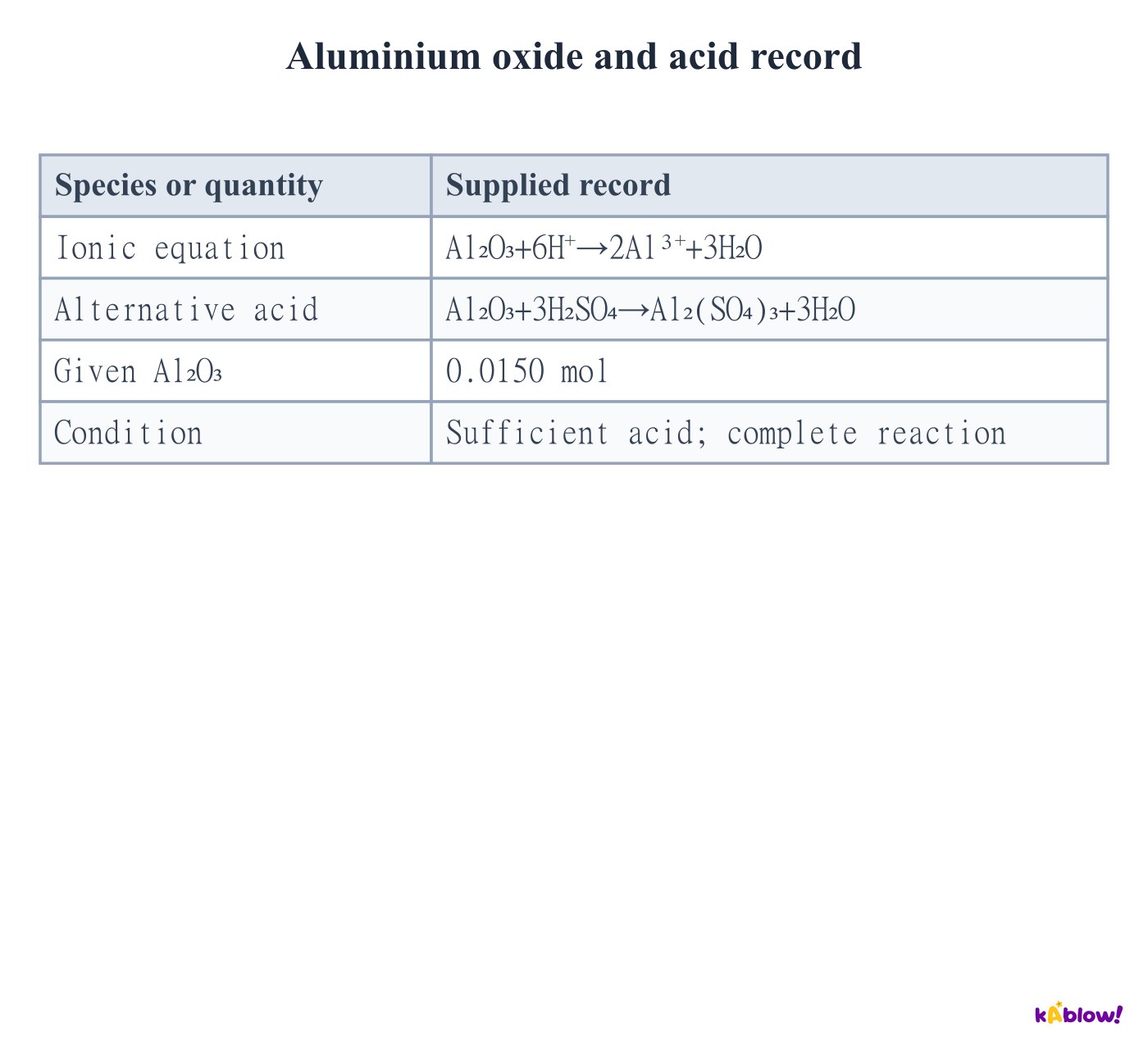
- Aluminium oxide reacts with acid to form aluminium salt and water. Its basic role is shown by proton consumption.
- Al₂O₃+6H⁺→2Al³⁺+3H₂O conserves atoms and charge. The aluminium oxidation state remains +3.
- This acid reaction alone shows basic behaviour. To demonstrate amphoterism, also show a suitable reaction with base.
Aluminium oxide and acid record
Show aluminium oxide reacting with base
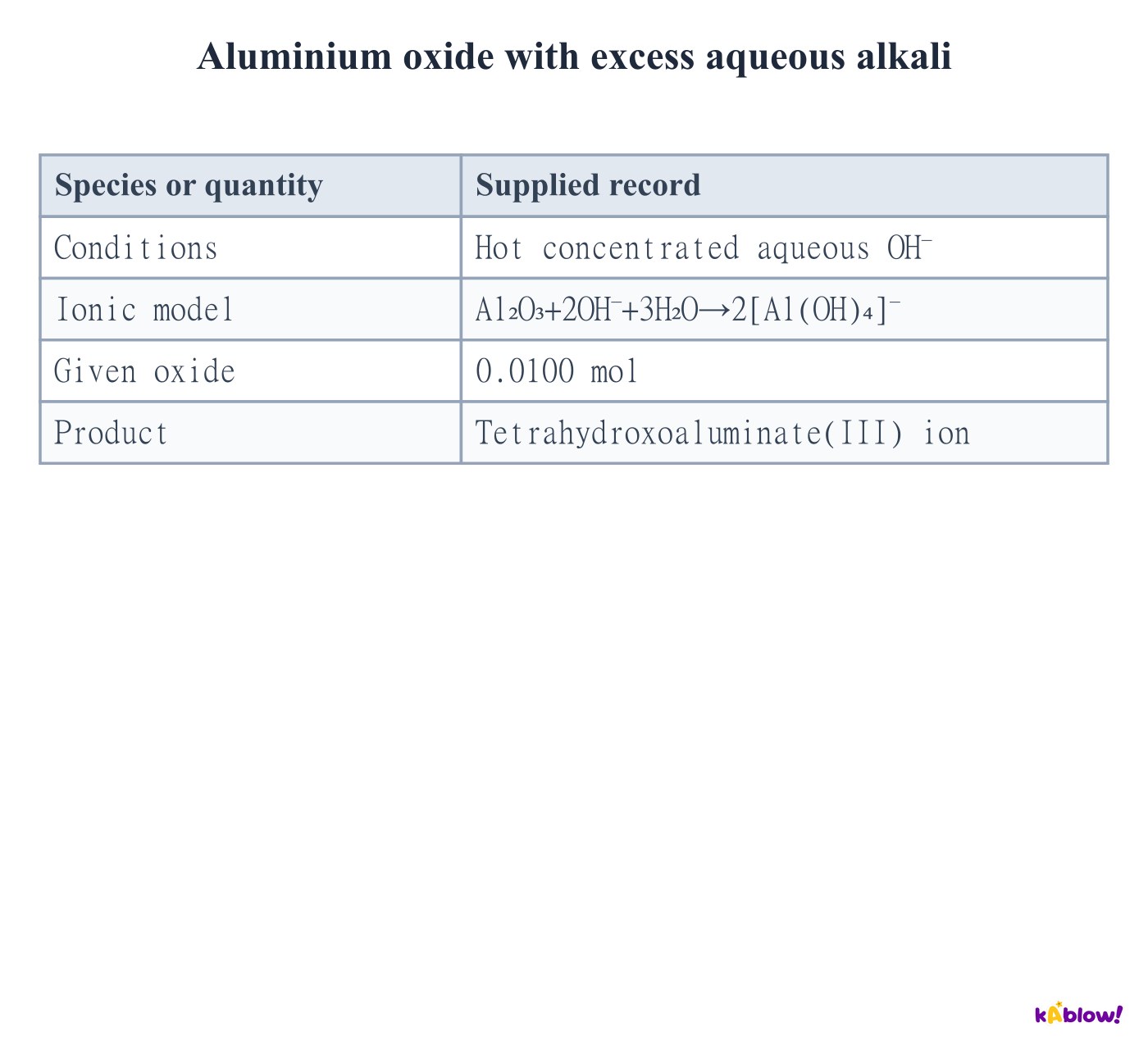
- Hot concentrated aqueous alkali can convert Al₂O₃ to tetrahydroxoaluminate(III), [Al(OH)₄]⁻.
- The ionic model is Al₂O₃+2OH⁻+3H₂O→2[Al(OH)₄]⁻. Combined with its acid reaction, this demonstrates amphoterism.
- Aluminium remains +3 in the complex. Proton transfer and complex formation do not automatically mean a change in oxidation state.
Aluminium oxide with excess aqueous alkali
Classify silica by its reaction with strong base
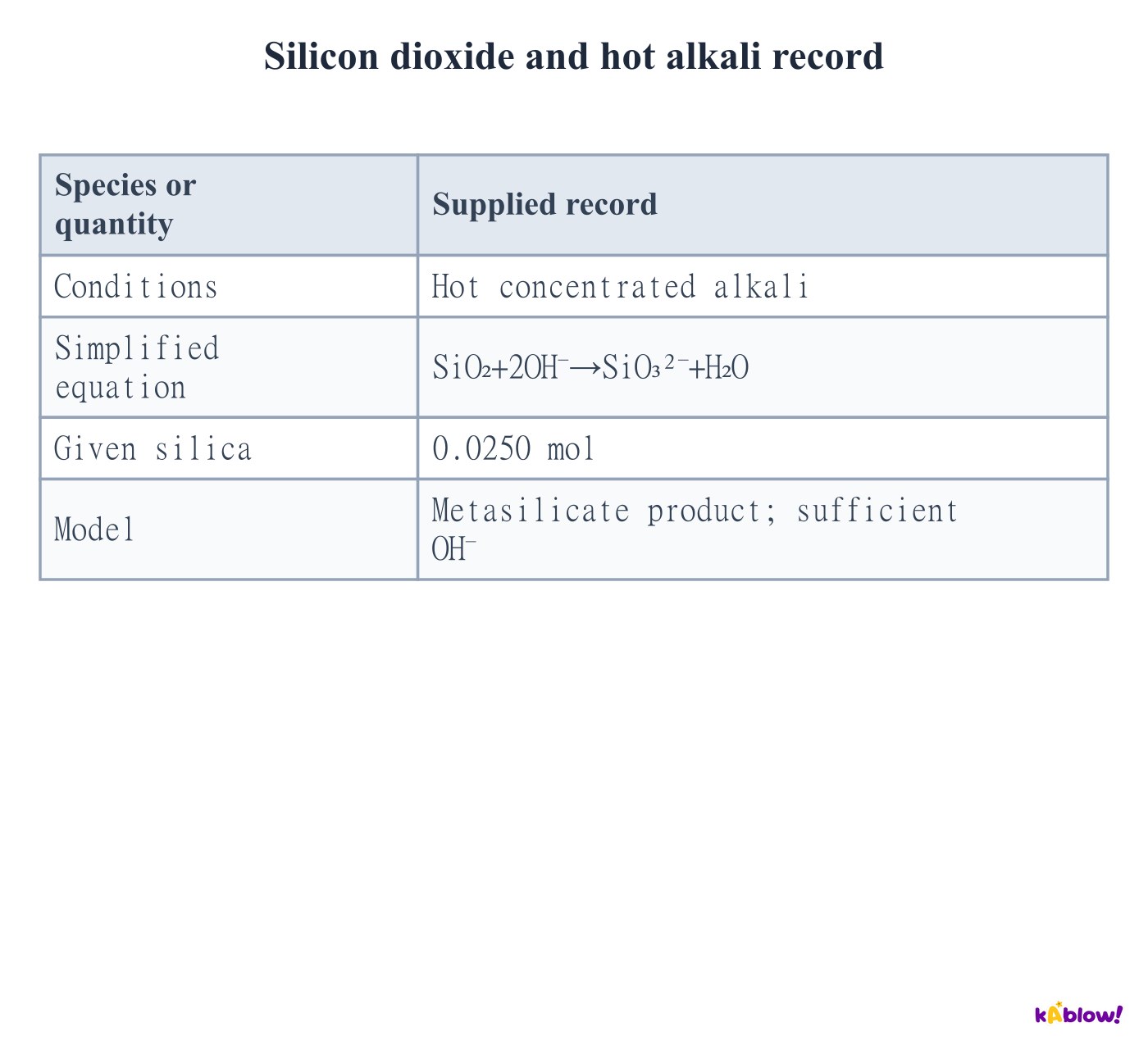
- Silicon dioxide is an acidic oxide even though it does not react appreciably with cold water. Hot concentrated alkali can attack its network.
- The simplified metasilicate equation is SiO₂+2OH⁻→SiO₃²⁻+H₂O, or SiO₂+2NaOH→Na₂SiO₃+H₂O.
- Actual silicate speciation depends on conditions. Use the stated metasilicate model for this stoichiometric calculation.
Silicon dioxide and hot alkali record
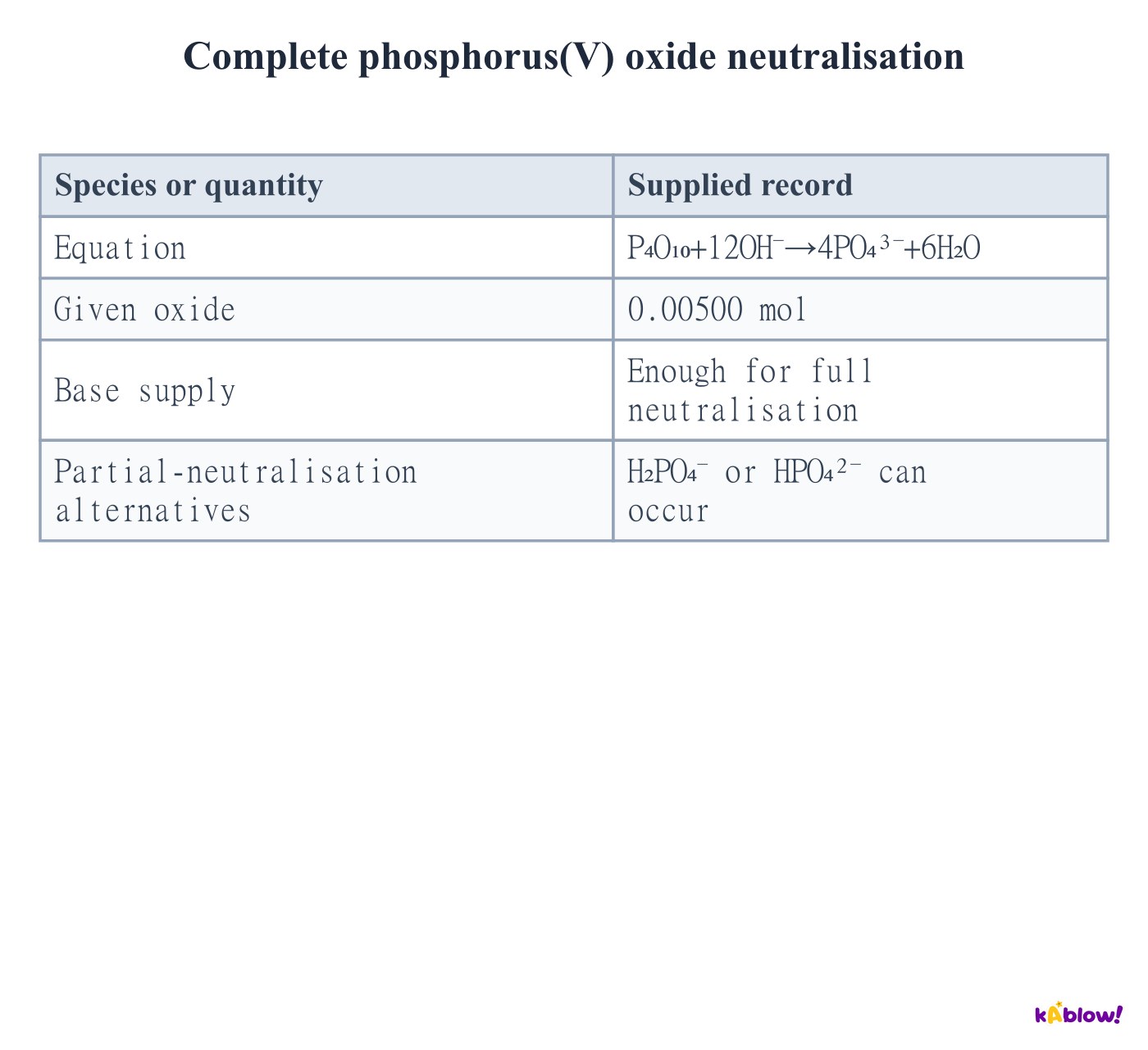
State the endpoint in phosphate neutralisation
- With enough strong base for full neutralisation, P₄O₁₀+12OH⁻→4PO₄³⁻+6H₂O accounts for all twelve acidic hydrogen equivalents after hydration.
- Partial neutralisation can give dihydrogenphosphate or hydrogenphosphate salts. Do not assume PO₄³⁻ is the only possible product at every pH.
- A product statement and endpoint are essential before choosing a mole ratio for a polyprotic acid system.
Complete phosphorus(V) oxide neutralisation
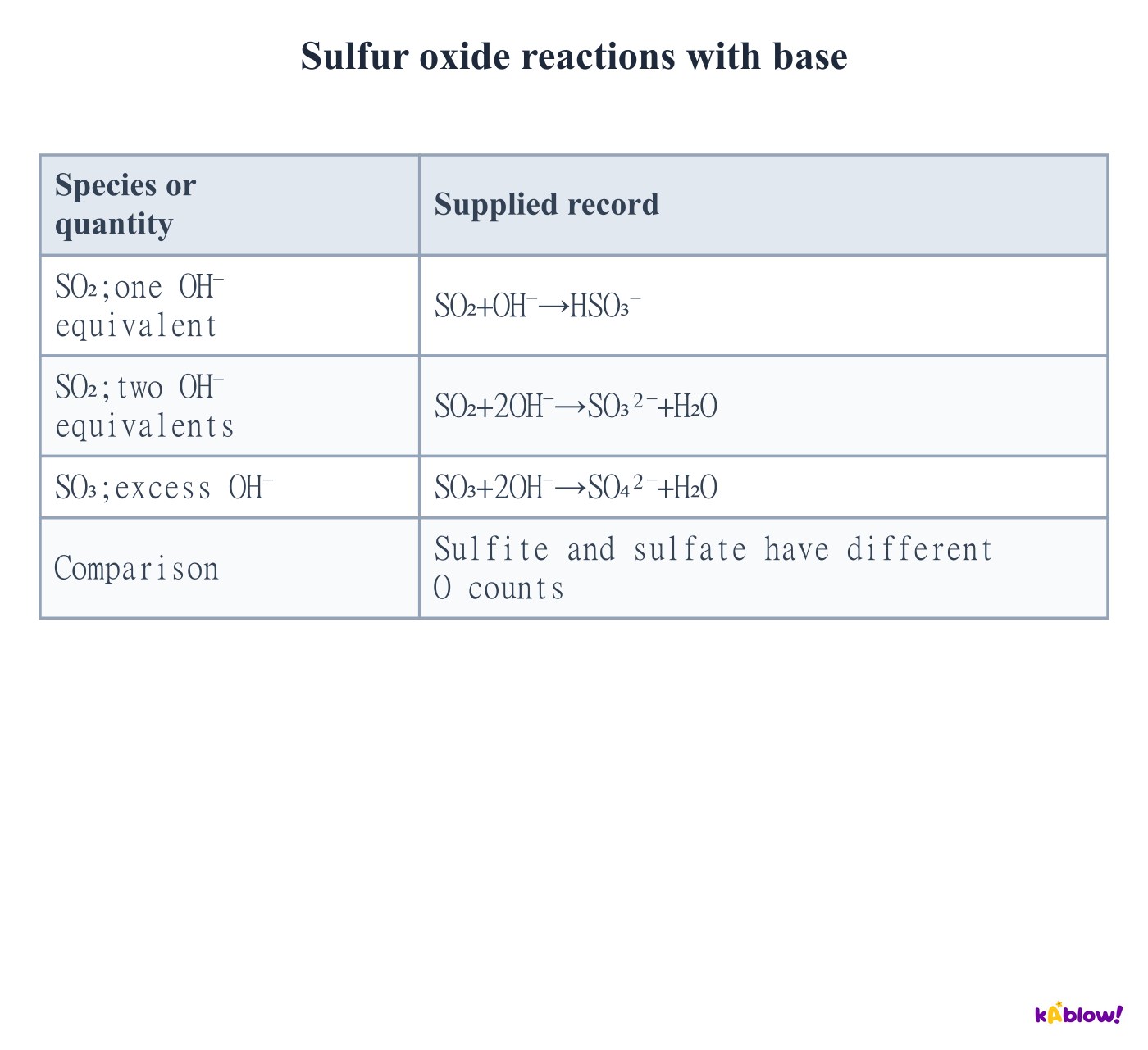
Distinguish sulfite, sulfate and partial neutralisation
- Sulfur dioxide forms hydrogensulfite with one OH⁻ equivalent or sulfite with two, depending on conditions and endpoint.
- Sulfur trioxide forms sulfate with sufficient OH⁻. Keep SO₃²⁻, the sulfite ion, separate from neutral SO₃, the sulfur(VI) oxide.
- No oxidation-state change is required in these neutralisations: sulfur remains +4 in the sulfur(IV) set and+6 in the sulfur(VI) set.
Sulfur oxide reactions with base
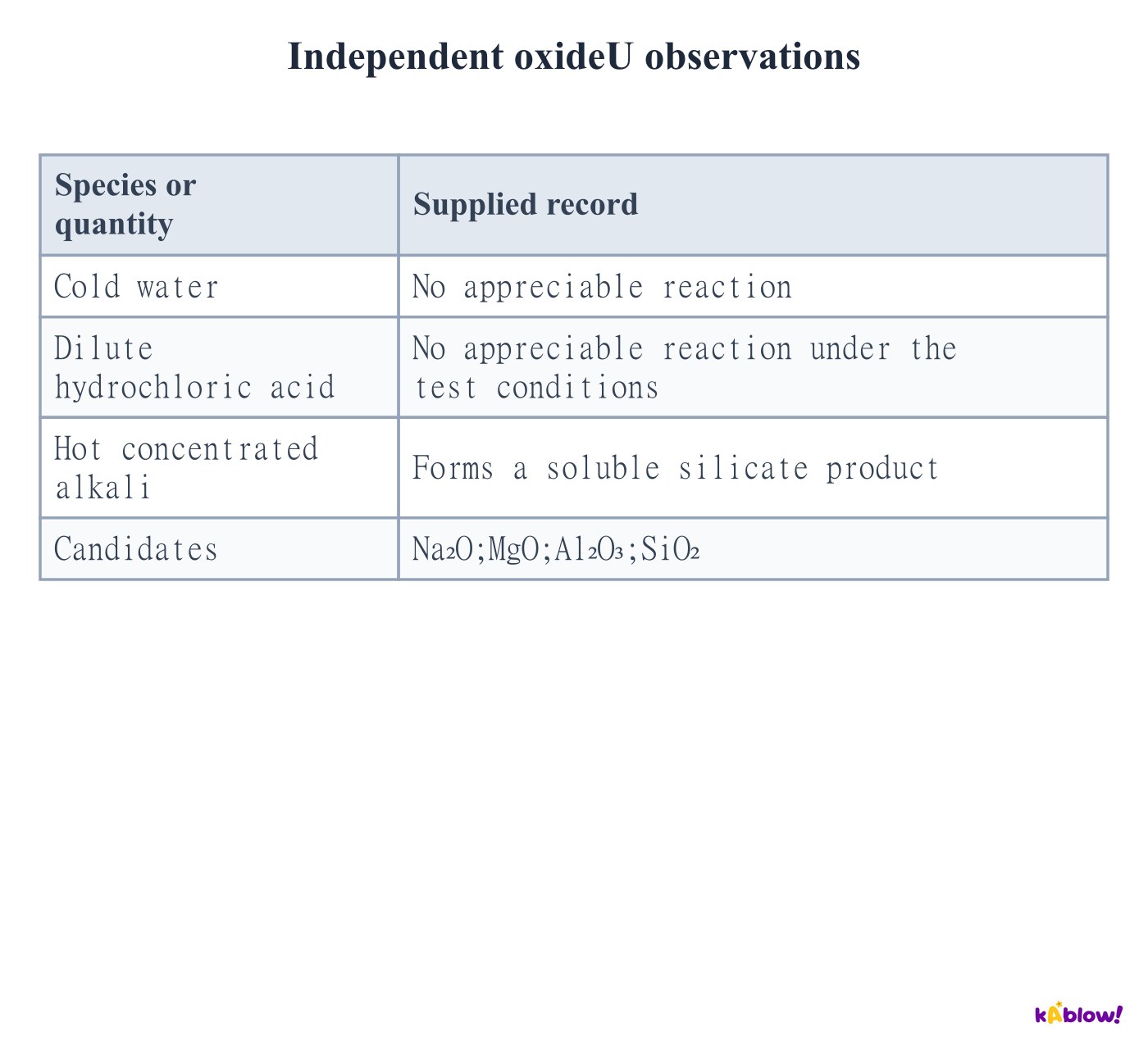
Interpret evidence with reagent conditions recorded
- A water observation alone cannot distinguish Al₂O₃ from SiO₂. Compare suitable acid and alkali reactions as well.
- Use separate small samples, comparable conditions and a blank when reviewing teacher-supplied evidence. Record solid, solution and pH observations distinctly.
- The supplied unknown gives a silicate in hot alkali, supporting SiO₂. A neutral water suspension does not establish a neutral oxide.
Independent oxideU observations
Combine reaction ratios with specified measurement data
- For complete reaction, 1.20 g Mg atAr 24.0 corresponds to 0.0500 mol. The steam equation gives 0.0500 mol H₂.
- Using the supplied molar volume24.0 dm³mol⁻¹ gives 1.20dm³ hydrogen. The molar volume is an input for stated conditions, not a universal gas constant.
- Check limiting reagents, gas losses, units and significant figures before comparing a calculated amount with an experimental observation.
Steam reaction calculation inputs
Slide
Sign up free to view the lesson slides
Step through every slide for this topic — plus flashcards and revision notes — with a free account.
Câu hỏi luyện tập
Xem trước miễn phí — 8 trên 60 câu hỏi. Đăng ký để xem tất cả.
1.If equal mole amounts of Na and Mg each react completely with excess cold water, which hydrogen-amount comparison follows from the equations?
Medium- AMg gives twice as much H₂ as Na
- BNa gives twice as much H₂ as Mg
- CBoth must give no hydrogen
- DMg gives four times as much H₂ as Na
2.What amount of hydrogen follows from the supplied complete steam-reaction input?
Medium- A0.0300 mol
- B0.0600 mol
- C0.120 mol
- D0.180 mol
3.Which statement correctly identifies magnesium’s role in its steam reaction?
Medium- AIt gains two electrons and is an oxidant
- BIt is unchanged because the product is white
- CIt loses electrons and acts as a reducing agent
- DOxygen changes from−2 to+2
4.Under the supplied Na₂O-only model, how much Na₂O forms from 0.100 mol Na?
Medium- A0.200 mol
- B0.100 mol
- C0.0250 mol
- D0.0500 mol
5.How many moles of O₂ are required per mole Al₂O₃ formed in the supplied equation?
Medium- A1.50 mol
- B0.500 mol
- C3.00 mol
- D2.00 mol
6.Using the supplied P₄O₁₀ formula and oxygen state−2, what is the phosphorus oxidation state?
Medium- A+3
- B+5
- C−3
- D0
7.How many moles O₂ are consumed per mole SO₂ converted in the supplied further-oxidation equation?
Medium- A0.250 mol
- B2.00 mol
- C0.500 mol
- D1.00 mol
8.Which supplied substance is expected to conduct electricity when molten but not as its ordinary solid, because ions become mobile?
Medium- ASO₂ gas
- BSiO₂ network
- CMolecular P₄O₁₀
- DNa₂O
Unlock all 60 questions, flashcards & more
Tạo tài khoản miễn phí để xem mọi câu hỏi, slide, thẻ ghi nhớ và ghi chú ôn tập cho chủ đề này.