
Types Of Bonding & Properties
Học bằng cách chơi
Trả lời những câu hỏi này để kiếm năng lượng, rồi câu cá và khám phá. Không cần tài khoản.
Ghi chú bài học
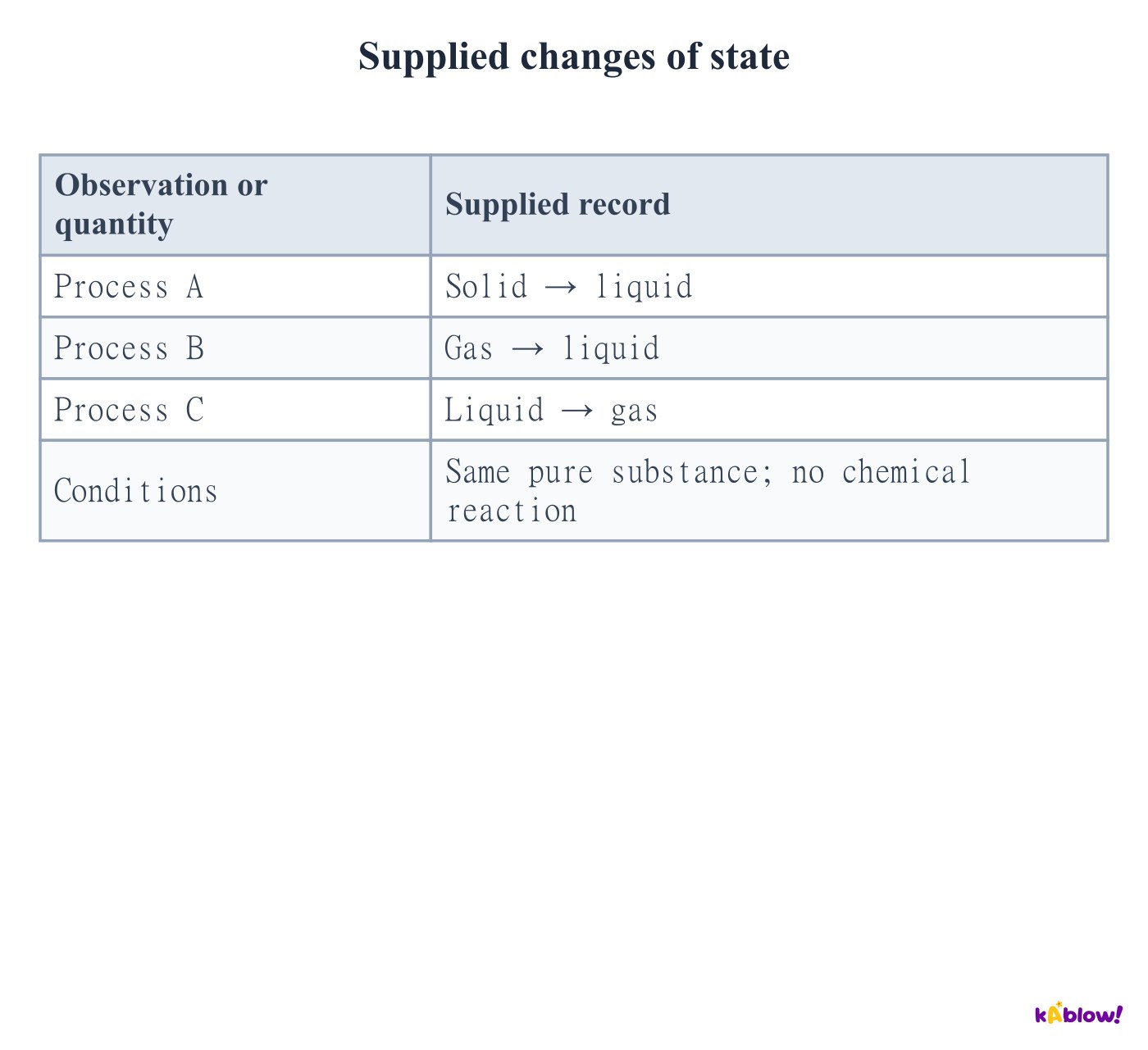
Relate a change of state to energy transfer
- A change of state changes physical organisation while preserving chemical identity when no reaction or decomposition occurs. Physical properties can change even though the substance remains the same.
- Melting and vaporisation require energy to overcome the relevant attractions; freezing and condensation release energy as a more strongly associated arrangement forms.
- Identify the particles and attractions correctly. Melting a molecular solid mainly overcomes attractions between molecules; an ionic or metallic structure requires a different bonding explanation.
Supplied changes of state
Distinguish evaporation from boiling
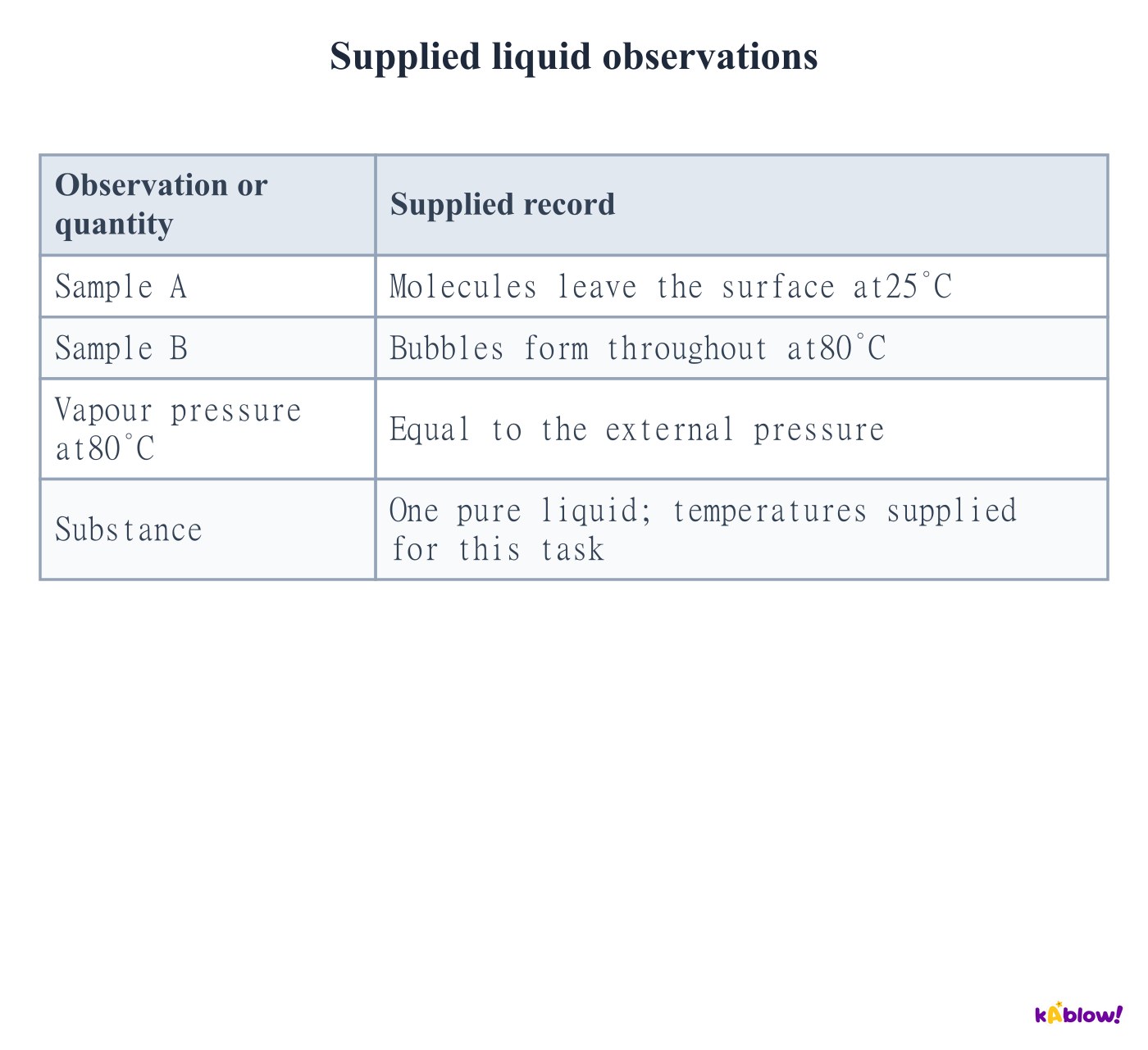
- Evaporation occurs at the liquid surface over a range of temperatures. Faster particles can escape, transferring energy away from the remaining liquid.
- Boiling involves vapour bubbles throughout the liquid when its vapour pressure matches the external pressure. The boiling temperature therefore depends on pressure rather than always applying at one atmospheric condition.
- Use the observation and conditions together. Surface loss alone does not show that the liquid is boiling, and evaporation is not confined by definition to one temperature below a boiling point.
Supplied liquid observations
Interpret a pure-substance heating plateau
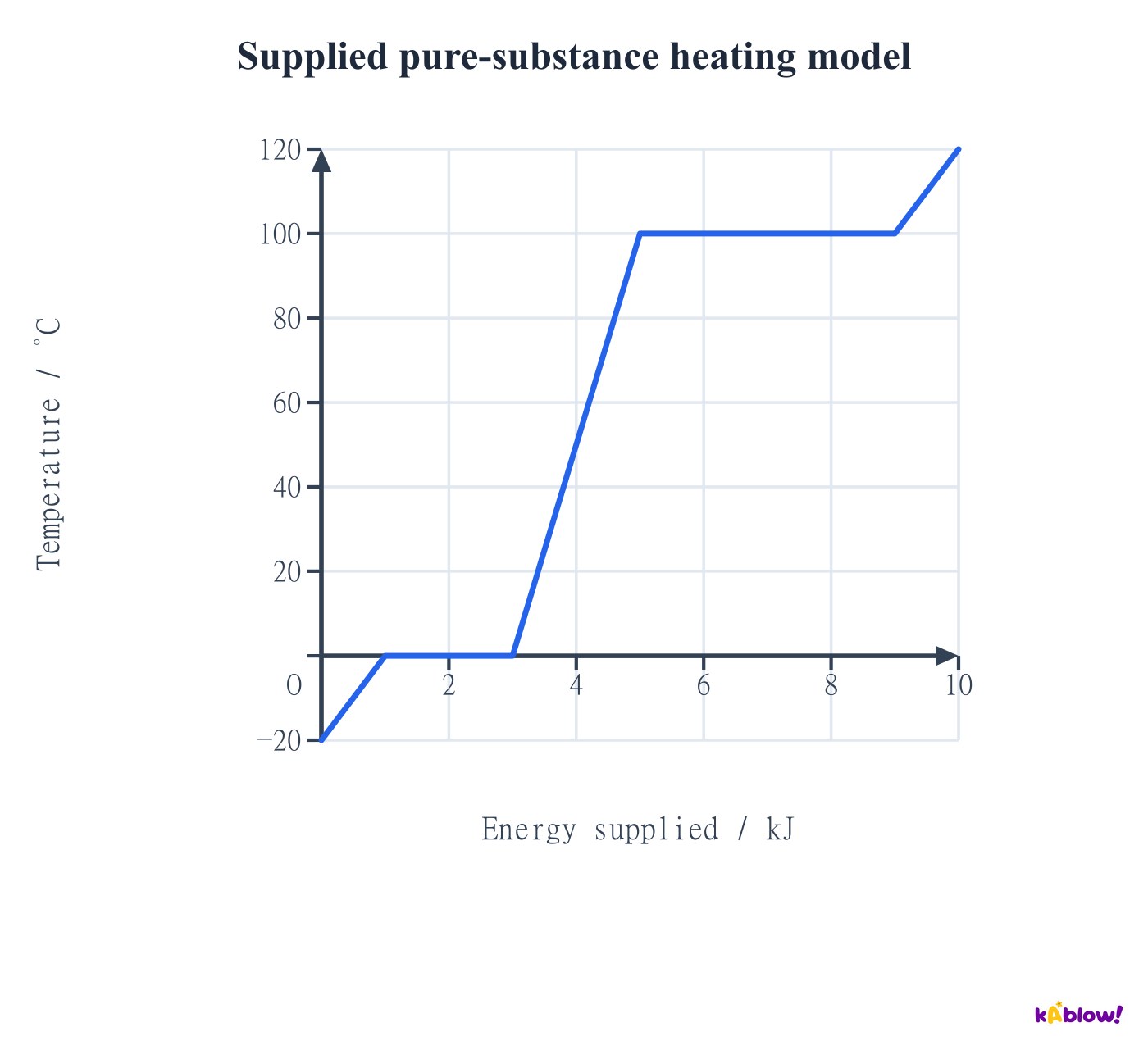
- For a pure substance changing phase at equilibrium under constant pressure, energy can enter while temperature remains approximately constant. A heating plateau is evidence under those stated conditions.
- Mean particle kinetic energy does not rise when temperature stays fixed. The added energy changes the arrangement and potential energy; it is not automatically breaking covalent bonds within molecules.
- Outside phase-change regions, added energy can raise temperature. Mixtures, changing pressure, heat loss or non-equilibrium measurements can give a different curve, so retain the model assumptions.
Supplied pure-substance heating model
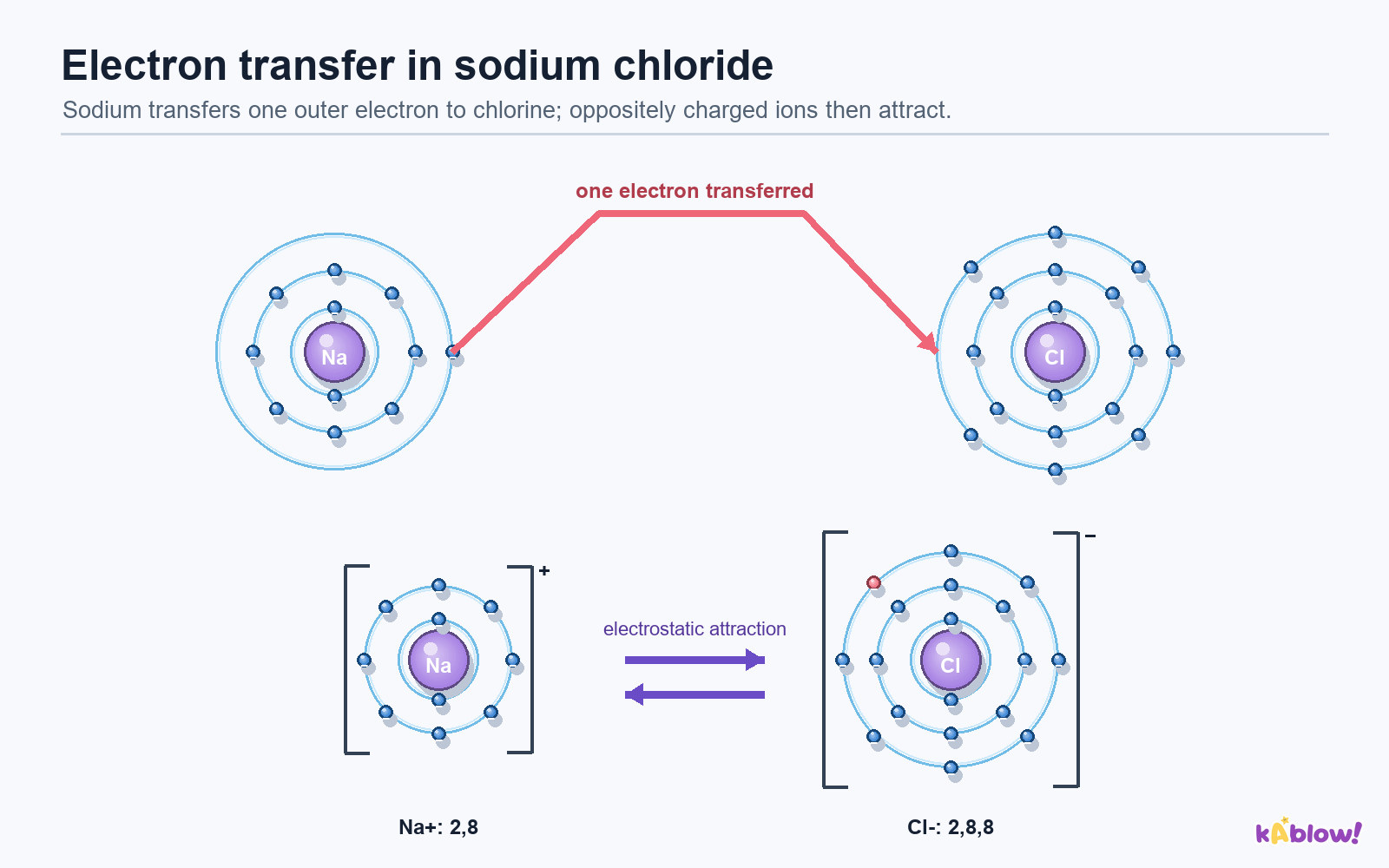
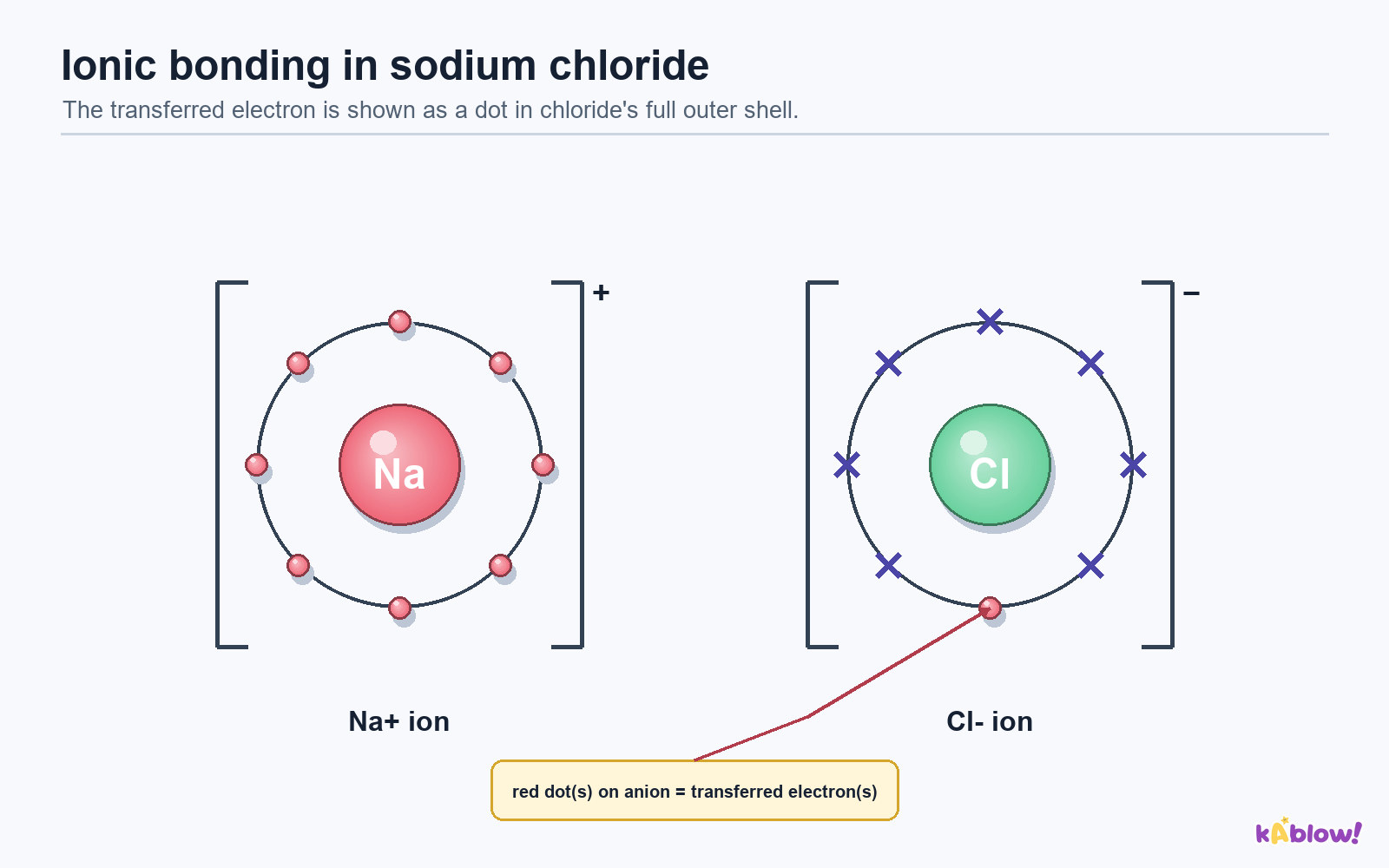
Separate ion formation from ionic bonding
- Ionic bonding is electrostatic attraction between oppositely charged ions. Electron transfer is one model of how ions can form from atoms; it is not the definition of the bond itself.
- Losing an electron leaves a more positive species, while gaining one makes a species more negative. Formation energies and the extended lattice matter; a full shell alone is not a complete energetic explanation.
- Ionic substances need not contain a metal: ammonium salts are familiar counterexamples. Not every ion has a noble-gas configuration, especially among transition-metal ions.
Ion formation and subsequent attraction
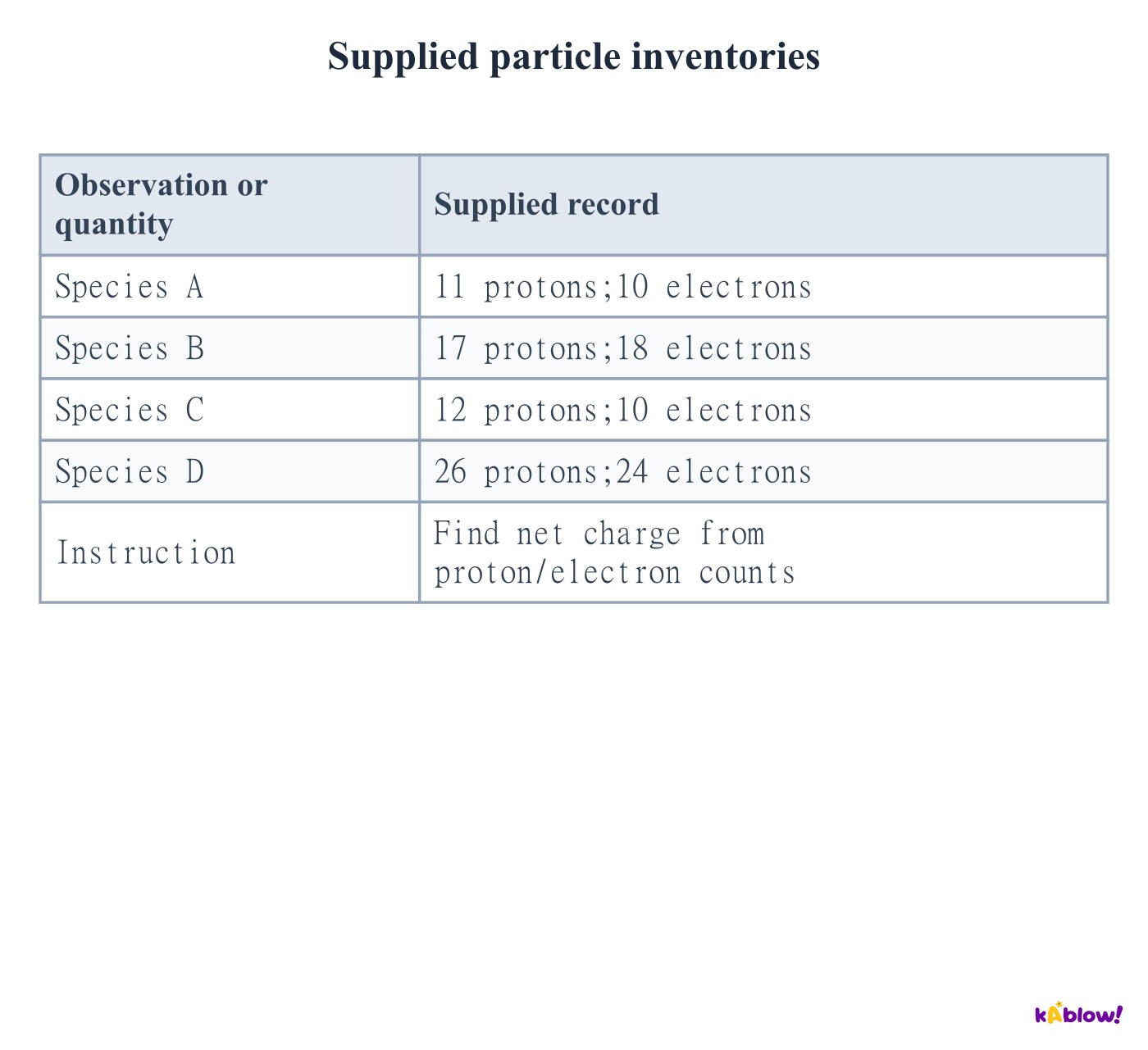
Determine ion charge from particle counts
- Count positive nuclear charges and negative electron charges. Ion formation changes the electron number in this model, not the element’s proton number.
- An ordinary Na⁺ ion has ten electrons, matching neon, while Cl⁻ has eighteen, matching argon. Use the actual electron count rather than assuming all ions have the same arrangement.
- For transition metals, a familiar main-group full-shell shortcut may fail. A species with 26 protons and 24 electrons has charge 2+ whether or not its electrons match a noble-gas arrangement.
Supplied particle inventories
Use charge neutrality to obtain an ionic formula
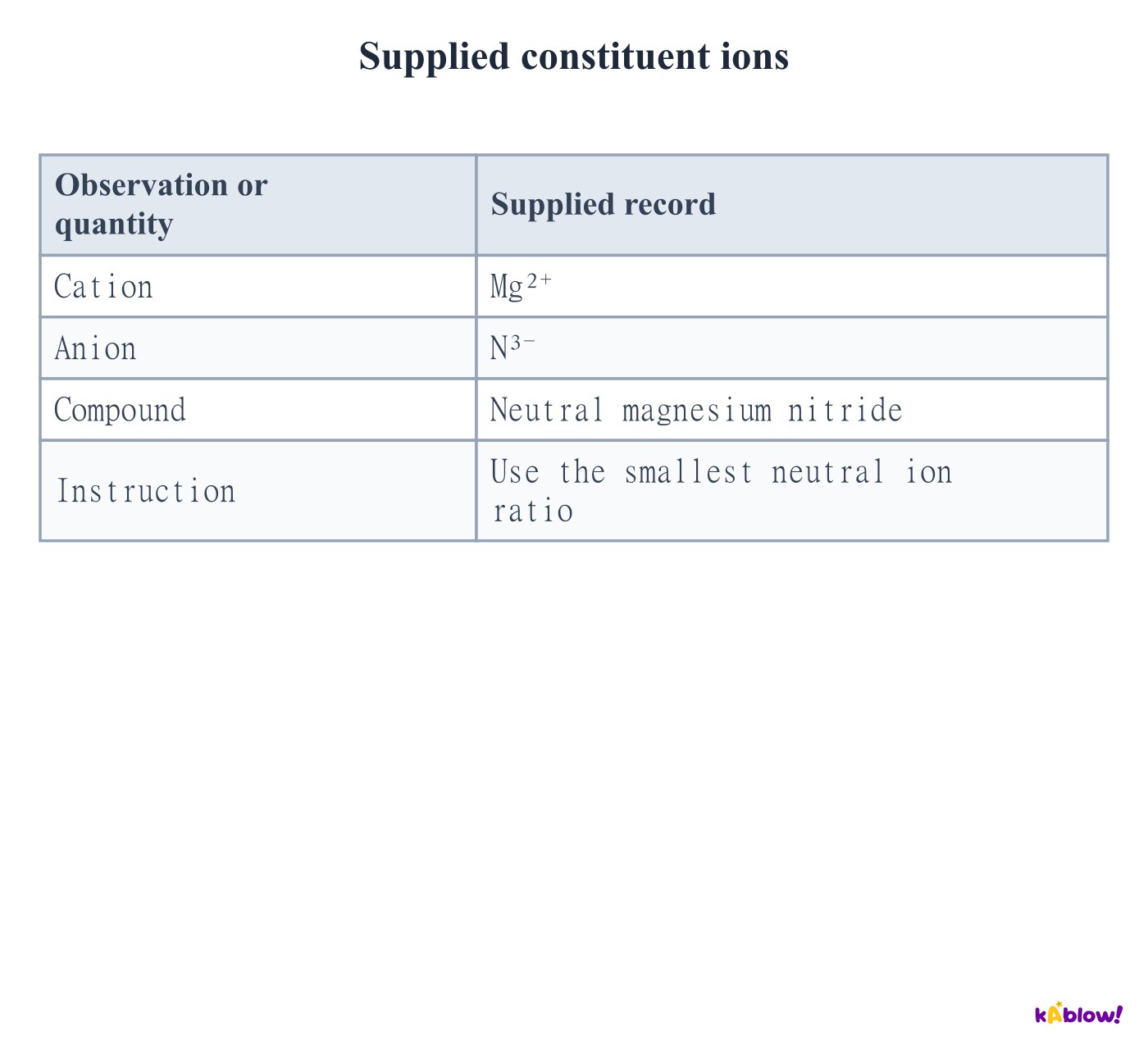
- An ionic formula expresses a neutral constituent-ion ratio in an extended structure. It does not normally identify one isolated molecular unit.
- Choose the smallest numbers of ions whose total positive and negative charges sum to zero. Keep any polyatomic ion intact when writing the formula.
- The overall solid is neutral because of its stoichiometric charge balance. Attraction does not cancel the charge carried by each individual ion.
Supplied constituent ions
Interpret an ionic dot-and-cross representation
- Draw the ions separately, enclose the relevant species in brackets and write the overall charge outside each bracket. Show the appropriate outer-shell electron arrangement for the stated representation.
- Dots and crosses track electron origins; they are not physically different kinds of electron. A transferred electron becomes indistinguishable from other electrons on the receiving species.
- Brackets identify the charged species and its overall charge. They do not prove that charge is distributed uniformly within every polyatomic ion.
Separate bracketed ions
Describe an extended ionic lattice
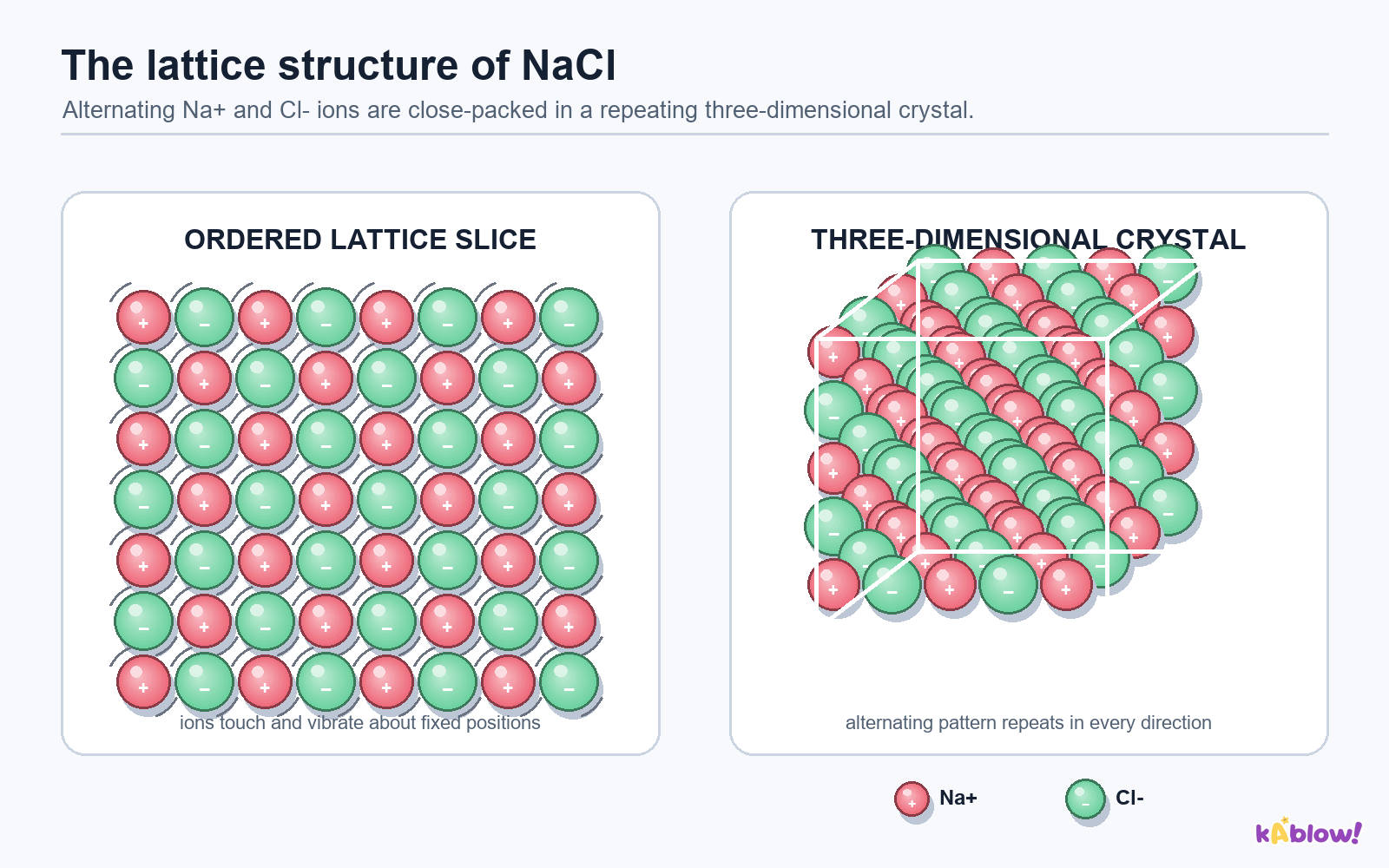
- In an ionic crystal, ions occupy a repeating three-dimensional arrangement with attractions to oppositely charged ions and repulsions from like charges. The lattice is not a collection of separate covalent molecules.
- The NaCl model shows an extended arrangement. A cropped fragment ends at artificial boundaries; use a complete structural model before inferring coordination from an edge ion.
- Electrostatic attraction acts throughout the structure, with strength depending on charge and separation. Non-directional does not mean every pairwise attraction has equal magnitude.
An extended NaCl lattice
Explain a shared electron pair
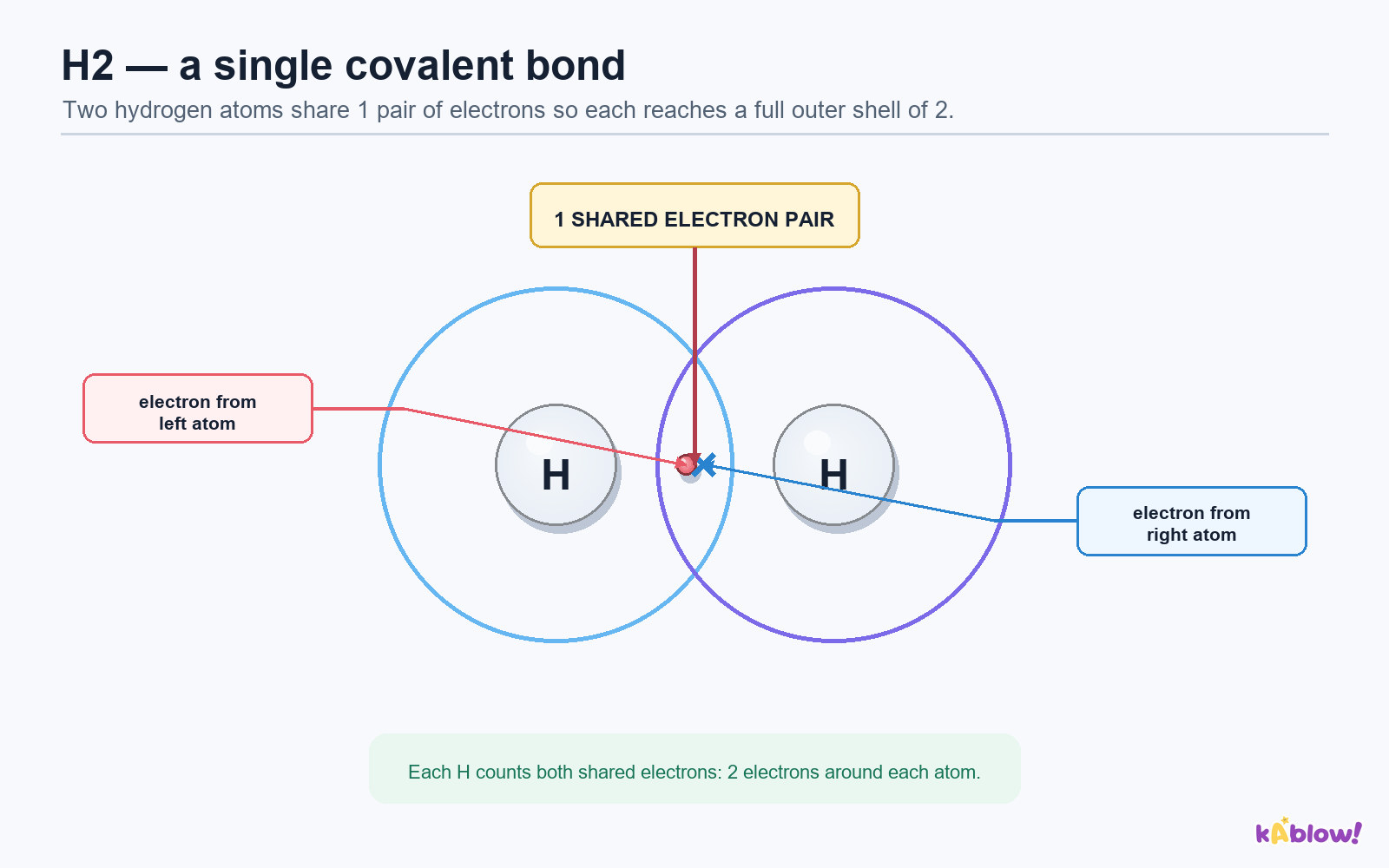
- A single covalent bond is associated with one shared electron pair attracted to the two nuclei. Multiple bonds involve more shared pairs in the simple Lewis model.
- Each hydrogen counts both electrons in its shared pair towards a duet. For many main-group examples, an octet is a useful pattern rather than a universal rule for every molecule.
- The circles in a dot-and-cross drawing are bookkeeping devices. They do not show measured electron paths or directly determine a molecule’s three-dimensional shape.
One shared pair in hydrogen
Construct a Lewis electron budget
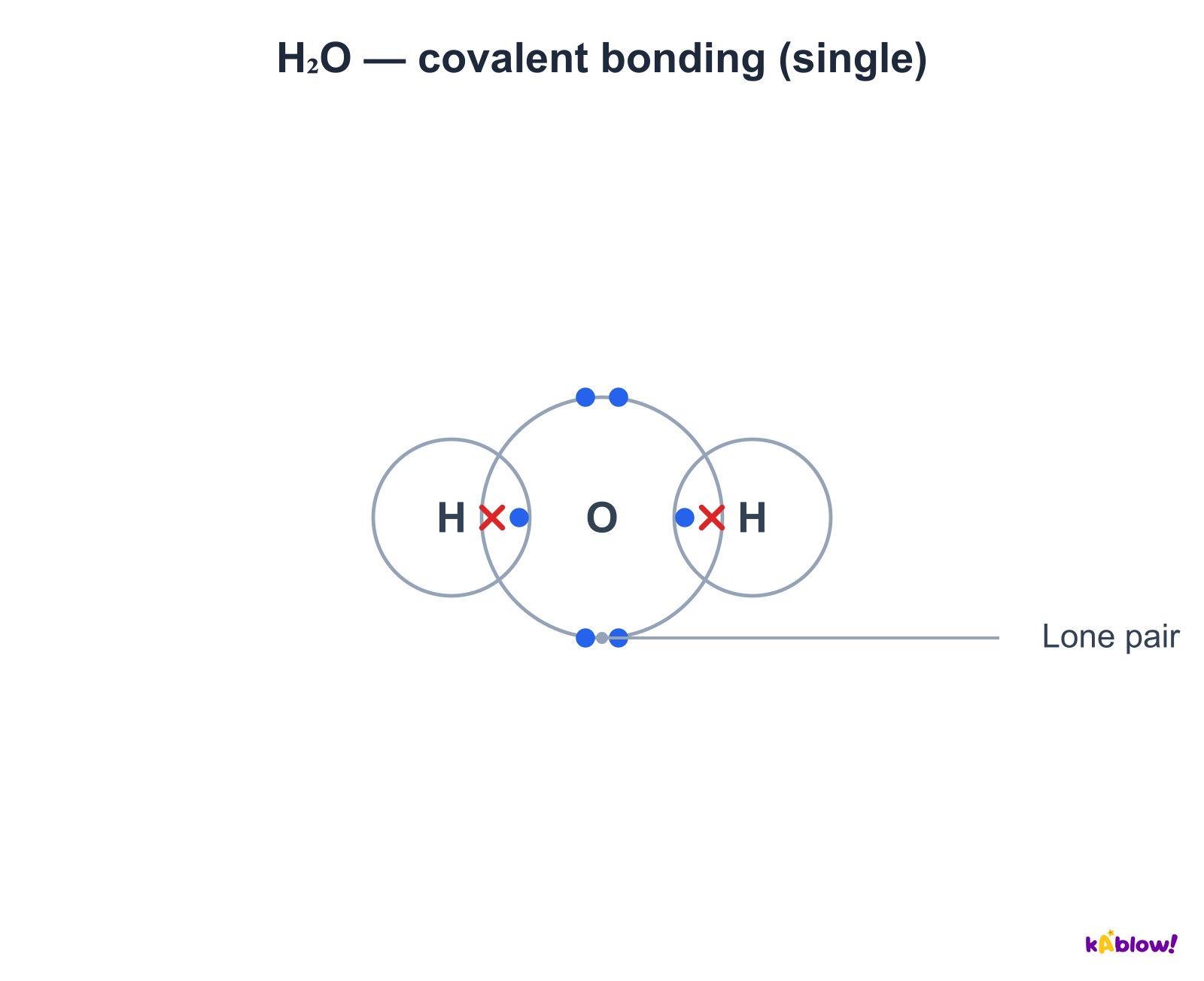
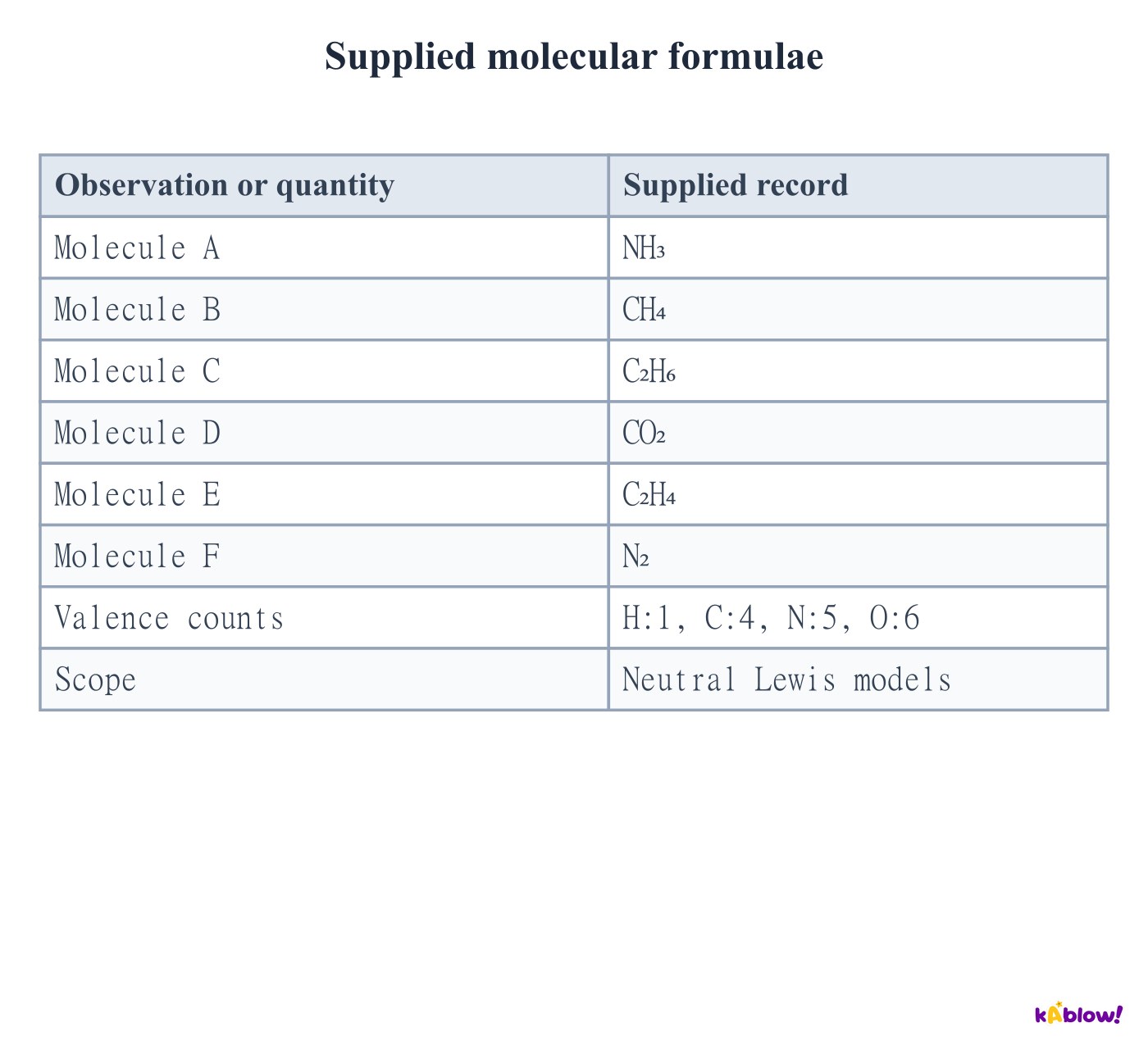
- Add the valence electrons of all atoms, then adjust for overall ionic charge. Allocate bonding pairs and remaining lone pairs while checking the model’s electron count.
- For ammonia, three N–H bonds use six electrons and one nitrogen lone pair uses two. Methane has four C–H bonds and no carbon lone pair in the ordinary neutral Lewis model.
- Ethane contains six C–H single bonds plus one C–C single bond. Count every bond once across the molecule; do not count a shared pair as two different pairs.
Bonding and lone pairs in water
Distinguish single, double and triple bonds
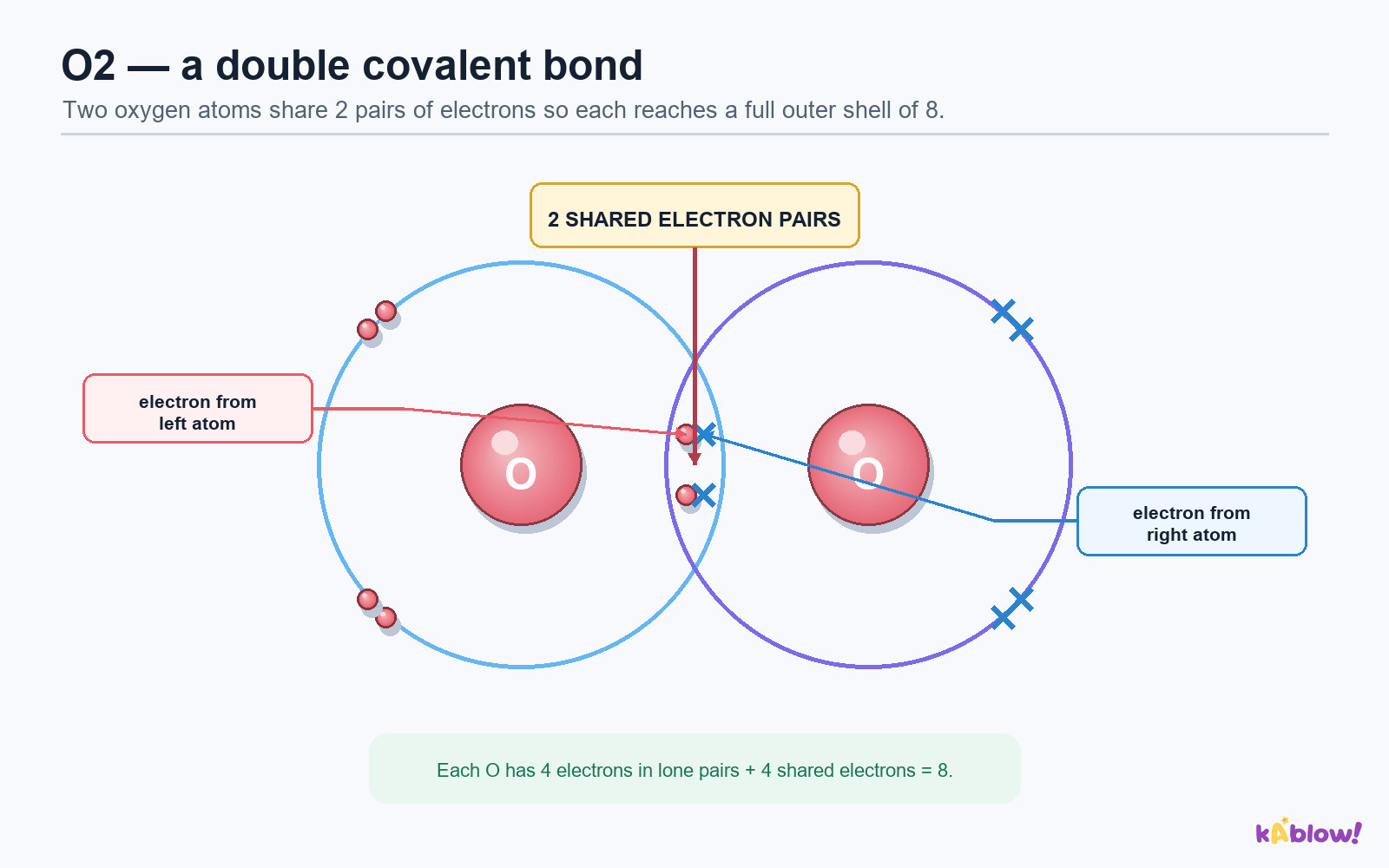
- A single bond contains one shared pair, a double bond two pairs and a triple bond three pairs. Their shared-electron counts are two, four and six respectively.
- In a simple O₂ Lewis drawing, each oxygen has two lone pairs and the atoms share two bonding pairs. N₂ instead has a triple bond with one lone pair on each nitrogen.
- Carbon dioxide has two C=O double bonds in its ordinary neutral Lewis model. Ethene has a C=C double bond and four C–H single bonds. These models describe bonding, not the full molecular-orbital behaviour of every species.
Two shared pairs in oxygen
Use the octet rule with its limits
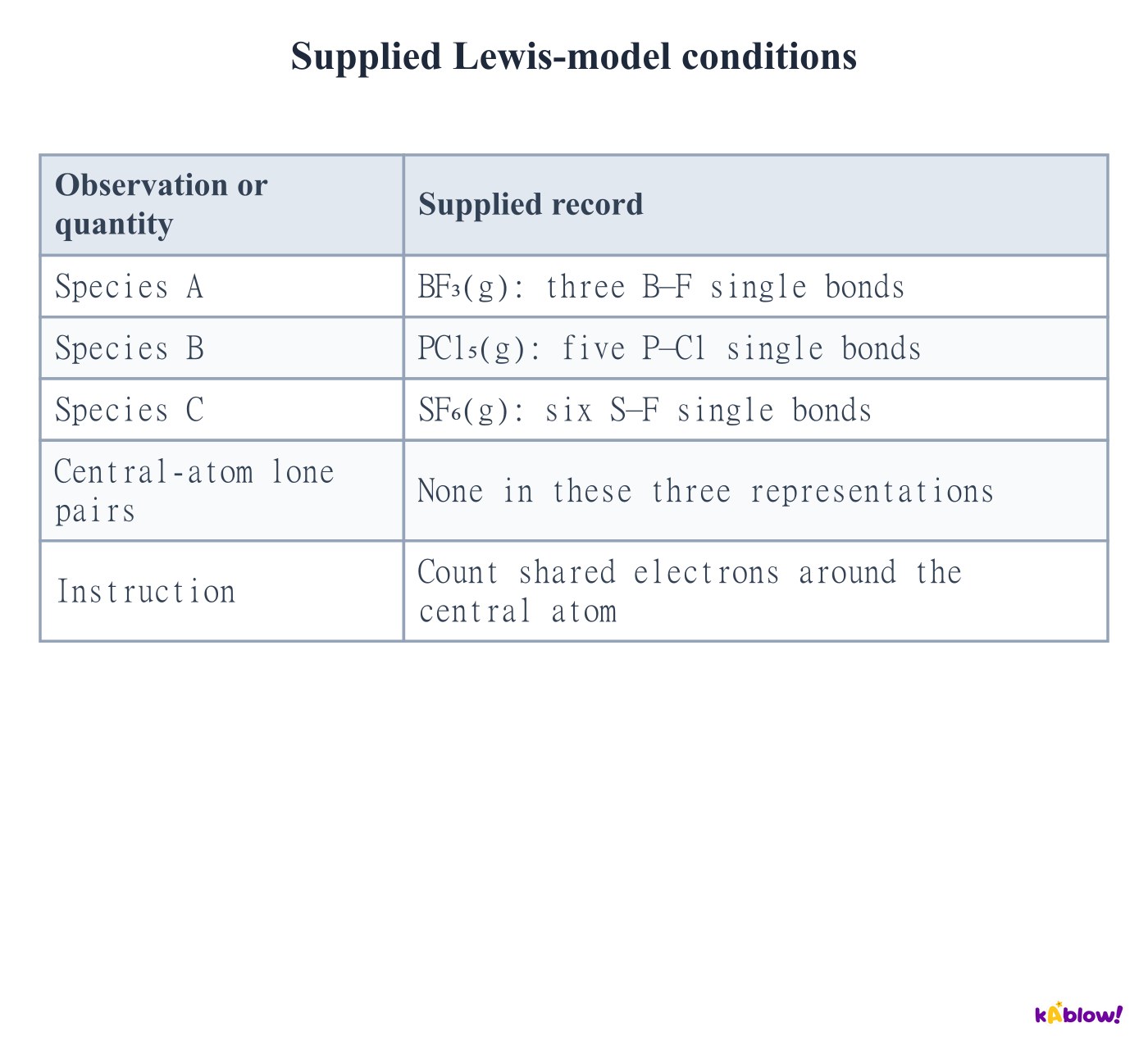
- An electron-deficient Lewis structure can leave a central atom with fewer than eight surrounding electrons. BF₃ has six around boron; it is boron trifluoride, not bromine trifluoride.
- Some Period 3 central atoms are represented with expanded octets: gaseous PCl₅ has ten surrounding bonding electrons and SF₆ has twelve in the simple Lewis count.
- State the species and phase. Solid PCl₅ has ionic features and solid BeCl₂ is not simply a set of the isolated gaseous molecules. A Lewis count is a model, not proof that every atom seeks an identical shell arrangement.
Supplied Lewis-model conditions
Represent coordinate bond formation
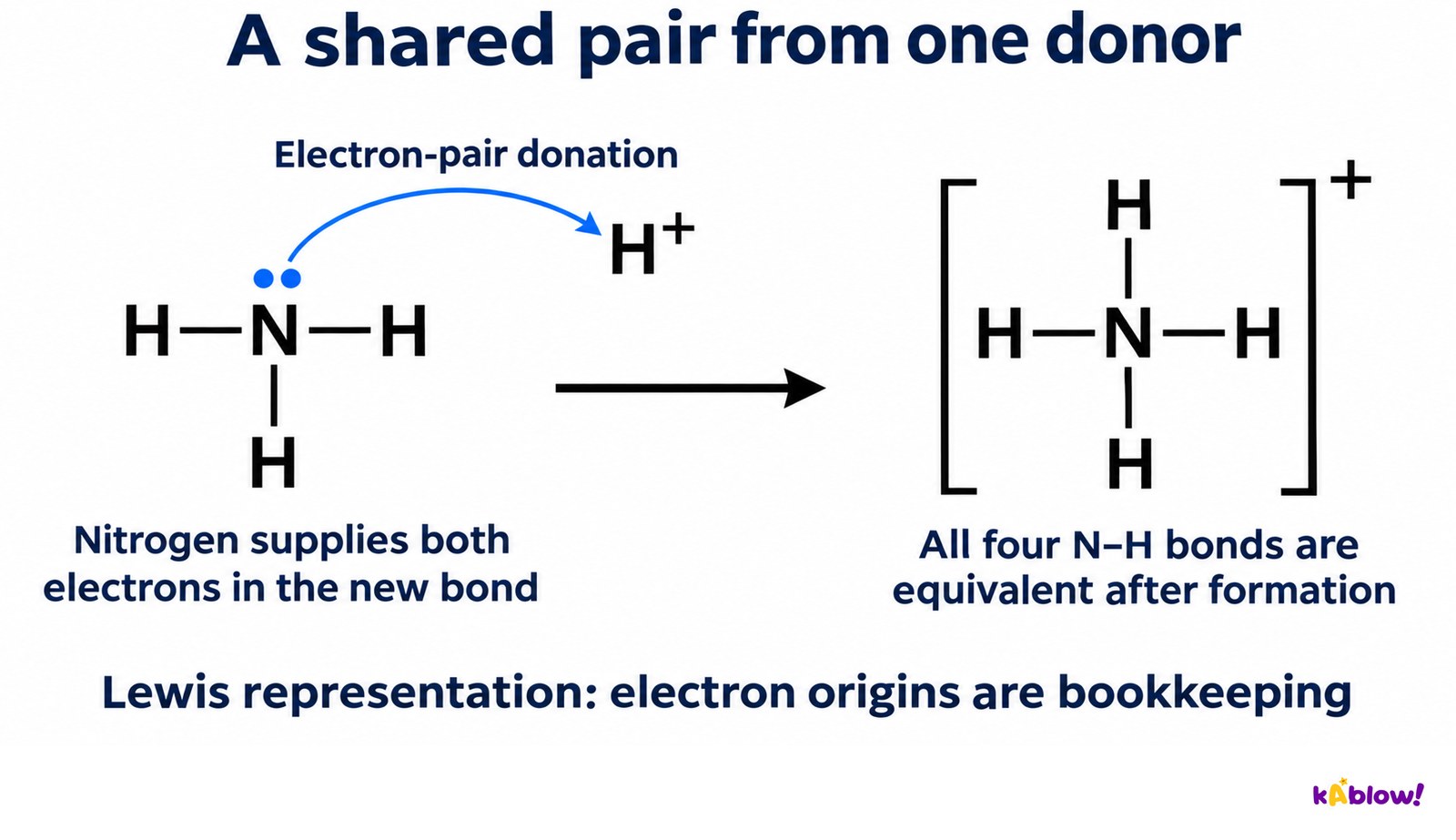
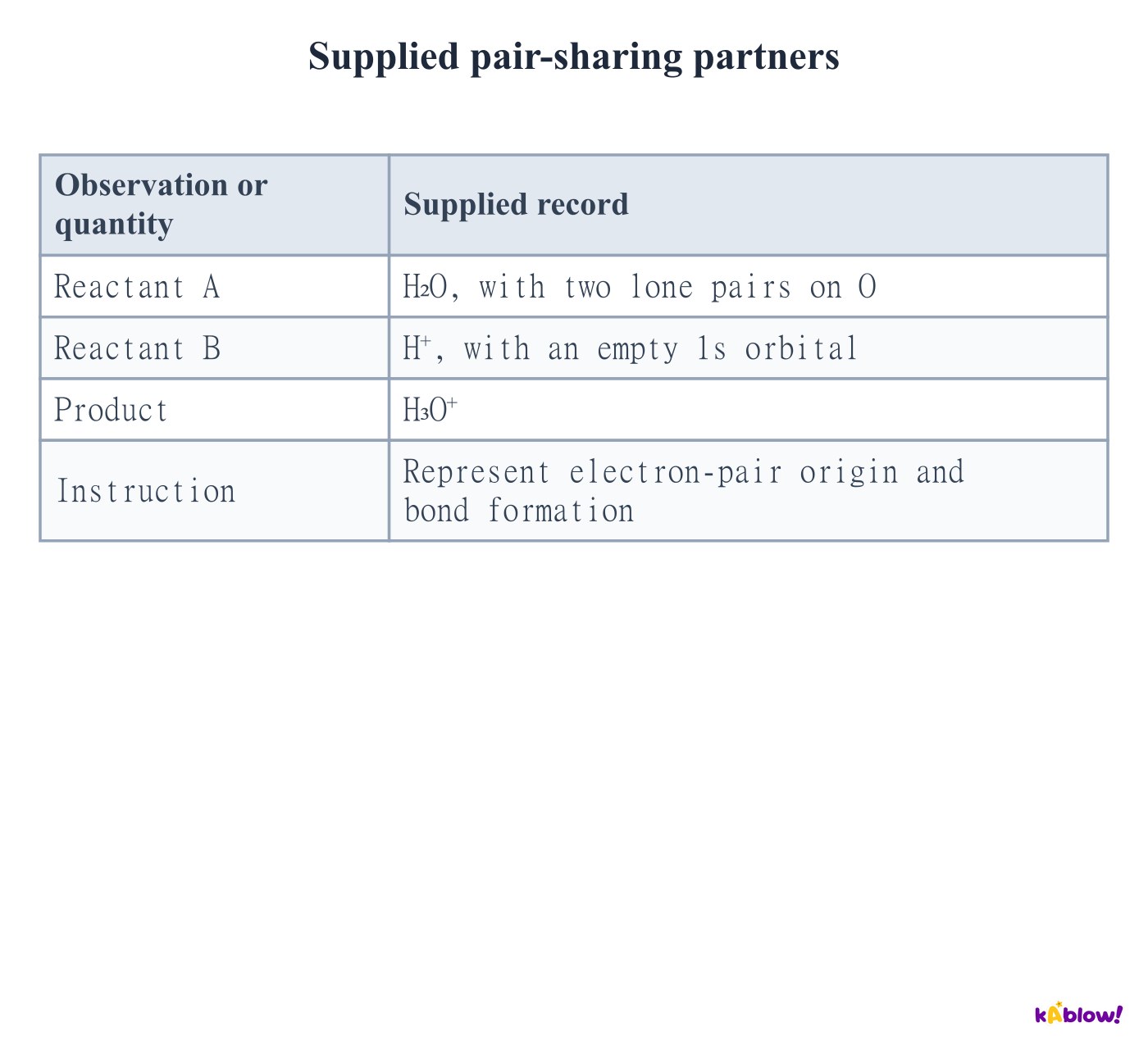
- In coordinate, or dative covalent, bond formation, both electrons in a new shared pair come from the donor. The acceptor has an appropriate vacant orbital.
- For NH₃ +H⁺, nitrogen donates its lone pair. A coordinate bond arrow points from donor to acceptor; a curved electron-pair arrow can show movement of the donated pair during formation.
- After NH₄⁺ forms, its four N–H bonds are equivalent. The formation history does not leave one permanently weaker or chemically special N–H bond.
Electron-pair donation to a proton
Apply the donor–acceptor model to aluminium chloride
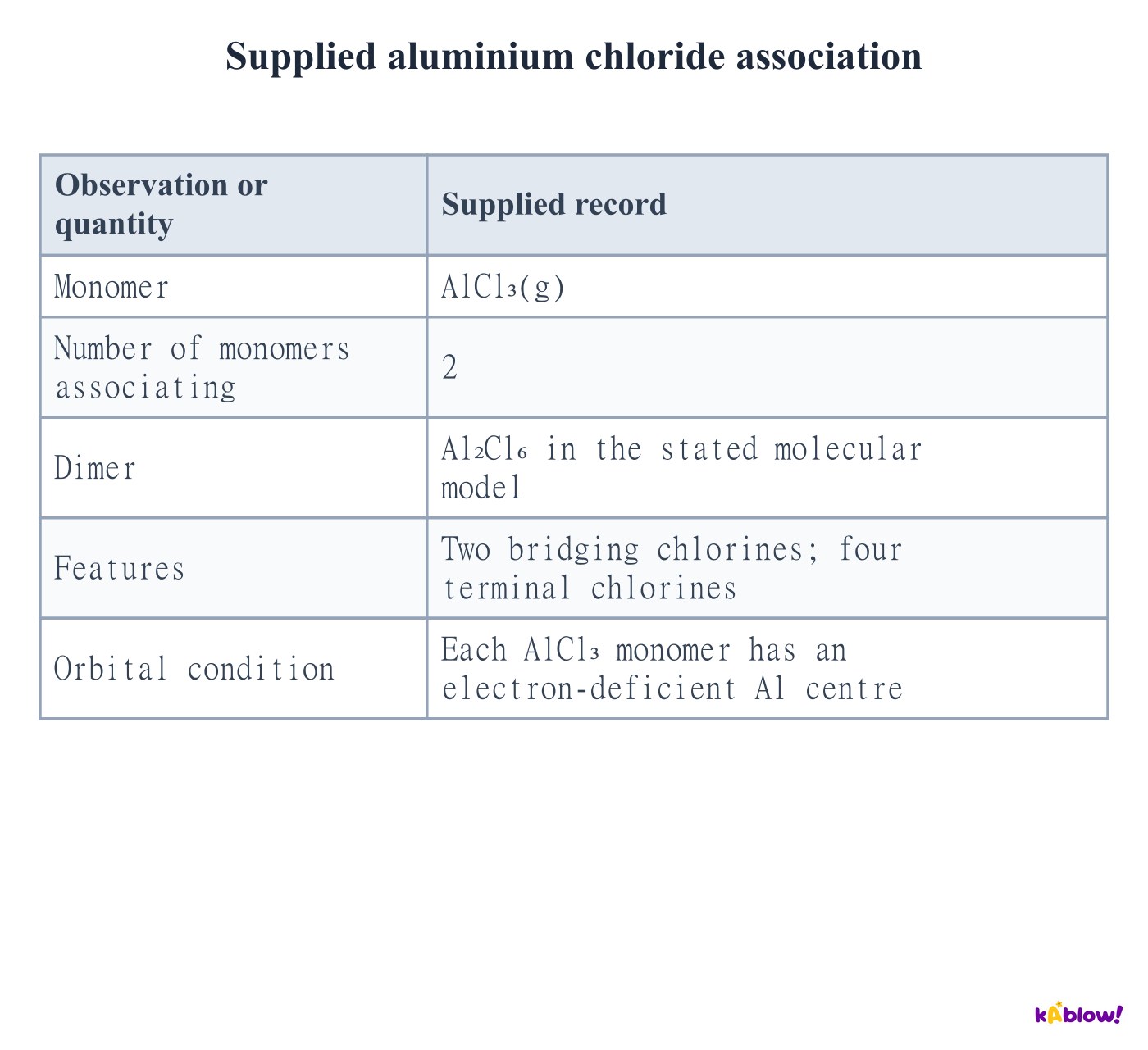
- An isolated gaseous AlCl₃ molecule is electron-deficient at aluminium in its simple Lewis representation. Under suitable molecular-phase conditions, association can produce Al₂Cl₆.
- The dimer has two bridging chlorines and four terminal chlorines. Lone-pair donation from chlorine to an electron-deficient aluminium centre describes the formation of the bridging interactions in the school model.
- Keep the phase qualification. Aluminium chloride is not universally a collection of the same isolated dimers in every solid, liquid, vapour and solution environment.
Supplied aluminium chloride association
Explain metallic cohesion
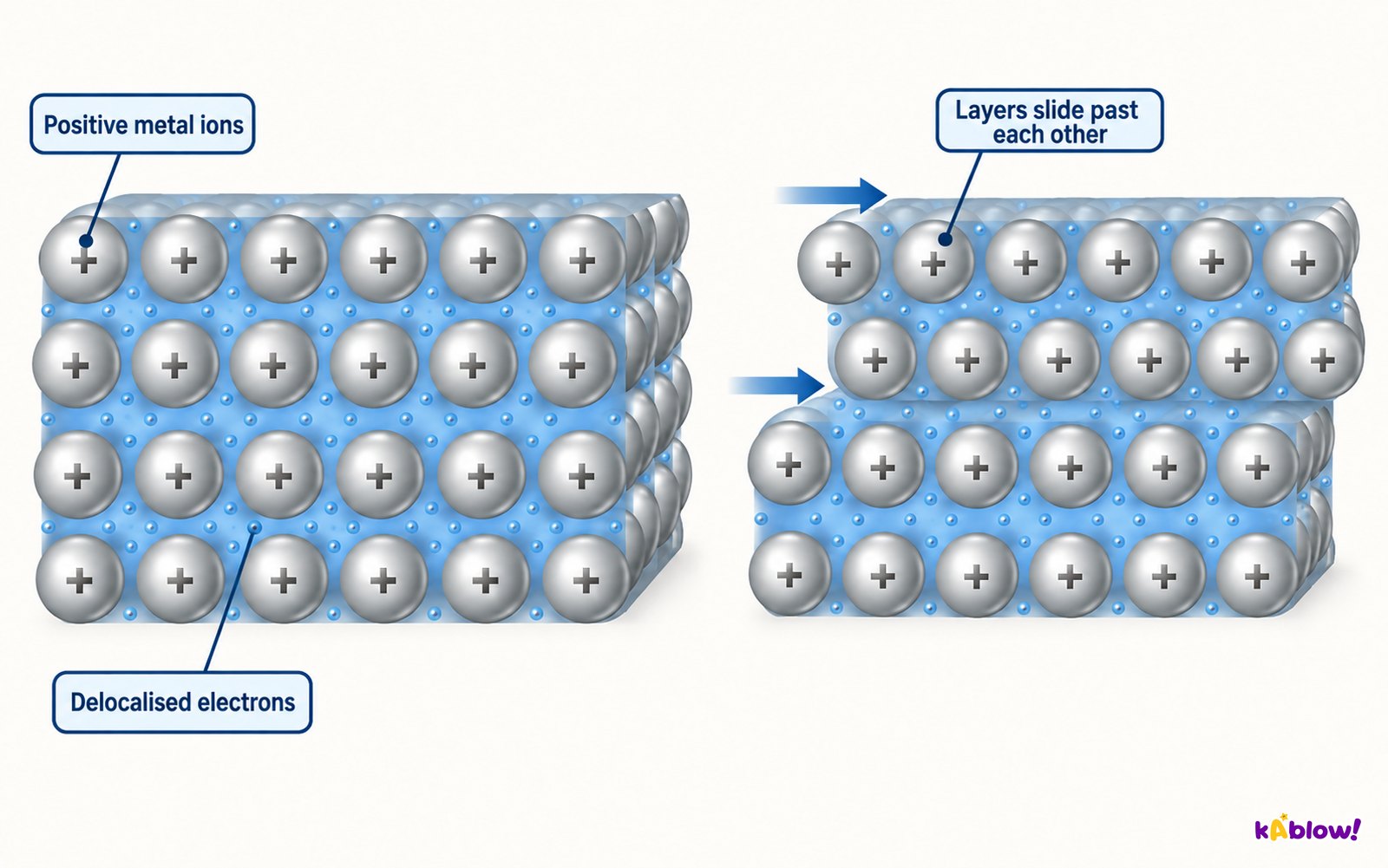
- The metallic model contains positive metal cores and delocalised valence electrons. Electrostatic attraction between them provides cohesion throughout the material.
- Repulsion between positive cores is also present, but it is not what alone holds the structure together. The stable arrangement reflects a balance of attractive and repulsive interactions.
- A regular crystal diagram is a simplified model. Molten metals lose long-range crystalline order while retaining mobile electrons and metallic interactions.
Metallic cohesion during slip
Identify charge and thermal carriers in metals
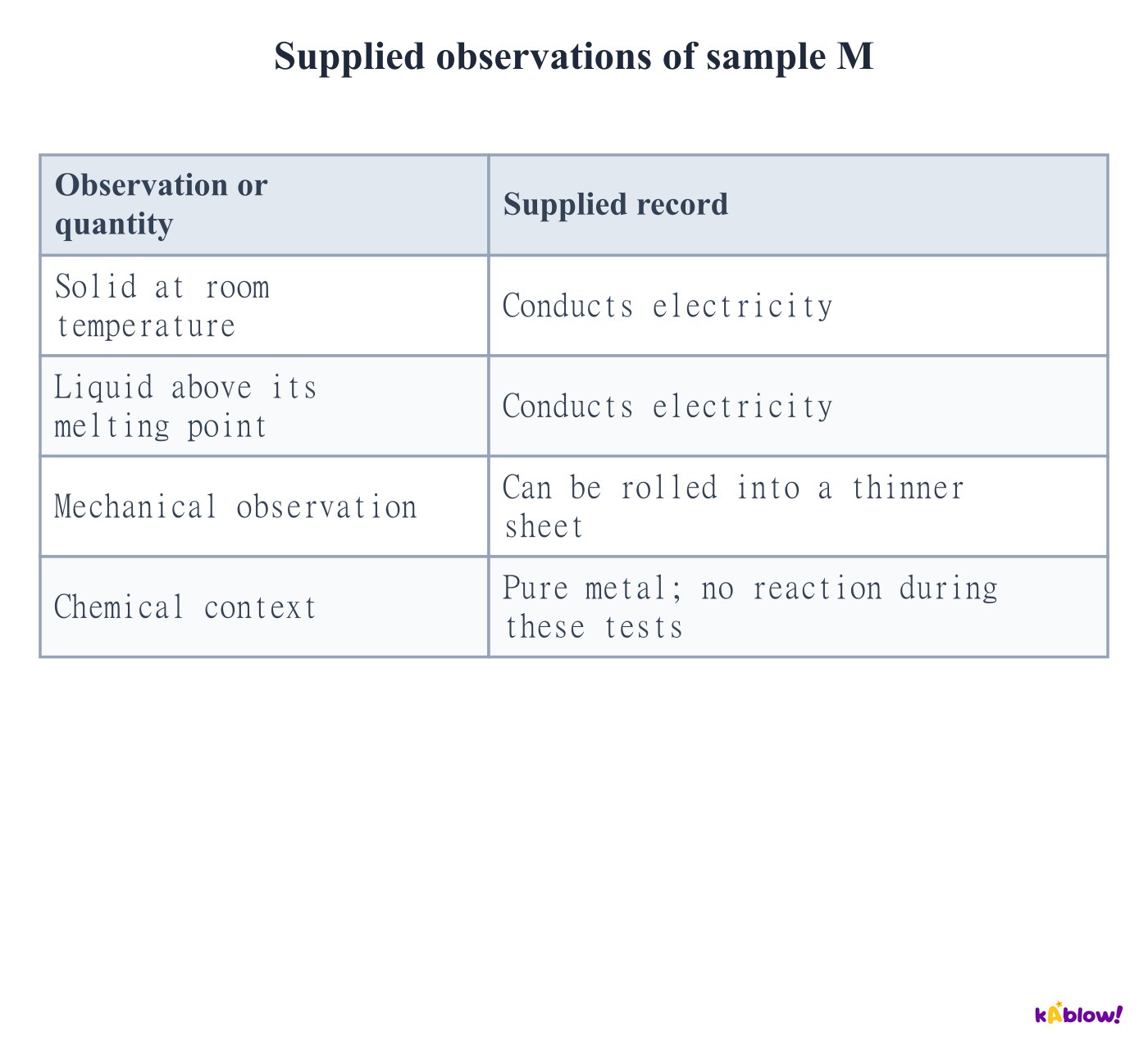
- Metals can conduct in solid and liquid states because electrons are mobile in both. Positive cores in a solid vibrate about positions rather than travelling through the material as the main electrical carriers.
- With an applied potential difference, electron drift carries charge through the metal. This organised drift is distinct from the electrons’ much faster random motion.
- Energy can also be transferred by mobile electrons and lattice vibrations. Do not picture solid metal cores freely colliding like gas particles or infer conductivity from electron count alone.
Metallic cohesion during slip
Relate deformation to slip and alloy structure
- Metal layers or crystal planes can slip while attraction to delocalised electrons maintains cohesion. This helps explain malleability and ductility.
- Adding other elements can obstruct slip through changes in the lattice and microstructure. An alloy can therefore be harder to deform than its base metal under particular conditions.
- Avoid saying every alloy is stronger in every sense. Composition, processing, temperature and the type of strength test all affect the comparison.
Metallic cohesion during slip
Qualify simple metallic trends
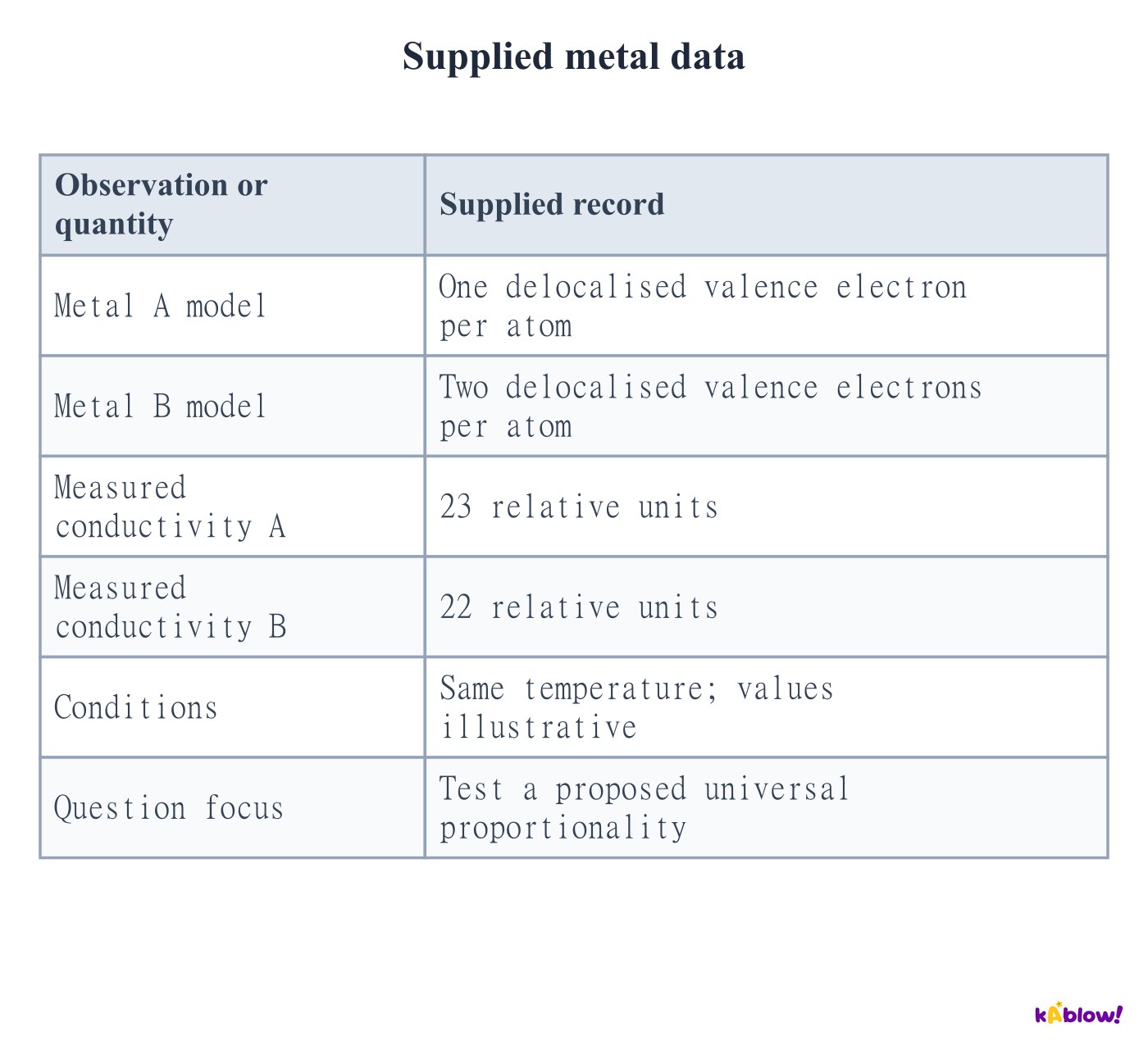
- For a restricted comparison of similar metals, charge density and available delocalised electrons can help explain differences in cohesive attraction and melting behaviour.
- Electrical conductivity also depends on carrier mobility and scattering. It is not universally proportional to the number of valence electrons per atom.
- Metals are not all hard or high-melting: their properties span a wide range. Use measured data and stated comparisons rather than converting a simple model into an absolute rule.
Supplied metal data
Relate ionic attraction to melting and brittleness
- Many ionic solids have high melting temperatures because substantial electrostatic attractions must be overcome to permit extensive ion rearrangement.
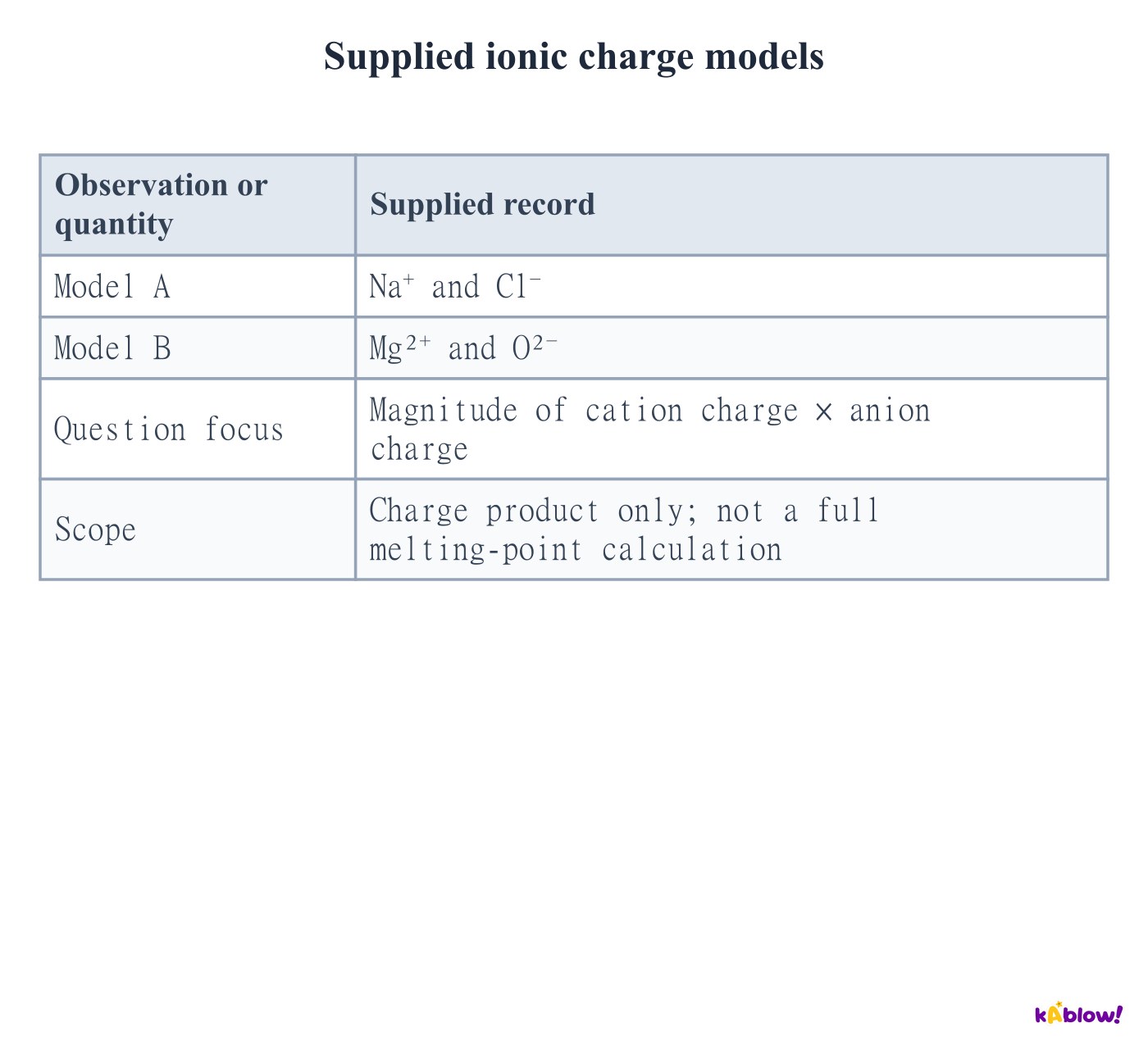
- Charge and ion separation influence the attraction, so a simple comparison can help explain why MgO is more thermally stable than NaCl. A full melting prediction also depends on structure and other factors.
- Ionic crystals are often brittle: slip can bring like charges close together, favouring repulsion and fracture. Strong bonding does not mean the crystal is ductile.
An extended NaCl lattice
Explain why a molten salt conducts
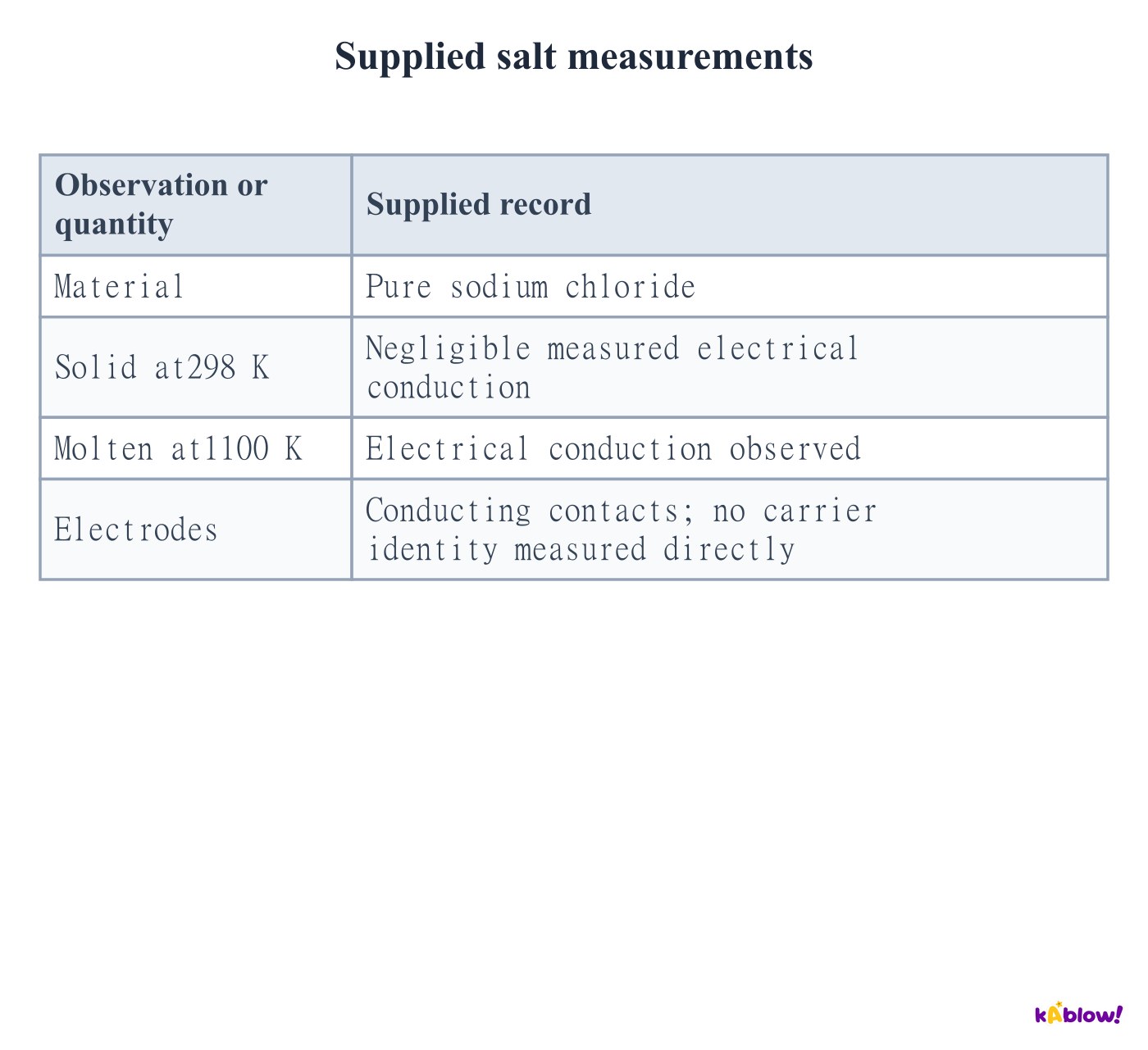
- In an ideal solid ionic crystal, ions have fixed average positions and cannot migrate through the sample as bulk electrical carriers. They can still vibrate.
- Melting allows positive and negative ions to move, so the melt can conduct when an electrical circuit is completed. The principal carriers are ions, not a metallic sea of free electrons.
- An aqueous ionic solution can conduct if mobile ions are present. Do not infer that every ionic compound must dissolve sufficiently to give a strongly conducting solution.
An extended NaCl lattice
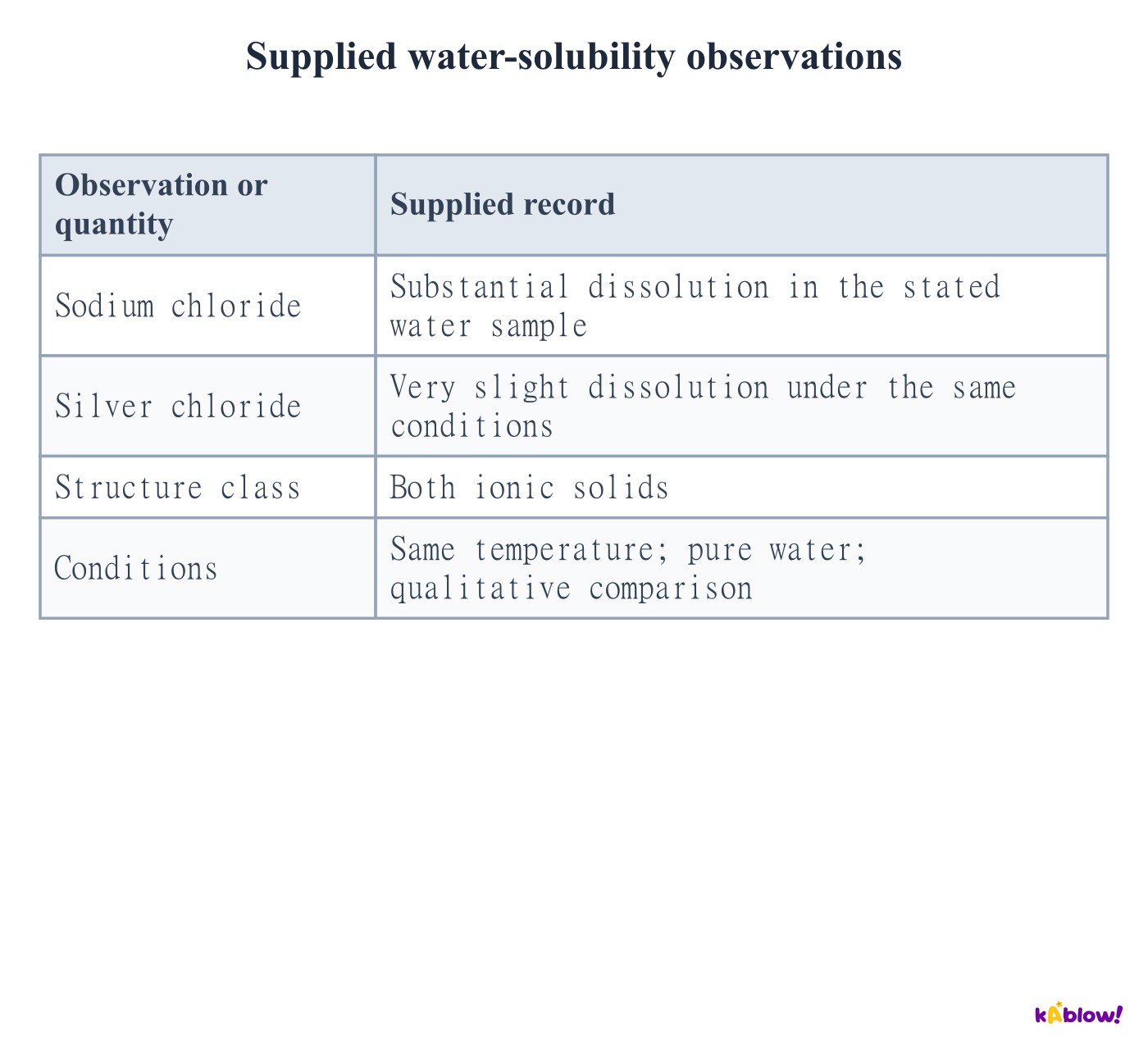
Evaluate ionic solubility rather than assuming it
- Dissolving an ionic solid depends on the balance between separating its lattice and stabilising dissolved species, together with the change in disorder.
- Water can stabilise ions, but this does not guarantee that every ionic solid dissolves extensively. Sodium chloride and silver chloride provide contrasting observations under stated conditions.
- A solubility result should be connected to the actual substance and solvent. Reaction with water is a chemical process and must not automatically be called simple dissolution.
Supplied water-solubility observations
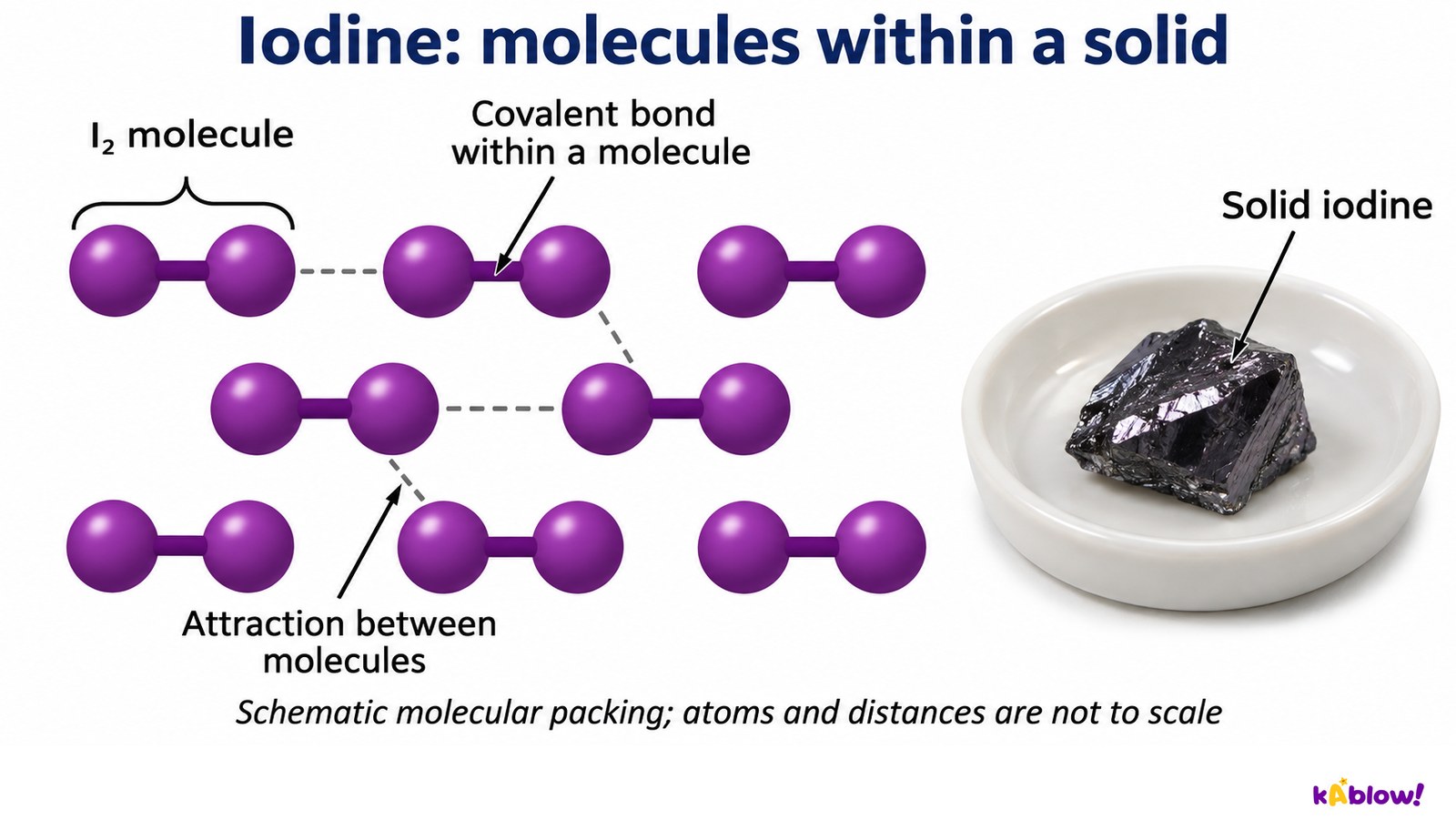
Distinguish molecular attractions from internal bonds
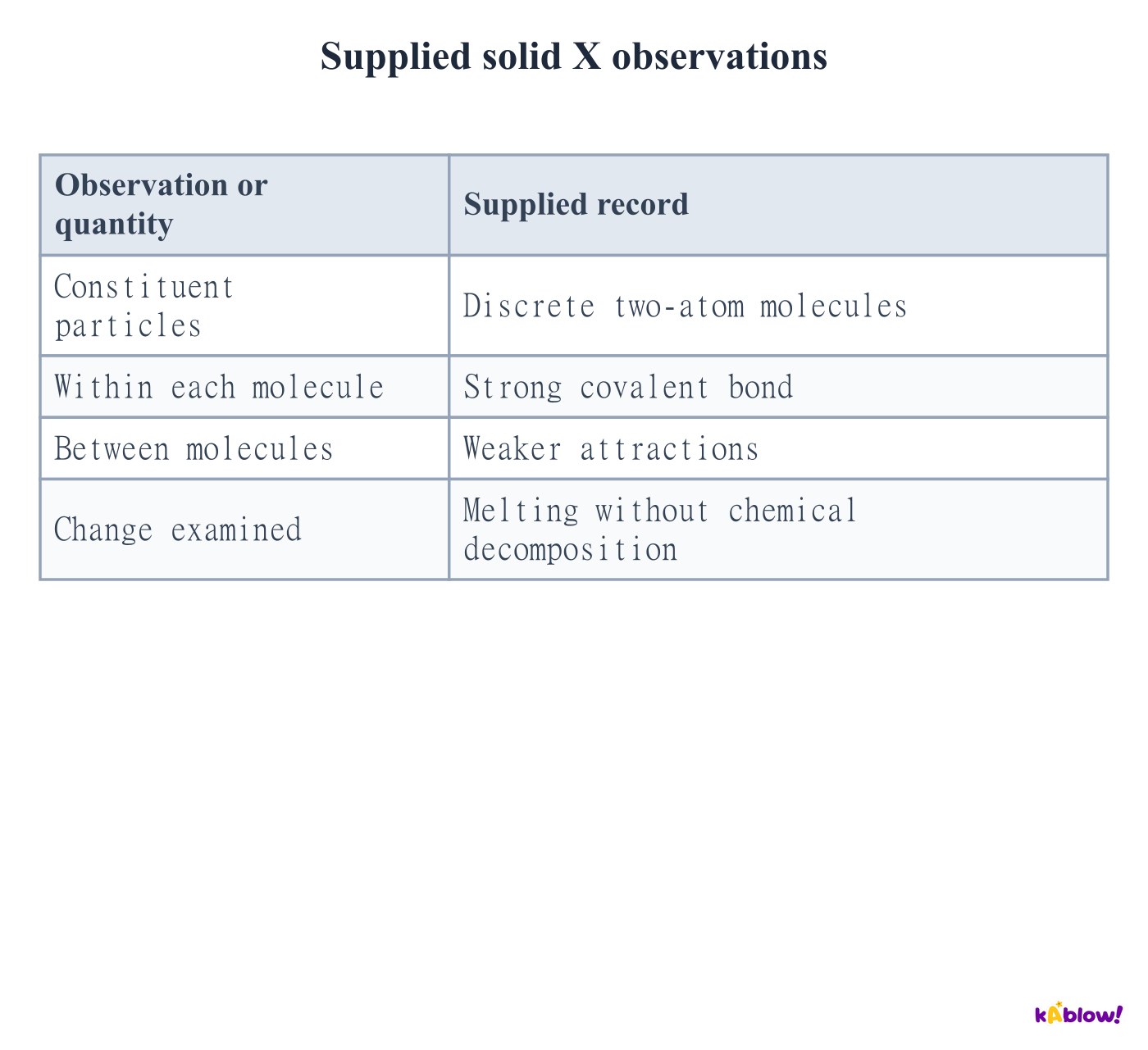
- A molecular solid contains discrete molecules joined internally by covalent bonds. Attractions between those molecules are different interactions.
- Melting a molecular solid without decomposition mainly disrupts the intermolecular organisation. It does not require breaking every covalent bond within the molecules.
- Many small molecular substances melt at relatively low temperatures, but molecular size, shape and intermolecular attractions vary. Avoid turning a useful tendency into a universal numerical rule.
Iodine molecules within a solid
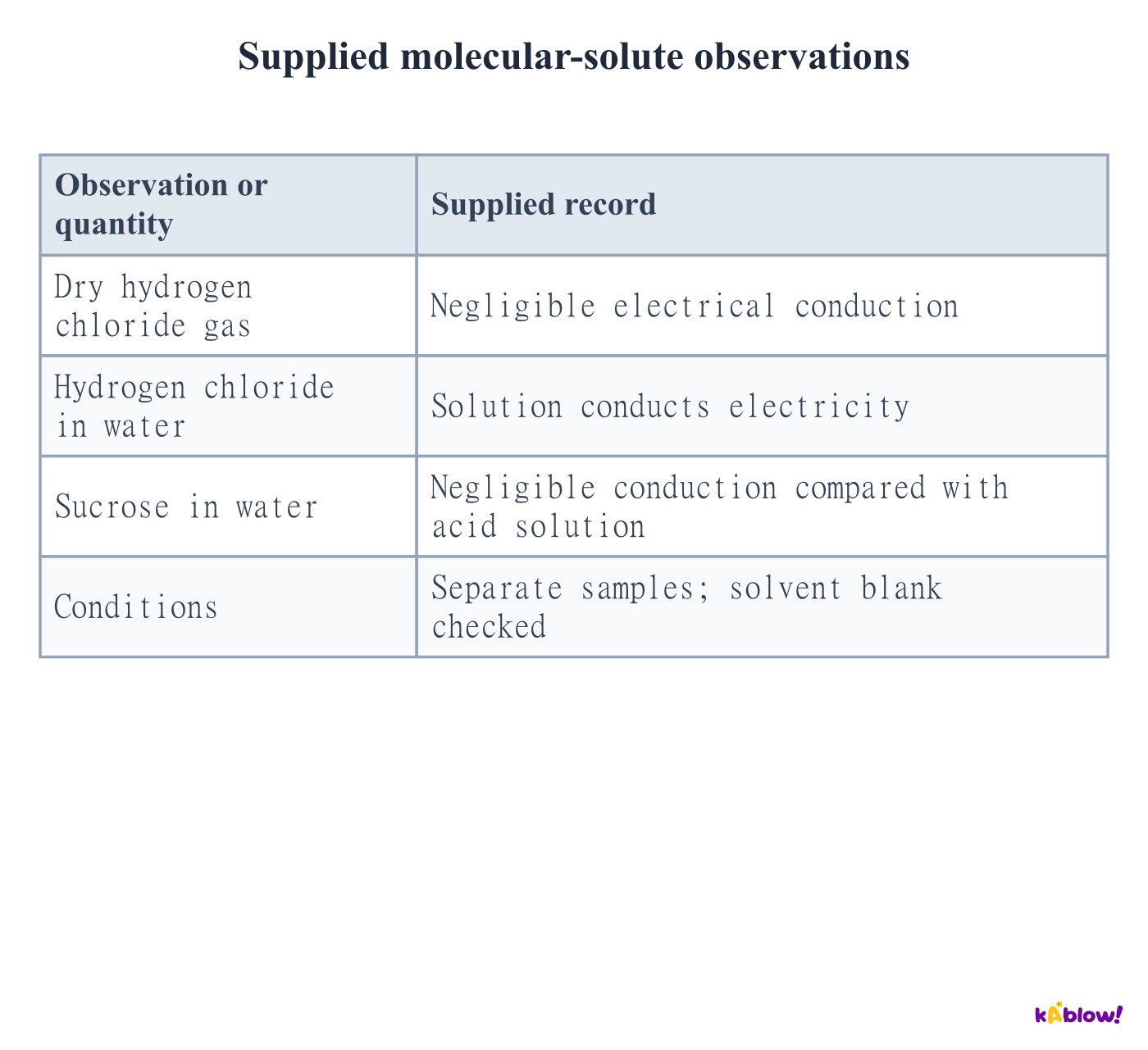
Explain molecular substances in conducting solutions
- An ordinary pure molecular material often has no effective mobile charge carriers, even though its atoms contain charged protons and electrons.
- Some molecular substances form ions on reacting with water. Hydrogen chloride gives an acidic ionic solution; sucrose can dissolve mainly as neutral molecules.
- Solubility and electrical conduction are different observations. Neither being molecular nor being dissolved alone determines whether the final solution has many mobile ions.
Supplied molecular-solute observations
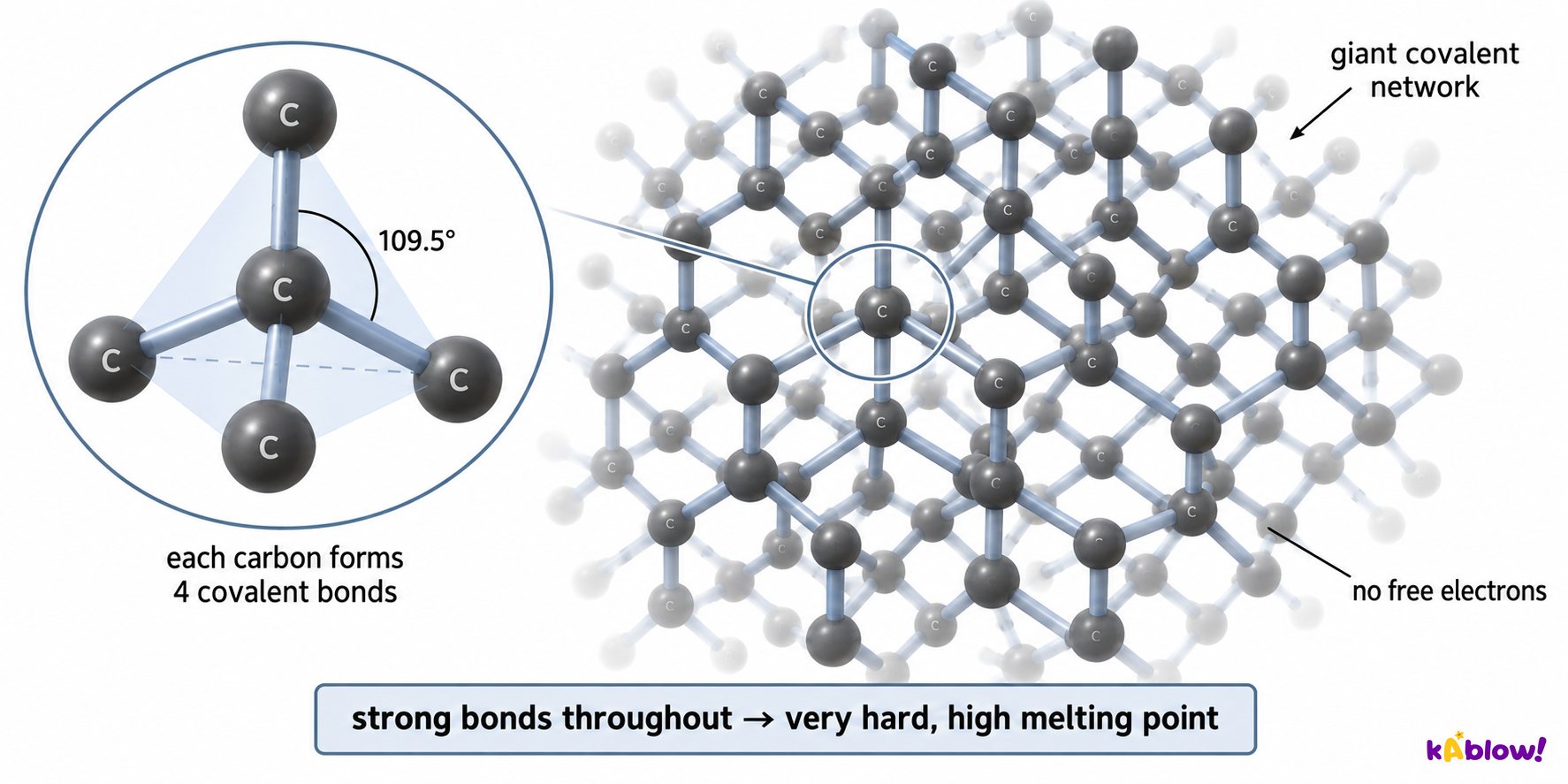
Relate diamond’s network to its properties
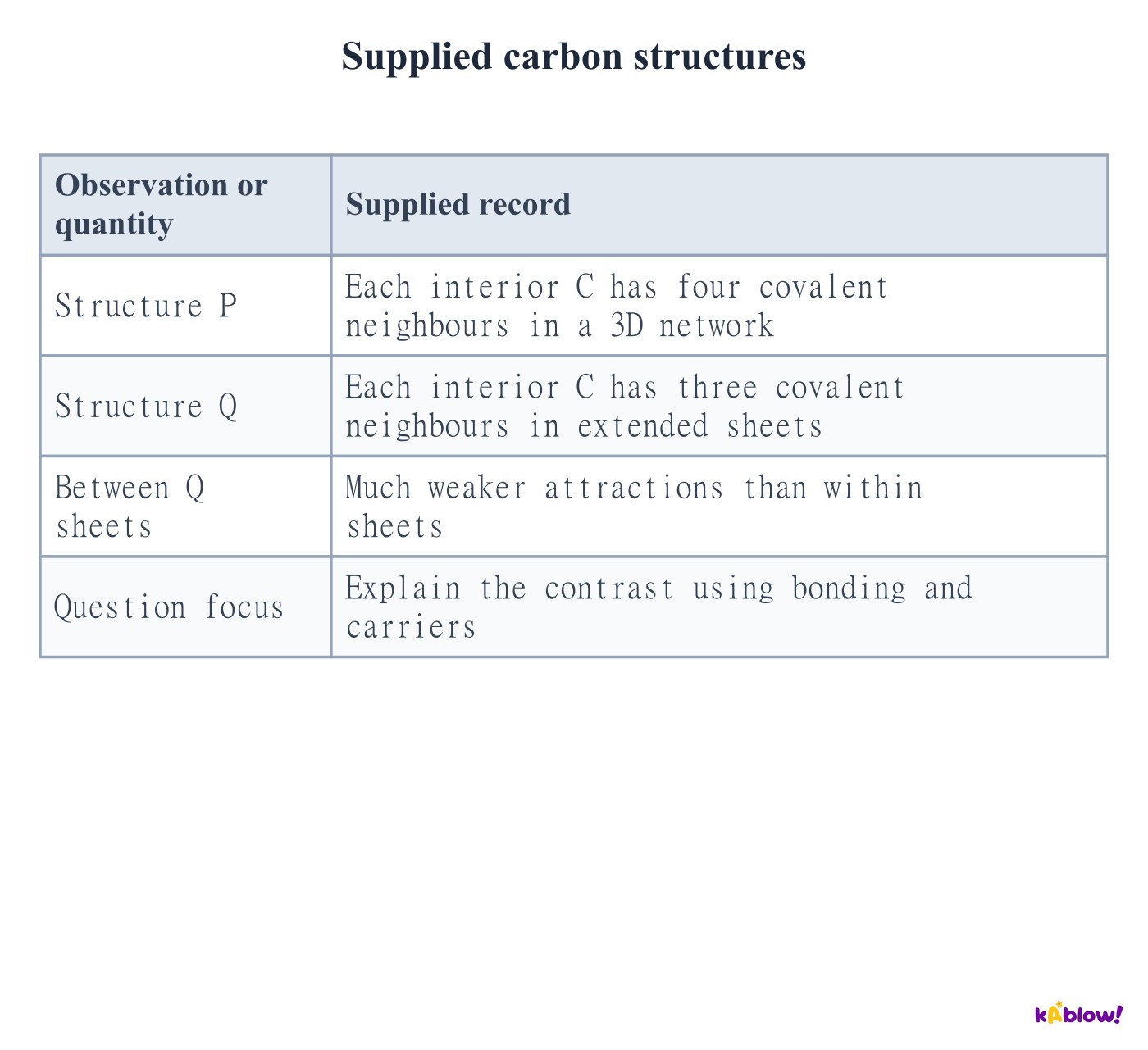
- In diamond, each interior carbon forms four covalent bonds in a three-dimensional tetrahedral network. It is not a collection of discrete C₄ molecules.
- Disrupting the extended strong-bond network requires considerable energy, giving high thermal stability and hardness. Phase behaviour at high temperature depends on pressure and conditions.
- In the ordinary pure diamond model, valence electrons are associated with covalent bonding rather than effective mobile carriers, so it is an electrical insulator.
Diamond’s extended covalent structure
Separate graphite’s in-plane and interlayer interactions
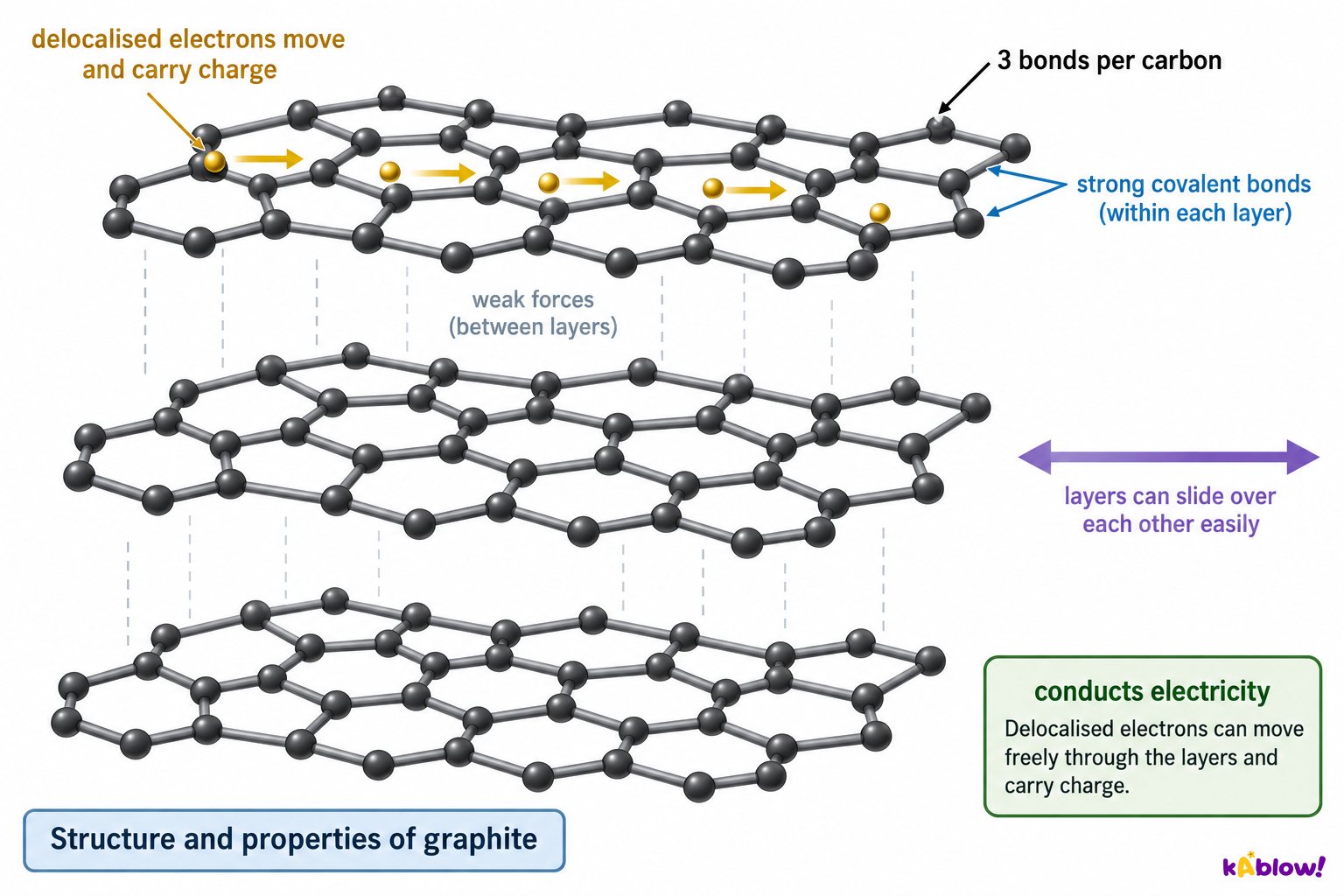
- Each interior graphite carbon has three covalent neighbours in an extended hexagonal sheet. Delocalised electronic states support electrical conduction particularly along the sheets.
- Attractions between sheets are much weaker than the covalent framework within a sheet, allowing relatively easy slip. Edge atoms in a cropped illustration mark where the real structure continues.
- Do not describe the carriers as electrons freely swimming only in the gaps between layers. The delocalisation belongs to the extended carbon-sheet electronic system.
Graphite sheets and interlayer attractions
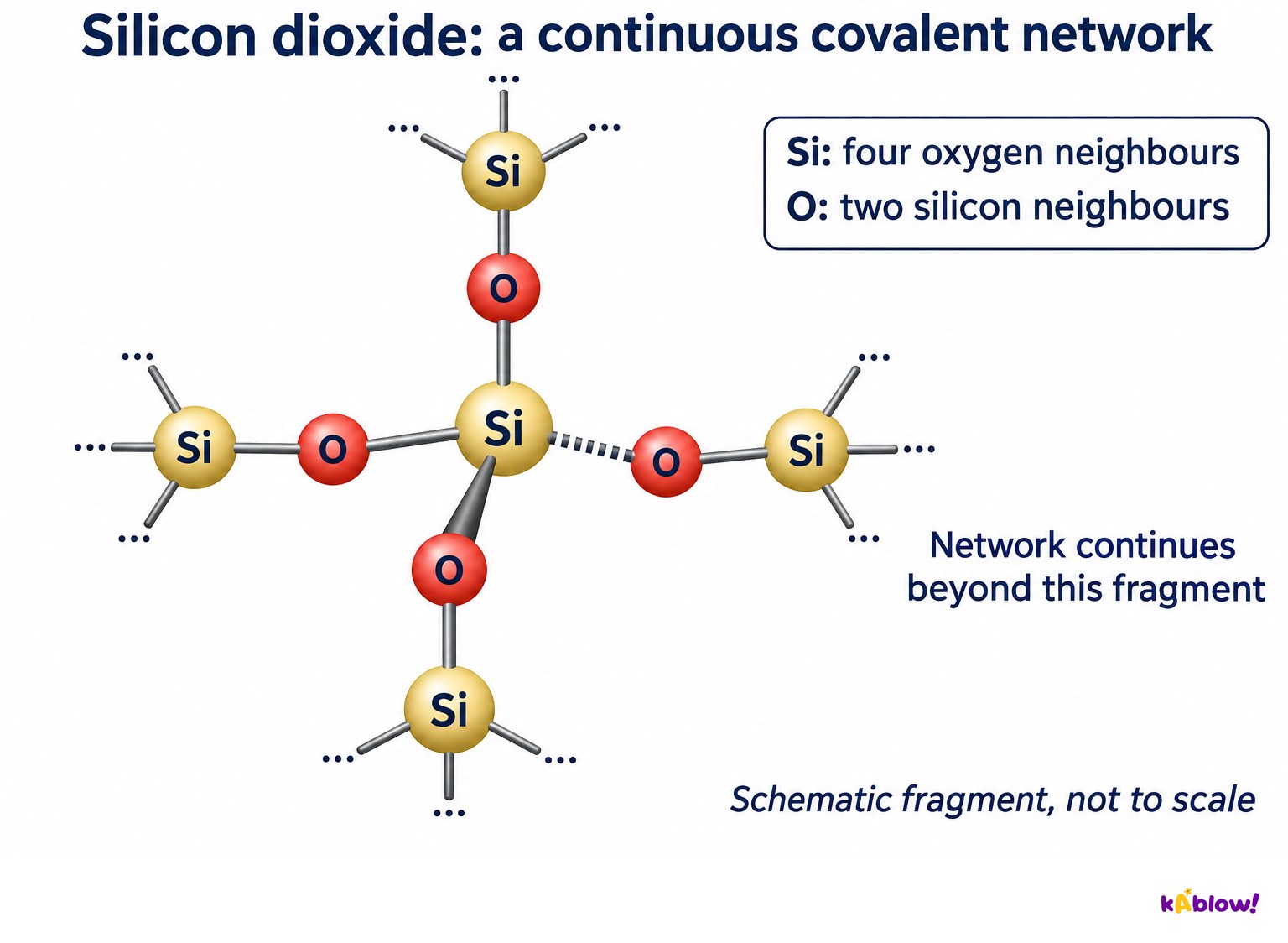
Read a silicon dioxide network fragment
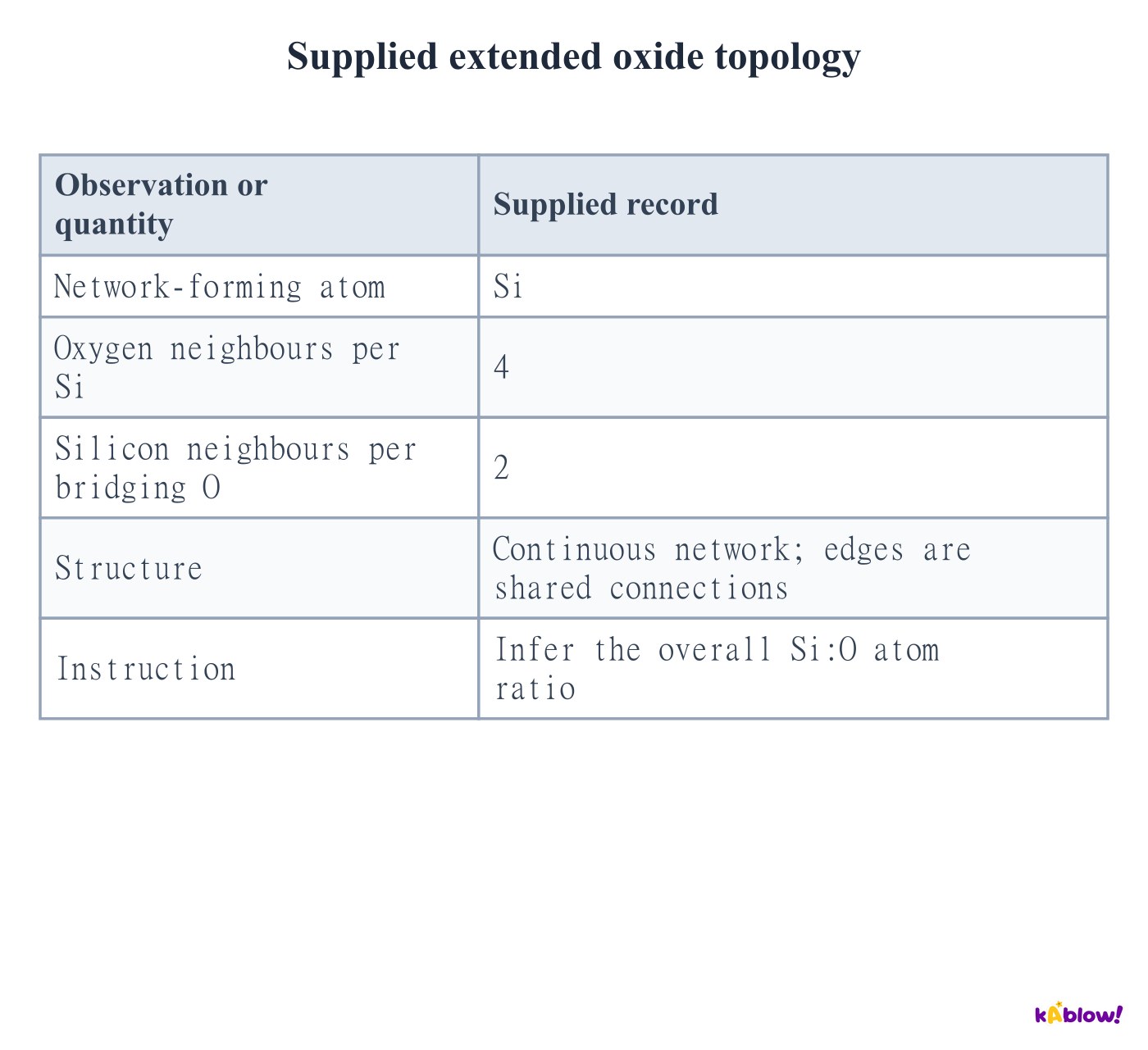
- In the usual silica network model, each silicon has four oxygen neighbours and each oxygen bridges two silicons. The strong covalent framework extends beyond the illustrated fragment.
- Counting shared oxygen connections gives an overall Si:O ratio of 1:2. SiO₂ expresses composition rather than a set of separate three-atom molecules in this solid.
- The connected network explains high thermal stability and hardness. The ordinary pure model has no effective mobile electrical carriers; it does not behave like a molten ionic salt simply because it is an oxide.
A continuous silicon dioxide network
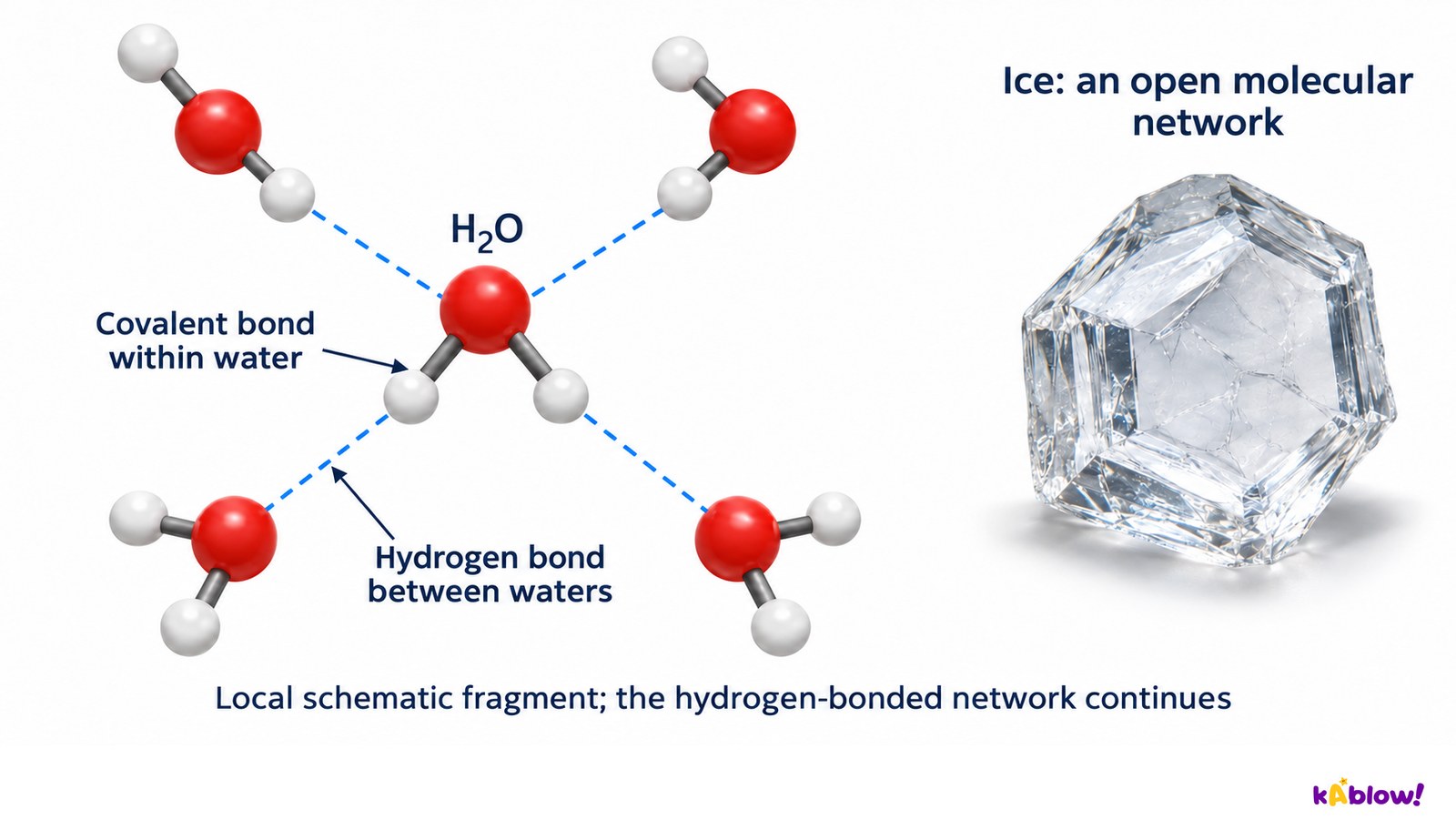
Keep water molecules intact within ice
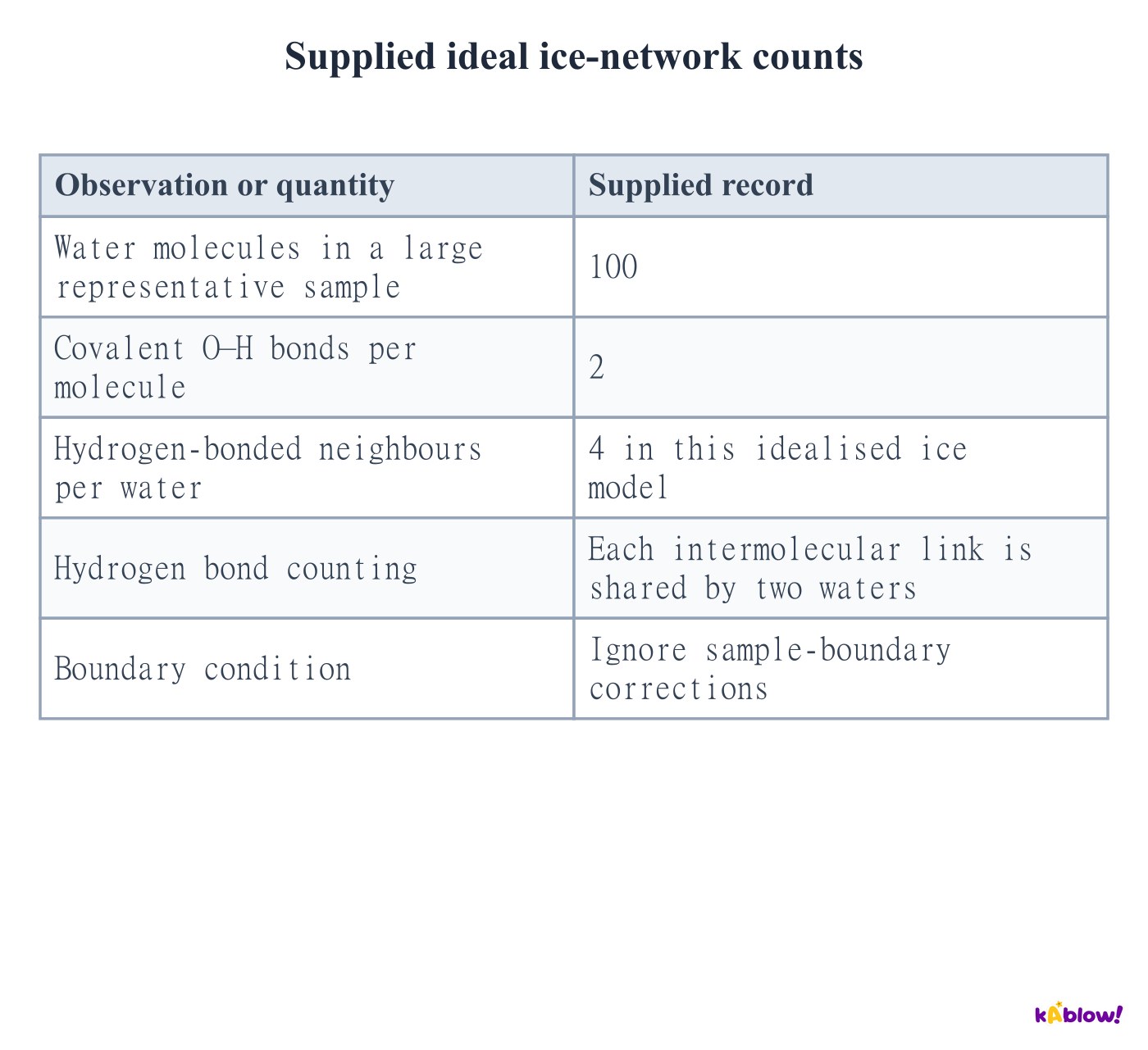
- Ice is a molecular crystal with an extended hydrogen-bonded arrangement. Covalent O–H bonds hold each water molecule together; hydrogen bonds connect neighbouring molecules.
- In a common ideal ice model, each water has four hydrogen-bonded neighbours. The local illustration is a schematic fragment, with two donor and two acceptor connections at the central molecule.
- Melting rearranges the hydrogen-bonded network while largely preserving water molecules. This is different from breaking the O–H bonds to produce separate hydrogen and oxygen.
A local hydrogen-bonded ice fragment
Recognise discrete molecules in iodine and fullerene solids
- Solid iodine contains I₂ molecules: each pair is joined internally by a covalent bond, while intermolecular attractions hold the molecular solid together.
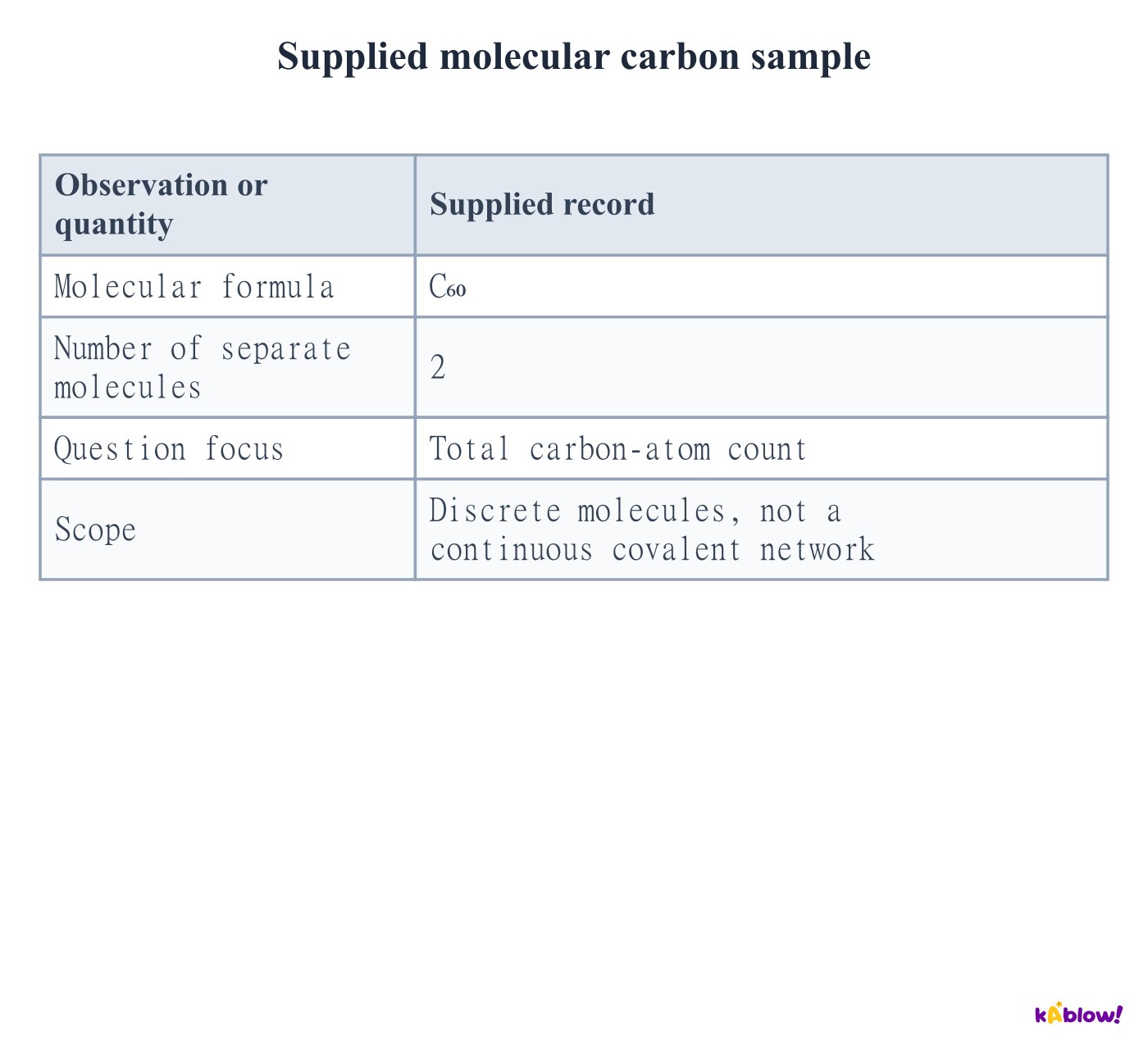
- A large molecule is not automatically a giant covalent network. Buckminsterfullerene consists of discrete C₆₀ molecules, unlike diamond or graphite’s extended covalent structures.
- Use the particle unit to choose an explanation. Within-molecule bonding and between-molecule attractions can affect different properties and should not be described as one interchangeable force.
Iodine molecules within a solid
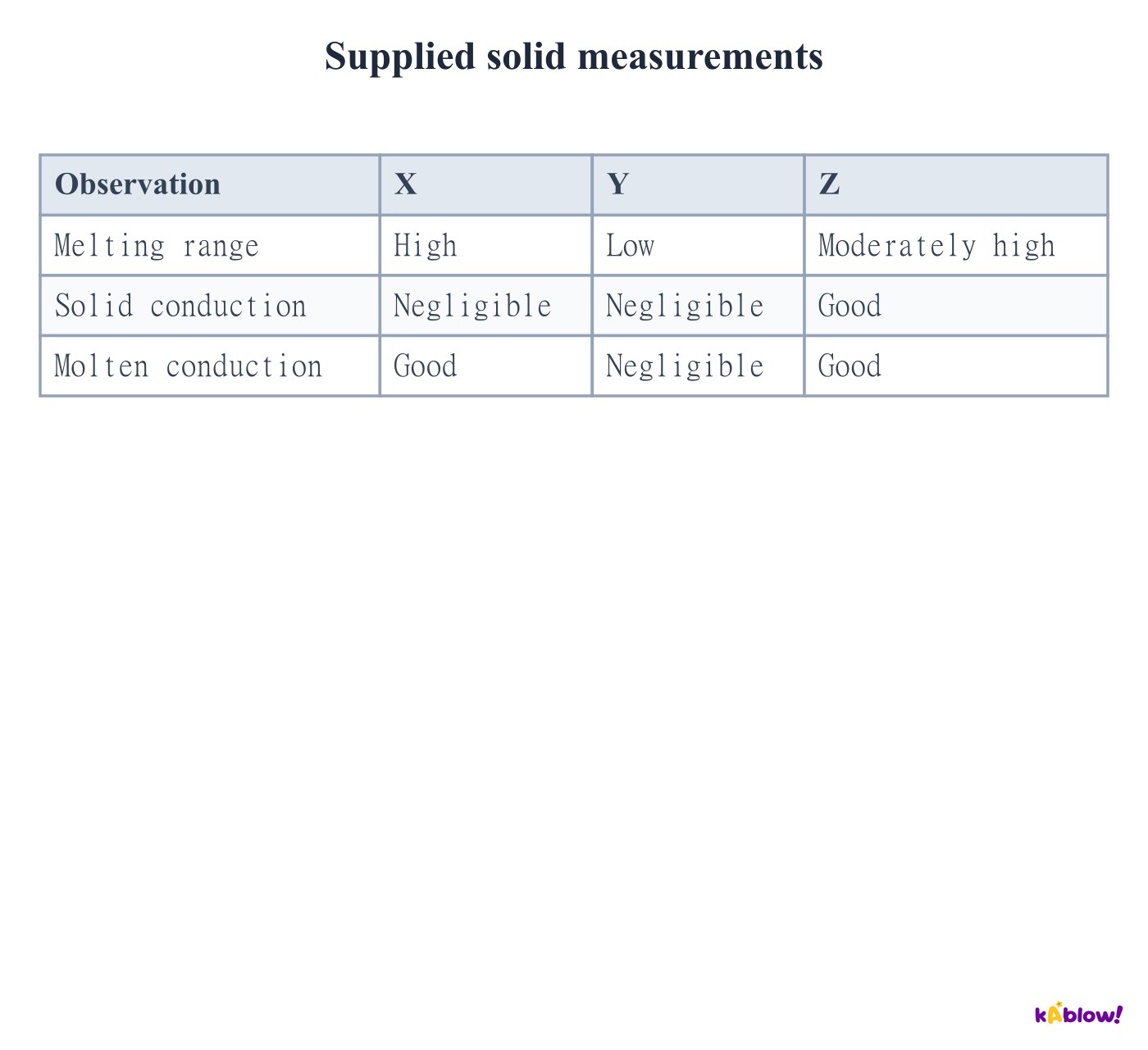
Combine observations to infer a structure class
- Use melting behaviour, electrical conduction in different states and other measurements together. One property by itself may fit several structural models.
- Within the restricted ionic, molecular and metallic candidate set, a solid that does not conduct but whose melt does conduct fits mobile ions becoming available on melting.
- A conducting solid and conducting liquid supports a metallic model within that candidate set. A low-melting non-conductor supports a molecular model, while broader possibilities require additional evidence.
Supplied solid measurements
Identify when the evidence is incomplete
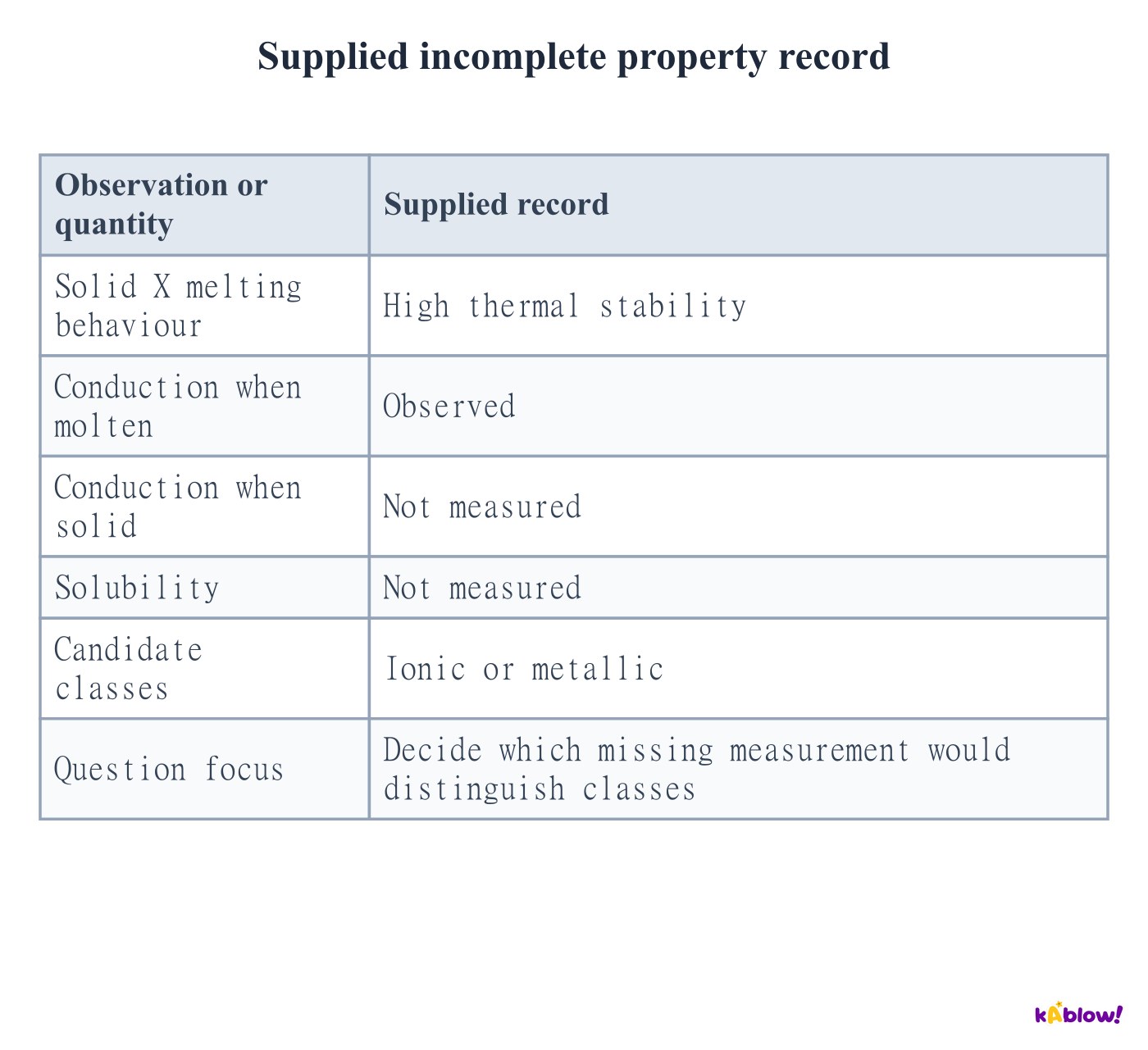
- High thermal stability and conduction in a liquid do not by themselves uniquely identify a metal. An ionic melt can also conduct.
- If the candidate classes are ionic and metallic, measuring conduction in the solid is a useful distinguishing test under the ordinary pure-material model.
- State the limit of the inference rather than claiming certainty from missing data. A valid explanation connects the observed state, available carriers and the set of permitted structural models.
Supplied incomplete property record
Slide
Sign up free to view the lesson slides
Step through every slide for this topic — plus flashcards and revision notes — with a free account.
Câu hỏi luyện tập
Xem trước miễn phí — 8 trên 60 câu hỏi. Đăng ký để xem tất cả.
1.Which supplied process releases energy to the surroundings?
Medium- AA only
- BB only
- CC only
- DA and C
2.Which supplied sample shows boiling?
Medium- AA only
- BB only
- CBoth samples
- DNeither sample
3.In the supplied heating model, how much energy enters during the lower-temperature plateau?
Medium- A1 kJ
- B2 kJ
- C3 kJ
- D4 kJ
4.Which net charge follows for supplied species B?
Medium- A+1
- B−1
- C+2
- D−2
5.Which charge belongs to supplied species D?
Medium- A0
- B+1
- C+2
- D−2
6.Which formula follows from the supplied magnesium and nitride ions?
Medium- AMgN
- BMg₂N₃
- CMg₃N₂
- DMg₃N
7.How many electrons are gained in total when three neutral nitrogen atoms each become N³⁻?
Medium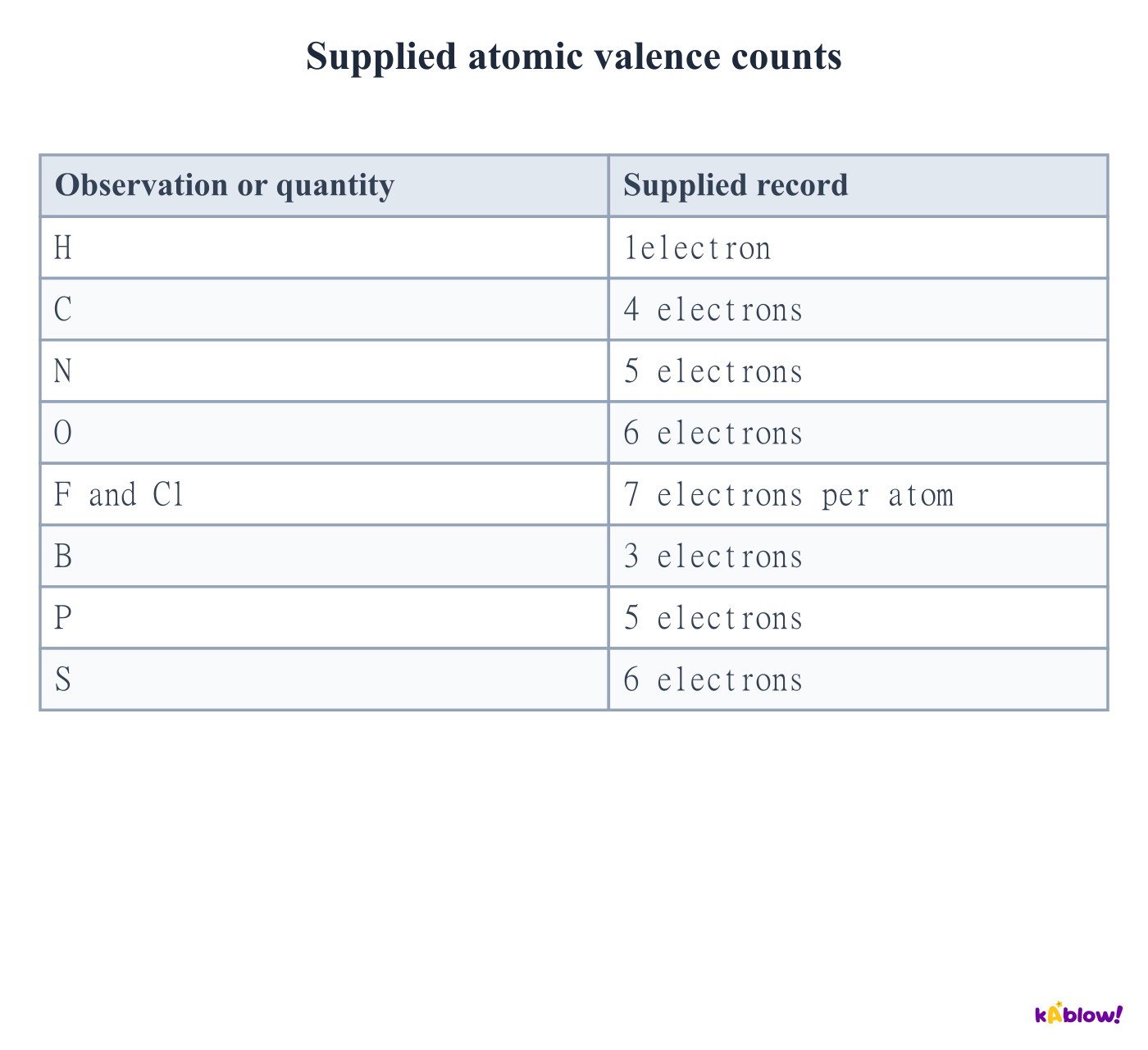
- A1
- B3
- C6
- D9
8.How many anions are needed for the supplied neutral representative set?
Medium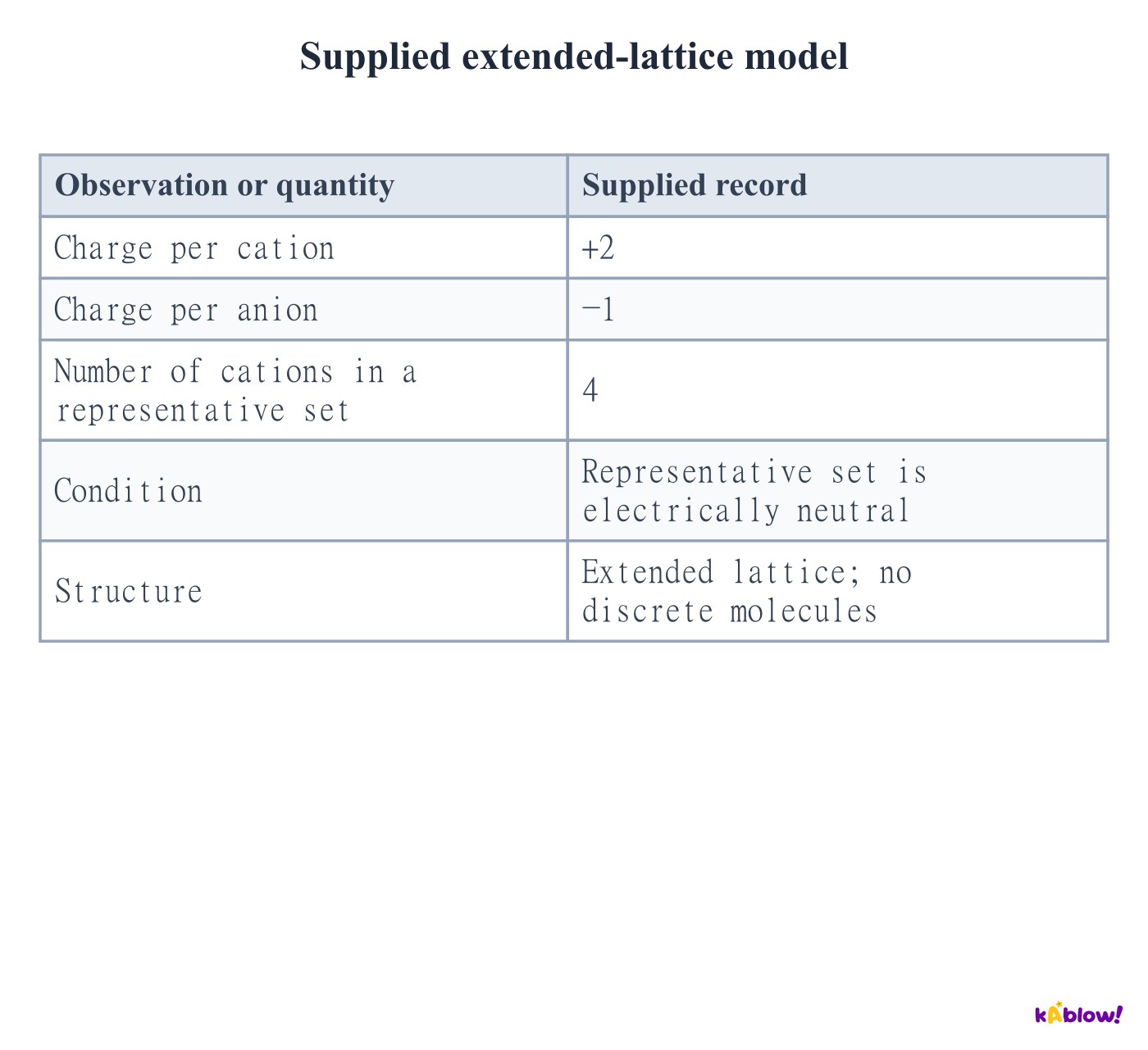
- A2
- B4
- C6
- D8

Unlock all 60 questions, flashcards & more
Tạo tài khoản miễn phí để xem mọi câu hỏi, slide, thẻ ghi nhớ và ghi chú ôn tập cho chủ đề này.