
Photography and digital media
Học bằng cách chơi
Trả lời những câu hỏi này để kiếm năng lượng, rồi câu cá và khám phá. Không cần tài khoản.
Dành cho nhà giáo dục: slide bài học, ghi chú ôn tập sẵn dùng cho Photography and digital media (Art and Design, Materials and Processes) — dùng trong bài giảng của bạn, hoặc chạy chủ đề như một hoạt động lớp học tương tác để người học chơi như một trò chơi trực tiếp.
Ghi chú bài học
Composition, focus and capture
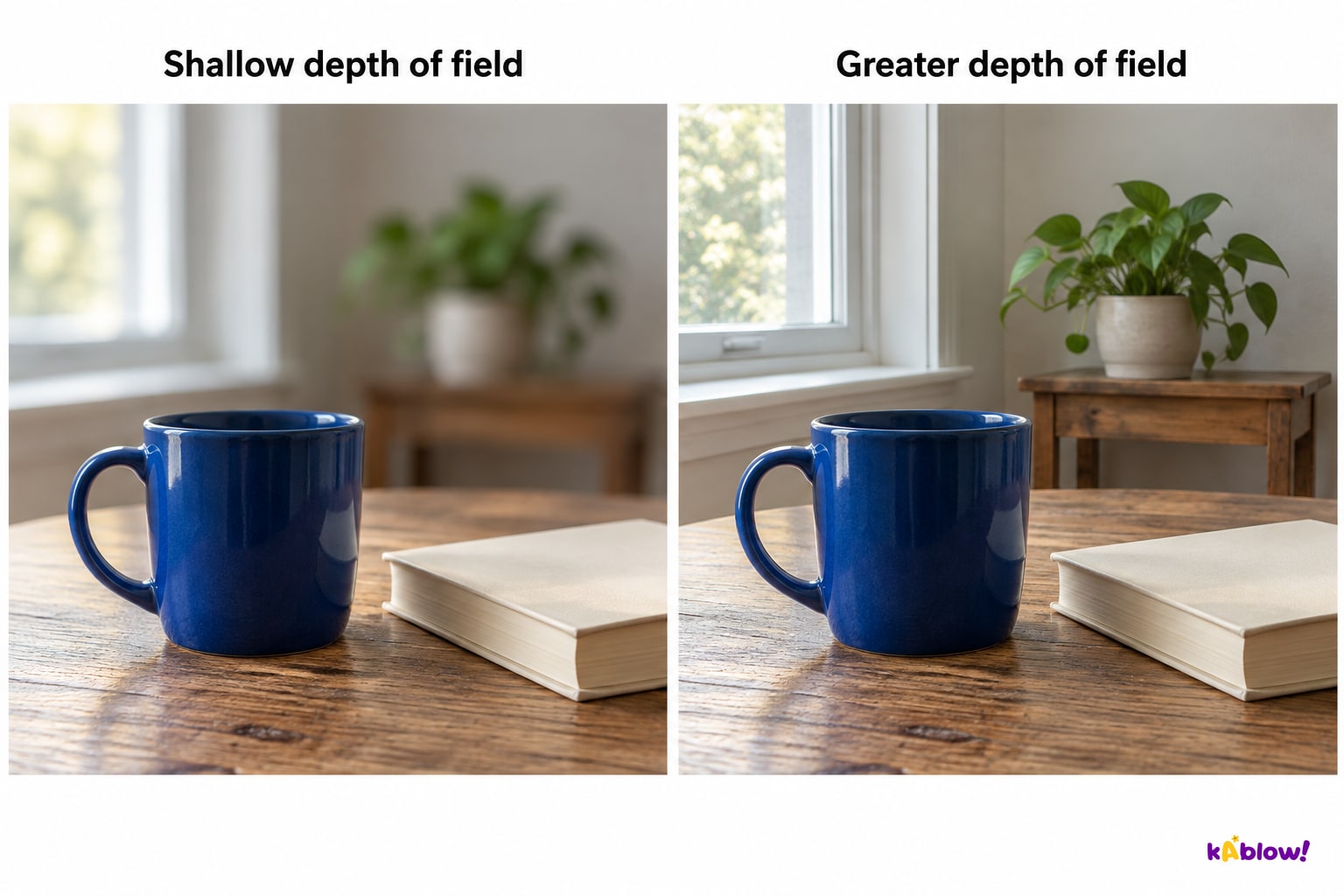
- Depth of field is the range of depth appearing acceptably sharp, not a synonym for a blurred background. The generated mug comparison illustrates shallow and greater apparent focus range without claiming real camera settings.
- Choose viewpoint, framing, leading lines and focus relationships for the intention. Genres may overlap: a portrait can be staged, abstracted or documentary, while landscape orientation is different from landscape subject matter.
Shallow and greater apparent focus range
Editing and digital work
- Preserve an original and use a working file with separate layers. Adjustments and masks can retain flexibility; flattening or exporting may discard some editable structure. Digital drawing, painting, montage and animation offer different possibilities.
- Cropping, tonal and colour changes, filters and compositing should serve a stated intention. Explain which changes were made and distinguish an openly constructed image from one presented as documentary evidence.
Preserve editing options
Selection and presentation
- Use a contact sheet to compare alternatives and explain the selected viewpoint, light, crop and focus. A series can be sequenced for meaning rather than simply arranged by filename.
- Choose suitable pixel dimensions and output for the intended print or display. Cropping discards pixels; a larger file-size alone does not prove greater sharpness or a better image. Retain the original and editable working version.
Review and present deliberately
Respectful project practice
- Agree participation and intended use for a class portrait, respecting the participant’s wishes and school process. State whether work is staged, edited or generated when relevant to its interpretation.
- Check permissions for source material and credit contributions. A credit alone does not grant reuse permission. For documentary claims, context, captions, framing and content changes affect how viewers judge the evidence.
Explain the image’s status
Camera settings and noise
- Aperture is the lens opening and contributes to depth of field; smaller f-numbers generally mean larger openings under comparable conditions. Shutter speed is exposure duration and affects motion blur. Lens and focus distance also influence apparent focus range.
- Digital ISO changes signal gain or brightness interpretation rather than admitting more light when aperture and time are fixed. Digital noise is brightness/colour variation, often more visible with low collected light and strong brightness processing. It is distinct from physical film grain.
Separate the setting roles
Light, negative and constructed images
- Backlight is behind the subject relative to the camera and can produce a silhouette or rim, depending on exposure and fill. Side light can show form; low-angle golden-hour conditions vary rather than last an exact universal hour.
- A conventional negative reverses tonal relationships compared with a positive; colour negatives encode colours differently too. Not every film image is a negative, because reversal film produces positives. Photomontage combines photographic elements physically or digitally.
Practitioners and context
- Dorothea Lange’s Migrant Mother is from a 1936 series of Florence Owens Thompson and her children. Ansel Adams is particularly associated with landscapes and conservation. Henri Cartier-Bresson’s Images à la sauvette was published in English as The Decisive Moment.
- Cindy Sherman uses herself to stage constructed characters and representations rather than simple autobiographical self-portraits. Study particular works and their context; the generated still life is not a reproduction of any named practitioner’s artwork.
Use a contextual practitioner reference
Slide
Sign up free to view the lesson slides
Step through every slide for this topic — plus flashcards and revision notes — with a free account.
Câu hỏi luyện tập
Xem trước miễn phí — 8 trên 33 câu hỏi. Đăng ký để xem tất cả.
1.What is photography?
Easy- Amaking images using light
- Bpainting
- Csculpting
- Dprinting
2.What is a portrait?
Easy- Aan image defined only by horizontal orientation
- Ba label meaning every object is in focus
- Ca file type that prevents editing
- Dan image presenting a person or group as its main subject
3.What is a landscape photograph?
Easy- Aan image that cannot include a person
- Ban image that cannot be abstracted
- Can image concerned with scenery or an environment
- Dany image only because it is wider than tall
4.What is a still life?
Easy- Aa portrait
- Ban arrangement of objects
- Can action shot
- Da crowd
5.What is cropping?
Easy- Aremoving outer parts to change the image’s framing
- Badding colour
- Cprinting
- Dframing
6.What does aperture control?
Easy- Ashutter length
- Bfilm speed
- Czoom
- Dthe lens opening, affecting light passage and depth of field with other factors
7.What does shutter speed control?
Easy- Acolour
- Bprint size
- Cthe exposure duration over which light is recorded
- Dfocus only
8.In basic digital-camera use, what does the ISO setting mainly change?
Easy- Azoom
- Bhow the recorded signal is amplified or interpreted for image brightness
- Cfocus
- Dcolour
Unlock all 33 questions & more
Tạo tài khoản miễn phí để xem mọi câu hỏi, slide, thẻ ghi nhớ và ghi chú ôn tập cho chủ đề này.
Đề thi cũ
Luyện đề thi cũ cho chủ đề này sắp ra mắt.
Sắp ra mắt