
Sorting algorithms: bubble, insertion and merge sort
Học bằng cách chơi
Trả lời những câu hỏi này để kiếm năng lượng, rồi câu cá và khám phá. Không cần tài khoản.
Dành cho nhà giáo dục: slide bài học, ghi chú ôn tập sẵn dùng cho Sorting algorithms: bubble, insertion and merge sort (Computer Science, Algorithms) — dùng trong bài giảng của bạn, hoặc chạy chủ đề như một hoạt động lớp học tương tác để người học chơi như một trò chơi trực tiếp.
Ghi chú bài học
Why sort?
- Sorted data is easier to search (binary search) and to display. Sorting algorithms put items in order (ascending or descending).
Bubble sort
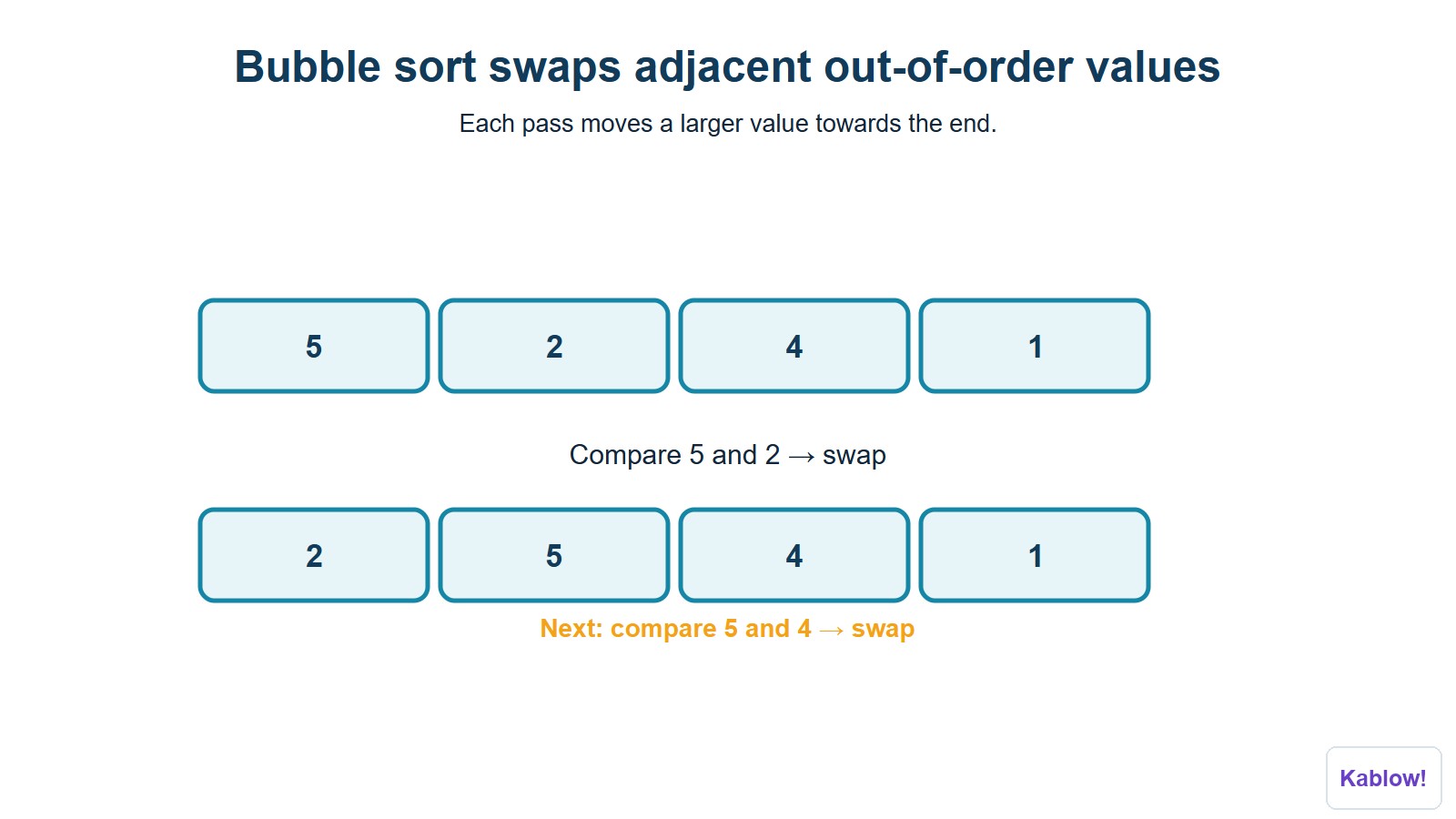
- Repeatedly compare adjacent pairs and swap them if they are in the wrong order. After each pass the largest unsorted item "bubbles" to the end. Stop when a complete pass makes no swaps.
- Example: 5, 2, 4 → compare 5 and 2, swap: 2, 5, 4 → compare 5 and 4, swap: 2, 4, 5. A further pass has no swaps, so it stops.
- Simple but slow for large lists.
Bubble sort
Insertion sort
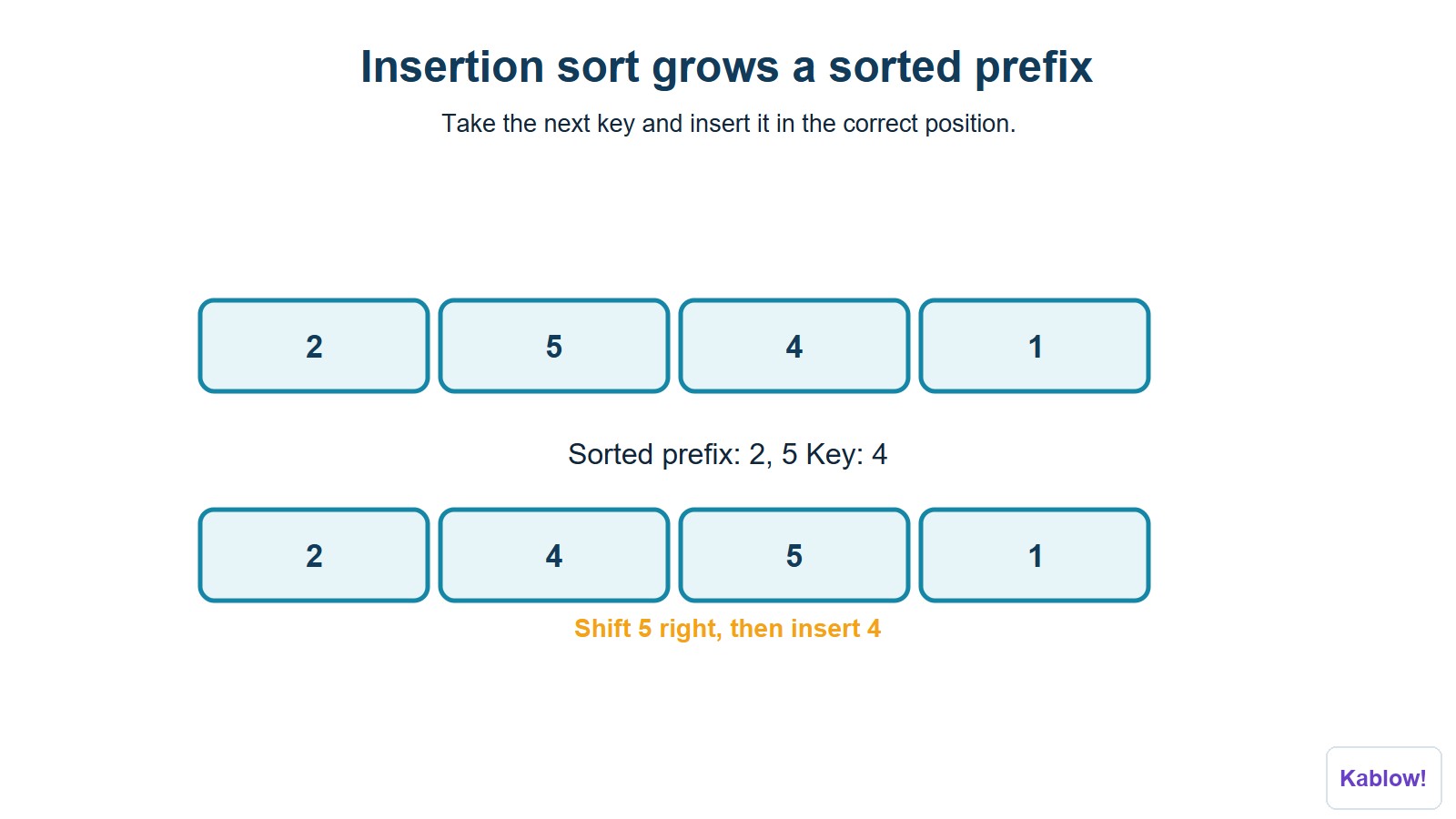
- Treat the first item as sorted. Take the next item and insert it into the correct position among the sorted items by shifting larger items right. Repeat until all items are sorted.
- Efficient for small or nearly sorted lists.
Insertion sort
Merge sort
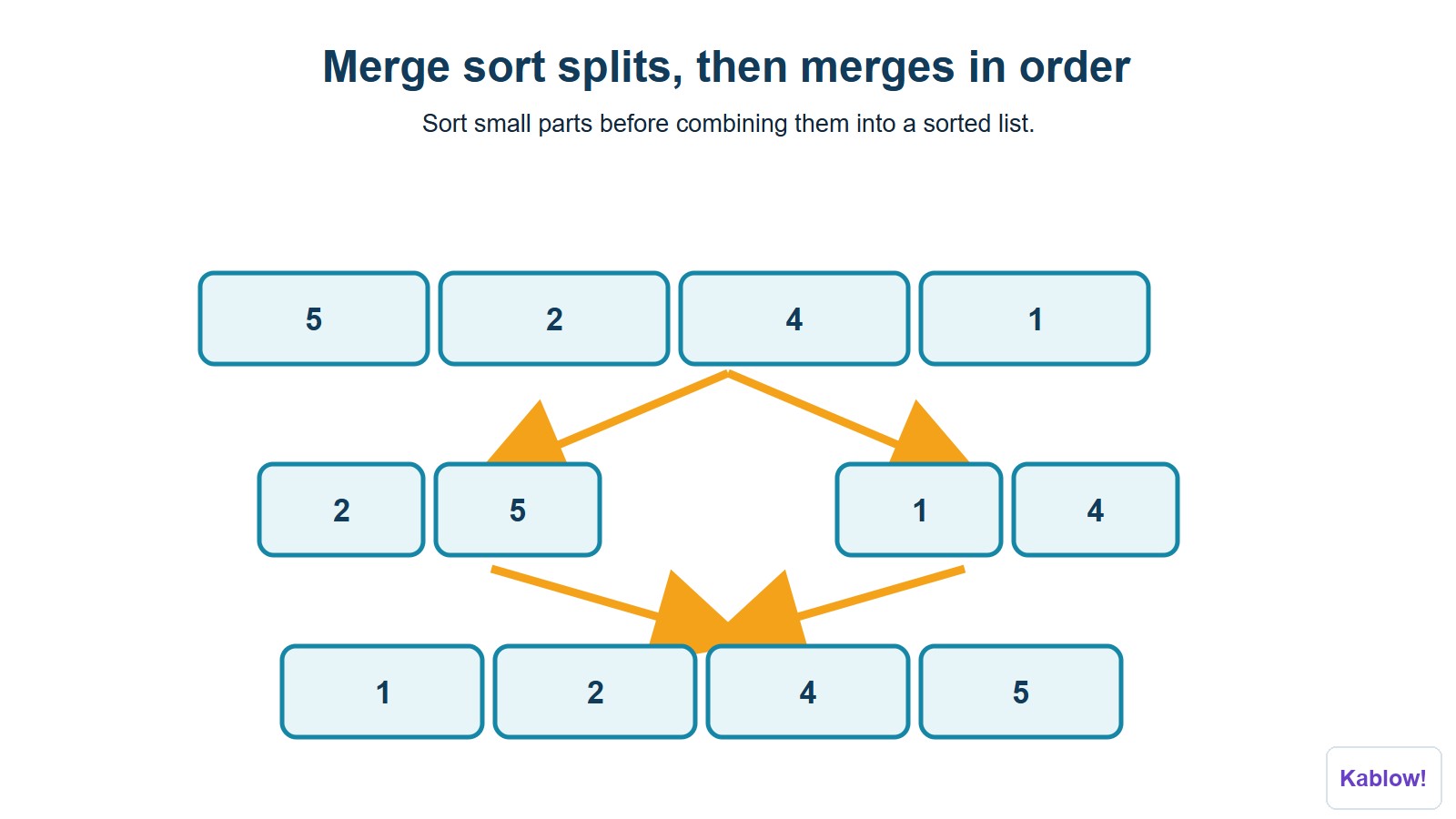
- A divide and conquer algorithm: split the list into halves repeatedly until each part has one item, then merge the parts back together in order.
- Much faster for large lists but uses more memory, and it is more complex.
Merge sort
Comparing
- Bubble: simple, slow. Insertion: good for small lists. Merge: fast, memory-hungry.
Slide
Sign up free to view the lesson slides
Step through every slide for this topic — plus flashcards and revision notes — with a free account.
Câu hỏi luyện tập
Xem trước miễn phí — 8 trên 33 câu hỏi. Đăng ký để xem tất cả.
1.What is a sorting algorithm?
Easy- Aone that puts data into order
- Bone that finds data
- Cone that deletes data
- Done that copies data
2.What does bubble sort compare?
Easy- Aadjacent items
- Bfirst and last
- Crandom items
- Dmiddle items
3.What happens if two adjacent items are in the wrong order in bubble sort?
Easy- Athey are swapped
- Bthey are deleted
- Cthey are merged
- Dthey are ignored
4.What does insertion sort do with each new item?
Easy- Ainserts it into the correct place in the sorted part
- Bswaps it with the last
- Cdeletes it
- Dmerges it
5.What is merge sort based on?
Easy- Adivide and conquer
- Bswapping neighbours
- Csearching
- Dhashing
6.One left-to-right pass of ascending bubble sort on 4, 2, 5, 1 gives:
Easy- A2, 4, 1, 5
- B1, 2, 4, 5
- C4, 2, 5, 1
- D5, 4, 2, 1
7.Which value reaches its final position after the first left-to-right pass of ascending bubble sort?
Easy- Athe largest
- Bthe smallest
- Cthe middle
- Dthe first
8.What is a 'pass'?
Easy- Aone complete run through the list
- Bone swap
- Cone comparison
- Done item
Unlock all 33 questions & more
Tạo tài khoản miễn phí để xem mọi câu hỏi, slide, thẻ ghi nhớ và ghi chú ôn tập cho chủ đề này.
Đề thi cũ
Luyện đề thi cũ cho chủ đề này sắp ra mắt.
Sắp ra mắt