
Networks, topologies and protocols
Học bằng cách chơi
Trả lời những câu hỏi này để kiếm năng lượng, rồi câu cá và khám phá. Không cần tài khoản.
Dành cho nhà giáo dục: slide bài học, ghi chú ôn tập sẵn dùng cho Networks, topologies and protocols (Computer Science, Networks and Security) — dùng trong bài giảng của bạn, hoặc chạy chủ đề như một hoạt động lớp học tương tác để người học chơi như một trò chơi trực tiếp.
Ghi chú bài học
Types of network
- LAN (local area network): covers a small area (building); owned by the organisation. WAN (wide area network): covers a large area (the Internet is the largest WAN); uses third-party links.
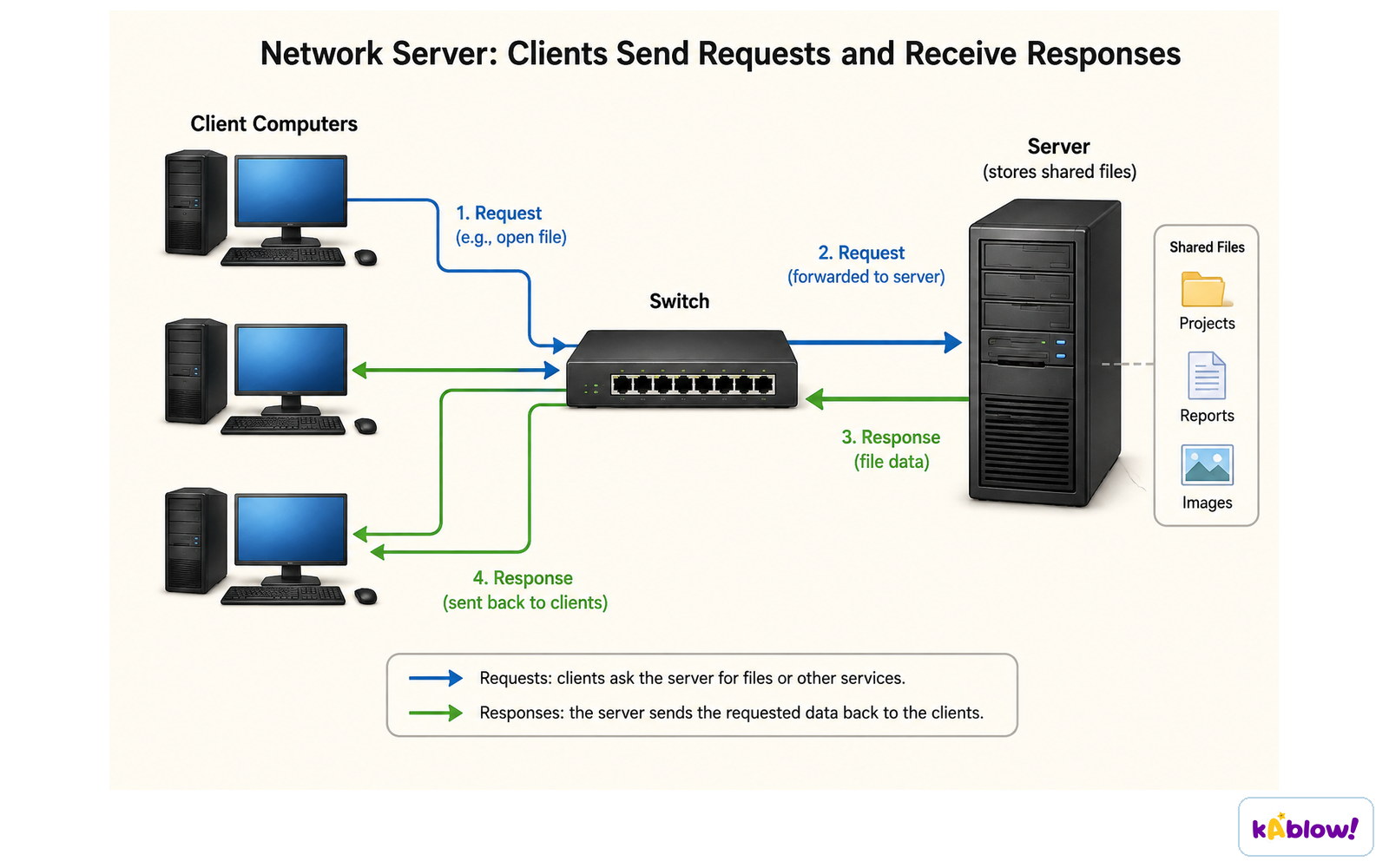
- Client-server: a central server provides services (files, web, email) to clients; easier to manage and secure. Peer-to-peer: each computer shares resources equally; cheap, but harder to manage and less secure.
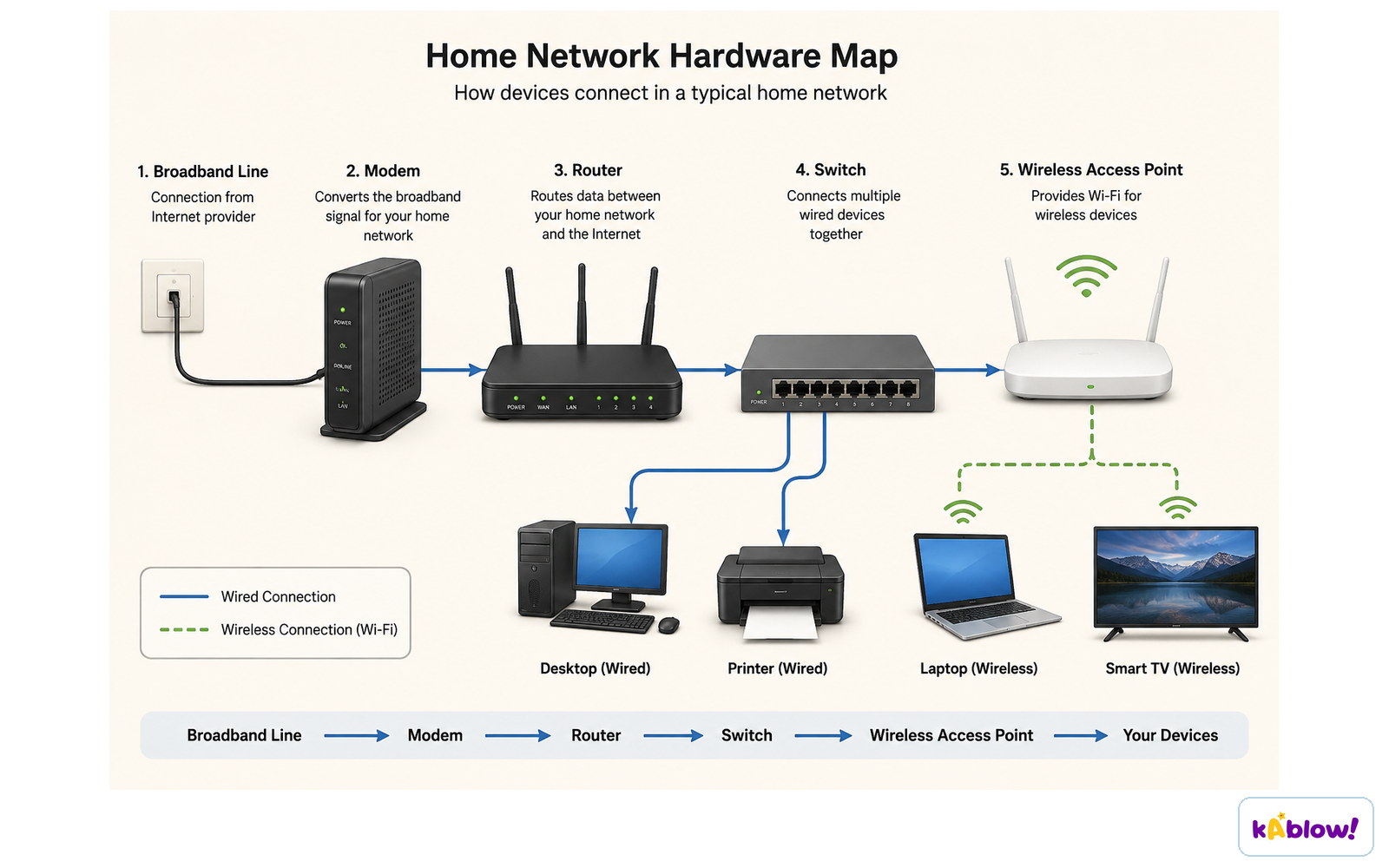
A home local-area network
Hardware
- NIC (network interface card), router (connects networks and directs data), switch (connects devices in a LAN), wireless access point (WAP), modem, cables (copper, fibre optic) or wireless.
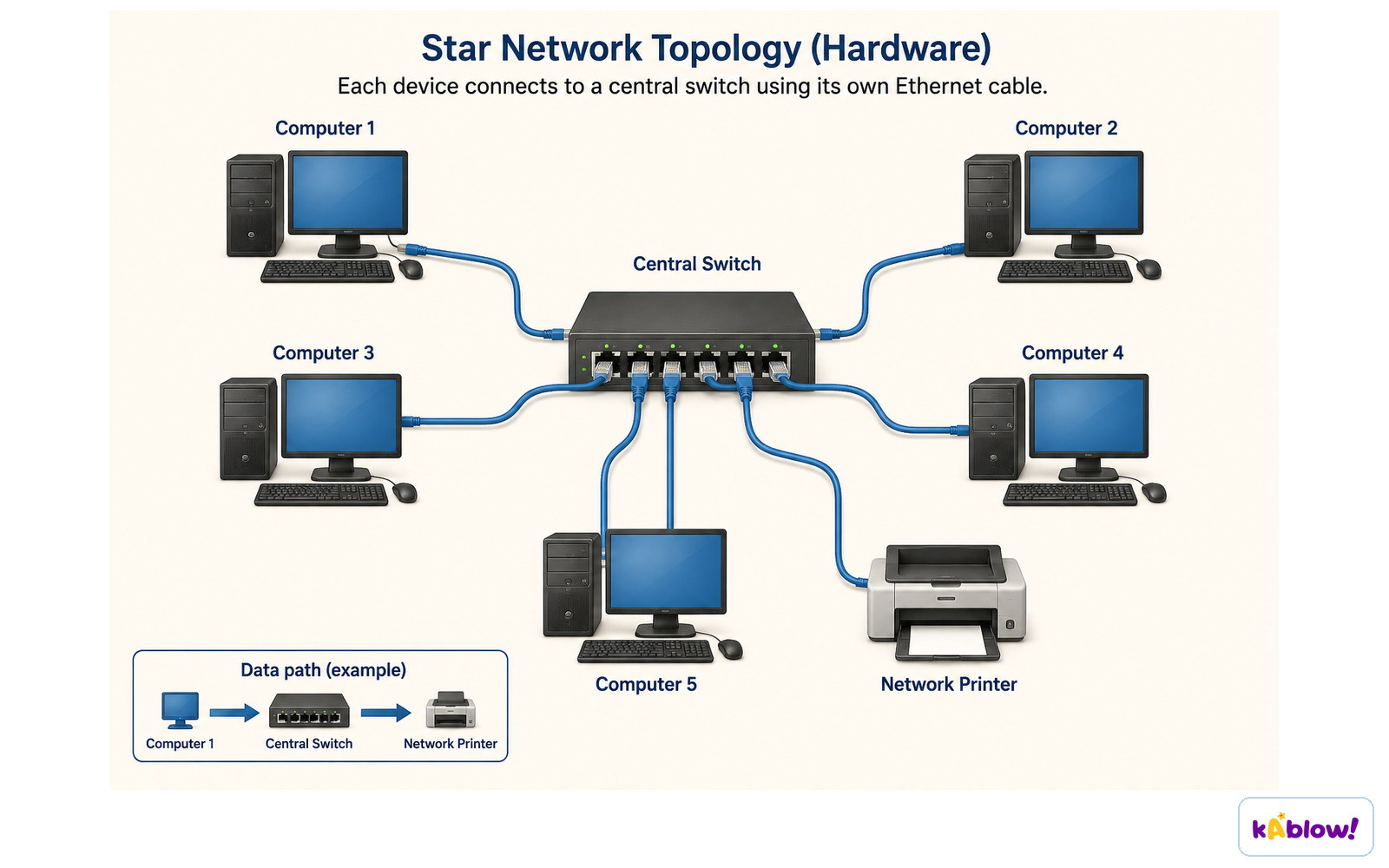
A central switch in a star LAN
Topologies
- Star: all devices connect to a central switch; if one cable fails, others work; the switch is a single point of failure; popular.
- Mesh: devices connect to many others; very reliable but costly.
Addresses
- An IP address identifies a network interface for routing and communication; IPv6 offers a much larger address space than IPv4.
- A MAC address identifies an interface on a local link. It may be manufacturer-assigned or locally assigned/randomised; it is not an infallible permanent identity.
- DNS resolves domain names to associated records, including IP addresses.
Protocols and layers
- A protocol defines communication rules. HTTP/HTTPS serve the Web, SMTP sends email, IMAP/POP access mail, and FTP is specifically named for file transfer. HTTP can transfer files too.
- HTTPS uses TLS to protect HTTP traffic in transit and authenticate the server; it does not guarantee that a site’s contents are trustworthy.
- IP forwards packets between networks. TCP can provide ordered reliable delivery, including recovery of missing data; not every protocol retransmits packets.
Client requests and server responses
Slide
Sign up free to view the lesson slides
Step through every slide for this topic — plus flashcards and revision notes — with a free account.
Câu hỏi luyện tập
Xem trước miễn phí — 8 trên 34 câu hỏi. Đăng ký để xem tất cả.
1.What does LAN stand for?
Easy- Alocal area network
- Blarge area network
- Clong access network
- Dlinked area node
2.What does WAN stand for?
Easy- Awide area network
- Bweb area network
- Cwired area network
- Dwireless area node
3.What is a router?
Easy- Aa device that connects networks and directs data
- Ba storage device
- Ca printer
- Da monitor
4.What is a switch?
Easy- Aconnects devices in a LAN
- Bconnects networks
- Cstores data
- Dencrypts data
5.What is an IP address?
Easy- Aidentifies a device on a network
- Ba hardware ID
- Ca website name
- Da password
6.What is a MAC address?
Easy- Aan address identifying a network interface on a local link
- Ba website domain name
- Can email message
- Da password
7.What is a protocol?
Easy- Aa set of rules for communication
- Ba type of cable
- Ca device
- Da program
8.Which protocol is used to send email?
Easy- ASMTP
- BHTTP
- CFTP
- DIMAP
Unlock all 34 questions & more
Tạo tài khoản miễn phí để xem mọi câu hỏi, slide, thẻ ghi nhớ và ghi chú ôn tập cho chủ đề này.
Đề thi cũ
Luyện đề thi cũ cho chủ đề này sắp ra mắt.
Sắp ra mắt