
Subprograms: functions and procedures
Học bằng cách chơi
Trả lời những câu hỏi này để kiếm năng lượng, rồi câu cá và khám phá. Không cần tài khoản.
Dành cho nhà giáo dục: slide bài học, ghi chú ôn tập sẵn dùng cho Subprograms: functions and procedures (Computer Science, Programming) — dùng trong bài giảng của bạn, hoặc chạy chủ đề như một hoạt động lớp học tương tác để người học chơi như một trò chơi trực tiếp.
Ghi chú bài học
Why subprograms?
- A subprogram is a named block of code that does a specific job. They make programs modular, easier to read, test, reuse and maintain, and support team development.
Calling a reusable subprogram
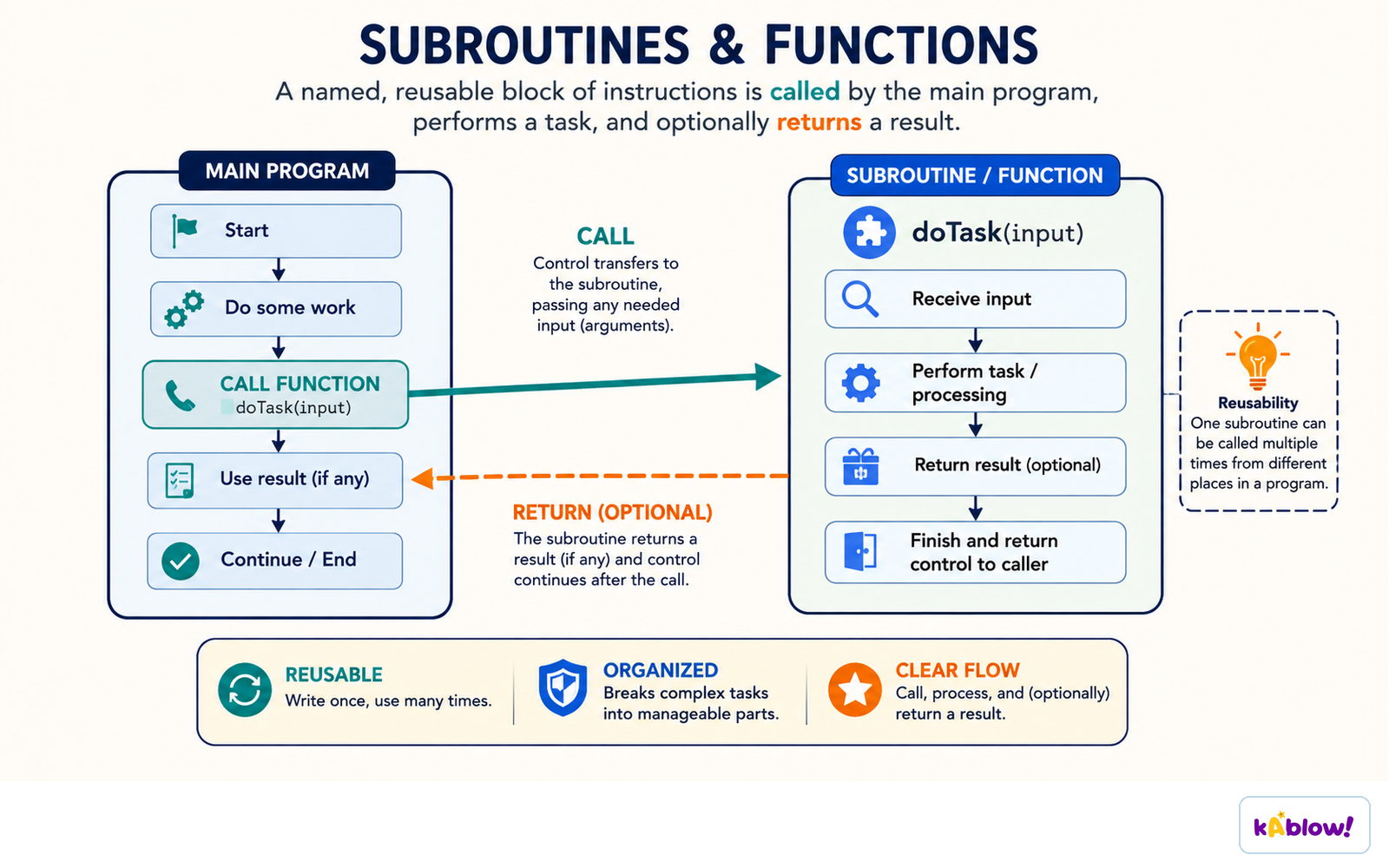
Procedures and functions
- A procedure performs actions but does not return a value to the caller.
- A function returns a value: RETURN result.
- Example: FUNCTION area(w, h) RETURN w×h ENDFUNCTION. Call: x = area(3, 4) gives 12.
Parameters and arguments
- Parameters are variables in the definition (w, h); arguments are values passed when calling (3, 4). Parameters make subprograms flexible.
Definition and call
Scope
- Scope describes where a name can be accessed. A local variable or parameter is accessible within its local scope; a global name has wider program scope under this lesson’s model.
- Scope is different from lifetime. Prefer local variables and explicit parameters to reduce unintended changes to shared state.
Names and scope
Structured programming
- Use sequence, selection and iteration to organise control flow. Divide a complex solution into focused subprograms with clear interfaces.
- A main program can call subprograms; those subprograms may call others.
Library routines
- A library routine is a prewritten reusable subprogram provided by a library; some are built into the language environment.
- Using a tested routine can save implementation time, but check its parameters, return value and assumptions.
Slide
Sign up free to view the lesson slides
Step through every slide for this topic — plus flashcards and revision notes — with a free account.
Câu hỏi luyện tập
Xem trước miễn phí — 8 trên 33 câu hỏi. Đăng ký để xem tất cả.
1.What is a subprogram?
Easy- Aa named block of code that does a job
- Ba variable
- Ca loop
- Dan input
2.In a function, what does RETURN followed by an expression do?
Easy- Asends a value back to the caller
- Bends the program
- Ccreates a loop
- Dprints
3.What is a procedure?
Easy- Aa subprogram that does not return a value
- Ba subprogram that returns a value
- Ca variable
- Da loop
4.What is a parameter?
Easy- Aa variable in a subprogram definition
- Ba value passed in
- Ca loop
- Da function
5.What is an argument?
Easy- Aa value passed to a subprogram
- Ba variable in the definition
- Can error
- Da loop
6.Why use subprograms?
Easy- Ato reuse code and make programs easier to maintain
- Bto slow programs
- Cto add errors
- Dto avoid variables
7.What is a local variable?
Easy- Aone accessible only within its local scope
- Bone accessible everywhere
- Cone that must be constant
- Done that must control a loop
8.What is a global variable?
Easy- Aone accessible throughout the program
- Bone inside a subprogram
- Cone that never changes
- Da loop
Unlock all 33 questions & more
Tạo tài khoản miễn phí để xem mọi câu hỏi, slide, thẻ ghi nhớ và ghi chú ôn tập cho chủ đề này.
Đề thi cũ
Luyện đề thi cũ cho chủ đề này sắp ra mắt.
Sắp ra mắt