
Selecting materials and their working properties
Học bằng cách chơi
Trả lời những câu hỏi này để kiếm năng lượng, rồi câu cá và khám phá. Không cần tài khoản.
Dành cho nhà giáo dục: slide bài học, ghi chú ôn tập sẵn dùng cho Selecting materials and their working properties (Design and Technology, Core Technical Principles) — dùng trong bài giảng của bạn, hoặc chạy chủ đề như một hoạt động lớp học tương tác để người học chơi như một trò chơi trực tiếp.
Ghi chú bài học
Properties of materials
- Physical properties include density, conductivity, absorbency and melting behaviour. Density is mass divided by volume, so it does not alone state the mass of an object. Fusibility concerns melting under heat; a material may soften, melt over a range or degrade, depending on its structure.
- Mechanical properties describe behaviour under loading. Strength concerns a stated yield or fracture limit; stiffness concerns resistance to elastic deformation; hardness concerns local indentation or scratching; toughness concerns energy absorbed before fracture. These are distinct properties, so a hard material can still be brittle.
- Ductility supports permanent deformation under tension, as in wire drawing. Malleability supports permanent shaping under compression, as in rolling. Elasticity means recovery after unloading within limits; brittleness means relatively little plastic deformation before fracture, not literally zero elastic movement.
- Corrosion resistance concerns interaction with the environment rather than a mechanical loading mode. Rust specifically concerns iron corrosion. A material that does not rust may still corrode or degrade by a different mechanism.
Keep mechanical properties distinct
Choosing the right material
- Translate the function into material and product requirements, then compare candidate grades and constructions. Suitable copper can provide a ductile conductor; selected tool steels can provide hard cutting edges; transparent acrylic can be a display or model candidate; a selected timber species can provide appearance and structural performance. None of these names alone is a complete specification.
- A product property also depends on geometry, joints, finishes, tolerances and manufacturing quality. A water-resistant polymer enclosure may leak through an opening; a low-density material can still give a heavy object if its volume is large. Link each reason to the actual application and identify evidence still needed.
Link selection to the product
Stock forms and sizes
- Stock forms are shapes supplied for manufacture, such as sheet, bar, rod, tube, plank, roll and pellets. Availability depends on material and grade. Rod commonly identifies solid circular stock, while tube is hollow; a bar can have different solid sections.
- Specify grade, nominal dimensions, permitted variation and any process allowance. For example, 2 mm sheet identifies a nominal thickness, not an assurance that every measured point is exactly 2.000 mm or suitable for every design.
Describe the supplied stock
Other considerations
- Include production quantity, process capability, cost, supply, appearance, maintenance and useful life. Recyclability depends on a practical collection and recovery route as well as the material. Compare relevant alternatives for the same required function.
- A tolerance is permitted variation around a specified target. For 20.0 ± 0.2 mm, the inclusive limits are 19.8 and 20.2 mm. Parts must also satisfy other required dimensions and conditions; this one tolerance alone does not establish a whole assembly fit.
One dimension with a stated tolerance
Worked density comparison
- The table uses invented teaching specimens, not measured material grades. A has mass 54 g and volume 20 cm³, giving density 54 ÷ 20 = 2.7 g/cm³. B has mass 27 g and volume 10 cm³, giving the same density.
- C has mass 20 g and volume 20 cm³, giving density 1.0 g/cm³. A and C have equal volume, so their masses can be compared directly from density. A and B instead show that different total masses can belong to the same density.
Invented specimens: density = mass / volume
Test the selected construction
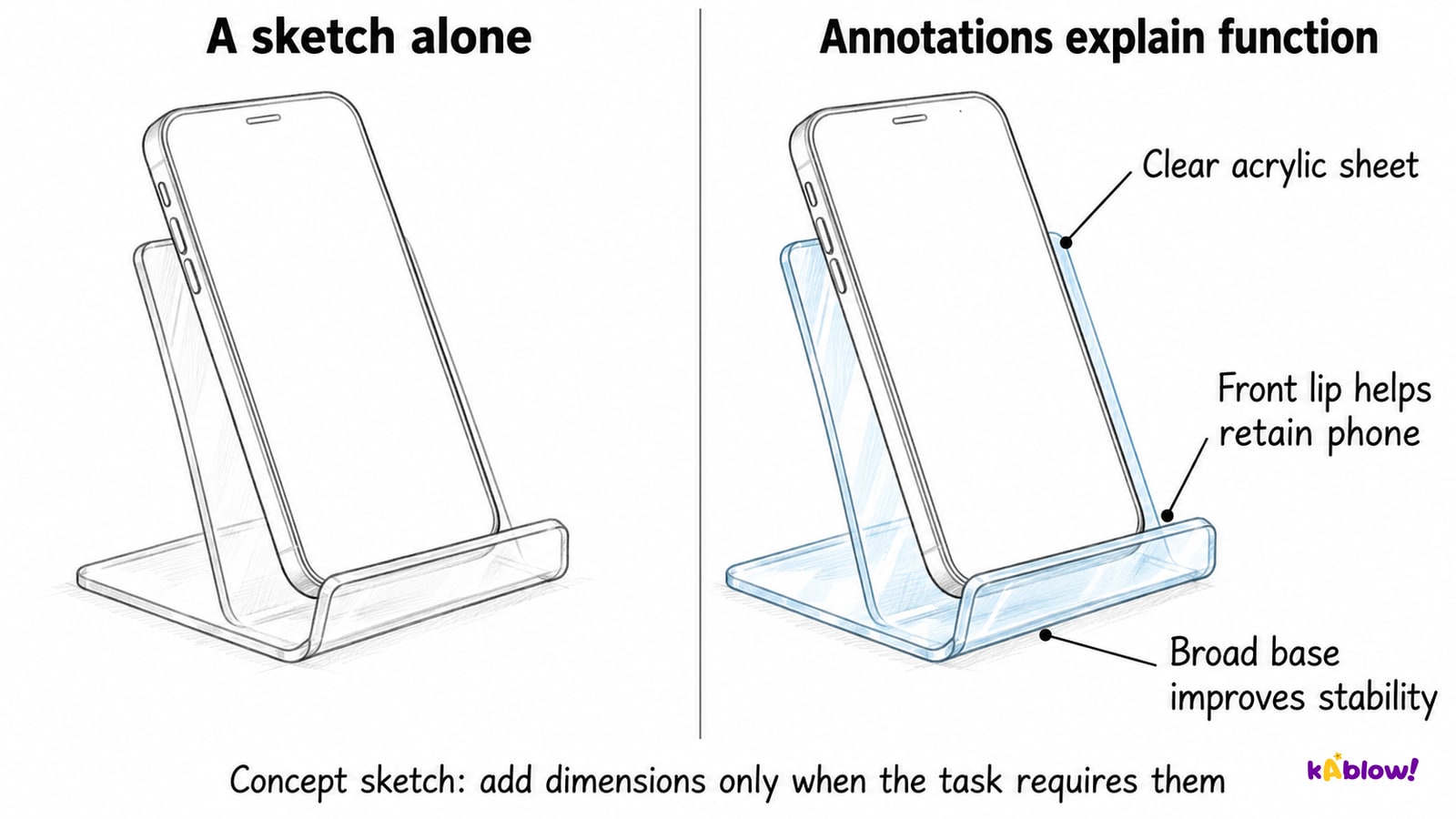
- The phone-stand illustration communicates an acrylic-sheet concept with a retaining lip and broad base. It contains no tested dimensions or verified strength, stability or impact performance. Use the required phone size, loading, environment and manufacture to plan suitable checks.
- A justified selection names the requirement, explains why a relevant property supports it, and acknowledges a trade-off or unresolved check. Avoid treating a material family, a price or one attractive property as sufficient proof.
A material proposal needs evidence
Slide
Sign up free to view the lesson slides
Step through every slide for this topic — plus flashcards and revision notes — with a free account.
Câu hỏi luyện tập
Xem trước miễn phí — 8 trên 33 câu hỏi. Đăng ký để xem tất cả.
1.What is density?
Easy- Amass per unit volume
- Bhardness
- Cstrength
- Dcolour
2.What is strength?
Easy- Aability to be drawn into wire
- Bcolour
- Cshine
- Dability to withstand a specified stress before a stated failure or yield limit
3.What is toughness?
Easy- Aability to bend
- Bability to melt
- Cability to absorb energy before fracturing
- Dresistance to scratching
4.What is malleability?
Easy- Aresistance to heat
- Bability to be hammered into shape
- Cability to be drawn into wire
- Dresistance to scratching
5.What is elasticity?
Easy- Arecovery after unloading within the elastic range
- Bto break
- Cto melt
- Dto rust
6.What is corrosion?
Easy- Ascratching
- Bheating
- Cstretching
- Dgradual damage of metal by chemical reaction
7.Why is ordinary brittle glass unsuitable for an impact hammer head?
Easy- Ait is ductile
- Bit is elastic
- Cit is brittle
- Dit is tough
8.Which material has high thermal conductivity?
Easy- Afoam
- Bcopper
- Cpolystyrene
- Dwood
Unlock all 33 questions & more
Tạo tài khoản miễn phí để xem mọi câu hỏi, slide, thẻ ghi nhớ và ghi chú ôn tập cho chủ đề này.
Đề thi cũ
Luyện đề thi cũ cho chủ đề này sắp ra mắt.
Sắp ra mắt