
Systems approach and mechanical devices
Học bằng cách chơi
Trả lời những câu hỏi này để kiếm năng lượng, rồi câu cá và khám phá. Không cần tài khoản.
Dành cho nhà giáo dục: slide bài học, ghi chú ôn tập sẵn dùng cho Systems approach and mechanical devices (Design and Technology, Core Technical Principles) — dùng trong bài giảng của bạn, hoặc chạy chủ đề như một hoạt động lớp học tương tác để người học chơi như một trò chơi trực tiếp.
Ghi chú bài học
The systems approach
- The systems approach models interacting components through inputs, processing and outputs across a chosen boundary. Inputs can be information, energy or material. Feedback returns information about an output or resulting condition to influence control.
- For room-temperature control, measured temperature and a target setpoint inform the controller, which commands the heating. The room and its heat losses affect the resulting temperature; sensing it again closes the control loop. A controller command is not the same thing as heat energy itself.
Room heating: information and control
Types of motion
- Linear motion follows a straight path; rotary motion turns about an axis. Reciprocating motion repeats along a straight path, while oscillating motion in this mechanisms classification swings repeatedly about a pivot. These labels are useful descriptions rather than mutually exclusive rules for all physics.
- A guided piston is a reciprocating example, a rotating shaft is rotary, and a pendulum is oscillating. Random motion is also a meaningful broader scientific description; it is not one of the four mechanism categories emphasised here.
Four useful motion descriptions
Levers
- A lever turns about a fulcrum. Class 1 places the pivot between effort and load, as in a seesaw; class 2 places the load between them, as in a wheelbarrow; class 3 places effort between them, as in ordinary tweezers. Between does not mean equally spaced.
- Mechanical advantage = load force ÷ effort force. A 100 N load moved by a 25 N effort gives MA = 4. Velocity ratio = effort distance ÷ corresponding load distance; 20 cm ÷ 5 cm gives VR = 4. Both ratios are dimensionless. For the ideal model MA = VR; losses reduce useful output work.
Which element lies between the other two?
Linkages and cams
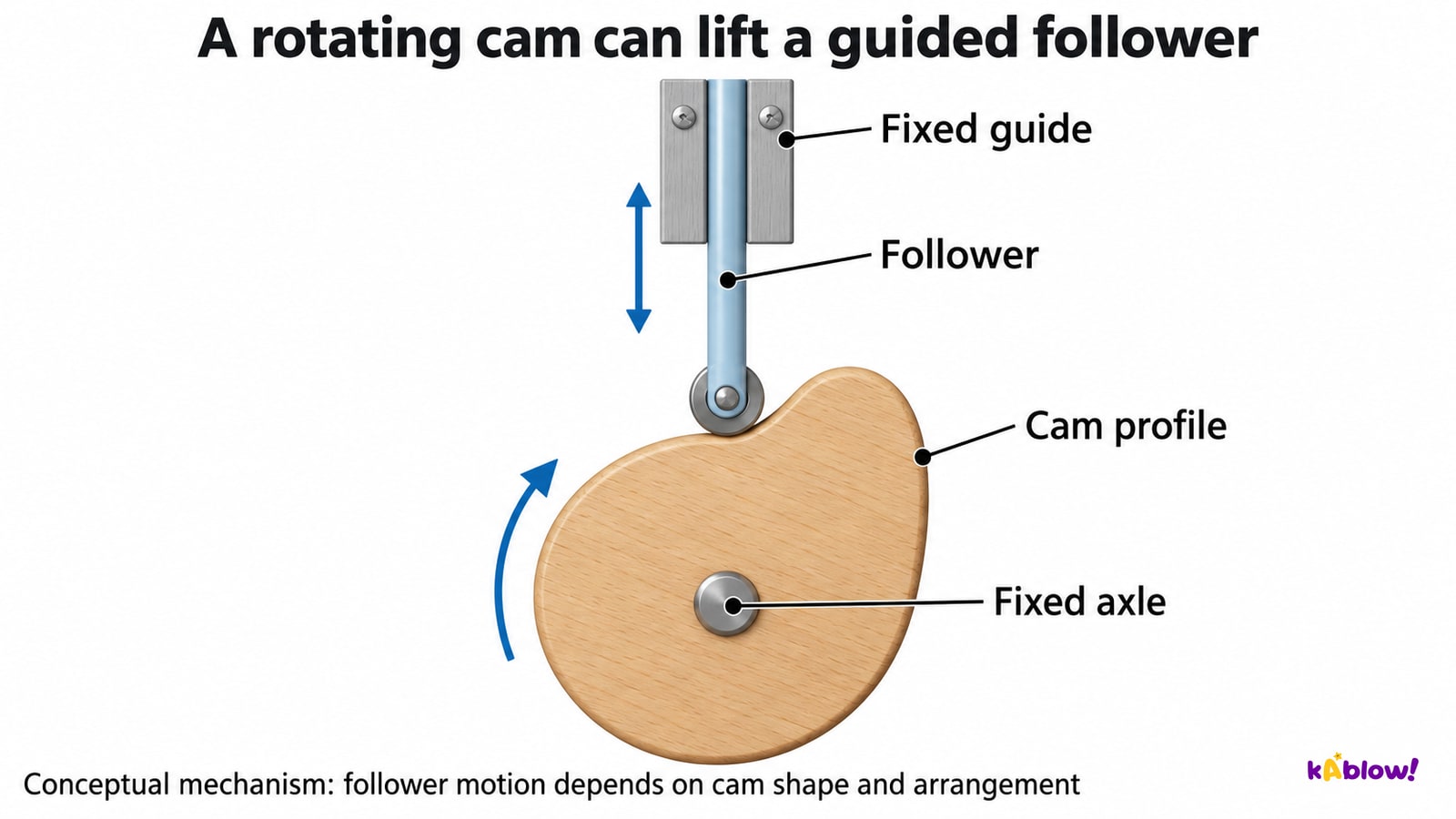
- A cam rotates while its profile drives a follower. A translating guide can give reciprocation; a pivoted follower can give oscillation. A concentric circular disc gives no varying lift in the simple translating arrangement, while an eccentric circular disc can. Follower speed need not be constant even at constant cam speed.
- The original illustration shows a roller contacting a profiled cam and a rod constrained by a fixed guide. It is conceptual, with gravity-loaded contact assumed at suitable low speed; it does not specify a measured lift law, operating speed or build dimensions. A spring or positive constraint may be needed in other arrangements.
- Linkages connect pivoted members to redirect or alter movement. A bell crank is an angled lever, often used to redirect a motion approximately through a right angle. A crank-and-slider can convert rotation and reciprocation, depending on how it is driven.
Cam and guided follower
Gears, pulleys and belts
- For the simple external pairs used here, ratio = driven teeth ÷ driver teeth and output speed = input speed ÷ ratio. A 15-tooth driver and 45-tooth driven gear give 3:1 and one-third output speed, with opposite rotation. A 40-tooth driver and 10-tooth output give 1:4 and four times output speed.
- Inserting one simple external idler between unchanged input and output gears changes direction relative to direct meshing while leaving their ideal speed ratio unchanged. This is different from a compound train with two different gears fixed on an intermediate shaft. Additional meshes can add losses.
- Speed reduction trades for greater ideal torque under a power balance, not energy creation. An open belt on parallel shafts normally preserves rotation direction, while a suitable crossed arrangement reverses it. Actual belt drives can slip and require a suitable belt and clearance.
- A worm and wormwheel can give large reduction; ratio depends on wheel teeth and worm starts. Not all worm drives are self-locking. An engaged ratchet and pawl resists one rotation direction; releasing it changes the constraint. Shafts and suitable torsional couplings can transmit torque.
Simple external pairs: stated ratio convention
Torque and useful work
- Torque is a turning moment, measured in N m. For one force, its magnitude is force multiplied by the perpendicular distance from the rotation axis. Calling it simply a force omits the distance and gives the wrong physical quantity.
- Useful output work cannot exceed input work for these passive mechanisms. A force or torque increase is accompanied by a movement or speed trade-off; friction and deformation reduce useful transfer. State the model and arrangement before applying a ratio.
Worked ratios for one teaching model
Slide
Sign up free to view the lesson slides
Step through every slide for this topic — plus flashcards and revision notes — with a free account.
Câu hỏi luyện tập
Xem trước miễn phí — 8 trên 33 câu hỏi. Đăng ký để xem tất cả.
1.What is a system?
Easy- Ainputs, processes and outputs
- Ba type of tool
- Ca material
- Da drawing
2.What is feedback?
Easy- Astopping a system
- Bchanging a material
- Cstarting a motor
- Dreturning output or condition information to influence control
3.What is linear motion?
Easy- Aswinging
- Bremaining stationary
- Cmovement in a straight line
- Dcircular movement
4.What is rotary motion?
Easy- Abouncing
- Bcircular movement
- Cstraight movement
- Dswinging
5.What is reciprocating motion?
Easy- Abackwards and forwards in a straight line
- Bcircular
- Cswinging
- Dvibrating
6.What is oscillating motion?
Easy- Amoving in a straight line
- Bspinning
- Crolling
- Dswinging back and forth about a point
7.Which is a class 1 lever?
Easy- Atweezers
- Bnutcracker
- Cseesaw
- Dwheelbarrow
8.Which is a class 2 lever?
Easy- Ascissors
- Bwheelbarrow
- Cseesaw
- Dtweezers
Unlock all 33 questions & more
Tạo tài khoản miễn phí để xem mọi câu hỏi, slide, thẻ ghi nhớ và ghi chú ôn tập cho chủ đề này.
Đề thi cũ
Luyện đề thi cũ cho chủ đề này sắp ra mắt.
Sắp ra mắt