
Papers, boards and textiles
Học bằng cách chơi
Trả lời những câu hỏi này để kiếm năng lượng, rồi câu cá và khám phá. Không cần tài khoản.
Ghi chú bài học
Papers and boards
- Grammage is mass per area, usually g/m² or gsm. Thickness is measured separately, often in micrometres (µm), with 1 µm = 0.001 mm. Paper and board can be described by both; there is no universal gsm threshold that predicts thickness or every product classification.
- Select paper for its surface and task: cartridge for drawing, suitable layout paper for development, translucent tracing paper, grid paper and appropriate marker paper. Grade and medium compatibility matter; bleed-resistant does not mean every ink is prevented from penetrating.
- Corrugated board has a fluted medium with liners; folding carton boards such as duplex grades support printed packaging. Foil-lined board adds a metallic layer for selected functions; foam-core board combines lightweight core and facing layers for models. The entire construction determines performance, food-contact suitability and recycling options.
- Worked measurements: 200 g/m² × 0.25 m² = 50 g for the stated sheet. A separate thickness of 250 µm equals 0.25 mm. Neither number alone determines the other, because density and structure can vary.
Separate the measurements and construction
Textile fibres
- Natural fibres include plant-derived cotton and linen and animal-derived wool and silk. Synthetic fibres include polyester, nylon, acrylic and elastane; regenerated viscose is made by processing cellulose. Fibre source is separate from yarn formation, fabric construction or finish.
- Suitable cotton fabrics can absorb moisture and feel soft; wool can contribute resilience and insulation; polyester can offer strength and relatively low moisture absorption; nylon can provide abrasion resistance. Grade, yarn and fabric affect performance, so do not infer waterproofness or ideal comfort from a fibre name alone.
- Blends such as polycotton target property combinations, but ratio and construction matter. Elastane can add stretch and recovery. Discuss compromises, care and the available end-of-life route, since mixing fibres can complicate some recycling processes.
Fibre source is not fabric structure
Fabric construction
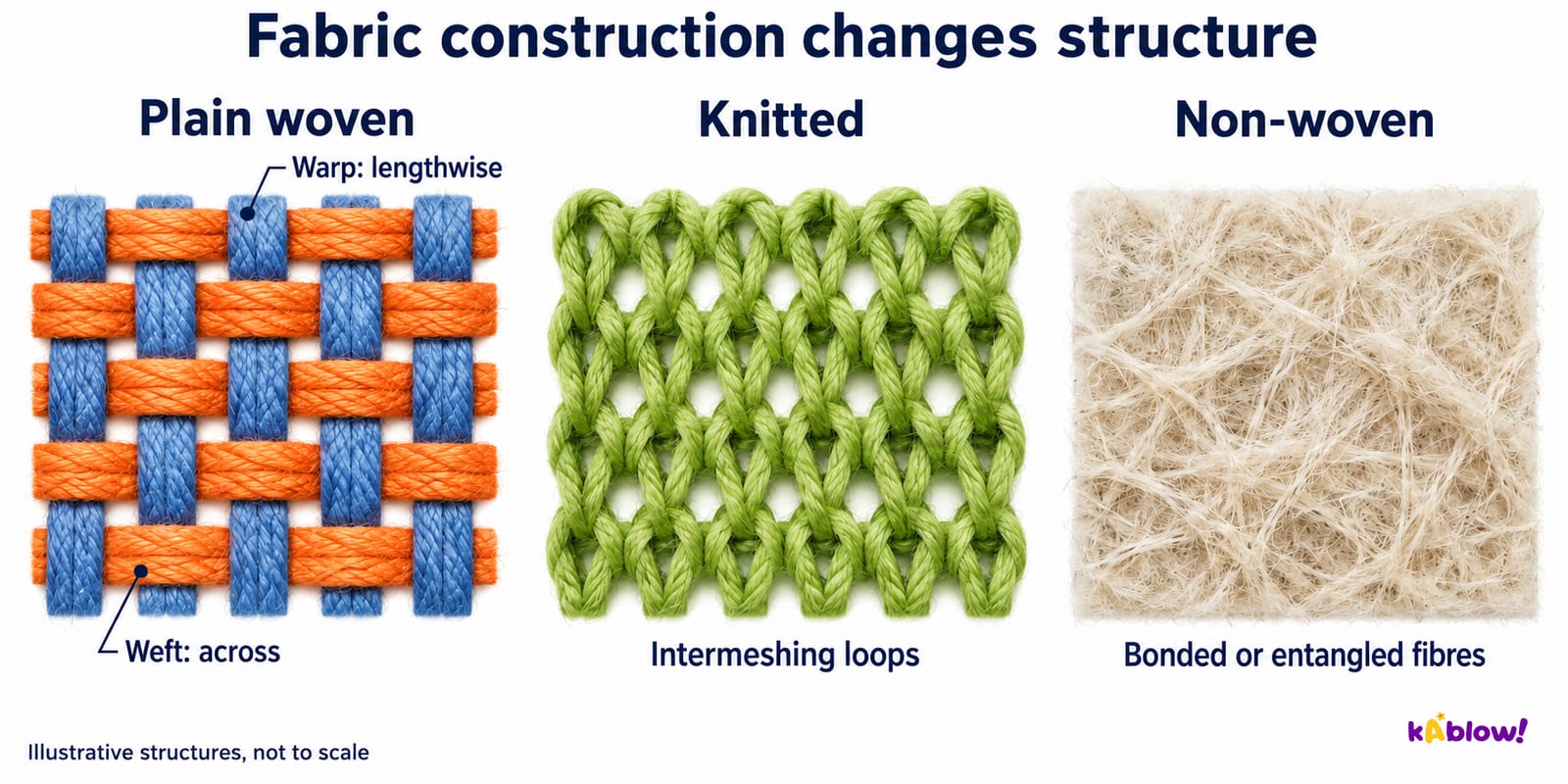
- Woven fabric interlaces lengthwise warp and across-width weft yarns. Plain weave alternates over one and under one, with each adjacent warp following the opposite sequence. Twill and satin use different interlacings. The original illustration shows a simple plain weave rather than a universal pattern for every woven textile.
- Knitted fabric intermeshes loops. Many knits can stretch as loops change shape, but structure, direction, fibre and finishing affect the outcome; woven fabric can also stretch, for example with elastane or along the bias.
- Nonwovens bond or entangle fibres rather than forming a regular woven grid or knitted loop structure. Felt is an example and need not use only one fibre type. The original magnified illustration is schematic, not a microscope image or a measured stretch comparison.
Fabric construction changes structure
Finishes and sustainability
- Finishes can alter handling, appearance or function, including water repellency, crease resistance or specified flame-retardant performance. Water-repellent does not automatically mean waterproof; a flame-retardant treatment is not a fireproof guarantee. Care, wear and construction affect lasting performance.
- An organic fibre claim and a certified processing standard have different scopes. Relevant standards can restrict inputs, but organic must not be taught as chemical-free, universally harmless or necessarily the lowest impact in every category. Recycled content likewise does not guarantee that the mixed, coated final product is recyclable.
- Consider durability, repair, actual wear, washing, drying, supply-chain conditions and waste. Synthetic textiles can shed plastic microfibres during manufacture, use or care. Compare relevant evidence and feasible collection routes rather than choosing solely from a natural, recycled or fashion label.
Test the scope of a sustainability claim
Slide
Sign up free to view the lesson slides
Step through every slide for this topic — plus flashcards and revision notes — with a free account.
Câu hỏi luyện tập
Xem trước miễn phí — 8 trên 35 câu hỏi. Đăng ký để xem tất cả.
1.What does gsm stand for?
Easy- Agrams per square metre
- Bgreat sheet material
- Cgeneral standard measure
- Dgram sheet mass
2.Which is a natural fibre?
Easy- Apolyester
- Bnylon
- Cacrylic
- Dcotton
3.Which paper is translucent for copying designs?
Easy- Anewsprint
- Bgrid
- Ctracing paper
- Dcartridge
4.Which is a synthetic fibre?
Easy- Alinen
- Bpolyester
- Cwool
- Dsilk
5.What is a blended fabric?
Easy- Aone made from two or more fibre types
- Bone made from one fibre
- Ca knitted fabric
- Da non-woven felt
6.Which is a common folding-carton board type used for packaging such as cereal boxes?
Easy- Afoam core
- Bcorrugated only
- Cmounting board
- Dduplex board
7.Which board type includes a metallic foil layer for selected packaging barrier functions?
Easy- Afoam core
- Btracing paper
- Cfoil-lined board
- Dgrey board
8.Which construction often stretches through deformation of intermeshing loops?
Easy- Anone
- Bknitted
- Cwoven
- Dfelt
Unlock all 35 questions & more
Tạo tài khoản miễn phí để xem mọi câu hỏi, slide, thẻ ghi nhớ và ghi chú ôn tập cho chủ đề này.