
Climate change: causes, evidence and responses
Học bằng cách chơi
Trả lời những câu hỏi này để kiếm năng lượng, rồi câu cá và khám phá. Không cần tài khoản.
Dành cho nhà giáo dục: slide bài học, ghi chú ôn tập sẵn dùng cho Climate change: causes, evidence and responses (Geography, Physical Geography) — dùng trong bài giảng của bạn, hoặc chạy chủ đề như một hoạt động lớp học tương tác để người học chơi như một trò chơi trực tiếp.
Ghi chú bài học
Evidence for climate change
- Climate evidence combines instrumental records, ocean and ice changes, sea level and dated proxies. Ice cores preserve past gas composition and provide temperature proxies; they do not directly record tomorrow’s weather.
- IPCC AR6 reported global surface warming of about 1.1°C for 2011–2020 compared with 1850–1900. State both periods. This historical average is not a claim about the present year, every region or a single-year Paris threshold.
Read a temperature statement
Causes
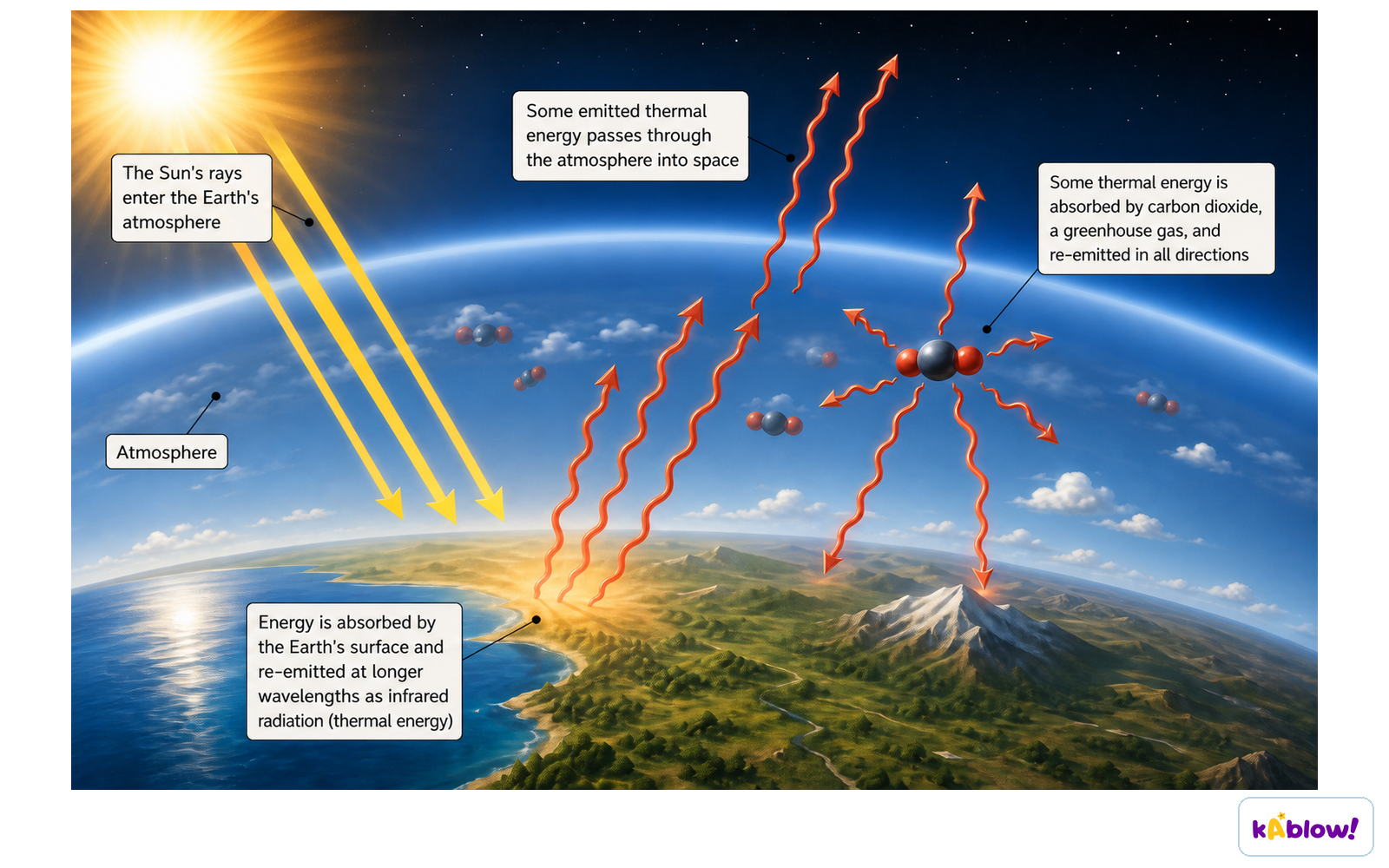
- The greenhouse effect involves absorption and emission of infrared radiation, not a sealed blanket that prevents all energy escaping. Increasing greenhouse gases changes Earth’s energy balance. Human activities, primarily greenhouse-gas emissions, are responsible for recent global warming.
- Fossil-fuel combustion and land-use change add CO2; agriculture, landfill and fossil-fuel systems emit methane, while soils and fertilisers can emit nitrous oxide. Water vapour largely amplifies warming as a feedback. Orbital changes influence long-term climate; large eruptions can temporarily cool through stratospheric sulfate aerosols. These do not account for the recent human-driven trend.
Infrared absorption and emission
Effects
- Climate change affects heat, rainfall, ecosystems, food and water risks, with different local consequences. Attribution to a specific event requires evidence; one storm or retreating glacier alone is not a complete global analysis.
- Sea-level rise includes thermal expansion and land-ice loss. Floating sea-ice melt contributes little directly to sea level. Flood risk also depends on local land movement, tides, storms, exposure and adaptation. Longer frost-free periods can benefit some activities but do not guarantee higher yields or offset all other impacts.
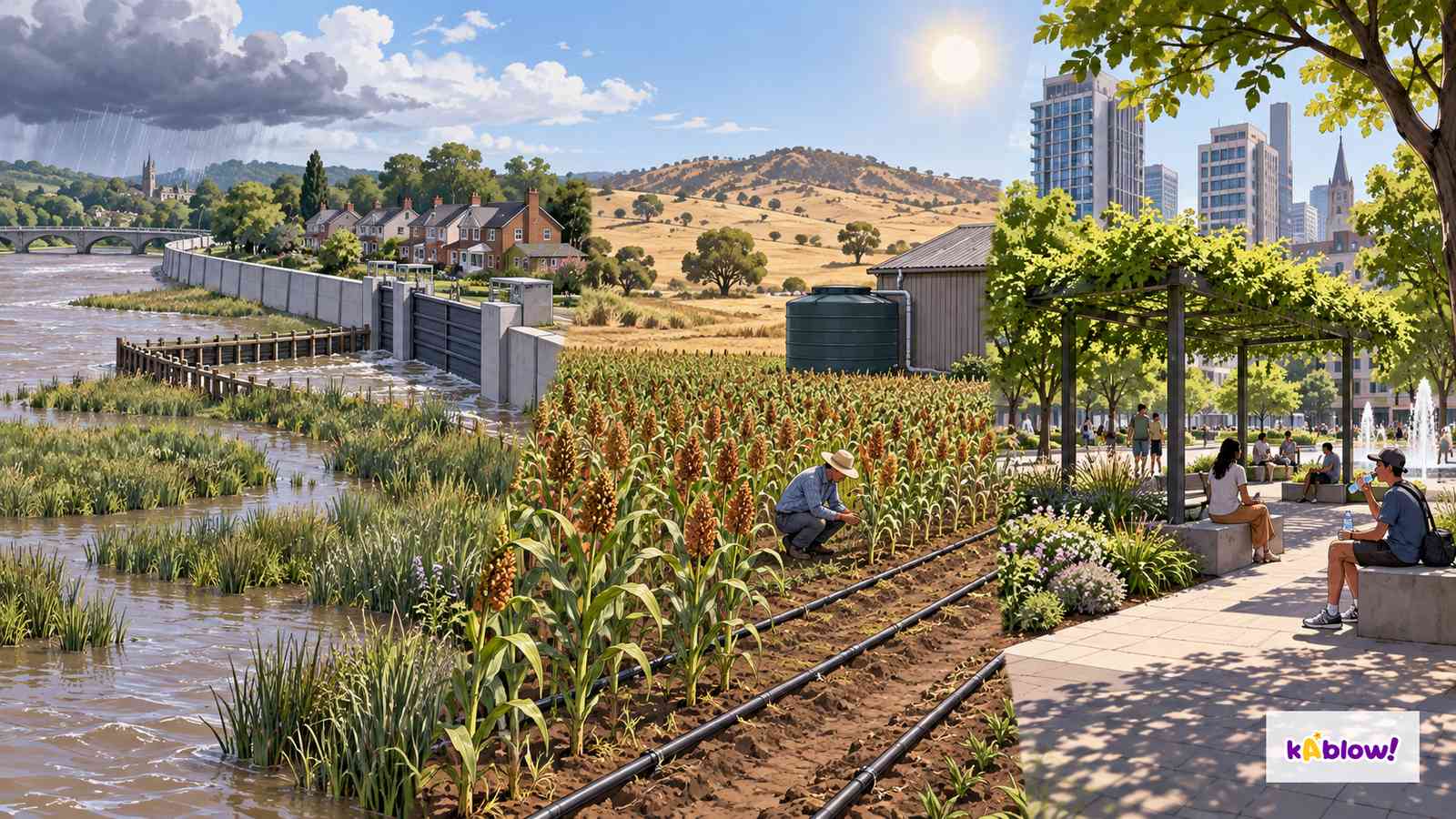
Imagined adaptation options
Managing climate change
- Mitigation reduces emissions or strengthens removals; adaptation manages risks and exposure. Energy efficiency, low-carbon energy, appropriate forestry and durable carbon storage need lifecycle, permanence and land-use evaluation. Flood protection, shade, water conservation and crop choices need local risk assessment.
- The Paris Agreement was adopted in 2015, seeking warming well below 2°C and pursuing efforts towards 1.5°C above pre-industrial conditions. It concerns long-term global temperature; a single-year anomaly is a different measure. Policy adoption is not proof that every target is achieved.
- Both response types need investment and fair access. Adaptation has limits and possible unintended effects; forest carbon can be lost, capture needs durable storage and defences retain residual risk. Evaluate effectiveness, maintenance and distribution rather than promising a risk-free solution.
Two complementary responses
Slide
Sign up free to view the lesson slides
Step through every slide for this topic — plus flashcards and revision notes — with a free account.
Câu hỏi luyện tập
Xem trước miễn phí — 8 trên 33 câu hỏi. Đăng ký để xem tất cả.
1.What is the greenhouse effect?
Easy- Agreenhouse gases absorbing and emitting outgoing infrared radiation
- Bplants growing in glass
- Cthe sun cooling
- Drain forming
2.Which gas is the main greenhouse gas from burning fuels?
Easy- Aoxygen
- Bnitrogen
- Chelium
- Dcarbon dioxide
3.Which is a natural cause of climate change?
Easy- Adeforestation
- Bfarming cattle
- Cvolcanic eruptions
- Dburning coal
4.Which is a human cause?
Easy- Avolcanoes
- Bburning fossil fuels
- Csunspots
- Dorbital changes
5.Which gas does agriculture release?
Easy- Amethane
- Bhelium
- Cargon
- Dneon
6.What is mitigation?
Easy- Aadapting to its effects
- Bignoring it
- Ccausing it
- Dreducing the causes of climate change
7.What is adaptation?
Easy- Adenying it
- Bcausing it
- Cadjusting to the effects of climate change
- Dstopping emissions
8.What did the Paris Agreement (2015) aim for?
Easy- Aending winter
- Bhold long-term warming well below 2°C and pursue efforts towards 1.5°C above pre-industrial levels
- Cending the greenhouse effect
- Dbanning cars
Unlock all 33 questions & more
Tạo tài khoản miễn phí để xem mọi câu hỏi, slide, thẻ ghi nhớ và ghi chú ôn tập cho chủ đề này.
Đề thi cũ
Luyện đề thi cũ cho chủ đề này sắp ra mắt.
Sắp ra mắt