
Coastal landscapes in the UK
Học bằng cách chơi
Trả lời những câu hỏi này để kiếm năng lượng, rồi câu cá và khám phá. Không cần tài khoản.
Dành cho nhà giáo dục: slide bài học, ghi chú ôn tập sẵn dùng cho Coastal landscapes in the UK (Geography, Physical Geography) — dùng trong bài giảng của bạn, hoặc chạy chủ đề như một hoạt động lớp học tương tác để người học chơi như một trò chơi trực tiếp.
Ghi chú bài học
Waves and processes
- Swash runs up a beach after a wave breaks; backwash returns downslope under gravity. Constructive and destructive wave models compare the relative sediment-building and sediment-removing effects, not whether backwash exists. Oblique swash with downslope backwash gives a simplified zigzag longshore-drift path; net direction depends on wave conditions.
- Hydraulic action forces water into weaknesses; abrasion wears the coast with moving sediment; attrition reduces the sediment particles themselves; solution dissolves soluble minerals. Transport includes traction, saltation, suspension and solution. Weathering breaks material down in place, while mass movement transfers it downslope. These processes can combine at a cliff.
A simplified longshore-drift sequence
Landforms
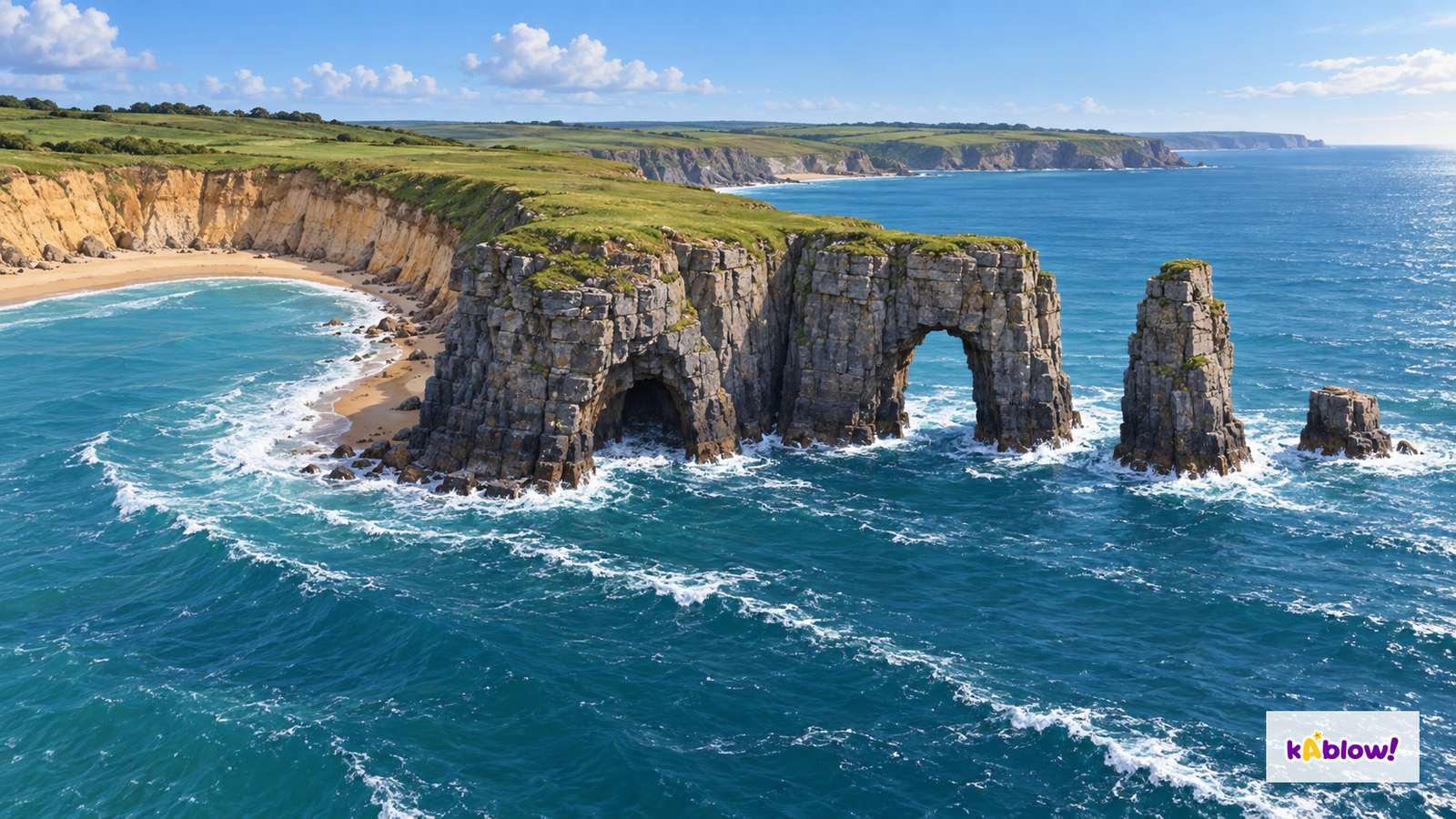
- A headland projects into the sea and a bay is an inlet. Where weaker rock erodes faster, contrasting resistance and structure can produce bays between more resistant headlands. Wave attack can enlarge weaknesses into caves and arches; roof collapse can isolate a stack, with further erosion and collapse leaving a stump. This is a simplified possible sequence, not a rule for every headland.
- Wave attack can cut a notch near a cliff base. Instability, weathering and mass movement promote collapse and retreat, leaving a sloping wave-cut platform exposed at suitable tides. The imagined figure shows coexisting arch, stack and low remnant rather than a named UK site or a time series. Old Harry Rocks and Durdle Door provide separate UK examples; the invented image is not evidence of either site.
- Deposition occurs when conditions allow sediment to settle. Beaches contain sand and/or shingle; longshore supply can build a spit attached at one end where the coastline changes direction. A bar crosses a bay, sometimes enclosing a lagoon; a tombolo connects offshore land. Spurn and Slapton Sands are distinct UK examples, not interchangeable names for all depositional landforms. Wind-blown sand and vegetation can build dunes behind a beach.
Imagined erosional landforms
Coastal management
- Sea walls resist wave attack but can reflect energy and require maintenance; rock armour dissipates energy between boulders, while gabions hold stones in wire cages. Groynes interrupt longshore sediment transfer and may retain a beach updrift while reducing supply downdrift. None guarantees elimination of flood or erosion risk.
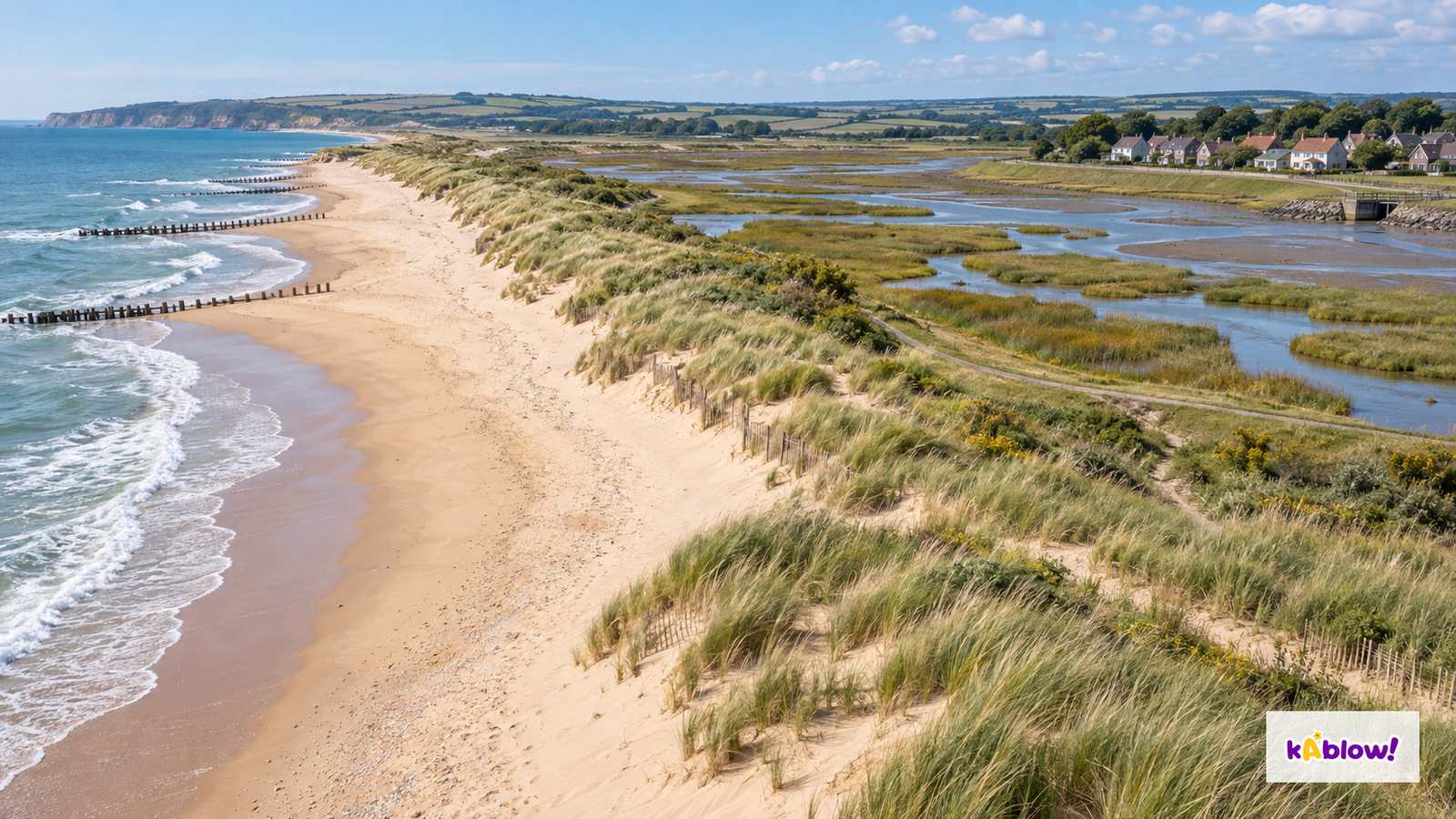
- Nourishment adds compatible sand or shingle and commonly needs repetition. Dune fencing, vegetation and access management help retain sand and reduce disturbance. Soft engineering can support natural processes but is not always cheaper or suitable for every wave climate. The imagined dune scene also shows groynes, which are hard structures.
- Shoreline-management options include hold the line, advance the line, managed realignment and no active intervention. Realignment plans a different defence line and controlled inundation; no active intervention is also a considered policy. Evaluate long-term feasibility, residual risk, habitats, infrastructure, livelihoods, funding and distribution of losses. Avoid reducing decisions to property prices alone.
Imagined dunes and a mixed-management coast
Case study: Holderness coast
- Much of the Holderness coast is readily eroded glacial till containing clay, sand and stones. Waves remove material at the toe; water in the sediment, weathering and mass movement can contribute to cliff retreat. Rates differ among sites and periods, and individual failures can be episodic. Do not use an unsupported fastest-in-Europe ranking or treat one average as a prediction for every year.
- Mappleton received rock defences in 1991. These can protect a local frontage and infrastructure while altering a connected sediment system. Reduced downdrift supply is a plausible pathway to increased erosion, but assessing an actual change needs evidence on waves, sediment, geology and other interventions as well.
- Compare local protection with consequences elsewhere and over time. A useful evaluation identifies who benefits, who bears costs or land-use changes, maintenance requirements, residual risk and environmental effects. An undated defence cost or a single coast-wide erosion number is not sufficient evidence of overall success.
Evaluate a coastal intervention
Slide
Sign up free to view the lesson slides
Step through every slide for this topic — plus flashcards and revision notes — with a free account.
Câu hỏi luyện tập
Xem trước miễn phí — 8 trên 33 câu hỏi. Đăng ký để xem tất cả.
1.What is swash?
Easy- Athe movement of water up the beach
- Bthe movement down
- Ca type of rock
- Da cliff
2.What is backwash?
Easy- Awater going up
- Ba wave type
- Ca wind
- Dwater flowing back down the beach
3.What is abrasion?
Easy- Arocks colliding
- Bwind erosion
- Crocks thrown by waves wearing away the cliff
- Dwaves dissolving rocks
4.What is attrition?
Easy- Awind blows
- Brocks wear each other into smaller, rounder pieces
- Cwaves hit cliffs
- Drocks dissolve
5.What is hydraulic action?
Easy- Aforce of water forcing air into cracks
- Bchemical reaction
- Crock collision
- Dwind
6.What is longshore drift?
Easy- Awave erosion
- Bcliff collapse
- Ctide rise
- Dmovement of sediment along the coast
7.Which landform has a flat, rocky area at the base of a cliff?
Easy- Aan arch
- Ba spit
- Ca wave-cut platform
- Da stack
8.What is a spit?
Easy- Aan island
- Ba ridge of sand or shingle attached to land at one end
- Ca cliff
- Da cave
Unlock all 33 questions & more
Tạo tài khoản miễn phí để xem mọi câu hỏi, slide, thẻ ghi nhớ và ghi chú ôn tập cho chủ đề này.
Đề thi cũ
Luyện đề thi cũ cho chủ đề này sắp ra mắt.
Sắp ra mắt