
Ecosystems and the global distribution of biomes
Học bằng cách chơi
Trả lời những câu hỏi này để kiếm năng lượng, rồi câu cá và khám phá. Không cần tài khoản.
Dành cho nhà giáo dục: slide bài học, ghi chú ôn tập sẵn dùng cho Ecosystems and the global distribution of biomes (Geography, Physical Geography) — dùng trong bài giảng của bạn, hoặc chạy chủ đề như một hoạt động lớp học tương tác để người học chơi như một trò chơi trực tiếp.
Ghi chú bài học
Ecosystems
- An ecosystem includes organisms and the physical and chemical environment with which they interact. Biotic components include animals, plants, fungi and microorganisms. Abiotic factors include temperature, light, water and mineral conditions; soil contains both living organisms and non-living material. Producers make organic matter, usually by photosynthesis in this GCSE context; algae and microorganisms mean producers are not all plants.
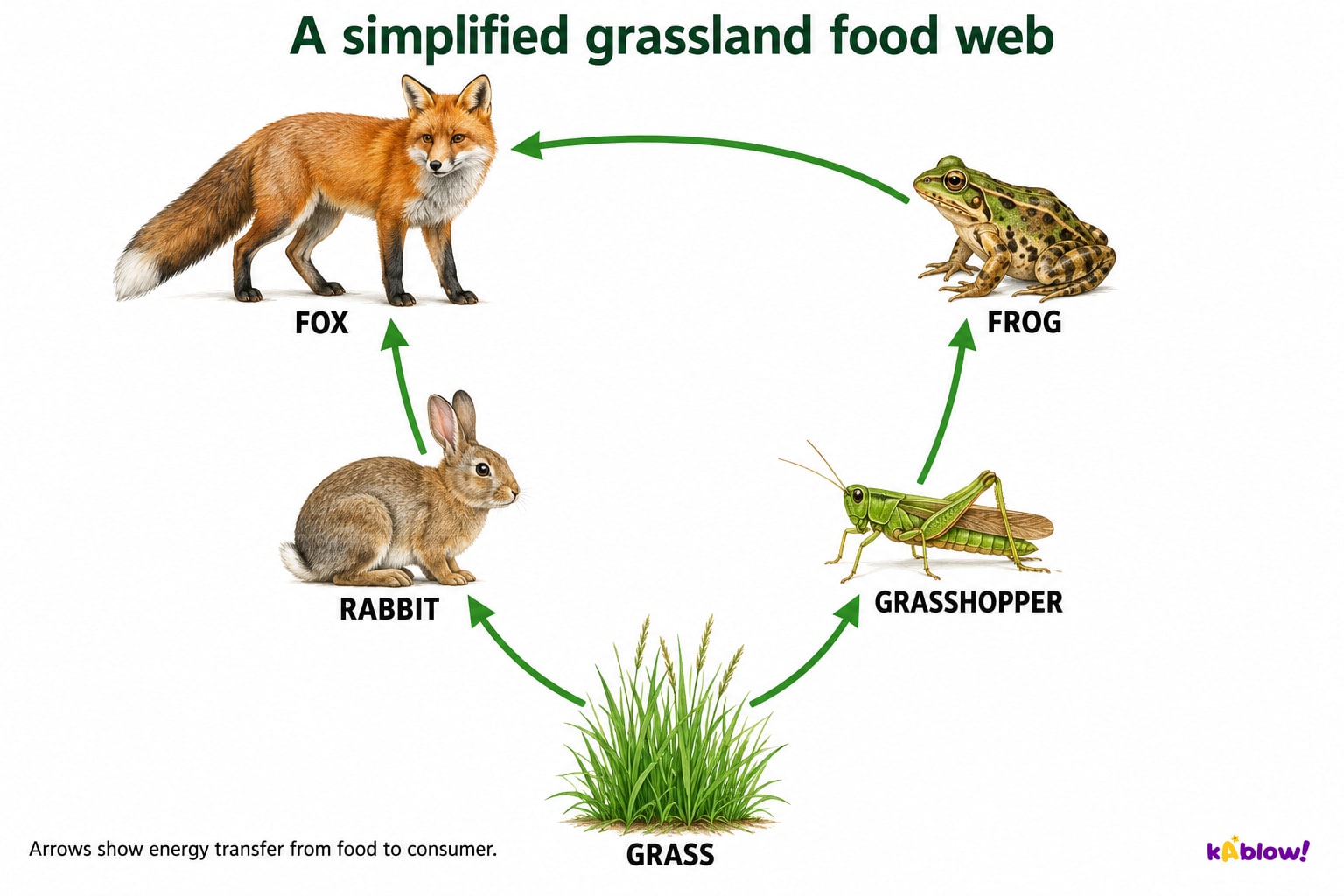
- Consumers obtain organic material from other organisms. Decomposers, including many fungi and bacteria, break down dead material; detritivores ingest fragments. These categories depend on the classification, so a fungus should not be used as an unqualified wrong answer to which organism is a consumer. Food-chain and food-web arrows normally point from food to consumer. The original grassland web contains five selected possible links and no measured abundances.
- Nutrients move among biomass, litter and soil through feeding, death, litterfall, decomposition and uptake. Inputs and outputs mean a real ecosystem is not a perfectly closed cycle. Energy instead flows through organisms and detrital pathways and is ultimately dissipated as heat through respiration; it is not destroyed and does not cycle back from soil to the Sun.
- Interdependence means changes can propagate through linked feeding, habitat and environmental relationships. Removing a predator can change prey and vegetation, but other predators, disease, food and environmental conditions affect outcomes. Avoid treating balance as a permanently fixed state or a trophic cascade as inevitable.
A simplified grassland food web
Biomes
- A biome is a broad ecological region characterised by climate and typical vegetation, containing many local ecosystems. Classification schemes differ. Temperature, precipitation and seasonality strongly shape patterns, while altitude, soils, drainage, disturbance, history and land use affect local form and boundaries. Biomes are not exact horizontal stripes or a map of present human land use.
- Tropical rainforest occurs in warm, wet parts of the Amazon and Congo basins and Southeast Asia. Savanna grasslands occupy seasonal tropical settings with grasses and scattered trees, such as parts of East Africa. Many hot deserts occur near 20–30° north and south, including the Sahara and Arabian deserts, where subtropical sinking air contributes to low rainfall; currents, rain shadows and continentality also matter.
- Temperate forests occur in suitable moist mid-latitude regions, such as parts of Europe, eastern North America and East Asia; temperate grasslands include continental interiors. Boreal forest or taiga extends across northern North America and Eurasia. Arctic tundra occupies cold northern regions with short growing seasons; alpine tundra occurs at high elevation. Polar ice is extensive in Greenland and Antarctica, but polar regions are not uniformly ice-covered land.
- Climate change can alter suitable species ranges and disturbance patterns, sometimes favouring poleward or uphill shifts. Species disperse at different rates and face barriers, so whole communities do not simply migrate together. Warming alone cannot predict every local change.
Broad biome patterns and regional examples
A UK ecosystem
- A small UK pond provides an example rather than a named field survey. Waterweed and algae can produce organic material; grazing snails and some larvae consume producers, while predators and omnivores use other food. The simplified chain algae → grazing snail → duck shows selected possible links, not the entire diet of every duck. Fungi, bacteria and detritivores process dead material.
- Light, temperature, water level, chemistry and dissolved oxygen affect the community. Seasonal growth and respiration vary through the day and year; the presence of plants does not guarantee high oxygen at all times. Drainage removes aquatic habitat, and pollution can alter which organisms survive.
- Excess nutrient input can stimulate growth of algae and other plants. Dense growth can shade submerged plants; decomposition of additional organic material can increase oxygen demand and harm oxygen-sensitive organisms. The result depends on nutrient levels, light, mixing and other conditions. Clean-water pond creation and appropriate habitat management can support freshwater life; human impacts are not uniformly negative.
Components of an illustrative UK pond
Why it matters
- Ecosystems supply material goods such as food and timber and services such as water regulation, carbon storage, recreation and cultural value. These benefits are not all traded or evenly distributed, and flood regulation is not a guarantee that flooding cannot happen.
- Biodiversity includes genetic, species and ecosystem variation. Species richness is one useful measure, not the whole definition. Warm moist conditions support tropical productivity, while ecological history and varied niches contribute to diversity. Management should evaluate habitat condition and relationships as well as a single species count.
Slide
Sign up free to view the lesson slides
Step through every slide for this topic — plus flashcards and revision notes — with a free account.
Câu hỏi luyện tập
Xem trước miễn phí — 8 trên 33 câu hỏi. Đăng ký để xem tất cả.
1.What does 'biotic' mean?
Easy- Aliving
- Bnon-living
- Csoil
- Dair
2.What does 'abiotic' mean?
Easy- Aliving
- Bdead
- Cmoving
- Dnon-living
3.Which is a consumer?
Easy- Aa photosynthetic fern
- Ba rock
- Ca herbivore
- Da tree
4.Which is a producer?
Easy- Aa mushroom
- Bgrass
- Ca rabbit
- Da fox
5.Which is a decomposer?
Easy- Afungus
- Boak tree
- Cdeer
- Dhawk
6.What does a food web show?
Easy- Aweather
- Brocks
- Crivers
- Dfeeding relationships between many species
7.Where are tropical rainforests found?
Easy- Aat 60°N
- Bat 30°N
- Cnear the equator
- Dat the poles
8.Where are hot deserts mostly found?
Easy- Aat 60°
- Baround 30° north and south
- Cat the equator
- Dat the poles
Unlock all 33 questions & more
Tạo tài khoản miễn phí để xem mọi câu hỏi, slide, thẻ ghi nhớ và ghi chú ôn tập cho chủ đề này.
Đề thi cũ
Luyện đề thi cũ cho chủ đề này sắp ra mắt.
Sắp ra mắt