
Speaking and writing in German
Học bằng cách chơi
Trả lời những câu hỏi này để kiếm năng lượng, rồi câu cá và khám phá. Không cần tài khoản.
Dành cho nhà giáo dục: slide bài học, ghi chú ôn tập sẵn dùng cho Speaking and writing in German (German, Exam Skills) — dùng trong bài giảng của bạn, hoặc chạy chủ đề như một hoạt động lớp học tương tác để người học chơi như một trò chơi trực tiếp.
Ghi chú bài học
Speaking tasks
- Role-play, image discussion and conversation have different purposes. Current AQA 8662 also includes reading aloud from a supplied text; prepare for the actual board, tier and task rather than an outdated universal speaking format.
- Original read-aloud practice: nach der Schule gehe ich in den Park. Dort lese ich ein Buch. Morgen möchte ich mit dem Zug fahren. Practise the words and sound–spelling links with feedback; this written text is not an audio model or a pronunciation score.
Match response to the task
Developing answers
- Develop an answer using relevant detail, an opinion, a reason or an example when the question calls for them. Meiner Meinung nach explicitly introduces an opinion; zum Beispiel an example and außerdem an addition.
- Use time frames for the requested meaning: gestern habe ich gelesen, heute lese ich, morgen werde ich lesen. Ich würde gern reisen and ich möchte reisen express hypothetical/wish meanings rather than the same indicative future. Variety or extra length alone does not guarantee a stronger answer.
Choose the connector pattern
Describing a photo
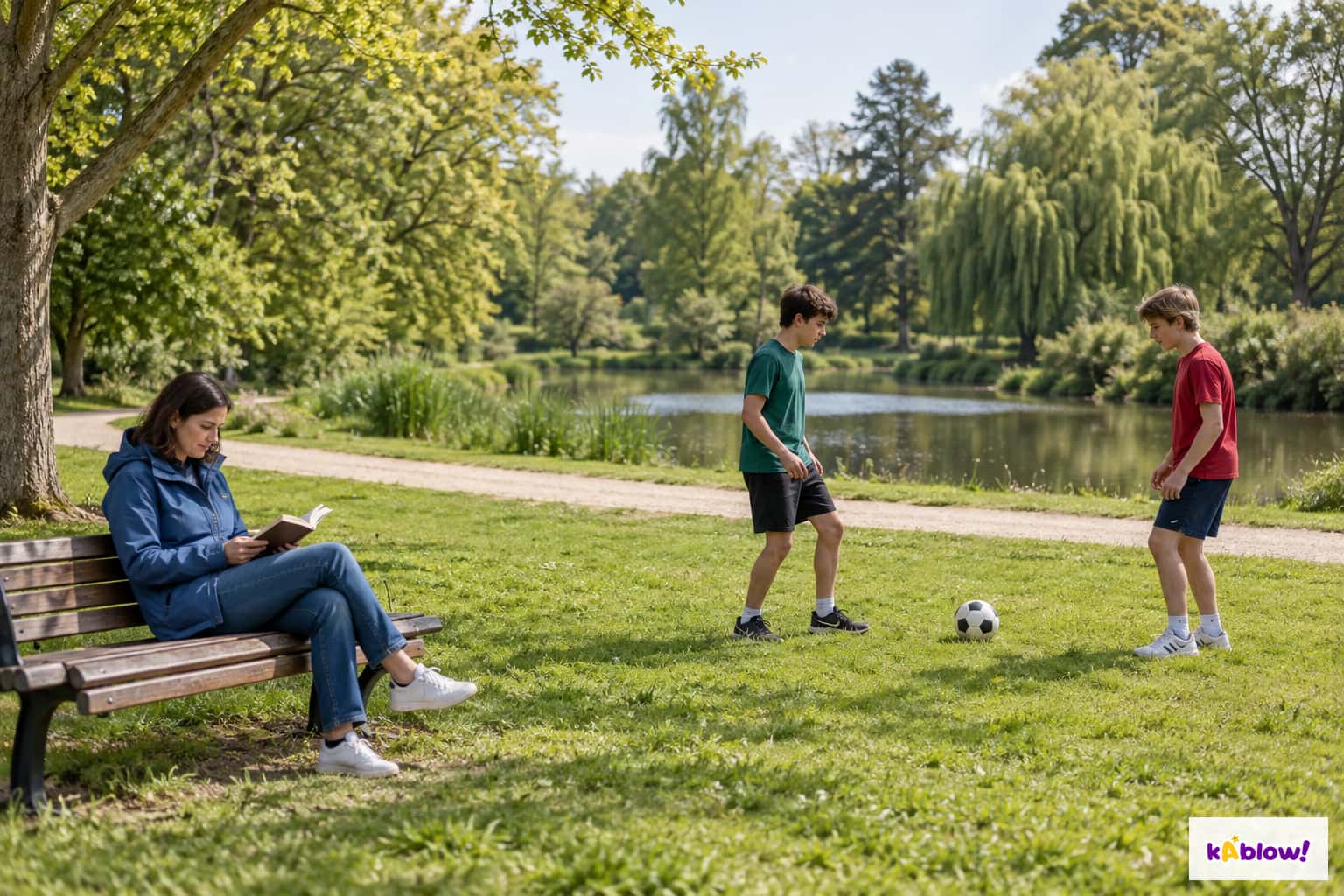
- The original shared illustration shows three people. Auf dem Bild sieht man drei Personen; links sitzt eine Person und liest ein Buch; zwei andere Personen stehen bei einem Ball. Im Hintergrund sieht man Bäume und Wasser.
- The ball rests on the ground; the image does not capture a kick. No visible detail establishes family relationships, identity, nationality or feelings. Describe evidence before clearly marked speculation; this generated illustration is practice material rather than a documentary photograph.
Describe visible image evidence
Handling unexpected questions
- Wie bitte?, können Sie das wiederholen? and können Sie bitte langsamer sprechen? request repetition or slower speech in suitable contexts. Ich verstehe nicht states non-understanding and lassen Sie mich überlegen means let me think.
- Actual tasks control what can be repeated or rephrased. Na ja, also and eigentlich have different conversational functions; a brief natural hesitation may help, but repeated fillers are not a replacement for a relevant response or an automatic scoring advantage.
Repair communication appropriately
Writing tasks
- Read the writing prompt’s target language, compulsory content and approximate length. Current AQA has several writing tasks with different guidance; 90–150 words is not a universal requirement for every task, level or board.
- Plan a coherent response covering the required points, then check it against the prompt. A dialogue should have distinct speakers and a role-play may ask for a specific short question; no task is improved merely by adding unrelated memorised material.
Plan the response the prompt needs
Translation into German
- Preserve meaning while checking the relevant construction. Heute spiele ich has finite spiele after one opening constituent; weil es regnet closes the written reason clause with regnet; denn es regnet retains declarative order in the reason.
- A participle does not always end every clause: weil ich gespielt habe has habe final. Ich lese, um Deutsch zu lernen has the same understood subject; ich helfe dir, damit du Deutsch lernst explicitly assigns learning to du. Use the actual subject and purpose rather than inserting um…zu automatically.
Check the complete construction
Checking
- Ordinary nouns such as Park, Schule and Buch take initial capitals. Sentence starts and formal Sie also have capitalisation rules. Check umlauts ä/ö/ü and ß according to the target variety and word, without treating every German-speaking country’s spelling as identical.
- Check verb endings, case, gender, number, punctuation and pronoun referents. Ich würde reisen differs from ich wurde müde; small spelling differences can change mood or meaning. Correction should preserve the intended message and the task’s content.
Complex structures
- Use complex structures when they serve the task: wenn es regnet, bleibe ich zu Hause; obwohl es regnet, gehe ich aus; ich lese, um Deutsch zu lernen. The written subordinate patterns close with the finite verb in these models.
- Original town response: ich wohne in einer kleinen Stadt. Es gibt einen Park und ein Kino. Ich mag die Stadt, weil sie ruhig ist. A relevant past extension is optional unless the prompt requests it; no real address or private travel history is required.
Develop the original town response
Slide
Sign up free to view the lesson slides
Step through every slide for this topic — plus flashcards and revision notes — with a free account.
Câu hỏi luyện tập
Xem trước miễn phí — 8 trên 37 câu hỏi. Đăng ký để xem tất cả.
1.In an image description, what does links mean?
Easy- Aon the left
- Bon the right
- Cin the front
- Din the back
2.In an image description, what does rechts mean?
Easy- Aon the left
- Bin the front
- Cin the back
- Don the right
3.What does "im Hintergrund" mean?
Easy- Aon the left
- Bat the end
- Cin the background
- Din the foreground
4.What does "im Vordergrund" mean?
Easy- Aat the top
- Bin the foreground
- Cin the background
- Don the right
5.What does "ich verstehe nicht" mean?
Easy- AI do not understand
- BI do not know you
- CI do not agree
- DI do not like
6.What does "wie bitte" mean?
Easy- Ahow much is it?
- Bhow much?
- Cwhy not?
- Dpardon?
7.What does "lassen Sie mich überlegen" mean?
Easy- Alet me over there
- Blet me lay
- Clet me think
- Dleave me alone
8.In Na ja… ich finde den Film interessant, how can na ja function?
Easy- Asays no
- Bas a hesitation or qualified response before continuing
- Cends the conversation
- Dasks a question
Unlock all 37 questions & more
Tạo tài khoản miễn phí để xem mọi câu hỏi, slide, thẻ ghi nhớ và ghi chú ôn tập cho chủ đề này.
Đề thi cũ
Luyện đề thi cũ cho chủ đề này sắp ra mắt.
Sắp ra mắt