
Anglo-Saxon and Norman England: the Norman Conquest
Học bằng cách chơi
Trả lời những câu hỏi này để kiếm năng lượng, rồi câu cá và khám phá. Không cần tài khoản.
Dành cho nhà giáo dục: slide bài học, ghi chú ôn tập sẵn dùng cho Anglo-Saxon and Norman England: the Norman Conquest (History, British Depth Study) — dùng trong bài giảng của bạn, hoặc chạy chủ đề như một hoạt động lớp học tương tác để người học chơi như một trò chơi trực tiếp.
Ghi chú bài học
Anglo-Saxon England before 1066
- Edward ruled until his death in January 1066. Kings worked with earls, thegns and church leaders, and the witan advised on important matters including succession. It was not a modern elected parliament or a fixed constitutional committee.
- Shires, sheriffs, local courts and taxation helped administer the kingdom. Society included powerful landholders, free peasants, dependent smallholders and enslaved people. Labels conceal differences in wealth and obligation; neither every peasant nor every lord had an identical role. The Church held land, learning and political influence, with varied individual allegiances.
Institutions and status before the Conquest
The claimants
- Edward’s childlessness left disputed expectations rather than no possible heir. Harold was a powerful earl with support among leading English figures; reports of a deathbed nomination are not unambiguous. William relied on accounts of an earlier promise and Harold’s oath. These claims need source criticism rather than automatic acceptance.
- Hardrada’s claim drew on earlier Scandinavian succession arrangements, while Edgar’s royal descent gave him a dynastic claim despite youth and limited backing. Kinship, promises, elite acceptance and force all mattered. They did not operate as one universally agreed modern succession rule.
- Norman accounts describe papal backing for William, conventionally linked to a blessed banner from Alexander II. Historians have debated the evidence and its implications. Papal backing should not be expanded into the claim that all English clergy supported William, nor treated as proof that his invasion was just.
Claims were different and contested
The invasions of 1066
- At Fulford on 20 September, Hardrada and Tostig defeated Edwin and Morcar near York. Harold then defeated the invading army at Stamford Bridge on 25 September, where Hardrada and Tostig were killed. The first battle must not be omitted when ordering the autumn campaign.
- William landed at Pevensey on 28 September. Harold returned south and assembled forces before Hastings on 14 October. The journey’s details and how many northern veterans fought at Hastings are uncertain; additional southern recruitment means an identical exhausting march cannot be assumed for every soldier.
- At Hastings, English infantry defended a strong position while William’s force used several troop types. Narratives describe pursuit after retreats and counter-attacks, with debate about exact planning and sequence. Harold was killed and William won. The arrow-in-the-eye story is not a securely established complete account of his death.
Keep the autumn campaign in order
Why William won
- Explain mechanisms rather than list labels: recruitment and logistics enabled an invasion, varied troops offered tactical options, and broken formation could expose defenders. The northern campaign created pressure, but fatigue alone cannot be assumed to explain every English action. Leadership, casualties and Harold’s death interacted with circumstances.
- William’s Christmas Day coronation at Westminster followed further campaigning and political submission. Hastings did not itself secure immediate, universal obedience. Resistance and the establishment of Norman rule require a further lesson.
- The Bayeux Tapestry is embroidery in wool on linen, probably made in the 1070s. Its makers and exact commission are uncertain; Odo is widely proposed as patron. It offers a selective narrative and viewpoint. Its depiction of an oath or a battle is valuable evidence to compare, not a photograph or a complete transcript of contested events.
Different military roles created tactical options
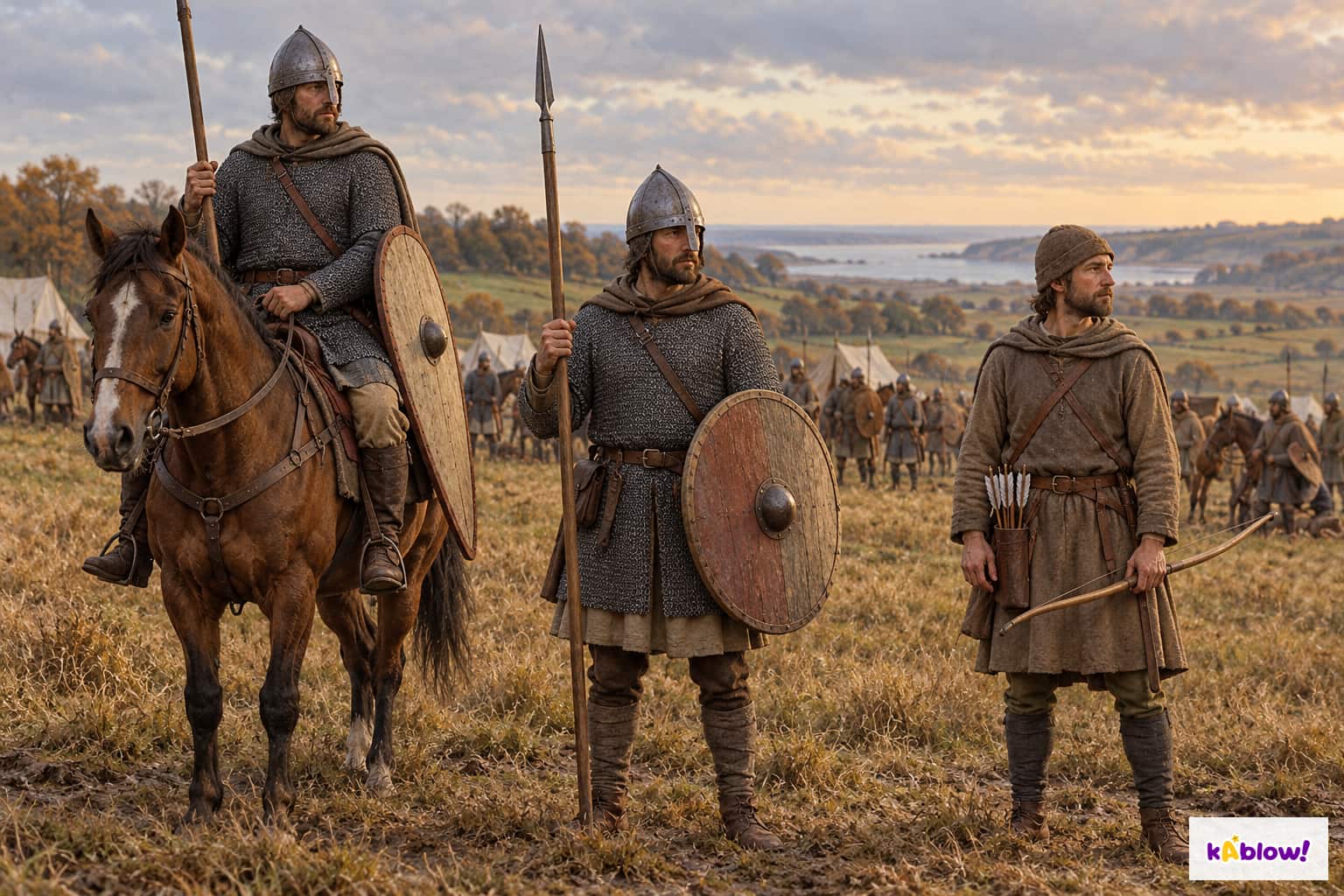
Slide
Sign up free to view the lesson slides
Step through every slide for this topic — plus flashcards and revision notes — with a free account.
Câu hỏi luyện tập
Xem trước miễn phí — 8 trên 35 câu hỏi. Đăng ký để xem tất cả.
1.Who was Harold Godwinson’s immediate predecessor as king of England?
Easy- AEdward the Confessor
- BWilliam
- CEdgar
- DCnut
2.Where did William land?
Easy- ADover
- BHastings
- CLondon
- DPevensey
3.Who was Harold Godwinson?
Easy- Athe Pope
- BWilliam's son
- Cthe Earl of Wessex and king in 1066
- Dthe King of Norway
4.Who was Harald Hardrada?
Easy- Aa Saxon priest
- BKing of Norway who claimed the throne
- CDuke of Normandy
- Dan English earl
5.What was the witan?
Easy- Aa gathering of leading nobles and churchmen advising the king
- Ba type of army
- Ca sheriff
- Da church
6.What was a thegn?
Easy- Aa slave
- Ba monk
- Ca sheriff
- Da lesser noble who held land from the king or an earl
7.What was a shire?
Easy- Aa church
- Ba battle
- Ca county-level administrative area with royal and local officers
- Da castle
8.What was a shield wall?
Easy- Aa siege weapon
- Ba defensive line of overlapping shields
- Ca castle wall
- Da church screen
Unlock all 35 questions & more
Tạo tài khoản miễn phí để xem mọi câu hỏi, slide, thẻ ghi nhớ và ghi chú ôn tập cho chủ đề này.
Đề thi cũ
Luyện đề thi cũ cho chủ đề này sắp ra mắt.
Sắp ra mắt