
Weimar and Nazi Germany: Hitler's rise to power 1919-33
Học bằng cách chơi
Trả lời những câu hỏi này để kiếm năng lượng, rồi câu cá và khám phá. Không cần tài khoản.
Dành cho nhà giáo dục: slide bài học, ghi chú ôn tập sẵn dùng cho Weimar and Nazi Germany: Hitler's rise to power 1919-33 (History, Period Study) — dùng trong bài giảng của bạn, hoặc chạy chủ đề như một hoạt động lớp học tương tác để người học chơi như một trò chơi trực tiếp.
Ghi chú bài học
Early Nazi Party
- Hitler joined the German Workers’ Party in 1919; it became the NSDAP in 1920. The 25-point programme contained extreme nationalism, antisemitism, racial exclusion and demands for strong central authority, alongside other claims. Party self-description should not be confused with a neutral account of its practice.
- The failed Munich putsch in November 1923 led to imprisonment. Hitler began Mein Kampf in 1924; its two volumes appeared in 1925 and 1926. The book promoted racist, antisemitic and expansionist ideas, not reliable explanations of national hardship.
- After reorganisation, the party used elections and local campaigning while continuing intimidation and violence. Hitler asserted authority at Bamberg in 1926. Goebbels became Berlin party leader in 1926, national party propaganda leader in 1930 and government propaganda minister in 1933; those appointments should not be merged.
Different stages and offices
The Depression
- German dependence on foreign credit made it vulnerable to international shocks. Credit withdrawal, banking problems, output cuts and government responses deepened hardship after 1929. Do not say every American loan ended instantly on the day of the crash. Registered unemployment reached roughly six million near the 1932 peak.
- The Nazis adapted appeals to different audiences and exploited dissatisfaction, anti-communism and prejudice. Their scapegoating of Jewish people was false. Support varied by class, religion, region and time; many unemployed people supported other parties, and farmers, businesses and middle-class voters were not uniform blocs.
- Reichstag seats provide one measure: 12 in 1928, 107 in 1930, 230 in July 1932 and 196 in November 1932. The party remained largest after its November loss but did not have an outright majority. The decline disproves a story of uninterrupted, inevitable electoral growth.
Largest party did not mean a majority
Political manoeuvring
- Brüning, Papen and Schleicher served as chancellor between 1930 and January 1933 while Hindenburg was president. Increasing reliance on presidential emergency powers had already weakened parliamentary government. Ebert’s brief 1918 chancellorship belongs to a different period.
- Papen and other conservatives negotiated for a cabinet in which they expected to restrain Hitler. Hindenburg appointed him on 30 January 1933. Electoral strength supplied leverage, but neither a direct chancellor election nor an automatic right of the largest party produced the appointment.
- Appointment and the subsequent construction of dictatorship are different stages. Conservative choices and failures of restraint mattered; describing Hitler’s accession as inevitable conceals alternatives and responsibility.
Appointment followed political choices
Why Hitler gained power
- Explain the interaction of economic crisis, parliamentary deadlock, prejudice, organisation, propaganda, coercion and elite calculations. An individual speech, slogan or source image cannot establish every voter’s motives.
- Some business and conservative figures supplied support or resources, but backing varied and did not form one united explanation for all Nazi gains. Political choices were needed to turn electoral influence into the chancellorship.
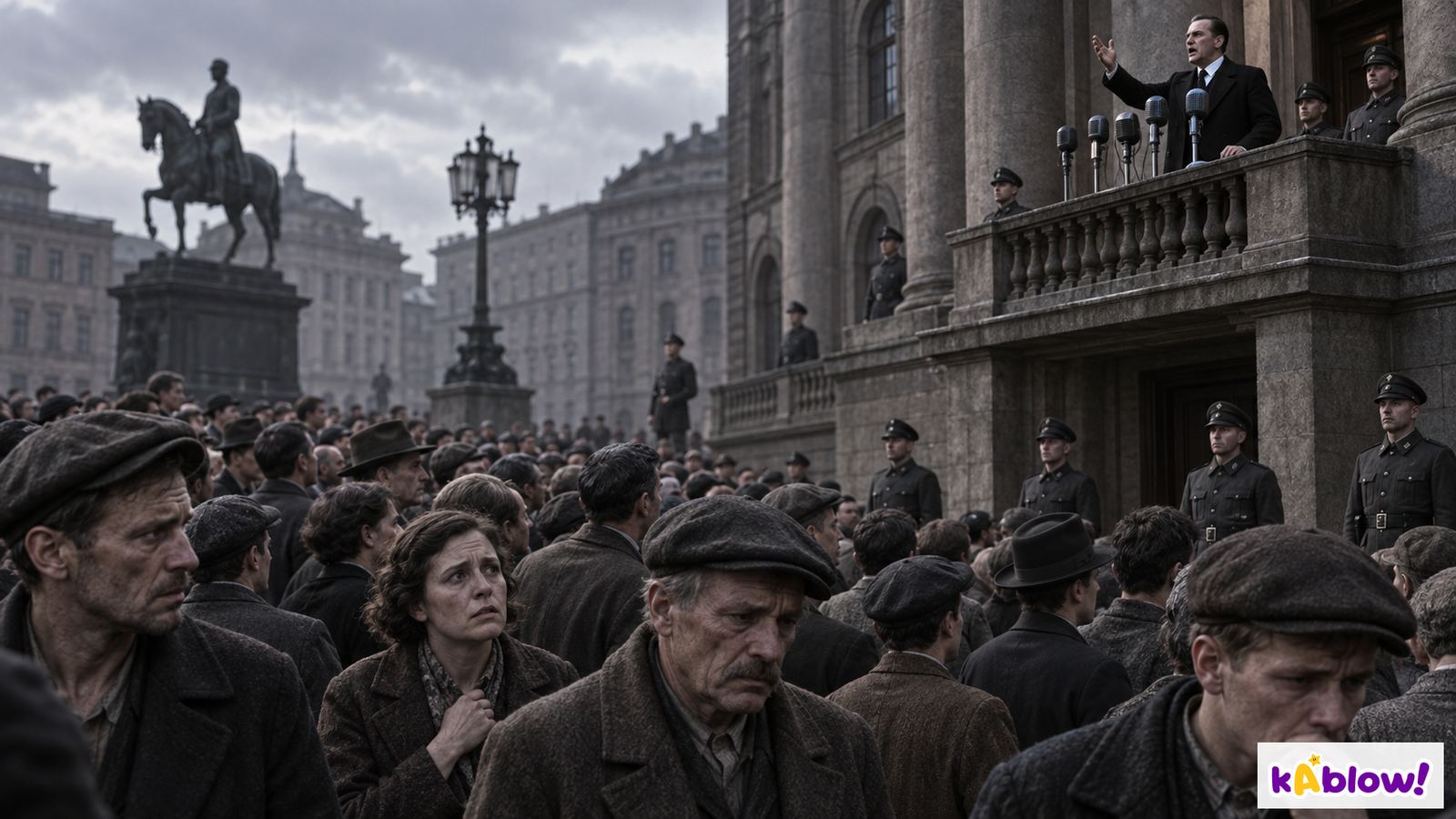
- Distinguish printed campaign appeals and pre-1933 media access from the later regime’s control of broadcasting and its propaganda ministry. A generated rally picture is contextual interpretation, not an authenticated Hitler speech, evidence of a particular event or a poll of public belief.
A staged political appeal
Slide
Sign up free to view the lesson slides
Step through every slide for this topic — plus flashcards and revision notes — with a free account.
Câu hỏi luyện tập
Xem trước miễn phí — 8 trên 33 câu hỏi. Đăng ký để xem tất cả.
1.What does NSDAP stand for?
Easy- ANational Socialist German Workers' Party
- BNational Security Defence Army Party
- CNazi Secret Defence Army Police
- DNone
2.Which financial event is associated with Black Tuesday, 29 October 1929?
Easy- AHitler became Chancellor
- Bthe Reichstag Fire
- Cthe Munich Putsch
- Dthe Wall Street Crash
3.Approximately how many people were registered unemployed in Germany near the 1932 peak?
Easy- A600
- B60 million
- Cabout 6 million
- D600,000
4.What did the SA do?
Easy- Aran schools
- Bprotected Nazi meetings and attacked opponents
- Cran the economy
- Dmade laws
5.Who was Joseph Goebbels?
Easy- ANazi propaganda chief
- Bleader of the SS
- Cthe Chancellor
- Da general
6.What was Mein Kampf?
Easy- Aa Weimar law
- Ba newspaper
- Ca treaty
- DHitler's book setting out his ideas
7.What strategic change followed the failed 1923 putsch?
Easy- Ato end the party
- Bto flee
- Cgreater use of elections and party organisation alongside continuing intimidation
- Dto join the army
8.How did Nazi campaigning seek support?
Easy- Aonly Jews
- Bby adapting messages for several social and occupational groups
- Conly the rich
- Donly the army
Unlock all 33 questions & more
Tạo tài khoản miễn phí để xem mọi câu hỏi, slide, thẻ ghi nhớ và ghi chú ôn tập cho chủ đề này.
Đề thi cũ
Luyện đề thi cũ cho chủ đề này sắp ra mắt.
Sắp ra mắt