
Keys, scales and the circle of fifths
Học bằng cách chơi
Trả lời những câu hỏi này để kiếm năng lượng, rồi câu cá và khám phá. Không cần tài khoản.
Dành cho nhà giáo dục: slide bài học, ghi chú ôn tập sẵn dùng cho Keys, scales and the circle of fifths (Music, Notation and Theory) — dùng trong bài giảng của bạn, hoặc chạy chủ đề như một hoạt động lớp học tương tác để người học chơi như một trò chơi trực tiếp.
Ghi chú bài học
Major scales
- A major scale follows T T S T T T S from tonic to octave, with T a tone and S a semitone in this teaching model. C major uses natural pitch letters and a signature without sharps or flats, but chromatic accidentals can still appear in a C-major work.
- Scale degrees include tonic (1), supertonic (2), mediant (3), subdominant (4), dominant (5) and submediant (6). A leading note is a semitone below the tonic; the unraised seventh of natural minor is a whole tone below and is called subtonic. Degree names do not all identify the same fixed pitch in every key.
Build C major from successive steps
Minor scales
- Natural minor follows T S T T S T T. A natural minor is A B C D E F G A; harmonic minor raises G to G sharp. The conventional classical melodic-minor exercise raises F and G on the ascent and restores F and G natural on descent. Actual music and jazz melodic-minor practice can differ from that exercise.
- Relative major/minor share a key signature but have different tonics: C major/A minor and G major/E minor are examples. The minor signature reflects natural minor; harmonic or melodic raised degrees are normally notated as accidentals as needed. Parallel major/minor share a tonic instead, such as A major and A minor.
Three written A-minor scale forms
Circle of fifths
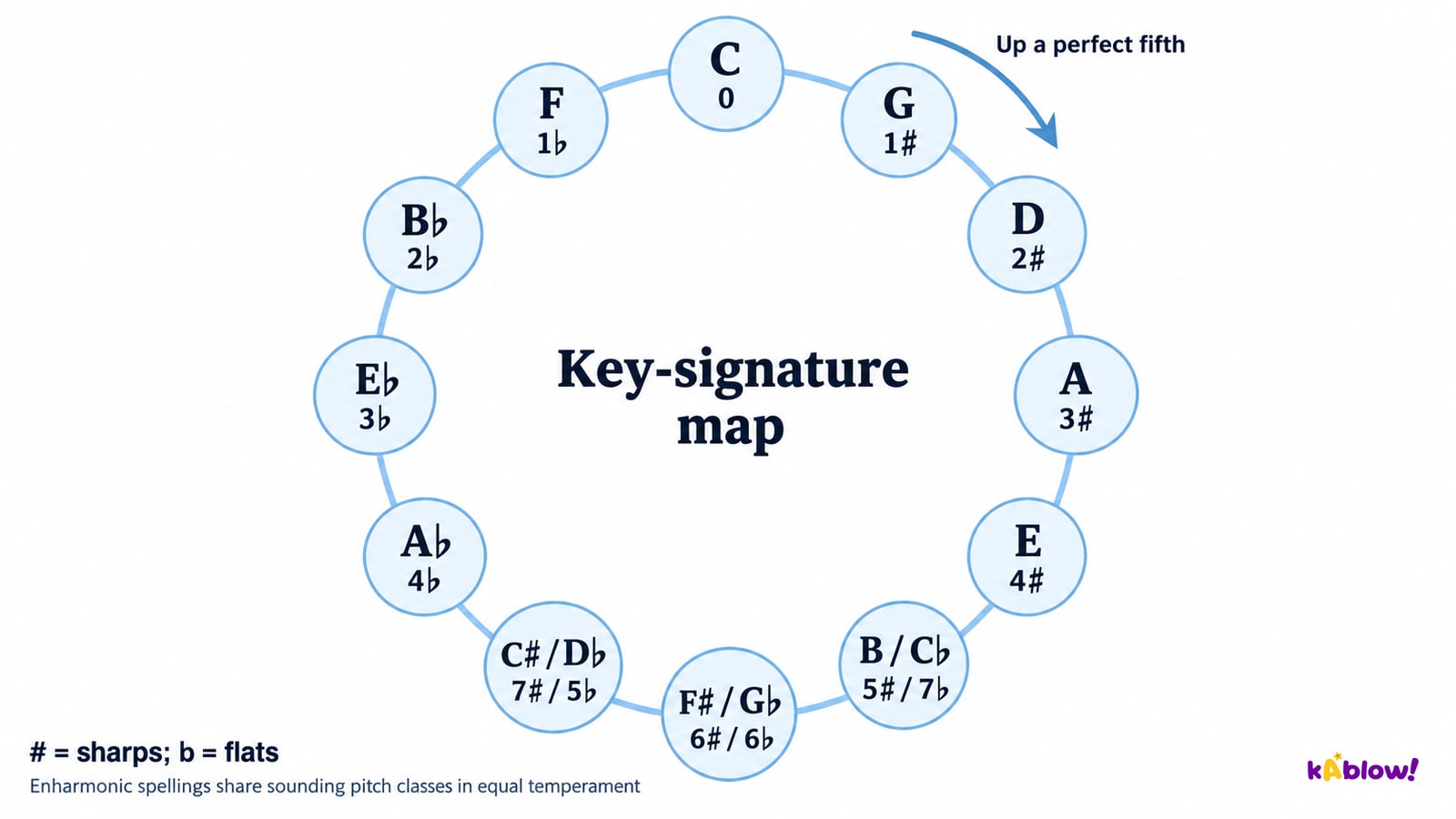
- The key-signature circle orders major tonic relationships by perfect fifths. With C at the top, clockwise upward fifths give G, D, A, E, B, F sharp and C sharp; anticlockwise downward fifths give F, B flat, E flat, A flat, D flat, G flat and C flat. Changes become sharper or flatter according to the current spelling.
- The graphic pairs B/Cb, F#/Gb and C#/Db. In twelve-tone equal temperament these pairs share sounding pitch classes but have different written signatures: 5 sharps/7 flats, 6 sharps/6 flats and 7 sharps/5 flats respectively. A respelling prevents a simple add-one-sharp count from continuing unchanged around the whole displayed circle.
- A signature alone does not decide the tonic: relative keys share it and local pitch alterations are possible. The circle helps compare key collections and related modulations; it is not the same as a diatonic descending-fifths chord progression within one key.
Circle of fifths: major keys
Modes
- Compare modes on the same tonic rather than by a vague mood. Dorian has a minor third and a sixth raised relative to natural minor: D E F G A B C D. Mixolydian lowers degree 7 relative to major: G A B C D E F G. These pitch relationships do not assign a single emotion to every performance.
- A mode needs an appropriate tonal reference and musical treatment, not merely a claim that any all-white-note passage starting on D must be Dorian. The same letter collection can support different tonal centres and functions in context.
Compare modes on a stated tonic
Other scales
- Pentatonic means five distinct pitch classes per octave, and different pentatonic collections have different intervals. C D E G A is a common major-pentatonic model. It does not guarantee freedom from dissonance when combined with a harmony, register or another part.
- A common minor-blues model is C Eb F Gb G Bb, related to C minor pentatonic C Eb F G Bb by adding Gb. Performed blue notes involve inflection and can lie between fixed equal-tempered pitches. This model is not a complete definition of all blues melody.
- A chromatic collection has twelve pitch classes per octave in this model; a whole-tone collection has six, moving by tones. Exclude the repeated octave tonic when counting distinct pitch classes. These are written teaching collections, not copied repertoire or a listening test.
Slide
Sign up free to view the lesson slides
Step through every slide for this topic — plus flashcards and revision notes — with a free account.
Câu hỏi luyện tập
Xem trước miễn phí — 8 trên 36 câu hỏi. Đăng ký để xem tất cả.
1.How many distinct pitch classes per octave does pentatonic mean, excluding octave repetition?
Easy- Afive
- Bseven
- Ceight
- Dtwelve
2.What is the tonic?
Easy- Athe fifth degree
- Bthe last note
- Ca chord
- Dthe first degree of a scale
3.What is the dominant?
Easy- Athe fourth degree
- Bthe seventh degree
- Cthe fifth degree of the scale
- Dthe first degree
4.What is the subdominant?
Easy- Athe seventh degree
- Bthe fourth degree
- Cthe fifth degree
- Dthe first degree
5.In the usual tonal sense, which description identifies a leading note?
Easy- Athe seventh degree a semitone below the tonic
- Bthe first degree
- Cthe fifth degree
- Dthe fourth degree
6.What is the mediant?
Easy- Athe second degree
- Bthe sixth degree
- Cthe fifth degree
- Dthe third degree
7.What is a relative minor?
Easy- Aa louder key
- Ba faster key
- Cthe minor key sharing a major key's signature
- Da minor key with no notes
8.What is the relative minor of C major?
Easy- AG minor
- BA minor
- CD minor
- DE minor
Unlock all 36 questions & more
Tạo tài khoản miễn phí để xem mọi câu hỏi, slide, thẻ ghi nhớ và ghi chú ôn tập cho chủ đề này.
Đề thi cũ
Luyện đề thi cũ cho chủ đề này sắp ra mắt.
Sắp ra mắt