
Transition Metals
边玩边学
回答这些题目来赚取能量,然后钓鱼探索。无需账号。
给教育者: 面向 Transition Metals(Chemistry,AQA)的即用型课程幻灯片, 复习笔记, 图示——用在你的课堂上,或将该知识点作为学习者可实时游玩的互动课堂活动来运行。
课程笔记
Distinguish a transition metal from a d-block position
- For this AQA course, a transition metal is a d-block element forming at least one stable ion with an incomplete d sublevel. The first-row examples run from Ti to Cu.
- Sc³⁺ is d⁰ and Zn²⁺ is d¹⁰ in their ordinary chemistry, so Sc and Zn are excluded by this course definition. This is not a claim that no unusual oxidation states can ever exist.
- Copper qualifies because Cu²⁺ is d⁹, even though Cu⁺ is d¹⁰. Test the existence of an appropriate ion rather than requiring every ion to be incomplete.
Common-ion electron configurations
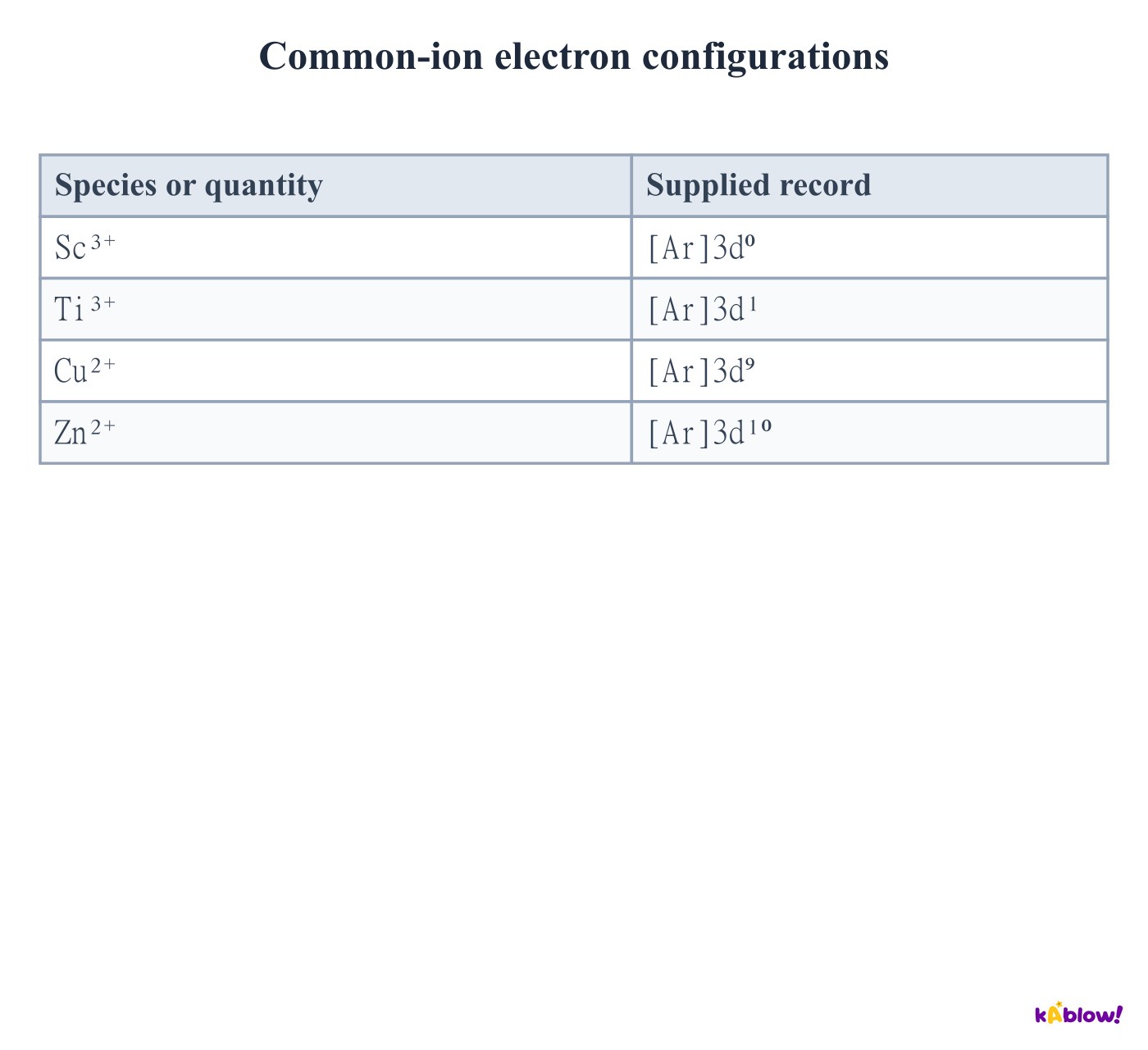
Use the observed chromium and copper configurations
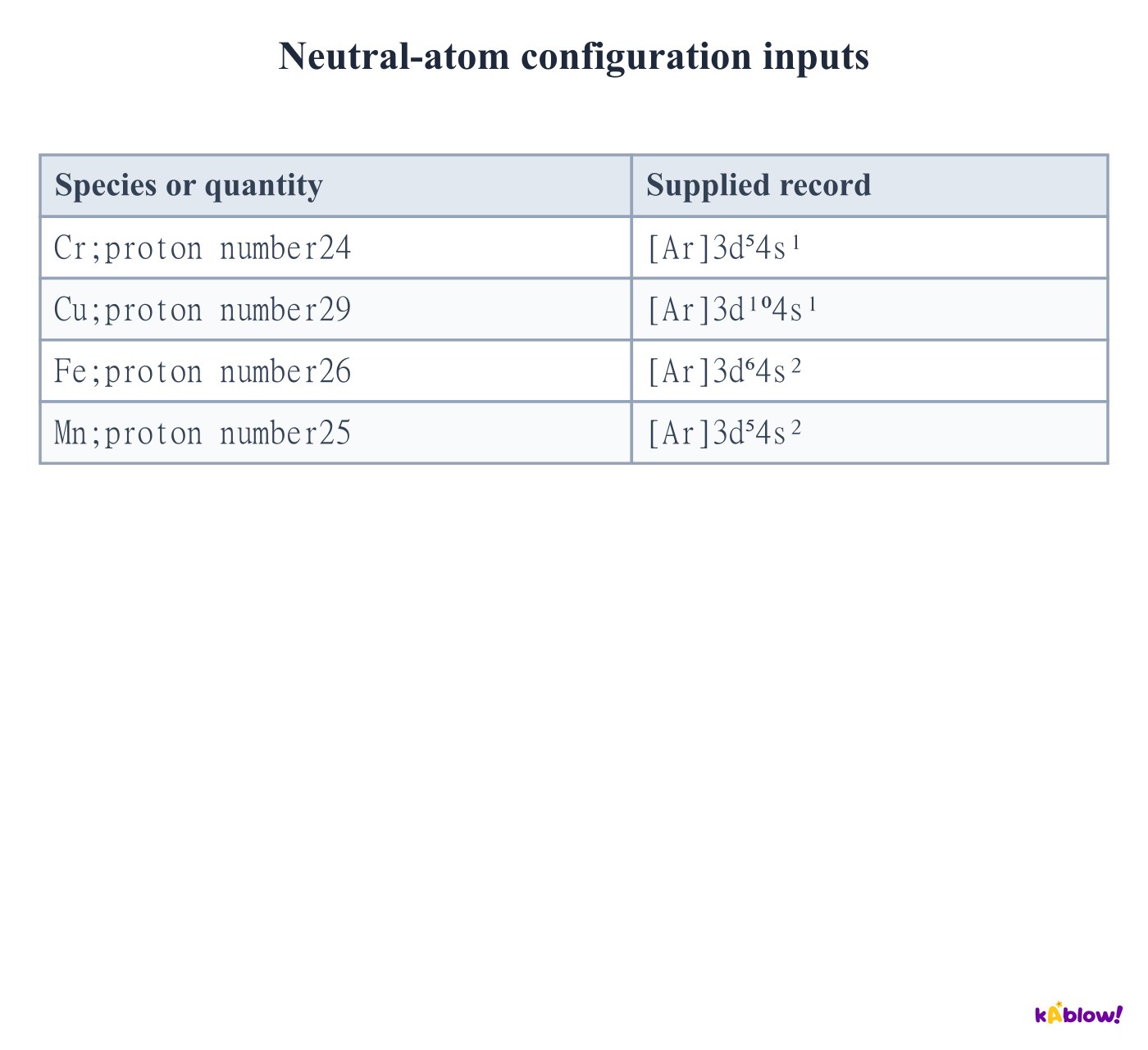
- Neutral chromium is[Ar]3d⁵4s¹ and neutral copper is[Ar]3d¹⁰4s¹. They differ from a simple filling-order prediction.
- The observed arrangements reflect the total energy of interacting electrons. Half-filled or filled d sublevels are useful school-level stability comparisons, not a filmed sequence of an electron being promoted.
- Count every electron, including the 18-electron argon core. Do not carry an assumed4s² into chromium or copper ion calculations.
Neutral-atom configuration inputs
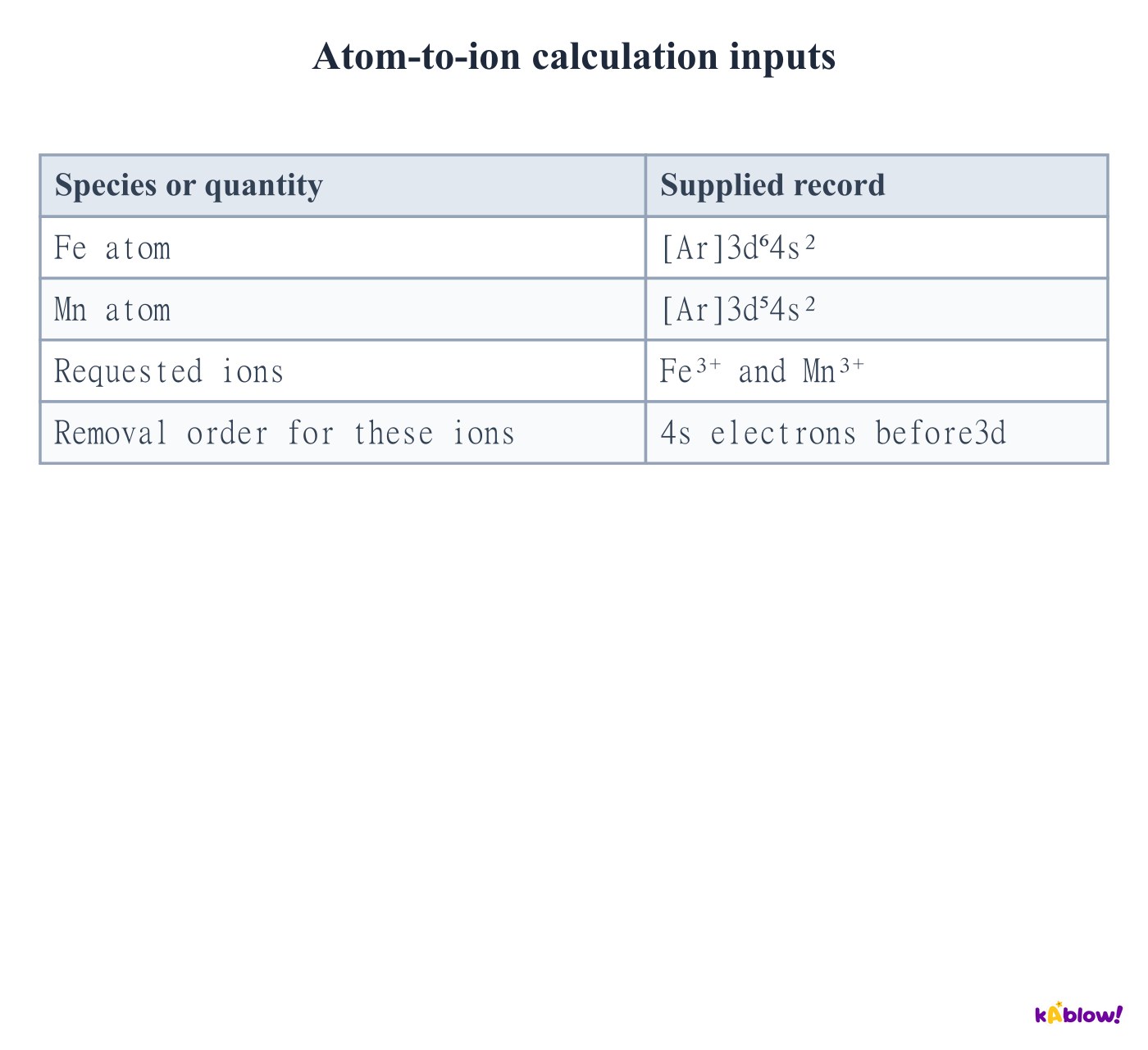
Remove 4s electrons before 3d for these ions
- For the first-row ions considered here, remove occupied 4s electrons before 3d electrons. The relative orbital energies depend on occupation and ionisation.
- Fe³⁺ is[Ar]3d⁵:remove both 4s electrons and one 3d electron from neutral Fe. Mn³⁺ similarly becomes[Ar]3d⁴.
- Ionisation energies remain substantial. Stable oxidation states depend on the balance of ionisation, bonding, lattice and hydration energies, not on electrons costing almost no energy to remove.
Atom-to-ion calculation inputs
Treat characteristic properties as patterns with exceptions
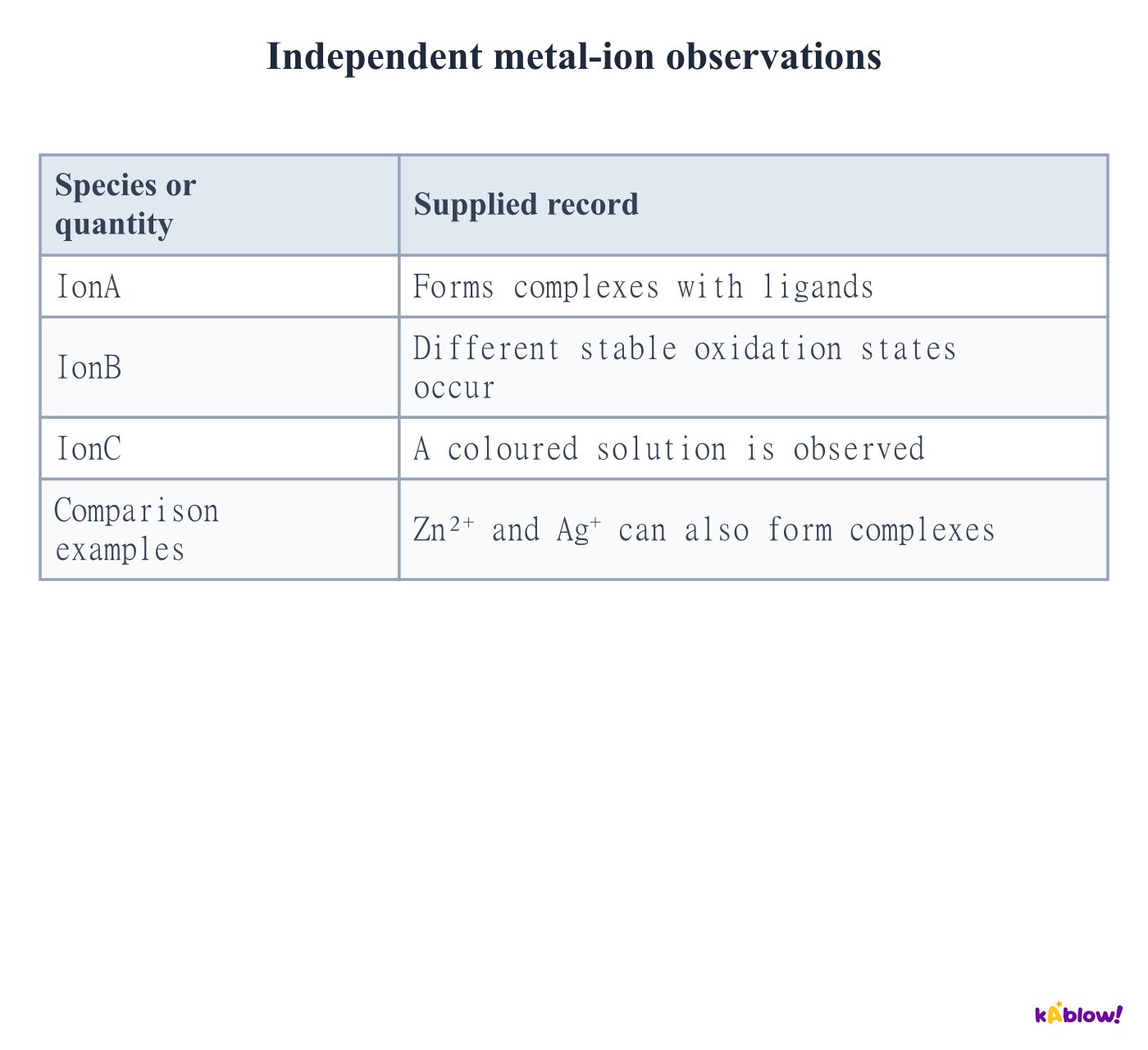
- Transition-metal chemistry commonly includes complex formation, coloured species, variable oxidation states and catalytic activity. These are characteristic patterns rather than four universal tests for every compound.
- Complex formation is not caused simply by variable oxidation states:Zn²⁺ and Ag⁺ also bind ligands. A coordination bond involves donation of an electron pair to a suitable acceptor.
- A d⁰ or d¹⁰ configuration rules out ordinary d–d excitation within that ion, but other transitions can still give colour. Purple MnO₄⁻ is an important charge-transfer example.
Independent metal-ion observations
Identify ligands as electron-pair donors
- A ligand donates an electron pair to form a coordinate bond to a central atom or ion. In this role it acts as a Lewis base.
- Water binds through oxygen and ammonia through nitrogen. Both are neutral ligands; chloride is a negatively charged ligand.
- A negative charge is not compulsory. Count the donor atoms that actually bind, rather than assuming every atom with a lone pair must coordinate in the chosen complex.
Ligand donor-atom inputs
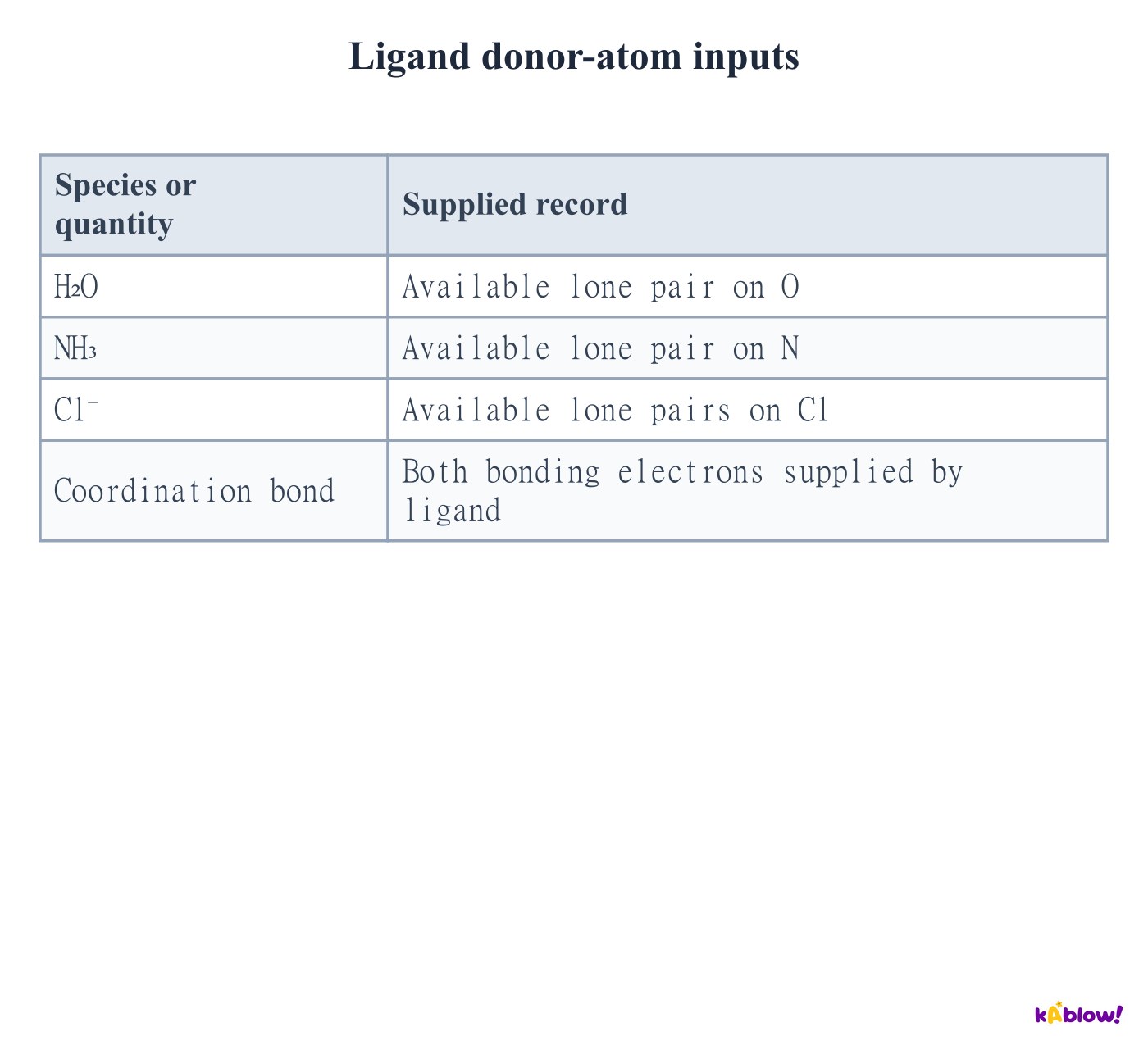
Separate ligand number from coordination number
- A monodentate ligand supplies one donor bond. A bidentate ligand can bind through two donor atoms, forming a chelate ring.
- Ethane-1, 2-diamine has two nitrogen donors; ethanedioate can use two oxygen donors. Their whole molecular or ionic identities remain single ligands.
- Three bidentate ligands give six donor bonds in[Co(en)₃]³⁺. Coordination number counts those bonds, not just the three ligand molecules.
Specified ligand binding modes
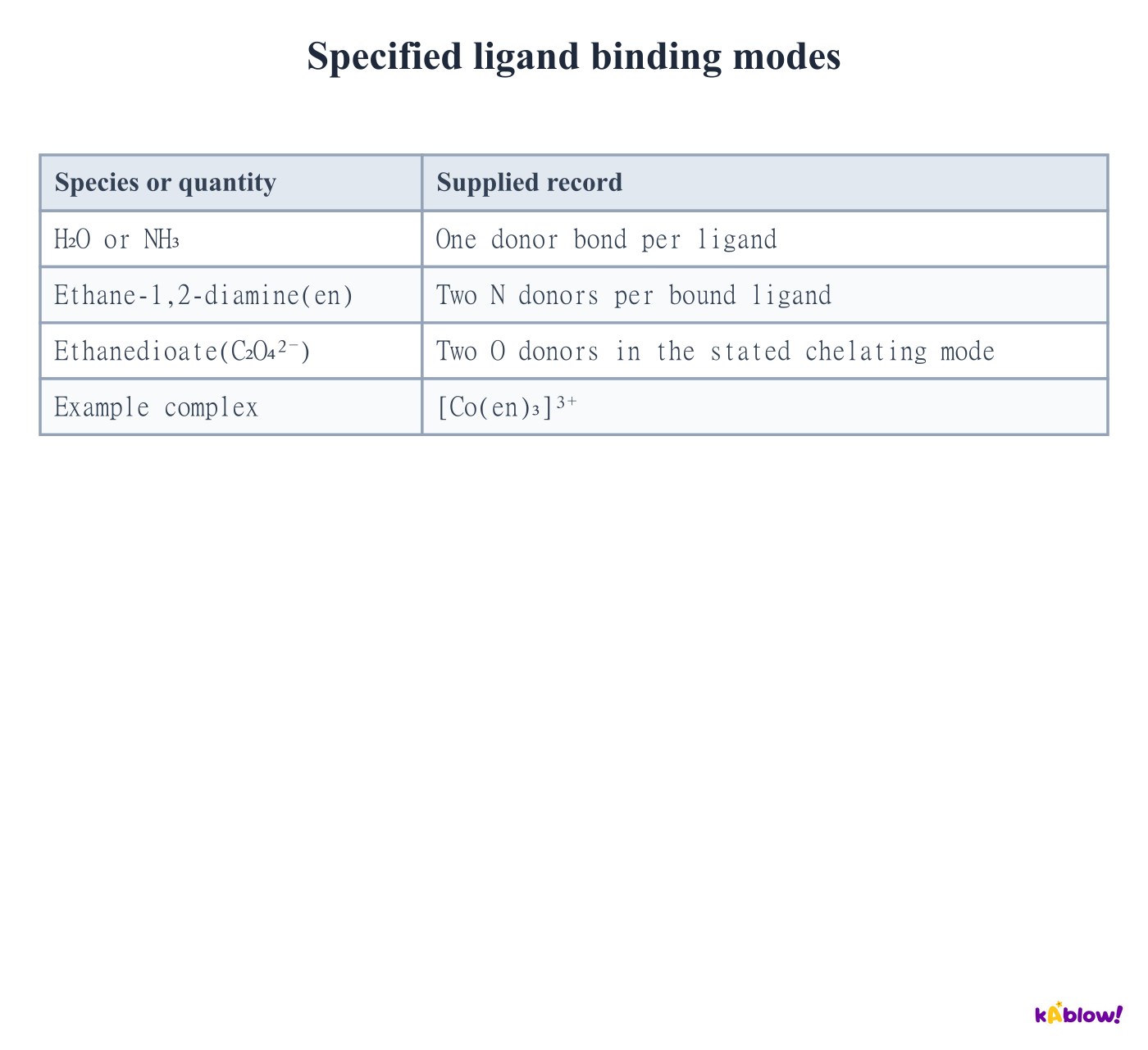
Use the six-donor EDTA model with its charge stated
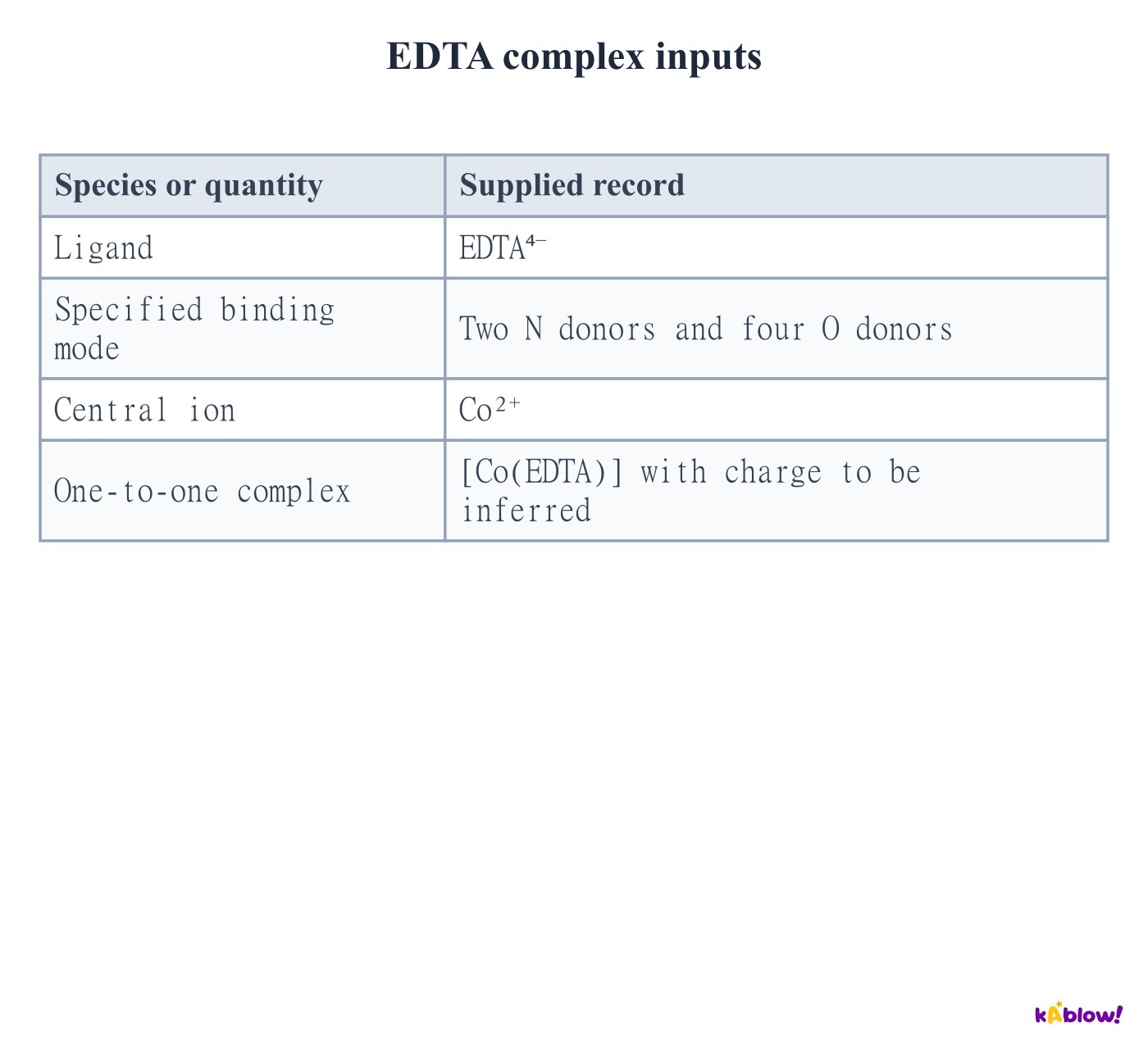
- EDTA⁴⁻ can bind through two nitrogen atoms and four oxygen atoms in the usual six-donor model. One such ligand can occupy six coordination sites.
- Not every multidentate ligand is hexadentate, and binding modes can depend on the metal and conditions. State the model rather than turning a common example into a universal rule.
- For Co²⁺ plus EDTA⁴⁻, the complex charge is−2. Neutral water released in substitution does not alter that charge balance.
EDTA complex inputs
Calculate charge separately from coordination number
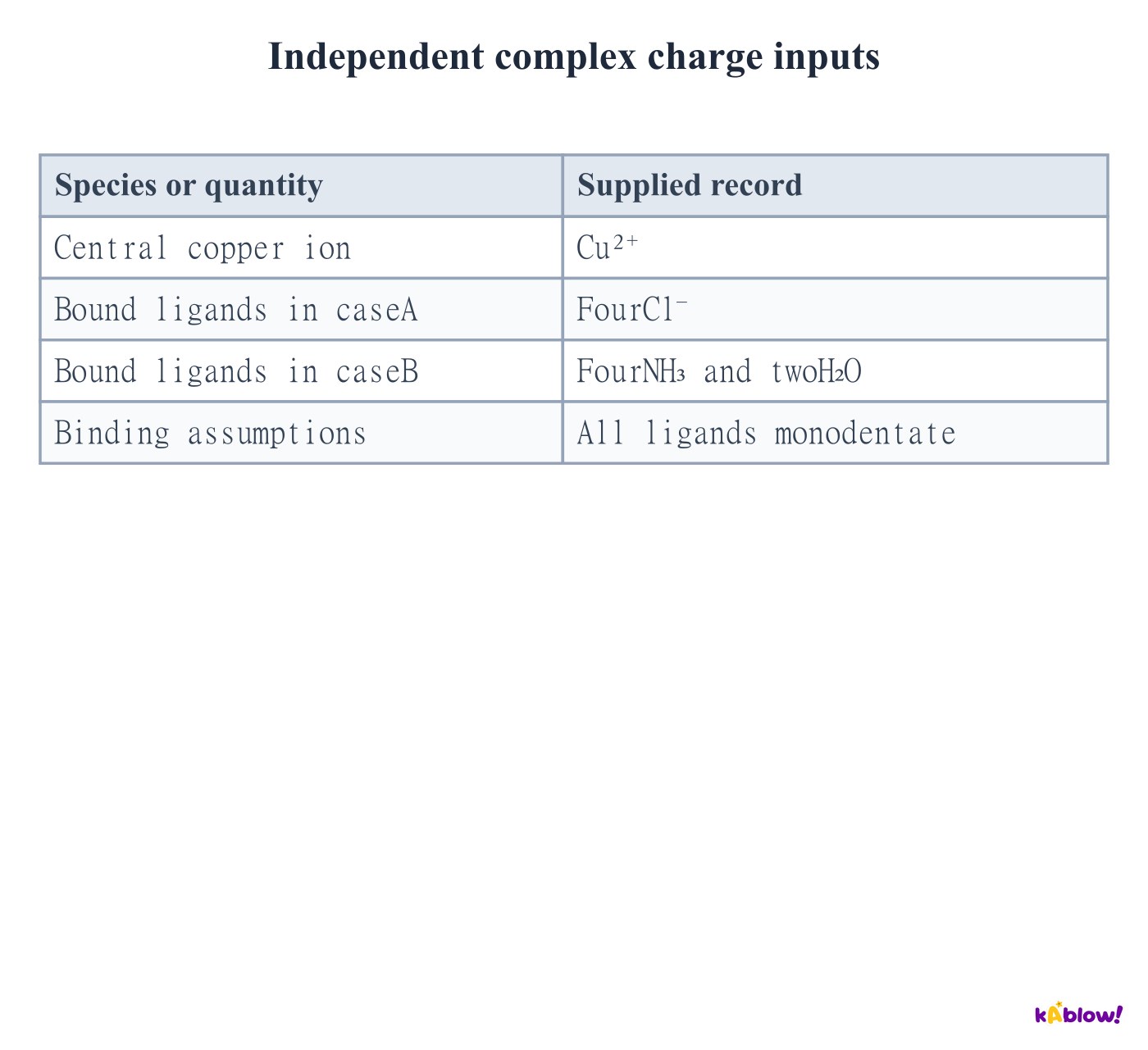
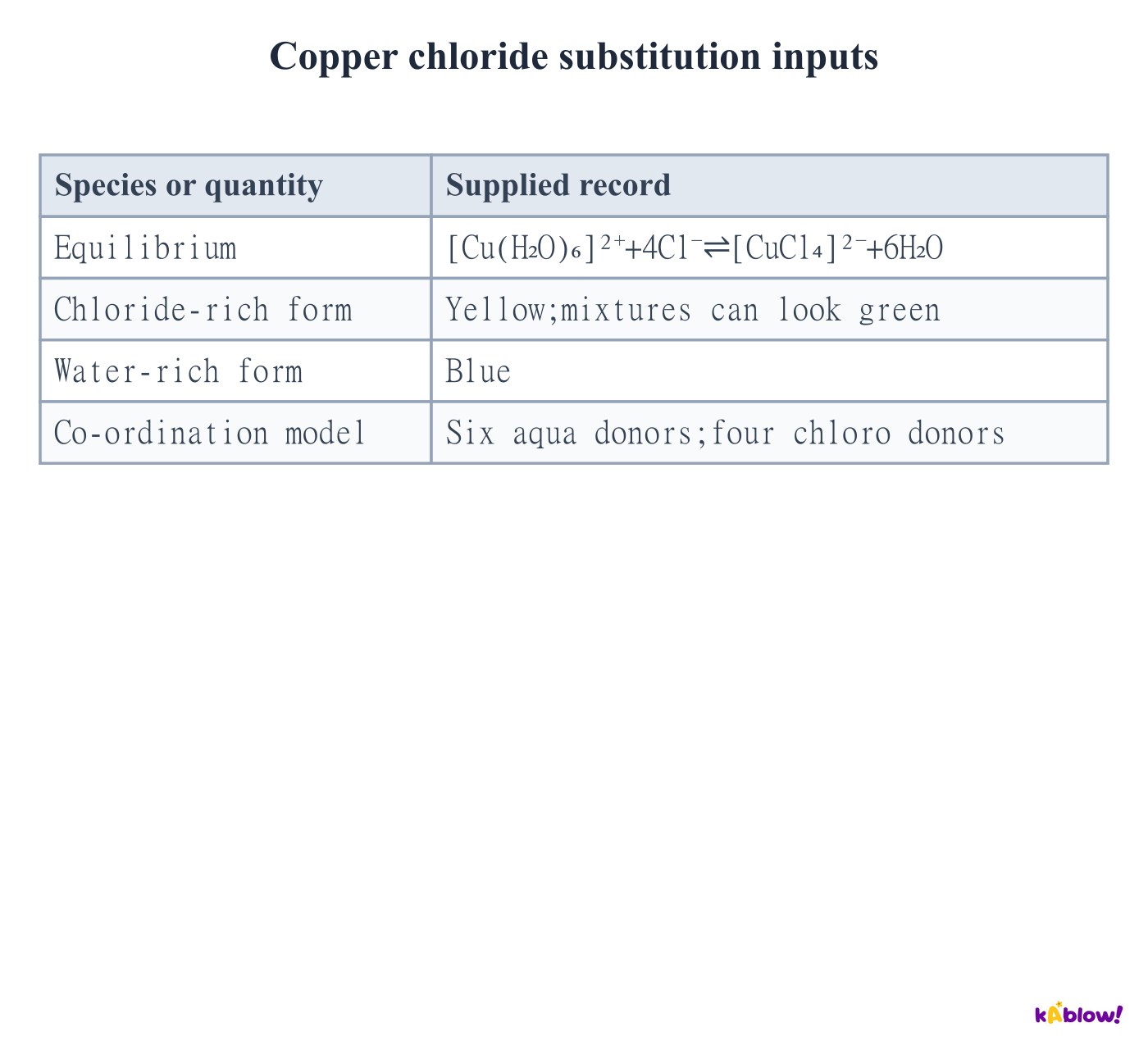
- The overall charge is the central-ion charge plus all ligand charges. FourCl⁻ around Cu²⁺ give[CuCl₄]²⁻.
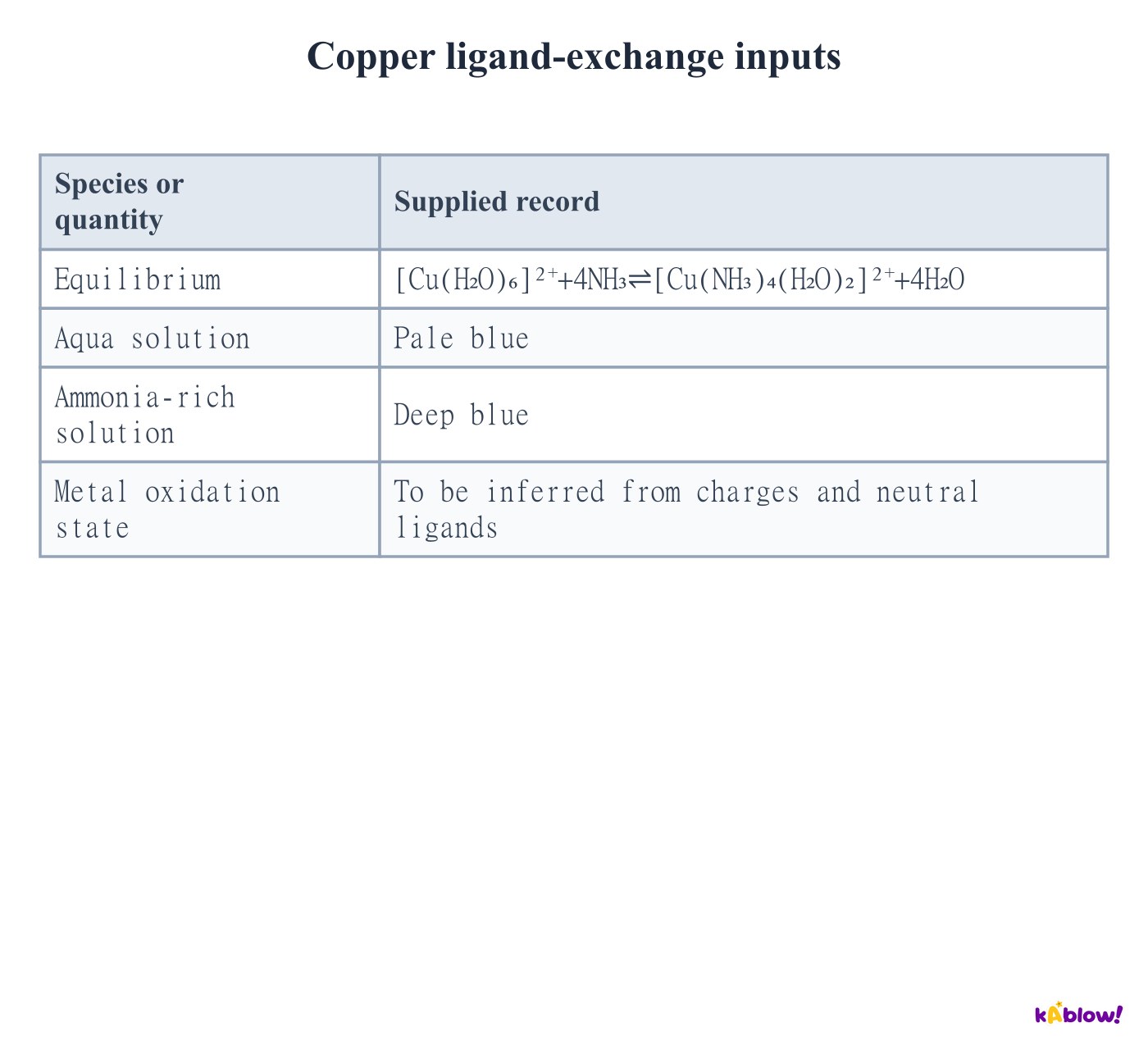
- FourNH₃ and two H₂O are six neutral ligands, so[Cu(NH₃)₄(H₂O)₂]²⁺ retains charge+2 and coordination number 6.
- Roman numerals specify metal oxidation state; they are not the overall complex charge. The same copper(II) centre can occur in positive or negative complexes.
Independent complex charge inputs
Read an octahedral aqua-complex model
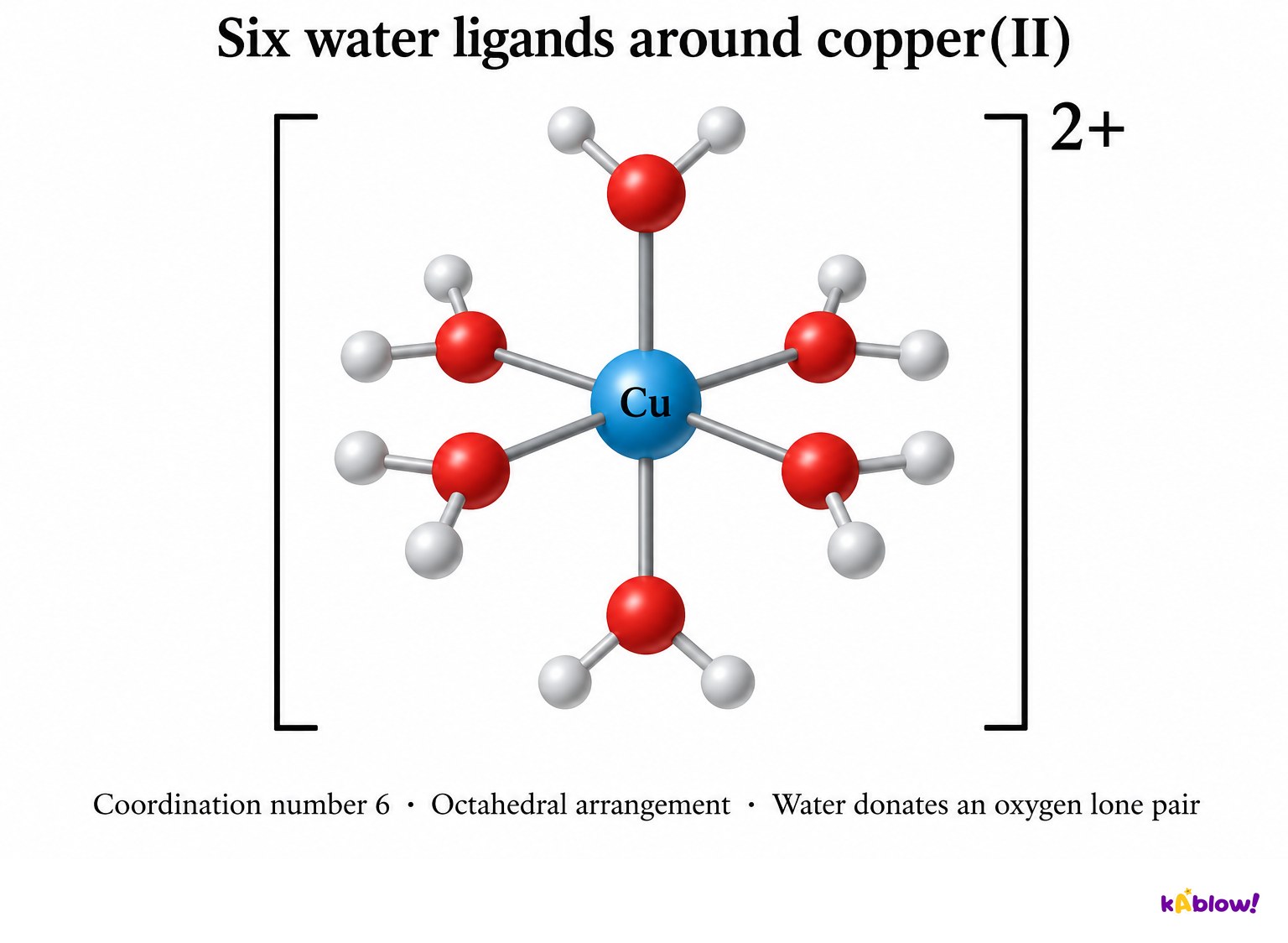
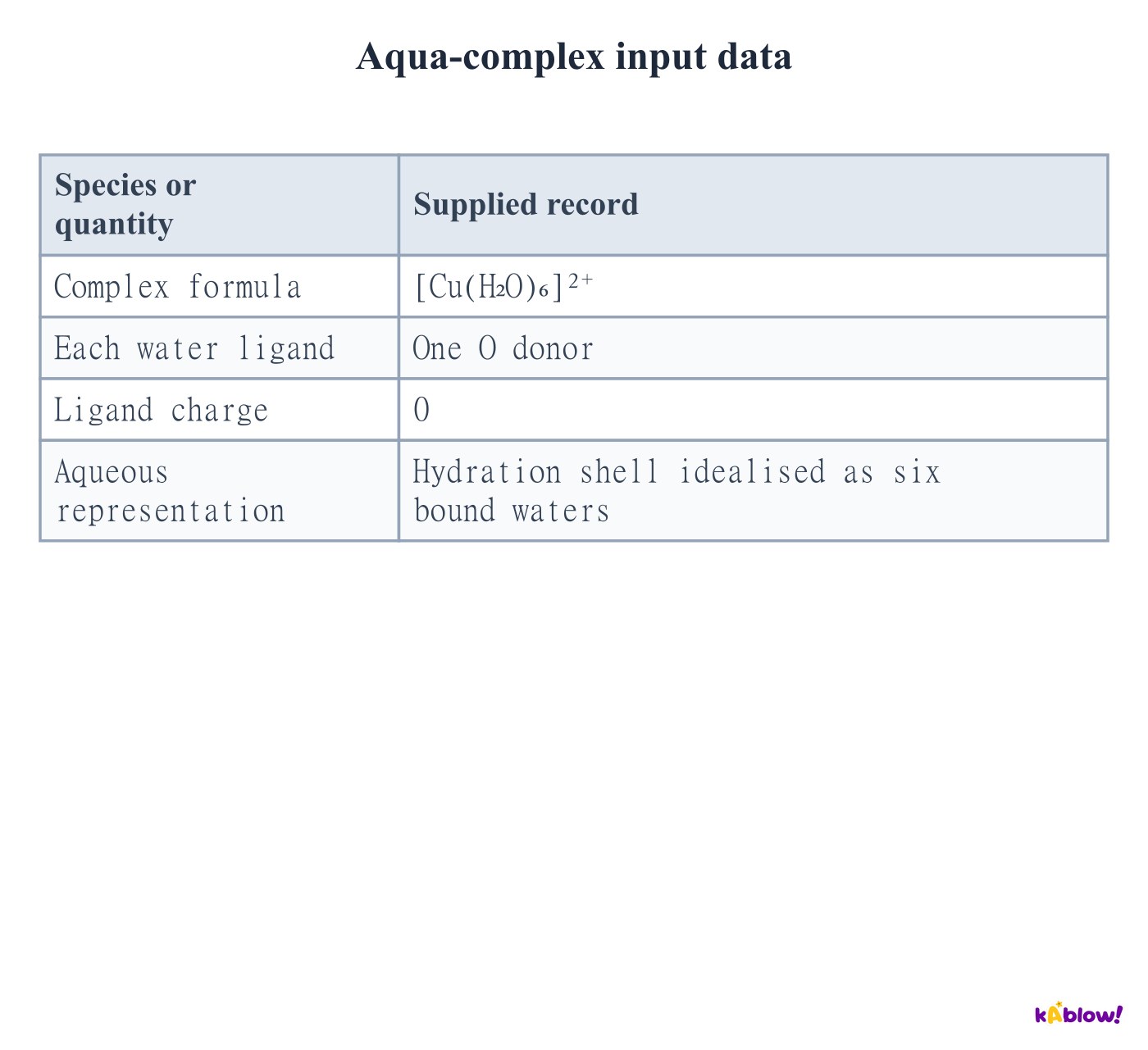
- The reviewed bucket illustration shows six waters coordinated through oxygen around copper(II). Its brackets and 2+ charge identify the entire complex ion.
- The six-donor arrangement is treated as octahedral; aqueous copper(II) commonly has an elongation, so an ideal diagram does not assert six identical measured Cu–O distances.
- The shorthand Cu²⁺(aq) usually implies hydration. It is not a drawing of an unaccompanied gas-phase ion moving through water.
Six water ligands around copper(II)
Explain partial substitution by ammonia
- Excess ammonia favours[Cu(NH₃)₄(H₂O)₂]²⁺, a deep-blue complex. Four waters are replaced, but two waters remain coordinated.
- The coordination number stays 6 and copper stays+2. Ligand substitution need not be a redox change or complete replacement of every ligand.
- An equilibrium responds to concentrations and other conditions. Avoid saying every ligand exchange must form a more stable product regardless of composition.
Copper ligand-exchange inputs
Separate initial base chemistry from excess-ligand chemistry
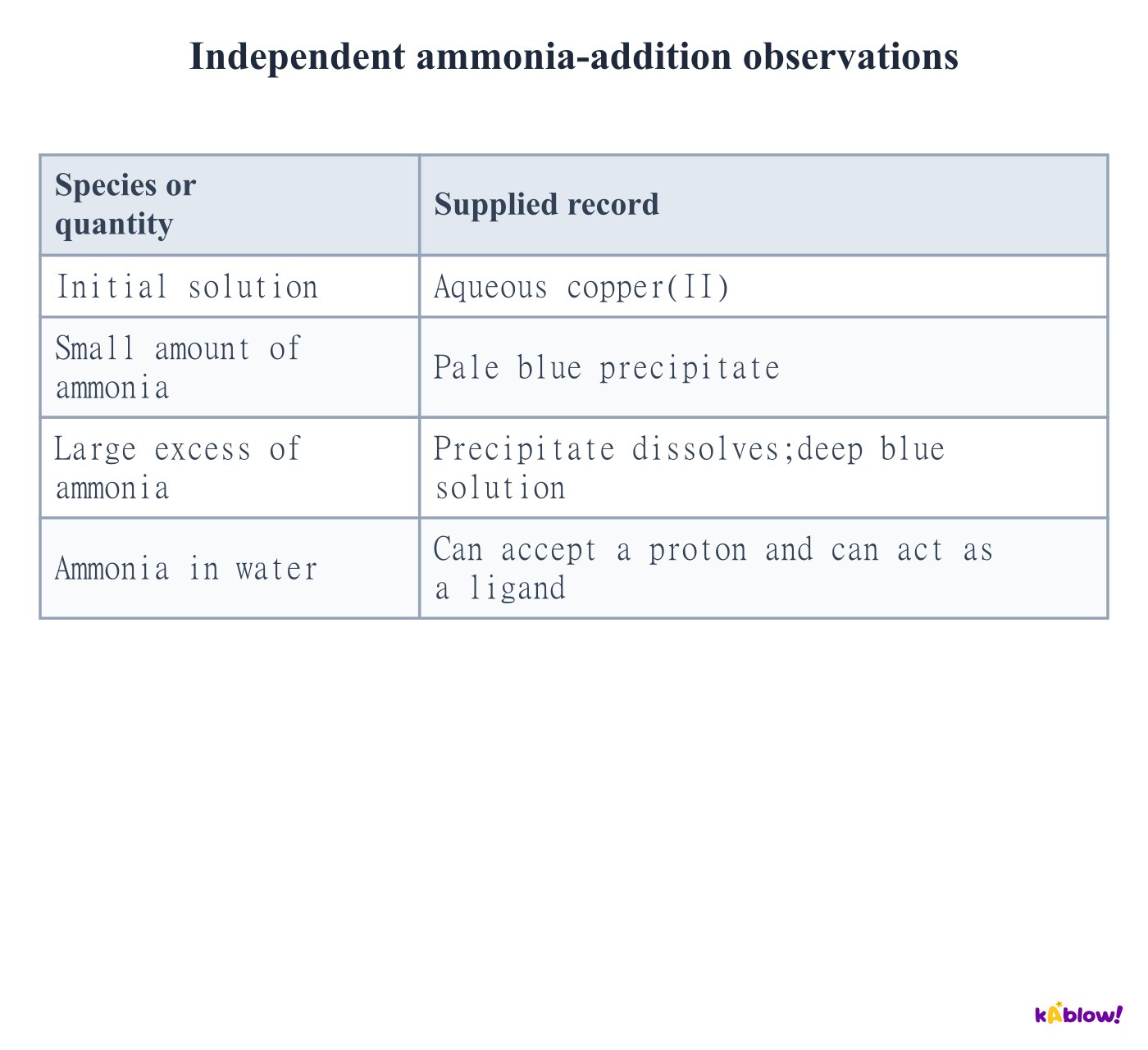
- A small amount of ammonia can remove protons from coordinated water, forming a pale-blue copper(II) hydroxide-containing precipitate. This is initially base chemistry.
- In excess ammonia, formation of the soluble ammine complex can dissolve the precipitate. The observation changes from a solid suspension to a deep-blue solution.
- Do not label every hydroxide precipitation as simple replacement of water by OH⁻. Proton transfer, precipitation and ligand equilibria are distinct parts of the explanation.
Independent ammonia-addition observations
Link chloride exchange to geometry and equilibrium
- High chloride concentration favours a four-chloride complex in the school model. Copper remains +2 while the coordination number changes from 6 to 4.
- The aqua complex is blue and the chloro-rich form yellow; mixtures can appear green. Colour is evidence to interpret with concentration and speciation.
- Adding water favours the aqua form. Ligand size helps rationalise this example, but chloride does not force coordination number 4 for every metal complex.
Copper chloride substitution inputs
Compare cobalt substitution with oxidation in air
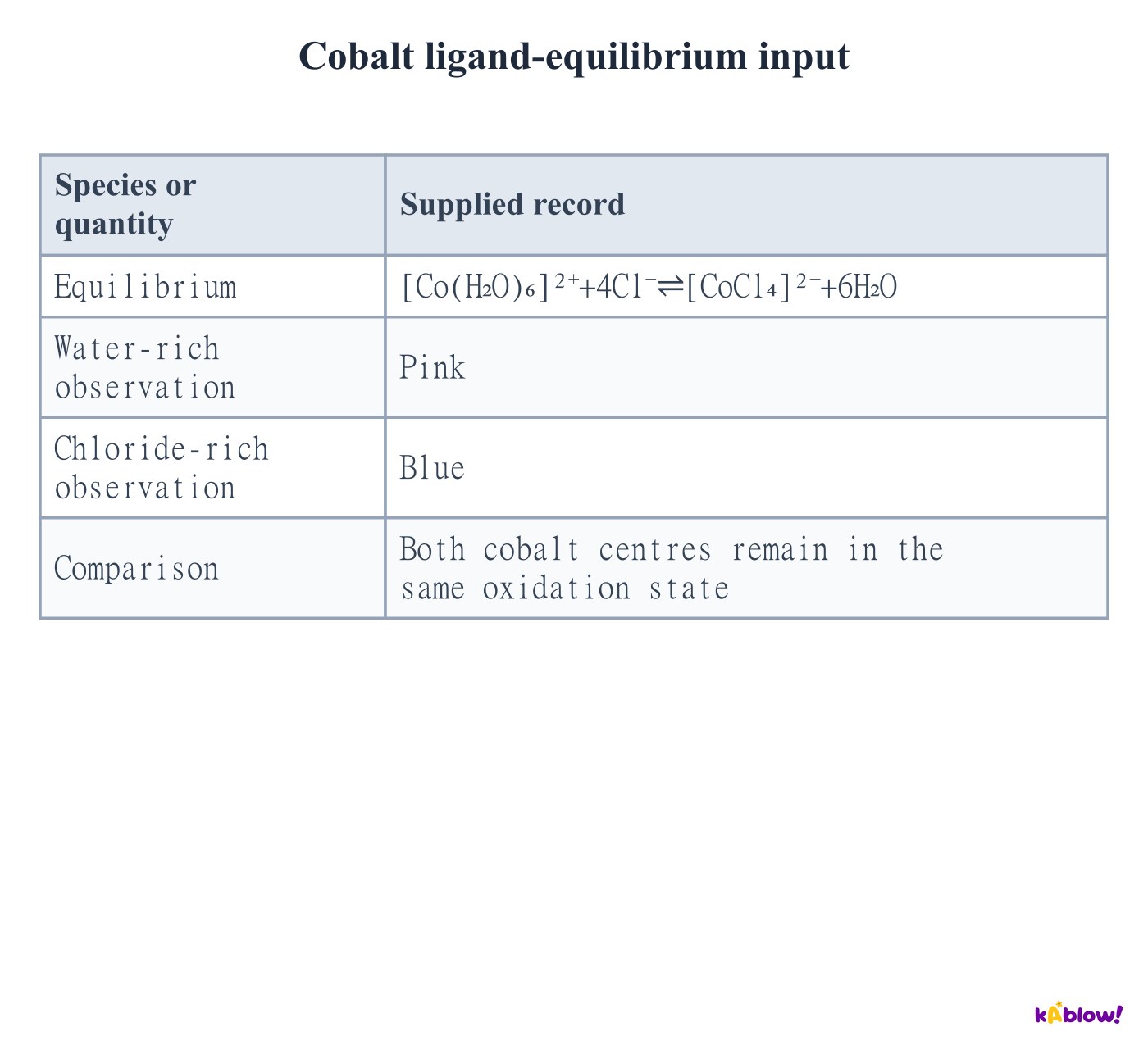
- Cobalt(II) aqua and chloride-rich solutions commonly show pink and blue colours respectively. Water/chloride changes shift the ligand equilibrium.
- Ammonia substitution is a separate example, and subsequent oxidation by air can produce cobalt(III) ammine species. Distinguish substitution from that additional electron-transfer step.
- Colours depend on conditions and mixtures. Do not assign every brown ammonia-treated cobalt solution to one pure species without further evidence.
Cobalt ligand-equilibrium input
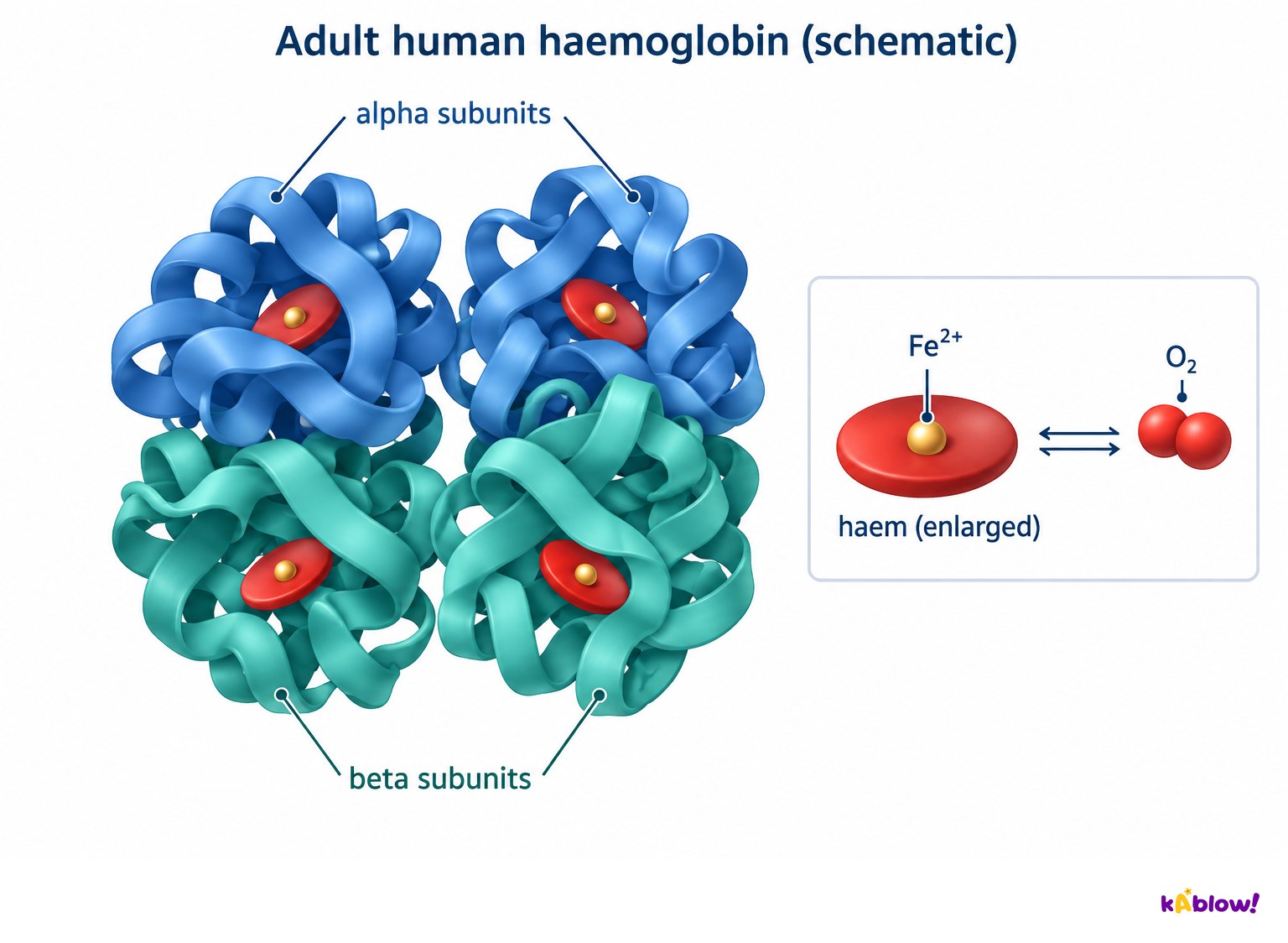
Use haem to explain oxygen binding and CO competition
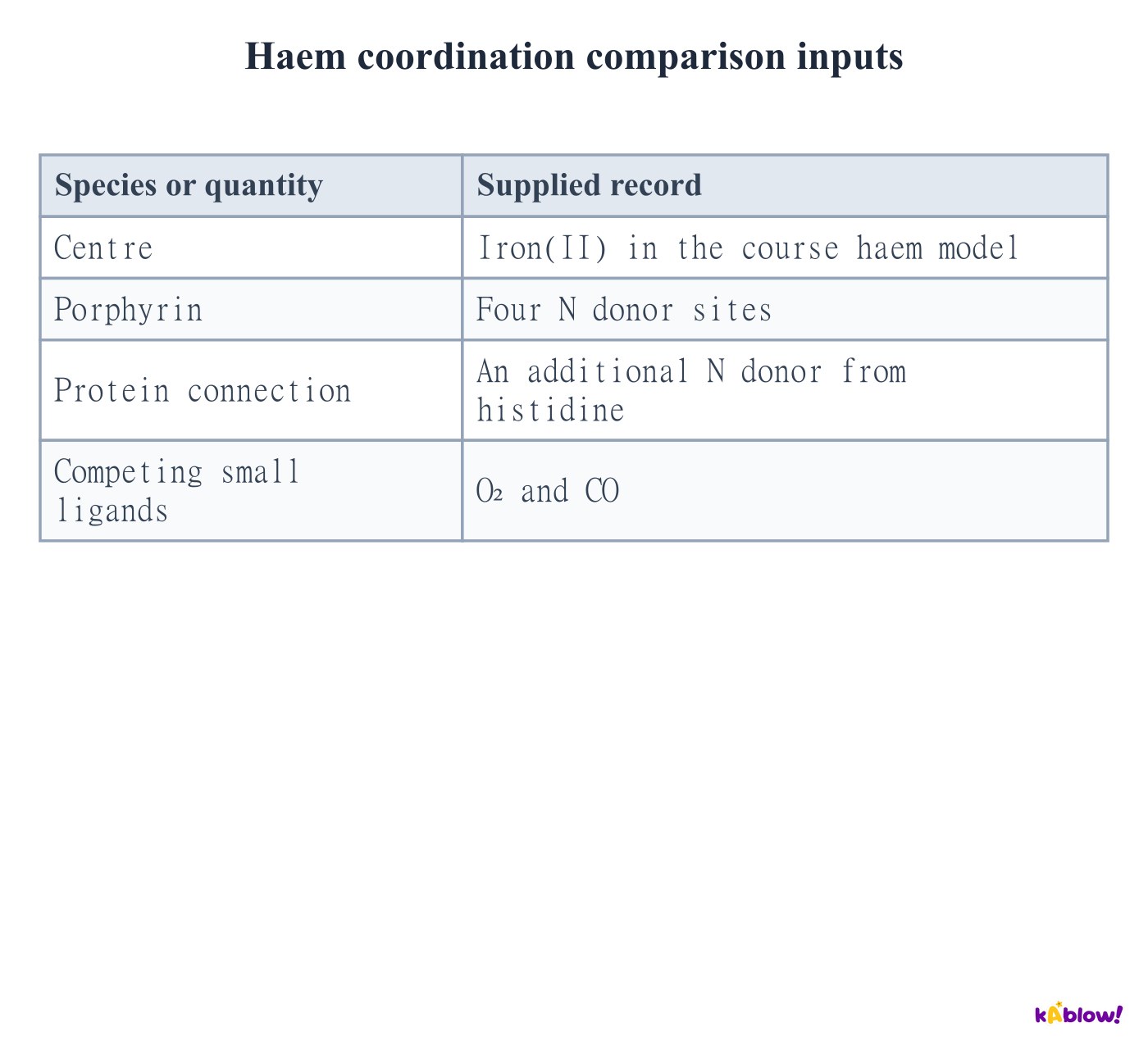
- The reviewed haemoglobin overview shows haem iron sites and reversible O₂ binding. Each haem contains iron coordinated by a multidentate porphyrin and the surrounding protein; an O₂ molecule can occupy a further binding position in the school model.
- Carbon monoxide competes strongly for haem binding and reduces effective oxygen transport. Its binding has high affinity and slow dissociation; it is not chemically irreversible.
- This ligand comparison explains an aspect of toxicity. It does not make colour alone a diagnostic test or imply that every cause of anaemia is iron deficiency.
Haem iron sites in haemoglobin
Explain the chelate effect without an absolute entropy rule
- Chelating ligands often form more stable complexes than comparable monodentate ligands. The chelate effect is a relative equilibrium-stability comparison.
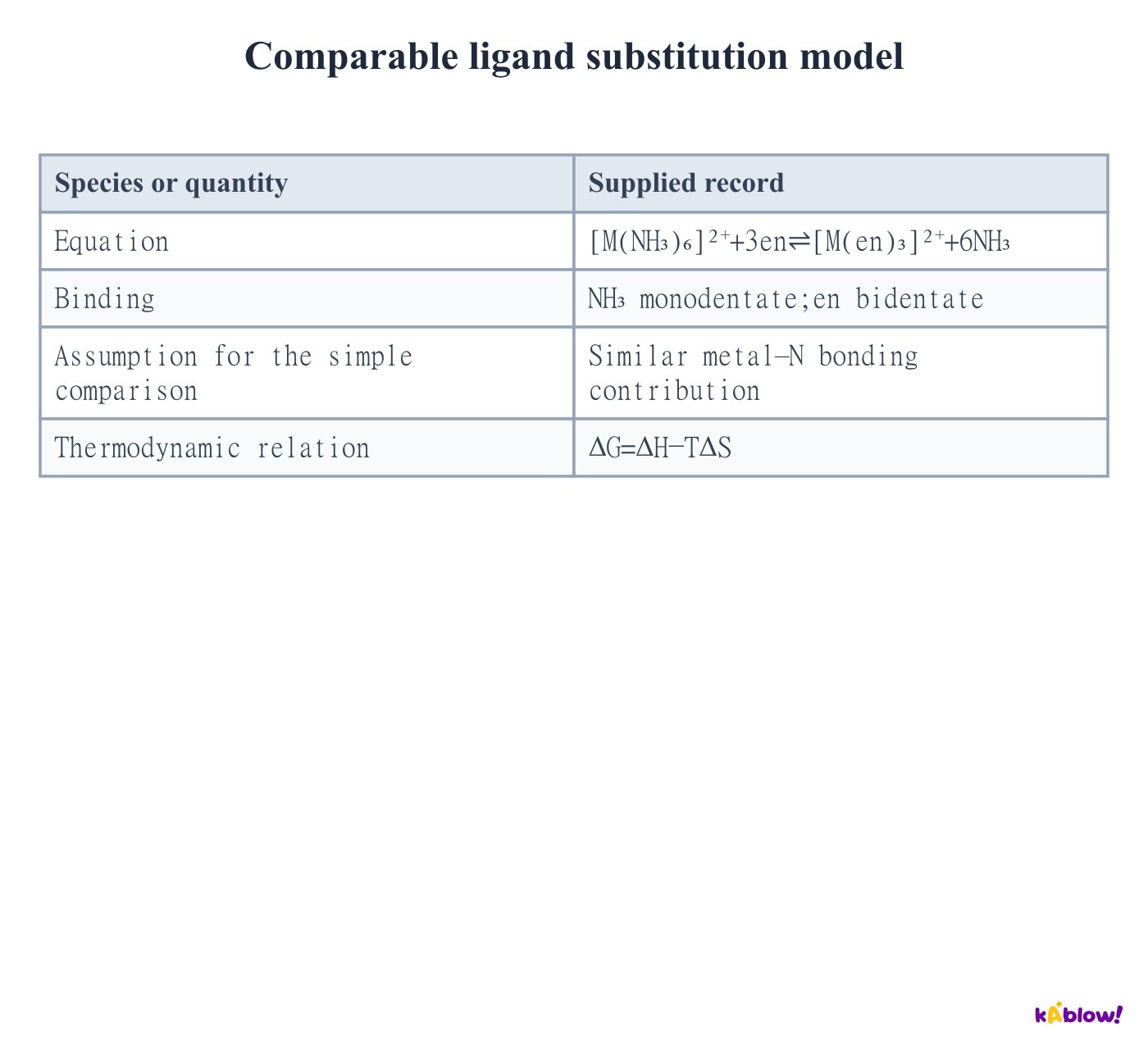
- Replacing six bound ammonia ligands by three en ligands releases more solute particles in the simplified model. A favourable entropy contribution can help drive substitution.
- Enthalpy, solvation, protonation and concentrations also matter. Entropy is not always positive, and counting liquid solvent water as independent dilute solute particles is not a complete thermodynamic proof.
Comparable ligand substitution model
Compare enthalpy and entropy in a chelation calculation
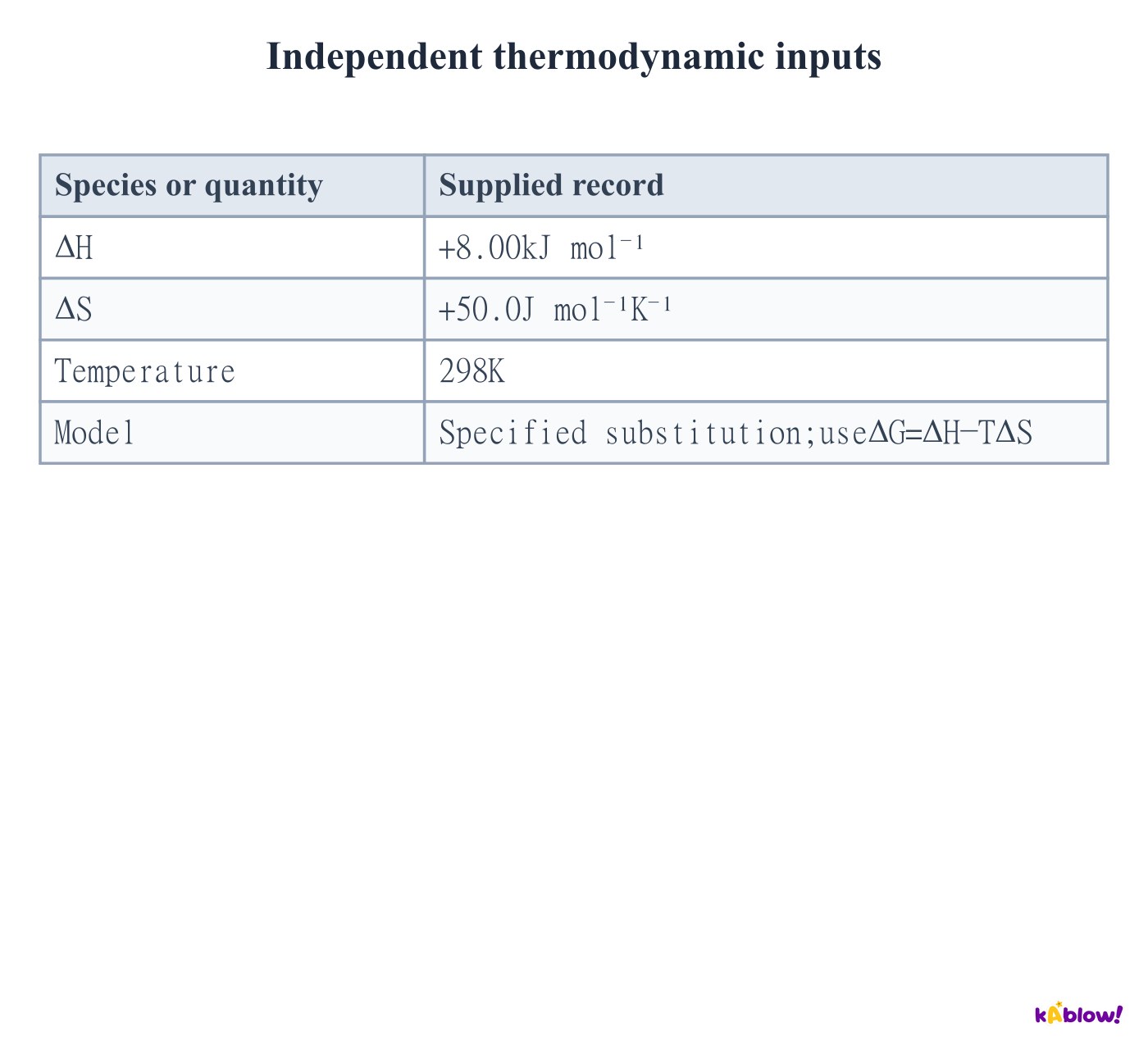
- Use consistent units in ΔG=ΔH−TΔS. Convert 50.0Jmol⁻¹K⁻¹ to 0.0500kJmol⁻¹K⁻¹ before multiplying by 298K.
- For these supplied inputs, ΔG=8.00−298×0.0500=−6.90kJmol⁻¹. The positive enthalpy does not prevent a negative Gibbs change.
- A negative standard Gibbs change indicates a thermodynamically favourable standard comparison, not an unlimited yield or a guaranteed fast reaction.
Independent thermodynamic inputs
Read the linear silver ammine geometry
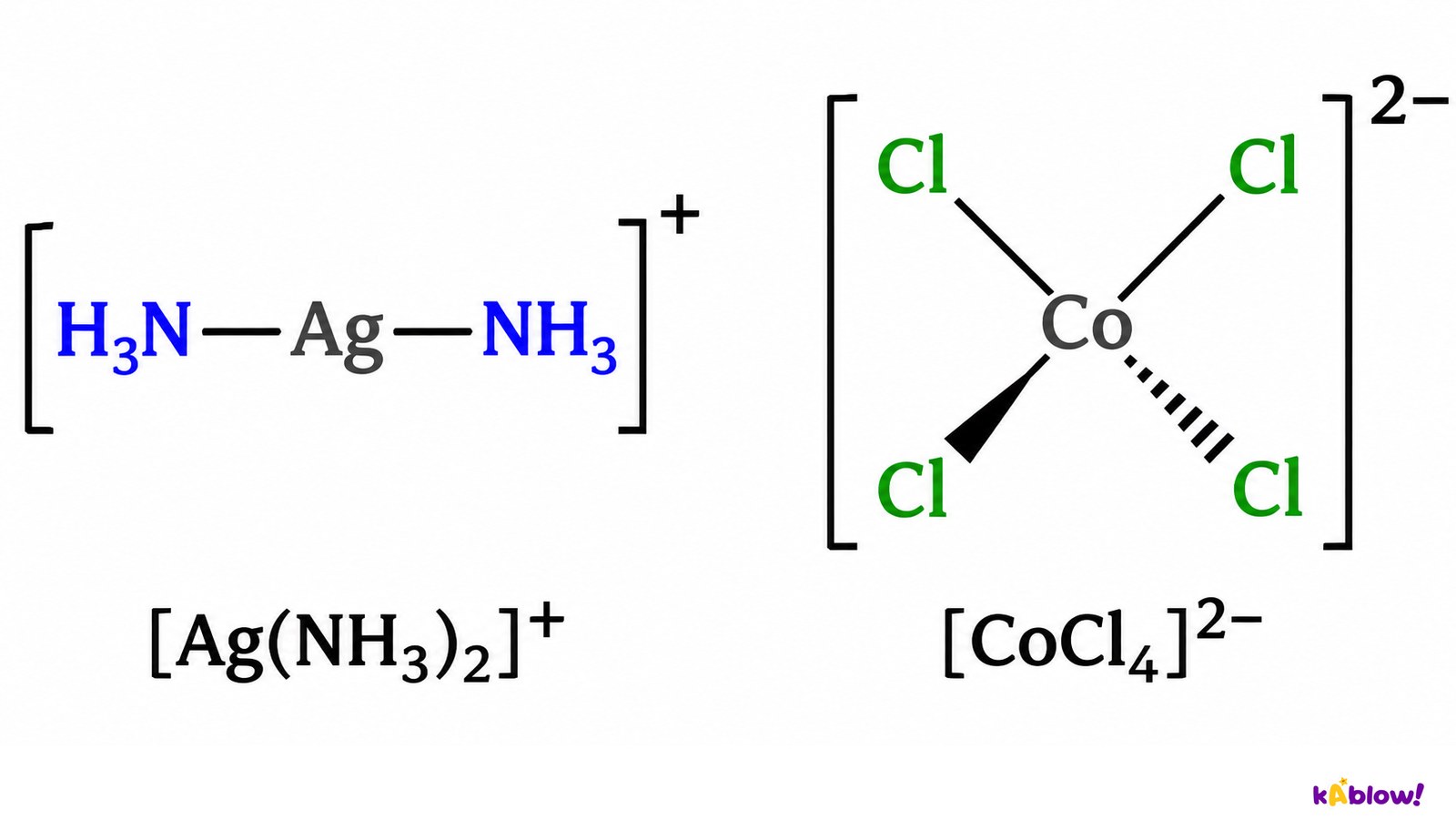
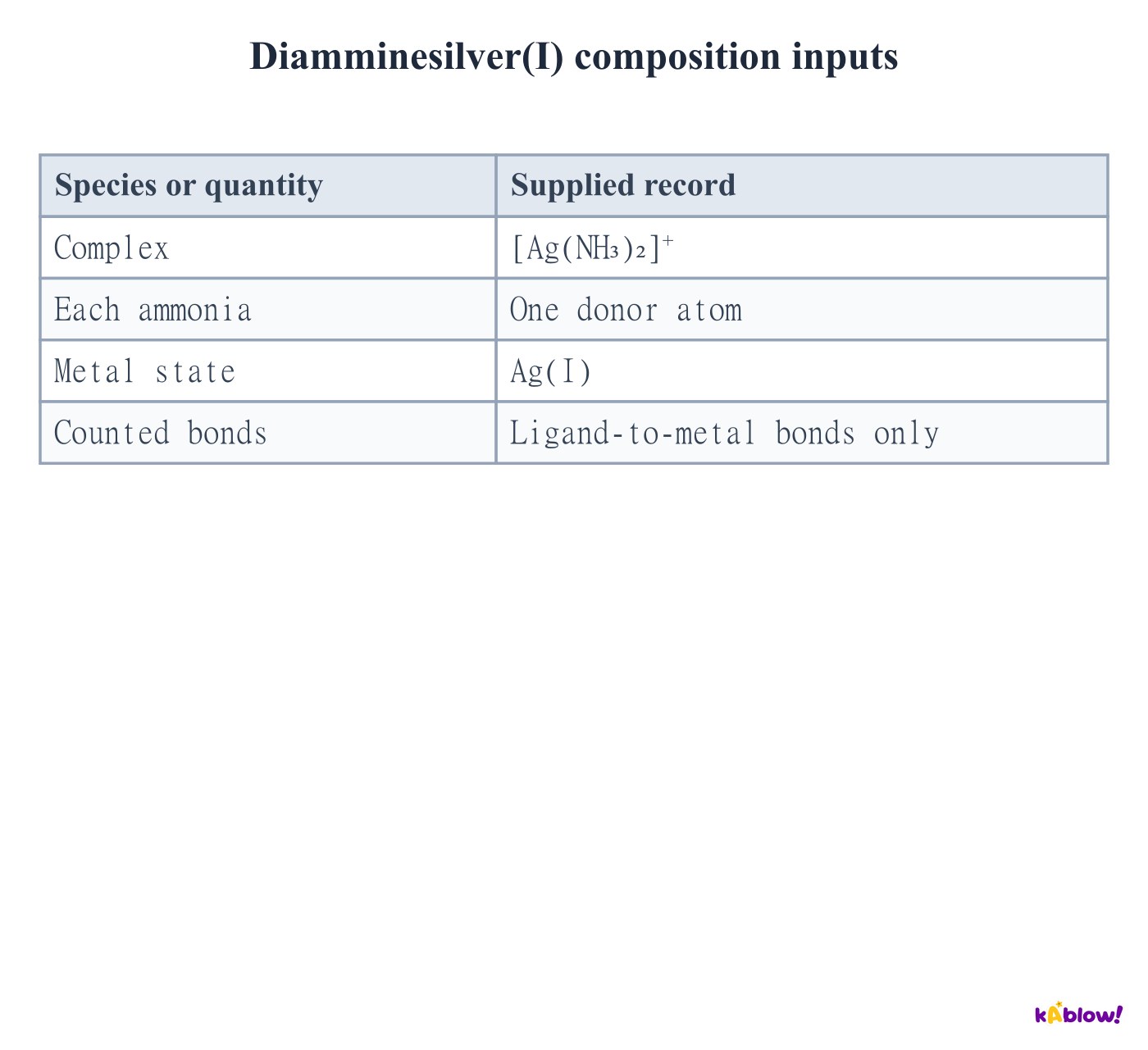
- Diamminesilver(I), [Ag(NH₃)₂]⁺, has coordination number 2 and a linear donor arrangement with bond angle180°.
- The two nitrogen atoms donate to silver; their donor bonds are distinct from N–H bonds within each ligand.
- This complex is used in Tollens’ reagent. Silver is not one of the first-row Ti–Cu examples, but its coordination chemistry gives a useful shape comparison.
Linear and tetrahedral donor arrangements
Distinguish tetrahedral coordination from a flat cross
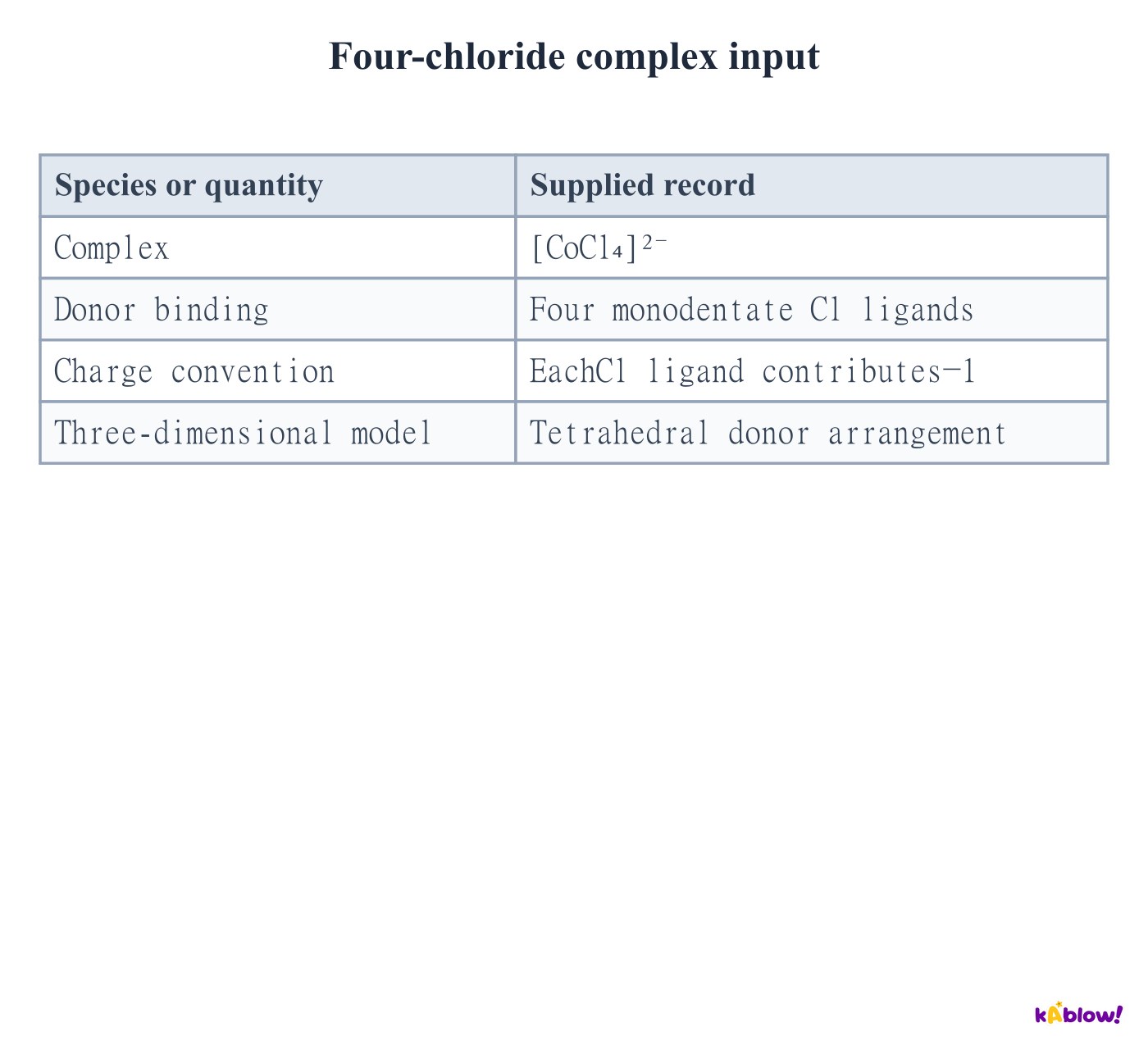
- [CoCl₄]²⁻ is treated as tetrahedral, with ideal Cl–Co–Cl angles about109.5°. Four donor sites do not lie in a square plane.
- Wedges indicate a bond towards the viewer and hashed wedges a bond away; ordinary lines indicate the page plane. They are perspective conventions, not additional bonds.
- Coordination number 4 can also be square planar for other complexes. Choose the specified species rather than predicting shape from the number alone.
Linear and tetrahedral donor arrangements
Compare square planar cisplatin and transplatin
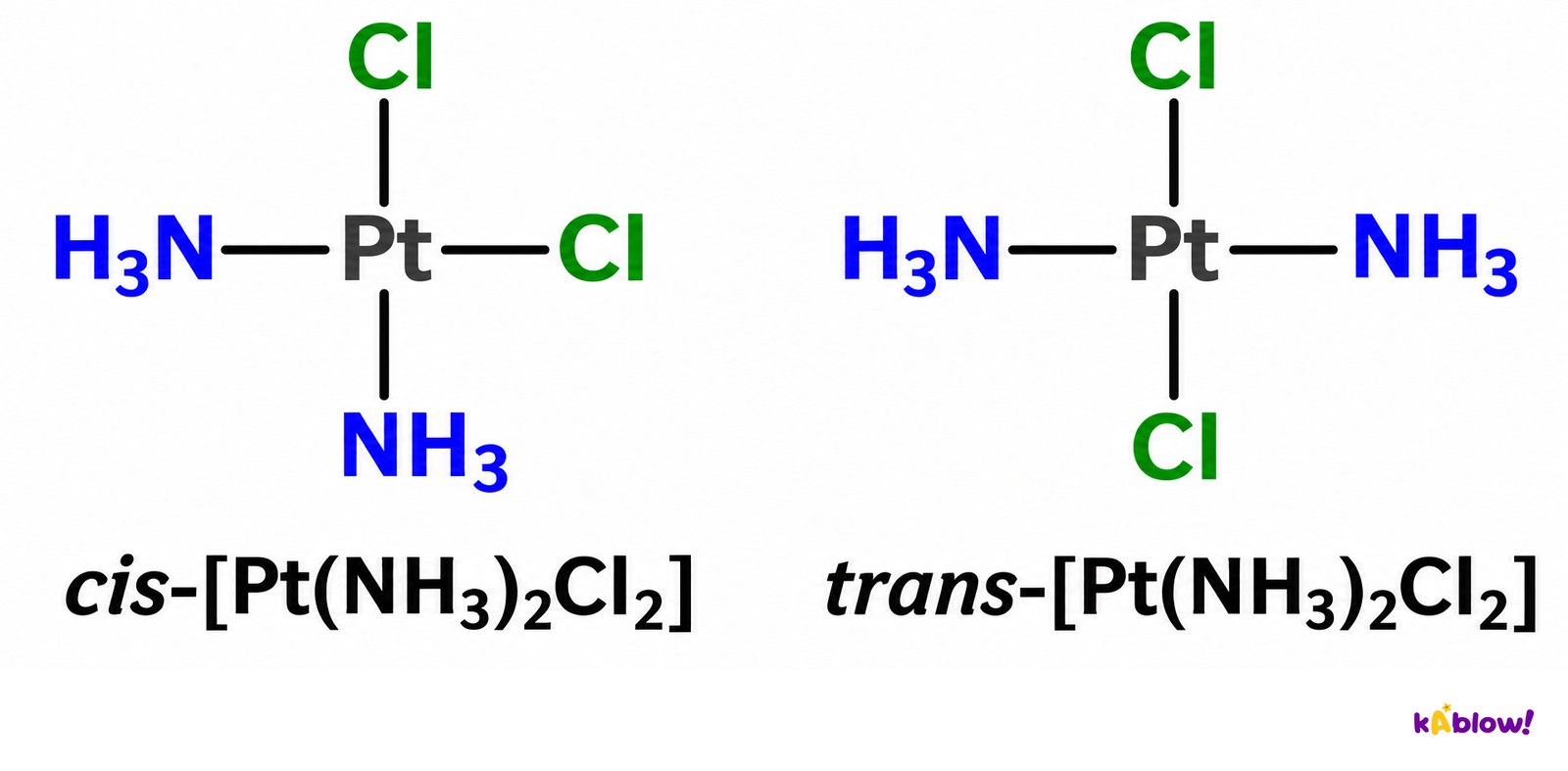
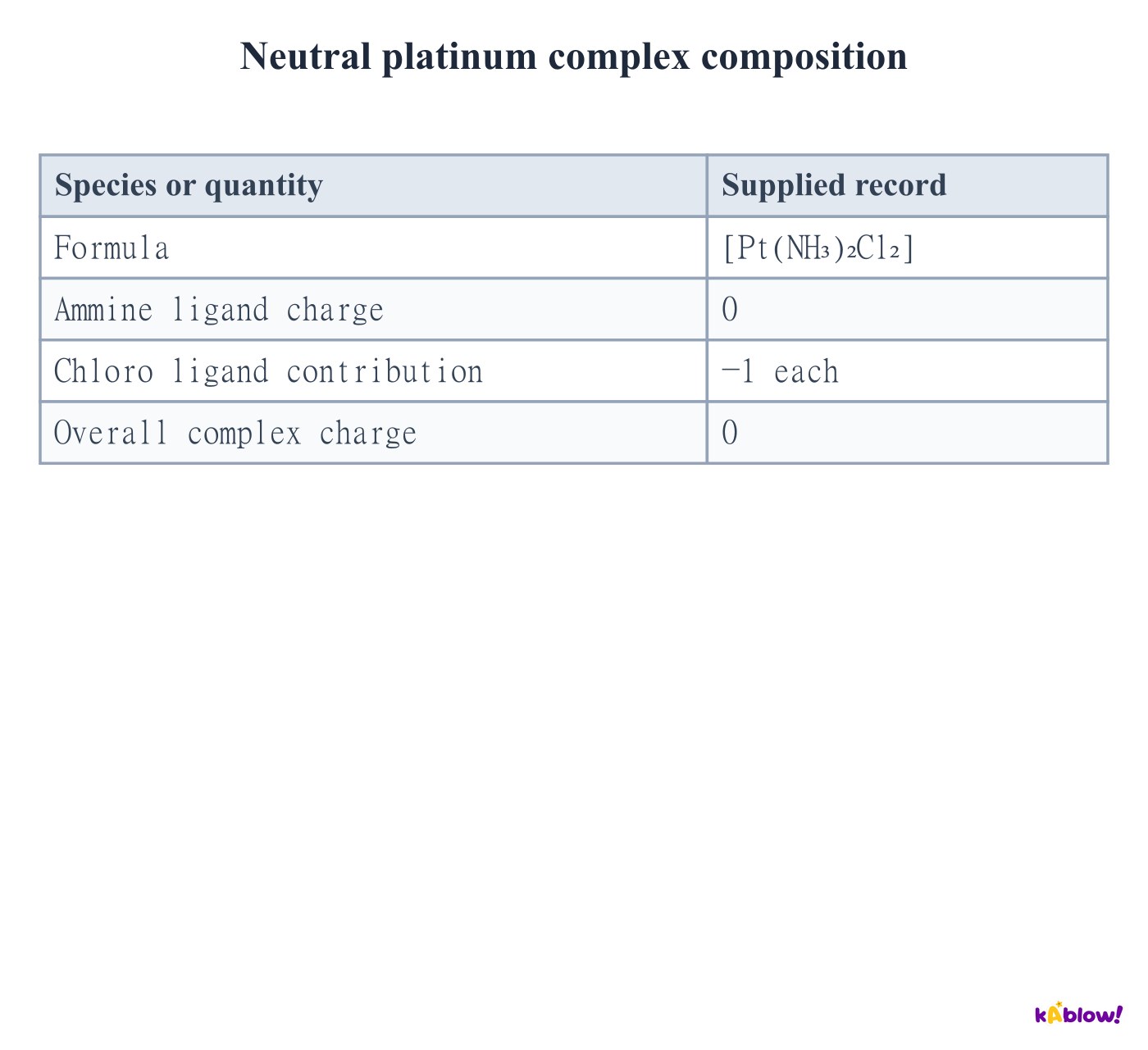
- The two displayed platinum complexes are square planar. In the cis form, the chloride donors are adjacent; in the trans form, they are opposite.
- Both have the same composition, Pt oxidation state +2 and coordination number 4. The ligand positions differ, so they are geometrical isomers.
- Cisplatin’s geometry matters to its DNA cross-linking and anticancer activity. Avoid the broader claim that every trans platinum compound is unable to bind DNA or has identical biological behaviour.
Square planar platinum geometrical isomers
Recognise the six-donor octahedral arrangement
- An octahedral complex has six donor sites arranged around a centre. Adjacent ideal donor directions make90° and opposite directions180°.
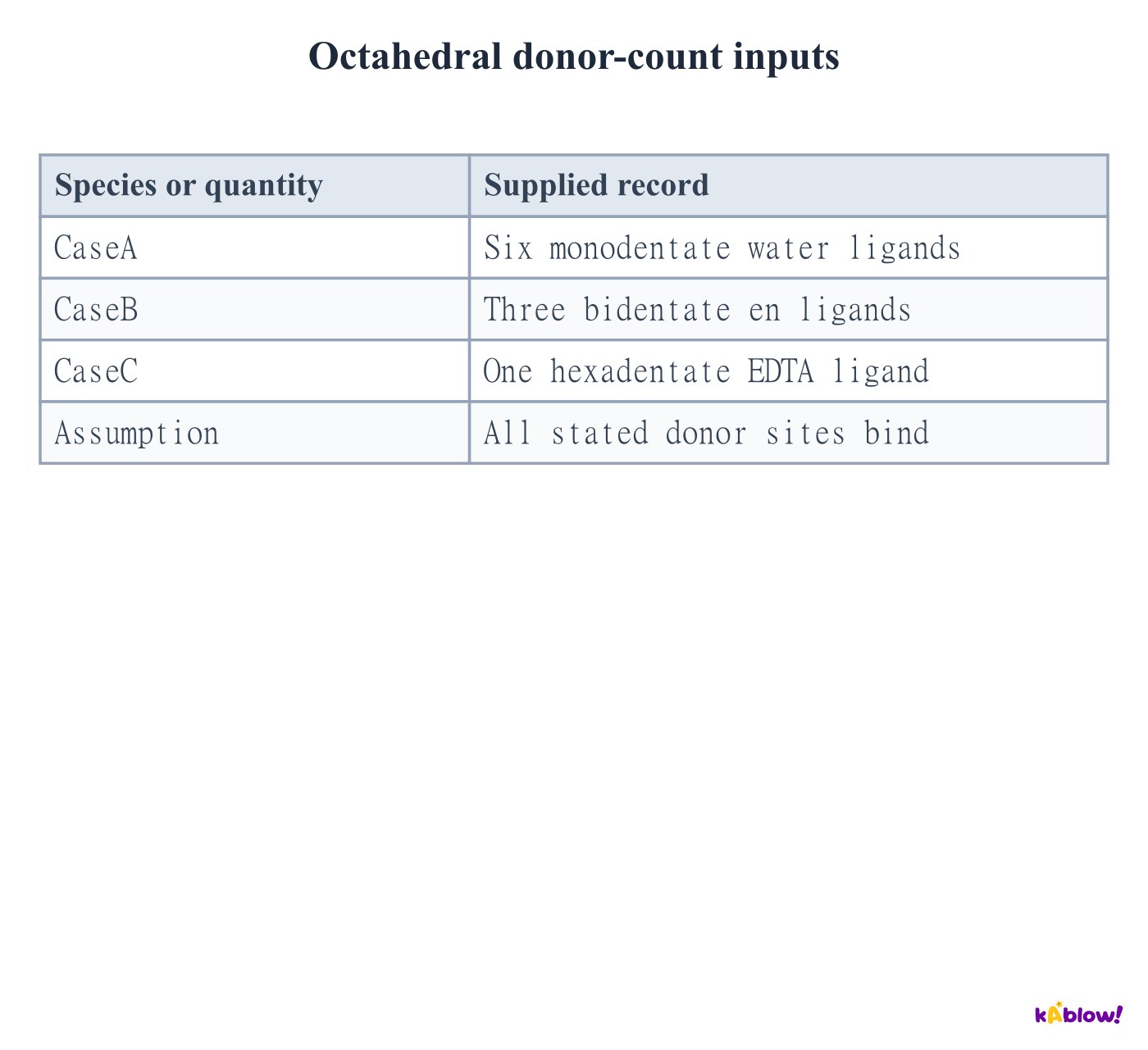
- Six monodentate ligands, three bidentate ligands or one appropriate hexadentate ligand can each provide coordination number 6.
- The number of ligand molecules is therefore insufficient to assign coordination number or geometry without their binding modes.
Six water ligands around copper(II)
Describe octahedral cis–trans isomerism
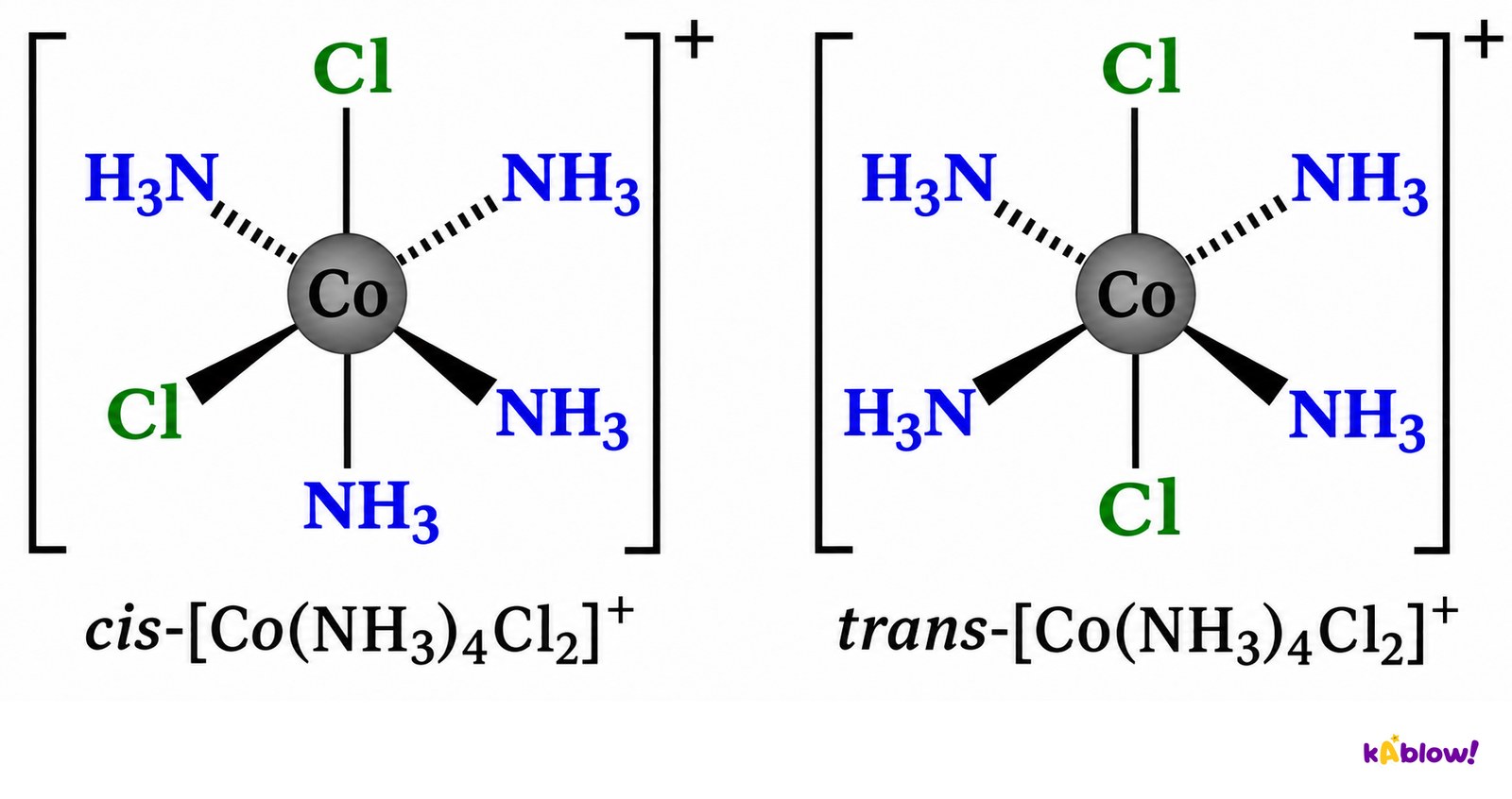
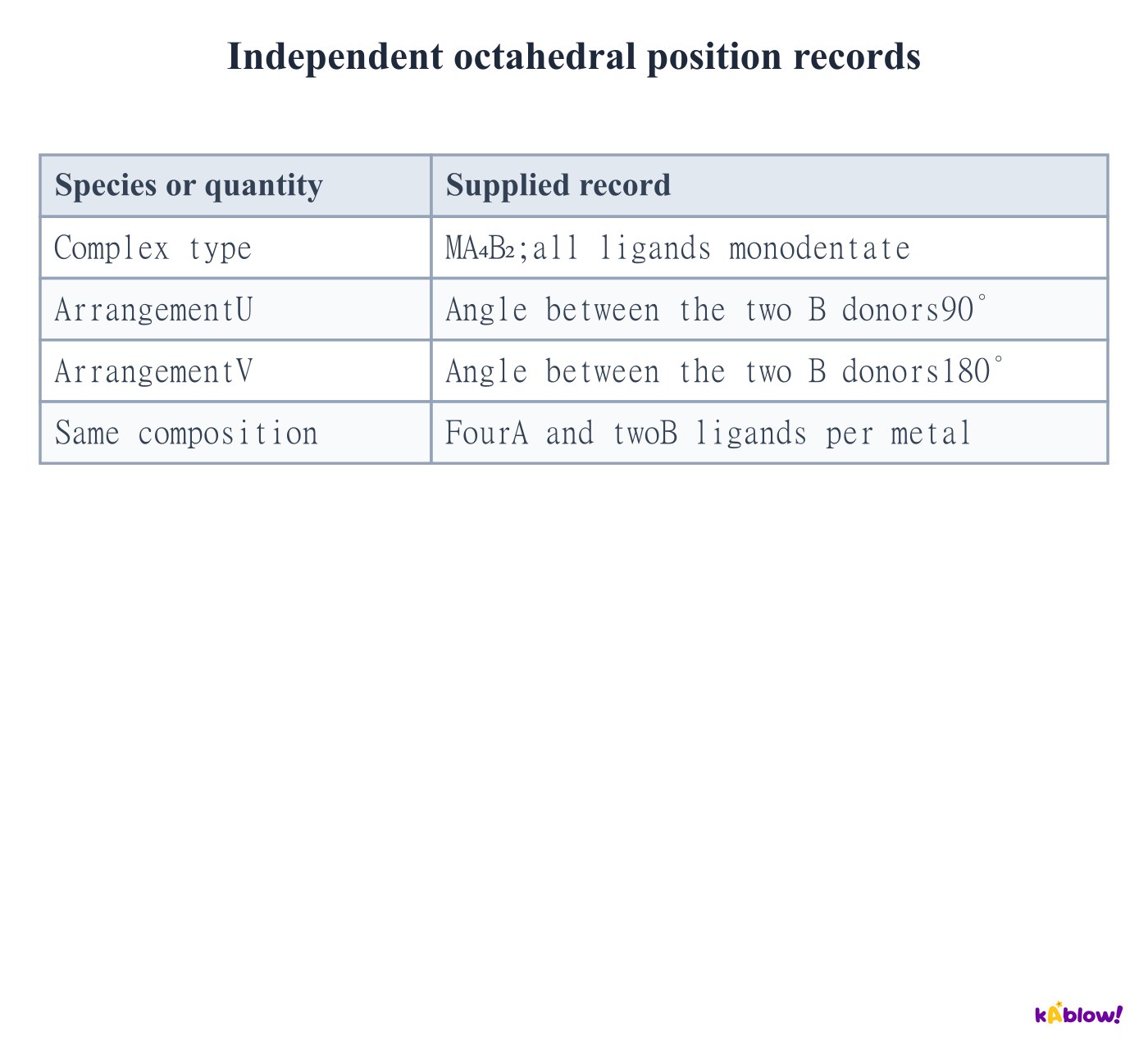
- In an octahedral MA₄B₂ complex, the two B ligands can be adjacent(cis)or opposite(trans). Their relative positions differ while the composition stays fixed.
- The same concept extends to suitable complexes with bidentate ligands, but not every formula or every geometry must have geometrical isomers.
- A tetrahedral MA₂B₂ complex with simple monodentate ligands does not give the same cis–trans pair. Use the actual three-dimensional arrangement.
Octahedral cobalt geometrical isomers
Identify non-superimposable mirror-image chelates
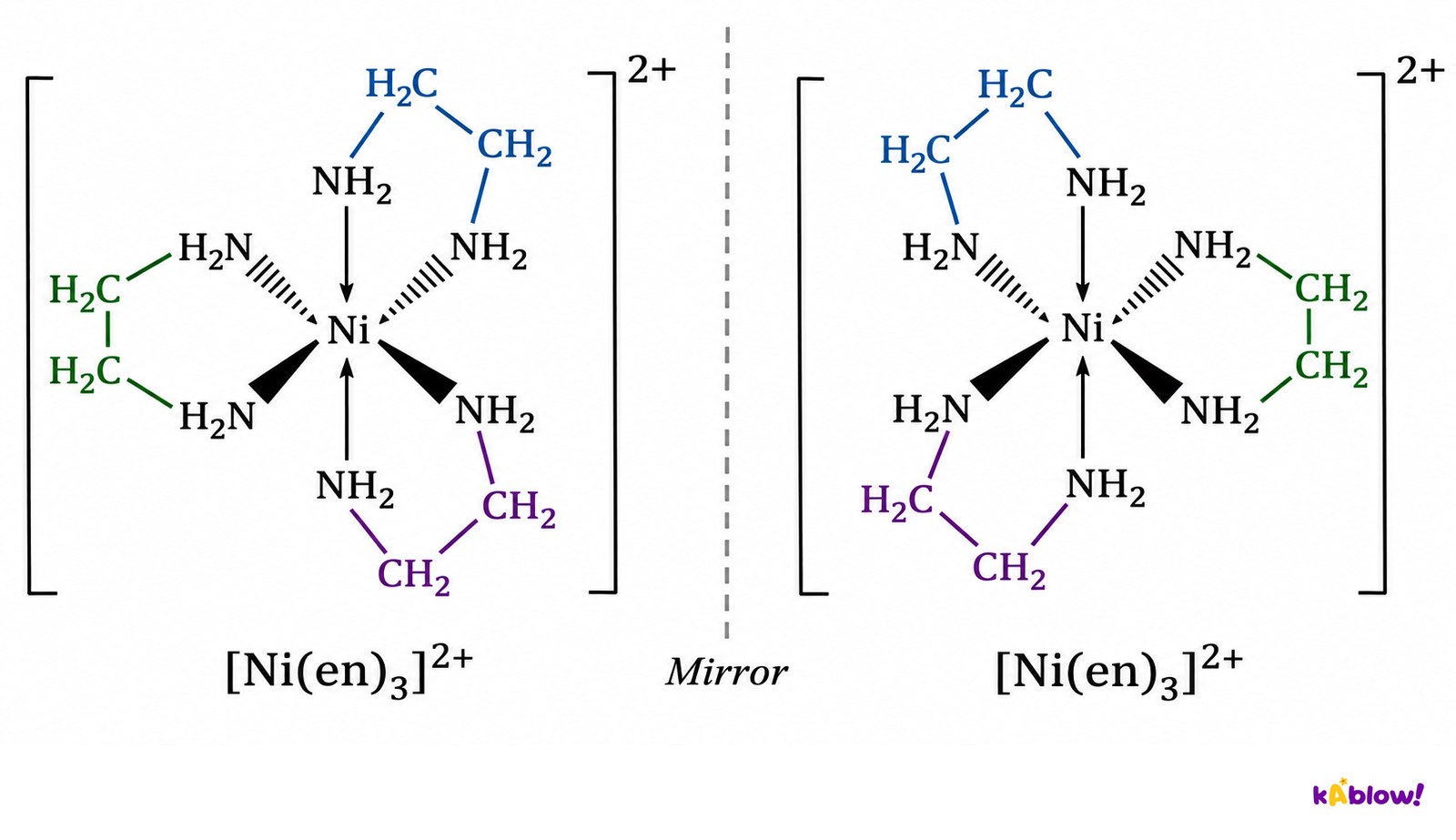
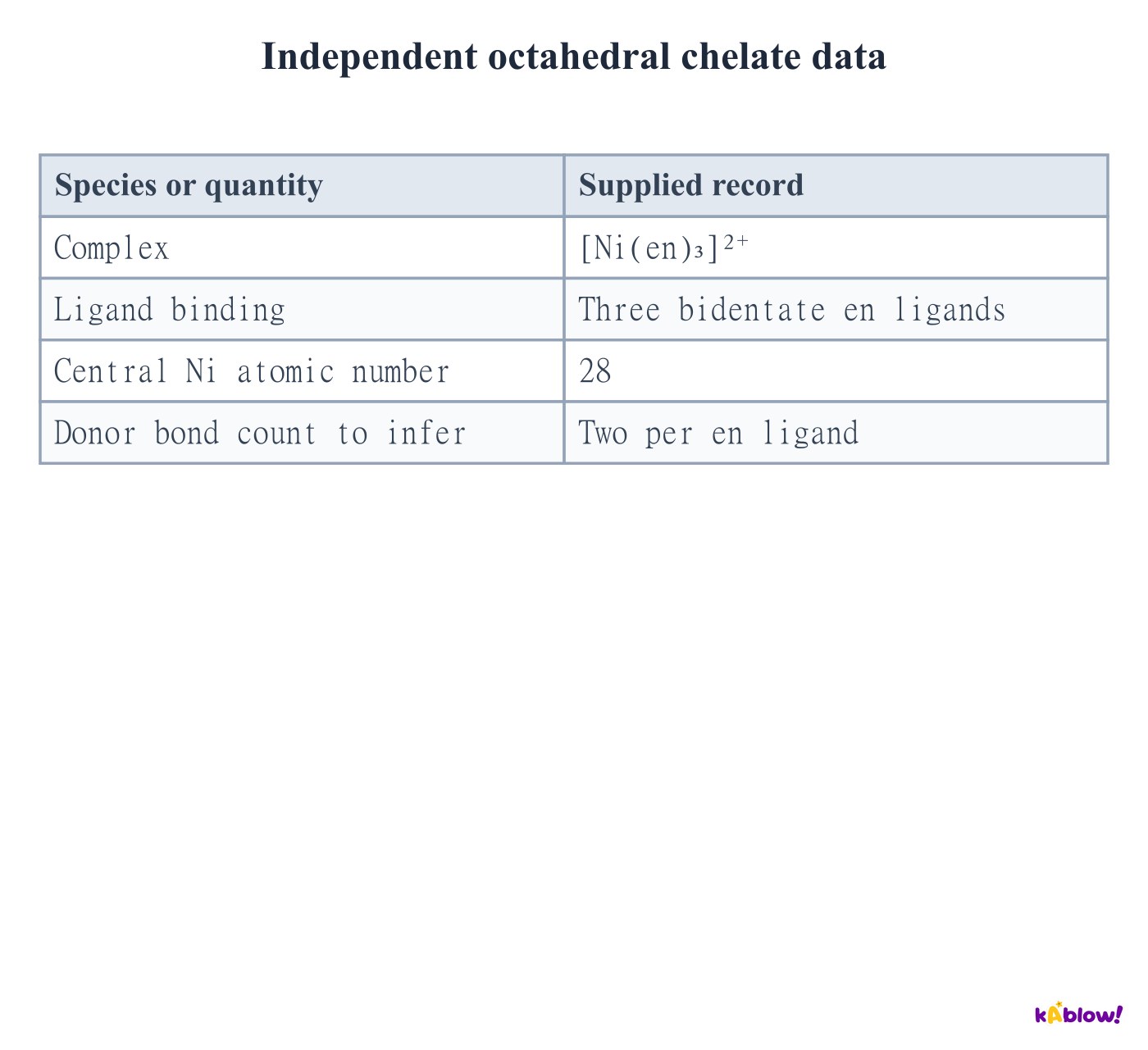
- The new structure pair shows opposite handed arrangements of three bidentate en ligands around nickel. Each has six nitrogen donors and three intact ligand backbones.
- These mirror images cannot be superimposed by rotating the entire complex, so they are optical isomers. Reflection and rotation are different operations.
- Enantiomers have matching properties in achiral surroundings apart from opposite optical rotation under comparable conditions; they can interact differently with chiral environments. Not every octahedral complex is optically active.
Opposite-handed octahedral nickel chelates
Explain d-level splitting and photon absorption
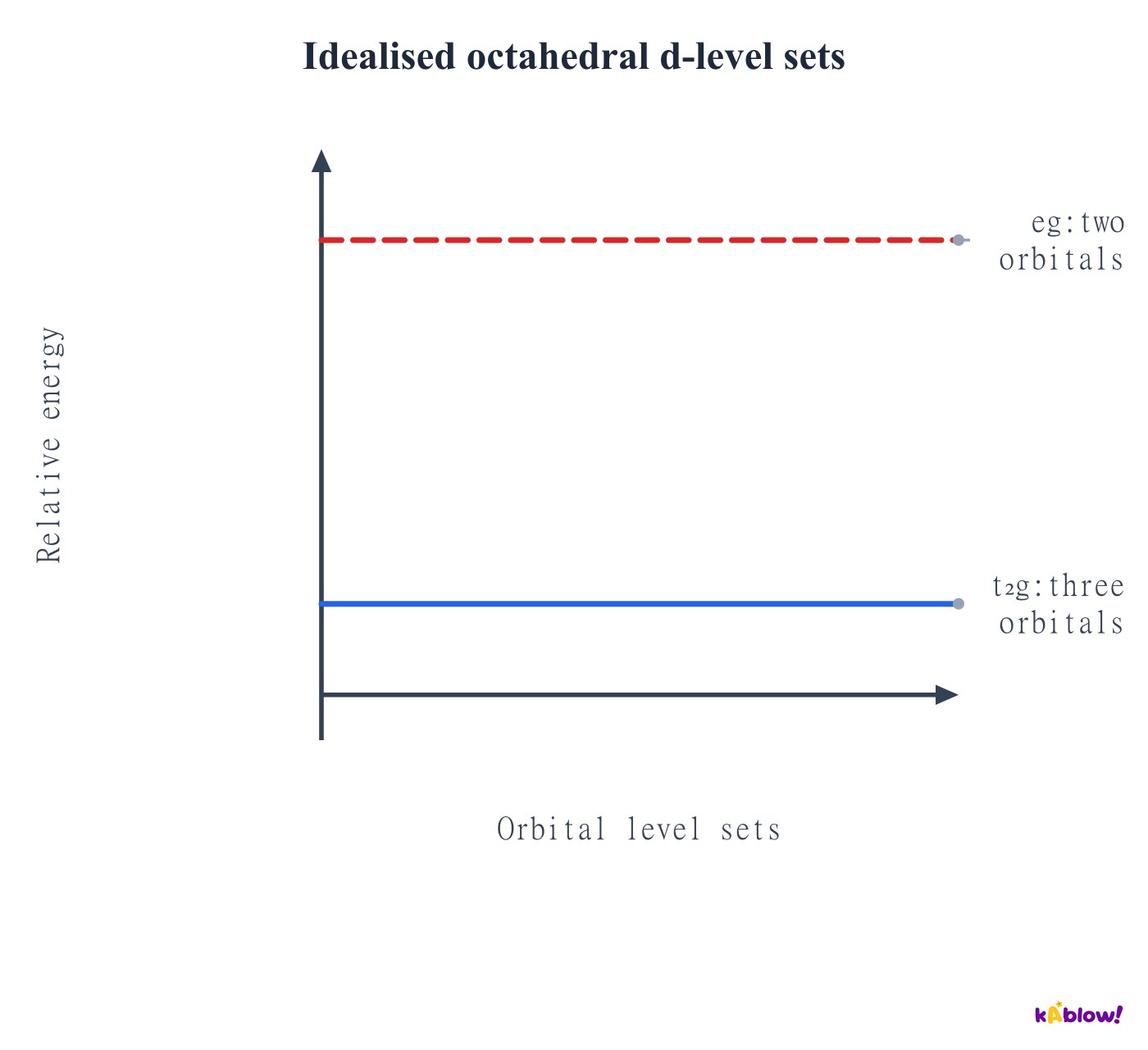
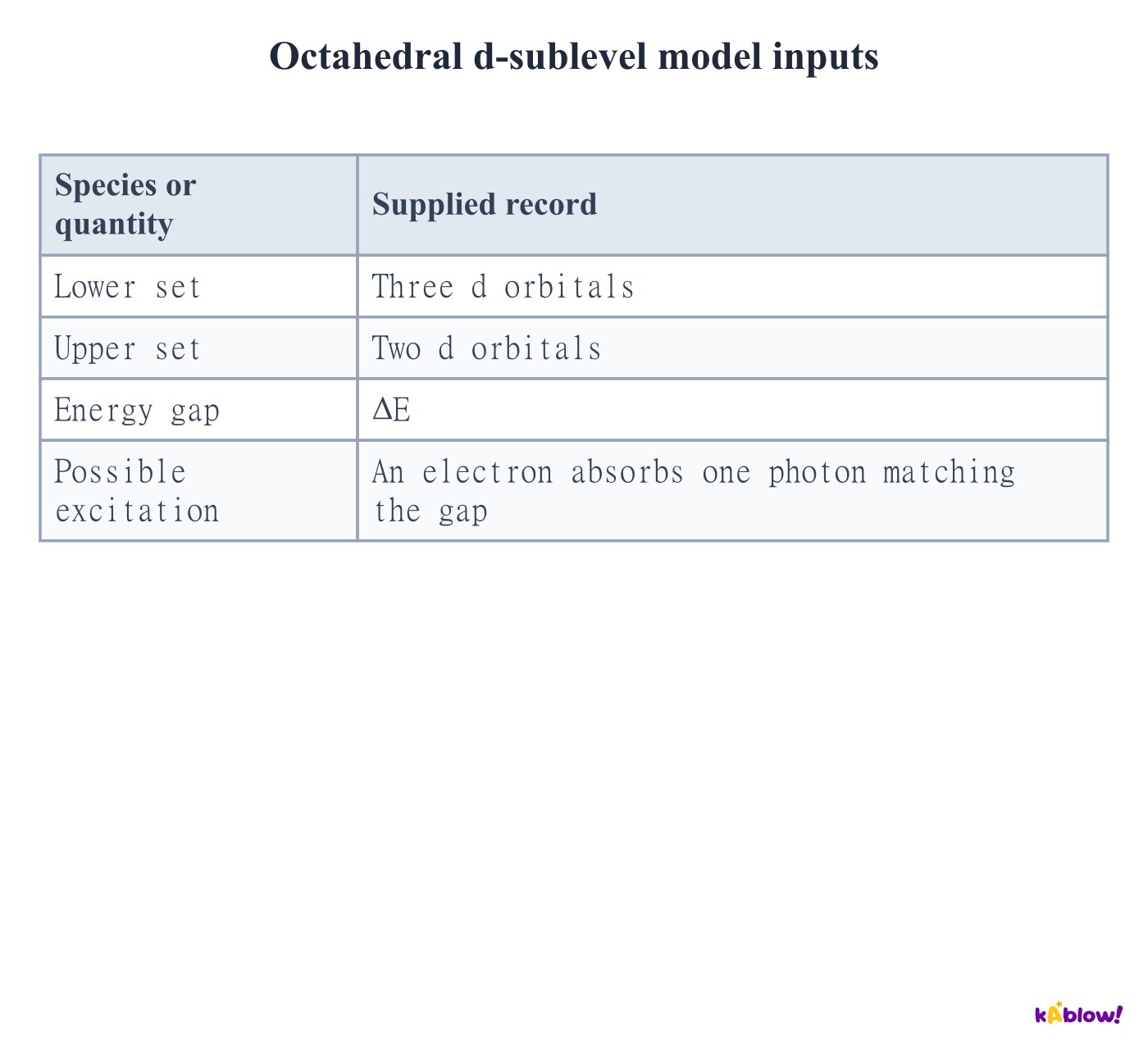
- In the ideal isolated-ion model, the five d orbitals are degenerate. An octahedral ligand environment splits them into a lower set of three and an upper set of two.
- An allowed excitation can absorb a photon with energy matching the gap, ΔE=hν=hc/λ. Orbitals within each ideal set remain degenerate in this model.
- Actual spectra include selection rules, broadening and other transitions. Do not assume every geometry has the same two-set pattern or every visible colour is a d–d transition.
Idealised octahedral d-level sets
Distinguish absorbed colour from observed colour
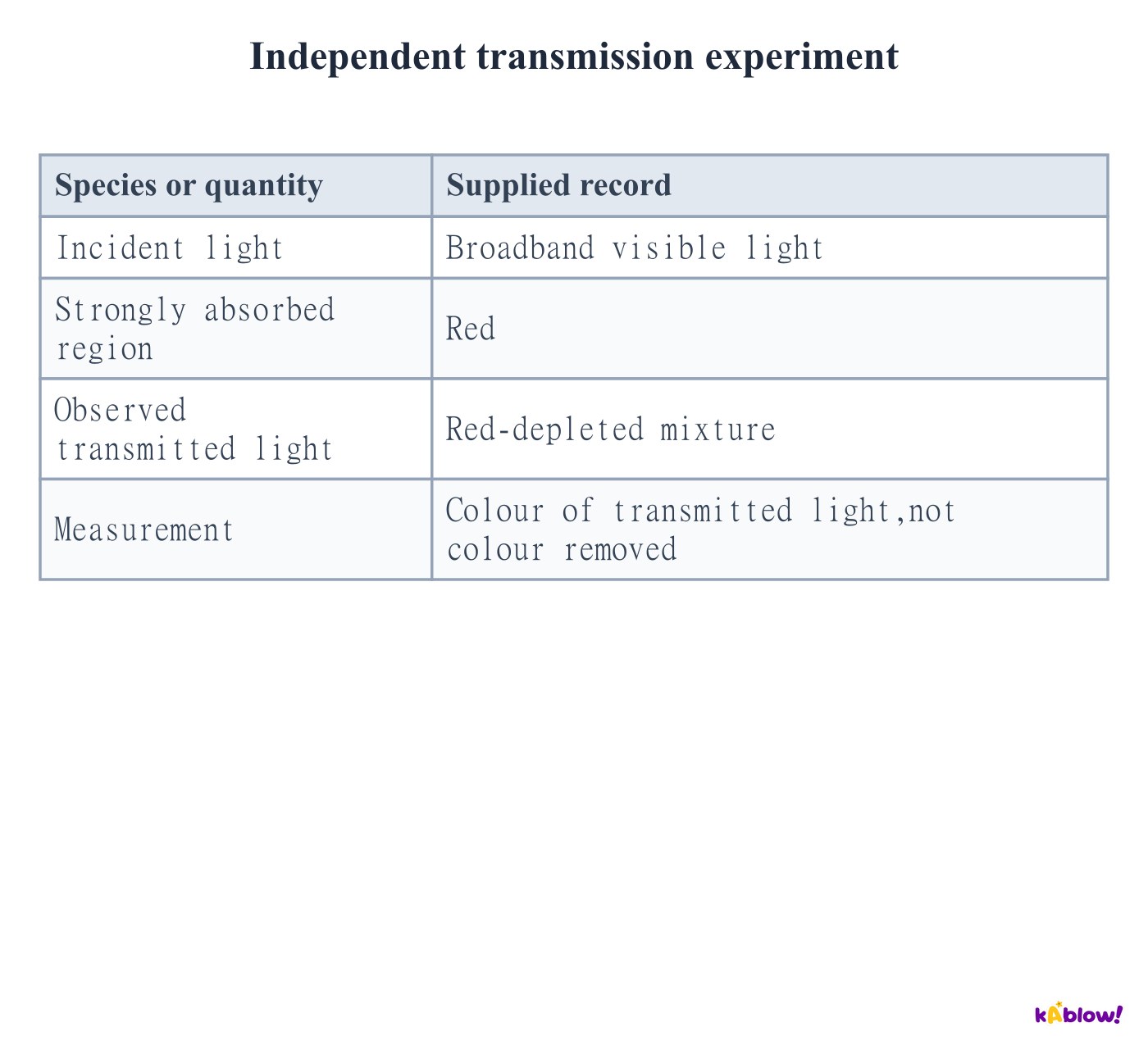
- A coloured solution removes some wavelengths from incident white light. The remaining transmitted or reflected wavelengths combine to give the observed colour.
- A blue or cyan-looking copper solution absorbs strongly in a complementary region, commonly toward red. The absorbed light itself is not what the observer sees coming through.
- Perceived colour also depends on the full spectrum, concentration, path length and illumination. A single colour wheel is a guide rather than a complete spectrum.
Independent transmission experiment
Calculate the energy of an absorbed photon
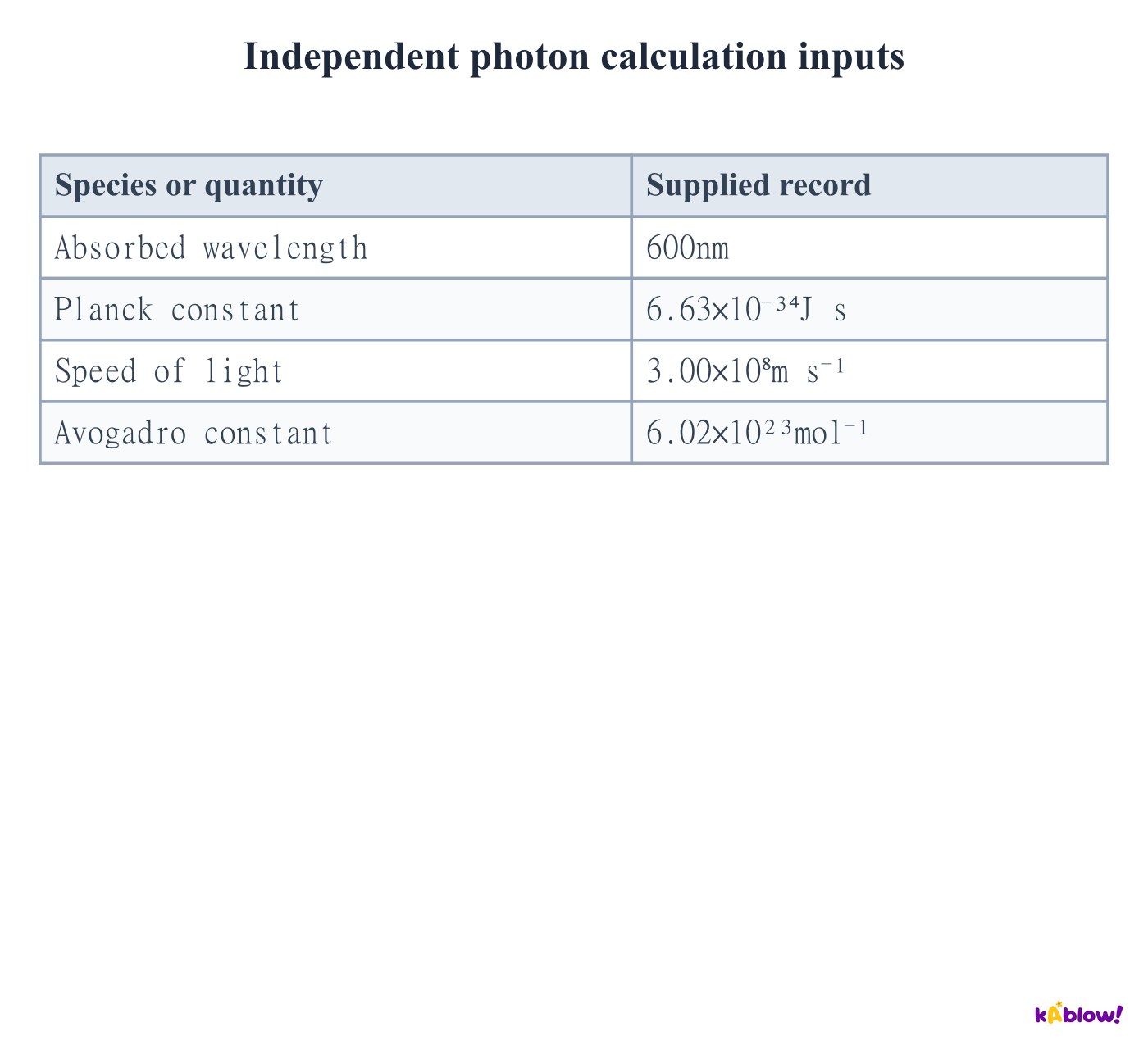
- Convert 600nm to 600×10⁻⁹m. The frequency is c/λ=5.00×10¹⁴s⁻¹.
- Using the supplied constants, E=hc/λ=3.315×10⁻¹⁹J per photon. Multiply by Avogadro’s constant to compare one mole of these photons.
- A shorter wavelength has greater photon energy. Keep per-photon joules separate from per-mole kilojoules and from a chemical bond dissociation energy.
Independent photon calculation inputs
Use ligand changes to explain a changed spectrum
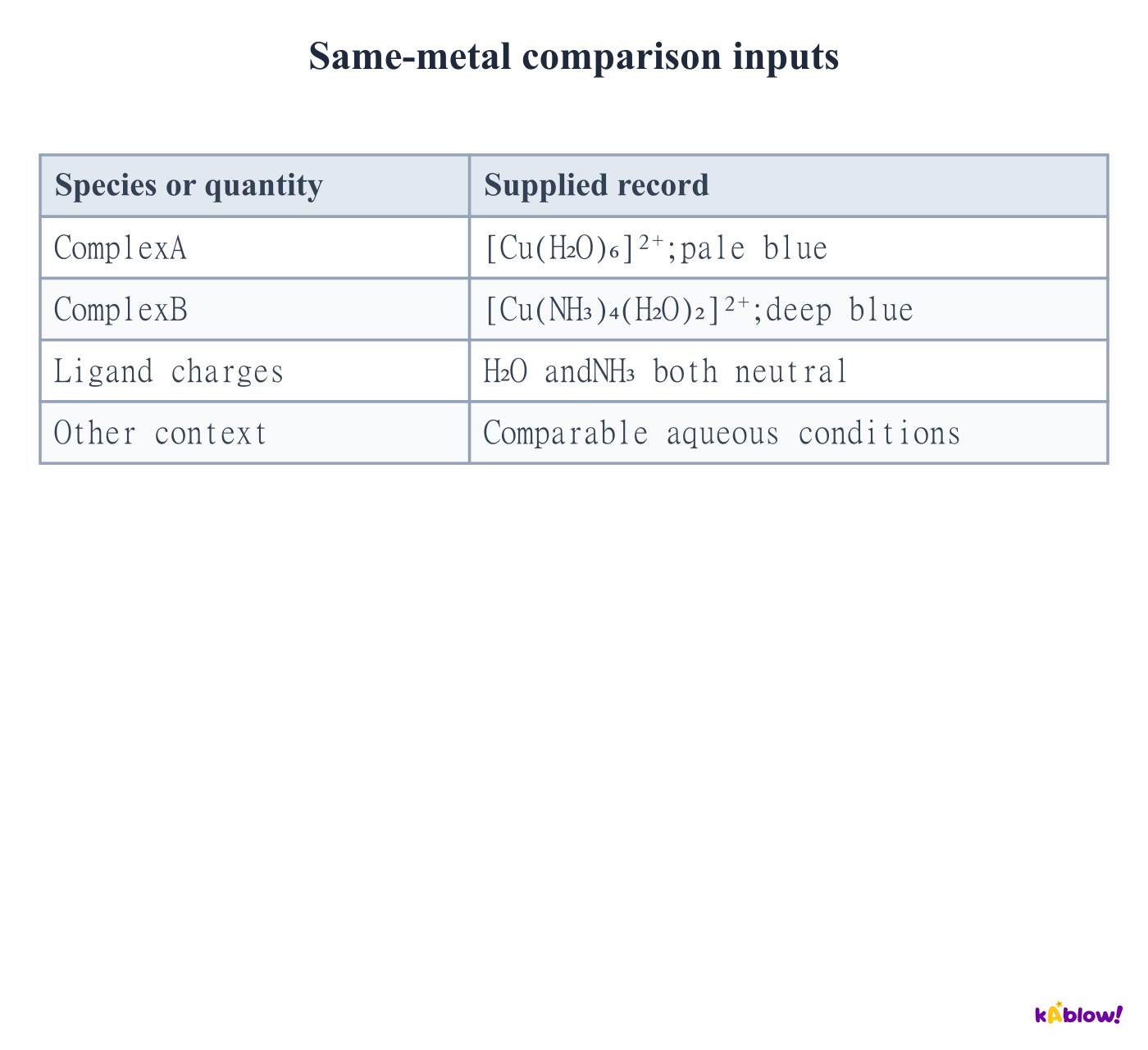
- Changing ligands changes the interaction with metal d orbitals and can change the splitting energy. A different absorption spectrum can result.
- Both supplied copper complexes have Cu+2 and coordination number 6. Their colour difference does not by itself establish oxidation or a change to four-coordinate geometry.
- Stronger-field ligands generally give larger splitting in comparable complexes. Do not turn this into an unqualified ranking across different metals, geometries and spin states.
Same-metal comparison inputs
Control oxidation state, geometry and speciation
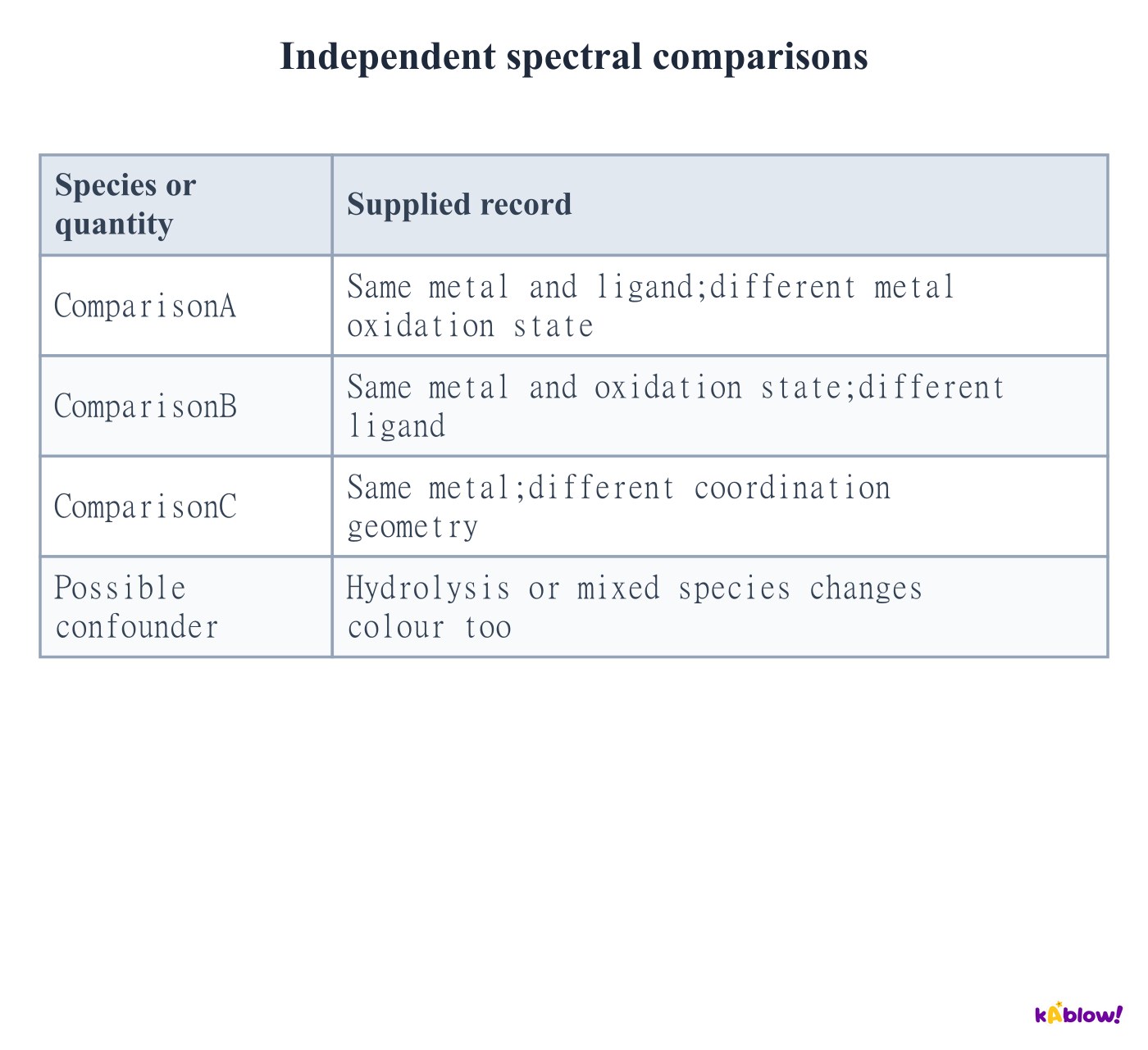
- Metal oxidation state, ligand identity and coordination geometry can each change d-level splitting and the spectrum. A controlled comparison identifies which factors changed.
- Coordination number often changes together with ligand identity, so one observation may not isolate a single cause. Higher oxidation state is not a universal colour or gap rule across all complexes.
- Pure hexaaquairon(III) is pale violet; ordinary yellow or orange iron(III) solutions often include hydrolysed species. Do not attribute every such colour to one pure-ion d–d gap.
Independent spectral comparisons
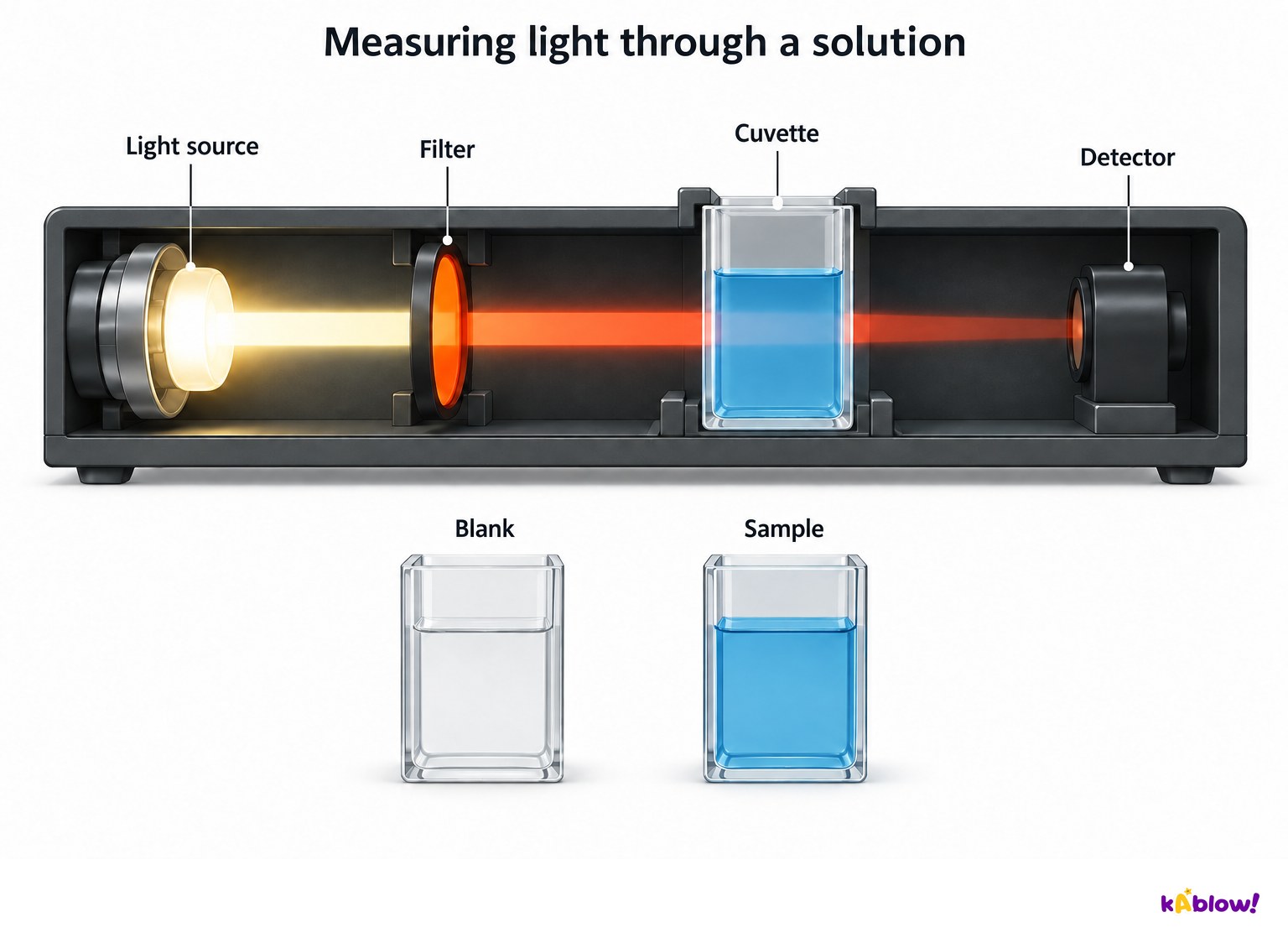
Use a colorimeter with controlled sample conditions
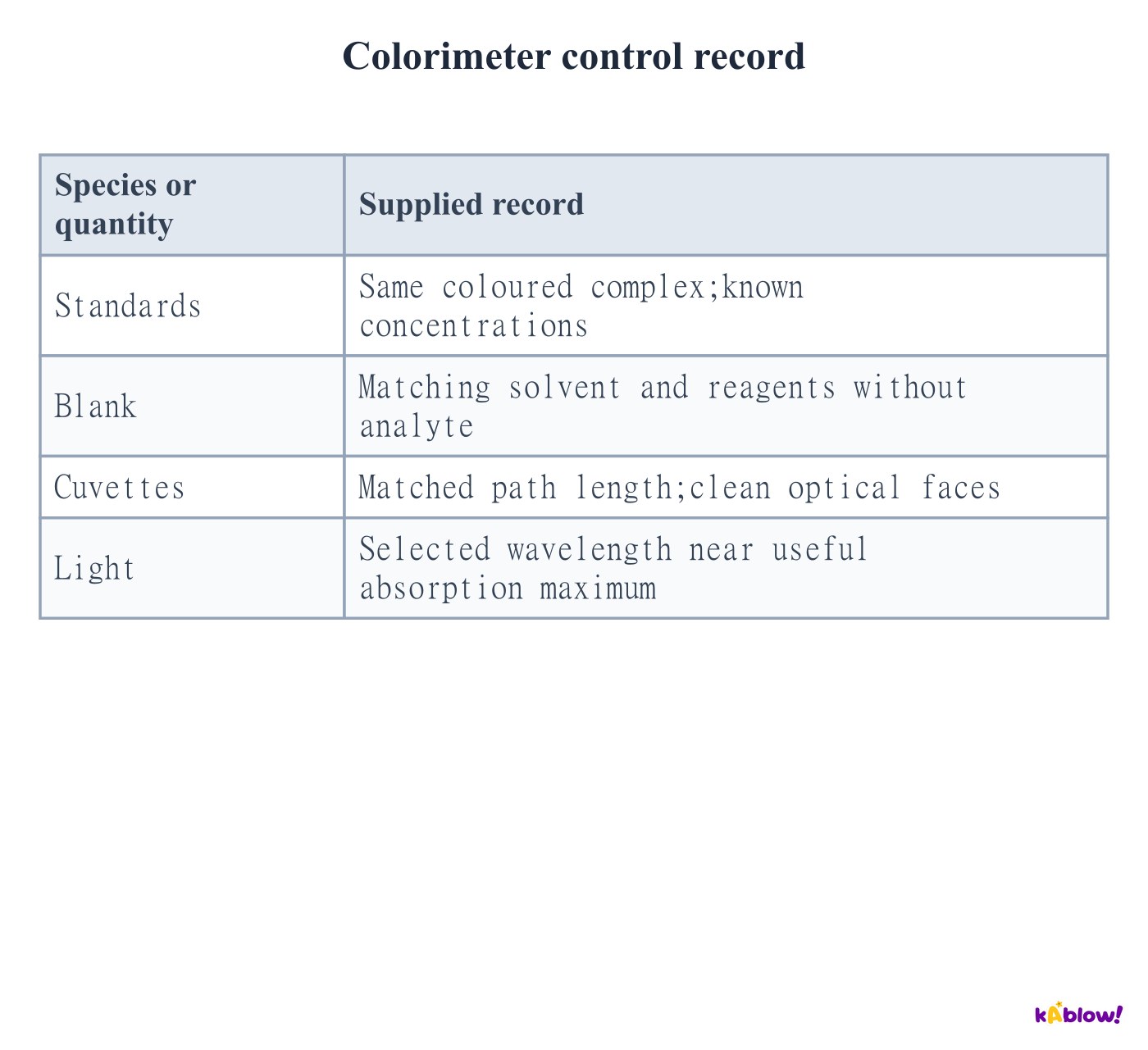
- The reviewed optical-path illustration shows selected light passing through a cuvette to a detector. Absorbance compares transmitted intensity with a blank.
- Use standards of the same complex under matched ligand, pH, path-length and temperature conditions. Blank against the same reagent mixture without the analyte.
- Choose a wavelength the analyte absorbs usefully and avoid detector saturation. A complementary-colour filter can help, but available instrument wavelengths and interference also matter.
Measuring light through a coloured solution
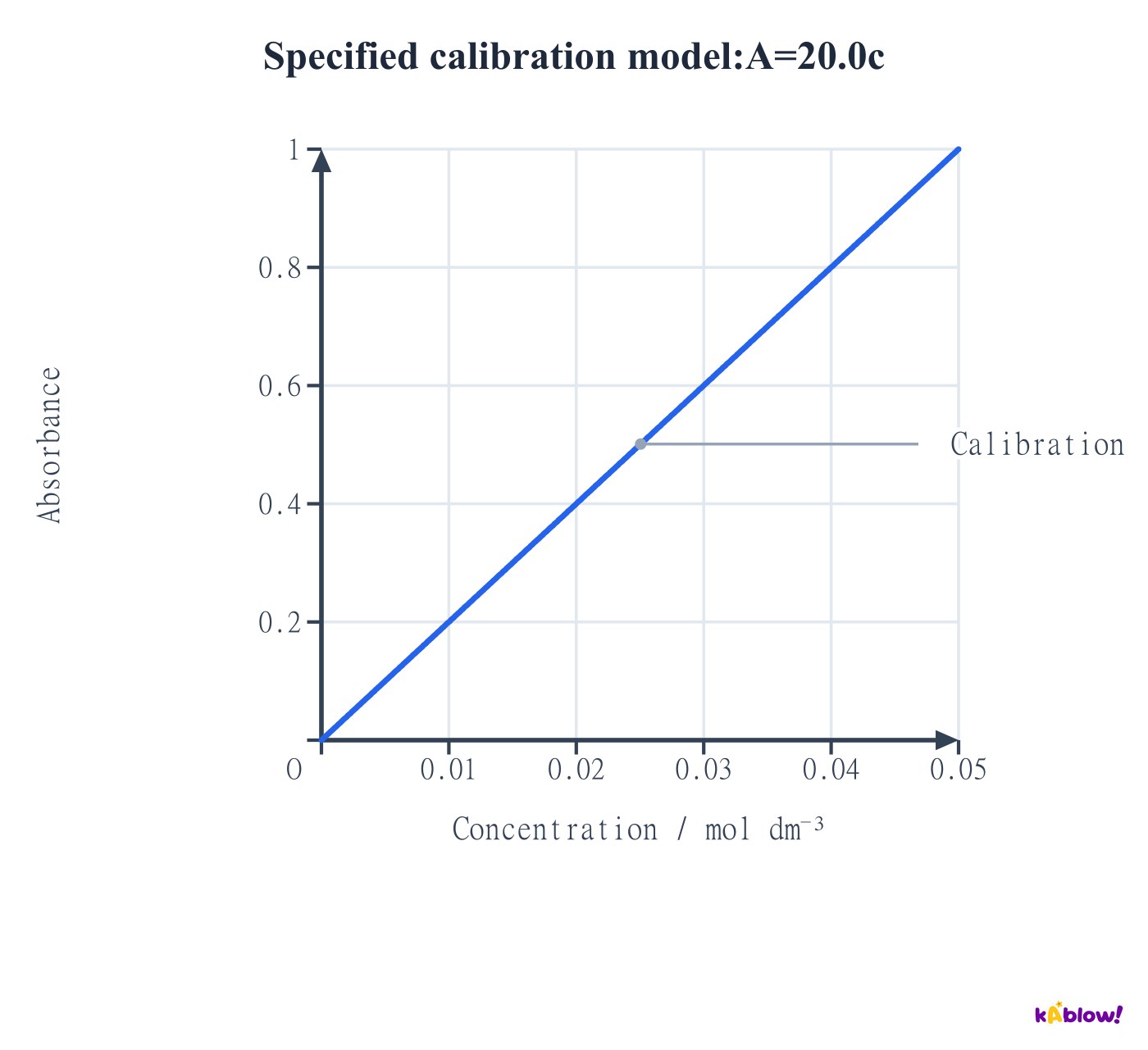
Interpolate concentration within a validated calibration
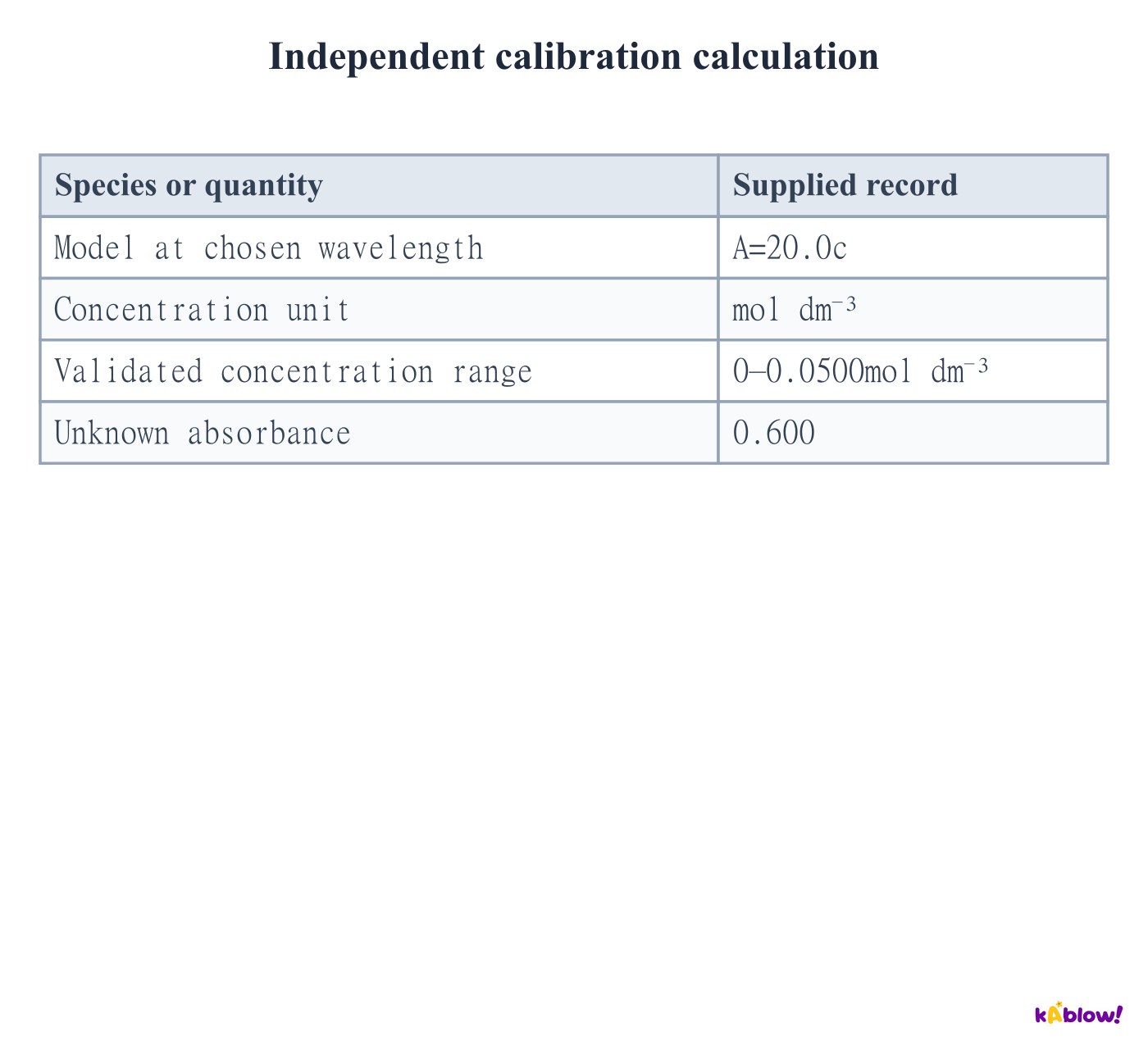
- For the supplied calibration, A=20.0c within0–0.0500moldm⁻³. An absorbance of 0.600 corresponds to c=0.0300moldm⁻³.
- The graph shows the specified linear model, not a claim of unlimited Beer–Lambert behaviour. An unknown must have the same absorbing species and measurement conditions.
- Dilute a sample into the validated range when necessary and include the dilution factor. Do not extrapolate a saturated reading and present the result as equally reliable.
Specified calibration model:A=20.0c
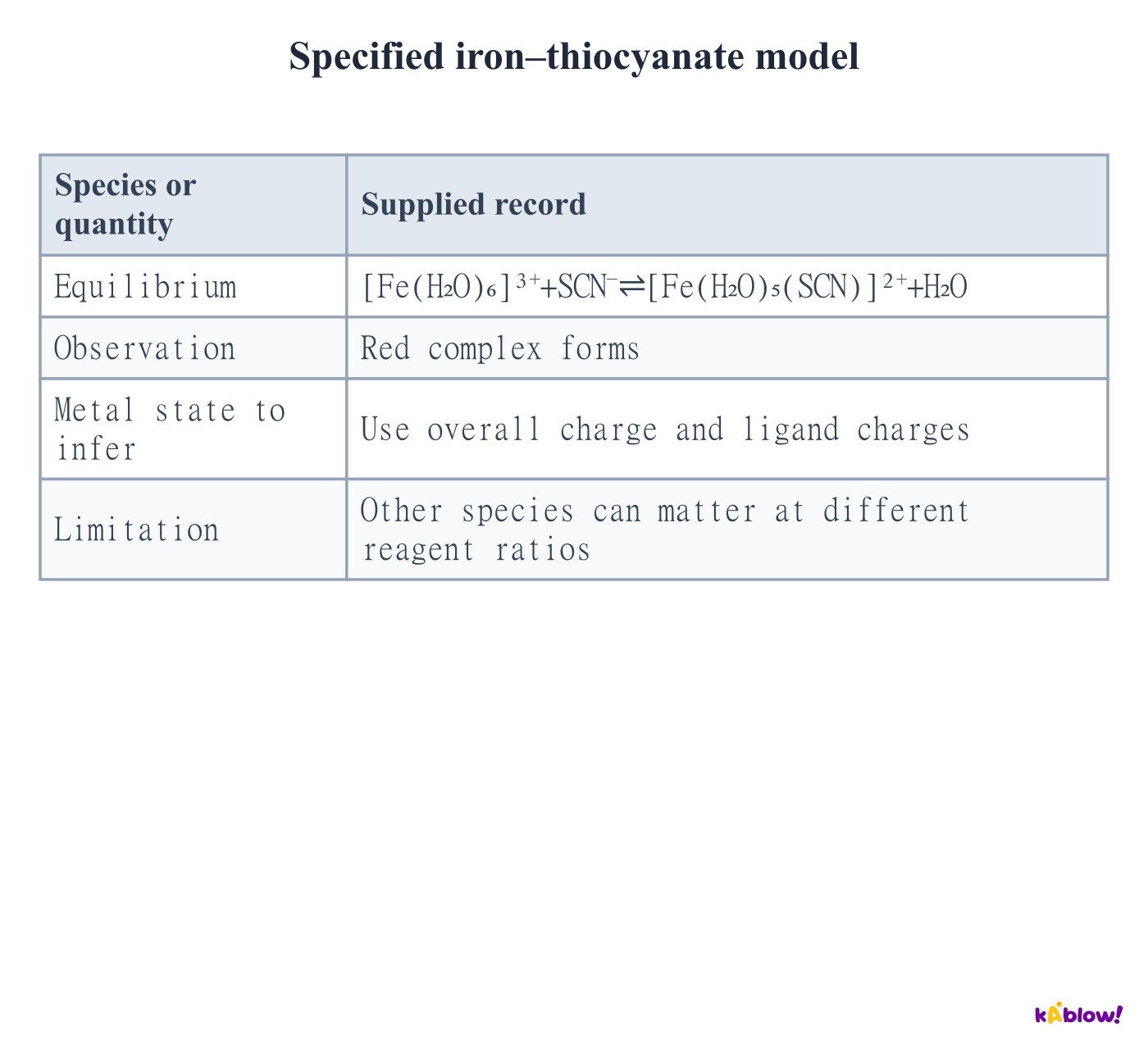
Intensify colour using a specified ligand equilibrium
- Thiocyanate can form an intensely red iron(III) complex. The supplied equation uses a one-thiocyanate model with complex charge 2+.
- This can make a concentration measurement more sensitive when ligand conditions and equilibrium are controlled. Calibration must use the same chemistry as the unknown.
- The visible change is not proof that Fe(III) became Fe(II). Multiple thiocyanate complexes can occur, so identify the intended model rather than assuming one formula fits all mixtures.
Specified iron–thiocyanate model
State pH and products when comparing redox behaviour
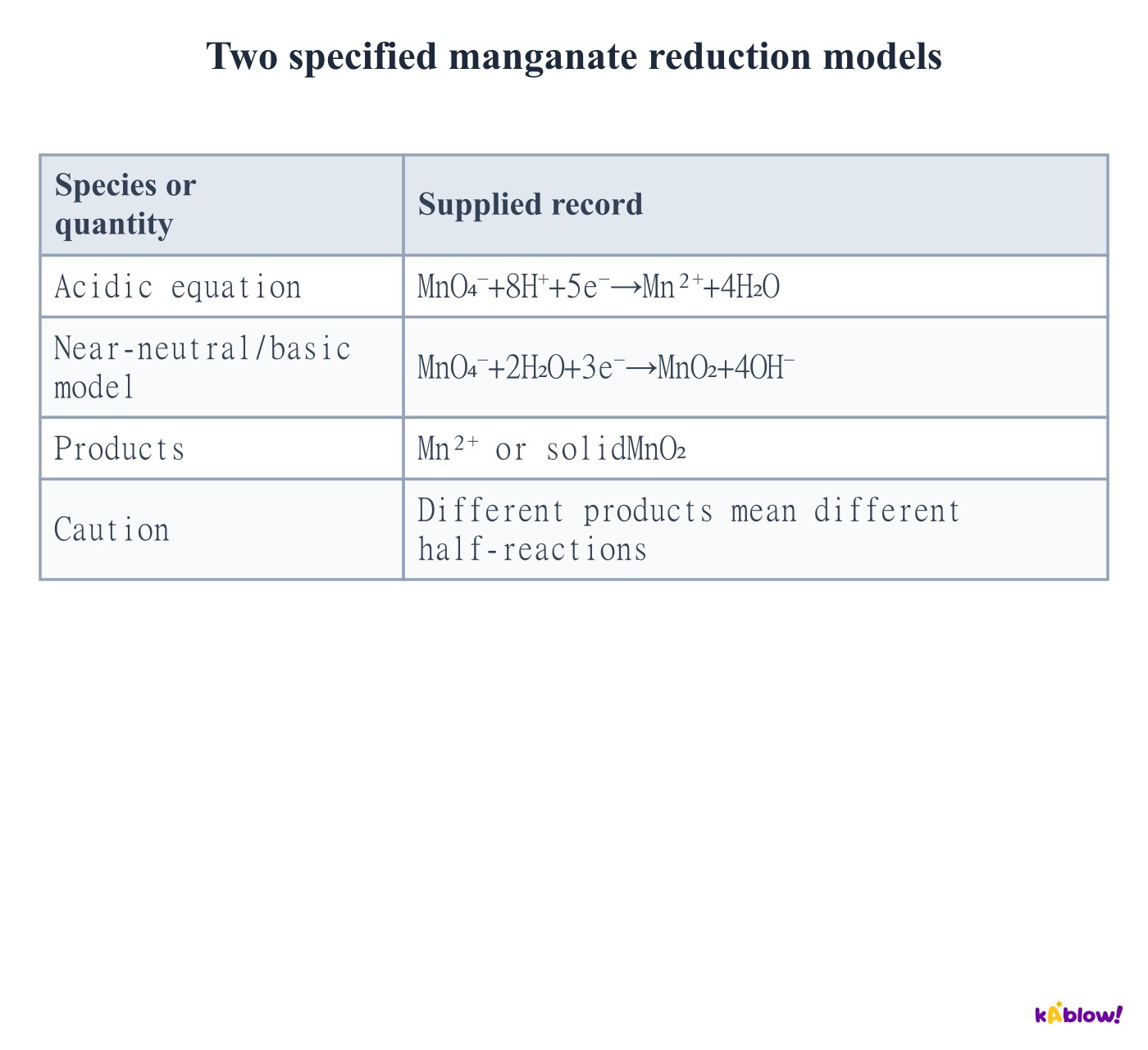
- Acidified manganate(VII) can be reduced to Mn²⁺, a five-electron change per Mn. Under other conditions, MnO₂ is a common product involving three electrons.
- pH influences reduction potentials when protons or hydroxide are involved. Very alkaline conditions can support additional species, such as manganate(VI).
- The two displayed equations have different products. Their potentials cannot be treated as a pure pH comparison for one unchanged half-reaction.
Two specified manganate reduction models
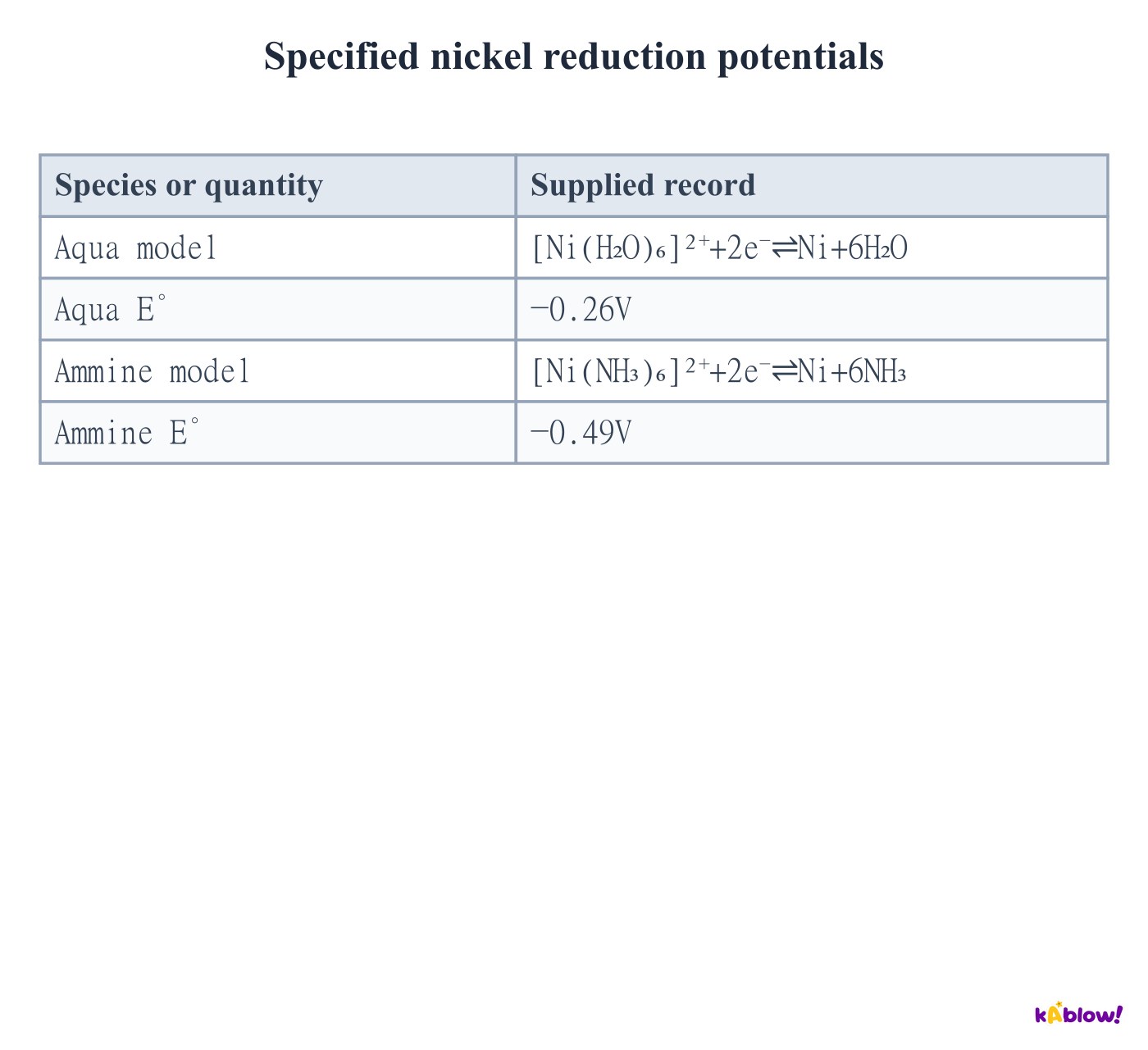
Compare ligand effects using paired reduction potentials
- The supplied ammine reduction potential is more negative than the aqua value. In this standard comparison, the ammine complex is harder to reduce to nickel metal.
- Ligand stabilisation of an oxidation state can change the redox potential. The effect is not determined by ligand size alone.
- A single half-potential does not prove an isolated chemical reaction goes to completion. Pair it with an oxidation half-reaction and consider concentrations and kinetics.
Specified nickel reduction potentials
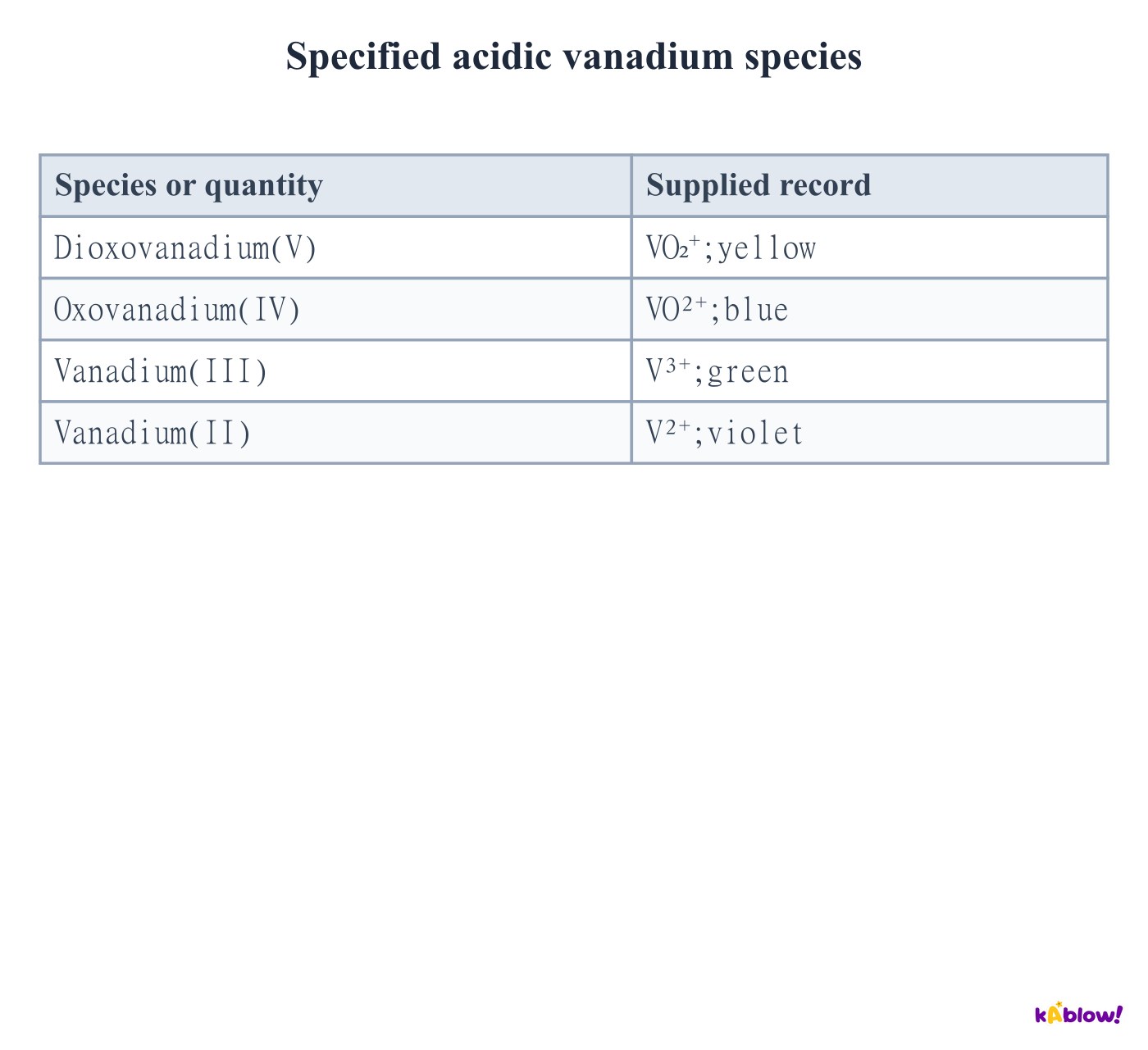
Preserve subscripts and charges in vanadium species
- Acidic vanadium(V) is represented here by VO₂⁺:two oxygen atoms and overall+1 charge. Vanadium(IV) is VO²⁺:one oxygen and+2 charge.
- Successive reduction can then give V³⁺ and V²⁺. The familiar yellow, blue, green and violet observations belong to the specified acidic species and conditions.
- Writing both oxo ions as plainVO2+ loses a crucial distinction. Use genuine subscripts and superscripts, and calculate oxidation states from the whole formula.
Specified acidic vanadium species
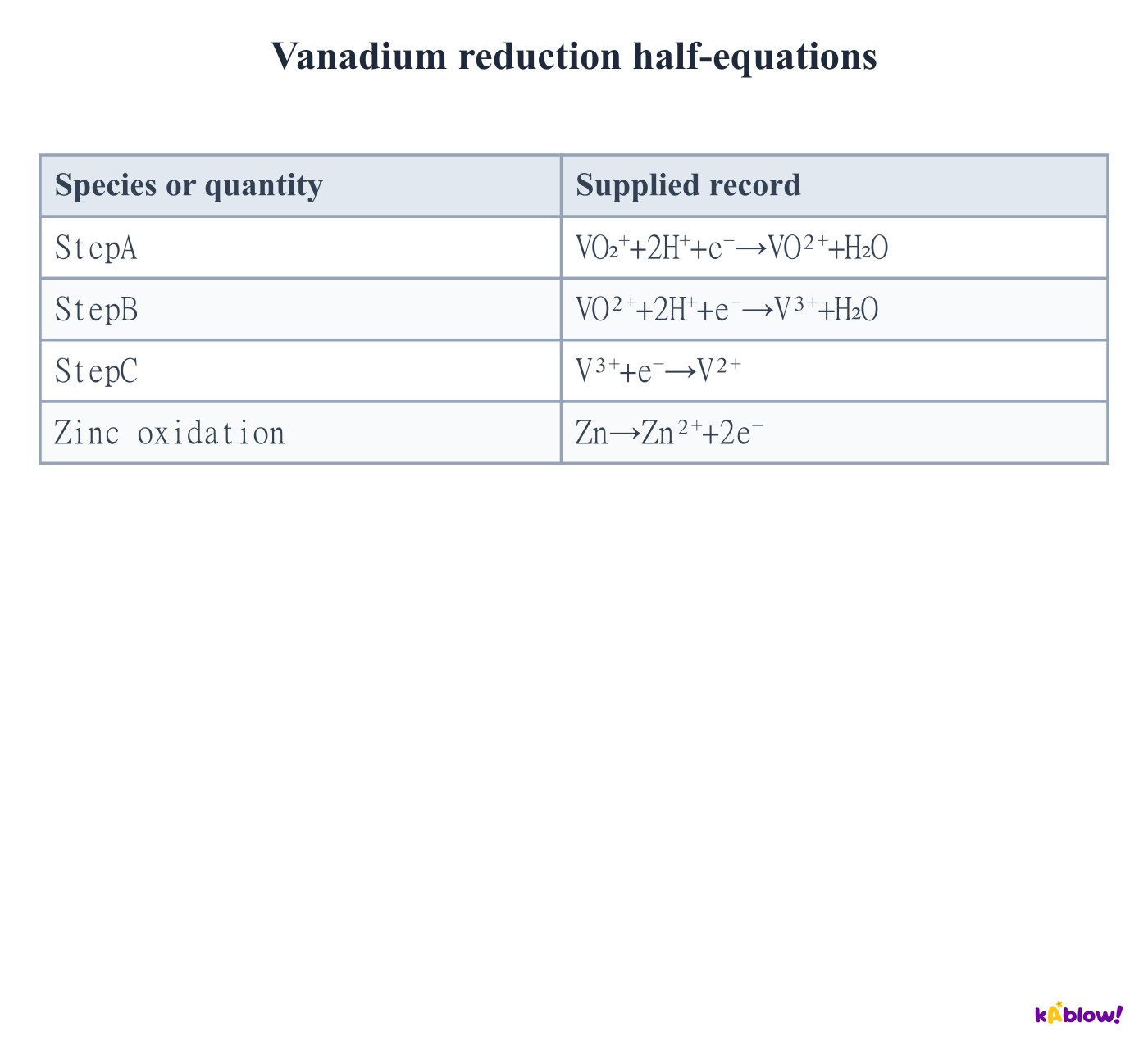
Balance successive vanadium reductions by zinc
- Each displayed vanadium step accepts one electron per V centre. Zinc can donate two electrons as Zn→Zn²⁺+2e⁻.
- For the first stage, the balanced combination is2VO₂⁺+4H⁺+Zn→2VO²⁺+2H₂O+Zn²⁺. Atom and charge totals must agree on both sides.
- Reduction from V(V) all the way to V(II) requires three electrons per V overall. Intermediate colour mixtures do not alter the electron balance.
Vanadium reduction half-equations
Predict a stopping point with a stated potential model
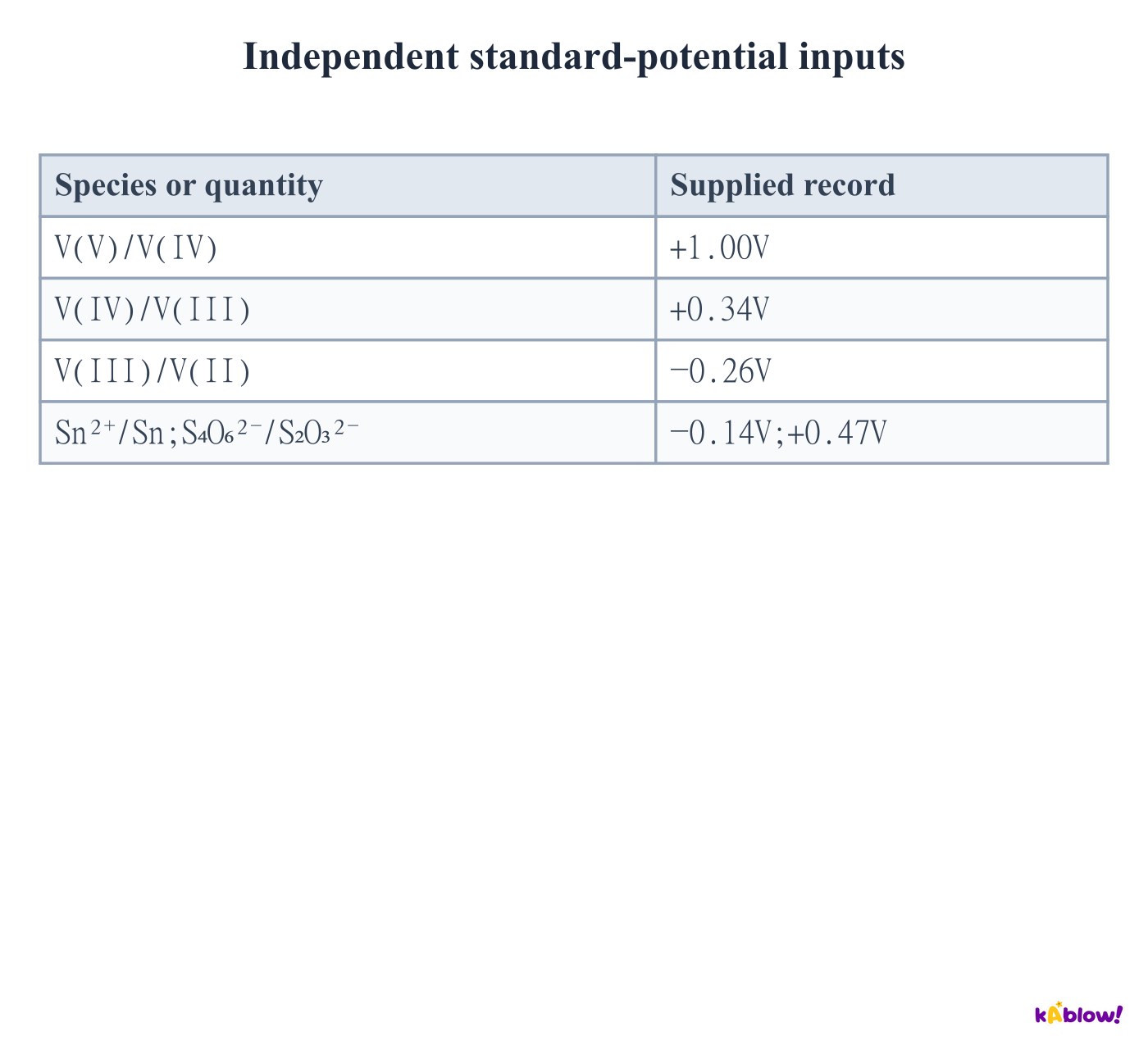
- For tin oxidation coupled to V(IV) reduction, E°cell=0.34−(−0.14)=+0.48V. The next V(III)→V(II) comparison gives−0.12V, so the standard model stops at V(III).
- Thiosulfate oxidation gives a favourable V(V)→V(IV) comparison of+0.53V, but the next step gives−0.13V. The corresponding model stops at V(IV).
- These are thermodynamic standard comparisons. Actual concentrations, speciation and reaction rates can affect an experiment; never multiply a potential when scaling an equation.
Independent standard-potential inputs
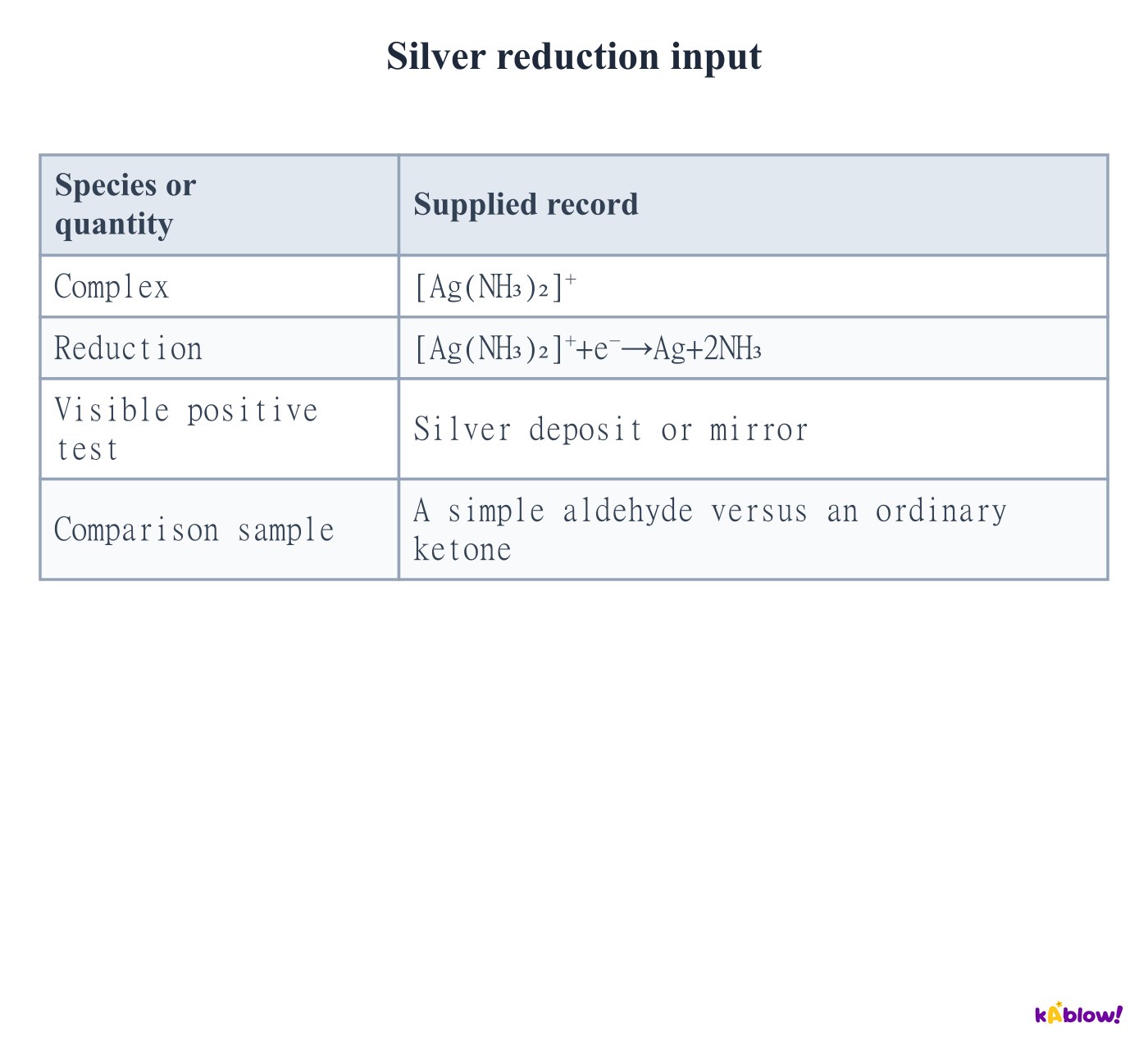
Connect Tollens’ test to silver reduction
- A suitable aldehyde reduces silver(I) in Tollens’ reagent to metallic silver, giving a silver deposit or mirror. Silver accepts one electron per atom.
- An ordinary ketone is negative in the simple comparison, but other reducing compounds and some hydroxyketone systems can also respond. The test is evidence rather than an exclusive label for every unknown.
- The silver complex is linear and d¹⁰. Complex formation here does not require an incomplete d sublevel in Ag(I).
Silver reduction input
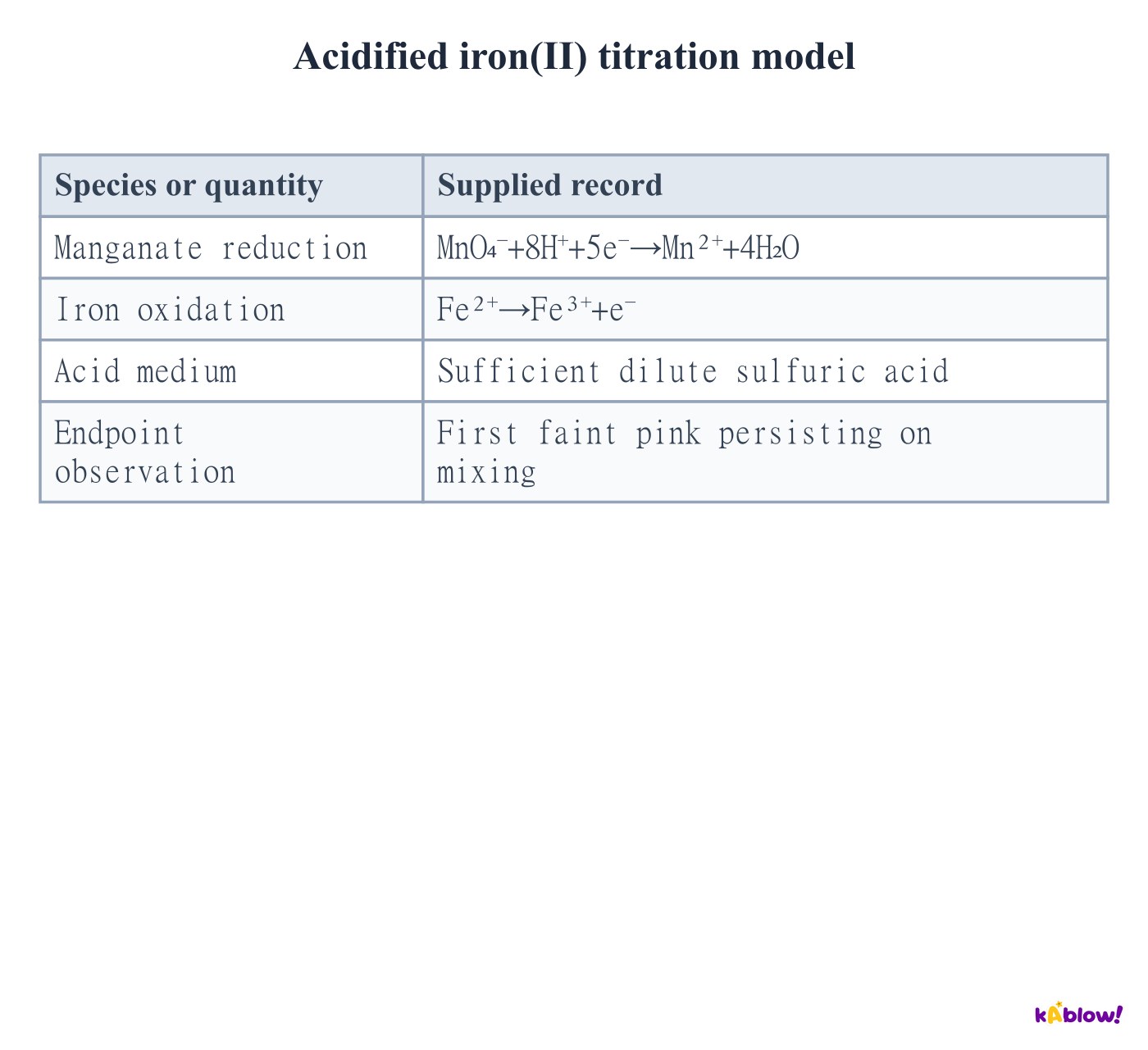
Use the five-to-one iron titration ratio
- Combining the two half-equations givesMnO₄⁻+8H⁺+5Fe²⁺→Mn²⁺+4H₂O+5Fe³⁺. One manganate ion oxidises five iron(II) ions.
- A slight excess of manganate gives the first persistent faint pink endpoint. A deep purple colour indicates an overshoot, rather than a more precise endpoint.
- Use sufficient suitable acid. Hydrochloric acid can introduce oxidisable chloride, and insufficient acidity can produce a different manganese product and mole ratio.
Acidified iron(II) titration model
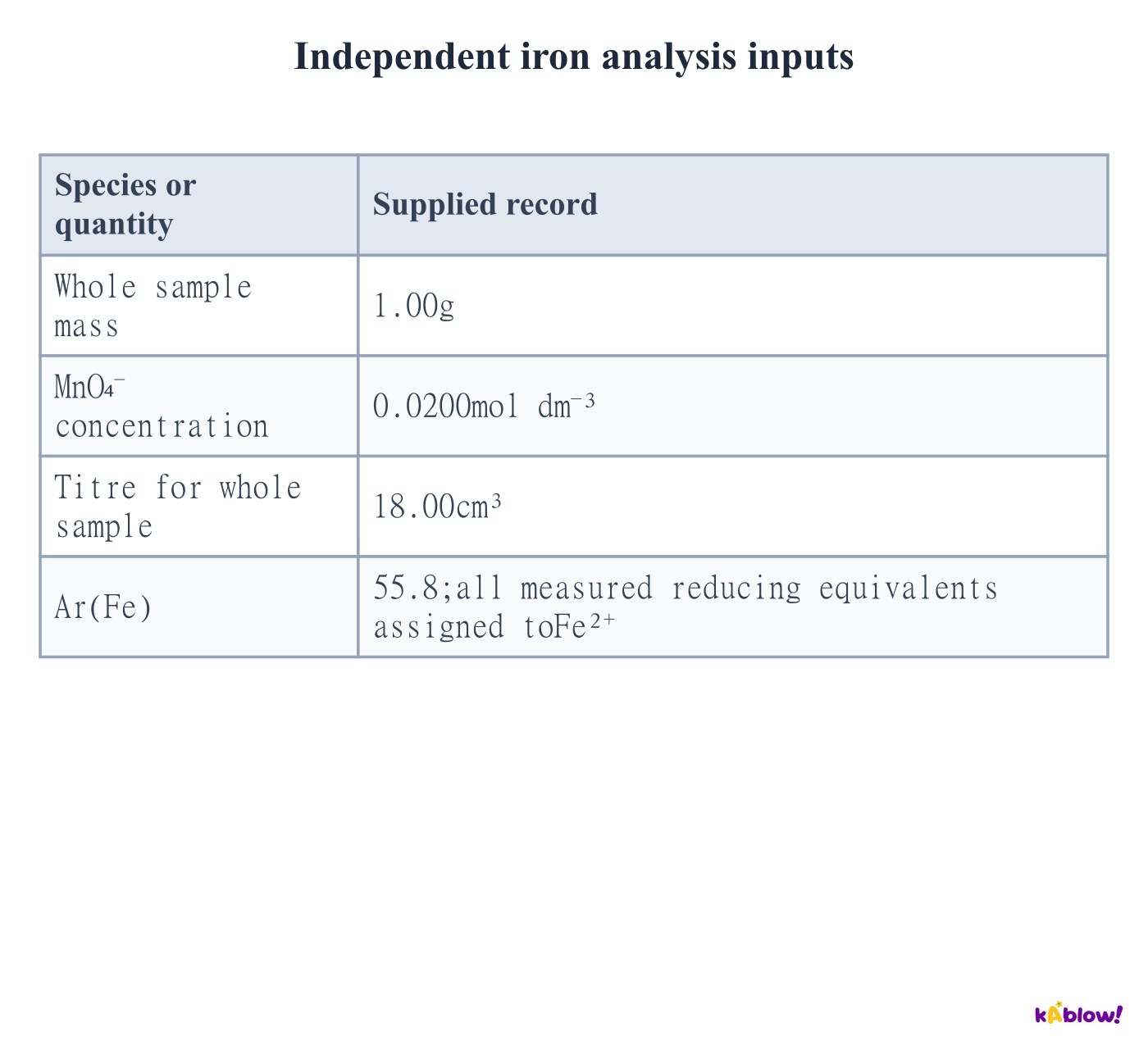
Calculate an iron mass fraction under explicit assumptions
- The titre is0.01800dm³, so manganate amount=0.0200×0.01800=0.000360 mol. The iron amount is five times larger:0.00180 mol.
- UsingAr55.8 gives 0.10044 g iron, or10.0% to three significant figures in the 1.00 g sample. Keep extra digits until the final rounding.
- The result assumes complete dissolution, all relevant iron initially Fe²⁺ and no other reducing interferents. An aliquot would require its stated dilution factor.
Independent iron analysis inputs
Balance ethanedioate oxidation with manganate reduction
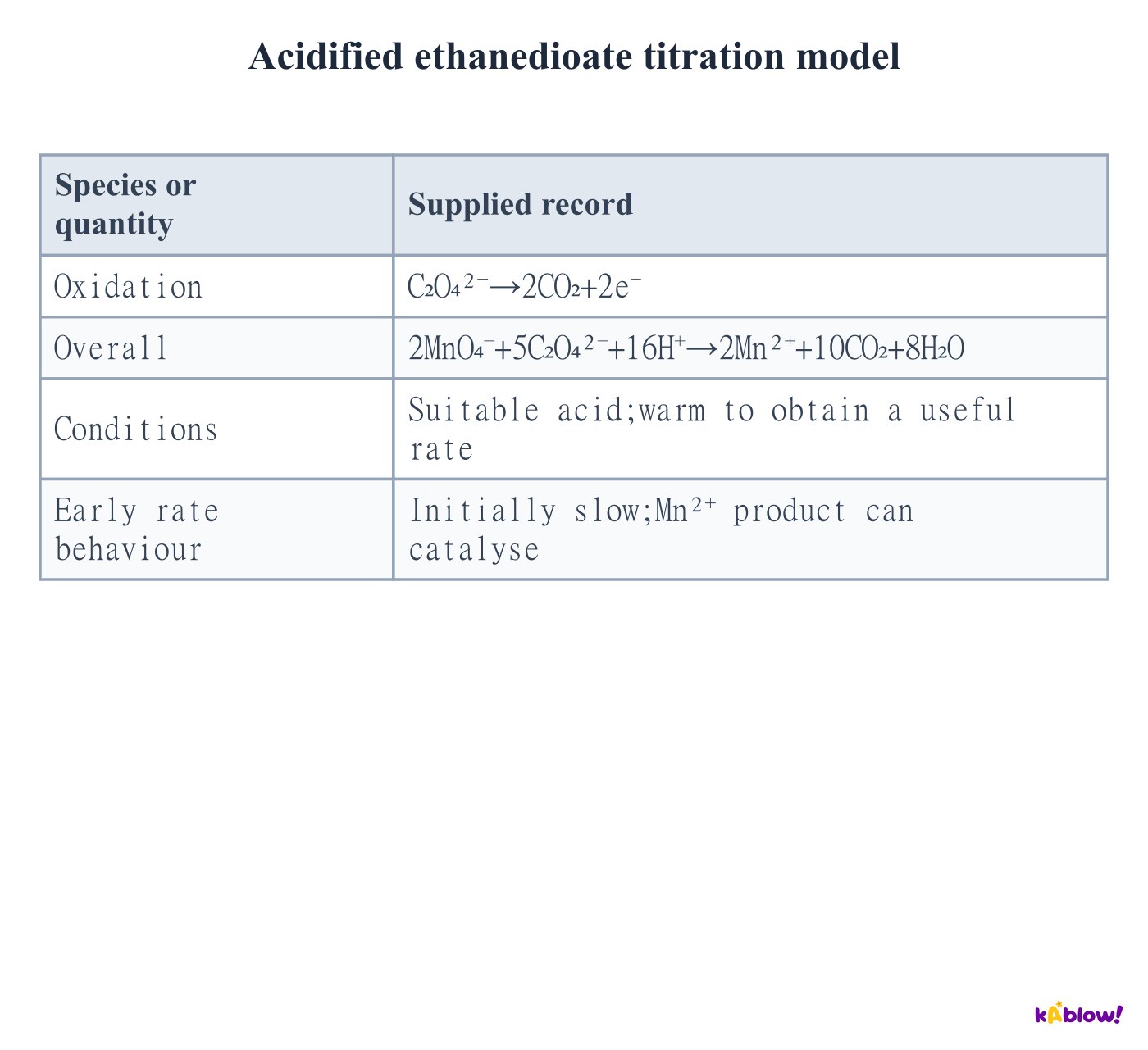
- Ethanedioate oxidation releases two electrons per ion. Five oxalate ions therefore supply the ten electrons needed by two manganate ions in acid.
- The balanced overall equation has the ratio2MnO₄⁻:5C₂O₄²⁻. Carbon dioxide forms while manganese is reduced to+2.
- Warming helps achieve a useful initial rate. Product Mn²⁺ can then catalyse the reaction; the rate eventually falls as reactants are depleted.
Acidified ethanedioate titration model
Infer hydration only from a justified sample model
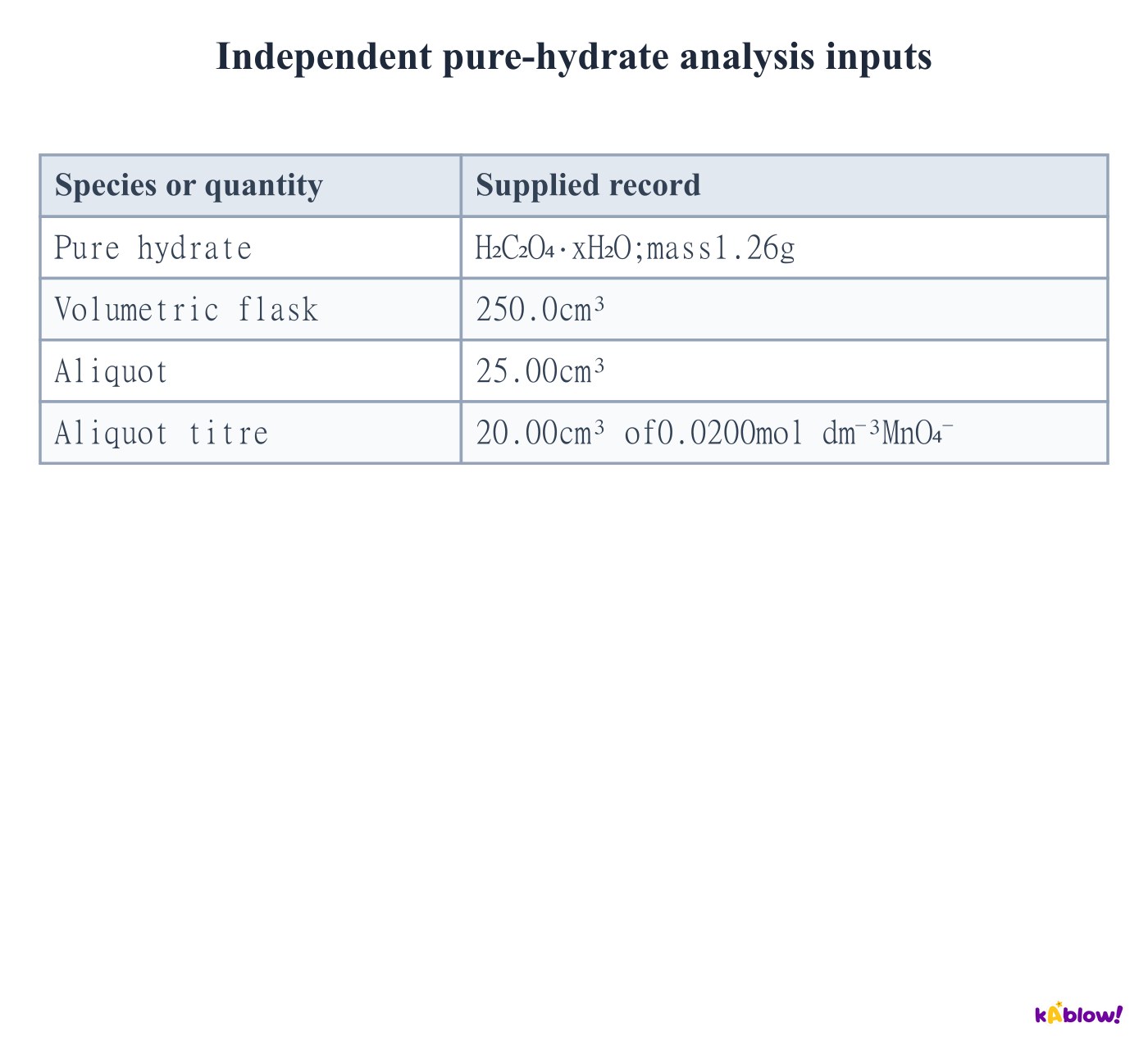
- For these inputs, manganate in the aliquot is0.000400 mol, so ethanedioate is0.00100 mol. The full flask contains 0.0100 mol of the acid formula units.
- The apparent molar mass is1.26/0.0100=126gmol⁻¹. Under the explicit pure-hydrate assumption, 90.0+18.0x=126 givesx=2.
- If the specimen were simply described as impure acid, these measurements would not establish its true molar mass. Purity or hydration needs an independently justified model.
Independent pure-hydrate analysis inputs
Classify catalysts by phase rather than state alone
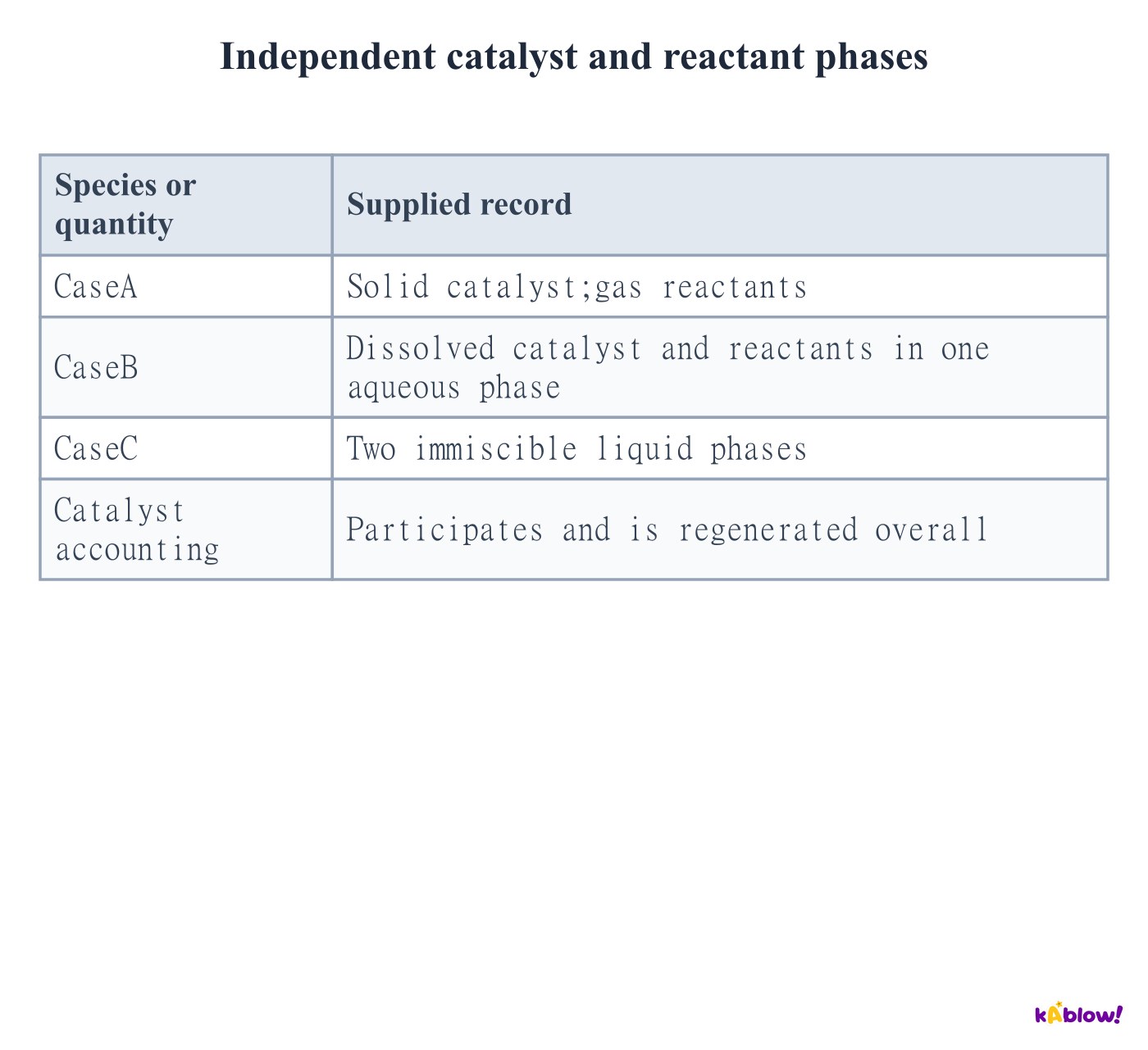
- A heterogeneous catalyst is in a different phase from the reactants; surface active sites are central to its action. A homogeneous catalyst shares their phase.
- Two liquids can form separate phases, so same physical state is not enough to prove homogeneous catalysis. Phase is the more precise distinction.
- Catalysts provide an alternative pathway with lower effective activation barriers. They do not change the overall reaction Gibbs change or the equilibrium constant.
Independent catalyst and reactant phases
Regenerate vanadium(V) oxide in the Contact cycle
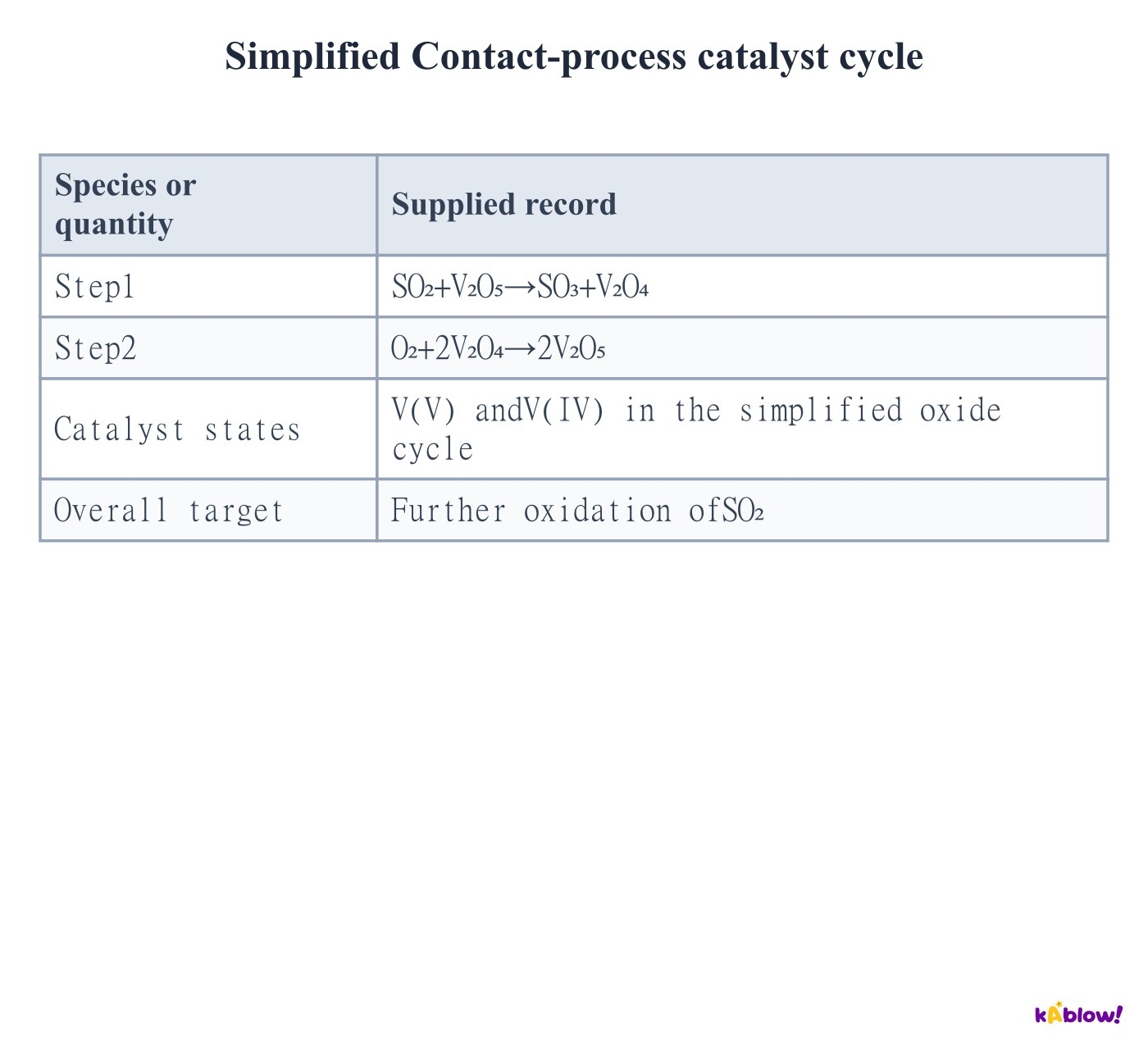
- In the simplified cycle, SO₂ reduces V₂O₅ to V₂O₄ while becoming SO₃. Oxygen then restores V₂O₅.
- Multiply the first step by two and add the regeneration step. Both vanadium oxides cancel, giving2SO₂+O₂→2SO₃.
- This school-level oxide bookkeeping explains variable oxidation states and regeneration. It does not claim a complete microscopic mechanism for every operating catalyst surface.
Simplified Contact-process catalyst cycle
Explain active sites, supports and catalyst poisoning
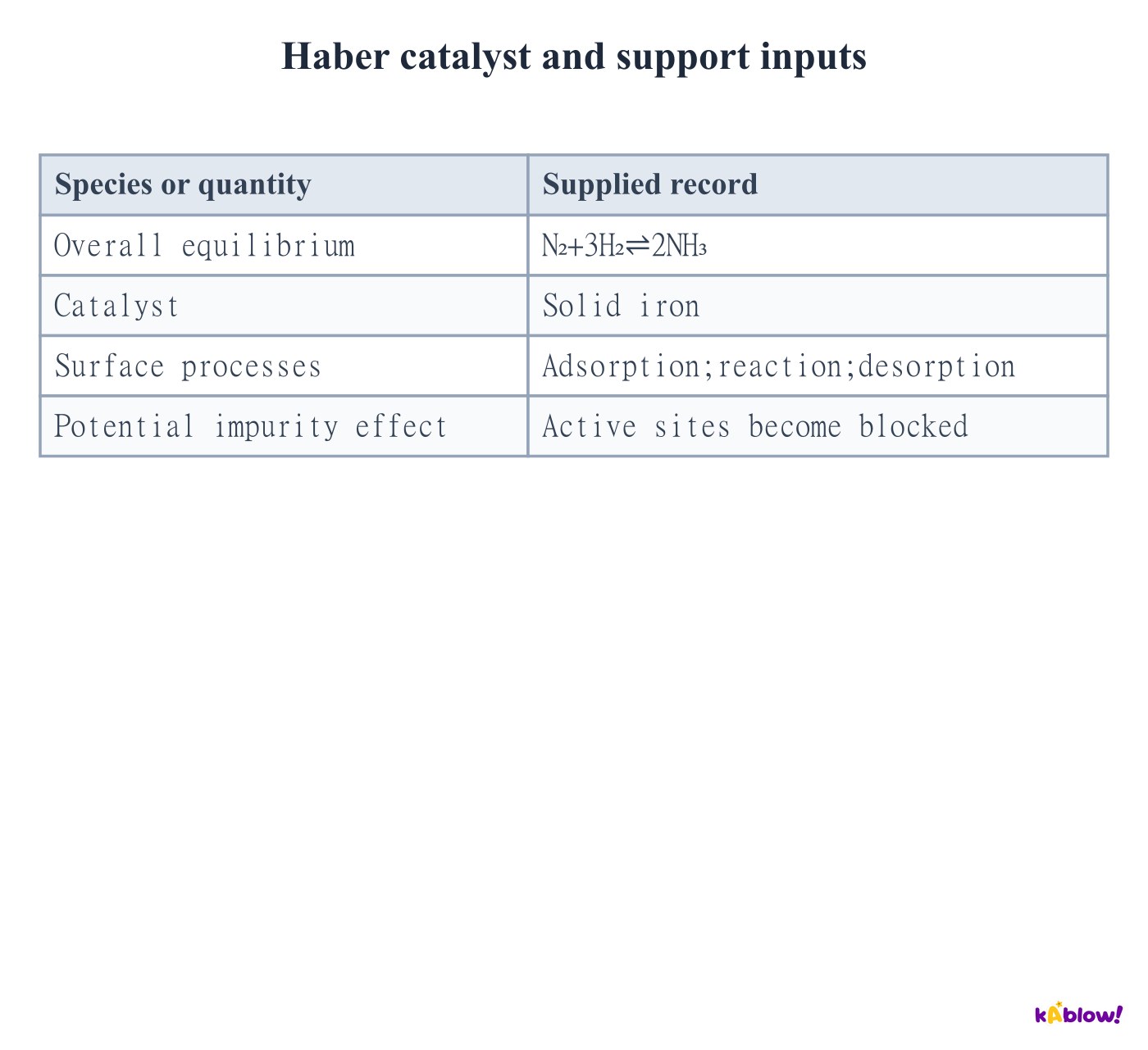
- Reactants adsorb onto suitable iron surface sites in the Haber process. Surface interactions weaken relevant bonds and facilitate new bonds before products desorb.
- A large accessible surface area can expose more active sites. Supports can disperse expensive catalysts without requiring the entire support to be the active material.
- Impurities can poison sites and heating can change surface structure. Avoid a universal converter warm-up time or a claim that every transition-metal catalyst works only through empty atomic d orbitals.
Haber catalyst and support inputs
Cancel a homogeneous iron redox cycle
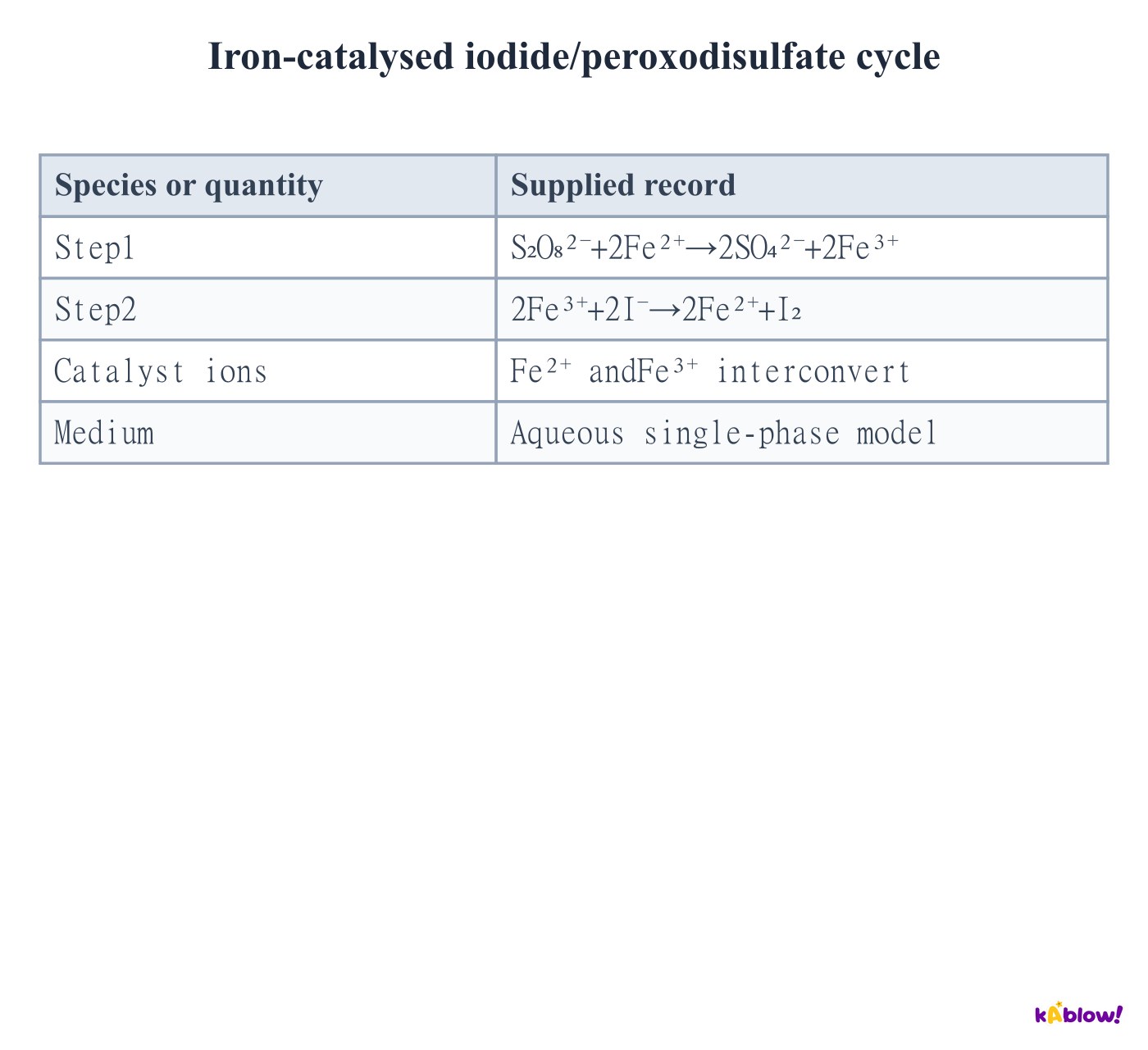
- Iron(II) reduces peroxodisulfate and becomes Fe³⁺. Iron(III) then oxidises iodide and regenerates Fe²⁺.
- Adding the two balanced steps cancels the iron species, givingS₂O₈²⁻+2I⁻→2SO₄²⁻+I₂. The catalyst participates but is restored overall.
- The alternative sequence avoids the direct encounter of two negative reactant ions and lowers the effective barrier. Homogeneous catalysis in general is not restricted to this redox mechanism.
Iron-catalysed iodide/peroxodisulfate cycle
Identify product catalysis and eventual depletion
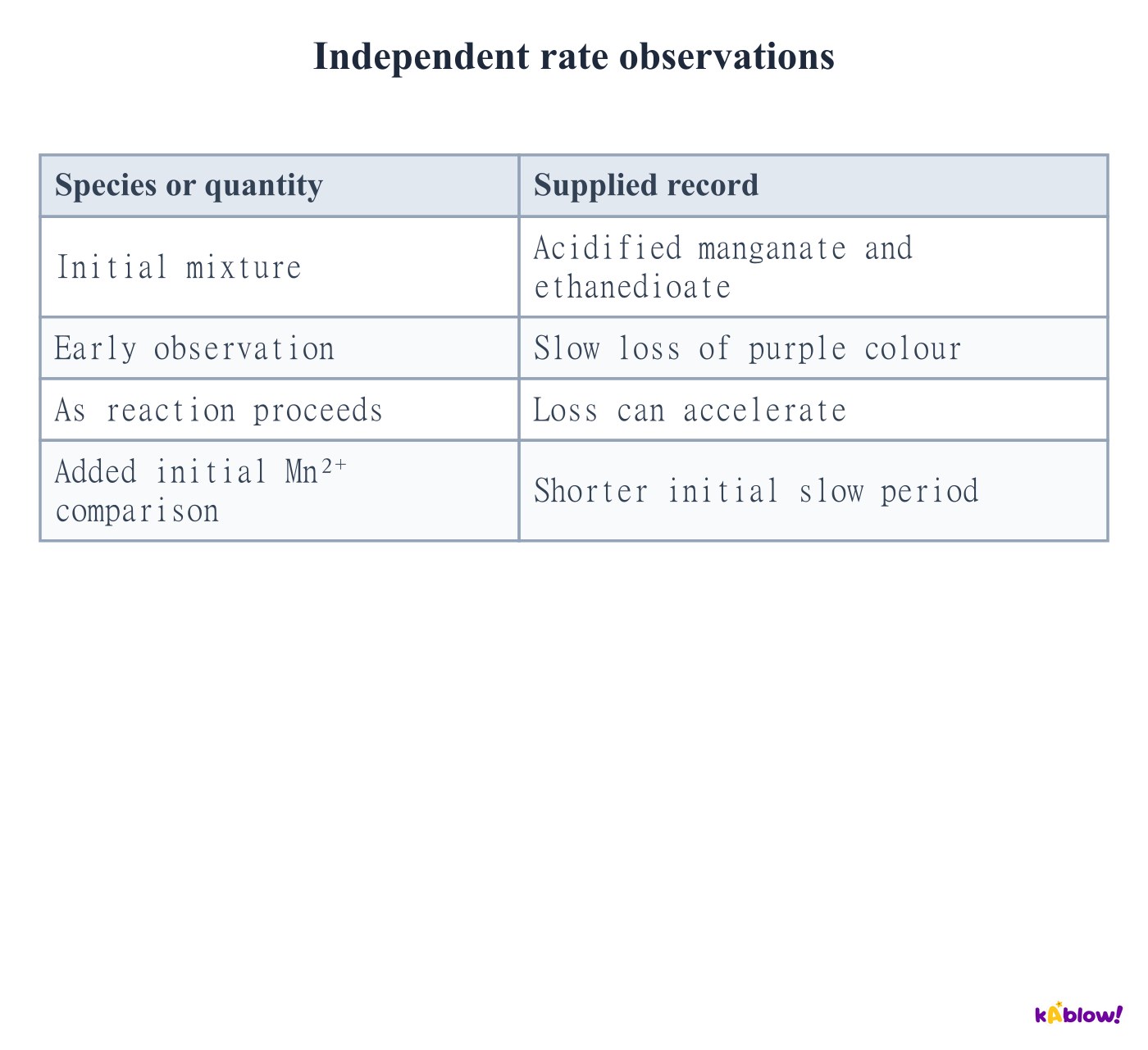
- Autocatalysis occurs when a product catalyses the reaction that forms it. Mn²⁺ can play this role in acidified manganate–ethanedioate chemistry.
- As Mn²⁺ accumulates, the reaction can speed up after an initial slow period. Adding a small initial amount can shorten that period.
- The rate does not increase forever. Falling reactant concentrations eventually outweigh the catalytic build-up, and the reaction slows toward completion.
Independent rate observations
Check catalyst regeneration in the manganese cycle
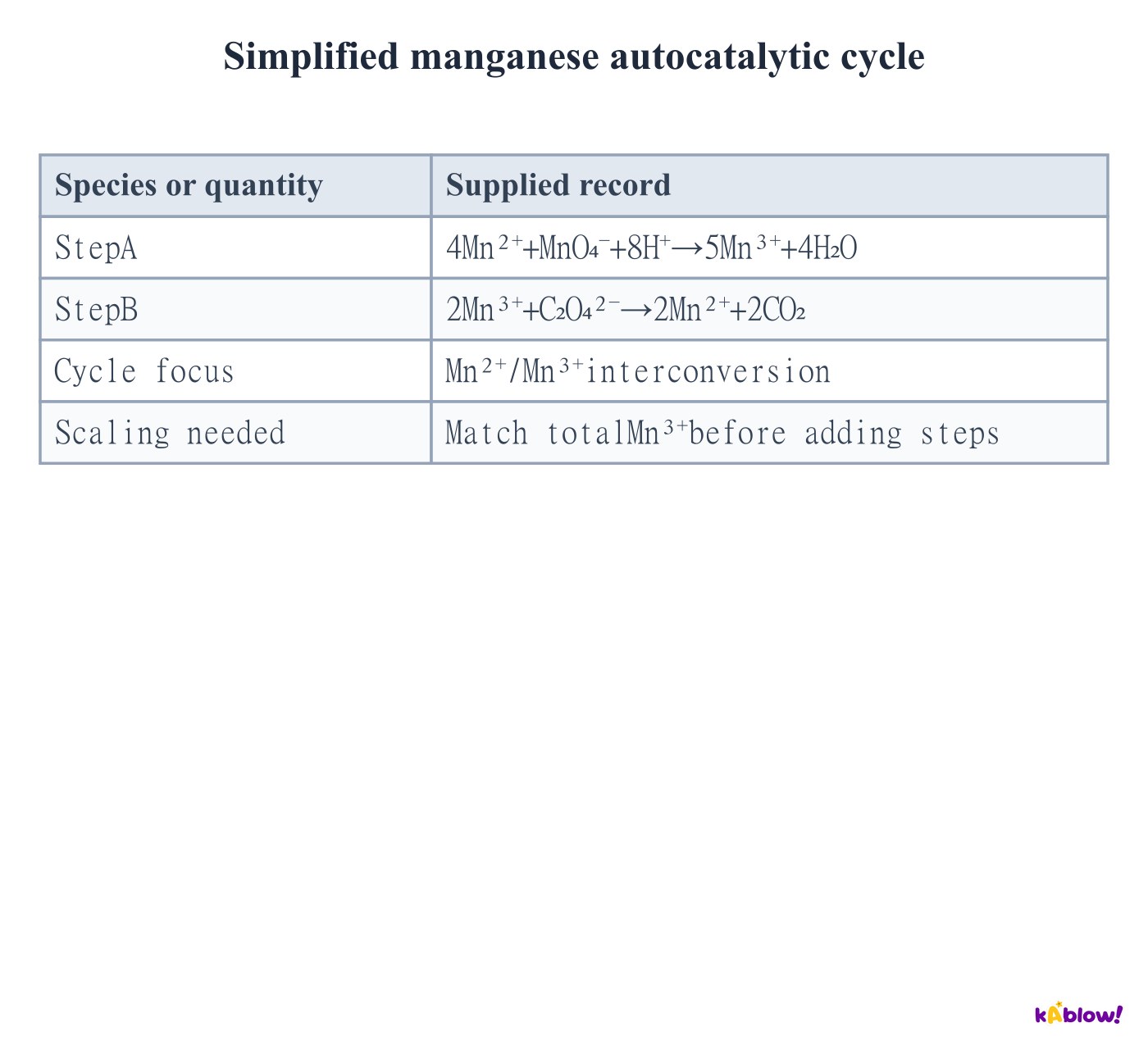
- The supplied simplified steps interconvert Mn²⁺ and Mn³⁺. Multiply stepA by two and stepB by five to cancel ten Mn³⁺ ions.
- The result is2MnO₄⁻+5C₂O₄²⁻+16H⁺→2Mn²⁺+10CO₂+8H₂O. Mn²⁺is regenerated in the cycle and also produced overall.
- That net production explains why the catalyst can build up. A reaction mechanism can contain several steps; these equations are a useful balanced model, not a claim that each written event is one elementary collision.
Simplified manganese autocatalytic cycle
Read changing rate from a product–time graph
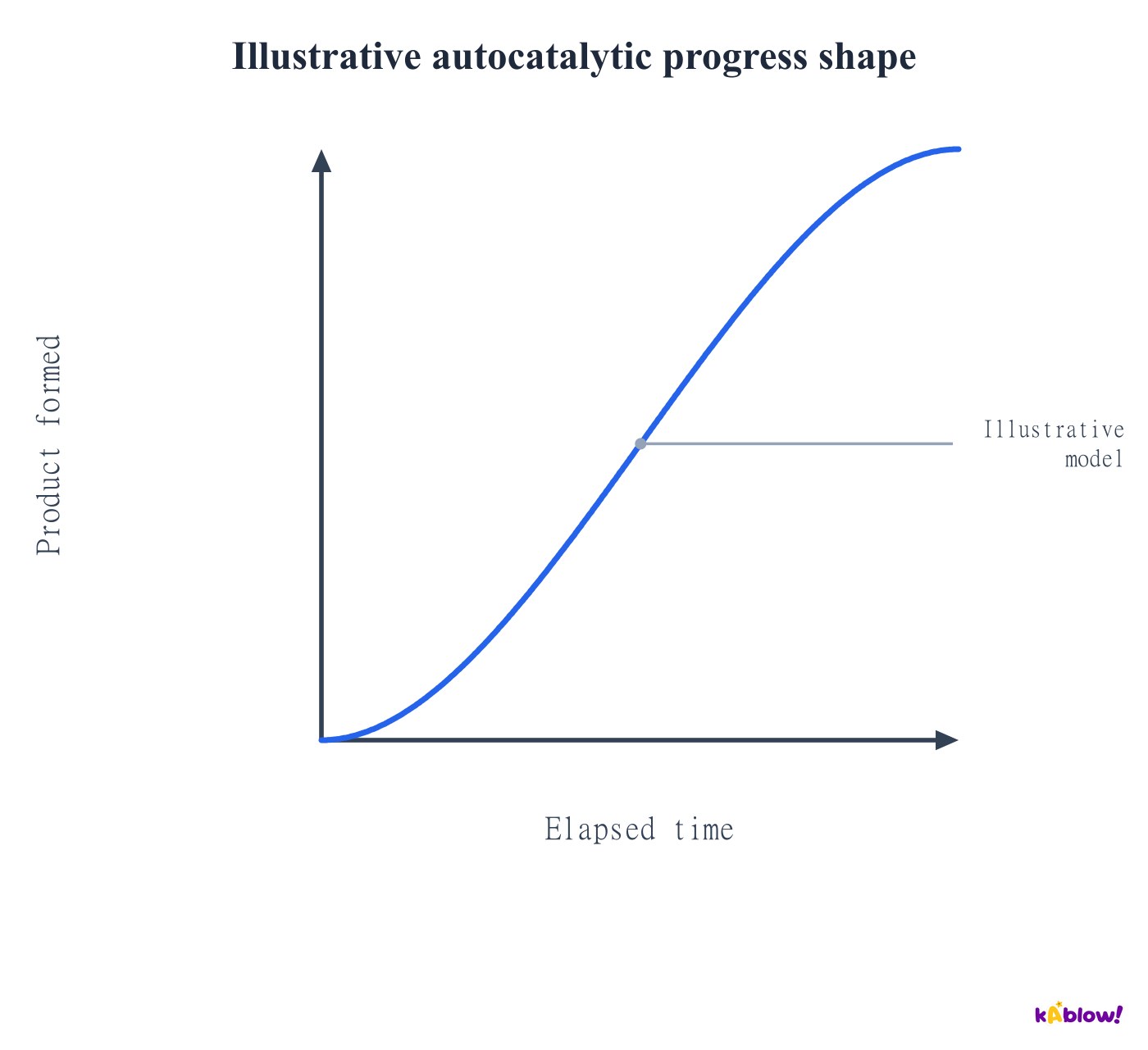
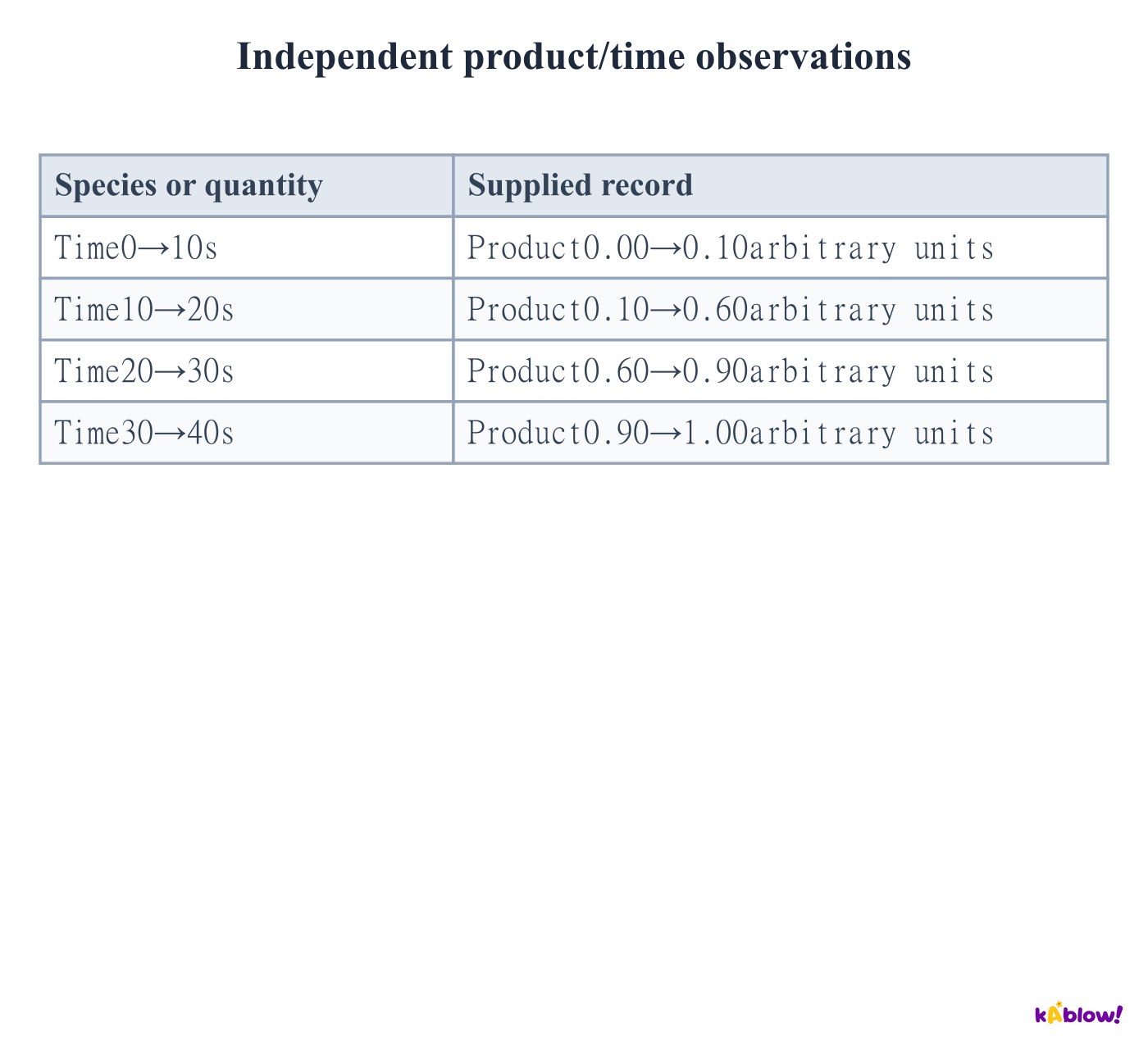
- A product–time curve can begin shallow, become steeper during acceleration, and flatten as reactants are exhausted. Rate corresponds to its local gradient.
- The plotted curve is a qualitative mathematical illustration, not fitted experimental data or a universal kinetic law. The separate observation record supplies independent interval calculations.
- Always identify what the vertical axis measures. A falling reactant curve has negative gradient, while a rising product curve has positive gradient; compare rate magnitudes consistently.
Illustrative autocatalytic progress shape
幻灯片
练习题
免费预览——80 题中的 8 题。注册即可查看全部。
1.Which listed ion provides direct evidence that copper meets the course transition-metal definition?
Hard- ACu²⁺ with 3d⁹
- BZn²⁺ with 3d¹⁰
- CSc³⁺ with 3d⁰
- DAny neutral noble-gas atom
2.How many electrons lie outside the argon core in neutral chromium from the supplied configuration?
Hard- A4
- B6
- C8
- D10
3.Which d-electron count follows for Mn³⁺ from the supplied atom and removal order?
Hard- A7
- B5
- C4
- D2
4.Which inference is supported by the supplied comparison examples?
Hard- AEvery complex must contain an incomplete d sublevel
- BComplex formation proves variable oxidation states in that particular sample
- CAll coloured ions must be d–d absorbers
- DComplex formation alone does not prove the course transition-metal definition
5.Which atom in the supplied ammonia ligand provides the donating lone pair?
Hard- AN
- BH
- CThe metal nucleus
- DAn oxygen absent from NH₃
6.What coordination number follows for[Co(en)₃]³⁺ in the specified bidentate binding mode?
Hard- A3
- B6
- C9
- D2
7.What signed charge follows for the stated one-to-one Co²⁺–EDTA⁴⁻ complex?
Hard- A+6
- B+2
- C−2
- D−6
8.Which pair gives the coordination number and charge for caseB?
Hard- A4 and−2
- B4 and+2
- C6 and−2
- D6 and+2
历年真题
该知识点的历年真题练习即将推出。
即将推出