
Composition, perspective and space
边玩边学
回答这些题目来赚取能量,然后钓鱼探索。无需账号。
给教育者: 面向 Composition, perspective and space(Art and Design,Visual Elements)的即用型课程幻灯片, 复习笔记——用在你的课堂上,或将该知识点作为学习者可实时游玩的互动课堂活动来运行。
课程笔记
Composition and optional guides
- Composition arranges elements and spaces. Balance, contrast, emphasis, rhythm, proportion, scale and unity describe relationships that can support different intentions. Mirror symmetry and asymmetrical balance are both possible.
- The rule of thirds uses a three-by-three grid as a placement guide. Centring, symmetry, cropping and leading lines offer alternatives. No guide guarantees quality or forces every viewer to look in the same order.
Choices support different intentions
Space and depth cues
- Overlap can suggest front/back relationships, including with flat-colour shapes. Equal-sized objects normally appear smaller with distance, but actual object size matters. Detail and contrast can also help suggest depth.
- Atmospheric perspective often reduces distant clarity, contrast and saturation; colour depends on conditions rather than a universal pale-blue rule. Negative space includes areas around, between and within chosen positive forms.
Qualify the depth cue
Perspective directions and eye level
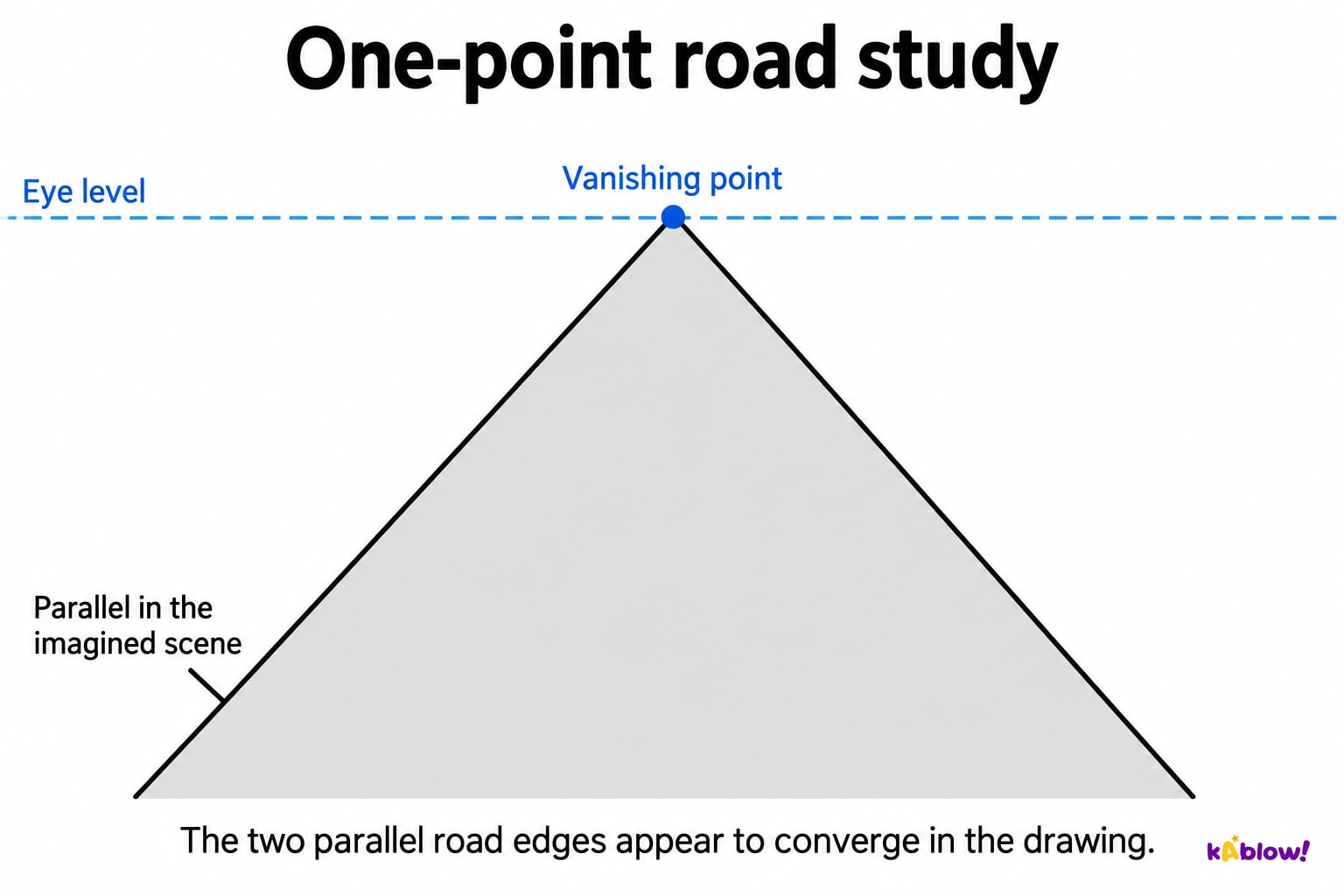
- In the standard level-view system, the horizon or eye-level line represents the viewer’s eye level even when no land–sky boundary is visible. A vanishing point is associated with a particular parallel receding direction.
- One-point construction has one main depth family; front-facing horizontals and verticals remain parallel in the image. Two-point construction gives two principal horizontal families with points on the same eye level; verticals remain vertical. Different orientations can need other systems.
Eye level and a shared depth direction
Scale, proportion and foreshortening
- Scale compares size with other things or the setting; proportion compares parts. Deliberate exaggeration can communicate importance or an expressive relationship rather than naturalistic accuracy.
- Foreshortening depicts apparent compression of an extent pointing towards or away from the viewer. Observe projected angles and shapes instead of assuming the full known length must appear across the picture.
Distinguish size relationships
Viewpoint, crop and negative space
- A bird’s-eye view looks down; a worm’s-eye view is very low, often looking up. Viewpoint changes visible surfaces and relationships, but its effect depends on the image.
- A crop excludes some information and changes the frame’s relation to what remains. Compare context, emphasis and negative space. Leading lines may guide attention through the work rather than only towards one fixed focus.
Viewpoint and framing
One-point room construction
- Set eye level and a vanishing point for the main depth direction. Draw a front-facing back-wall rectangle and extend lines through its corners away from that point to define the surrounding room.
- Keep horizontal and vertical wall edges parallel to the picture surface as appropriate. Only the long depth family shares the point: this is apparent convergence of parallel-in-reality edges.
Two-point box construction
- Place two well-separated points on one eye-level line and a nearest vertical corner below it for a view showing the top. Send its top and bottom towards both points to establish the side families.
- Add farther verticals, then close the top with lines aimed at the corresponding points. Check each edge’s family and retain vertical verticals in this standard construction; wide point spacing helps avoid an excessively distorted example.
幻灯片
练习题
免费预览——33 题中的 8 题。注册即可查看全部。
1.What is composition?
Easy- Athe arrangement of elements in an artwork
- Bthe colour of a painting
- Cthe paper
- Dthe frame
2.What is a focal point?
Easy- Athe border
- Bthe background
- Cthe signature
- Dan area given particular visual emphasis
3.In a level-view linear-perspective construction, what does the horizon line represent?
Easy- Athe border
- Ba shadow
- Cthe viewer’s eye level, whether or not a land–sky boundary is visible
- Da vertical line
4.What is a vanishing point?
Easy- Aa highlight
- Bthe apparent convergence of one set of parallel receding directions
- Cthe focal point
- Dthe foreground
5.What is symmetrical balance?
Easy- Aboth sides mirror each other
- Bone side heavier
- Cno balance
- Drandom
6.What is asymmetrical balance?
Easy- Aboth sides identical
- Bno balance
- Call one colour
- Ddifferent elements balance without mirroring
7.What is foreshortening?
Easy- Acolouring
- Btracing
- Cdepicting an extent as compressed when it points towards or away from the viewer
- Dmaking things bigger
8.What is atmospheric perspective?
Easy- Ano change
- Bchanges in contrast, clarity and sometimes colour that suggest distance through atmosphere
- Cdistant objects look darker
- Ddistant objects look larger
历年真题
该知识点的历年真题练习即将推出。
即将推出