Kablow!

Operating systems and software

边玩边学

回答这些题目来赚取能量,然后钓鱼探索。无需账号。

给教育者: 面向 Operating systems and software(Computer Science,Computer Systems)的即用型课程幻灯片, 复习笔记——用在你的课堂上,或将该知识点作为学习者可实时游玩的互动课堂活动来运行。

课程笔记

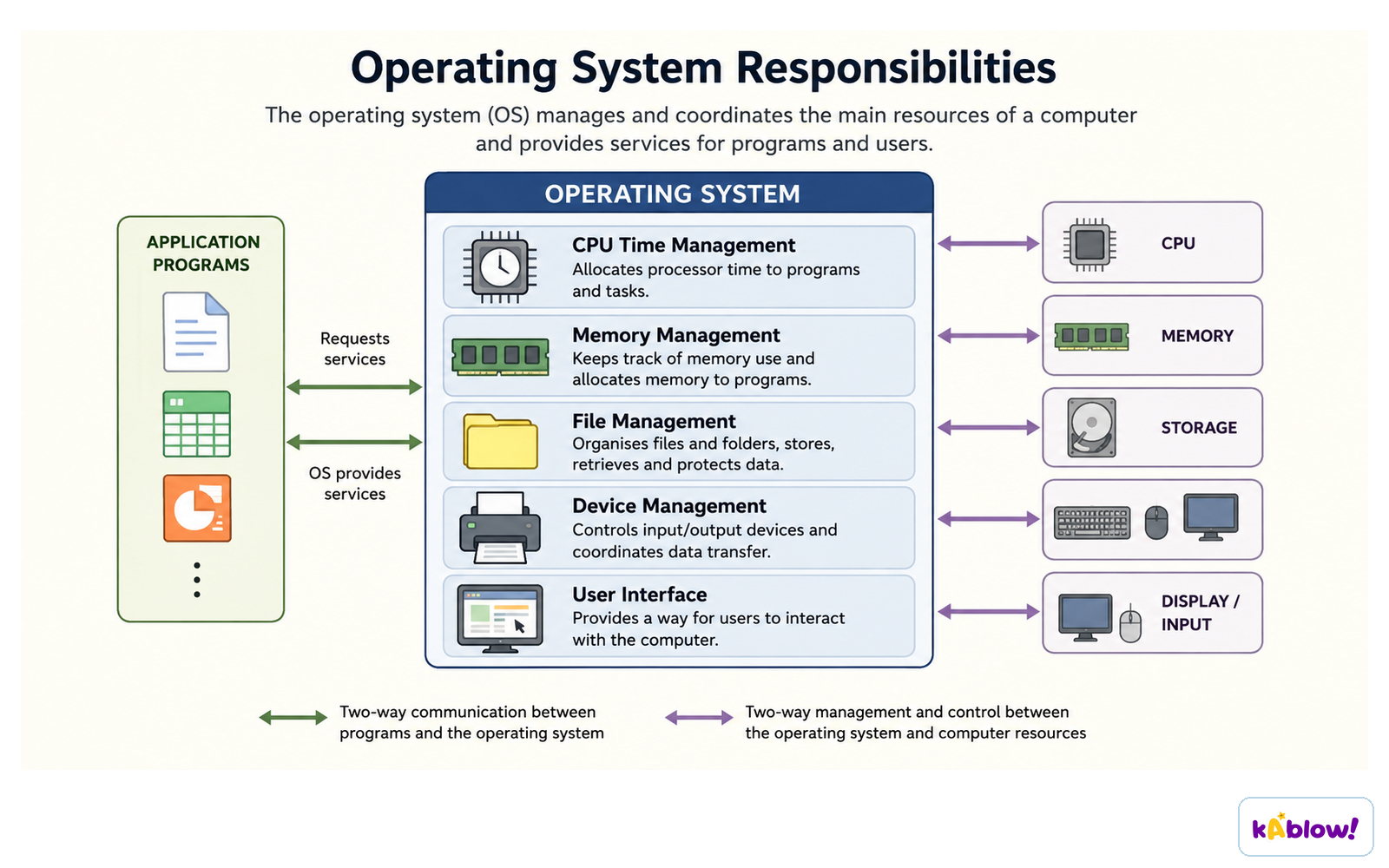
Operating systems (OS)

  • An operating system manages the computer's hardware and provides services for software. Functions: user interface (GUI or command line), memory management, multitasking (process scheduling), file management, device management (drivers) and security (accounts, permissions).
  • Examples: Windows, macOS, Linux, Android, iOS.

Operating system responsibilities

Operating system responsibilities

Types of software

  • System software: OS and utility software (antivirus, backup, disk defragmenter, compression).
  • Application software: performs tasks for users (word processor, web browser, games).

System and application software

System and application softwareCategoryExamplesPurposeSystem: operatingsystemWindows; LinuxManages resourcesSystem: utilitiesBackup;anti-malwareMaintains /protects systemApplicationWord processor;browserPerforms user tasks

Programming languages

  • High-level languages use readable abstractions and can be implemented on different platforms; a suitable translator or runtime and libraries are still needed.
  • Machine code and assembly are low-level and processor-specific. They permit close hardware control, but are harder to write and maintain.

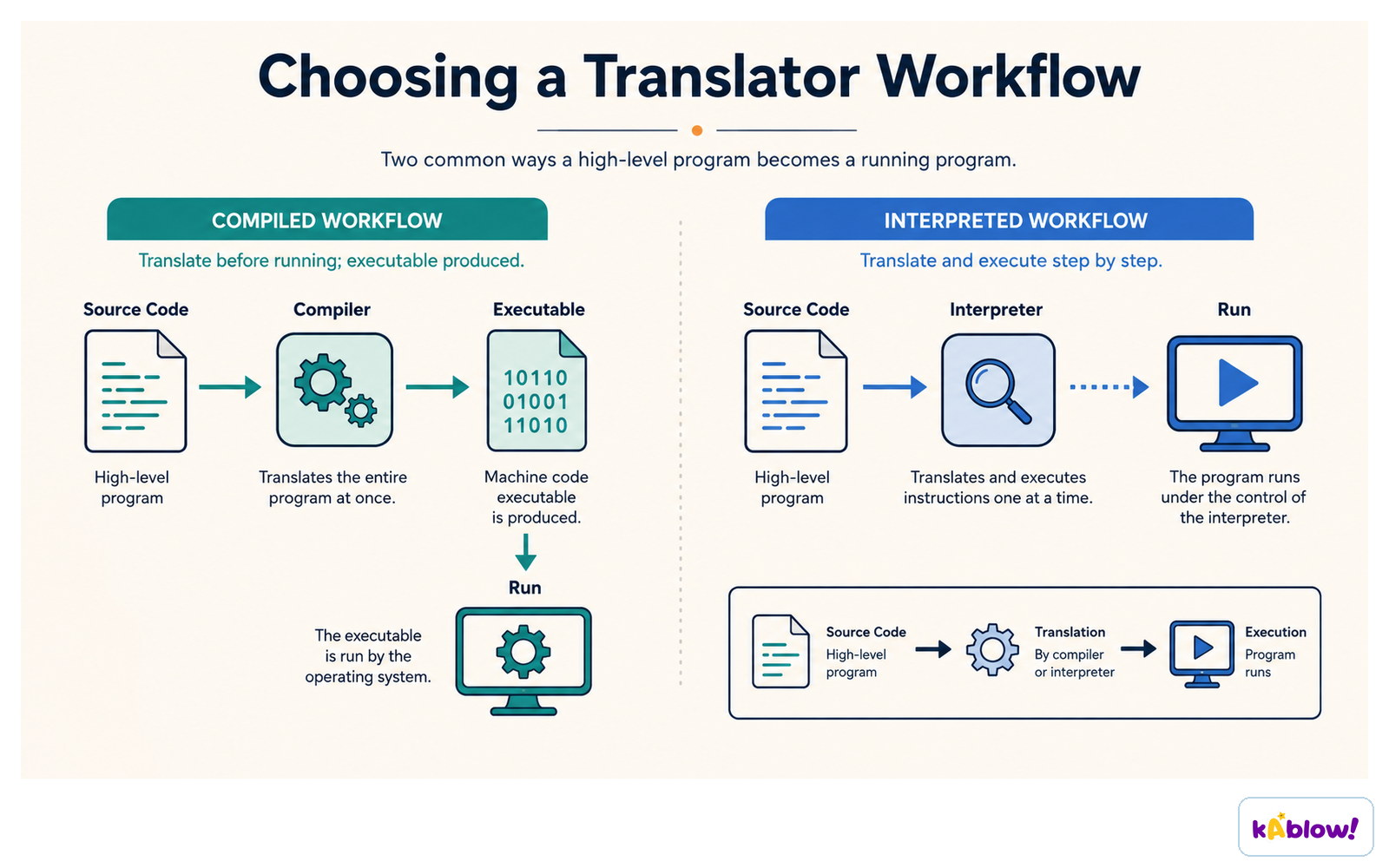
Translating and running source code

Translating and running source code

Translators

  • In the simplified GCSE model, a compiler translates source before execution, often producing a native executable; an interpreter translates and executes as the program runs.
  • An assembler translates assembly notation to machine code. Real systems may combine interpretation, bytecode and just-in-time compilation.
  • Compiled code often runs faster, while interpretation can support interactive debugging; neither is a universal speed rule.

Open source vs proprietary

  • Open-source licences provide source-code access and permissions to use, modify and redistribute under specified conditions.
  • Proprietary licences reserve more control to the rights holder. Proprietary software may be paid or free; price alone does not determine the licence category.

幻灯片

Sign up free to view the lesson slides

Step through every slide for this topic — plus flashcards and revision notes — with a free account.

练习题

免费预览——33 题中的 8 题。注册即可查看全部。
  1. 1.What is an operating system?

    Easy
    • Asoftware that manages the computer
    • Ba word processor
    • Ca game
    • Da browser
  2. 2.What is application software?

    Easy
    • Asoftware that performs tasks for the user
    • Bthe OS
    • Cfirmware
    • Ddrivers
  3. 3.Which is an example of an operating system?

    Easy
    • AWindows
    • BExcel
    • CChrome
    • DPhotoshop
  4. 4.Which is utility software?

    Easy
    • Aantivirus
    • Ba game
    • Ca spreadsheet
    • Da browser
  5. 5.What is a high-level language?

    Easy
    • Aa programming language close to human language
    • Bmachine code
    • Cassembly
    • Dbinary
  6. 6.What is machine code?

    Easy
    • Abinary instructions the CPU executes directly
    • BPython code
    • CEnglish text
    • Da flowchart
  7. 7.What is assembly language?

    Easy
    • Aa low-level language using mnemonics
    • Ba high-level language
    • Ca database
    • Da network
  8. 8.What does a compiler do?

    Easy
    • Atranslates the whole program before it runs
    • Bruns one line at a time
    • Cstores data
    • Dcompresses files

Unlock all 33 questions & more

创建免费账号,即可查看该知识点的每一道题、幻灯片、闪卡和复习笔记。

历年真题

该知识点的历年真题练习即将推出。
即将推出