Kablow!

Computer Science exam technique and programming tasks

边玩边学

回答这些题目来赚取能量,然后钓鱼探索。无需账号。

给教育者: 面向 Computer Science exam technique and programming tasks(Computer Science,Exam Skills)的即用型课程幻灯片, 复习笔记——用在你的课堂上,或将该知识点作为学习者可实时游玩的互动课堂活动来运行。

课程笔记

Know the papers

  • Check the current specification and assessment arrangements for your chosen board: paper names, timing and programming requirements vary.
  • This generic lesson practises computer-systems knowledge, algorithms, tracing and programming responses; its illustrative papers do not represent official exam documents.

Preparing systems and programming skills

Preparing systems and programming skills

Command words

  • State/Give/Name: short fact. Describe: say what something is or does. Explain: give a reason ("because"). Compare: similarities and differences. Evaluate/Discuss: weigh up advantages and disadvantages and reach a judgement. Write/Complete: produce code or fill in a table.

Answering a storage question

Answering a storage questionCommandResponse focusExampleStateA relevant factSSD has no moving partsDescribeWhat it is / doesFlash stores data electronicallyExplainFact + consequenceNo moving parts reduces shock riskEvaluateTrade-offs + judgementChoose using cost and speed

Reading and writing algorithms

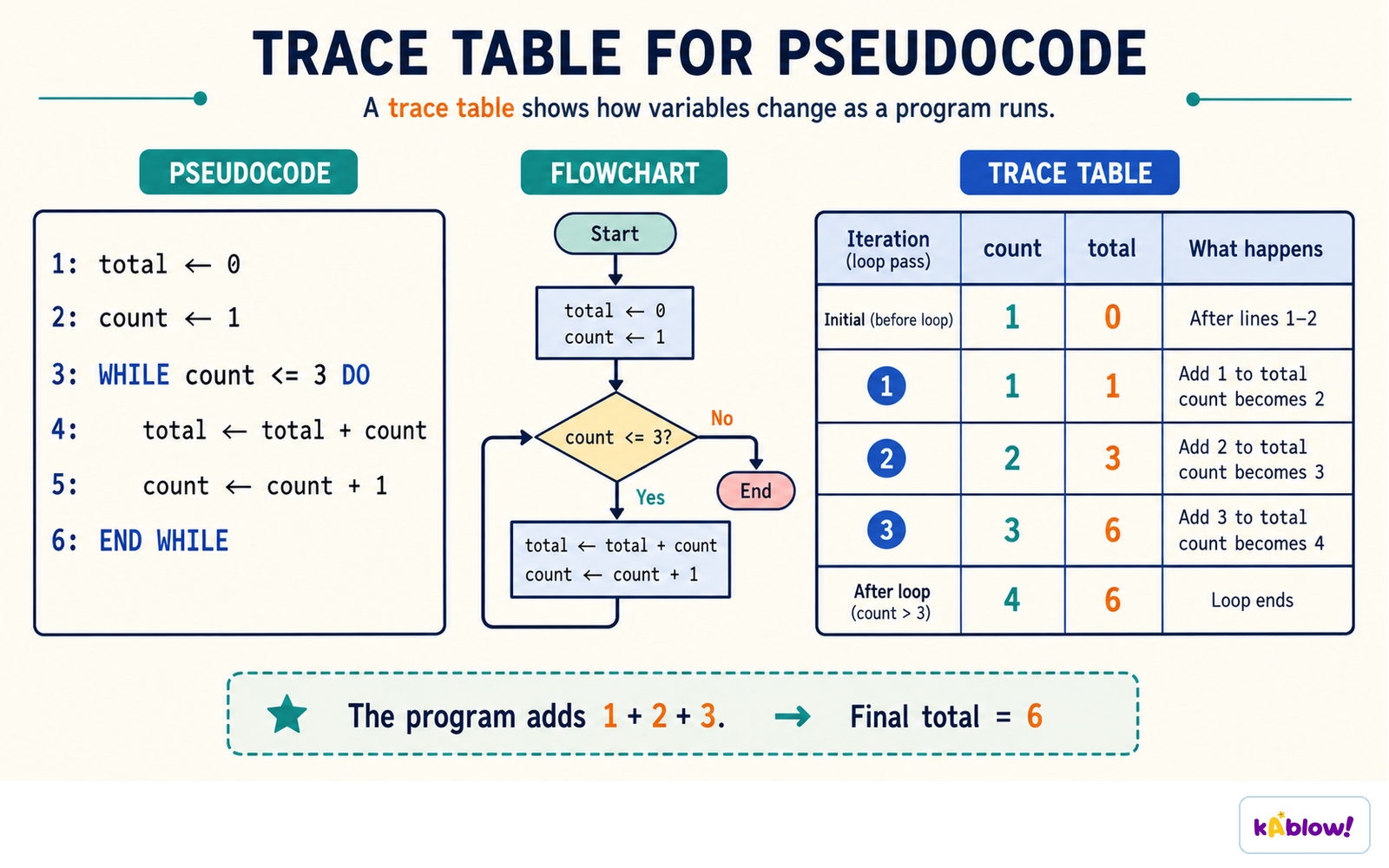
  • Read pseudocode carefully; trace with a table; write code using the language or pseudocode listed. Use meaningful names, indentation and comments. Check boundaries and loop conditions (off-by-one errors).

Check an algorithm with a trace

Check an algorithm with a trace

Extended-response questions

  • Use chains of reasoning: point, because, therefore. Apply knowledge to the scenario; use technical terms accurately; include both sides for evaluation.

Calculations

  • Convert between binary, denary and hexadecimal; file-size calculations; show working.

Time management

  • Use the paper’s actual duration and total marks to plan an approximate time budget, leaving time to check. Do not assume a universal one-mark-per-minute rule.
  • Attempt relevant steps in difficult questions; partial-credit rules depend on the mark scheme.

Revision

  • Practise past papers; flash cards for key terms; write code; use trace tables; review mistakes.

幻灯片

Sign up free to view the lesson slides

Step through every slide for this topic — plus flashcards and revision notes — with a free account.


练习题

免费预览——31 题中的 8 题。注册即可查看全部。
  1. 1.What does the command word State normally ask you to provide?

    Easy
    • Aa concise relevant fact
    • Ban unsupported personal opinion
    • Cevery fact you know
    • Da complete program regardless of the question
  2. 2.What does 'describe' ask you to do?

    Easy
    • Asay what something is or does
    • Bmake a list
    • Cdraw only
    • Dgive a number
  3. 3.What does 'compare' ask for?

    Easy
    • Asimilarities and differences
    • Bone fact
    • Ca drawing
    • Da code
  4. 4.What is a good way to prepare for exams?

    Easy
    • Apractise past papers
    • Bread once
    • Cavoid practice
    • Dskip topics
  5. 5.Which tool helps you follow an algorithm step by step?

    Easy
    • Atrace table
    • Bflowchart only
    • Ccompiler
    • DIDE
  6. 6.For a 6-mark evaluate question, what should you include?

    Easy
    • Aadvantages, disadvantages and a judgement
    • Bone fact
    • Ca list of terms
    • Da diagram only
  7. 7.What does 'off-by-one' error mean?

    Easy
    • Aa loop runs one too many or too few times
    • Bone wrong letter
    • Ca missing semicolon
    • Da crash
  8. 8.What is the first step when answering a pseudocode question?

    Easy
    • Aread the code and any variables carefully
    • Bguess
    • Cskip
    • Dwrite at once

Unlock all 31 questions & more

创建免费账号,即可查看该知识点的每一道题、幻灯片、闪卡和复习笔记。

历年真题

该知识点的历年真题练习即将推出。
即将推出