
Systems approach and mechanical devices
边玩边学
回答这些题目来赚取能量,然后钓鱼探索。无需账号。
给教育者: 面向 Systems approach and mechanical devices(Design and Technology,Core Technical Principles)的即用型课程幻灯片, 复习笔记——用在你的课堂上,或将该知识点作为学习者可实时游玩的互动课堂活动来运行。
课程笔记
The systems approach
- The systems approach models interacting components through inputs, processing and outputs across a chosen boundary. Inputs can be information, energy or material. Feedback returns information about an output or resulting condition to influence control.
- For room-temperature control, measured temperature and a target setpoint inform the controller, which commands the heating. The room and its heat losses affect the resulting temperature; sensing it again closes the control loop. A controller command is not the same thing as heat energy itself.
Room heating: information and control
Types of motion
- Linear motion follows a straight path; rotary motion turns about an axis. Reciprocating motion repeats along a straight path, while oscillating motion in this mechanisms classification swings repeatedly about a pivot. These labels are useful descriptions rather than mutually exclusive rules for all physics.
- A guided piston is a reciprocating example, a rotating shaft is rotary, and a pendulum is oscillating. Random motion is also a meaningful broader scientific description; it is not one of the four mechanism categories emphasised here.
Four useful motion descriptions
Levers
- A lever turns about a fulcrum. Class 1 places the pivot between effort and load, as in a seesaw; class 2 places the load between them, as in a wheelbarrow; class 3 places effort between them, as in ordinary tweezers. Between does not mean equally spaced.
- Mechanical advantage = load force ÷ effort force. A 100 N load moved by a 25 N effort gives MA = 4. Velocity ratio = effort distance ÷ corresponding load distance; 20 cm ÷ 5 cm gives VR = 4. Both ratios are dimensionless. For the ideal model MA = VR; losses reduce useful output work.
Which element lies between the other two?
Linkages and cams
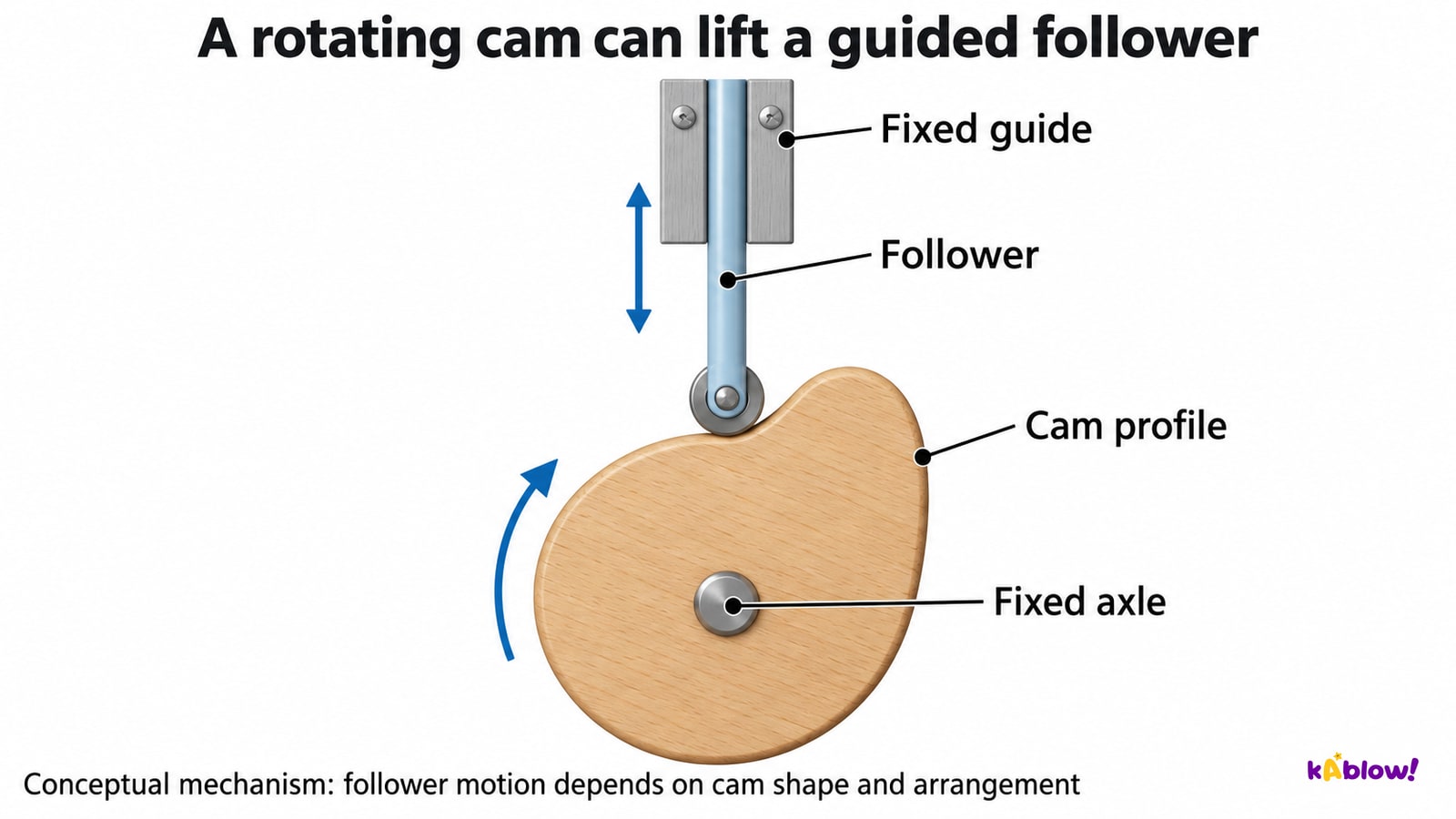
- A cam rotates while its profile drives a follower. A translating guide can give reciprocation; a pivoted follower can give oscillation. A concentric circular disc gives no varying lift in the simple translating arrangement, while an eccentric circular disc can. Follower speed need not be constant even at constant cam speed.
- The original illustration shows a roller contacting a profiled cam and a rod constrained by a fixed guide. It is conceptual, with gravity-loaded contact assumed at suitable low speed; it does not specify a measured lift law, operating speed or build dimensions. A spring or positive constraint may be needed in other arrangements.
- Linkages connect pivoted members to redirect or alter movement. A bell crank is an angled lever, often used to redirect a motion approximately through a right angle. A crank-and-slider can convert rotation and reciprocation, depending on how it is driven.
Cam and guided follower
Gears, pulleys and belts
- For the simple external pairs used here, ratio = driven teeth ÷ driver teeth and output speed = input speed ÷ ratio. A 15-tooth driver and 45-tooth driven gear give 3:1 and one-third output speed, with opposite rotation. A 40-tooth driver and 10-tooth output give 1:4 and four times output speed.
- Inserting one simple external idler between unchanged input and output gears changes direction relative to direct meshing while leaving their ideal speed ratio unchanged. This is different from a compound train with two different gears fixed on an intermediate shaft. Additional meshes can add losses.
- Speed reduction trades for greater ideal torque under a power balance, not energy creation. An open belt on parallel shafts normally preserves rotation direction, while a suitable crossed arrangement reverses it. Actual belt drives can slip and require a suitable belt and clearance.
- A worm and wormwheel can give large reduction; ratio depends on wheel teeth and worm starts. Not all worm drives are self-locking. An engaged ratchet and pawl resists one rotation direction; releasing it changes the constraint. Shafts and suitable torsional couplings can transmit torque.
Simple external pairs: stated ratio convention
Torque and useful work
- Torque is a turning moment, measured in N m. For one force, its magnitude is force multiplied by the perpendicular distance from the rotation axis. Calling it simply a force omits the distance and gives the wrong physical quantity.
- Useful output work cannot exceed input work for these passive mechanisms. A force or torque increase is accompanied by a movement or speed trade-off; friction and deformation reduce useful transfer. State the model and arrangement before applying a ratio.
Worked ratios for one teaching model
幻灯片
练习题
免费预览——33 题中的 8 题。注册即可查看全部。
1.What is a system?
Easy- Ainputs, processes and outputs
- Ba type of tool
- Ca material
- Da drawing
2.What is feedback?
Easy- Astopping a system
- Bchanging a material
- Cstarting a motor
- Dreturning output or condition information to influence control
3.What is linear motion?
Easy- Aswinging
- Bremaining stationary
- Cmovement in a straight line
- Dcircular movement
4.What is rotary motion?
Easy- Abouncing
- Bcircular movement
- Cstraight movement
- Dswinging
5.What is reciprocating motion?
Easy- Abackwards and forwards in a straight line
- Bcircular
- Cswinging
- Dvibrating
6.What is oscillating motion?
Easy- Amoving in a straight line
- Bspinning
- Crolling
- Dswinging back and forth about a point
7.Which is a class 1 lever?
Easy- Atweezers
- Bnutcracker
- Cseesaw
- Dwheelbarrow
8.Which is a class 2 lever?
Easy- Ascissors
- Bwheelbarrow
- Cseesaw
- Dtweezers
历年真题
该知识点的历年真题练习即将推出。
即将推出