
Timbers and manufactured boards
边玩边学
回答这些题目来赚取能量,然后钓鱼探索。无需账号。
给教育者: 面向 Timbers and manufactured boards(Design and Technology,Materials)的即用型课程幻灯片, 复习笔记——用在你的课堂上,或将该知识点作为学习者可实时游玩的互动课堂活动来运行。
课程笔记
Natural timbers
- Hardwoods are timbers from flowering trees, commonly broad-leaved species such as oak, beech, ash and teak. Some are evergreen. Softwood timbers commonly come from conifers such as pine, spruce, cedar and larch; larch is deciduous. Leaf-shedding is not the defining hardwood/softwood distinction.
- The names do not guarantee physical hardness, density, durability, growth rate or cost. Choose species and grade for the purpose: suitable softwoods can serve structural applications, and some hardwood species are relatively soft. Supply, provenance and processing affect price as well as growth and demand.
Botanical groups; variable properties
Seasoning and conversion
- Conversion cuts a log into usable sections. Cutting patterns affect yield, grain appearance and movement, while seasoning concerns reducing moisture toward a level appropriate to intended service. These are different operations.
- Air drying and kiln drying offer different control and time requirements. Kiln drying manages temperature, airflow and humidity; an unsuitable schedule can create defects. The aim is not necessarily to remove every trace of water.
- Wood can gain or lose moisture as conditions change and can shrink, swell or distort. Seasoning reduces some later movement risks but does not permanently prevent them. Appropriate storage, exposure protection and design allowance remain important.
Seasoning and later service are connected
Manufactured boards
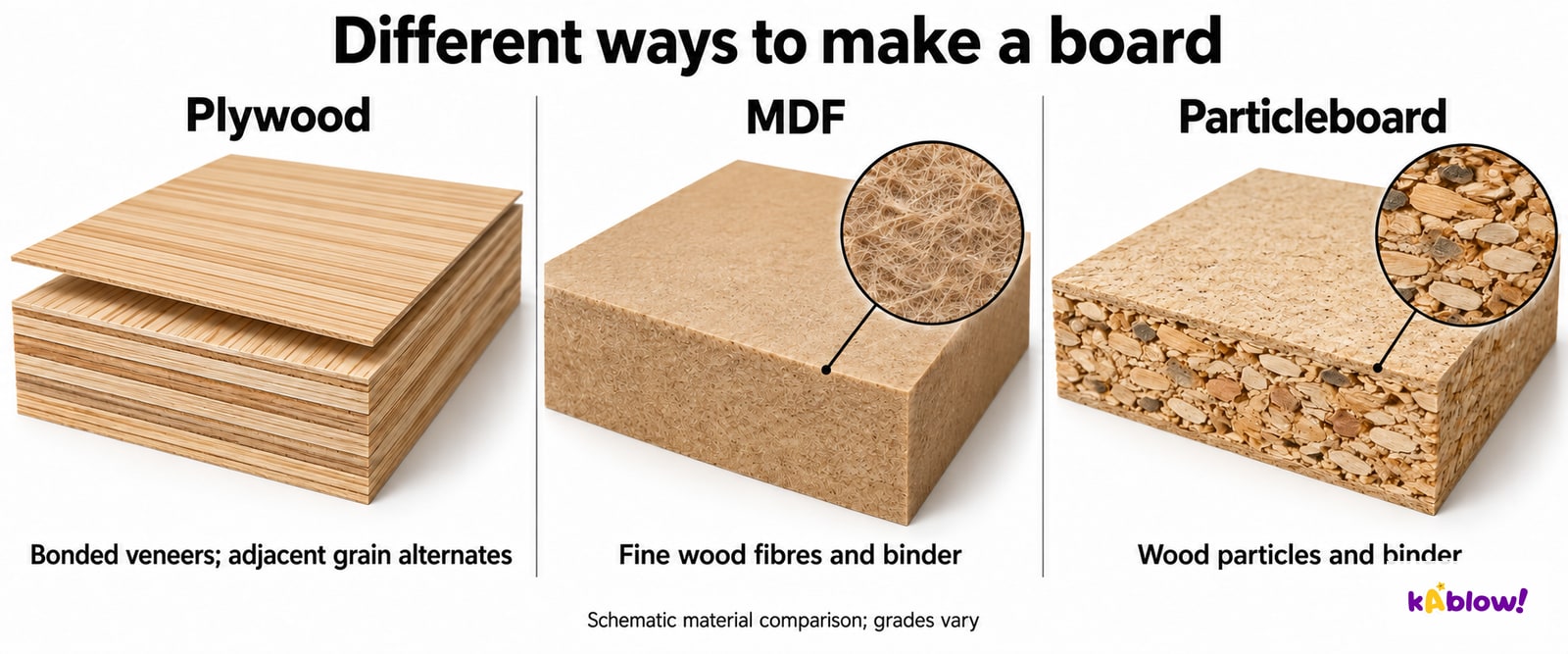
- Plywood uses bonded veneers with commonly alternating adjacent grain directions. This can improve dimensional stability and distribute properties across directions, but strength and durability depend on lay-up, grade, thickness, adhesive and loading. It can still split, delaminate or deteriorate under unsuitable conditions.
- MDF uses fine wood fibres and binder, while particleboard uses coarser particles and binder. A smooth MDF face can suit paint; suitable particleboard can provide an economical indoor panel. Standard interior boards are not automatically suitable for repeated wetting, and moisture-resistant does not mean waterproof.
- Blockboard typically uses a core of wood strips with facing veneers; hardboard is another fibreboard form. Coatings or decorative veneers change the finished surface but do not make the entire core solid timber. Select fixing design, edge treatment, span and grade for the application.
- MDF and other wood dust need appropriate control because inhalation can harm health. Follow supervised, assessed workshop procedures. Natural solid timber is not exempt from dust concerns; this lesson does not prescribe equipment settings or replace workshop instruction.
Different ways to make a board
Joints and finishes
- Choose joints by function, grain and load. A tenon fits a mortise in a frame; dovetails interlock to resist relevant separation forces in drawer corners; dowels locate and connect parts. A joint name alone does not guarantee strength without suitable proportions, fit and assembly.
- Finishes such as paint, varnish, oil, stain and wax offer different appearance and protection. They do not universally waterproof timber or stop moisture movement. Specify suitable preparation, exposure and maintenance rather than assuming a decorative finish substitutes for durability or drainage.
A plausible material needs conditions
Sustainability
- FSC 100% identifies forest-based material from FSC-certified forests; FSC Recycled concerns recycled material; FSC Mix combines permitted categories including certified, recycled and/or controlled sources. Read the actual sourcing claim rather than treating all labels as identical.
- Responsible sourcing is one aspect of sustainability, alongside forest effects, material efficiency, useful life, repair, adhesives, transport and recovery. Replanting alone or a certification label does not establish the lowest whole-life impact or structural suitability of the finished product.
Read the actual FSC sourcing claim
幻灯片
练习题
免费预览——33 题中的 8 题。注册即可查看全部。
1.What is a hardwood?
Easy- Atimber from flowering trees, commonly broad-leaved, whether deciduous or evergreen
- Btimber from conifers
- Ca manufactured board
- Da plastic
2.What is a softwood?
Easy- Atimber from deciduous trees
- Ba manufactured board
- Ca metal
- Dtimber commonly from coniferous trees
3.Which is a hardwood?
Easy- Aspruce
- Blarch
- Coak
- Dpine
4.Which is a softwood?
Easy- Ateak
- Bspruce
- Cbeech
- Dash
5.What is plywood?
Easy- Athin layers of wood glued with alternating grain
- Bcompressed wood fibres
- Cwood chips
- Dsolid timber
6.What is MDF made from?
Easy- Athin veneers
- Blarge wood chips
- Csolid planks
- Dwood fibres and resin
7.What is chipboard made from?
Easy- Asolid boards
- Bplastic
- Cwood chips and adhesive
- Dwood fibres
8.What does seasoning do?
Easy- Acuts timber
- Bremoves moisture from timber
- Cadds moisture
- Dpaints timber
历年真题
该知识点的历年真题练习即将推出。
即将推出